• 검색 결과가 없습니다.

Plasmid profiling of multi-drug resistant Vibrio sp. isolated from influent and effluent water samples of fish farms in Jeju, South Korea

N/A
N/A
Protected

Academic year: 2021

Share "Plasmid profiling of multi-drug resistant Vibrio sp. isolated from influent and effluent water samples of fish farms in Jeju, South Korea"

Copied!
7
0
0

로드 중.... (전체 텍스트 보기)

전체 글

(1)

The objective of this study was to investigate the plasmid profiling of multi-drug resistant (MDR) Vibrio in influent (inflow) and effluent (discharged) water samples of fish farms in Jeju, South Korea. MDR isolates identified through disc diffusion susceptibility tests, were subjected to plasmid profiling.

One hundred fifty Vibrio isolates were obtained from each influent and effluent water sample. All MDR isolates were subjected to plasmid profiling. Greater number of bacteria were enumerated from effluents (61%) comparing to influents (39%).

High incidence of neomycin, sulfamethoxazole, amoxicillin and oxytetracycline resistance was observed among the isolates, which was higher in effluent samples. In contrast, Vibrio isolates were more susceptible to florfenicol, chloramphenicol, cipro- floxacin, and nalidixic acid. Among 99 (influent 39 and effluent 60) MDR isolates, a total of 58 (influent 38 and effluent 20) were found to bear plasmids ranging from 1.7 kb to >10 kb and showed 19 different antibiograms according to the size of plasmids. MDR isolates showed six and four distinct plasmid profiles in influent and effluent, respectively. Effluent samples contained more plasmid-carrying MDR Vibrio isolates with more diverse plasmid profiles and antibiograms, suggesting that fish farm tanks may serve as a reservoir of antibiotic resistance genes. The presence of plasmid-carrying MDR Vibrio isolates in fish farm effluent water may contribute to the

dissemination of antibiotic resistance genes to the environments, which ultimately poses threat to human health.

Keywords: Vibrio, antibiotic resistance genes, fish farm effluent, plasmid profile

The Vibrio sp. are important component of marine eco- systems reported to cause mortalities and extensive economic losses in aquaculture production worldwide (Martinez-Urtaza et al., 2012; Yang et al., 2017). About one third of Vibrio sp. are potential human pathogens involved in water and seafood related outbreaks of gastrointestinal and wound infections in humans (Thompson et al., 2005).

Excessive amount of antibiotics has been widely used to treat Vibrio infections in aquaculture, which has caused high incidence of antibiotic resistance (Malla et al., 2014). These antibiotic resistance genes (ARGs) can be easily disseminated through horizontal gene transfer (Serrano, 2013). Hence, anti- microbial resistant Vibrio not only disseminate ARGs between fish pathogens and other aquatic bacteria but also between other bacteria belonging to the different genera (Vezzulli et al., 2002; Chelossi et al., 2003).

In South Korea, inland fish farms commonly apply ‘flow-

Plasmid profiling of multi-drug resistant Vibrio sp. isolated from influent and effluent water samples of fish farms in Jeju, South Korea

Adeel Farooq and Tatsuya Unno*

Faculty of Biotechnology, College of Applied Life Science, SARI, Jeju National University, Jeju 63243, Republic of Korea

제주 양식장 유입수과 방출수에서 분리한 다제내성 Vibrio 균 플라스미드 프로파일링

파루크 아딜 ・ 운노타쯔야*

제주대학교 생명자원과학대학 생명공학부

(Received December 11, 2017; Revised January 8, 2018; Accepted January 8, 2018)

*For correspondence. E-mail: [email protected];

Tel.: +82-64-754-3354; Fax: +82-64-756-3351

(2)

through’ method, by which sea water near a fish farm is pumped in, passed through fish tanks, and discharged untreated directly into the environment by a drainage system. This fish farm effluent may contain uneaten feed, fish excretion, and residual antibiotics, providing an ideal place where ARGs can be disseminated. Therefore, fish farm effluent may repeatedly introduce ARGs into coastal area and consequently affect the human health (Pruden et al., 2013).

In the present study, we investigated the abundance, anti- biotic susceptibility patterns, and plasmid profiling of Vibrio spp. isolated from influent and effluent water samples in coastal fish farms located in the northern part of Jeju island, South Korea to provide insights into the occurrence of plasmid harboring multi-drug resistant (MDR) Vibrio isolates.

Materials and Methods

Sample collection

Influents and effluents of fish farms were sampled in the northern part of Jeju Island, South Korea. Water samples were collected using a four-liter sterilized sampling bottle in triplicates in the beginning of September 2017. All the samples were transferred back to the laboratory within 2 h after the collection.

Enumeration of Vibrio spp.

Influent and effluent water samples (30, 10, and 3 ml) were directly filtered through a sterile mixed cellulose ester membrane filter with 0.2 µm pore size and a diameter of 47 mm (Hyundai Micro Co., Ltd.). The membranes were then transferred onto the surface of Thiosulfate Citrate Bile Salts Sucrose Agar (TCBS, DIFCO

TM

Becton & Dickenson) agar plates for incubation.

Distinctive 300 (150 each from influent and effluent) colonies on TCBS agar plates were streaked again for single colony isolation. After culturing individual colonies on Mueller Hinton II (MH) agar (BBL

TM

Becton & Dickenson), all the isolates were preserved at -80

o

C in 50% of glycerol in phosphate buffer saline for further experiments.

Analysis of antibiotic resistance pattern

The susceptibility of isolates was examined by the disc

diffusion method according to the guidelines of the National Committee on Clinical Laboratory Standards, NCCLS (Marie, 2005). Briefly, MH agar containing 1.5% NaCl and eight different antibiotic discs including oxytetracycline (OTC, 30 µg), amoxicillin (AMX, 30 µg), chloramphenicol (CHL, 10 µg), ciprofloxacin (CIP, 5 µg), nalidixic acid (NAL, 30 µg), florfenicol (FFC, 30 µg), neomycin (N, 10 µg) and sulfame- thoxazole (SUL, 25 µg) representing different classes of anti- biotics used in this study. Initially three hundred isolates were screened based on resistance to AMX, OTC, CIP, and CHL.

MDR isolates that are resistant to more than one antibiotics were screened for plasmid profiling. Plasmid-carrying Vibrio were tested for four additional antibiotics NAL, FFC, N, and SUL. All agar plates were incubated at 37°C for 18 h. The results were expressed as susceptible (S), intermediate (I), or resistant (R) following the guidelines of the CLSI (CLSI, 2015).

Plasmid profiling

Plasmid DNA was extracted from overnight culture of Vibrio isolates in MH broth using QIAprep spin miniprep kit according to the manufacturer’s instructions. Isolated plasmid DNA samples were subjected to electrophoresis using 0.7%

agarose gel for 3 h at 50V.

Results and Discussion

Vibrio abundance

Greater number of Vibrio were present in effluent (61%) samples comparing to influent (39%) samples (data not shown).

It has been previously reported that fish farm sediments receive a large amount of organic matter due to uneaten food, residual antibiotics and fecal materials, which could consequently increase the number of Vibrio in fish farms (Sandaa et al., 1992;

Vezzulli et al., 2002; Igbinosa, 2016). Although we did not measure the amount of organic matter in the fish tank, accumulated organic matter in fish tanks may have served as a reservoir for ARGs.

Analysis of antibiotic resistance pattern

Initial antimicrobial susceptibility tests for 300 isolates

(3)

against four antibiotics identified 99 MDR Vibrio isolates (Table 1). Briefly, AMX resistance was 39% and 70%, OTC resistance was 21% and 31%, CIP resistance was 23% and 25%, CHL resistance was 6% and 8%, among influent and effluent isolates respectively. Greater number of effluent isolates showed resistance against AMX and OTC. In this study we found 99 MDR isolates that were resistant to more than two tested antibiotics, of which, 58 (influent 20, effluent 38) isolates were found to harbor plasmids.

Antibiograms of the 58 MDR plasmid-carrying Vibrio isolates

To investigate antibiograms, antibiotic susceptibility testing with four additional antibiotics was conducted for the 58 plasmid-carrying isolates (Table 2). More than 68% of them were resistant to N, SUL, and AMX, whereas less than 50%

were resistant to NAL, OTC, CIP, CHL, and FFC. In particular, 86% of them (influent 16, effluent 34) were resistant to neomycin, which is in line with the previous studies that showed high resistance of Vibrio isolates against neomycin and other aminoglycosides (Hörmansdorfer et al., 2000; Manjusha and Sarita, 2011). In addition, 79% of the Vibrio isolates (influent 13, effluent 33) were resistant to SUL, resistance to which has been widely spread in the sea and fish farm discharged water (Yoo et al., 2003; Suzuki et al., 2015; You et al., 2016). Similarly, 40 of them (influent 14, effluent 26) were resistant to AMX which is in agreement with the previous report where more than half of the Vibrio isolates in Korean coastal areas were resistant to AMX (Yoo et al., 2003). There were 27 MDR isolates (influent 10, effluent 17) resistant to OTC, the most commonly used antimicrobial in Korean fisheries, particularly for the treatment of infection by Vibrio sp. (Bien et

al., 2015). Fewer MDR isolates resistant to NAL and CIP were found (influent 7, effluent 21, and influent 8, effluent 15, respectively). Resistance of Vibrio isolates against quinolones has already been reported (Kang et al., 2017), although quinolones had been considered effective against Vibrio infections (Yoo et al., 2003). It has been suggested that quinolone resistant Enterobacteriaceae gradually increase, probably owing to the presence of plasmid mediated quinolone resistance (PMQR) (Palmer et al., 1992). Conversely, most of the MDR Vibrio isolates were susceptible to CHL and FFC, which is in agree- ment with the previous studies showing susceptibility of Vibrio to phenicols in aquaculture (Palmer et al., 1992; Norman et al., 2009; Kang et al., 2017).

Plasmid profiling of the 58 MDR plasmid-carrying Vibrio isolates

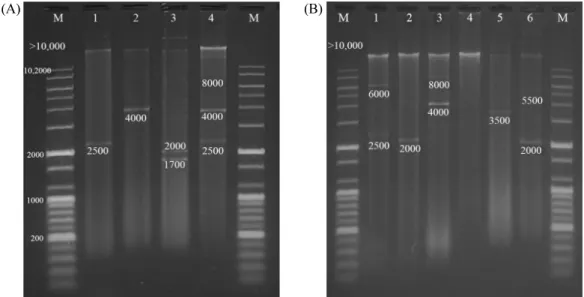
Of the 58 isolates analyzed, four and six distinct plasmid profiles were observed for influent and effluent samples, respectively (Fig. 1). Plasmid sizes ranged from 1,700 bp to

>10,000 bp, which is consistent with a previous study where 50% of the Vibrio isolates were found to have plasmids with sizes ranging from 1.5 kb to 26 kb in coastal water (Zanetti et al., 2001). Among them, 2,000 bp, 2,500 bp, 4,000 bp, 8,000 bp and > 10,000 bp were common in influent and effluent Vibrio isolates. Conversely, plasmids with size 3,500 bp, 5,500 bp, 6,000 bp were only present among effluent isolates and only one plasmid having size 1,700 bp was present among influent

Table 1. Percentages of Vibrio isolates resistant to antibiotics. R, I, and S indicate resistant, intermediate, and susceptible, respectively.

Antibiotics* Influents (n = 150) Effluent (n = 150)

R I S R I S

OTC

b

21.59 26.32 52.09 30.78 48.55 20.67 AMX 38.74 48.69 12.57 70.11 26.49 3.4

CIP 23.48 55.28 21.24 25.20 65.69 9.12 CHL 6.78 11.61 81.61 8.32 28.15 63.53

*OTC, AMX, CIP, and CHL indicate oxytetracycline, amoxicillin, ciprofloxacin, and chloramphenicol, respectively.

Table 2. Multi-drug resistance profile of 58 plasmid harboring Vibrio isolates. R, I, and S indicate resistant, intermediate, and susceptible, respectively.

Antibiotics* Influent samples (n = 20) Effluent samples (n = 38)

R I S R I S

OTC 10 5 5 17 19 2

AMX 14 4 2 26 12 -

CIP 8 8 4 15 19 4

CHL 4 6 10 12 16 10

NAL 7 10 3 21 11 6

N 16 3 1 34 2 2

FFC 5 1 14 9 3 26

SUL 13 5 2 33 3 2

*OTC, AMX, CIP, CHL, NAL, N, FFC, and SUL indicate oxytetracycline,

amoxicillin, ciprofloxacin, chloramphenicol, nalidixic acid, neomycin, florfenicol,

and sulfamethoxazole, respectively.

(4)

isolates.

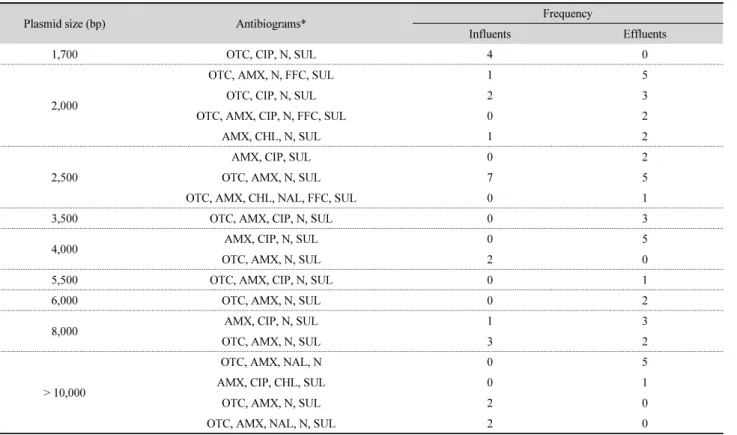
Nine different sizes of plasmids were observed in this study.

In each size of plasmid, 1 to 4 antibiograms were observed (total 19), out of which, 9 were distinctly present among effluent and 4 among influent isolates (Table 3). SUL, N, AMX, and OTC are found in most of the antibiograms, while CHL and FFC were only found in effluent antibiograms. There was low number of plasmid-carrying Vibrio resistant to FFC and CHL.

The 4 distinct antibiograms in influent are mostly consisted of N, SUL, AMX and OTC, whereas the 9 distinctive antibiograms include the resistance to CHL and FFC in addition to the four antibiotics. While the number of antibiotics included in the influent antibiogram ranged from 4 to 5, effluent antibiogram showed 3 to 6 antibiotics. Although number of isolates analyzed in this study is not high, our results suggest antibiotic resistant Vibrio isolates carry different types of plasmids with different antibiograms. Further study may clarify what causes this difference between influent and effluent.

We observed 6 influent and 7 effluent MDR Vibrio isolates carrying multiple plasmids and some of them show different antibiograms (Table 4). It has been studied that the presence of multiple plasmid harboring Vibrio isolates is a common pheno- menon in marine environment. Similar plasmid profiles were noticed in previous reports, although within the same plasmid profiles there exist different antibiograms that suggest these plasmids may encode different types of ARGs (Manjusha and

Sarita, 2013; Silvester et al., 2017).

Norman et al. (2009) reported that plasmids equal or more than 30 kb are likely to be R-plasmids where multi-antibiotic resistance genes are coded. Although most of the plasmids we identified in this study are less than 10 kb, multi-antibiotic resistance genes may be involved in these plasmids. On the other hand, 41 out of 99 MDR isolates detected in this study were without the presence of plasmids, suggesting that MDR- related genes in these Vibrio can potentially be obtained through non-plasmid mediated horizontal gene transfers such as integron- mediated. García-Aljaro et al. (2017) reported that membrane vesicles can contain genetic elements and disseminate ARGS to other organisms especially in marine ecosystem. Chromosomal mediated ampicillin and tetracycline resistance in Vibrio has already been studied where all the ampicillin resistant isolates (176/200) and tetracycline resistant isolates (26/200) remain resistant to the respective antibiotics after plasmid curing (Letchumanan et al., 2015). Nevertheless our results showed effluent water from fish farms have more plasmid-carrying MDR Vibrio comparing to that of influent water samples, suggesting fish farms may serve as a source of dissemination of antibiotic resistant genes to the other environments (Luo et al., 2014). It has been reported that effluent water from flow through fish farms may look clean but could act as a potential pollutant containing antibiotic residues and ARGs (Mirzoyan et al., 2010). The presence of subsequent dissociation of (A)

(B)

Fig. 1. Four plasmid profiles among influents (A) and six in effluents (B). Numbers (1-6) and the letter ‘M’ indicate different isolates and DNA ladder,

respectively.

(5)

uneaten feed, metabolic byproducts and antibiotic residues in fish farm tanks may suite the growth of fish pathogens including Vibrio (Buschmann et al., 2012; Schumann et al., 2017). In Mexico it was studied that about 70% of the Vibrio isolated from aquaculture settings were multidrug resistance (Molina-Aja

et al., 2006). It was further investigated that fish farms may serve as reservoir for pathogenic Vibrio strains, which can withstand environmental conditions established inside the tanks and would be able to cause infections (Ben-Haim et al., 2003).

Table 3. Relationship between plasmid profiles and resistance patterns of 20 influent and 38 effluent isolates.

Plasmid size (bp) Antibiograms* Frequency

Influents Effluents

1,700 OTC, CIP, N, SUL 4 0

2,000

OTC, AMX, N, FFC, SUL 1 5

OTC, CIP, N, SUL 2 3

OTC, AMX, CIP, N, FFC, SUL 0 2

AMX, CHL, N, SUL 1 2

2,500

AMX, CIP, SUL 0 2

OTC, AMX, N, SUL 7 5

OTC, AMX, CHL, NAL, FFC, SUL 0 1

3,500 OTC, AMX, CIP, N, SUL 0 3

4,000 AMX, CIP, N, SUL 0 5

OTC, AMX, N, SUL 2 0

5,500 OTC, AMX, CIP, N, SUL 0 1

6,000 OTC, AMX, N, SUL 0 2

8,000 AMX, CIP, N, SUL 1 3

OTC, AMX, N, SUL 3 2

> 10,000

OTC, AMX, NAL, N 0 5

AMX, CIP, CHL, SUL 0 1

OTC, AMX, N, SUL 2 0

OTC, AMX, NAL, N, SUL 2 0

*OTC, AMX, CIP, CHL, NAL, N, FFC, and SUL indicate oxytetracycline, amoxicillin, ciprofloxacin, chloramphenicol, nalidixic acid, neomycin, florfenicol, and sulfamethoxazole, respectively.

Table 4. Vibrio isolates carrying more than one plasmid

Influent/Effluent Size of plasmids (bp) No. of antibiograms*

Influent 1700, 2000, > 10,000

OTC, CIP, N, SUL AMX, CHL, N, SUL OTC, AMX, N, FFC, SUL

AMX, CIP, CHL, SUL

Influent 2500, 4000, 8000, > 10,000 OTC, AMX, N, SUL

OTC, AMX, N, SUL

Effluent 2500, 6000, > 10,000

OTC, AMX, CHL, NAL, FFC, SUL OTC, AMX, N, SUL AMX, CIP, CHL, SUL

Effluent 4000, 8000 AMX, CIP, N, SUL

Effluent 2000, 5500, > 10,000

OTC, AMX, CIP, N, FFC, SUL OTC, AMX, CIP, N, SUL

AMX, CIP, CHL, SUL

*OTC, AMX, CIP, CHL, NAL, N, FFC, and SUL indicate oxytetracycline, amoxicillin, ciprofloxacin, chloramphenicol, nalidixic acid, neomycin, florfenicol, and

sulfamethoxazole, respectively.

(6)

Conclusion

This study revealed that fish farm effluent water contains greater number of Vibrio, more plasmid-carrying MDR isolates, diverse range of antibiograms and diverse plasmid profiles than those of influents. Although we did not investigate the cause, it is likely that deposition of organic matter deriving from fish metabolism, uneaten feed, and antibiotic residues in the fish farm tanks contributed to the dissemination of ARGs in effluent. MDR Vibrio may not only cause economical damage to fish industry, but also cause a great risk to public health. It was also observed that fish farm Vibrio were resistant to most of the commonly used antibiotics such as SUL, N, AMX, and OTC. Plasmid-carrying MDR Vibrio may contribute to the dissemination of ARGs in different environments. Surveillance and monitoring of antibiotic resistance and the resulting pollution levels of antibiotics in aquaculture environments should be encouraged to curtail improper usage of antibiotics. Also, proper treatment of coastal aquaculture effluent should be performed to control the dissemination of ARGs in marine ecosystem.

Acknowledgements

This study was supported by the Korea Institute of Marine Science & Technology Promotion funded by the Ministry of Oceans and Fisheries, Korea (KIMST-20150307).

적 요

이 실험은 제주도내 양식장으로부터 유입수와 방출수의 다 제내성(MDR)을 가진 Vibrio 균의 plasmid profiling을 위해 진 행하였다. Plasmid profiling을 위해 사용한 다제내성을 가진 균주는 디스크 확산법을 통해 확인하였고, 유입수와 방출수으 로부터 각각 150개의 Vibrio 균주를 분리하였다.

모든 다제내성 균주를 대상으로 plasmid profiling을 실시하 였으며, 유입수와 비교하여 방출수에서 많은Vibrio 균이 열거 되었다(유입수 39%, 방출수 61%). 방출수에서는 neomycin, sulfamethoxazole, amoxicillin 및 oxytetracycline의 내성을 가 진 균주가 유의적으로 많은 것으로 확인되었고, 대조적으로 Vibrio 균주는 florfenicol, chloramphenicol, ciprofloxacin 및

nalidixic acid 에 더 민감한 것으로 확인이 되었다. 99종의 다제 내성 균주(유입수 39종과 방출수 60종) 중에서 총 58종(유입 수 38종과 방출수 20종)이 1.7 kb에서 10 kb 이상의 플라스미 드를 가지고 있는 것을 확인하였으며 플라스미드 크기마다 19 가지의 다른 다제내성 패턴을 보였다. 6종의 유입수와 4종의 방출수에서 다제내성 균주는 특이적인 plasmid profile이 확인 되었다.

방출수 샘플은 보다 많은 플라스미드를 가진 다제내성 Vibrio 균주와 다양한 plasmid profile들과 다제내성 패턴을 가 지고 있었고 이는 양식장의 저장탱크가 항생제내성 유전자의 저장소 역할을 할 수 있다는 점을 시사한다. 양식장의 방출수 에서 plasmid를 가진 다제내성 Vibrio 균주의 존재는 항생제 내성 유전자의 전파에 기여할 수 있으며 이로 인해 인간의 건 강을 위협할 수 있다.

References

Ben-Haim, Y., Thompson, F.L., Thompson, C.C., Cnockaert, M.C., Hoste, B., Swings, J., and Rosenberg, E. 2003. Vibrio coralliilyticus sp. nov., a temperature-dependent pathogen of the coral Pocillopora damicornis. Int. J. Syst. Evol. Microbiol. 53, 309 –315.

Bien, T.L.T., Sato-Takabe, Y., Ogo, M., Usui, M., and Suzuki, S. 2015.

Persistence of multi-drug resistance plasmids in sterile water under very low concentrations of tetracycline. Microbes Environ.

30, 339 –343.

Buschmann, A.H., Tomova, A., López, A., Maldonado, M.A., Henríquez, L.A., Ivanova, L., Moy, F., Godfrey, H.P., and Cabello, F.C.

2012. Salmon aquaculture and antimicrobial resistance in the marine environment. PLoS One 7, 26 –28.

Chelossi, E., Vezzulli, L., Milano, A., Branzoni, M., Fabiano, M., Riccardi, G., and Banat, I.M. 2003. Antibiotic resistance of benthic bacteria in fish-farm and control sediments of the Western Mediterranean. Aquac. 219, 83 –97.

CLSI. 2015. Methods for antimicrobial dilution and disk susceptibility testing of infrequently isolated or fastidious bacteria, 3rd ed.

CLSI document M 45. Clinical and Laboratory Standards Institute, Wayne, PA, USA.

García-Aljaro, C., Ballesté, E., and Muniesa, M. 2017. Beyond the canonical strategies of horizontal gene transfer in prokaryotes.

Curr. Opin. Microbiol. 38, 95 –105.

Hörmansdorfer, S., Wentges, H., Neugebaur-Büchler, K., and Bauer, J. 2000. Isolation of Vibrio alginolyticus from seawater aquaria.

Int. J. Hyg. Environ. Health 203, 169–175.

Igbinosa, E.O. 2016. Detection and antimicrobial resistance of Vibrio isolates in aquaculture Environments: Implications for public health. Microb. Drug Resist. 22, 238 –245.

Kang, C.H., Shin, Y.J., Jang, S.C., Yu, H.S., Kim, S.K., An, S., Park,

(7)

K., and So, J.S. 2017. Characterization of Vibrio parahaemolyticus isolated from oysters in Korea: Resistance to various antibiotics and prevalence of virulence genes. Mar. Pollut. Bull. 118, 261 – 266.

Letchumanan, V., Chan, K.G., and Lee, L.H. 2015. An insight of traditional plasmid curing in Vibrio species. Front. Microbiol. 6, 735.

Luo, Y., Wang, Q., Lu, Q., Mu, Q., and Mao, D. 2014. An ionic liquid facilitates the proliferation of antibiotic resistance genes mediated by class i integrons. Environ. Sci. Technol. Lett. 1, 266 –270.

Malla, S., Dumre, S.P., Shakya, G., Kansakar, P., Rai, B., Hossain, A., Nair, G.B., Albert, M.J., Sack, D., Baker, S., et al. 2014. The challenges and successes of implementing a sustainable anti- microbial resistance surveillance programme in Nepal. BMC Public Health 14, 269.

Manjusha, S. and Sarita, G.B. 2011. Plasmid associated antibiotic resistance in Vibrios isolated from coastal waters of Kerala. Int.

Food Res. J. 18, 1171–1181.

Manjusha, S. and Sarita, G.B. 2013. Characterization of plasmids from multiple antibiotic resistant Vibrios isolated from molluscan and crustacean of Kerala. Int. Food Res. J. 20, 77 –86.

Marie, B.C. 2005. Manual of antimicrobial susceptibility testing.

American Society for Microbiology, Washington, DC, USA.

Martinez-Urtaza, J., Blanco-Abad, V., Rodriguez-Castro, A., Ansede- Bermejo, J., Miranda, A., and Rodriguez-Alvarez, M.X. 2012.

Ecological determinants of the occurrence and dynamics of Vibrio parahaemolyticus in offshore areas. ISME J. 6, 994–

1006.

Mirzoyan, N., Tal, Y., and Gross, A. 2010. Anaerobic digestion of sludge from intensive recirculating aquaculture systems: Review.

Aquaculture 306, 1 –6.

Molina-Aja, A., Garcia-Gasca, A., Abreu-Grobois, A., Bolan-Mejia, C., Roque, A., and Gomez-Gil, B. 2006. Plasmid profling and antibiotic resistance of Vibrio strains isolated from cultured penaeid shrimp. FEMS Microbiol. Lett. 213, 8 –13.

Norman, A., Hansen, L.H., and Sorensen, S.J. 2009. Conjugative plasmids: vessels of the communal gene pool. Philos. Trans. R.

Soc. B Biol. Sci. 364, 2275–2289.

Palmer, R., Kawai, K., and Kusuda, R. 1992. In vitro activity of quinolone antibacterials against selected fish pathogens. Fish Pathol. 27, 131 –142.

Pruden, A., Joakim Larsson, D.G., Amézquita, A., Collignon, P., Brandt, K.K., Graham, D.W., Lazorchak, J.M., Suzuki, S.,

Silley, P., Snape, J.R., et al. 2013. Management options for reducing the release of antibiotics and antibiotic resistance genes to the environment. Environ. Health Perspect. 121, 878 –885.

Sandaa, R.A., Torsvik, V.L., and Goksøyr, J. 1992. Transferable drug resistance in bacteria from fish-farm sediments. Can. J. Microbiol.

38, 1061 –1065.

Schumann, M., Unger, J., and Brinker, A. 2017. Floating faeces:

Effects on solid removal and particle size distribution in RAS.

Aquacult. Eng. 78, 75–84.

Serrano, P.H. 2013. Responsible use of antibiotics in aquaculture.

Food Agriculture Organization, Rome, Italy.

Silvester, R., Alexander, D., George, M., and Hatha, A.A.M. 2017.

Prevalence and multiple antibiotic resistance of Vibrio coralliilyticus, along the Southwest Coast of India. Curr. Sci. 112, 1749 –1749.

Suzuki, S., Ogo, M., Koike, T., Takada, H., and Newman, B. 2015.

Sulfonamide and tetracycline resistance genes in total- and culturable-bacterial assemblages in south african aquatic envi- ronments. Front. Microbiol. 6, 1–8.

Thompson, F.L., Gevers, D., Thompson, C.C., Dawyndt, P., Hoste, B., Munn, C.B., Swings, J., and Naser, S. 2005. Phylogeny and molecular identification of Vibrios on the basis of multilocus sequence analysis phylogeny and molecular identification of Vibrios on the basis of multilocus sequence analysis. Appl.

Environ. Microbiol. 71, 5107 –5115.

Vezzulli, L., Chelossi, E., Riccardi, G., and Fabiano, M. 2002.

Bacterial community structure and activity in fish farm sediments of the Ligurian sea (Western Mediterranean). Aquacult. Int. 10, 123 –141.

Yang, J.H., Mok, J.S., Jung, Y.J., Lee, K.J., Kwon, J.Y., Park, K., Moon, S.Y., Kwon, S.J., Ryu, A.R., and Lee, T.S. 2017.

Distribution and antimicrobial susceptibility of Vibrio species associated with zooplankton in coastal area of Korea. Mar.

Pollut. Bull. 125, 39 –44.

Yoo, M.H., Huh, M.D., Kim, E.H., Lee, H.H., and Jeong, H.D. 2003.

Characterization of chloramphenicol acetyltransferase gene by multiplex polymerase chain reaction in multidrug-resistant strains isolated from aquatic environments. Aquaculture 217, 11 –21.

You, K.G., Bong, C.W., and Lee, C.W. 2016. Antibiotic resistance and plasmid profiling of Vibrio spp. in tropical waters of Peninsular Malaysia. Environ. Monit. Assess. 188, 1–15.

Zanetti, S., Spanu, T., Deriu, A., Romano, L., Sechi, L.A., and Fadda,

G. 2001. In vitro susceptibility of Vibrio spp. isolated from the

environment. Int. J. Antimicrob. Agents 17, 407 –409.

수치

Table 1. Percentages of  Vibrio isolates resistant to antibiotics. R, I, and S  indicate resistant, intermediate, and susceptible, respectively.
Fig. 1. Four plasmid profiles among influents (A) and six in effluents (B). Numbers (1-6) and the letter ‘M’ indicate different isolates and DNA ladder,  respectively.
Table 3. Relationship between plasmid profiles and resistance patterns of 20 influent and 38 effluent isolates.

참조

관련 문서

Key words : Aquaculture, Edwardsiella sp., Edwardsiellosis, Fish diseases, Flounder, Streptococcus sp., Streptococcosis, Vibrio sp., Vibriosis... The number

In addition, using the properties of water shown in diverse shapes, Ki Hyung-do's recognition on the reality and future consciousness from regression of

Multi-step method are methods that use information from more than one of the preceding steps,

Current water quality standards for phosphorus in the sewage effluent from 2012 0.2mg/L until tightened according to the existing sewage treatment facilities

A retrospective analysis of invasive tumor percentages of GSS tumor samples showed that samples with high tumor content correlated well with FNAB samples

Biological treatment of wastewater is an economical green technology, however, the effluent water quality of a biological wastewater treatment facility is

So, the result of the comparative analysis in the social studies object, curriculums and textbooks of South and North Korea indicate that the differences

Variations automatic water analyzer & laboratory manual data of suspended solids concentration form effluent of petroleum chemical plant · ·