—
ISSN 1229-3350(Print) ISSN 2288-1867(Online)
—
J. fash. bus. Vol. 22, No. 6:83-93, December. 2018 https://doi.org/
10.12940/jfb.2018.22.6.83
Applications on App Users' Continuous Usage Intention
Hyekyung Hong
*· Yeonseo Shin · MiYoung Lee
†*Retail Operations Team, Jimmy Choo Korea, Korea Dept. of Fashion Design & Textiles, Inha University, Korea
Corresponding author
—
MiYoung Lee Tel : +82-32-360-8137 Fax.: +82-32-865-8130 E-mail : [email protected]
Keywords Abstract
big data,
fashion application,
expectation-confirmation model, continuous usage intention
The purpose of this research is to investigate the characteristics of big data-based fashion shopping (BDFS) application, perceived usefulness, and expectation confirmation that influence the continuous usage intention of BDFS application users based on the expectation-confirmation model. A survey was conducted with female consumers in their 20s, who are living in Seoul and Incheon area and have used BDFS applications, A total of 182 responses were used for the data analysis. Five hypotheses were proposed, and regression analyses were conducted to test those hypotheses. The results indicated that the users’ perceived usefulness increased with the increase of accuracy and personalization characteristics of the app and the expectation confirmation. The result suggested that it is essential to provide accurate information for users to feel useful and to develop the personalized offerings and services which can be the biggest strength of the big-data based mobile fashion store. It was also found that continuous usage intention increases with increased perceived usefulness and expectation confirmation. This result suggests that expectations can play a critical role in perceiving the usefulness of BDFS applications and the user’s expectation confirmation also significantly affected the users’ continuous usage intention.
. Introduction
Ⅰ
Online shopping channels are migrating from PC to mobile platforms as consumers’ purchasing behaviors via mobile devices are increasing with their everyday use of smartphones. According to an online shopping survey from Statistics Korea in January 2018, the proportion of mobile shopping in online shopping increased from 55%
to 60.3% and online shopping sales via mobile devices increased by 32.4% from the previous year (Statistics Korea, 2018). In addition to this increase in mobile shopping, the fashion shopping mall industry has recently encountered a new change with the entrance of big data-based shopping applications(apps), such as
“ZigZag,” “Brandi,” and “StyleShare,” which analyze shopping mall data and recommend popular products according to a user’s circumstances and preferred style. Big data refers to large (dozens of terabytes) structured or even unstructured data sets whose size is beyond the management ability of traditional data-processing software tool (Manyika et al., 2011).
The term also refers to the technology of extracting value from data and analyzing the results (Gantz &
Reinsel, 2011).
With the development of technology, the amount of data people use is rapidly increasing. Since information about what data users want and how they use them is contained in these accumulating data, reading the flow of consumers’ data and using big data to provide products and services that match this flow is an essential strategy for companies. Many companies use big data. For example, Amazon records all purchases by their customers in a database and analyzes these records to understand their consumption preferences and interests (Jang, 2012). In addition, through the use of big data, Amazon displays “recommended products” for each customer. In the same way that Amazon indicates recommended products, Google and Facebook are expanding their use of big data on their users by instantly processing their users’ search terms and even their use of unstructured data, such as photos and videos, to provide customized advertisements.
Furthermore , the analysis of trend information using big data enables fashion companies to make more precise forecasts about consumers’ preferences and can affect their product design and planning. As for cases of big data usage by fashion companies, GoFind.ai provides a fashion-curating service to help users with their shopping by using image data analytics to locate clothes that best match the features in the clothes images captured by users with their mobile devices. Online shopping mall Stitch Fix provides a personal styling service that regularly delivers clothes and accessories that match the user’s tastes. The user’s preference profile information is transmitted to a styling expert, according to which fashion items are selected based on big data analysis for delivery. By handling styling and shopping at once for the customers, Stitch Fix is raising customer satisfaction with its service. Domestic fashion distribution company Musinsa analyzes the size specification data of consumers who purchase products from its online site, then sorts products that are similar to the specifications of products that have been frequently purchased to make recommendations when the customers visit an offline store. Thus, many companies use big data in marketing to make accurate forecasts and provide customized product recommendation services to secure competitiveness. This study, therefore, investigated how the characteristics of big data-based fashion shopping (BDFS) apps influence continuous usage intention of app users based on the expectation-confirmation model.
. Literature Review
Ⅱ
1. Mobile Fashion Applications
Mobile applications (apps) are software applications that are operated on smart devices, such as smartphones and tablet computers , in a mobile environment (Yoon, 2014). Mobile fashion apps refer to fashion-related applications downloaded and used on smartphones (Bae, 2010). Compared with e-Commerce, Clarke (2001) defined m-Commerce as characterized by its ubiquity, convenience, localization, and personalization. Ubiquity is
a feature that enables mobile users to access information and perform virtual transactions in real time at any location. It means that communication is possible regardless of the location of the person using m-Commerce. Convenience is an attribute resulting from the speed and accessibility of m-Commerce and refers to the feature of being free from time or place restrictions.
Localization means that the location of the internet user can be identified. It is an important characteristic of m-Commerce that distinguishes it from e-Commerce.
This feature is possible because the location of a user can be confirmed accurately through location-based technology such as the Global Positioning System (GPS).
Using this technology, m-Commerce providers can send and receive location-based information. Personalization is a feature that allows the delivery of individualized messages suitable for various segmented markets based on time and place using mobile technology. Accordingly, marketers can integrate a variety of information and provide personalized services to an app user.
With the rapid growth of mobile apps, fashion companies started to use mobile apps aggressively in 2008 to promote their brands. The mobile apps of famous fashion brands offer various access opportunities to consumers by providing the latest information on fashion, such as quick updates on fashion trends, latest collections, and sales events (Kim, 2011). Fashion apps can be divided into three types: informative, entertainment, and community (Lee, 2012). Informative fashion apps provide product information (product images, prices, sizes, and color information, etc.), information about stores using location-based services, fashion show photos and videos, fashion-related news, magazine pictures, and styling information. Entertainment fashion apps are easy for app users to install, but they can also be deleted swiftly when they are not useful or interesting to users. For this reason, “A X CLUBBING” │ content by A X │ Armani Exchange introduces information about clubs in each area, including business hours, performance information, music, and events, as well as styling tips. Community fashion apps encourage users to actively participate and share a variety of
information. They provide opportunities for direct communication between companies and consumers or designers and consumers.
Previous studies on mobile apps have been conducted mainly based on the Technology Acceptance Model (TAM) of F. Davis (Davis, 1989). Davis, Bagozzi, &
Warshaw (1989) extended the TAM by including external variables that influence the process of accepting innovative technology. Since then, other researchers have explained TAM by setting other external variables, such as individual characteristics and social environmental factors (Agarwal & Karahanna, 2000; Chen, Gillenson &
Sherrell, 2002). As for previous studies on mobile apps related to fashion, a study by Sung (2013) noted that the perceptual characteristics of users (e.g. perceived usefulness, perceived ease of use, perceived enjoyment, perceived risk), service attributes of fashion apps, fashion involvement, and so on affect mobile shopping attitude and mobile usage intention. Other studies also analyzed the influence of the relationship between the variables of mobile shopping characteristics and the variables included in TAM. Lee (2007) stated that personalization/
usefulness, enjoyment, and ease of use affect perceived value, which in turn influences the purchase intention of consumers. Hong (2013) suggested that visibility and personalization among mobile shopping characteristics and perceived usefulness and enjoyment among consumer characteristics affect the purchase intention for fashion-related products.
2. Big Data
Big data refers to large-scale datasets that are beyond the storage, management, and analysis abilities of conventional database software (Manyika et al., 2011).
According to an International Data Corporation report, the amount of data generated over the last two years exceeds the amount of data generated for a decade up to 2011. It was also reported that the amount of digital information worldwide is doubling every two years (Gantz & Reinsel, 2011). Big data are different from existing datasets in terms of volume, variety, and
velocity. In terms of volume, digital information increases exponentially in big data. In terms of diversity, big data not only include text but also data that is not structured; thus, they are characterized by increased unstructured data, such as photos, videos, and various forms of other multimedia. In terms of velocity, big data are characterized by the real-time calculation of a large amount data at a very high speed, which is why they become so enormous.
In general, conventional information based on marketing research indicates only the causal relationship acknowledged by a marketer in advance. However, big data, containing more than terabytes of accessible information gathered with the consent of the customers, such as location information, transaction information, and purchase patterns, is raw information as it is inclusive of all the real behaviors of consumers. Big data marketing is a method of using big data for marketing in an accurate manner through the elaboration of necessary data among these big data. With the development of big data technologies, customized product recommendation services became available through the real-time analysis of customer behavior patterns and interests (Manyika et al., 1994). Through big data analysis, Zara, a fast fashion company in Spain, was able to reflect the latest fashion trends in product development, establish a rapid strategy of producing a small quantity of various items in a short period of time, forecast product demand ahead of time, and calculate the optimum stock level for each retail store (Baker, 2016). Thus, by utilizing big data, companies can gain insight into the future, develop countermeasures against future risks, and cultivate competitiveness.
3. Expectation-confirmation Model
The expectation-confirmation model (ECM), a theoretical model based on expectation-disconfirmation theory (EDT), focuses on how the expectations of a consumer formed before using a product change in the course of using the actual product (Oliver, 1980). Based on the TAM proposed by Davis (1989) and EDT proposed by
Oliver, Bhattacherjee (2001) presented the structural relationship between expectancy confirmation, perceived usefulness, satisfaction, and continuous usage intention through the ECM. The TAM determines the causal relationship involving users’ attitude and behavioral intention regarding new information systems through their perceived usefulness and ease of use (Davis, 1989). Expectation-confirmation theory (ECT) analyzes consumers’ continuous usage intention for a certain product or service through the process of understanding the stages of the perceived level of expectation formed among consumers after they have experienced the product or service (Oliver, 1980).
For overcoming the limitations of the TAM, which neglects the influence of users’ understanding of continuous use and experience gained in the course of use on their actual perceived usefulness after acceptance, Bhattacherjee (2001) suggested that an ECM that shows users’ expectation confirmation influences perceived usefulness, which in turn affects the satisfaction of continuous usage intention. Emphasizing the relevance of the ECM in studying the continuous use of information technology, Hsu and Lin (2015) explained that the ECM can be applied to various fields, such as Internet commerce, Internet information utilization, online education, and mobile applications.
In an expanded TAM, Davis et al. (1989) introduced external variables that influence the process of accepting innovative technology. Previous studies have shown that perceived ease of use, perceived enjoyment, perceived risk (Sung, 2013), personalization, usefulness, enjoyment, and ease of use (Lee, 2007) have a significant effect on the process of accepting new innovative technologies in fashion products. Davis et al. (1992) and Nysveen, Pedersen, and Thorbjornsen, (2005) defined perceived enjoyment as the extent to which the activity of using a certain technology is perceived as enjoyable regardless of the expected performance outcome. Therefore, enjoyment means the experience of fun, pleasure, and amusement perceived in the process of searching for information about and/or purchasing products while using mobile fashion apps (Jung, 2014). Accuracy refers to the
consistent, accurate, and reliable quality of information provided by the fashion app (Kim & Chae, 2013; Park, 2016). Personalization refers to tailoring a service or a product to accommodate specific individuals. In a business environment, such as online commerce, where interaction is possible, personalization works as a differentiating factor in maintaining a lasting relationship.
Personalization not only provides the opportunity to show information related to customers on a case-by-case basis but also leads to continuous visits to the website and can generate customer loyalty. In mobile apps, visibility refers to the interface design factor in mobile apps, including information, interaction, and visual design. In using BDFS apps, visibility means the users’ experience with the visual design displayed (Kim, Jang, & Choi, 2011). Based on these external variables discussed in previous studies, this study developed the following hypotheses.
H1-1. The enjoyment characteristics of BDFS apps will have a positive effect on the user’s perceived usefulness of BDFS apps.
H1-2. The visibility characteristics of BDFS apps will have a positive effect on the user’s perceived usefulness of BDFS apps.
H1-3. The information accuracy characteristics of BDFS apps will have a positive effect on the user’s perceived usefulness of BDFS apps.
H1-4. The personalization characteristics of BDFS apps will have a positive effect on the user’s perceived usefulness of BDFS apps.
Along with perceived usefulness, perceived ease of use in the TAM is considered a crucial variable that affects user behavior. Perceived ease of use is the user’s degree of expectation regarding the ease of using a new information technology or system. It signifies a user’s degree of subjective belief that a new information technology or system can be learned easily without effort because it is not mentally or physically difficult (Davis, 1989). Perceived usefulness is defined as a user’s degree of subjective belief that
using a new information technology or system can improve their individual performance (Davis, 1989). It has been found in many previous studies that perceived ease of use and perceived usefulness have a significant impact on consumer usage intention.
Therefore, this study presents the following hypotheses.
H2. The user’s perceived ease of use of BDFS apps will have a positive effect on the user’s perceived usefulness of BDFS apps.
H3. The user’s perceived usefulness of BDFS apps will have a positive effect on the user’s continuous usage intention regarding BDFS apps.
Bhattacherjee (2001) pointed out that perceived usefulness of users are ultimately influenced by their expectation confirmation, which is defined as the degree to which a user’s expectation for a new product or service before experience is confirmed after having an actual experience of that new product or service.
Previous studies on mobile app information usage intention have empirically demonstrated that expectation confirmation has a statistically significant effect on perceived usefulness (Hsu & Lin, 2015; Thong, Hong, &
Tam, 2006). Therefore, the following hypotheses were developed based on the findings of previous studies.
H4. The user’s extent of expectation confirmation for BDFS apps will have a positive effect on the user’s perceived usefulness of BDFS apps.
H5. The user’s extent of expectation confirmation of BDFS apps will have a positive effect on the user’s continuous usage intention regarding BDFS apps.
. Methods
Ⅲ 1. Research Model
As shown in Figure 1, a research model was constructed for this study based on the ECM (Bhattacherjee, 2001) and a literature review, and it focused on the hypotheses presented above.
Figure 1. Proposed Model
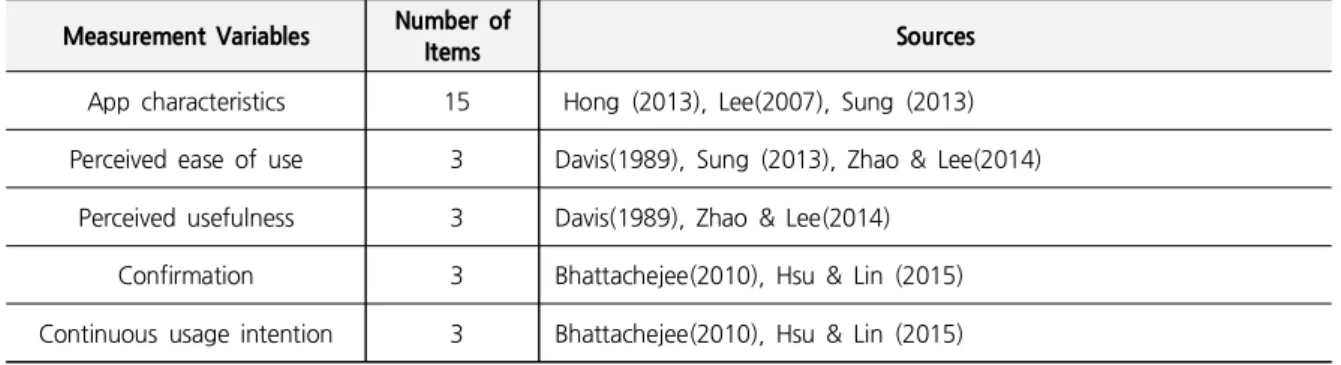
Table 1. Sources of Measurement
Measurement Variables Number of
Items Sources
App characteristics 15 Hong (2013), Lee(2007), Sung (2013)
Perceived ease of use 3 Davis(1989), Sung (2013), Zhao & Lee(2014)
Perceived usefulness 3 Davis(1989), Zhao & Lee(2014)
Confirmation 3 Bhattachejee(2010), Hsu & Lin (2015)
Continuous usage intention 3 Bhattachejee(2010), Hsu & Lin (2015)
2. Measurement
Based on previous research, the survey questionnaire was composed of 15 items on the characteristics of the mobile app, three items on perceived usefulness, three items on expectation confirmation, and three items on continuous usage intention. All items were measured on a four-point Likert scale. The analysis methods employed in this study were factor analysis, reliability analysis, and regression analysis.
3. Sampling
To collect the data for this study, a survey was conducted with female consumers in their 20s, who are
the main consumers of BDFS apps in Korea. A total of 184 women in their 20s, who lived in the Seoul and Incheon areas and had used a certain BDFS app, participated in an online survey conducted in May 2018.
A total of 182 responses were used for the analysis, excluding two that noted that they had used the BDFS app only once and no longer used it.
. Results
Ⅳ 1. Sample Characteristics
A total of 182 responses were used for the analysis. The majority of the respondents were in the mid-20s (aged between 23 and 26, 56.6%) and college students (73.6%).
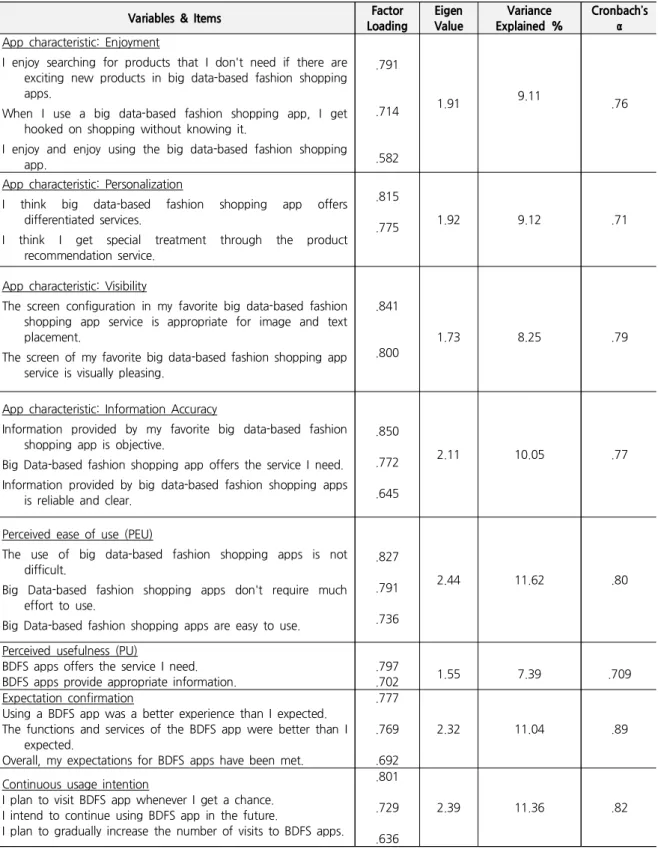
Table 2. Result of Factor Analysis and Reliability Tests
Variables & Items Factor
Loading
Eigen Value
Variance Explained %
Cronbach’s α App characteristic: Enjoyment
I enjoy searching for products that I don't need if there are exciting new products in big data-based fashion shopping apps.
When I use a big data-based fashion shopping app, I get hooked on shopping without knowing it.
I enjoy and enjoy using the big data-based fashion shopping app.
.791
.714
.582
1.91 9.11
.76
App characteristic: Personalization
I think big data-based fashion shopping app offers differentiated services.
I think I get special treatment through the product recommendation service.
.815
.775 1.92 9.12 .71
App characteristic: Visibility
The screen configuration in my favorite big data-based fashion shopping app service is appropriate for image and text placement.
The screen of my favorite big data-based fashion shopping app service is visually pleasing.
.841
.800
1.73 8.25 .79
App characteristic: Information Accuracy
Information provided by my favorite big data-based fashion shopping app is objective.
Big Data-based fashion shopping app offers the service I need.
Information provided by big data-based fashion shopping apps is reliable and clear.
.850
.772
.645
2.11 10.05 .77
Perceived ease of use (PEU)
The use of big data-based fashion shopping apps is not difficult.
Big Data-based fashion shopping apps don't require much effort to use.
Big Data-based fashion shopping apps are easy to use.
.827
.791
.736
2.44 11.62 .80
Perceived usefulness (PU)
BDFS apps offers the service I need.
BDFS apps provide appropriate information.
.797
.702 1.55 7.39 .709
Expectation confirmation
Using a BDFS app was a better experience than I expected.
The functions and services of the BDFS app were better than I expected.
Overall, my expectations for BDFS apps have been met.
.777
.769
.692
2.32 11.04 .89
Continuous usage intention
I plan to visit BDFS app whenever I get a chance.
I intend to continue using BDFS app in the future.
I plan to gradually increase the number of visits to BDFS apps.
.801
.729
.636
2.39 11.36 .82
In terms of the frequency of BDFS app use, users of the BDFS app for no more than once a week accounted for the largest percentage (44.5%, n=81), followed by those who used it two to three times a week (28.0%, n=51), four to five times a week (17.6%, n=32), and six or more times a week (7.7%, n=14).
2. Factor Analysis and Reliability Test
Factor analysis (principal component analysis) with Varimax rotation was conducted and eight factors were extracted from the analysis. Cronbach α, indicating the internal consistency, was used to examine the reliability of measures. Kline (2000) suggested that measures with a Cronbach α score higher than 0.7 indicates “good” internal consistency.
Thus, all measures were used for further analyses.
The results of the factor analysis and the reliability test are shown in Table 2.
3. Hypothesis Testing
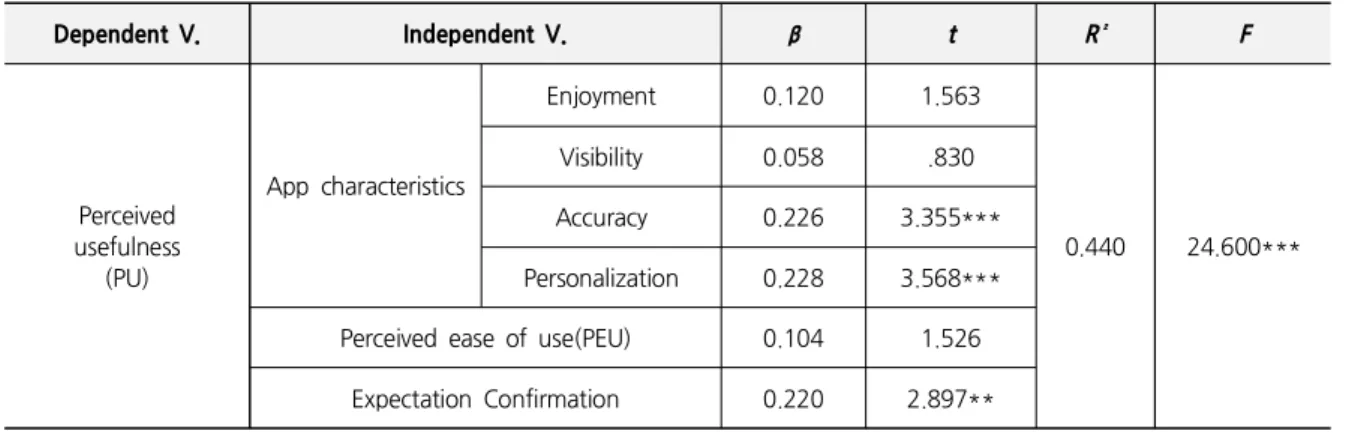
A regression analysis was conducted to examine the effects of the BDFS app characteristics, perceived ease of use, and expectation confirmation on the users’ perceived usefulness of BDFS apps. The results indicated that, overall, the regression model predicts the outcome
Table 3. Effect of BDFS Apps’ Characteristics and PEU on PU of BDFS Apps
Dependent V. Independent V. β t R² F
Perceived usefulness
(PU)
App characteristics
Enjoyment 0.120 1.563
0.440 24.600***
Visibility 0.058 .830
Accuracy 0.226 3.355***
Personalization 0.228 3.568***
Perceived ease of use(PEU) 0.104 1.526
Expectation Confirmation 0.220 2.897**
*p<.05, **p<.01, ***p<.001
variable (F=43.632, p<.001), and 66% of the total variation in the dependent variable could be explained by the independent variables. The users’ perceived usefulness increased with the increase of the respective characteristics of the app and the expectation confirmation: information accuracy (β=.226, p<0.001), personalization (β=.228, p<001), and expectation confirmation (β=.220, p<.01). The βscore revealed that BDFS app’s personalization and information accuracy characteristics had the greatest effect on the users’
perceived usefulness. The usefulness of BDFS apps was perceived to be greater as the perceived information accuracy, personalization and expectation confirmation of BDFS apps increased. Thus, hypothesis 1 was partially supported and hypothesis 4 were supported.
Another regression analysis was conducted to analyze the effect of the perceived usefulness of using BDFS apps and expectation confirmation on continuous usage intention regarding BDFS apps. The result indicated that, overall, the regression model predicted the outcome variable (F=86.346, p<.001), and 48.7% of the total variation in the dependent variable could be explained by the independent variables. It was found that continuous usage intention increased with increased perceived usefulness (β= .127, p <.05) and expectation confirmation (β=.625, p<.001). Thus, hypothesis 3 and hypothesis 5 were supported.
Table 4. Effect of BDFS apps’ PU and Expectation Confirmation on Continuous Usage Intention regarding BDFS Apps
Dependent V. Independent V. β t R² F
Continuous usage intention toward BDFS
apps
Perceived
usefulness(PU) .127 1.992*
0.487 86.346***
Expectation Confirmation .625 9.822***
*p<.05, **p<.01, ***p<.001
. Conclusion
Ⅴ
The summary of the findings is as follows: First, the findings from the analysis on the effects of the BDFS app characteristics, and expectation confirmation on the users’ perceived usefulness showed that information accuracy and personalization app characteristics, and expectation confirmation had a positive effect on the users’ perceived usefulness. Second, it was found that the BDFS app users' perceived usefulness and expectation confirmation had a positive significant effect on continuous usage intention, indicating BDFS app users’
continuous usage intention increased with higher level of perceived usefulness and expectation confirmation regarding the BDFS app.
Given the nature of the app, which provides a customized service based on big data analysis, it was expected that the personalization factor would have the most significant effect on the users’ perceived usefulness and the results of this study support this hypothesis. While it is essential to provide accurate information for users to feel useful in big data-based mobile shopping apps, it is also important to develop the personalized offerings and services which can be the biggest strength of the big-data based mobile fashion stores.
The users’ expectations for the BDFS app must be confirmed to draw a positive influence from perceived usefulness, suggesting that the user perception of BDFS app utility may also be adjusted by the extent of their expectation confirmation. The perception of BDFS app usefulness was increased when expectations were met.
This supported the findings from previous studies (Hsu
& Lin, 2015; Thong et al., 2006). This result suggests that expectations can play a critical role in perceiving the usefulness of BDFS apps. In addition, the user’s expectation confirmation also found to be a significantly affect the users’continuous usage intention.
A number of limitations found in this paper require further in-depth reflection and examination. In this paper, relatively few samples of 180 respondents were used for the analysis as the research was carried out on users who actually used BDFS apps. It is necessary to examine BDFS app usage with other age groups and to determine if there are differences between age groups. In addition, due to the relatively small sample, this study did not validate the model using the SEM light and focused on the relationship between the margins . Future research should require a larger sample with more BDFS app users to validate the model fit.
References
Agarwal, R., & Karahanna, E. (2000). Time flies when you're having fun: cognitive absorption and beliefs about information technology usage. MIS Quarterly, 24(4), 665-692. doi: 10.2307/3250951
Bae, E. (2010). A study on perceived value and user satisfaction and intention to reuse corresponding to characteristic factors in mobile fashion application : Focusing on consumer innovation and smart phone lifestyle (Unpublished doctoral dissertation). Yonsei University, Seoul, Korea.
Baker, S. (2017, November 23). Zara’s recipe for success: More data, fewer bosses. Bloomberg Businessweek. Retrieved August 3, 2018 from
https://www.bloomberg.com/news/articles/2016-11-23 /zara-s-recipe-for-success-more-data-fewer-bosses Bhattacherjee, A. (2001). Understanding information
systems continuance: An expectation-confirmation model. MIS Quarterly, 25(3), 351-370. doi: 10.2307/
3250921
Chen, L., Gillenson, M. L., & Sherrell, D. L. (2002).
Enticing online consumers: an extended technology acceptance perspective. Information and Management, 39(8), 705-719. doi: 10.1016/S0378-7206(01)00127-6 Clarke, I. (2001). Emerging value propositions for
M-commerce. Journal of Business Strategies, 18(2), 133 149. –
Davis, F. (1989). Perceived usefulness, perceived ease of use, and user acceptance of information technology.
MIS Quarterly, 13(3), 319 340. doi: 10.2307/249008– Davis, F. D. Bagozzi, R. P., & Warshaw, P. R.(1989).
User acceptance of computer technology: A comparison of two theoretical models. Management Science, 35(8), 982-1003. doi: 10.1287/mnsc.35.8.982 Davis, F. D., Bagozzi, R. P., Warshaw, P. R. (1992).
Extrinsic and Intrinsic Motivation to Use Computers in the Workplace. Journal of Applied Social Psychology, 22(14), 1111-1132. https://doi.org/
10.1111/j.1559-1816.1992.tb00945.x
Gantz, J., & Reinsel, D. (2011, June). Extracting value from chaos. IDC IVIEW. Retrieved May 11, 2016 from https://www.emc.com/collateral/analyst reports/ – idc-extracting-value-from-chaos-ar.pdf
Hong, S. B. (2013). A study on the mobile fashion commerce characteristics and consumer groups according to purchase intention. (Unpublished master's thesis). Ewha Woman’s University, Seoul, Korea.
Hsu, C., & Lin, J. (2015). What drives purchase intention for paid mobile apps? An expectation confirmation model with perceived value. Electronic Commerce Research and Applications, 14(1), 46-57.
https://doi.org/10.1016/j.elerap.2014.11.003
Jang, Y. J. (2012). 경영학콘서트 [Business administration concert]. Seoul: The Business Books Publishing.
Jung, S. Y. (2014). The effect of mobile shopping user experience on satisfaction and continuous usage
intention: Focusing on smartphone users (Unpublished Master’s thesis). Hongik University, Seoul, Korea.
Kim, S.-Y. (2011). (A) Study on model of fashion application, 'Style By Me' (Unpublished master’s thesis). Sungshin Women's University, Seoul, Korea.
Kim, E.-D., & Chae, M.-S. (2013). An empirical study on the differences of relationship between content quality factors and user satisfaction on mobile contents based on user characteristics. Journal of the Korea Academia-Industrial Cooperation Society, 14(4), 1957-1968. doi: 10.5762/KAIS.2013.14.4.1957
Kim, C. Y., Hwang, J. S., & Cho, J. J. (2015).
Relationships among mobile fashion shopping characteristics, perceived usefulness, perceived enjoyment, and purchase intention: Mediating effect of ease of use. Journal of the Korean Society of Clothing and Textiles, 39(2), 161-174. doi:10.5850/JKSCT.
2015.39.2.161
Kim, Y., Jang, E., & Choi, J. (2011). Trait factors of smartphone application influencing the formation of a brand image: Focusing on department store application. Journal of the Korea Contents Association, 11(8), 102-111. http://dx.doi.org/10.5392/JKCA.2011.
11.8.102
Kline, P. (2000). The handbook of psychological testing (2nd ed.). London: Routledge.
Lee, E. K. (2007). A study on the effect of mobile fashion shopping characteristics and perceived risk on perceived value and purchase intention: Focusing on personal innovation and mobile internet lifestyle.
(Unpublished master's thesis), Yonsei University, Seoul, Korea.
Lee, M. J. (2012). Mobile shopping motives and fashion application attribute importance (Unpublished master’s thesis). Hanyang University, Seoul, Korea.
Manyika, J., Chui, M., Brown, B., Bughin, J., Dobbs, R., Roxburgh, C., & Byers, A. H. (2011). Big data: The next frontier for innovation, competition, and productivity. McKinsey Global Institute. Retrieved May 11, 2016 from https://www.mckinsey.com
Nysveen, H., Pedersen, P. E., & Thorbjornsen, H. (2005).
Explaining intention to use mobile chat services:
Moderating effects of gender. Information Systems Research, 13(3), 296-315. https://doi.org/10.1108/
07363760510611671
Oliver, R. (1980). A cognitive model of the antecedents and consequences of satisfaction decision. Journal of Marketing Research, 17(4), 460 469. doi:10.2307/ – 3150499
Park, E. H. (2016). The effect of characteristics of mobile fashion application on satisfaction and continuous usage intention (Unpublished master’s thesis). Sungkyunkwan University, Seoul, Korea.
년 월 온라인쇼핑 동향
Statistiacs Korea (2018). 2018 1
[Report of Online Shopping Survey in January 2018]
(2018). Daejeon: Statistic Korea
Sung, H. W. (2013). A study on the determinants of attitude toward and intention to use mobile shopping through fashion apps: Comparisons of gender and age group differences. Journal of the Korean Society of Clothing and Textiles, 37(7), 1000-1014. doi:
10.5850/JKSCT.2013.37.7.1000
Thong, J.Y.L., Hong, S.J. & Tam, K.Y., (2006). The effects of post-adoption beliefs on the expectation-confirmation model for information technology continuance. International Journal of Human-Computer Studies, 64(9), 799-810. https://
doi.org/10.1016/j.ijhcs.2006.05.001
Zhao, L., & Lee, M. (2014). Effects of fashion company’s marketing activities using micro-blogging services on Chinese consumer’s attitude toward company and purchase intention. Journal of Fashion Business, 18(6), 157-173.http://dx.doi.org/10.12940/
jfb.2014.18.6.157
Received (November 5, 2018) Revised (December 10, 2018) Accepted (December 17, 2018)