JOurNal Of MuShrOOM SCIeNCe aND PrODuCTION 9 (4) 2011 198
Mushroom is cultivated as one of the major economi- cal crops in many areas of the Korea. The total produc- tion has steadily increased approximately 186,400 M/T in 2007 to 216,276 M/T in 2010. The button mushroom, Agaricus bisporus, showed the 5th production to 22,635 M/T in 2010. Several Cladobotryum species have been recorded from cultivated mushrooms by various authors and include C. dendroides, C. multiseptatum, C. mycophi- lum and C. varium(Sinden, 1971; De Hoog, 1978; Sharma et al., 1992). Cobweb disease of mushrooms is caused by a few species of Cladobotryum, most notably C. den- droides and C. mycophilum. Both of these occur on oth- er mushroom species growing in the wild(Rogerson and Samueis, 1993, 1994). Until the late 1980’s the disease was rarely seen on mushroom farms worldwide, and was easily controlled by a variety of fungicides used in the in- dustry( Fletcher et al., 1986). But some fungicide(Mertect and Topsin) resistance was reported by Lockley and Gay(1983). This disease was first reported to be caused by C. mycophilum by Back et al. (2010) in Korea. This study was conducted to investigate characateristics and pathogenicity of the casual fungus causing cobweb dis- ease of button mushroom in Korea.
Disease incidence and symptoms. Diseased fruit- ing bodies of A. bisporus with symptoms resembling cobweb disease were observed in 10 mushroom farms.
Early symptoms were noticed as round, fleshy, yellowish brown lesions on mushroom caps(Fig. 1. A). Late symp- toms progressed when the parasitic fungus formed white cobweb circular colonies on dead or damaged pinheads, spread on the surface of the casing, and covered en- tirely fruiting bodies(Fig. 1. B). Mushroom caps turned
Characteristics and pathogenicity of Cladobotryum mycophilum isolated from cobweb disease of button mushroom (Agaricus bisporus) in Korea
Chan-Jung Lee*, Hye-Su Han, Chang-Sung Jhune, Jong-Chun Cheong, Jin-A Oh and Won-Sik Kong Mushroom Research Division, National Institute of Horticultural and Herbal Science, RDA,
Suwon 441-707, Korea
(Received November 5, 2011, Revised November 12, 2011, Accepted November 20, 2011)
ABSTRACT : Cobweb disease symptoms were observed in a mushroom farm in Buye, Korea during a disease survey in 2008-2011.
Five isolates of Cladobotryum sp. were obtained from the infected caps and stipes. These isolates of Cladobotryum sp. were identified as C. mycophilum based on their morphological, cultural characteristics and analysis of the ITS sequences. Early symptoms were noticed as round, fleshy, yellowish brown lesions on mushroom caps. Late symptoms progressed when the parasitic fungus formed white cobweb circular colonies on dead or damaged pinheads, spread on the surface of the casing, and covered entirely fruiting bodies. Optimal temperature and pH for mycelial growth on MEA is 23℃ and 6.0. Microscopically the spores of the fungus are large and most 2~3 celled produced on vertically branched conidiophores. Mushroom caps turned dark brown and shrunk due to soft rot. Testing of sensitivity to selected fungicides showed that isolate was highly resistance to Mancozeb and Thiophanate-methyl, moderately sensitivity to Iprodione, and highly sensitivity to Benomyl, Prochloraz-Mn and Carbendazim.
KEYWORDS : Agaricus bisporus, Cladobotryum mycophilum, Cobweb disease, Mushroom
Journal of Mushroom Science and Production
Copyright ⓒ 2011 by The Korea Society of Mushroom Science Vol. 9, No 4, p198-201 December 2011
Printed in S. Korea
*Corresponding author <[email protected]>
Fig. 1. Symptoms of coweb disease on button mushroom caused by Cladobotryum mycophilum. a, B : Typical symptoms on fruit- ing body in mushroom field. C : Symptoms induced by artifi- cial inoculation in pot. D : Colony of C. mycophilum grown for 7days malt extract agar (Mea) .
�������9-4��.indd 198 2012.2.2 4:33:37 PM
199 Characteristics and pathogenicity of Cladobotryum mycophilum isolated from cobweb disease of button mushroom
(agaricus bisporus) in Korea
dark brown and shrunk due to soft rot. On occasion, the mycelium and infected mushrooms might have some reddish/orange color and on agar some isolates have a
‘camphor-like’ odor. Colonies growing on the casing are usually circular and rapidly overwhelm mushrooms, caus- ing rapid decay. The pathogen grows very rapidly across the beds, especially under moist and humid conditions.
These symptoms correspond with symptoms caused by Cladobotryum isolates.
Pathogenicity test. Pathogenicity assasy on mush- room pilei showed that each of the twenty isolates had high virulence level for button mushrooms. The symp- toms were not produced when sterile water was used as a negative control. All isolates induced severe disease symptoms on mushroom pilei. The growth of the patho- genic mycelia was recorded two days after inoculation.
Three days after inoculation, the sporocarps were com- pletely covered with white cottony mycelia with abun- dant sporulation, resembling the symptoms of natural infection(Fig. 1 C). The pilei were completely rotten, soft and decayed on the fourth day of incubation. There were no significant differences in levels of symptom develop- ment among the different isolates.
Mycological characteristics. The isolates formed white, cottony, aerial mycelium on MEA at 25℃. Opti- mal spore germination temperature is 25℃. Under these conditions, the pathogen can germinate and grow in 7 days. The fungus abundantly sporulates in contact with mushroom tissue and the dry spores are easily dislodged when watering or salting an infected area. The fungus sporulated and mycelium turned yellow three days after innoculation. After a few more days, conidia and colo- nies turned reddish. Microscopically the spores of the
fungus are large and most 2~3 celled produced on ver- tically branched conidiophores(Fig. 2). The colonies grow as fast as 15~20 mm per day on agar plates(Fig. 1. D).
Optimal temperature and pH for mycelial growth on MEA is 23℃ and 6.0(Fig. 3, 4).
Internal transcribed spacer (ITS) sequence analysis. DNA was isolated from pure cultures of fun- gus using the Qiagen Genomic DNA Isolation Kit (Qia- gen, USA). The rDNA ITS region of the Cladobotryum isolate was amplified with conserved fungal primers Fig. 2. Morphological characteristics of Cladobotryum mycophilum isolated from button mushroom.
a ; Conidiophores and conidia in head, B : Conidia, C : Germination of conidia.
Fig. 3. Growth properties of the Cladobotryum mycophilum isolated from button mushroom. The isolated was grown at different temperature on malt extract agar (Mea) for 3 days.
Fig. 4. ph properties of the Cladobotryum mycophilum isolated from button mushroom. The isolated was grown at different ph on malt extract agar (Mea) for 3 days.
�������9-4��.indd 199 2012.2.2 4:33:38 PM
JOurNal Of MuShrOOM SCIeNCe aND PrODuCTION 9 (4) 2011 200
ITS1 and ITS4. The size of the ITS fragment was ap- proximately 580 bp, which includes ITS1, 5.8S and ITS4 regions. The sequences were compared with the pub- lished Cladobotryum fungi sequences available in the NCBI database. The strain is closely related to strains of the type species of Cladobotryum mycophilum (Fig.
5). This strain showed 99% ITS region sequence simi- larity to Cladobotryum mycophilum, according to blast search for homologous(Table 1). Phylogenetic trees were constructed using the neighbour-joining method (Saitou and Nei, 1987) with the MEGA3.0 program (Kumar et al., 2004); bootstrap percentages were based on 1000 replications (Felsenstein, 1985).
Testing of sensitivity to selected fungicides.
Sensitivity analysis was done with isolates grown on MEA amended with the following fungicides:
Benomyl 50%, Iprodione 50%, Prochloraz-Mn complex 50%, Mancozeb 75%, Carbendazim 60% and Thiophan- ate-methyl 70%. The preliminary concentrations of all selected fungicides were 1, 2, 10 and 20 ppm. The plates were inoculated with inverted mycelial agar disk (10 mm) taken from the edge of 7 days old culture of C. mycoph- ilum isolate, placed centrally on fungicide-amended and fungicide-free medium (control) and incubated at 25℃.
Colony diameter was measured after 4 days of growth.
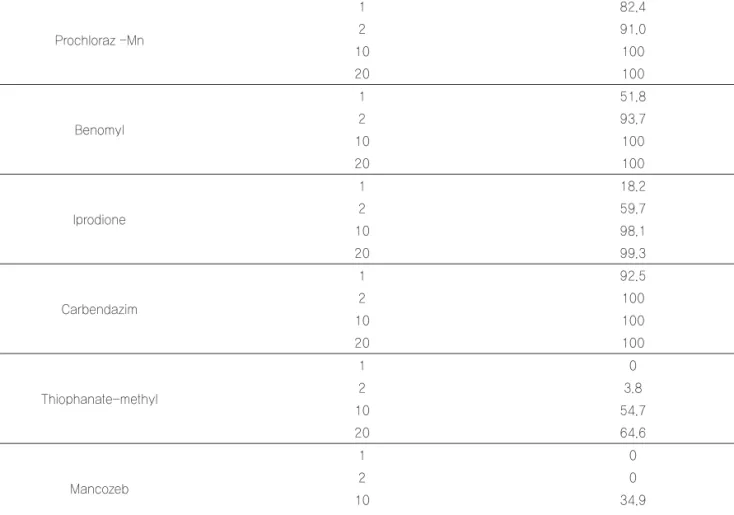
Growth of colonies on the fungicide-amended medi- um was given as a percentage of the control. In these in vitro investigations of the sensitivity of C. mycoph- ilum isolate to the selected fungicides, studied isolate showed highly resistance to Mancozeb and Thiophan- ate-methyl; and moderate sensitivity to Iprodione; and high sensitivity to Benomyl , Prochloraz-Mn and Car- bendazim (Table 2).
Fig. 5. Phylogenetic relationships of of Cladobotryum mycophilum based on internal tran- scribed spacer(ITS) sequences. Numerical values on branches are the boots trstrap values as percentage of bootstrap replication from 1000 replicate analysis.
Table 1. Similarities(%)(upper right) and evolutionary distances(lower left) between rDNA ITS region sequences of species of the genus Cladobotryum
1 2 3 4 5 6 7 8 9
1 100 100 99.8 99.8 99.6 98.6 98.6 91.5
2 0 100 99.8 99.8 99.6 98.6 98.6 91.5
3 0 0 99.8 99.8 99.6 98.6 98.6 91.5
4 0.2 0.2 0.2 99.6 99.4 98.4 98.4 91.8
5 0.2 0.2 0.2 0.4 99.4 98.4 98.4 91.3
6 0.4 0.4 0.4 0.6 0.6 98.2 98.0 91.3
7 1.2 1.2 1.2 1.4 1.4 1.6 97.8 92.2
8 1.4 1.4 1.4 1.6 1.6 1.8 2.3 91.1
9 7.5 7.5 7.5 7.3 7.7 7.9 7.2 8
1: BaC01, 2: BaC03, 3: BaC04, 4: Cladobotryum_mycophilum Y17095, 5: BaC05, 6: BaC06, 7: Cladobotryum_asterophorum Y7089, 8: Cladobotryum_dendroides Y17091, 9: Cladobotryum_varium Y17087.
�������9-4��.indd 200 2012.2.2 4:33:39 PM
201 Characteristics and pathogenicity of Cladobotryum mycophilum isolated from cobweb disease of button mushroom
(agaricus bisporus) in Korea
References
Back, C. G., Kim, Y. H., Jo, W. S., Chung, H. W., Jung, H. Y. 2010. Cobweb disease on Agaricus bisporus caused by Cladobotryum mycophilum in Korea. J.
Gen Plant Pathol. 76 : 232–235 .
De Hoog, L. C. 1978. Notes on some fungicolus hypho- mycetes and their relatives. Pesoonia 10 : 33-81.
Felsenstein, J. 1985. Confidence limits on phyloge- nies: an approach using the booststrap. Evolution 393 : 783-791.
Fletcher, J. T., White, P. F., Gaze, R. H. 1986. Mush- room-pest and disease control. Inytercept Limited, Ponteland, Newcastle-upon-Tyne, England.
Kumar, S., Tamura, K., and Nei, M. 2004. MEGA3: in- tegrated software for molecular evolutionary genet- ics analysis and sequence alignment. Brief Bioinfor- matics. 5 : 150-163.
Lockeley, K. D., Gay, C. 1983. Differential sensitivity to
benzimidazole fungicides in strains of Hypomyces rosellus. Plant Pathologists Technical Conference 1983, PPT/798. Ministry of Agricultural Fisheries and Food, ADAS, Bristol, England.
Rogerson, C. T., Samuels, G. J. 1993. Agaricicolous spe- cies of Hypomyces. Mycologia 85 : 231-271.
Rogerson, C. T., Samuels, G. J. 1994. Agaricicolous species of Hypomyces. Mycologia 86 : 839-866.
Saitou, N., and Nei, M. 1987. The neighbor-joining method: a new method for reconstructing phylo- genetic trees. Molecular Biology and Evolution. 4 : 406-425.
Sharma, V. P., Suman, B. C., Guleria, D. S. 1992. Clado- botryim verticillatum- a new pathogen of Agaricus bitorquis(Quel.) Sacc. Indian Journal of Mycology and Plant Pathology 22 : 62-65.
Sinden, J. W. 1971. Ecological control of pathogens and weed moulds in mushroom culture. Annual Review of Phytopathology 9 : 411-432.
Table 2. In vitro sensitivity of Cladobotryum mycophilum isolate to selected fungicides
fungicides Concentration(ppm)ppm)) Mycelial growth inhibition rate(%)
Prochloraz -Mn
1 82.4
2 91.0
10 100
20 100
Benomyl
1 51.8
2 93.7
10 100
20 100
Iprodione
1 18.2
2 59.7
10 98.1
20 99.3
Carbendazim
1 92.5
2 100
10 100
20 100
Thiophanate-methyl
1 0
2 3.8
10 54.7
20 64.6
Mancozeb
1 0
2 0
10 34.9
20 59.7
�������9-4��.indd 201 2012.2.2 4:33:39 PM