• 검색 결과가 없습니다.

The study of hanbok course in Chinese university

N/A
N/A
Protected

Academic year: 2021

Share "The study of hanbok course in Chinese university"

Copied!
14
0
0

로드 중.... (전체 텍스트 보기)

전체 글

(1)

The study of hanbok course in Chinese university

Yu Hua Cui

Assistant Professor, Academy of Fine Arts, Yanbian University, China

(2020. 7. 15 접수; 2020. 11. 17 수정; 2020. 12. 18 채택)

Abstract

This research investigates how interest develops across a set of tasks within a course defined by a specific knowledge domain. The current study examined the relationships among self-concept, self-efficacy, Korea-related factors, and evaluation, in the context of learning about the Hanbok costume at Chinese universities. A survey (n=300) was conducted using an online survey website (www.sojump.com) from the 1st to the 25th of June. The structural equation model (SEM) analysis, including total and specific forms of self-evaluation with Hanbok courses, showed that self-concept was positively associated with self-efficacy. Conversely, K-culture interest and K-country image did not significantly affect self-efficacy in clothing, but positively affected Hanbok's self-efficacy. Meanwhile, the more self-efficacy perceived, the higher the level of evaluation. Overall, our findings imply that supporting the students' Korean culture interest, country image perception, and self-concept for regulation can enhance self-evaluation and self-realization success.

Theoretical and practical implications for Hanbok courses are discussed.

Key Words: Hanbok course(한복수업), self-concept(자아개념), self-efficacy(자기효능감), evaluation(평가)

† Corresponding author ; Yu Hua Cui Tel. +86-433-243-5801

E-mail : [email protected]

Ⅰ. Introduction

In an increasingly complex, interconnected world, effective teachers of today's students require intercultural competency and a global perspective, or knowing how to teach core content in ways that are relevant and transcend borders (Crawford et al., 2020).

Research suggests, however, that the majority of students perceive the world from an ethnocentric orientation (Auken et al., 2007; Crawford et al., 2020; Das &

Jebarajakirthy, 202). While international

practical may enhance university design

students’ cultural sensitivity, nurture

empathy for others, and expand their

(2)

worldview, few students are able to participate in such culture experiences. In response to this proposal, there are still individual universities offering related Hanbok (Korean traditional costume, 한복) courses, such as Yanbian University, Minzu University of China, Beijing Institute Of Fashion Technology, etc. These universities are well-known in China with clothing major, and the study of intercultural costumes is also very long. Cross-culture costume programs are thus charged with designing impactful experiences to enhance design students' global perspectives and cross-cultural understandings so they may, in turn, transfer these competencies to their future development.

Yet, there is a dearth of research on the effects of student training on design students' attitudes toward global costume (Hanbok) learning and how it can be systematically fostered (Crawford et al., 2020; Lee & Lee, 2019). In previous studies, the dimensions (academic, domain) of self-concept were analysed in relation to the other important aspects in daily life of college and university students, such as self-efficacy (Fryer et al., 2020; Morony et al., 2013; Sagone &

Caroli, 2014). Generally, we will learn the cultural knowledge and regional customs of the country we like (Cubillo et al., 2006; Whang et al., 2015). Therefore, this paper also explores boldly the relationship culture interest, country image and evaluation of Hanbok course. On the other hand, a large amount of published works have examined the relationship between self-efficacy and students’ evaluation outcome and performance (Dou et al., 2016; Hashemi et al., 2017; Jiang, 2015). Previous research on the traditional costume has focused mainly on the costume industry (such as Chinese tourists' experience with Hanbok, decorating the Hanbok design and wearing Hanbok for modernization of traditional costumes) rather than the effect on

university design major students' studying in Hanbok course in China. Thus, it is urgent and meaningful to carry out this research.

This study aims to investigate and increase the Korean traditional outfit, Hanbok, in Chinese university design major course. The present study explore the relationship between self-concept (academic, clothing), K-culture interest, K-country image, self-efficacy (clothing, Hanbok), and evaluation in university students attending Hanbok course. Then, we discuss the implications, and suggest areas for further research.

Ⅱ. Literature review

1. Self-concept and self-efficacy

1) Self-concept

Shimp and Sharma (1987) conceptualize consumer ethnocentrism as a consumer’s tendency to view domestically manufactured products as being superior compared to foreign -made products. This attitude consists of two major components: love and concern for one’s own country and the fear of losing control of one’s economic interests; and the intention or willingness not to purchase foreign products (Eren, 2013). Research in international marketing shows that consumers evaluate products by using a number of cues which is either extrinsic or intrinsic. Bias, real or imagined, towards foreign products has featured prominently in the literature. One of these biases relates to consumer ethnocentrism (Mostafa, 2010).

In general, academic self-concept has been

defined as students’ perception of themselves

within the academic environment. Self-concept is

continually formed by experience and interaction

with the environment (Scherer, 2013). Also,

self-concept is an essential part of the cognitive

(3)

system of individuals and is involved in regulating ongoing behaviors. The looking-glass self theory implies that people shape their self-concept based on their understanding of how others perceive them (Lu et al., 2017). In educational sciences, this construct has been extensively studied and, up to now, much is known about the general structure of self-concept.

Self-concept is due to successful relationship with others and learning skills. The most important elements of make self-concept are:

family, school, social activities, and reciprocal relationship which the individual learns (Reishehrei et al., 2014).

Academic self-concept (what one believes about one’s academic ability), especially domain specific academic self-concept, is the most specific with respect to evaluation of cognitive ability (Peterson & Whiteman, 2007). In current study, self-concept is divided into academic self-concept (general academic) and clothing self-concept (domain specific) and analyzed in many aspects.

2) Self-efficacy

Self-efficacy is defined as a person’s belief in their ability to bring about desired specific outcomes. A self-efficacy assessment includes both an affirmation of a capability level and the strength of that belief (Morony et al., 2013).

Scherer (2013) point out that students’

self-efficacy in science plays an important role in solving problems, which demand a higher level of working memory capacity in science.

Self-efficacy is equally pivotal to learning, especially in the face of challenge and failure.

Understanding of the role of self-efficacy in this development is more nascent, but recent and longstanding evidence suggests its central function and potentially reciprocal relationship with interest (Fryer et al., 2020).

Self-efficacy, on the other hand, can be assessed in a general way as illustrated in the example above and in the Method section of this paper or it can be assessed in a way that is closely linked to individual items (Stankov et al., 2012). Our measure of self-efficacy is also separated into academic self-efficacy (general academic) and Hanbok self-efficacy (domain specific) in being closely tied to the answer to a particular item in a test.

3) Relationship between self-concept and self-efficacy

Self-concept and self-efficacy are also difference, as they differ in the context of students’ evaluations. Self-efficacy largely refers to context-specific judgments whereas self-concept mainly relies on aggregated and global perceptions (Scherer, 2013). Surjanti et al. (2020) indicate that self-efficacy significantly affected the sustainability of students’ behavior, but self-concept had no significant effect on it. This also shows that self-efficacy can directly affect the outcome variable, but self-concept needs a medium such as self-efficacy.

Additionally, there has been empirical support for the positive relationship between self-concept and self-efficacy. Morony et al. (2013) argue that self-concept is positively correlated with self-efficacy, and reflects a more general sense of how well a person thinks she/he performs at a school subject or set of tasks. Especially, Interest and self-efficacy are vital to enhancing learning experiences across formal education. Fryer et al.

(2020) indicate that students’ task interest directly

predicted future course self-efficacy, but was

mediated by course interest fro future domain

interest. Sagone and Caroli (2014) demonstrate

that the more the university students were likely

to personally control the circumstances and more

expressed a positive self-concept, the more they

perceived themselves as academically efficient.

(4)

Furthermore, Lu et al. (2017) demonstrated that self-concept was positively associated with self-efficacy and abstinence motivation. The results show that self-concept mediated the relationship between childhood maltreatment and self-efficacy.

In many studies, researchers found significant and substantial differences between general academic and domain-specific self-concept, also academic and domain-specific self-efficacy (Peterson & Whiteman, 2007; Scherer, 2013;

Stankov et al., 2012 ). In this study, two scales of self-concept are used: The first refers to general academic self-concept; the second refers to domain-specific self-concept for clothing. Also, self-efficacy is divided into two parts: general clothing self-efficacy, and Hanbok self-efficacy.

The above discussion gives rise to the following hypotheses:

H1a: Academic self-concept is positively associated with clothing self-efficacy.

H1b: Academic self-concept is positively associated with Hanbok self-efficacy.

H2a: Clothing self-concept is positively associated with clothing self-efficacy.

H2b: Clothing self-concept is positively associated with Hanbok self-efficacy.

2. K-Culture interest and K-Country image

1) K-Culture interest

Ford et al. (2003) defined culture as the collective programming of mind, which distinguishes the members of one group from another. In similar approach, culture is defined as a system of values and norms that are shared among a group of people and that when taken together constitute a design for living.

Globalisation facilitated the process of acculturation by enabling direct and indirect

exposure to multiple cultures (Das &

Jebarajakirthy, 2020). Researchers view acculturation as the adoption of the values, behaviors, attitudes and belief system of another culture. Because culture operates in the mind, contextual elements can activate different cultural notions in memory that then influence perception, judgment, and behavior (Shavitt & Barnes, 2020). Especially in China, lots of people interest in K-pop, K-drama, K-fashion, K-food, and K-film contents industry consider Korea culture as an interesting enjoyment.

2) K-Country Image

Country image consists of the symbols and associations that people envision when thinking about a particular country. These associations influence judgments in relation to particular foreign countries (Ghazarian, 2016). The country image, which can be described as “the total of all descriptive, inferential, and informational beliefs one has about a particular country”, was examined through different perspectives by different researchers. Dedeoğlu (2019) examines country image from political, economic, and technological aspects. Chaulagain, Wiitala & Fu (2019) indicate that country image encompasses security and safety, economic, technological, technological, political dimensions. Meanwhile, the theoretical emphasis of Saliu (2013) is concentrated in explaining concepts, which today are present in the discourse for increasing the country image, such as public diplomacy, massive diplomacy, soft-power, international public relations etc.

3) Effect of K-Culture Interest and K-Country Image on Self-efficacy

Srihadi et al. (2016) represent foreign visitors

who are interested in culture of a specific

country as like historical places and festivals and

(5)

local culture performances, they are interested in learning about the country. Auken et al. (2007) indicate that exchanges with native speakers at local establishments, on the street, at the university, etc., for example, play an important role in student development though knowledge gained regarding the target culture. In Das and Jebarajakirthy (2020), the more Gen-Y consumers are interest in western culture, the more they like to learn and buy from the west.

In Zhang and Effendi (2017), mostly respondents study Bahasa Indonesia because China have positive country image, having good relations with Indonesia. Cubillo et al. (2006) show that the country image play an important role in the selection of students for international education. Due to the prestige image of certain countries, students tend to believe that higher education offered in these countries is high quality. Traditional costumes show a distinctive culture in each region, and a traditional costume can be a factor in increasing culture interests.

Korean traditional costume Hanbok significantly impact on heritage authenticity and perceived value had a significant impact on culture interests (Lee & Lee, 2019).

Based on previous literature, Korea culture interest has been found to influence a student’s capacity, including clothing and Hanbok self-efficacy. Furthermore, empirical research supported that a positive country image has a positive effect on students’ ability, which in turn may lead to the evaluation overall. Therefore, the following hypotheses are proposed:

H3a: K-culture interest is positively associated with clothing self-efficacy.

H3b: K-culture interest is positively associated with Hanbok self-efficacy.

H4a: K-country image is positively associated with clothing self-efficacy.

H4b: K-country image is positively associated with Hanbok self-efficacy.

3. Evaluation

A method encouraging students to reflect on performance is to ask them to estimate the number of times in the test they have completed correctly (Morony et al., 2013). We include this self-evaluation (labeled “evaluation” in the present study) as an alternative self-assessment measure.

Evaluation is both a process and an activity. It is the ability to be realistic in judging one’s own performance and in being able to monitor or check one’s own learning (Yang & Chen, 2012).

Meanwhile, core self-evaluation refers to the fundamental, bottom-line appraisals that people make of themselves, and that is implicit in all their other beliefs and evaluations (Dou et al., 2016). Palmer et al. (1985) designed two evaluation forms for instrument: (1) Performance evaluation, this solicited comments and quantitative measures of the students’ performance; (2) Quality evaluation, referred to the specificity, completeness, and appropriateness of this student’s comments.

Hashemi et al. (2017) indicate that some

interventions such as regular psychological

counseling to increase the self-efficacy of

students and educational programs to

increase the outcome expectations,

evaluation of students are necessary. Yang

and Chen (2012) found that there’s positive

relationship between writing self-efficacy

and evaluation of Senior High School

students’ English writing performance. Dou

et al. (2016) examined the relationships

between core self-evaluation, regulatory

emotional self-efficacy and depressive

symptoms in Chinese adolescents, and found

that self-efficacy was positively correlated

with evaluation. Zhao and Shi (2018) show

that the attitude toward a person who

committed suicide or attempted suicide

(6)

Academic Self-concept

Clothing Self-concept

K-culture Interest

K-country Image

H1a H1b H2a H2b

H3a H3b H4a H4b

H6 H5 Clothing

Self-efficacy

Hanbok Self-efficacy

Evaluation

<Fig. 1> Research model played a mediation effect from perceived

self-efficacy in managing curiousness to core self-evaluation. According to Jiang (2015), both doing and mastery orientations fully mediated the relationship between core self-evaluation and career decision self-efficacy.

These findings above review some important mechanisms underlying the role of self-efficacy on one’s evaluation and offer useful implications.

Thus, we test these relationships through the following hypotheses:

H5: Clothing self-efficacy is positively associated with evaluation.

H6: Hanbok self-efficacy is positively associated with evaluation.

Considering all hypotheses, Figure 1 shows the research model proposed in this study.

Ⅲ. Methodology

1. Data collection and analysis

To test our conceptual model, we gathered data through an online survey

(www.sojump.com) of Chinese consumers from July 1st to 15th in 2020. We selected China as the sample because of China is the most obsessed with importing (foreign) goods. As outlined earlier, we deliberately chose visual arts products as a focal product category because Chinese consumers purchase such products on the basis of both functional and social benefits.

Such as clothing, electrical appliances, artwork with design sense, etc. At the beginning of the questionnaire, these contents will also be introduced to the respondents in detail. Further, the visual arts products market in China is one in which foreign and domestic brands compete head-to-head in an emerging market of major economic importance. This approach allowed us to limit the potential impact of xenocentric biases on our brand attachment measurements a rising from the brands' geographic origin. The questionnaire was originally developed in English and translated into Mandarin using double back-translation procedures by two bilingual translators (Craig & Douglas, 2005). 302 usable responses were employed in the data analysis.

A self-administered online questionnaire

(www.sojump.com) was developed to examine

the aforementioned hypotheses. First of all, we

screened out the respondents with the question,

(7)

‘Have you ever study in Hanbok course in your university?’ The answers were ‘Yes(1)’ or ‘No(2)’.

For the respondents who answered yes, another open question was used to further inquire about the every main variables. 300 usable responses were employed in the data analysis after eliminating incomplete responses from June 1st to 25th in 2020.

To test the proposed model in Figure 1, the present study followed Anderson and Gerbing (1988)’s two-step approach. First, the measurement model was examined, and second, the structural model was tested.

Confirmatory factor analysis (CFA) was used to assess the measurement model for composite reliability and construct validity, and structural equation modeling (SEM) was used to evaluate the proposed structural model and to test hypotheses. The data were analyzed using the Statistical Package for the Social Sciences (SPSS) software and analysis of moment structures (AMOS).

Measurement Instrument

This study is quantitative research due to the causality relationship among variables.

The self-concept and self-efficacy research instruments are adopted from Peterson and Whiteman (2007) and Fryer et al. (2016) on how students’ self-concept and self-efficacy were assessed in course understanding. Specifically, academic self-concept (general academic) and clothing self-concept (domain specific) from the similar patterns of adaptive learning scales, using three items for each.

The clothing self-efficacy and Hanbok self-efficacy use the similar patterns of four items separately. Moreover, this study refer to K-culture interest developed by Whang et al. (2016) and Das and Jebarajakirthy (2020), K-country image developed by Chaulagain et al. (2019).

Meanwhile, regarding to evaluation,

researchers developed instruments adopted from Gardner and Pierce (2010) and Palmer et al. (1985) referring to the students’

evaluation of performance outcome measurement indicators. The assessments used a 5-point Likert scale, ranging as: 1) strongly disagree to 5) strongly agree. Brief definitions and examples of items used to assess each construct in current study reported in the present paper are as follows (Dedeoğlu, 2019; Morony et al., 2013;

Stankov et al., 2012; Whang et al., 2016):

Self-concept - one’s perception of self.

(e.g., In my clothing class, I understand even the most difficult work).

Self-efficacy - one’s belief about one’s capability to produce outcomes.

(e.g., I am sure I can do difficult work in my clothing class).

K-Culture interest - one’s interest in Korean culture. (e.g., I am interest in K-pop culture).

K-Country image - one’s perception of Korea, which is conceptualized and categorized in economic, technological, and political aspects. (e.g., Korea is a peaceful country).

Evaluation - one’s self-evaluation of Hanbok post-test and performance outcome. (e.g., I do well on the Hanbok theory and practical).

Ⅳ. Results

1. Demographic results

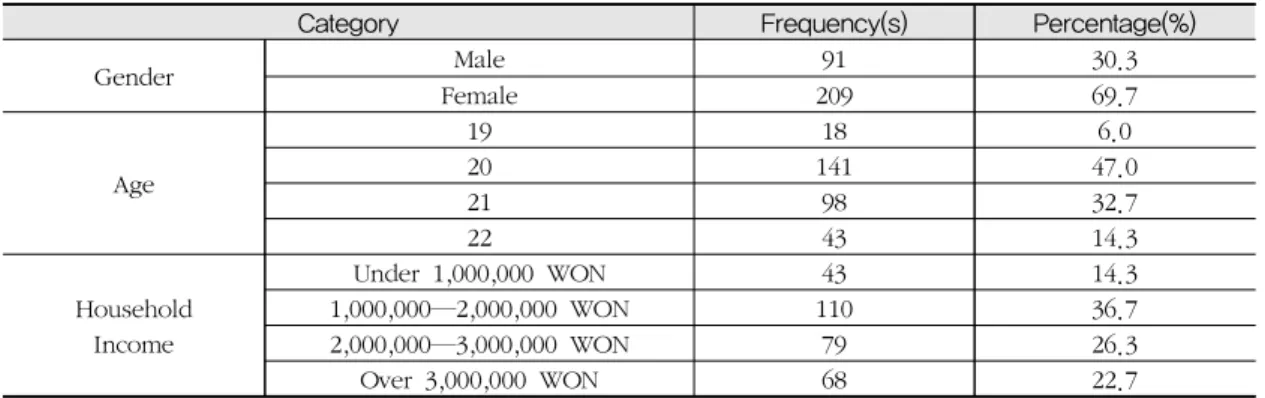
Of the respondents, 69.7% (209) and 30.3%

(91) are female and male, respectively. All the

respondents are Chinese college students who are

(8)

<Table 1> Characteristics of the study population

Category Frequency(s) Percentage(%)

Gender Male 91 30.3

Female 209 69.7

Age

19 18 6.0

20 141 47.0

21 98 32.7

22 43 14.3

Household Income

Under 1,000,000 WON 43 14.3

1,000,000―2,000,000 WON 110 36.7

2,000,000―3,000,000 WON 79 26.3

Over 3,000,000 WON 68 22.7

fashion design majors, and have studied the Hanbok course. Therefore, their age ranges from 19 to 22, which is relatively young. As for monthly income, 14.3% of respondents reported a monthly household income of below 1,000,000 WON, and 36.7% of respondents indicated a family income of between 1,000,000 and

2,000,000 WON; 26.3% were

2,000,000~3,000,000 WON; in addition, 22.7% reported a monthly income of more than 3,000,000 WON. Demographic information of the sample were reported as descriptive analysis in Table 1.

2. Measurement model

Prior to conduct a validity test for the proposed research model, a confirmatory factor analysis (CFA) of internal and external variables was implemented for the structural equating model, using AMOS 22.0.

The model fit index ( X 2 /df = 1.436; GFI = 0.916; NFI = 0.931; IFI = 0.983; CFI = 0.983; RMSEA = 0.038) met the acceptable value for structural model analysis.

Therefore, it can be said that uni-dimensionality can be accepted (Hair et al., 1998). In addition, Cronbach’s alpha values of the constructs range from 0.783 to 0.955, which are all greater than 0.70. The standardized factor loadings were found to

have values greater than 0.7 as well as the average of variance extracted (AVE) for each construct exceeds 0.6 (Bagozzi & Yi, 1988), suggesting adequate convergence (Table 2).

In discriminant validity, according to the suggestion of Fornell and Larcker (1981), the comparison of square roots of AVEs with the correlation between variables were utilized to evaluate the discriminant validity.

The results demonstrated that the square roots of AVE values were more than the correlations between factors, thus confirming a satisfactory discriminate validity (Table 3).

3. Hypotheses testing

Structural equation model (SEM) analysis is conducted to test the study hypotheses.

The results indicate a good model fit. The Chi-square to degrees of freedom ratio is less than the recommended value of 3.0. In addition, other fit indices reflected acceptable values: RMSEA = 0.059, GFI = 0.871, CFI = 0.957, NFI = 0.901, RFI = 0.911 and IFI = 0.957 (Hair et al., 1998).

Table 4 presents the results of the

hypotheses. H1 and H2 predicts

self-concpet (general academic, domain

specific) positively influence self-efficacy

(9)

<Table 2> The results of confirmatory factor analysis

Construct Scales Standard

Estimates t-value Cronbach's α AVE CR

Academic Self-concept

I like most courses. 0.782 ━

0.783 0.649 0.808 I am good at most courses. 0.723 10.922

***

I get good marks in most academic

courses. 0.716 10.850

***

Clothing Self-concept

I like clothing courses. 0.773 ━

0.789 0.661 0.808 I am good at clothing courses. 0.793 11.879

***

I get good marks in clothing courses. 0.676 10.638

***

K-Country Interest

I am concerned about Korean

traditional culture. 0.889 ━

0.930 0.816 0.924 I am interested in Korean pop culture. 0.915 23.289

***

I like to learn lifestyle from Korean

culture. 0.905 22.852

***

K-Country Image

Korea is a secure country. 0.862 ━

0.871 0.695 0.868 Korea is an economically developed

country. 0.788 15.285

***

Korea has high level of technology

research. 0.849 16.462

***

Clothing Self-efficacy

I am certain I can master the skills

being taught in clothing courses. 0.916 ━

0.953 0.837 0.943 I am confident I can do an excellent

job on assignments and test. 0.897 25.250

***

I am certain I can understanding the most difficult clothing material

presented in texts. 0.940 28.821

***

I can do even the hardest work in

clothing class if I try. 0.905 25.864

***

Hanbok Self-efficacy

I am certain I can master the skills

being taught in Hanbok course. 0.886 ━

0.950 0.829 .947 I am confident I can do an excellent

job on assignments and test in Hanbok

course. 0.908 23.827

***

I am certain I can understanding the most difficult Hanbok material

presented in texts. 0.930 25.192

***

I can do even the hardest work in

Hanbok class if I try. 0.915 24.255

***

Evaluation

I do well on the Hanbok theory. 0.900 ━

0.955 0.842 0.962 I do well on the Hanbok practic. 0.923 26.041

***

I got a high evaluation of Hanbok from

professor. 0.911 25.220

***

I got a high score of Hanbok from

professor. 0.936 27.062

***

(general academic, domain specific). There's significant positive effect of both academic

self-concept ( β =0.225, p < 0.001) and

clothing self-concept ( β = 0.225, p <

(10)

<Table 3> Discriminant validity Academic Self-concept

Clothing Self-concept

K-culture Interest

K-country Image

Clothing Self-efficacy

Hanbok

Self-efficacy Evaluation Academic

Self-concept 0.649 a Clothing

Self-concept 0.472 b 0.661 a K-culture

Interest 0.470 b 0.374 b 0.816 a

K-country

Image 0.267 b 0.410 b 0.232 b 0.695 a

Clothing

Self-efficacy 0.317 b 0.326 b 0.146 b 0.201 b 0.837 a Hanbok

Self-efficacy 0.451 b 0.498 b 0.447 b 0.465 b 0.221 b 0.829 a

Evaluation 0.314 b 0.424 b 0.203 b 0.315 b 0.365 b 0.420 b 0.842 a

Academic Self-concept

Clothing Self-concept

K-culture Interest

K-country Image

0.225

***

0.201

***

0.225

***

0.269

***

0.120 0.272

***

0.092 0.326

***

0.336

***

0.288

***

Clothing Self-efficacy

Hanbok Self-efficacy

Evaluation

X

2/

df

=2.052; RMSEA=0.059; GFI=0.871; CFI=0.957; NFI=0.901; RFI=0.911; IFI=0.957; TLI=0.951;

p

***<0.001

<Fig. 2> Results of path analysis 0.001) on the clothing self-efficacy, also

academic self-concept ( β = 0.201, p <

0.001) and clothing self-concept ( β = 0.269, p < 0.001) have positively significant effect on Hanbok self-efficacy. It means that Chinese university students’ perceive higher academic and clothing self-concept, they will have more clothing and Hanbok self-efficacy. In addition, the results shows the effect of clothing self-concept is bigger than academic self-concept on the Hanbok self-efficacy (0.269 > 0.201). The reason for this result is that Hanbok has a kind of

professional pertinence. Compared with general academic self-concept, clothing self-concept has a strong influence on the self-efficacy affirmation of clothing, so as to promote the skill training of Hanbok course. Thus, H1a, H1b, H2a and H2b are all supported.

Another important results are that there’re significant positive effect of both perceived K-culture interest ( β = 0.272, p < 0.001) and K-country image ( β = 0.326, p <

0.001) on Hanbok self-efficacy, but they

have no significant effect on clothing

(11)

<Table 4> Hypothesis testing results

Hypotheses Path Standardized

Coefficient SE t-value Contrast H1a Academic self-concept → Clothing self-efficacy 0.225

***

0.087 3.454 Accepted H1b Academic self-concept → Hanbok self-efficacy 0.201

***

0.067 3.360 Accepted H2a Clothing self-concept → Clothing self-efficacy 0.225

***

0.085 3.482 Accepted H2b Clothing self-concept→ Hanbok self-efficacy 0.269

***

0.067 4.440 Accepted H3a K-culture Interest → Clothing self-efficacy 0.120 0.062 1.340 Rejected H3b K-culture Interest → Hanbok self-efficacy 0.272

***

0.049 4.944 Accepted H4a K-country Image → Clothing self-efficacy 0.092 0.066 1.513 Rejected H4b K-country Image → Hanbok self-efficacy 0.326

***

0.053 5.654 Accepted

H5 Clothing self-efficacy → evaluation 0.288

***

0.047 5.178 Accepted

H6 Hanbok self-efficacy → evaluation 0.336

***

0.057 5.917 Accepted

Notes: p

***<0.001

self-efficacy. More clearly, the effect both of K-culture interest and K-country image perception are more determinative for the Hanbok self-efficacy, not for general clothing self-efficacy of Chinese university students. Also, the results shows the effect of K-country image perception is bigger than K-culture interest on the Hanbok self-efficacy (0.326 > 0.272). For young person especially college students, it may be easier to understand the image of a foreign country than to be familiar with a foreign culture. Many respondents just stay in the vague image of foreign countries, a few people will be particularly interested in culture. This is also the reason for this result. Thus, H3b and H4b are supported while H3a and H4a are rejected.

As for the last hypothesis 4 and 5, the path from clothing self-efficacy ( β = 0.288, p < 0.001) and Hanbok self-efficacy ( β = 0.336, p < 0.001) perception to evaluation of respondents’ Hanbok course relative, are significantly positive. In other words, when students perceived the more self-efficacy, the higher evaluation they will get. Also as expected, Hanbok self-efficacy has more positive effect on evaluation than clothing self-efficacy (0.336 > 0.288). The reason is that the evaluation here refers to

the efficiency evaluation of Hanbok course, of course, there will be such a comparison.

Therefore, H4 and H5 are both supported.

Ⅴ. Conclusion

In the present study, the relationship among self-concept (general academic, domain specific), self-efficacy (general academic, domain specific), Korean culture interest, Korean country image, and evaluation with Hanbok course are examined. This study is important especially for fashion design major of Chinese universities, which want to develop the international routes. Therefore, the importance of these variables above relationship for the Chinese university students with Hanbok course perception should not be ignored. Consistent with our hypotheses, we have the following findings.

First, this study uncovers the positive influence of self-concept on self-efficacy.

Academic self-concept and clothing self-concept can increase both clothing and Hanbok self-efficacy, which is consistent with the extant research findings (Fryer et al., 2020; Morony et al., 2013; Sagone &

Caroli, 2014). In addition, Chinese

(12)

university students perceive more about clothing self-concpet, which is playing a greater role in self-efficacy than Academic self-concept. The potential implication is that fashion design major students need to pay more attention to increase their self-concept with clothing, especially during study course work. Our findings remind Chinese universities and faculties to stimulate students to study and work hard with clothing knowledge.

Second, K-culture interest and K-country image perception that can increase Hanbok self-efficacy, which is consistent with the study (Cubillo et al., 2006; Whang et al., 2015). The results suggest that fashion Hanbok course faculties should consider focusing more of their energy on providing Relevant contents of South Korea. Also, Our study highlights the importance of K-culture interest and K-country image. Specifically, mastering foreign culture and knowledge enables students to love their costumes and broaden their horizons of internationalization.

Third, clothing and Hanbok self-efficacy have a positive significant effect on evaluation of respondents, which is consistent with the research (Dou et al., 2016; Hashemi et al., 2017; Jiang, 2015).

High self-efficacy perceptions strengthen the fashion design students evaluation of outcome, in particular, the impact of Hanbok self-efficacy is crucial. In order to improve Hanbok course performance, teachers need to improve students’ self-efficacy with Hanbok. Use some encouraging words, as like “You can master the skills... I trust you...I have confidence in you.” to motivate students. Of course, there is also an interest in promoting Korean country and Korean clothing.

Nevertheless, this study is not without

limitations and future research is needed to validate the results. (1) For Chinese university students learn Korean traditional costume as the study focus, this study findings may not be generalizable to other countries. (2) A self-administered questionnaire using an online platform was employed to collect the data for the study.

Surveys completed by supervising students fact to face may reveal further consistent and valid findings. Future studies exhibiting a more diversified sample profile may also yield different results.

References

Anderson, J. C., & Gerbing, D. W. (1988).

Structural equation modeling in practice: A review and recommended two-step approach.

Psychol Bulletin, 103 (3), 411–423.

Auken, H. V., Gasta, C. M., Lee, L., &

Domínguez, J. (2007). A culture-based entrepreneurship program: Impact on student interest in business ownership. International Entrepreneurship & Management Journal, 9 (2), 261-272.

Bagozzi, R. P., & Yi, Y. (1988). On the evaluation of structural equation models. Journal of the Academy of Marketing Science, 16 (1), 74-94.

Chaulagain, S., Wiitala, J., & Fu, X. (2019). The impact of country image and destination image on us tourists' travel intention. Journal of Destination Marketing and Management, 12, 1-11.

Crawford, E. O., Higgins, H. J., & Hilburn, J.

(2020). Using a global competence model in an instructional design course before social studies methods: A developmental approach to global teacher education. The Journal of Social Studies Research, 1-15.

Cubillo, J. M., Sanchez, J., & Cervino, J. (2006).

International students' decision-making

(13)

process. International Journal of Educational Management, 20(2), 101-115.

Das, M., & Jebarajakirthy, D. C. (2020). Impact of acculturation to western culture (AWC) on western fashion luxury consumption among Gen-Y consumers in the Asia-Pacific region.

Journal of Retailing and Consumer Services, 56, 1-17.

Dedeoğlu, B. B. (2019). Shaping tourists' destination quality perception and loyalty through destination country image: The importance of involvement and perceived value. Tourism Management Perspectives, 29, 105-117.

Dou, K., Wang, Y. J., Li, J. B., & Liu, Y. Z.

(2016). Core self-evaluation, regulatory emotional self-efficacy, and depressive symptoms: Testing two mediation models.

Social Behavior & Personality An International Journal, 44 (1), 391-400.

Ford, D. P., Connelly, C. E., & Meister, D. B.

(2003). Information systems research and Hofstede's culture's consequences: An uneasy and incomplete partnership. IEEE Transactions on Engineering Management Em, 50 (1), 8-25.

Fornell, C., & Larcker, D. F. (1981).

Evaluating structural equation models with unobservable variables and measurement error: Algebra and statistics. Journal of Marketing Research, 18 (4), 427-427.

Fryer, L. K., Thompson, A., Nakao, K., Howarth, M., & Gallacher, A. (2020).

Supporting self-efficacy beliefs and interest as educational inputs and outcomes: Framing ai and human partnered task experiences. Learning and Individual Differences, 80, 1-11.

Gardner, D. G., & Pierce, J. L. (2010). The core self-evaluation scale: Further construct validation evidence. Educational

& Psychological Measurement, 70 (2), 291-304.

Ghazarian, P. G. (2016). Country image and the study abroad destination choice of students from mainland China. Journal of International Students, 6 (3), 700-711.

Hair, J. F., Tatham, R. L., Anderson, R. E., &

Black, W. (1998). Multivariate data analysis (5th ed.). Englewood Cliffs, NJ:

Prentice Hall.

Hashemi, F. S., Soltani, R., Hassanzadeh, A.,

& Eslami, A. A. (2017). Relationship between breakfast consumption and self-efficacy, outcome expectations, evaluation and knowledge in elementary students. Int. J. Pediatr, 5 (1), 4163-4174.

Lee, K. Y., & Lee, H. (2019). Traditional constume experience at a cultural heritage

festival. Tourism Management

Perspectives, 32, 1-13.

Lu, F. Y., Wen, S., Deng, G., & Tang, Y. L.

(2017). Self-concept mediate the relationship between childhood maltreatment and abstinence motivation as well as self-efficacy among drug addicts. Addictive Behaviors, 68, 52-58.

Morony, S., Kleitman, S., Lee, Y. P., &

Stankov, L. (2013). Predicting achievement: Confidence vs self-efficacy, anxiety, and self-concept in Confucian and European countries. International Journal of Educational Research, 58, 79-96.

Palmer, P. B., Newman, H. J., & Rohe, D. A.

(1985). Effect of videotape replay on the quality and accuracy of student self-evaluation. Physical Therapy, 65 (4), 497-501.

Peterson, E. R., & Whiteman, M. C. (2007). “I

think I can, I think I can...”: The

interrelationships among self-assessed

intelligence, self-concept, self-efficacy and the

personality trait intellect in university students

in Scotland and New Zealand. Personality and

(14)

Individual Differences, 43 (4), 959-968.

Reishehrei, A. P., Reishehrei, A. P., & Soleimani, E. (2014). A comparison study of self concept and self efficacy in martial arts and non martial arts athletics in Iran. Procedia Social and Behavioral Sciences, 116, 5025-5029.

Sagone, E., & Caroli, M. E. D. (2014). Locus of control and academic self-efficacy in university students: The effects of self-concepts. Procedia Social and Behavioral Sciences, 114, 222-228.

Saliu, H. (2013). The image of a country, communication actors in educational exchanges. SSRN Electronic Journal, 1, 89-98.

Scherer, R. (2013). Further evidence on the structural relationship between academic self-concept and self-efficacy: On the effects of domain specificity. Learning & Individual Differences, 28, 9-19.

Shavitt, S., & Barnes, A. J. (2020). Culture and the consumer journey. Journal of Retailing, 96 (1), 40-54.

Srihadi, T. F., Hartoyo, Sukandar, D., & Soehadi, A. W. (2016). Segmentation of the tourism market for Jakarta: Classification of foreign visitors' lifestyle typologies. Tourism Management Perspectives, 19, 32-39.

Stankov, L., Lee, J., Luo, W., & Hogan, D. J.

(2012). Confidence: A better predictor of academic achievement than self-efficacy, self-concept and anxiety?. Learning and Individual Differences, 22 (6), 747-758.

Surjanti, J., Soejoto, A., Seno, D. N., & Subroto, W. T. (2020). Mangrove forest ecotourism:

participatory ecological learning and sustainability of students’ behavior through self-efficacy and self-concept. Social Sciences

& Humanities Open, 2, 1-6.

Whang, H., Yong, S., & Ko, E. (2015). Pop culture, destination images, and visit intentions: theory and research on travel motivations of Chinese and Russian tourists. Journal of Business Research, 69, 631-641.

Xiaojun, Z., & Changxiu, S. (2018). The relationship between regulatory emotional self-efficacy and core self-evaluation of college students: The mediation effects of suicidal attitude. Frontiers in Psychology, 9, 598-564.

Yang, L., & Chen, R. (2012). The effects of positive self-evaluation on senior high school students' English writing performance and writing self-efficacy.

Chinese Journal of Applied Linguistics, 35 (3), 271-286.

Zhang, L., & Effendi, T. D. (2017). The image of

nation: Case study on Chinese student learning

Bahasa Indonesia. The 1 st UMM International

Conference on Pure and Applied Research,

388-394.

수치

Table  4  presents  the  results  of  the  hypotheses.  H1  and  H2  predicts  self-concpet  (general  academic,  domain  specific)  positively  influence  self-efficacy

참조

관련 문서

This study examines the relationship between self-efficacy and creativity of general characteristics of school dance classes of middle school students, and

The purpose of this study is to investigate the effects on elementary school students' academic English improvement, interest, and self-confidence through the

Objective: The purpose of this study was to investigate the effect of clinical practice satisfaction on professional self-concept among dental hygiene students.. Methods:

The purpose of this study is to analyze the interest and self-confidence of middle school students in learning English grammar and to examine the

Among the five sub-content categories, only in the communication domain 'listening and speaking', the social relations domain 'living together' and the

The study conducted a study of literature and research, and in literature, the study of cosmetic behavior, nail behavior, self esteem, and

A Contrastive Study on the Proverbs of Family Relationship of Korean and Chinese..

The purposes of this study were to investigate relations among the hope, connectedness, academic resilience, and academic resilience of adolescents, to develop