MULTIPLE LOD REPRESENTATION OF POLYHEDRAL BUILDING MODELS FOR LARGE-SCALE DIGITAL CITY VISUALIZATION
Wan-Jung Lin, Fuan Tsai, Liang-Chien Chen
300 Zhong-Da Road, Zhong-Li, Taoyuan 320 Taiwan, [email protected]
ABSTRACT Three dimensional (3D) building model is one of the most important components in cyber city and geographic information systems (GIS) implementation. Level of Detail (LOD) technique can generate different details of data sets according to viewing parameters to reduce unnecessary computations and to enhance system performance.
This paper demonstrates a semi-automatic approach to generalize 3D polyhedral building models and to formulate LOD representations of complicated city models for interactive visualization and real-time rendering. In this paper, we proposed a semi-automatic generalization of single 3D polyhedral building model to apply generalization in 2D orthographic views of 3D building models. Experimental result demonstrates that the proposed method can simplify 3D building geometries and decrease the number of points and polygons of building models effectively in different levels.
KEY WORDS: Level of detail, 3D building generalization, Visualization, Cyber city
1. INTRODUCTION 1.1 Introduction
3D cyber city is a visualization system to construct and represent of urban scenes. In application systems, the vast amount of building data may lead to lower efficiency. To accomplish interactive visualization and real-time rendering, Level of Detail (LOD) is a commonly adopted technique to generate different details of data sets.
System can select appropriate data level to display according to real-time viewing parameters.
Some researches have tried to generate the LOD generation of 3D building models. Mayer (1998) based on mathematical morphological operations and curvature space of scale-spaces theory to generalize 3D building models. Forberg (2007) suggested moving parallel facets toward each other to eliminate protrusion and close the gap. Kada (2007) segmented building models into several structural elements by half space modeling to generalize 3D building model. Anders (2005) used generalization techniques on 2D projections of 3D geometry to deal with linear and neighboring building groups. However, the existing methods are either computationally expensive or can only deal with certain types of buildings.
This paper proposes a semi-automatic approach for the generalization of 3D polyhedral building models.
Applying generalization in 2D orthographic views of individual buildings reconstructs simplified 3D models accordingly.
2. METHODOLOGY
The proposed method is a semi-automatic generalization of single 3D polyhedral building model to formulate LOD representations. The accuracy of building models is equal to LOD2 in OpenGIS® CityGML (City Geography Markup Language) encoding standard proposed by OGC
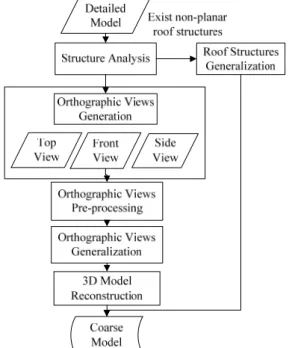
(Open Geospatial Consortium). The procedure of the proposed approach is illustrated in Fig. 1. First, structure analysis is to compute shape complexity for determining generalized levels and identify roof type. Next, orthographic views along three different directions of the 3D building geometries are generated and the topologies are constructed in the pre-processing. Based on the lengths and angles of the topology, convex and concave structures and short edges in orthographic views are generalized. Finally, simplified 3D building models are reconstructed from generalized 2D orthographic views with Boolean-based combination algorithms. For non- planar roof structures and special structures of building models, additional processes are developed to simplify them but maintain their characteristics.
Figure 1. The procedure of the proposed method
2.1 Structure analysis
Building models have a lot of different types. Some are simple, and some are complicated. Structure analysis in this paper is to determine the generalized lever of building models and to identify the roof types of building models. Shape complexity calculation and roof structures identification are applied in this part.
Shape complexity calculation is to calculate a value as the ratio of the points of roof polygons and the 3D convex hull of roof polygons and to determine the generalized levels of building models. The shape complexity (sc) is defined as E.g. 1, where Nr is the number of vertices of the roof polygon and N3DCON is the 3D convex hull of all roof structures.
( )
r DCON r
N N
sc= N − 3 (1)
Roof structures can separate into two types, planar and non-planar roof structures. Roof structures identification is applied to remain the characteristic of non-planar roof structures in generalization of building models. Non- planar roof structures detection is indentified by different elevations of topmost polygons. The non-planar roof structures in the paper separate into gabled roof and barrel roof.
2.2 Orthographic views generation
Three orthographic views are generated with orthogonal projections before generalized process. Orthographic views consist of horizontal views and vertical views.
Because there are discrete points on orthographic views, the outline of orthographic views will be constructed by pre-processing process.
Horizontal views are projected from roof planes and also seem as top views of building models. Loop tracing is used to construct the topology of the outline of top view.
Loop tracing is based on the topology of projected planes to analyze the relationship of projected lines.
Vertical views are projected from façade planes of building models and also seem as front view and side view. The outlines of side view and front view are generated by analyzing the raster data which is transformed from vector data. Target Defined Ground Operator (TDGO) (Chen & Lee, 1992) is modified to find the corner pixels and to record the topology of the outline of horizontal views.
2.3 Orthographic views generalization
The building generalization in this paper is applied in 2D orthographic views of 3D building models. According to three orthographic views, the topology of orthographic view is used to detect and eliminate insignificant
structures. This step contains two processes, convex and concave structures generalization and edge regularization.
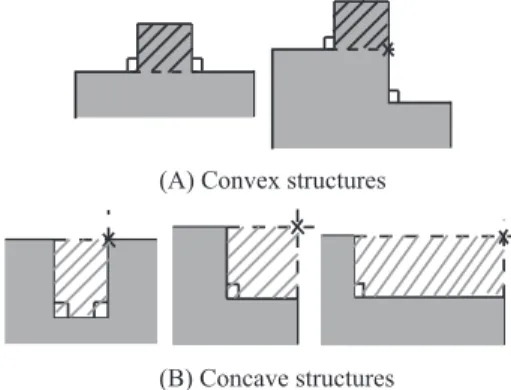
Convex and concave structures generalization is to detect convex and concave structures and eliminate small structures. Convex structures are shown in Fig. 2.
Concave structures can separate into U-, Z-, and L- structures which are demonstrated in. The lengths of edges and the angle between the adjoining edges are calculated based on the topological relationship of orthographic views. The areas of convex and concave structures are calculated and compared with pre-defined threshold to identify the insignificant ones. Convex structures with area which is smaller than the area threshold will be eliminated as. For concave structure, the junction point will be generated and the two edges will be eliminated.
Figure 2. Convex and concave structures
Edge regularization is to eliminate short-length edges.
Edges with lengths smaller than pre-defined thresholds are also as insignificant. The line threshold is also defined individually. Insignificant structures are eliminated and the junction points are generated according to the topology. However, the edge in convex or concave structures cannot be eliminated in edge regularization.
2.4 3D model reconstructions
After orthographic views are generalized, generalized building models can be reconstructed by the relationship between three orthographic views. The reconstructed algorithm is based on Boolean operations. The strategy of reconstruction algorithm is to segment top view into generalized roof planes according to the topology of front view and side view. And the roof plane heights can be calculated by projecting roof points to front view and side view.
2.5 Roof structures generalization
Roof structures generalization in this paper can manage gabled roof and barrel roof. After major structures of building model are generalized, the size of gabled roof is adjusted to the major part. On the other hand, if gabled
roof incomplete, the roof structure may be projected to 2D horizontal plane to be generalized and reconstructed by back-projection. After major structures of building model are generalized, the barrel roof structures also need to be adjusted to the generalized part. The characteristic of curve is maintained by curve fitting technique.
2.6 Semi-automatic process for special cases
In this paper, buildings with courtyards and buildings with non-planar façades were discussed as special cases.
The outlines of the inner structures on the orthographic views of building models with courtyards are constructed interactively. When orthographic views are generalized, the orthographic views of the inner structures are also generalized to remain the courtyard structure. Another special case is building models with curved façades. The curved models which constructed as polyhedron usually display as a lot of connected polygons. When the curved facades need to be adjusted to the generalized structure, the curve fitting technique can decrease the number of connected polygons and curved characteristic.
3. EXPERIMENTAL RESULTS
In the paper, the LOD generation of 3D building models is named BLOD (Building LOD) and categorized from BLOD0 to BLOD3. BLOD3 is the most detailed level, and BLOD0 is the coarsest level.
3.1 Experimental result for single building model
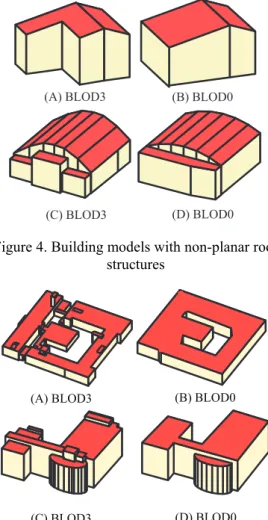
For building model with planar roof structures, as shown in Fig. 3, experimental results demonstrate that the proposed method can simplify 3D building models which contain U-, Z-, and L-structures and short edges by 2D orthographic views. For building model with non-planar roof structures, the characteristics of non-roof structures can also maintain completely. Fig. 4(A) and Fig. 4(B) are experimental results of gabled roof; Fig. 4(C) and Fig. 4 (D) is an example of barrel roof. For special cases, the experimental results of building models with courtyard are displayed in Fig. 5(A) and Fig. 5(B), and show that the semi-automatic process can preserve the characteristic of courtyard. Fig. 5(C) and Fig. 5(D) demonstrate that experimental results of building models with non-planar façades. Simplified models validate that the proposed method can also preserve the curved characteristic perfectly.
Figure 3. Building models with planar roof structures
Figure 4. Building models with non-planar roof structures
Figure 5. Building models with special cases 3.2 Experimental result for large area
The experimental area is located in a business district of Taipei. There are 1126 building models in the experimental area. After structure analysis, 374 building models are identified as simple structures, and they don’t need to conduct generalized process.
The LOD generation of building models in the experimental area are demonstrated from Fig. 6 to Fig. 9.
From these figures, it shows that 3D building geometries are simplified effectively in different levels. The number of points and polygons from BLD3 to BLOD0 are listed in Tab. 1. The proposed method is effective in decreasing the number of pints and polygons of building group from BLOD3 to BLOD0. This experimental result further demonstrates that the proposed method can reduce at least a half amount of data to enhance system performance.
Figure 6. BLOD3 of the experimental area
Figure 7. BLOD2 of the experimental area
Figure 8. BLOD1 of the experimental area
Figure 9. BLOD0 of the experimental area
Table 1. Quantitative analysis of experimental area
BLOD0 BLOD1 BLOD2 BLOD3
Number
of points 76910 77610 100135 264260 Number
of points 16679 16819 21799 57541
4. CONCLUSIONS
This paper proposes a semi-automatic approach for the generalization of 3D polyhedral building models. The idea is to apply generalization in 2D orthographic views of 3D building models. For special structures of building models, additional processes are developed to simplify them but maintain their characteristics. Finally, these special structures are combined with reconstructed façades to complete the generalization of 3D building models. A large building group of complex building models are used to test the developed building generalization algorithms. Experimental results of single building models demonstrate that the proposed method can effectively simplify 3D building geometries with generalized 2D orthographic views of building models.
For building groups in large areas, the proposed method is effective in decreasing the number of points and polygons of building groups in different levels. In addition, the experimental results of building models with special structures are also validated, proving that the proposed approach can preserve important visual characteristics of complicated building models.
REFERENCE
Anders, K.H., 2005. Level of detail generation of 3D building groups by aggregation and typification. In:
Proceedings of 22th International Cartographic Conference, La Coruña, Spain.9-16 August.
Chen, L.C., and L.H. Lee, 1992. Progressive Generation of Control Frameworks for Image Registration, Photogrammetric Engineering and Remote Sensing, Vol.
58, No. 9, pp. 1321-1328.
Forberg, A., 2007. Generalization of 3D building data based on a scale-space approach. ISPRS Journal of Photogrammetry & Remote Sensing, Vol.62, pp. 104-111.
Kada, M., 2007. Generalization of 3D building models by cell decomposition and primitive instancing. Joint ISPRS Workshop on Visualization and Exploration of Geospatial Data, Stuttgart, Germany, 27-29 June.
Mayer, H., 1998. Three dimensional generalization of buildings based on scale-spaces. Technical Report, Chair for Photogrammetry and Remote Sensing, Technische Universität München, Germany.