서 론
전세계적인 인구증가는 도시하수 및 축산폐수 증가로 인한 심각한 수질오염을 야기하였을 뿐만 아니라 화석에
너지 고갈을 초래하여 재생에너지 생산이 이슈화되고 있 다(Khan and Yoshida, 2008; Rodolfi et al., 2009). 국내 폐수처리 시설의 경우 방류수 수질 기준 강화에 따른 폐 수고도처리의 필요성이 대두되고 있지만, 기존의 활성슬 러지 공법을 이용한 폐수 처리 시 낮은 효율성과 발생된 슬러지 처리 운전 비용의 경제적 문제점으로 인해 적절 한 대안기술이 필요한 실정이다(Oswald, 2003; Park et al., 2010). 최근 재생에너지 분야 중 바이오매스의 환경/
에너지 원천기술 개발이 주목받고 있으며, 미세조류는 질소, 인(Lee and Lee, 2001; Voltolina et al., 2005) 및 중금속(Lamelas and Slaveykova, 2007) 등을 효율적으
Ourococcus multisporus YSW008을 이용한 폐수고도처리 및 바이오에너지 생산 가능성 평가
이민선1)· 홍근희2)· 황상원2)· 김선엽2)· 배상원2)· 전병훈1)*
Evaluation of Ourococcus multisporus YSW008 for Advanced Wastewater Treatment with Simultaneous Biofuel Feedstock Production
Minsun Lee, Kun Hee Hong, Sangwon Hwang, Sunyup Kim, Sangwon Bae and Byong-Hun Jeon*
Abstract : This study demonstrates the potential of Ourococcus multisporus YSW008 for removal of nitrogen and phosphorus from different types of wastewaters(municipal wastewater - influent, secondary and tertiary effluents, and piggery wastewater effluent) with simultaneous production of algal biofuel feedstock. Municipal wastewater supported a higher growth(0.2 to 0.22 g/L) compared to the piggery wastewater after 10 days of cultivation.
Removal efficiency of nitrogen and phosphorus in municipal wastewater was 94 and 95%, respectively. The microalgal carbohydrate and fatty acid contents cultivated in municipal wastewater were 31 and 9% higher compared to the piggery wastewater. The content of oleic acid was 2.5 times higher in the municipal wastewater than in the piggery wastewater. The results showed that O. multisporus has a higher potential of nitrogen and phosphorus removal from municipal wastewater compared to piggery wastewater, with simultaneous production of algal biomass for biofuel feedstock.
Key words : Ourococcus multisporus YSW008, Biomass, Removal of Nitrogen and Phosphorus, Biofuel 요 약 : Ourococcus multisporus YSW008(O. multisporus)을 이용한 폐수 내 질소와 인 제거 효율과 생산된 바이오매스의 에너지 전환가능성을 검토하였다. 하수에서 10일 동안 배양 시 바이오매스 생산량은 0.2-0.22 g/L 로 양돈폐수에 비해 생산량이 높았으며, 질소, 인 제거효율은 각각 94와 95% 이상으로 나타났다. 바이오매스 내 탄수화물 및 지방산 함량은 하수에서 배양 시 양돈폐수 배출수 적용 시 보다 각각 최대 31 및 9% 증가되었다.
또한, 지방산 성분 중 고품질 바이오디젤 생산에 적합한 올레산(C18:1n9c) 함량이 하수에서 배양 시 양돈폐수 배출수 보다 약 2.5배 이상 증가되었다. O. multisporus 종은 하수에서 배양 시 고도폐수처리 및 고품질 바이오연 료 전환에 적합하다고 판단된다.
주요어 : Ourococcus multisporus YSW008, 바이오매스, 질소와 인 제거, 바이오연료
2013 년 7월 18일 접수, 2013년 9월 10일 심사완료 2013년 10월 17일 게재확정
1) 연세대학교 환경공학부
2) 원주삼육고등학교
*Corresponding Author( 전병훈) E-mail; [email protected]
Address; Department of Environmental Engineering, Yonsei University, Wonju 220 ‐710, South Korea
ISSN 2288-2790(online) http://dx.doi.org/10.32390/ksmer.2013.50.5.651
연구논문
로 제거하고, 바이오매스 1 ton 당 2.83 ton의 이산화탄 소를 저감시켜 지구온난화 방지 뿐만 아니라 폐수처리장 에서 발생하는 슬러지, 이산화탄소 및 폐수고도처리 문 제를 동시에 해결할 수 있는 장점을 가지고 있다(Khan and Yoshida, 2008; Williams and Laurens, 2010). 미세 조류는 성장시 폐수를 사용하여 환경문제를 해결하는 동 시에 수확된 바이오매스로 바이오연료인 에탄올과 디젤 생산이 가능하다(Choi et al., 2011).
바이오 에탄올을 생산하기 위한 대표적인 바이오매스 는 당질계, 전분계, 목질계로 분류된다(Singh and Singh, 2010; Somerville, 2006). 당질계(사탕수수와 당밀)와 전 분계(옥수수, 고구마)는 인류의 식량문제와 연관되어 에 너지 전환 바이오매스로의 활용이 제한되고 있고(Rosegrant et al., 2006), 목질계인 폐 목재와 농업 부산물의 경우 자원이 한정되어 바이오 에너지 생산에 한계점이 나타나 고 있다(Sun and Cheng, 2002). 이러한 한계성을 극복 하기 위한 대안 중 하나로 미세조류의 적용은 빠른 성장 속도, 비식용 자원이라는 점에서 주목받고 있으며 최근 국내에서도 활발한 연구가 이루지고 있다(Chung et al., 2008; Choi et al., 2011). 미세조류 바이오매스는 탄수 화물, 지질, 단백질로 구성되어 있으며(Wilhelm and Jakob, 2011), 이 중 탄수화물 성분은 전 세계적으로 급증하고 있는 바이오에탄올 생산의 주원료로서 사용될 수 있다 (Chisti, 2007). 또한 조류 바이오매스 내 지질 성분은 바 이오디젤로 전환될 수 있으며 CO 및 SOx 배출 저감과 동시에(Luque et al., 2010) 일반 디젤과 유사한 특징을 가지고 있어 기존 디젤 엔진과 혼합되어 직접적으로 사 용되고 있다(Behzadi and Farid, 2007). 특히 미세조류 바이오디젤 성분 중 올레산(C18:1n9c)는 이중결합수가 1 개인 불포화지방산으로 융점이 낮고, 높은 산화안정성과 연소열이 뛰어난 장점을 가지고 있다(Rashid et al., 2008).
현재까지 미세조류를 이용한 폐수처리 및 바이오에너 지 생산과 관련된 대부분의 연구들은 한 종류의 폐수에 서 탄소원과 광원 등의 조건에 따른 조류성장 및 바이오 디젤 생산평가에 중점이 맞추어져 왔으나, 다양한 폐수 를 적용한 폐수고도처리 및 바이오연료 생산가능성 평가 는 미비하였다(Jiang et al., 2011; Wang et al., 2012).
본 연구에서는 O. multisporus를 W시 하수종말 처리장 내 유입수(유입수), 생물학적 처리 후 배출수(2차 배출 수), UV 처리 후 배출수(3차 배출수) 및 양돈폐수 방류 수에서 배양하여 각 폐수 별 일정기간 내 조류성장과 질 소, 인 제거 효율을 측정함으로써 폐수의 성상에 따른 미 세조류의 적응과 폐수고도처리 능력을 확인하고, 성장한 미세조류 바이오매스 내 탄수화물과 지방산 함량분석을 통해 바이오연료(바이오에탄올 및 바이오디젤)의 전환
가능성을 평가・비교하고자 한다.
실험방법
미세조류 분리 및 식별
본 연구에 사용된 미세조류 O. multisporus는 C시 양 돈폐수 처리장으로부터 채취하여 분리 배양되었다. 양돈 폐수 성상은 pH 8.2, 화학적 산소요구량(COD) 845 mg/L, 총 질소(TN) 1180 mg/L, 총 인(TP) 4 mg/L, 염소이온(Cl
‒) 593 mg/L, 황산염이온(SO
42‒) 86 mg/L 및 질산염이온(NO
3‒) 174 mg/L 로 나타났다.
폐수 내 조류 샘플 10 mL를 BBM(Bold Basal Medium) 200 mL 로 채워진 500 mL 삼각 플라스크에 주입하여, 온 도 27℃, 광도 40 µmol/m
2/s, 교반속도 150 rpm의 인큐베 이터 쉐이커(SH‐804L, Seyoung Scientific Co.)에서 3주 동안 배양하였다(Bischoff and Bold, 1963). 이 후 샘플 50 µL 취하여 petri dish에 주입 및 배양하여 생성된 colony 를 백금이로 채취한 뒤, 200 µL의 BBM으로 채 워진 96 microtiter plate에 옮겨 2차 배양을 진행하였 으며, 배양된 colony를 다시 petri dish에 반복 배양하는
(a)
(b)
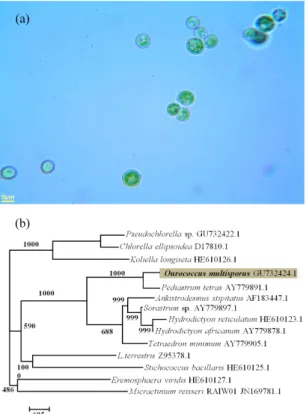
Fig. 1. (a) Light microscopic (x1000) image, and
(b) Phylogenetic tree of O. multisporus YSW008.
과정으로 순종 균주를 분리하였다. 현미경을 통해 균주 를 관찰한 결과, O. multisporus는 얇은 세포벽을 가진 구형으로 5 µm 정도 크기의 미세조류임을 확인하였다 (Fig. 1).
폐수 샘플링 및 미세조류 접종
본 연구에 사용된 폐수는 하수 및 양돈폐수의 두가지 형태로 하수는 W시 하수종말 처리장 내 유입수(1차), 생 물학적 처리 후 배출수(2차) 및 UV 소독 후 배출수(3차) 를 이용하였고, 양돈폐수 방류수는 W시에 위치한 양돈 폐수 처리장에서 공급받았다. 각 지점에서 채취된 폐수 는 고온증기멸균 후 0.45 µm GF/C(Glass fiber filter, Type C) 필터로 여과시켜 250 mL 플라스크에 각각 150 mL 씩 주입되었다. 이 후 BBM에서 배양된 조류 1.5 mL(OD
680=1.5) 를 플라스크에 각각 접종하여 인큐베이 터 쉐이커에서 10일간 배양하였다. 전처리 후 각 폐수의 물리화학적 성상들은 Table 1에 나타내었다.
수질분석방법 및 미세조류 성장 측정
시료는 0, 1, 3, 5, 7, 10일 간격으로 샘플링하여 0.2 µm 필터로 여과한 후 TN, TP 및 COD
Cr을 측정하였다. TN 및 TP는 각각 Chromotropic Acid Method와 Ascorbic Acid Method 로 측정하였고(APHA, 1998), 폐수 내 미
량원소는 ICP(ICP‐MS, PerkinElmer SCIEX, USA)로 분 석하였다. 미세조류의 성장은 SS(Suspended Solid) 방법 을 이용하여 측정하였다(APHA, 1998). 미세조류의 비증 식속도(Specific growth rate, μ)는 식 (1)을 이용하여 계 산하였다(Jiang et al., 2011).
ln ln
(1)
여기서, N
1및 N
2는 각 시간 t
1및 t
2에 해당하는 건중중 량 값으로 정의된다.
탄수화물 및 지방산 함량 분석
미세조류 바이오매스 내 탄수화물 함량 분석은 페놀-황 산법(Dubios method)을 이용하였다(Dubios et al., 1956).
분석은 각 조건 별 시료 2 mL를 5% 페놀 용액 1 mL와 99% 황산 용액 5 mL에 혼합하여 반응시킨 후 30분 방 냉하여 490 nm에서 흡광도를 측정하였다. 지방산 함량은 직접 전이에스테르화(Direct transesterification) 방법을 사 용하여 분석하였고(Na et al., 2011), Lepage와 Roy(1984) 의 방법으로 추출하여 HP-INNOWax capillary column (Agilent Technologies, USA) 이 장착된 가스 크로마토 그래피(Shimadzu GC-8A FID, Japan)로 측정하였다.
Table 1. Physico-chemical characteristics of municipal wastewater (influent, and secondary and tertiary effluents) and piggery wastewater effluent
Parameter Influent Secondary effluent Tertiary effluent Piggery effluent
pH 8.9 9.3 9.4 9.2
T-N (mg/L) 15.42 16.73 16.38 73.56
T-P (mg/L) 1.79 1.44 1.11 4.93
COD
cr(mg/L) 149.52 121.00 89.59 856.00
Metallic ions (mg/L)
Ca
2+22.18 23.85 25.64 24.05
K
+15.87 27.38 24.08 1009.80
Na
+47.24 45.90 46.58 450.10
Mg
2+4.41 5.67 5.76 31.19
Al
3+0.36 0.45 0.46 0.02
Zn
2+0.03 0.01 0.02 0.07
Mn
2+0.02 0.01 0.02 0.03
Cu
2+0.01 N.D.
aN.D.a 0.03
Fe
2+and Fe
3+N.D.
aN.D.
aN.D.
aN.D.
aN.D.
a= Not detected
결과 및 고찰
미세조류의 성장
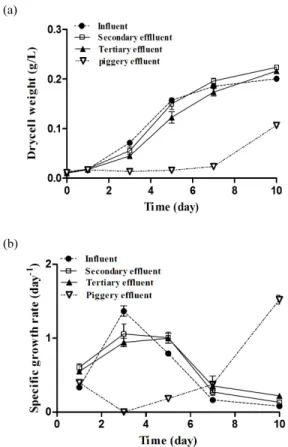
폐수의 종류 및 처리단계 별 시간에 따른 O. multisporus 의 성장율을 Fig. 2에 나타내었다. 사용된 폐수는 질소, 인 이외에도 조류 내 광합성 대사과정과 효소의 활성부 위에 중요한 역할을 하는 Ca
2+, K
+, Na
+, Mg
2+등의 미량 원소가 충분히 존재하여(Abou-Shanab et al., 2012) 조 류의 성장을 촉진 할 수 있다고 판단된다(Christensen, 1997; Chen et al., 2011). 유입수, 2차 배출수, 3차 배출 수의 경우 1일 이후 급격한 성장하여 10일째 0.200, 0.223, 0.216 g/L 로 각각 평형에 이르렀으며, 이는 O. multisporus 종이 모든 하수에 내성이 있음을 보여준다. Li 등(2010) 은 2차 배출수에서 Scenedesmus sp. LX1를 최대 0.11 g/L 배양하였으며, 본 연구에 사용된 O. multisporus 종 의 바이오매스 생산량은 보고된 미세조류보다 2배 높은
성장을 보여 하수 내성이 더 높다고 판단된다. 양돈폐수 방류수의 경우, 7일간의 지체기 후 급격히 성장하여 10 일째 0.106 g/L의 바이오매스 생산량을 보여 추후 추가 실험을 통하여 성장평형까지의 배양 기간이 더 필요한 것 으로 보여진다. 선행연구에서 Chlorella vulgris YSW-04 를 양돈폐수 방류수에서 배양한 경우 본 연구결과와 유 사한 지체기를 보였으며(Ji et al., 2013b), 이는 양돈폐 수 내에 항생제와 의약물질 등의 유기성분에 의한 성장 억제 또는 폐수의 높은 색도 영향으로 인한 빛 이용율이 낮아졌기 때문으로 판단된다(Ji et al., 2013c).
미세조류 성장에 따라 pH는 초기 pH 8.9~9.4에서 10 일 후 9.5~10.1로 증가하였으며, 폐수 내 무기탄소를 소비하는 동시에 수산화이온을 광합성 과정 동안 방출하 였기 때문이라 보고된다(de Morais and Costa, 2007).
O. multisporus 종의 최대 비증식 속도는 유입수, 2차 배 출수, 3차 배출수 및 양돈폐수에서 각각 1.36, 1.06, 0.94 및 1.52 day
‒1로 양돈폐수를 제외한 하수 중 유입수에서 3 일째 최대 µ값을 나타내었고 이후 질소, 인의 고갈로 µ 값이 점차 낮아짐을 확인하였다.
영양염류의 제거
본 연구에 사용된 하수의 초기 TN 농도는 유입수 15.4 mg/L, 2 차 배출수 16.7 mg/L 및 3차 배출수 16.4 mg/L 로 각각 나타났으며, O. multisporus 배양 10일 후 모든 하수의 TN의 제거량은 15.3~16.4 mg/L로 94~99.9%
의 제거율을 보여 미세조류의 고도폐수처리 가능성을 확 인하였다(Fig. 3a). 유입수의 TN농도는 2차 및 3차 배출 수에 비해 다소 낮게 측정되었는데 이는 폐수 전처리 중 고온멸균과정에 따른 NH
4+이온이 NH
3로 탈기되었기 때문으로 판단된다(Matusiak et al., 1976). 양돈폐수 방 류수의 경우 TN의 제거량은 13.7 mg/L로 18.6%의 제거 율을 보였으며, 이는 7일 이후 미세조류 성장이 시작되 어 TN 제거율이 낮은 것으로 사료된다. 폐수 내 다양한 영양염류 중 질소는 조류 바이오매스 성장에 영향을 주 는 주요인자로, 세포의 대사과정에 중요한 역할을 하며 특 히 지질함량 제어의 기능을 한다(Yeesang and Cheirsilp, 2011). 하수에 대한 TP의 초기 농도는 유입수 1.79 mg/L, 2 차 배출수 1.44 mg/L, 3차 배출수 1.12 mg/L 로 측정 됐으며, 양돈폐수 방류수에서 4.93 mg/L로 나타났다. 10 일 후 TP의 제거량은 하수에서 1.1~1.7 mg/L, 양돈폐 수에서 1.7 mg/L로 하수와 양돈폐수의 제거율은 각각 95 ~96% 및 34.4%로 확인되었다(Fig. 3b). 하수 2차 배 출수에서 9일 동안 Chlorella sp.를 배양한 선행연구 결 과 TN은 19.1에서 3mg/L로 TP는 1.5에서 0.2 mg/L까 지 제거되었으며(Cho et al., 2011), 본 연구 결과에서도 (a)
(b)
Fig. 2. Variation of (a) dry cell weight and (b) specific
growth rates, according to the growth of O. multisporus
YSW008 cultivated for 10 days in municipal wastewater
(influent, and secondary and tertiary effluents) and piggery
wastewater.
하수를 이용한 미세조류 배양 시 유사한 TN, TP 제거율 을 보여 미세조류의 고도폐수 처리 가능성을 나타내었다.
탄수화물 및 지방산 함량 분석
미세조류 바이오매스의 에너지 전환 가능성을 평가하 기 위해 탄수화물 및 지방산 함량을 분석하여 Table 2에 나타냈다. O. multisporus의 하수에 대한 탄수화물 함량은 유입수 31.6%, 2차 배출수 45.6%, 3차 배출수 36.4%를 보였으며, 양돈폐수 방류수에 대한 탄수화물은 14.7%로 나 타나 2차 배출수에서 총 탄수화물 함량이 가장 높게 측 정되었다(Table 2). C. vulgaris, S. obliquus 및 Tetraselmis sp. 등의 미세조류 탄수화물 함량은 26~55%로 보고되 고 있으며(Brown et al., 1998; Illman et al., 2000; Ho et al., 2012), 본 연구 결과 탄수화물 함량이 14.7~
45.6% 로 나타나 유사한 결과를 확인하였다. 조류 내 탄 수화물은 혐기성 공정을 이용하여 바이오에탄올로 전환 이 가능하며(Chung et al., 2008), 최근 연구결과에서는 S. obliquus 종을 초음파 처리 후 미세조류 내 용출된 탄 수화물의 85%를 바이오에탄올로 전환하였다(Choi et al., 2011).
하수에 대한 지방산 함량은 유입수 17.3%, 2차 배출수 22.3%, 3 차 배출수 18.5%로 나타났으며 양돈폐수 방류 수에 대한 지방산 함량은 13.4%로 2차 배출수에서 지방 산 함량이 가장 높게 측정되었다(Table 2). 지질생산량 또한 2차 배출수에서 49.7 mg/L로 가장 높았으며, 이는 실험 조건 내 최대 바이오매스 생산량과 지방산 함량의 결과로 분석된다. Brennan과 Owende(2010)의 연구 결 과에 따르면, 미세조류는 질소의 농도가 결핍 또는 고갈 된 스트레스 생장조건에서 다당류와 지방과 같은 유기물 들을 조류 내 축적시킨다고 보고하고 있고, 본 연구결과 질소가 결핍된 하수에서 양돈폐수보다 지방산 함량이 높 음을 알 수 있다.
미세조류 내에 구성된 지방산은 팔미트산(C16:0), 스 테아르산(C18:0), 올레산(C18:1n9c), 리놀레산(C18:2n6c) 와 리놀렌산(18:3n3)로 보고되며(Knothe, 2008), 그 중 불포화지방산인 올레산은 고품질 바이오디젤 생산에 중 요한 인자로 다른 불포화 지방산에 비해 융점이 낮고, 산 화 안정성이 높으며 연소열이 뛰어나 냉대기후지역에서 연료로 사용하기에 적합하다(Hu, 2004). 본 연구결과 폐 수 별 배양된 O. multisporus는 모두 불포화지방산 총 농
(a) (b)
Fig. 3. Removal of (a) total nitrogen, (b) total phosphorus from municipal wastewater (influent, and secondary and tertiary effluents) and piggery wastewater effluent.
Table 2. Total carbohydrate content (%), lipid content (%) and lipid productivity (mg/L) in O. multisporus YSW08 cultivated in municipal wastewater (influent, and secondary and tertiary effluents) and piggery wastewater effluent
Wastewater type Carbohydrate content (%) Lipid content (%) Lipid productivity (mg/L)
Influent 31.6 ± 0.9 17.3 ± 0.5 34.6 ± 1.0
Secondary effluent 45.6 ± 0.7 22.3 ± 0.4 49.7 ± 0.9
Tertiary effluent 36.4 ± 0.5 18.5 ± 0.2 40.1 ± 0.5
Piggery effluent 14.7 ± 0.8 13.4 ± 0.5 14.2 ± 0.6
도가 포화지방산의 농도보다 높게 나타났고, 2차 배출수 조건에서 불포화지방산(109.31 mg/g cell)의 함량이 가 장 높게 나타났다(Fig. 4). 고품질 바이오디젤의 주요 인 자인 올레산은 양돈폐수 방류수(9%)보다 하수(22~25%) 조건에서 높게 나타났으며, 질소 또는 인이 결핍된 상태 에서 증가되는 선행연구와 유사한 결과를 보였다(Msanne et al., 2012; Ji et al., 2013a).
결 론
본 연구에서는 O. multisporus YSW008의 폐수 내 질 소, 인 제거에 따른 폐수처리 효율과 생산된 바이오매스 의 탄수화물 및 지방산 함량 분석을 통한 바이오연료로 의 전환 가능성을 알아보았다. 하수 내에서 O. multisporus 을 10일동안 배양시 94와 95% 이상의 질소와 인 제거율 을 확인하였으며, 특히 2차 배출수 적용 시 0.22 g/L의 최대 바이오매스 생산량과 고함량 탄수화물(46%) 및 지 방산(22%) 함량을 얻을 수 있었다. O. multisporus 종의 바이오매스를 이용한 에너지 전환 시 고함량의 탄수화물 로 인해 바이오에탄올 생산 측면이 더 효율적으로 고려 되며, 바이오디젤의 경우 높은 불포화지방산 함량으로 겨울철 연료로의 사용이 적합하다고 판단된다.
사 사
본 연구는 연세대학교 환경공학부와 원주 삼육고등학 교가 연계한 2012-2013 방과후 학교 프로그램에 의해 수행되었습니다. 일부 연구비는 한국연구재단 “중견연 구자 지원사업(핵심공동연구, 2010-0026904)”의 지원에 의해 수행되었으며 이에 감사드립니다.
References
Abou-Shanab, Reda, A.I., Raghavulu, S.V., Hassanin, Nagah, M.A., Kim, S., Kim, Y.J., Oh, S.U., Oh, Y.-K. and Jeon, B.-Y., 2012, “Manipulating nutrient composition of microalgal growth media to improve biomass yield and lipid content of Micractinium pusillum,” African J. of Biotechnology, Vol. 11, pp. 16270-16276.
APHA, 1998, Standard methods for the examination of water and wastewater, American Public Health Association Baltimore, MD, USA.
Behzadi, S. and Farid, M.M., 2007, “Review: examining the use of different feedstock for the production of biodiesel,” Asia-Pacific J. of chemical Engineering, Vol.
2, pp. 480-486.
Bischoff, H.W. and Bold, H.C., 1963, “Phycological Studies IV. Some soil algae from enchanted rock and related algal species,” University of Texas Publication Vol. 6318, pp.
1-95.
Brennan, L. and Owende, P., 2010, “Biofuels from microalgae – a review of technologies for production, processing, and extractions of biofuels and co-products,” Renewable and Sustainable Energy Review, Vol. 14, pp. 557-577.
Brown, M.R., McCausland, M.A. and Kowalski, K., 1998,
“The nutritional value of four Australian microalgal strains fed to Pacific oyster Crassostrea gigas spat,”
Aqua-culture, Vol. 165, pp. 281-293.
Chen, M., Tang, H., Ma, H., Holland, T.C., Ng, K.Y.S. and Salley, S.O., 2011, “Effect of nutrients on growth and lipid accumulation in the green algae Dunaliella tertiolecta,”
Bioresource Technology, Vol. 102, pp. 1649-1655.
Chisti, Y., 2007, “Biodiesel from microalgae,” Biotechnology Advances, Vol. 25, pp. 294-306.
Cho, S., Luong, T.T., Lee, D., Oh, U.–K. and Lee, T., 2011,
“Reuse of effluent water from a municipal wastewater treatment plant in microalgae cultivation for biofuel production,” Bioresource Technology, Vol. 102, pp.
8639-8645.
Choi, J.-A., Hwang, J.-H., Dempsey, B.A., Abou-Shanab, Reda, A.I., Min, B., Song, H., Lee, D.S., Kim, J.R., Cho, Y., Hong, S. and Jeon, B.-H., 2011, “Enhancement of fermentative bioenergy(ethanol/hydrogen) production using ultrasonication of Scenedesmus obliquus YSW15 cultivated in swine wastewater effluent,” Energy Environmental Science, Vol. 4, pp. 3513-3520.
Christensen, K.K., 1997, “Differences in iron, manganese, and phosphorus binding in freshwater sediment vegetated with Littorella uniflora and benthic microalgae,” Water, Air, & Soil Pollution, Vol. 99, pp. 265-273.
Fig. 4. Fatty acid profile (%) of O. multisporus YSW008
cultivated in municipal wastewater (influent, and secondary
and tertiary effluents) and piggery wastewater effluent.
Chung, J.H., Kwon, G.-S. and Jang, H.-S., 2008, “Development of transportation bio-energy and its future,” Korean J. of Microbiology Biotechnology, Vol. 36, pp. 1-5.
de Morais, M.G. and Costa, J.A., 2007, “Biofixation of carbon dioxide by Spirulina sp. and Scenedesmus obliquus cultivated in a three-stage serial tubular photobioreactor,”
J. of Biotechnology, Vol. 129, No. 3, pp. 439-445.
Dubios, M., Gilles, K.A., Hamilton, J.K., Rebers, P.A. and Smith, F., 1956, “Colormetric method for determination of sugars and related substances,” J. of Analytical Chemistry, Vol. 28, pp. 350-356.
Ho, S.H., Chen, C.Y. and Chang, J.S., 2012, “Effect of light intensity and nitrogen starvationon CO
2fixation and lipid/carbohydrate production of an indigenous microalga Scenedesmus obliquus CNW-N,” Bioresource Technology, Vol. 113, pp. 244 –252.
Hu, Q., 2004, “Environmental effects on cell composition, in: Richmond, A.(Ed.), Handbook of Microalgal Culture:
Biotechnology and Applied Phycology,” Blackwell Publishing, Oxford, pp. 83-93.
Illman, A.M., Scragg, A.H. and Shales, S.W., 2000, “Increase in Chlorella strains calorific values when grown in low nitrogen medium,” Enzyme and Microbial Technology, Vol. 27, pp. 631-635.
Ji, M.-K., Abou-Shanab, Reda, A.I., Kim, S.-H., Salama, El-Sayed, Lee, S.-H., Kabra, Akhil, N. and Jeon, B.-H., 2013a, “Cultivation of microalgae species in tertiary municipal wastewater supplemented with CO
2for nutrient removal and biomass production,” Ecological Engineering, accepted, DOI 10.1016/j.ecoleng. 2013.06.020.
Ji, M.-K., Kim, H.-C., Sapireddy, V.R., Yun, H.-S., Abou-Shanab, Reda, A.I., Choi, J., Lee, W., Timmes, T.C., Inamuddin. and Jeon, B.-H., 2013b, “Simultaneous nutrient removal and lipid production from pretreated piggery wasteawater by Chlorella vulgaris YSW-04,”
Applied Microbiology Biotechnology, Vol. 97, No. 6, pp.
2701-2710.
Ji, M.-K., Abou-Shanab, Reda, A.I., Hwang, J.-H., Timmes, Thomas, C., Kim, H.-C., Oh, Y.-K. and Jeon, B.-H., 2013c, “Removal of nitrogen and phosphorus from piggery wastewater effluent using the green microalga Scenedesmus Obliquus,” J. of Environmental Engineering, Vol. 139, No. 9, pp. 1198-1205.
Jiang, L., Luo, S., Fan, X., Yang, Z. and Guo, R., 2011,
“Biomass and lipid production of marine microalgae using municipal wastewater and high concentration of CO
2,” Applied Energy, Vol. 88, pp. 3336-3341.
Khan, M. and Yoshida, N., 2008, “Effect of L-glutamic acid on the growth and ammonium removal from ammonium
solution and natural wastewater by chlorella vulgaris NTM06,” Bioresource Technology, Vol. 999, pp. 575-582.
Knothe, G., 2008, “Designer biodiesel: optimizing fatty ester composition to improve fuel properties,” Energy Fuels, Vol. 22, pp. 1358-1364.
Lamelas, C. and Slaveykova, V.I., 2007, “Comparison of Cd( Ⅱ), Cu(Ⅱ), and Pb(Ⅱ) biouptake by green algae in the presence of humic acid,” Environmental Science Technology, Vol. 41, No.11, pp. 4172-4178.
Lee, K. and Lee, C.-G., 2001, “Effect of light/dark cycles on wastewater treatments by microalgae,” Biotechnology and Bioprocess Engineering, Vol. 6, No. 3, pp. 194-199.
Lepage, G. and Roy, C.C., 1984, “Improved recovery of fatty acid through direct transesterification without prior extraction or purification,” J. of Lipid Research, Vol. 25, pp. 1391-1396.
Li, X., Hu, H.-Y. and Yang, J., 2010, “Lipid accumulation and nutrient removal properties of a newly isolated freshwater microalga, Scenedesmus sp. LX1, growing in secondary effluent,” New Biotechnology, Vol. 27, No.1, pp. 59-63.
Luque, R., Lovett, J.C., Datta, B., Clancy, J., Campelo, J.
M. and Romero, A.A., 2010, “Biodiesel as feasible petrol fuel replacement: a multidisciplinary overview,” Energy Environmental Science, Vol. 3, pp. 1706-1721.
Matusiak, K., Pryztocka-Jusiak, M., Leszczynska-Gerula, K. and Horoch, M., 1976, “Studies on the purification of wastewater from the nitrogen fertilizer industry by intensive algal cultures. II: Removal of nitrogen from wastewater,” Acta Microbiologica Polonica, Vol. 25, pp.
361-374.
Msanne, J., Xu, D., Konda, A.R., Casas-Mollano, J.A., Awada, T., Cahoon, E.B. and Cerutti, H., 2012, “Metabolic and gene expression changes triggered by nitrogen deprivation in the photoautotrophically grown microalgae Chlamydomonas reinhardtii and Coccomyxa sp. C-169,”
Phytochemistry, Vol. 75, pp. 50-59.
Na, J.-G., Lee, H.S., Oh, Y.-K., Park, J.-Y., Ko, C.H., Lee, S.-H., Yi, K.B., Chung, S.H. and Jean, S.G., 2011, “Rapid estimation of triacylglycerol content of Chlorella sp. by thermogravimetric analysis,” Biotechnology Letters, Vol.
33, pp. 957-960.
Oswald, W.J., 2003, “My sixty years in applied algology,”
J. of Applied Phycology, Vol. 15, pp. 99-106.
Park, J., Jin, H.F., Lim, B.R., Park, K.Y. and Lee, K., 2010,
“Ammonia removal from anaerobic digestion effluent of livestock waste using green alga Scenedesmus sp.,”
Bioresource Technology, Vol. 101, pp. 8649-8657.
Rashid, U., Anwar, F., Moser, B.R. and Knothe, G., 2008,
“Moringa oleifera oil: a possible source of biodiesel,”
Bioresource Technology, Vol. 99, pp. 8175-8179.
Rodolfi, L., Chini Zittelli, G., Bassi, N., Padovani, G., Biondi, N., Bonini, G. and Tredici, M.R., 2009, “Microalgae for oil: strain selection, induction of lipid synthesis and outdoor mass cultivation in a low-cost photobioreactor,”
Biotechnology Bioengineering, Vol. 102, pp. 100-112.
Rosegrant, M.W., Msangi, S., Sulser, T. and Valmonte-Santos, R., 2006, “Biofuels and the Gloval Food Balance,”
International Food Policy Research Institute, Washington DC, USA.
Sun, Y. and Cheng, J.Y., 2002, “Hydrolysis of lignocellulosic materials for ethanol production: a review,” Bioresource Technology, Vol. 83, pp. 1-11.
Singh, S.P. and Singh, D., 2010, “Biodiesel production through the use of different sources and characterization of oils and their esters as the substitute of diesel: A review,” Renewable and Sustainable Energy Review, Vol.
14, pp. 200-216.
Somerville, C., 2006, “The billion-ton biofuels vision,”
Science, Vol. 312, p. 1277.
Voltolina, D., Gómez-Villa. and Correa, G., 2005, “Nitrogen
removal and recycling by Scenedesmus obliquus in semicontinous cultures using artificial wastewater and a simulated light and temperature cycle,” Bioresource Technology, Vol. 96, No. 3, pp. 359-362.
Wang, J.V., Miller, T.W., Hobbs, S., Hook, P., Crowe, B.
and Huesemann, M., 2012, “Effects of light and temperature on fatty acid production in Nannochloropsis Salina,” Energies, Vol. 5, pp. 731-740.
Wilhelm, C. and Jakob, T., 2011, “From photons to biomass and biofuels: evaluation of different strategies for the improvement of algal biotechnology based on comparative energy balances,” Applied Microbiology and Biotechnology, Vol. 92, No. 5, pp. 909-919.
Williams, P.J. le B. and Laurens, L.M.L., 2010, “Microalgae as biodiesel & biomass feedstocks: Review & analysis of the biochemistry, energetics & economics,” Energy Environmental Science, Vol. 3, pp. 554-590.
Yeesang, C. and Cheirsilp, B., 2011, “Effect of nitrogen,
salt, and iron content in the growth medium and light
intensity on lipid production by microalgae isolated
freshwater sources in Thailand,” Bioresource Technology,
Vol. 102, pp. 3034-3040.
이 민 선
2013년 연세대학교 환경공학부 공학사
현재 연세대학교 환경공학부 석사과정 (E-mail; [email protected])
황 상 원
현재 원주삼육고등학교 재학 (E-mail; [email protected])
배 상 원
현재 원주삼육고등학교 재학 (E-mail; [email protected])
홍 근 희
현재 원주삼육중・고등학교 과학(물리)교사 (E-mail; [email protected])
김 선 엽
현재 원주삼육고등학교 재학 (E-mail; [email protected])
전 병 훈
1996년 한양대학교, 자원공학 학사 1998년 펜실베니아 주립대학교, 환경
공학, 석사
2001년 펜실베니아 주립대학교, 환경 공학, 박사
2005년 연세대학교 환경공학부 조교수 현재 연세대학교 환경공학부 부교수
(E-mail; [email protected])