1. 서 론
Microalgae는 제약분야, 염료생산, 단백질 생 산 등에 이용되고 있으며, 최근에는 Bio-fuel 생 산, wastewater treatment 등에 적용하기 위한 연구가 활발히 진행되고 있다(Wang and Lan, 2011; Brennan and Owende, 2010; Spolaore et al., 2006)
현재 일반적인 하·폐수처리 시스템은 호기성 미생물이 하·폐수 내의 유기물 제거에 필요한 산 소를 폭기를 통해 공급하고 있으며, BOD 1 kg 제거에 필요한 공기를 공급하기 위해서는 대략 1 kwh의 전기가 요구되며(Oswald, 2003), 질소
및 인 제거를 위해 NH3를 NO3-로 산화시키는 질 산화 과정과 NO3-를 N2로 환원시키는 탈질과정, 인 제거를 위한 호기, 혐기과정이 필요하므로 공 정이 복잡하다.
반면 미세조류를 이용한 하폐수처리기술은 기 존 하·폐수처리기술 보다 다양한 이점을 가지고 있다. 일반적인 하폐수처리 시스템과 달리 한 반 응조에서 유기물, 질소, 인의 동시 제거가 가능하 며, 질소, 인 등 영양물질 제거에 높은 효율을 기 대할 수 있다(Aslan and Kapdan, 2006; Per- ez-Garcia et al, 2011; Sancho et al., 1999;
Shi et al., 2007). 그리고 미세조류가 광합성을 하는 과정에서 발생하는 산소가 호기성 미생물 성 장에 필요한 산소원이 되므로, 산소공급을 위한 폭기 비용을 낮출 수 있다.
•Received 23 April 2012, revised 31 May 2013, accepted 3 June 2013.
* Corresponding author: Tel : +82-31-201-2497 Fax : +82-31-203-4589 E-mail : [email protected]
Effects of phosphorus concentration and nitrogen sources on photoauto- trophic microalgae Scenedesmus dimorphus applied wastewater treatment
인 농도 및 질소원이 광합성 미세조류인
Scenedesmus dimorphus
를 이용한 하수고도처리에 미치는 영향Tae-Hyeong Kim·Yong-Beom Cho·Jeong-Eun Park·Sun-Jin Hwang
*
김태형·조용범·박정은·황선진*
Department of Environmental Science and Engineering, Center for Environmental Studies, Kyung Hee University, Seochon-dong, Giheung-gu, Yongin-si, Gyeonggi-do 446-701, Republic of Korea
Abstract : A result of estimating the effects of initial phosphorus concentration and nitrogen sources on removal of nitrogen and phosphorus in wastewater treatment using Scenedesmus dimorphus shows that there was no difference in microalgae growth amount and nitrogen removal amount by phosphorus concentration(5 ~ 60 mg/L). On the other hand, as initial phospho- rus concentration increased, phosphorus removal amount was increased by luxury uptake of microalgae. Scenedesmus dimor- phus preferred to ammonia when ammonia(40 mg/L) and nitrate(40 mg/L) are simultaneously presented and nitrogen removal rate of ammonia was high at approximately 20 mg/L/day.
Key words : Microalgae, Scenedesmus dimorphus, Wastewater treatment, Nitrogen, Phosphorus
주제어 : 미세조류, Scenedesmus dimorphus, 하수처리, 질소, 인
화합물을 합성하기 위해 질소가 필요하며(Gra- ham et al., 2009), 이용되는 질소의 형태는 NH4+, NO3-, NO2-, 유기질소 형태로 대부분의 질소형태를 질소원으로 이용 가능하다(Kaplan et al., 1986; Palenik and Henson 1997;
Tuchman 1996).
인은 질소와 더불어 미세조류가 성장하는데 필수적인 원소이며, 미세조류 내에서 energy transfer, DNA, Nucleic acids 등이 합성에 이 용된다. 그리고 orthophosphate(PO42-) 등의 형태로 흡수되며 내부 및 외부의 인 농도는 미세 조류의 lipid, carbohydrate 구성에도 영향을 준다(Borowitzka, 1998).
따라서 본 연구에서는 질소원 종류 및 인 농도 가 미세조류 성장 및 질소, 인 제거에 미치는 영 향을 평가하여,
Scenedesmus dimorphous
의 질소 및 인 제거능을 알아보고자 하였다.2. 재료 및 실험방법
2.1 미세조류 분양 및 배양
본 연구에 사용한
Scenedesmus sp.
는 KO- RID (Korea Ocean Research & Develop- ment Institute)로부터 분양 받았으며, NaNO3 250 mg/L, MgSO4·7H2O 75 mg/L, NaCl 25 mg/L, K2HPO4 75 mg/L, KH2PO4 175 mg/L, CaCl2·2H2O 25 mg/L, H3BO3 114 mg/L, Trace elements solution (ZnSO4·7H2O 8.82 mg/L, MnCl2·4H2O 1.44 mg/L, MoO3 0.71 mg/L, CuSO4·5H2O 1.57 mg/L, Co(NO3)2·6H2O 0.49 mg/L) 1 mL, EDTA stock(EDTANa2 50 mg/L, KOH 31 mg/L) 1 mL, Fe solution(FeSO4·7H2O 4.98 mg/L, H2SO4 1 mL) 1 mL로 제조된 BBM(Bold’s Basal Medium) 배지와 250 mL cell culture flask를 이용하여 온도 25 ℃±1, PPFD(Photosynthetic photon flux density) 100 μmol/m2/sec인 조건에서Scenedesmus sp.
를 배 양하였다.2.2.1 인 농도 영향
인 농도가 미세조류 성장 및 질소, 인 제거에 미치는 영향을 평가하기 위해, BBM 배지 내의 질소농도를 40 mg NO3-N/L, 인 농도를 5 ~ 60 mg/L로 조정하였으며, 1 L 삼각플라스크에 BBM 배지와 미리 배양한
Scenedesmus di- morphus
를 9:1로 혼합하여 working volume 이 600 mL가 되게 하였다. 초기 pH는 8이 되 도록 조정하였으며, 하루에 한번씩 1N NaOH를 이용하여 pH를 8로 조절해 주었다. 광원은 LED 를 이용하여 Red light와 Blue light를 7:3으로 혼합하여 사용하였으며, 온도 25 ℃±1인 조건 에서 batch test를 7일간 진행하였다.2.2.2 질소원 영향
미세조류의 질소원 이용패턴을 알아보기 위 해, nitrate(NaNO3)와 ammonia(NH4Cl)를 각 각 40 mg-N/L의 농도로 주입하여 총 질소 농 도가 80 mg-N/L가 되도록 하였으며, 다른 운 전조건은 실험 2.2.1과 동일한 조건으로 설정하 여 batch test를 7일간 진행하였다.
2.3. 분석방법
미세조류의 성장량은 Standard method(200
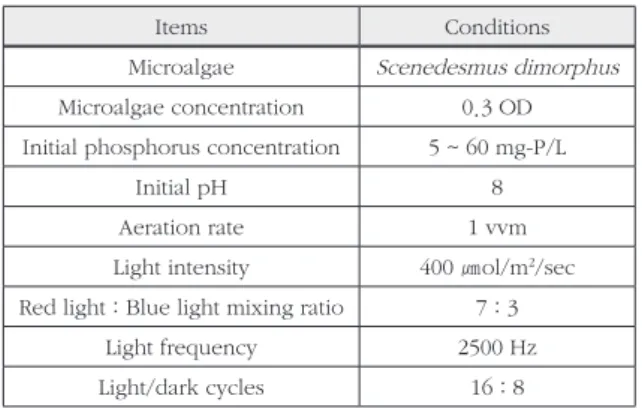
Items Conditions
Microalgae Scenedesmus dimorphus Microalgae concentration 0.3 OD Initial phosphorus concentration 5 ~ 60 mg-P/L
Initial pH 8
Aeration rate 1 vvm
Light intensity 400 ㎛ol/m
2/sec Red light : Blue light mixing ratio 7 : 3
Light frequency 2500 Hz
Light/dark cycles 16 : 8
Table 1. Experimental conditions for assessing initial phospho-
rus concentration effect
5)에 명시된 SS 측정방법과 OD 측정를 측정하 여 평가하였으며, OD(Optical Density) 측정 은 Spectrophotometer(X-ma 2000, Human Co., Korea)를 이용하여 660 nm에서의 흡광 도를 측정하였다. T-N, T-P 분석은 수질자 동분석기인 Auto Analyzer(AA3, BLTE Co., KOREA)를 사용하였으며, NO3-N, NH3-N, PO4-P 분석은 Water Analyzer(HS69 3100, Humas, Korea)를 이용하여 측정하였다.
3. 실험결과 및 고찰
3.1 인농도가 미세조류 성장 및 질소, 인 제거에 미치는 영향
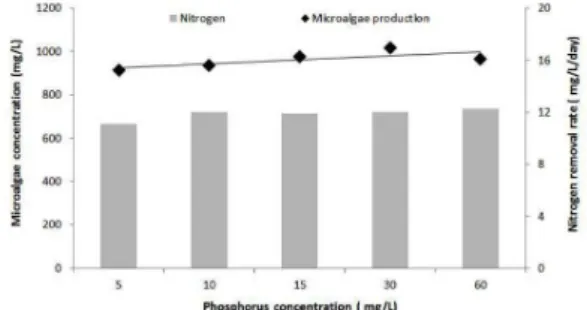
초기 인 농도를 달리하여 실험을 진행한 결과, 미세조류 성장량은 약 900 ~ 1000 mg/L로 인 농도에 따른 성장량 차이는 없었으며, 질소 제거 율도 약 11 ~ 12 mg/L/day로 차이를 보이지 않 았다(Fig. 1).
초기 인 농도 5 mg/L의 경우 운전 2일 만에 대부분의 인이 소비되었으며, 농도 15 mg/L의 이상에서의 제거량 차이는 크지 않았다. 그러나 운전 3일 시점에서는 인 농도가 높을수록 제거되 는 인의 양도 많은 것으로 나타났다(Fig. 2).
인은 일반적으로 미세조류 생체 내 1 % (dry weight) 정도를 차지하고 있으며(Goldman 1980), 충분한 양의 인이 존재할 경우 성장에 필요한 양 보다 많은 양의 인을 섭취하여 저장
하고 저장된 인은 외부의 인이 고갈되었을 때 성장에 재사용된다(Kuhl, 1974, John and Flynn, 2000). 그리고 이러한 현상을 “Luxury uptake” 라고 부른다(Eixler et al., 2006).
Scenedesmu sp.
의 경우도 luxury uptake가 가능한 것으로 보고되고 있다(Azad and Bor- chardt, 1969; Keeana and Auer, 1974).과잉 섭취된 인의 저장 형태는 polyphos- phate 형태이며, polyphosphate는 일반적으로 acid-soluble polyphosphate(ASP), acid- insoluble polyphosphate (AISP)로 구분되며, 저장 된 인의 형태는 AISP 형태이다.(Powell et al. 2009).
Powell et al.(2009) 연구에 의하면 초기 인 농도 5 mg/L에서는 AISP의 축적은 없었으며, ASP는 초기에 증가한 후 용액 내 인이 감소함에 따라 감소하였다. 반면초기 인 농도 30 mg/L에 서는 AISP가 미세조류 내 축적 되었으며, ASP 는 초기에 증가하였다가 감소한 후 일정한 농도 를 유지하였다. 이때 주입된 인은 일정량 소비된 후 더 이상 소비되지 않는 것으로 나타났다.
따라서 미세조류 성장량 및 질소 제거속도가 초기 인 농도에 상관없이 비슷한 것으로 보아 5 mg/L 농도의 인만 존재하더라도 미세조류가 성 장하는데 문제가 되지 않는 것으로 판단되며, 초기 인 농도 15 mg/L 이상에서는 미세조류의 luxury uptake에 의해 미세조류 생체 내에 저장
Fig. 2. Phosphorus removal amounts under different initial phos- phorus concentration
Fig 1. Effects of initial phosphorus concentrations on microal-
gae production and nitrogen removal rate
3.2 질소원에 따른 질소제거 패턴
Ammonia와 nitrate가 동시에 존재할 때 미 세조류의 질소원 소비패턴을 분석하기 위해 실 험을 진행한 결과, ammonia가 먼저 소비된 다 음 nitrate가 소비되어, 미세조류는 질소원으 로 nitrate 보다 ammonia를 더 선호하는 것 으로 나타타났으며, ammonia의 질소제거율은 약 20 mg/L/day, nitrate의 질소제거율은 약 12.6 mg/L/day로 암모니아의 제거속도가 빠른 것으로 도출되었다.
Ammonia와 nitrate는 미세조류가 이용하는 질소형태이나, nitrate는 아미노산과 다른 유 기 화합물로 합성되기 전에 질산환원효소(ni- trate reductase) 및 아질산환원효소(nitrite reductase)에 의해서 NH4+로 전환되며, 이러한 환원과정에서 에너지가 소요된다(Philip Sze, 1998; Graham et al, 2009). 그리고 ammo- nia가 흡수되는 과정에서 질산환원효소의 활성 이 억제되므로 ammonia와 nitrate 보다 먼저 소비한 것으로 판단된다(Ruiz et al., 2011).
4. 결론
• 일반적으로 하폐수의 유입수내 인 농도는 4
~ 5 mg/L 이므로, 미세조류를 하폐수처리
제거가 가능할 것으로 판단되었다. 하지만 본 연구결과에 따르면 미세조류의 luxury uptake 현상에 의한 인 제거를 기대하기 는 어렵다.
• 미세조류의 경우 질산성 질소 보다 암모니 아성 질소를 질소원으로 선호하였으며, 암 모니아의 제거속도도 빠른 것으로 나타났 다. 따라서 암모니아가 주요 질소원인 하 폐수에 미세조류를 적용할 경우, 질산화 과 정 없이도 질소제거가 가능할 것으로 판단 된다.
사 사
이 논문은 2013년도 정부(교육과학기술부)의 재원으로 한국연구재단의 기초연구사업지원을 받아 수행된 것임.(2011-0023132)
참고문헌