• 검색 결과가 없습니다.

Isolation of Microorganisms and Development of Microbial Augmentation for Treatment of Industrial Wastewater containing Ammonium Nitrogen

N/A
N/A
Protected

Academic year: 2021

Share "Isolation of Microorganisms and Development of Microbial Augmentation for Treatment of Industrial Wastewater containing Ammonium Nitrogen"

Copied!
8
0
0

로드 중.... (전체 텍스트 보기)

전체 글

(1)

Isolation of Microorganisms and Development of Microbial Augmentation for Treatment of Industrial Wastewater containing Ammonium Nitrogen

Myoung-Eun Lee, Seo-Jin Mun, Do-Hyuck Kwon and Hyun-Hyo Suh*

Department of Evironmental Engineering, Gyeongnam National University of Science and Technology, Jinju 660-758, Korea Received January 21, 2020 /Revised February 24, 2020 /Accepted February 25, 2020

For effective treatment of wastewater containing ammonium nitrogen (NH

4

-N), AT2, AT9, and AT12 strains, having high total organic carbon (TOC) removal capability, and FN47, possessing excellent ammonia nitrogen removal capability present in the activated sludge in the aeration tank of food wastewater treatment plants, were isolated and identified. The cells of these isolated strains were used for microbial augmentation with FIW-1 in the defatted rice bran as a medium to treat industrial wastewater. The investigation of the cultural characteristics of these isolated strains in the aeration tank showed that the affinities for substrate of the isolated strains were extremely high, of which AT12 (Alcaligenes sp. AT12) was the highest among the isolated strains. Ammonium nitrogen removal efficiency in the food wastewater was 71% in the isolated strain FN47 (Microbacterium sp. FN47) treat- ment group. When only activated sludge was added in the lab scale pilot using food wastewater dur- ing continuous culture experiment, the TOC removal efficiency was 63%. Meanwhile, the removal effi- ciency of 92% was obtained when the microbial augmentation FIW-1 for wastewater treatment was applied. In addition, the chemical oxygen demand (COD) level from the effluent wherein microbial augmentation FIW-1 was input for the initial three days in the wastewater treatment site experiment showed a treatment rate of about 43%, which was increased to 62% after an elapse of 5 days.

Key words : Ammonium nitrogen, microbial augmentation, pilot test, total organic carbon, wastewater treatment

*Corresponding author

*Tel : +82-55-751-3340, Fax : +82-55-751-3484

*E-mail : [email protected]

This is an Open-Access article distributed under the terms of the Creative Commons Attribution Non-Commercial License (http://creativecommons.org/licenses/by-nc/3.0) which permits unrestricted non-commercial use, distribution, and reproduction in any medium, provided the original work is properly cited.

Journal of Life Science

2020 Vol. 30. No. 2. 129~136 DOI : https://doi.org/10.5352/JLS.2020.30.2.129

Introduction

The organic wastewater generated from the industrial sites is composed of biodegradable organics, volatile organic compounds, recalcitrant organics, suspended solids, and nu- trient salts (nitrogen and phosphorus). The objective of wastewater treatment is to reduce organics in the waste- water and to remove nutrient salts to reduce the con- tamination of surface water and groundwater through wastewater treatment process. In the treatment of organic wastewater, a method of artificially increasing the efficiency of water self-cleaning is widely used, which is called a bio- logical treatment. In general, the biological treatment for wastewater treatment can be categorized into aerobic proc- ess like activated sludge method and biofilm process, and anaerobic process like digestion method. In many of the bio-

logical treatments, various microorganisms such as bacteria, fungi, protozoa, and micrometazoa are involved in the puri- fication, while dozens or more kinds of microorganisms con- stitute a mixed culture system. On the other hand, waste- water containing various kinds of miscellaneous compo- nents is a highly complex multicomponent system, and bio- logical treatment is a process of removing mixed substrates by mixed cultured microorganisms [5, 11, 16].

From the industrial wastewater, non-biodegradable or bio-toxic materials like synthetic organic compounds are de- tected along with biodegradable organics, which pose major factors affecting the deterioration of wastewater treatment efficiency and limiting the biological treatment [9, 19].

Removal of organic compounds by the biological treatment largely relies on the composition and treatment type of the wastewater and solid retention time. A typical aerobic bio- logical treatment is known to remove soluble organic car- bons until about 85%. Half of the organic compounds re- mained after biological treatment consists of humid acid, ful- vic acid, and hymathomelanic acid. Meanwhile, easily de- gradable organics, like carbohydrates and protein, account for about 25% of the soluble organics [13].

Biological treatment, where microorganisms are used, is

(2)

basically an economical method of treating wastewater by using metabolism; i.e., degradation, synthesis, and con- version of the organic matters presented in the wastewater.

It is used with the objectives of removing organics, nitrogen, and phosphorus; reducing generated sludge; and collecting and treating natural resources. In the biological treatment, the physicochemical treatments such as precipitation, filtra- tion, and coagulation are combined or used in parallel as a pretreatment or post-treatment to improve wastewater treatment efficiency.

Particularly, high concentrations of nitrogen included in the wastewater are not easily removed with general waste- water treatment, inflowing into the lakes and streams, thus inducing eutrophication to cause hyperplasia of hydro- phytes, deficiency of dissolved oxygen in the water, bad or- der, and worsening water quality by accumulation of de- composed matter, thereby leading to serious environmental problems and ultimately making this nitrogen emerge as a new contaminant [10].

Physicochemical methods such as absorption and ion ex- change, as well as the biological treatment method, are used to remove nitrogen in the wastewater. Though biological treatment method is friendlier to the environment, the effi- ciency is low in removing high concentrations of nitrogen;

therefore, it is being used along with physicochemical meth- od [2, 20].

For the biological treatment used in the treatment of nitro- gen containing wastewater, a considerable amount of re- search and development is continuing in terms of process.

Researches are mainly advanced not only in the selection of new microorganisms that can treat high concentrations of nitrogen but also in improving wastewater treatment sys- tem, suiting the characteristics of microorganisms for proc- ess improvement and utilizing microorganisms in strain im- provement and microorganism fixation [7-10].

In this study, microorganisms capable of degrading vari- ous organic materials and those that have excellent ammo- nium nitrogen removal capability were isolated and identi- fied from the aeration tank which contained ammonium ni- trogen in order to efficiently treat organic wastewater for environment purification. In addition, the isolated micro- organisms were formulated and optimized in order to be utilized in treating the industrial wastewater that contains organic source and ammonium nitrogen.

Materials and Methods

Isolation of microorganisms in the aeration tanks In order to isolate microorganisms codominant in the acti- vated sludge in the aeration tank of food wastewater treat- ment plant, a sample from the aeration tank was set as an isolated sample and was diluted in the normal saline. The diluted wastewater was spread on the plate count agar (PCA) medium followed by culturing at 37℃ for 3 days.

The population that formed the colony was isolated. The isolated strain was cultured in a liquid culture medium for the isolation of bacteria, while strain having exceptional cell growth was selected and used in the wastewater treatment efficiency test. The liquid culture medium for the isolation of bacteria was composed of 3.0 g glucose, 5.0 g yeast extract, and 3.0 g tryptone per 1 liter of medium. The pH of culture medium was adjusted to 7.0.

Isolation of ammonium nitrogen removal microor- ganisms

In order to isolate ammonium nitrogen (NH

4

-N) removal microorganisms, samples from soil, rivers, and wastewater around food, paper, and leather manufacturing plants na- tionwide were diluted in normal saline, and 0.7 g/l of (NH

4

)

2

SO

4

, as a single energy source, was spread on the solid medium wherein it was added. The strains were inoculated on the liquid culture medium for the isolation of bacteria and cultured at 30℃ for 3 days while the strain with ex- cellent nitrogen removal capability was selected. The iso- lation medium was composed of 0.7 g (NH

4

)

2

SO

4

, 0.8 g K

2

HPO

4

, 0.2 g MgSO

4

・7H

2

O, 0.1 g FeSO

4

・7H

2

O, and 3.0 g CaCO

3

per 1 liter of medium, with the pH adjusted to 7.0.

Identification and preservation of isolated strains After investigating the morphological, physiological, and biochemical characteristics of the isolated strains, the identi- fication of the strain was carried out according to Bergey's manual of determinative bacteriology [15] and biochemical tests for the identification of medical bacteria (2nd ed.) [12].

The DNA base composition of each strain (G+C contents)

was analyzed by reversed-phase HPLC according to the

method suggested by Tamaoka and Komagata [17]. The 16S

ribosomal RNA gene is the most widely used marker gene

in miocrobiology ecology. We therefor performed an addi-

tional experiment to demonstrate that sequencing of 16S

rRNA gene for identification of bacteria. PCR amplification

(3)

of the 16S rRNA genes was performed with primers contain- ing universal primers amplifying the V4 variable region (515F: GTGCCAGCMGCCGCGGTAA and 806R: GGACTAC HVGGGTWTCTAAT) [3]. PCR products were pooled, col- umn-purified, and size-selected through microfluidic DNA fractionation. Consolidated libraries were quantified by quantitative real-time PCR before loading into the sequencer.

Sequencing was performed in a pair-end modality on the Illumina NextSeq 500 platform rendering 2×150 bp pair- end sequences. The isolated strains were preserved by subculture and kept in an ampoule after freeze-drying.

Preparation and characteristics of microbial aug- mentation

The strain with high ammonium nitrogen removal capa- bilities among the strains isolated from the samples of soil, stream, and wastewater around food, paper, and leather manufacturing plants was added into the strains which showed a high colony forming capability, total organic car- bon (TOC), and chemical oxygen demand (COD) removal rate, among the microorganisms presented in the aeration tank of food wastewater treatment plant, in order to be used for microbial augmentation as a field application for in- dustrial wastewater treatment. This complex microbial aug- mentation was named FIW-1, which was spread on the PCA medium to investigate the reproducibility of microorgan- isms and verify the viability of cells.

Measurement of cell mass

Cell mass was measured by washing the cell obtained by centrifugation of the culture solution of isolated strain twice, dried at 105℃ for eight hours, and then determined as dry cell weight (DCW).

Analysis of basic feature of wastewater

The total organic carbon concentration of the subjected wastewater was analyzed using TOC analyzer (Dohrman DC-180). NH

4

-N was analyzed by liquid analyzer. Mean- while, chemical oxygen demand (COD) was analyzed ac- cording to standard methods for the examination of water [1].

Pilot test for treating industrial wastewater A continuous culture test employing a lab scale pilot re- actor with acryl was carried out in order to investigate the treatment efficiency of the food industrial wastewater. The

wastewater was input into the reactor as continuous reaction was induced to the control group, into which only activated sludge was added, and the test group, into which microbial augmentation was applied to measure wastewater treatment efficiency.

The pilot test for food wastewater treatment efficiency was adjusted for its hydraulic retention time of 24 hr, while the treatment efficiency changes of the control with only acti- vated sludge and treatment block and with microbial aug- mentation were observed over time. An inoculum of 200 mg/l was added daily.

Results and Discussion

Isolation of microorganism in the aeration tank The codominant microorganisms in the aeration tank de- grade organic sources symbiotically or competitively to use a self-proliferation process and to discharge water and car- bon dioxide as a final decomposition product. In order to select a codominant microorganism in the activated sludge in the aeration tank in the food wastewater treatment plant, a sample was spread on the PCA medium and cultured for 3 days. The 7 dominant strains that formed the colony were selected.

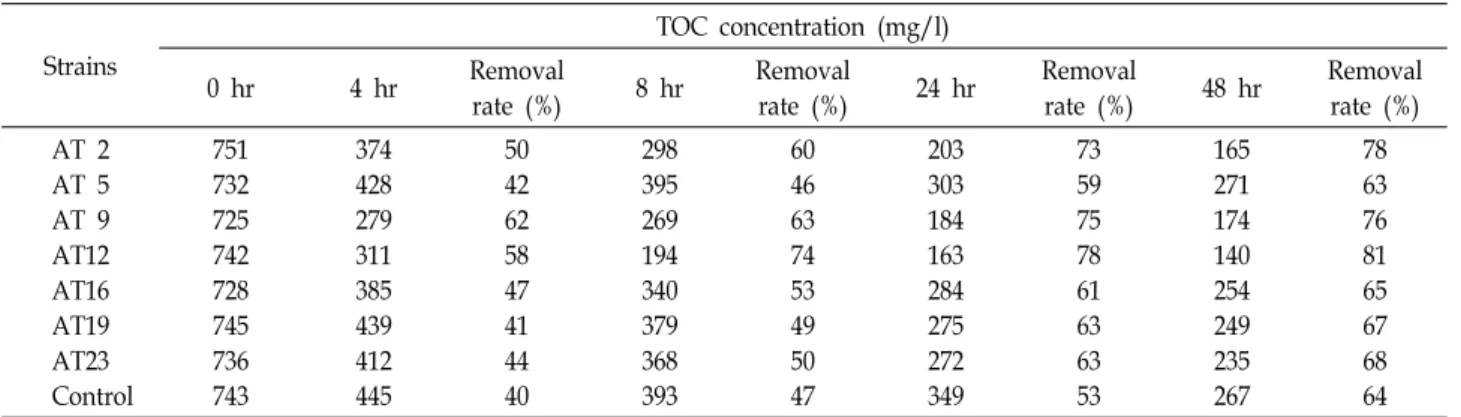
Among the strains isolated from the aeration tank, AT2, AT9, and AT12 strains were isolated as dominant micro- organisms. When the AT2, AT9, and AT12 strains were add- ed, the treatment efficiency for the total organics in the influ- ent water of the subjected wastewater was higher in the TOC removal activities compared with those of the control group wherein only an activated sludge was added as shown in Table 1. Particularly, in the case of the isolated AT12, the TOC removal rate was 81%, which was the highest treatment efficiency as well as the highest COD removal efficiency.

These isolated strains (AT2, AT9, and AT12) were used to prepare the microbial augmentation for biological waste- water treatment.

Isolation of nitrogen removal microorganisms

In order to isolate the ammonium nitrogen (NH

4

-N) re-

moval microorganisms, the strains having excellent nitrogen

removal capability among the 92 strains were isolated from

the soil, stream, and wastewater around food, paper, and

leather manufacturing plants nationwide. First, 12 strains

with excellent colony forming capabilities when cultured on

the solid culture medium containing ammonium nitrogen

(4)

Table 1. Selection of microorganisms for application test in the wastewater treatment site

Strains

TOC concentration (mg/l)

0 hr 4 hr Removal

rate (%) 8 hr Removal

rate (%) 24 hr Removal

rate (%) 48 hr Removal

rate (%) AT 2

AT 5 AT 9 AT12 AT16 AT19 AT23 Control

751 732 725 742 728 745 736 743

374 428 279 311 385 439 412 445

50 42 62 58 47 41 44 40

298 395 269 194 340 379 368 393

60 46 63 74 53 49 50 47

203 303 184 163 284 275 272 349

73 59 75 78 61 63 63 53

165 271 174 140 254 249 235 267

78 63 76 81 65 67 68 64

*Control: Only activated sludge was added. TOC: total organic carbon.

Table 2. BLAST search results of isolated strains

Strains Description Max

score

Total score

Query cover

Expect value

Percent identity AT 2

AT 9 AT12 FN47

Pseudomons sagittaria strain CC-OPY-1 16S rRNA, partial sequence Acinetobacter baumannii strain 16S rRNA, partial sequence Alcaligenes aquatilis strain LMG 22996, 16S rRNA, partial sequence Microbacterium diaminobutyricum strain RZ 63 16S rRNA, partial

sequence

2639 2497 2501 2438

2639 2497 2501 2438

100%

99%

99%

100%

0.0 0.0 0.0 0.0

99.59%

98.12%

98.11%

98.28%

*BLAST : basic local alignment search tool

for isolation of bacteria were selected. Among the isolated strains, strain FN47, which has exceptional strain growth and ammonium nitrogen removal capability, was finally selected. Isolated FN47 was found to be excellent not only for its ammonium nitrogen removal capability but also for its organic removal activity.

Identification of isolated strains

The microorganisms in the aeration tanks of the waste- water treatment plant were examined, isolated, and inves- tigated for their morphological, physiological, and bio- chemical characteristics for each strain (AT2, AT9, and AT12) (data not shown). The isolated strain AT2 was a gram-neg- ative bacillus and facultative aerobic bacteria that had mobility. It showed a positive response to the catalase and oxidase, producing acid in the glucose, but showed a neg- ative response toward Voges-proskauer (VP) test. It likewise showed a positive reaction to urease. The G+C content was 60%. These results exhibited similar characteristics with Pseudomonas species. It was found that the strain AT2 was a species which was very close to Pseudomonas sagittaria, when 16S rRNA of the isolated strain AT2 was analyzed further for more accurate identification (Table 2). Therefore, the isolated strain AT2 was finally named Pseudomonas sp.

AT2.

The AT9 strain was a gram-negative bacillus and had mobility. It showed a positive response to catalase and neg- ative response to oxidase, forming acid by reacting with glucose. When strain AT9 was used as a carbon source, it could not be fermented. Meanwhile, the strain AT9 could not use nitrate and showed a negative response to urease.

The G+C content of DNA was 67%, showing similar charac- teristics with the Acinetobacter species. It was found that the strain AT9 was a species which was very close to Acineto- bacter baumannii, when 16S rRNA of the isolated strain AT9 was analyzed further for more accurate identification. There- fore, the isolated strain AT9 was finally named Acinetobacter sp. AT9.

Meanwhile, the isolated strain AT12 was a gram-positive

bacillus and had mobility. The strain AT12 showed a pos-

itive response towards both catalase and oxidase. However,

AT12 could not produce acid with the glucose. AT12 used

nitrate and showed a negative response to urease. The G+C

content of AT12 was 58%. These results exhibited similar

characteristics with Alcaligenes species. It was found that the

strain AT12 was a species which was very close to Alcaligenes

aquatilis, when 16S rRNA of the isolated strain AT12 was

analyzed further for more accurate identification. Therefore,

(5)

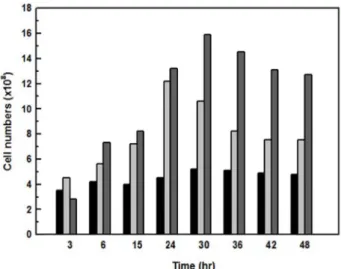
Fig. 1. Culture test using the isolated strain AT12 in the aeration tank of food wastewater. The symbols ; (

) activated sludge, ( ) isolate AT12+organic nitrogen source (0.1 g yeast extract), ( ) isolate AT12+3.0 g (NH

4

)

2

SO

4

, 0.3 g K

2

HPO

4

, 0.02 g FeSO

4

, 0.02 g MgSO

4

, and 0.01 g MnSO

4

per 1 liter of medium.

Table 3. Treatment efficiency of Microbacterium FN47 in the food wastewater containing ammonium nitrogen

Component Influent Control Removal rate (%) FN47 Removal rate (%)

Food wastewater

NH

4

-N (mg/l) T-N (mg/l) TOC (mg/l)

515 624 723

310 356 129

40 43 82

149 168 108

71 73 85

*Control: only activated sludge was added. T-N: total nitrogen, TOC: total organic carbon.

the isolated strain AT12 was finally named Alcaligenes sp.

AT12.

The ammonium nitrogen degrading strain FN47 was a gram-positive bacillus having the size of 0.5~0.6×1.2~2.7 μm and possessing mobility. The FN47 colony had a light-yellow color and it was facultative aerobic bacteria that could grow well under aerobic, as well as anaerobic condition. The strain FN47 showed a negative response to urease and well-de- graded starch and cellulose. The strain FN47 produced acids by reacting with saccharides like glucose, fructose, and lactose. Its G+G contents of DNA were 71%. These results exhibited similar characteristics with Microbacterium species.

It was found that the strain FN47 was a species which was very close to Microbacterium diaminobutyricum, when 16S rRNA of the isolated strain FN47 was analyzed further for more accurate identification (Table 2). Therefore, the isolated strain FN47 was finally named Microbacterium sp. FN47.

Incubation characteristics of isolated strains in the aeration tank

In order to investigate the incubation characteristics of isolated strains Pseudomonas sp. AT2, Acinetobacter sp. AT9, and Alcaligenes sp. AT12, the wastewater itself was used as a culture medium. After adding nitrogen, phosphorus, and micronutrients of 3.0 g (NH

4

)

2

SO

4

, 0.3 g K

2

HPO

4

, 0.02 g FeSO

4

, 0.02 g MgSO

4

, and 0.01 g MnSO

4

per 1 liter of me- dium, the growth activities of the isolated strains were investigated. The wastewater was used without sterilization so that the isolated strains could be used in actual waste- water generation sites. Therefore, wastewater had a con- tamination rate at around 10

5

-10

6

CFU/ml in the influent wastewater. Still, the isolated strains occupied most of the wastewater after culture so that affinity for substrate by the isolated strains was elevated. Particularly, when the culture test was conducted according to the nutrient source for iso- lated strain Alcaligenes sp. AT12, high culture characteristics were exhibited in the test group wherein nitrogen, phospho- rus, and micronutrients were added compared with the test group with organic nitrogen. The optimum activity of the

strain was exhibited after 30 hours of culture (Fig. 1).

Ammonium nitrogen removal efficiency in the industrial wastewater

In order to remove ammonium nitrogen contained in the industrial wastewater, the food wastewater having a high nitrogen concentration was adopted for the test (Table 3).

The ammonium nitrogen removal rate was depleted in the

control where only activated sludge was added, suggesting

that the active microorganisms inside the aeration tank sup-

pressed dominance of the nitrification bacteria, which ulti-

mately dropped total nitrogen removal efficiency. However,

the ammonium nitrogen removal rate reached 71% in the

treatment group with Microbacterium sp. FN47, which was

excellent compared with that of the control. From the above

results, it can be inferred that Microbacterium sp. FN47 is an

effective ammonium nitrogen removal strain in the waste-

water treatment site and is expected to improve water

quality.

(6)

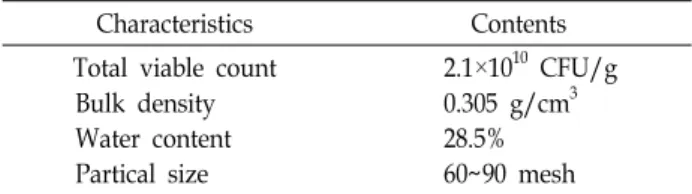
Table 4. Characteristics of microbial augmentation FIW-1

Characteristics Contents

Total viable count Bulk density Water content Partical size

2.1×10

10

CFU/g 0.305 g/cm

3

28.5%

60~90 mesh Preparation of microbial augmentations and their

characteristics

In order to investigate the wastewater treatment efficiency of the strains isolated from the aeration tank, the culture broth of the isolated strains Pseudomonas sp. AT2, Acineto- bacter sp. AT9, and Acaligenes sp. AT12, as well as the culture broth of ammonium nitrogen degrading strain Microbacte- rium sp. FN47 with the defatted rice bran as a medium, were used to prepare the microbial augmentation FIW-1 for food wastewater treatment.

Optimum media were developed for growing cells of the isolated strains in the batch liquid culture. Each cell culture liquid was mixed in the defatted rice bran at a ratio of 2:8 and then solid phase fermentation was induced, followed by air drying at room temperature to prepare the microbial augmentation with the four strains. These four types of mi- crobial augmentations were mixed at an equal ratio, with a complex microbial augmentation finally prepared. The complex microbial augmentation was prepared by the mix- ing of each strain in the defatted rice bran at a similar ratio.

The nutrient solution of 0.5% yeast extract was added at 5%

(v/w) in the rice bran, and combined with nitrogen, phos- phorous source, and mineral nutrients Ca

2+

and Fe

2+

. Ca

2+

was added to fill alkalinity and Fe

2+

was added to relax the absorption of microorganisms in the form of CaCl

2

and FeSO

4

. AMP, ADP, CaCl

2

, and FeSO

4

were also added at a weight ratio of 10% (W/W) by combining 1:1:2.0:0.5, respectively. The combined complex microbial augmentation was named FIW-1, and in the subsequent experiments, FIW-1 was added to the experimental group to examine its activity. The probiotic activity of the strains contained in the complex microbial augmentation FIW-1 was maintained at about 10

9

cells without significant change within 45 days of room temperature storage. The moisture content of the complex microbial augmentation containing four types of strains was measured 28.5%.

For the isolated strains, an optimum medium composition was established for cell growth in the batch liquid culture, and each culture broth was mixed with the defatted rice bran at a ratio of 2:8, followed by solid phase fermentation for 2 days. The fermented cell was air-dried to make each micro- bial preparation with five types of strains. These five strains were mixed for the microbial augmentation. All the five strains for the microbial augmentation maintained a cell mass higher than 10

9

CFU/g. In the case of a microbial aug- mentation FIW-1 where five microbial strains were mixed,

the cell mass was 2.4×10

10

CFU/g, the density was 0.305 g/cm

3

, and the moisture content was 28.5% (Table 4). There was difficulty in wastewater treatment in the actual waste- water treatment plants due to the mixing of various materi- als including recalcitrant organics. The microorganisms could be made as a formulation or immobilized, and then inoculated so that the density of the population can be raised for a biodegradation process in the wastewater treatment plants [4].

Pilot test for the effectiveness of industrial waste- water by microbial augmentation FIW-1

The wastewater treatment test for the subjected waste- water from the food industry was conducted in the lab scale reactor to confirm the applicability of the microbial augmen- tation FIW-1 for industrial wastewater treatment.

The treatment efficiency test was carried out for the con- trol in which only activated sludge from the test site was added and for test group into which microbial augmentation FIW-1 was added in the pilot for continuous treatment. The 1

st

treated water was set as an influent during five days be- fore the inputting of the microbial augmentation FIW-1 and before the treated supernatant of aeration tank was set as an effluent. The TOC, COD, and ammonium nitrogen con- centration were measured after making the reaction continue for 10 days in the culture.

In the case of control wherein only activated sludge was added, the TOC was removed at a rate of 63%, while the COD removal rate was 64%. However, when microbial aug- mentation FIW-1 was applied, the TOC and COD removal rates were increased to 92% and 85%, respectively. In the case of ammonium nitrogen removal rate, it was 37% in the control, and 82% of removal rate was observed from the test group with microbial augmentation FIW-1 (Table 5).

Field Application Test

A test was carried out to ascertain if the microbial aug-

mentation of FIW-1 can be applied in the wastewater treat-

ment site. The average COD in the influent water for 5 days

(7)

Table 5. Effectiveness of wastewater treatment using microbial augmentation FIW-1 on bench scale pilot

Treatment Group TOC (mg/l) COD (mg/l) NH

4

-N (mg/l)

Activated sludge (control)

Influent Effluent

Remaval rate (%)

716 265 63

986 355 64

521 328 37

Microbial augmentation, FIW-1

Influent Effluent

Removal rate (%)

723 58 92

1,034 155 85

538 97 82

*TOC: total organic carbon, COD: chemical oxygen demand.

before field test was 985 mg/l and in the effluent water 621 mg/l, showing that the COD removal rate of the aeration tank was merely 37%. However, during 3 days after input- ting of the microbial augmentation FIW-1, a constant treat- ment rate (43%) was observed, followed by 62% of the treat- ment rate with a COD value of 374 mg/l after an elapse of 5 days.

These results indicated that the microbial augmentation FIW-1 was composed of a dominant microorganism, and ammonium nitrogen removal microorganism can establish an effective biological treatment system not only in the food wastewater which was the subjected wastewater in the study but also in the paper mill wastewater and leather wastewater containing ammonium nitrogen if it is used through a site adaption process.

Acknowledgement

This work was supported by a Research Grant of Gyeongnam National University of Science and Technology in 2018 year.

The Conflict of Interest Statement

The authors declare that they have no conflicts of interest with the contents of this article.

References

1. APHA, AWWA, and WEF. 1992. Standard methods for the examination of water and wastewater. 18th eds., APHA, Washington.

2. Chung, G. T., Park, S. H., Park, J. H., Lim, E. T., Bang, S.

H. and Park, D. H. 2009. Effect of factors of nitrification process in wastewater treatment. Kor. J. Biotech. Bioeng. 24, 296-302.

3. Caporaso, J. G., Lauber, C. L., Walters, W. A., Berg-Lyons, D, Lozupone, C. A., Turnbaugh, P. J., Fierer, N. and Knight,

R. 2011. Global patterns of 16S rRNA diversity at a depth of millions of sequences per sample. Proc. Natl. Acad. Sci.

108, 4516-4522.

4. Haggblom, M. M., Nohyjek, L. J. and Salkinoja-Salonen, M.

S. 1988. Degradation o-methylation of chlorinated phenolic compounds b Rhodococcus and Mycobacterium strains. Appl.

Environ. Microbiol. 54, 3040-3052.

5. Kennedy, J. F. and Bradshow. 1984. Progress in industrial microbiology. Bushell, M. E. (ed.) Elsevier. 19, 319-365.

6. Layton, A. C., Karanth, P. N., Lajoie, C. A., Meyer, A. J., Gregory, I. R., Stapleton, R. D., Tayler, D. E. and Sayler, G. S. 2000, Quantification of hypomicrobium populations in activated sludge from an industrial wastewater treatment system as determined by 16 rRNA analysis. Appl. Environ.

Microbiol. 66, 1167-1174.

7. Lazarova, V. and Manem, J. 1995. Biofilm characterization and activity analysis in water and wastewater treatment.

Wat. Res. 29, 2227-2245.

8. Lee, S. L., Yoo, S. Y., Chung, S. Y., Park, C. S. and Choi, Y. L. 2003. Microbial immobilization, characterization and isolation of nitrogen oxidizing bacteria. Appl. Biol. Chem. 46, 1-6.

9. Leisinger, T., Cook, A. M., Hutter, R. and Nuesch, J. 1981.

Microbial degradation of xenobiotics and recalcitrant com- pounds. Academic Press. Zurich.

10. Liu, Y. and Capdeville, B. 1996. Specific activity of nitrifying biofilm in water nitrification process. Wat. Res. 30, 1645- 1650.

11. Loosdrecht, V. and Heijnen, S. J. 1993. Biofilm bioreactors for wastewater treatment. Trends Biotechnol. 11, 117-121.

12. MacFaddin, J. F. 1984. Biochemical tests for identification for medical bacteria. 2nd eds., Williams and Wilkins Co., Baltimore, Maryland.

13. Manka, J., Rebhun, M. and Mandelbaum, A. 1974. Characte- rization of organics in secondary effluents. Environ. Sci.

Technol. 8, 1017-1020.

14. Paniagua-Michel, J., Franco-Rivera, J. A., Cantera, J. L. and Stein, L. Y. 2005. Activityof nitrifying biofilms constructed on low-density polyester enhances bioremediation of acoast- al wastewater effluent. World J. Microbiol. Biotechnol. 21, 1371-1377.

15. Peter, H. A. S., Nicholas, S. M., Sharpe, M. E. and Holt,

J. F. 1986, Bergey’s manual of systematic bacteriology, Wil-

liams and Wilkins Co., Baltimore, Maryland.

(8)

초록:암모니아성 질소함유 산업폐수처리를 위한 미생물의 분리 및 복합미생물제제의 개발

이명은․문서진․권도혁․서현효*

(국립경남과학기술대학교 환경공학과)

암모니아성 질소(NH

4

-N) 함유폐수의 효과적인 처리를 위하여 암모니아성 질소가 함유되어있는 식품폐수처리

장의 폭기조 활성오니에 우점적으로 존재하는 미생물 중 TOC (total organic carbon) 제거율이 높은 AT2, AT9, AT12 균주와 암모니아성 질소 제거능이 우수한 FN47을 분리, 동정하였다. 이들 분리균주의 균체를 탈지강을 담 체로하여 산업폐수처리용 미생물제제 FIW-1 을 제조하였다. 폭기조 분리균주들의 대상으로 폐수자체를 배양기질 로 하여 배양학적 특성을 조사하였을 때 분리균주들의 기질친화성이 매우 높은 것으로 나타났으며, 분리균주 중 AT12 균주(Alcaligenes sp. AT12)가 가장 높은 기질친화성을 나타내었다. 식품폐수 중의 암모니아성 질소 제거효 율은 분리균주 FN47 (Microbacterium sp. FN47)의 처리구에서 71%의 제거율을 나타내었다. 실험실규모의 반응조 에서 식품폐수를 이용한 연속배양 실험에서 활성슬러지만을 첨가한 경우 63% TOC제거효율을 나타내었으며, 폐 수처리용 미생물제제 FIW-1을 첨가 시에는 92%의 제거효율을 나타내었다. 또한 폐수처리용 미생물제제 FIW-1의 폐수처리장 현장실험에서는 미생물제제 FIW-1을 투입한 초기 3일간의 유출수COD (chemical oxygen demand) 값은 43% 내외의 처리율을 나타내었으나, 5일이 경과하였을 때 유출수의 COD값은 62%의 처리효율을 나타내었 다.

16. Shin, S. B. and Ichikawa, K. 1980. Wastewater treatment by microorganism. Kor. J. Appl. Microbiol. 66, 5201-5205.

17. Tamaoka, K. and Komagata, K. 1984. Determination of DNA base composition by reversed-phase high-performance liq- uid chromatography. FEMS Microbiol. Lett. 25, 125-128.

18. Tanaka, K., Tada, M., Kimata, T., Harada, S., Fuji, Y., Mizu- guchi, T., Mori, N. and Emori, H. 1994. Development of new nitrogen removal system bacteria immobilized in synthetic

resin pellets. Wat. Sci. Tech. 1, 681-690.

19. Van Loosdrecht, M. C. M. and Heijnen, S. J. 1993. Biofilm bioreactors for wastewater treatment. Trends Biotechnol. 11, 117-121.

20. Wagner, M. and Loy, A. 2002. Bacterial community compo- sition and function in sewage treatment systems. Curr. Opin.

Biothechnol. 13, 218-227.

수치

Table  1.  Selection  of  microorganisms  for  application  test  in  the  wastewater  treatment  site Strains TOC  concentration  (mg/l) 0  hr 4  hr Removal rate  (%) 8  hr Removalrate  (%) 24  hr Removalrate  (%) 48  hr Removalrate  (%) AT  2 AT  5 AT  9
Fig.  1.  Culture  test  using  the  isolated  strain  AT12  in  the  aeration  tank  of  food  wastewater
Table  4.  Characteristics  of  microbial  augmentation  FIW-1
Table  5.  Effectiveness  of  wastewater  treatment  using  microbial  augmentation  FIW-1  on  bench  scale  pilot

참조

관련 문서