1. Introduction
1)With the ever increasing population and industrialization, domestic and industrial water demand of cities has massively increased and so is the quantity of wastewater discharged.
As a result, wastewater recycle and reuse has become an
Received 30 October 2017, revised 13 November 2017, accepted 15 November 2017
*
Corresponding author: Ilho Kim (E-mail: [email protected])
attractive option to extend the available water resources and to protect the environment. The wastewater should be treated to a safe level for reuse or discharge to the environment.
However, the wastewater discharged from many manufacturing industries comprise of a significant amount of refractory organic and inorganic matters that the treatment has become challenging. On the other hand, climate change interferes with the hydrologic cycle and waste entering natural
Applications of Ozone Micro- and
Nanobubble Technologies in Water and Wastewater Treatment: Review
정수 및 폐수처리에서 오존 미세기포와 초미세기포 기술의 적용 : 리뷰
Andinet Tekile
1・Ilho Kim
1,2*・Jai-Yeop Lee
2테킬 안디넷
1・김일호
1,2*・이재엽
21
Department of Construction Environment Eng., University of Science and Technology, Daejeon, Korea
2
Environmental and Plant Engineering Research Institute, Korea Institute of Civil Engineering & Building Technology, Gyeonggi-Do, Korea.
1과학기술연합대학원대학교, 건설환경공학과, 대전광역시, 대한민국
2한국건설기술연구원, 환경플랜트연구소, 경기도 고양시, 대한민국
ABSTRACT
Water and wastewater treatment has always been a challenging task due to the continuous increase in amount and the change in characteristics of the poorly biodegradable and highly colored organic matters, as well as harmful micro-organisms.
Advanced techniques are therefore required to successfully remove these pollutants from water before reuse or discharge to receiving water bodies. Application of ozone, which is a powerful oxidant and disinfectant, alone or as part of advanced oxidation process depends on the complex kinetic reactions and the mass transfer of ozone involved. Micro- and nano bubbling considerably improves gas dissolution compared to conventional bubbles and hence mass transfer. It can also intensify generation of hydroxyl radical due to collapse of the bubbles, which in turn facilitates oxidation reaction under both alkaline as well as acidic conditions. This review gives the overview of application of micro- and nano bubble ozonation for purification of water and wastewater. The drawbacks of previously considered techniques and the application of the hydrodynamic ozonation to synthetic aqueous solutions and various industrial wastewaters are systematically reviewed.
Key words: Hydroxyl radical, micro- and nanobubbles, organic matters, ozone, wastewater
주제어: 하이드록실 라디칼, 미세-초미세기포, 유기물, 오존, 폐수
water bodies; especially, the increases in water temperature and rainfall intensity are the cause for the considerable rise in the surface waters content of natural organic matter recently.
The nature of the organic matters is also changing in some regions (Eikebrokk et al., 2004).
The increase in amount and change in characteristics of natural and refractory organic matters necessitate the development of new technologies that effectively remove these pollutants from water and wastewater. Though conventional biological treatment techniques are cheap to run, the issue of biodegradability limits the treatment of specific kind of wastewater and thus, it is difficult to realize effluent qualities satisfying discharge standards using this method. On the other hand, high reactivity towards many pollutants, possibility of generation at the point of use, and self-decomposition to oxygen have made ozone a preferable oxidant than others in water and wastewater treatments (Jabesa and Ghosh, 2016). Ozonation has been used in wastewater treatments for years now, due to its high efficiency in decomposition of refractory organic matters as well as disinfecting pollutants. Ozone oxidation has also been applied in decolorization of wastewaters. In drinking water treatment also, ozone has been used as a pretreatment reagent, an oxidant and a disinfectant (Li and Tsuge, 2006; Loeb et al., 2012).
However, there are also a few limitations to the efficient water and wastewater ozonation treatment:
1) Low ozone solubility and stability, which leads to low utilization efficiency.
2) Application of excessive dosage to compensate for the low ozone solubility. This leads to high cost of ozonation process.
3) The formation of bromate, a harmful side product of ozone reaction which is recalcitrant and carcinogenic, in consequence to the excessive dose.
4) Ineffective mineralization of organic substances cause the formation of partial oxidation products, such as aldehydes, organic acids and ketones.
5) As the result of selectivity of ozone in oxidation, substances such as ammonia, pesticides, aromatic compounds, and chlorinated solvents are not easily oxidized by ozone.
Thus, a technique that can enhance the solubility of ozone
in water, perform rapid oxidation of the organic substances, and also decrease the loss of ozone in water and wastewater are desired. In the past, much attention has been paid to the development of advanced oxidation processes (AOPs) using O
3/H
2O
2, UV/O
3, or ultrasound/O
3, and catalytic ozonation using metal ions, metal oxides or activated carbon to enhance ozonation efficiency. In addition to direct reaction of ozone, non-selective and fast reactions are promoted by AOPs with the generation of hydroxyl (・OH) radicals by decomposing ozone in water. However, the applications of the advanced techniques are limited due to the complexity and high cost of the techniques, and poor ozone mass transfer (Shin et al., 1999; Walker et al., 2001). Thus, further investigation of an efficient technique which enhances the mass transfer of ozone and its oxidation ability for practical application is strongly needed. To this end, the innovative technique which involves bubble size has drawn the attention of researchers recently.
Practically bubbles exist in mixed sizes that either average bubble diameters or the size distribution of the bubbles is used for their presentation. However, researchers have not fully agreed on the size range used to describe micro and nano bubbles. Therefore, micro bubbles are generally defined as bubbles with diameter in the range of 10-50 µm or bubble having diameters less than 50 µm; whereas, nanobubbles are bubbles with diameter less than a micron size and larger than a nanometer. To avoid the confusion caused by the different size descriptions used in defining micro and nano bubbles, some researchers prefer to use combined naming,
‘micro-nano bubbles’. The use of micro and nanobubbles (MNBs) in environmental engineering research areas has attracted great attention due to their tiny size (with diameters ranging from tens of nano-meters to several tens of micro-meters), large interfacial area, long residence time in water, lower bubble rising velocity, and high internal pressure (Hu and Xia, 2018).
These unique physicochemical properties of MNBs
increase ozone mass transfer, hence its utilization rate and
enhance its oxidation of pollutants in water and wastewaters
(Zheng et al., 2015). Enhancing ozone utilization will decrease
the amount of the supplied ozone and lower the off-gas
ozone concentration, and therefore the unit for treating unused
ozone can be omitted or decreased in volume (Li and Tsuge, 2006). On the other hand, Khuntia et al. (2015) have stated that the amount of the hydroxyl radicals generated from ozone is a key factor for the determination of oxidation reaction. The ・OH radical is a more powerful oxidant than ozone itself and it readily reacts with various organic compounds (Beltran, 2003). Thus, the very effective generation of hydroxyl radicals (・OH) by the collapse of ozone MNBs under broad pH band contribute to complete decomposition of organic molecules (Takahashi et al., 2007;
Chu et al., 2008).
From the early time recognition of ozone gas potential, its efficient application in water and wastewater treatment schemes has been continuously improved worldwide (Loeb et al., 2012). In this review, the application of the current ozonation level, which involves synergic effect of cavitation and ozonation, to treat practical wastewater generated by various industries is systematically revised. The revision is done under application categories as: water disinfection, organic and inorganic pollutants removal, decolorization and others.
2. Water Disinfection
Disinfection aims at the destruction of microbes and it is, therefore, an important step in any drinking water treatment scheme taking into account the worth of human health. The drawbacks of the various chemical and physical ways of disinfection outweigh their efficiency and, therefore, there is a need to search for some alternate techniques.
Chlorination has been and still is, especially in developing countries, the most widely applied disinfectant of pathogenic microorganisms in water and wastewater. However, the associated undesirable byproducts, poor inactivation of spores, cysts, and some viruses at low dosage used for coliform removal, and the increase of cost by as much as 30% for dechlorination to reduce toxicity make chlorination unattractive.
In reclamation of wastewater too disinfection is the most important treatment process for public health protection.
Besides the health-related microbiological regulations, the requirement of releasing safe effluents into the sensitive
natural waters calls for the use of highly advanced disinfection processes. The strong oxidizing nature of ozone makes it effective in destroying bacteria, viruses, and especially the cyst-forming protozoan parasites like Giardia and Cryptosporidium, which are typically resistant to most other disinfectants.
Ozone is proved to be one of the most effective disinfectant and is widely used to inactivate pathogens in drinking water, and disinfect final municipal effluents, especially in the big cities of Europe, USA, Canada and Asia (Loeb et al., 2012).
However, low disinfection efficiencies and related cost have demanded for cutting-edge application techniques, which lower the dose and contact times. Besides, high deactivation efficiency makes advanced ozone treatment a preferred way to tackle chemical resistant spore forming bacteria. Ahmad and Farooq (1985) found that decrease in bubble sizes resulting in an increase in degree of inactivation of microbes under lower ozone utilization by the wastewater. The hydrodynamic cavitation based technique, which involves formation, growth and violent collapse of ozone bubbles in a liquid media generates an active environment to effectively destroy microorganisms and disinfect wastewater.
The formation of hydroxyl radicals and shock waves from collapsing ozone microbubbles are discussed as the main cause of complete E. coli inactivation (Sumikura et al., 2007;
Kobayashi et al., 2011). Microbubbles tend to gradually decrease in size and subsequently collapse and then the interior gases dissolve into the surrounding water. Some of the micro-bubbles collapse into nano-bubbles (NBs) and the interface of NBs which consists of hard hydrogen bonds in turn leads to reduced diffusivity of NBs that helps in maintaining high dissolution. Thus, in addition to the increased dissolution, the free radical-mediated oxidation reactions of nano bubbles ozonation play a role in the destruction of bacteria.
Studies have also shown that hydrodynamic cavitation
is very effective in reducing multiplication of Escherichia
coli. The observation of disinfection kinetic of E. coli has
also been confirmed by a faster reduction rate, a more complete
inactivation, a smaller reactor size, and a lower ozone dosage
requirement by applying MNBs in comparison to the
conventional ozonation disinfection process (Sumikura et
al., 2007). On the other hand, Chen (2009) used ozone nano-bubbling technology to control germs in a bathing pool due to the generation of free radicals and anions from ozone and dissolved oxygen. The rapid dissolution of ozone and the subsequent collapse of the generated nanobubbles in the bath provided an effective means for killing germs. In Table 1 some of the results of using ozone MNBs for disinfection are summarized. As a good disinfection efficiency is the function of amount of transferred ozone dosages and the duration of contact time, these factors are included in the table.
3. Oxidation of organic and inorganic pollutants
Natural organic matters (NOM) are complex and mix of compounds with varying molecular size and properties. They disturb water treatment plant operation by significantly increasing the dosage of coagulants and disinfectants required, restricting removal of other contaminants since they compete for adsorption sites, fouling membranes, favoring bacteria regrowth in the distribution networks, contributing to colour, Table 1. Use of Ozone micro- and nanobubbles (MNBs) for disinfection in water and wastewater.
Bubble Generation mechanism
Properties of the ozone
MNBs
Water or wastewater
source
Target Micro-
organism Resulting effect Reference
Pressurization type MBs generator (20NEDO4S;
Shigen-kaihatsu Co. Ltd., Japan)
Size 20 μm;
O3 Conc.
0.82-1.58 mg/L;
MB flow rate 2.5 L/min.
Plant nutrient (hydroponic culture) solutions
Fusarium oxysporumf.
sp. Melonis;
Pectobacterium carotovorum subsp.
carotovorum
Contact time 20 min;
O3 dissolved more easily with MBs;
Disinfecting activity >99%
against both phytopathogens.
Kobayashi et al.
(2011)
Pressure solution system
microbubbles (MBs) generator
Size (mode) 30-60μm;
O3 gas flow rate 0.75 mL/min;
O3 Conc.
4 mg/L.
Secondary effluent for wastewater reuse
Coliform group
Contact time 10 min;O3 consumption reduced by 3 mg-O3/L compared with conventional system to achieve 2-log inactivation of coliform.
Dissolution rate was also better and half-life of the ozone (t0.5) was 1.6 times longer.
Sumikura et al.
(2007)
Recycling pump under pressure (MBs)
Size 50-75 μm depending on inlet O3 conc.;
Gas flow 0.65-0.2 L/min;
O3 Conc.
0-5 mg/L;
Spores cultured in the lab
Bacillus subtilis
sporesFor 3 min contact time, log reduction at inlet O3 conc. of 140 mg/L was 5.2, which was nearly 10 times that at 40 mg/L (0.5-log reduction).
O3 utilization efficiency was also enhanced by increasing inlet O3 conc.
Zhang et al.
(2013)
Nanobubbles (NBs) - Bath, reservoir and circulating system
Germs in bathing pool assembly
NBs provided greater disinfection and cleaning in both bath and reservoir pools.
High prevention of pathogen growth
Chen (2009)
NBs - Tomato airborne
disease suspensions Culture
Alternaria solani Sorauer conidia and Cladosporium fulvum
Higher dissolution efficacy was achieved utilizing MNBs.
Good efficiency on both airborne disease pathogen treatments tested
He et al.
(2015)
taste and odor problems, and causing some additional technical complications. Moreover, NOM act as disinfection by products (DBP) precursor. Considering the continuously increase of NOM in surface and groundwater, and the change in characteristics, their effective treatment has become a challenge (Eikebrokk et al., 2004).
On the other hand, wastewaters discharged by industrial establishments such as the textile industry, pulp and paper industry, food processing industry and petroleum producing industry are becoming more and more complex. These wastewaters are characterized by the presence of non-volatile and poorly biodegradable organic and inorganic compounds and the inherent toxicity. For instance, the organic materials contained in discharges such as phthalates, a synthetic compound used to improve mechanical property of plastics, are resistant to biological treatment due to long alkyl chains (Jabesa and Ghosh, 2016). To safeguard the environment, the release standards are getting stricter every time, and so it has become difficult to achieve it by using the conventional biological treatment processes, as the wastewater contents produce intermediate products which cause odor, color and toxicity problems (Zheng et al., 2015).
Ozonation is considered a favorable treatment option because ozone is extremely powerful oxidant and it can convert organic and inorganic pollutants into non-toxic by-products (Loeb et al., 2012). However, it is very selective that some compounds such as ammonia, pesticides, aromatic compounds, and chlorinated solvents cannot be easily oxidized by ozone. So, to overcome the selectivity nature and to accelerate the decomposition rate, advanced oxidation processes (AOPs) which use ozone in conjunction with H
2O
2or through exposure to ultraviolet irradiation had been applied.
Several AOPs are recently applied to remove large number of NOM and wastewater pollutants.
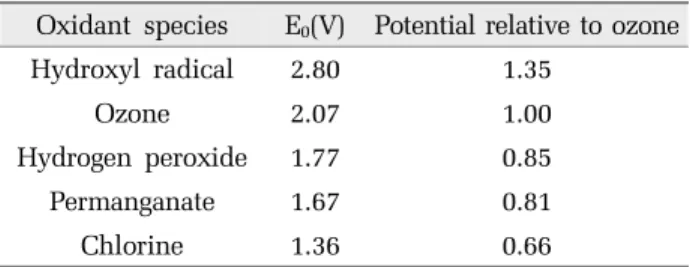
The AOPs increase the production of the hydroxyl radical species and then enhance utilization of ozone in an aqueous solution. The standard redox potentials of ・OH and ozone are 2.80 and 2.07 V, respectively, that ・OH is a more powerful oxidant and thus it reacts more rapidly with many dissolved compounds in the water matrix, than ozone itself (Table 2).
Consequently, the ozone based AOPs accelerate oxidation of any organic matter by combining direct reaction which
Table 2. Standard Oxidation potential (E
0) of some oxidizing agents (Beltran, 2003)
Oxidant species E0(V) Potential relative to ozone
Hydroxyl radical 2.80 1.35
Ozone 2.07 1.00
Hydrogen peroxide 1.77 0.85
Permanganate 1.67 0.81
Chlorine 1.36 0.66
uses O
3molecule and through indirect reaction involving hydroxyl radicals formed from O
3(Jabesa and Ghosh, 2016).
However, the action of ozone decomposition is pH dependent and many researchers found out that in macro bubbles the effect of ozone is negligible under acidic environment. Poor dissolution of ozone in conventional bubbles is compensated by using huge amount of the gas, and this makes the system costly.
Therefore, in addition to the increase in rate of decomposition of ozone in solution by the conventional ozone-based AOPs, improving mass transfer conditions by increasing the gas-liquid contact surface area has become focus of research. Recently, the use of fine and ultra-fine bubbling technologies have been extensively used for improving ozone-based AOPs for water and wastewater treatment. MNBs enhance the ozone mass transfer in water and therefore speed up oxidation of the organic compounds, and also decrease the loss of ozone (Chu et al., 2008; Zheng et al., 2015). In addition to enhancing ozone gas dissolution, ozone MNBs effectively generate hydroxyl radicals that are highly effective in decomposing the organic molecules in both acidic and alkaline water environment (Takahashi et al., 2007; Chu et al., 2008; Khuntia et al., 2013).
Besides mineralization of organic substances, MNBs ozonation is also applied to removal of inorganic materials in water. Khuntia et al. (2013) studied the removal of ammonia, which is major source of undesirable odor, from aqueous solution using Ozone MNBs. They found that microbubble-aided ozonation was a faster process and it can be applied under a wider range of pH, unlike the biological degradation of ammonia. Khuntia et al. (2014) has also shown application of MNBs ozonation to the oxidation of Arsenic, which is one of the most toxic element found in groundwater.
The more toxic form, As (III), was as well effectively oxidized
under wide range of pH in a pilot-plant by using ozone microbubbles. In both ammonia and arsenic oxidation, the intensive generation of radicals by the ozone MNBs enabled the removal under acidic condition.
Table 3 presents the summary of the recently conducted researches on the removal of organic and inorganic matters in water and wastewater. The mineralization cases involving dyestuff are presented in the next section along with color removal.
4. Color removal
Most of the colored contaminants are toxic to humans and they absorb and reflect sunlight, which potentially disturb the aquatic ecosystem. Decolorization is simply the vanishing of color without the actual breaking apart of the complex dye molecules. Therefore, the removal of color does not dictate the degradation of the organic matters contained in the water.
Wastewaters released from industries, such as the textile and dye manufacturing plants, are heavily colored and most of the color causing compounds have high molecular weight and are non-biodegradable in nature. Due to the complicated colour causing compounds contained in the industrial processes, it has become challenging to remove color before the wastewater is released to receiving water bodies. The change in NOM characteristics has also added to the scale of treating color, which is sometimes more than total organic carbon content (Eikebrokk et al., 2004). On the other hand, the addition of a bleach solution could decolorize wastewater, but the colorless waste may still contain organics and could be more toxic than the original colored wastewater. Thus, advanced techniques which result in both color removal and organic matter reduction efficiently are required to satisfy the release standard and the public demand for pollutant free water.
A wide range of biological, physical and chemical processes or a combination of them have been applied for the treatment of dyeing industrial wastewaters. Even though there are some applications of biological color removals, studies have shown that they are time consuming with low removal efficiency.
Particularly, wastewaters bearing Azo dyes, which are the largest class of synthetic dyes used in commercial applications, are highly resistant to biological wastewater treatment. The physico-chemical techniques, such as adsorption, coagulation/
flocculation, membrane nanofiltration and reverse osmosis processes are considered for wastewater dye removal. These methods have substantially removed color from wastewaters, but they also have drawbacks, such as being expensive, selective to some classes of dye, applicable only at narrow pH range, production of excessive sludge, or frequent fouling of membranes, even when they are applied in combination to improve effectiveness.
Alternatively, ozonation has been reported to be very effective in reducing the color of dyestuff wastewater, because it destroys conjugated double bonds which are often associated with color and it avoids sludge generation issue. However, ozonation is not suitable for decolorization of disperse and water-insoluble dyes, its effectiveness is also pH dependent, and its low solubility makes it a costly approach. To overcome the limitations of ozonation system in color removal, different AOPs have been employed. And, the high efficiency of color removal by ozone-based AOPs is well documented.
In addition to ozone molecule being a strong oxidizing agent, the generation of the radical species highly contributes to the high efficiency. Ozone in the presence of H
2O
2or UV as reaction promoter can produce more ・OH radicals and hence enhance decolorization rate. Typically, high pH facilitates oxidation initiated by the radical chain reaction.
However, the pH of the solution may decrease around the dye molecules due to the formation of organic acids as the ozonation products, and the reaction mechanism may shift towards the selective direct oxidation. Due to the fairly limited effect of AOPs involving ozone under acidic environment, the possible generation of undesirable toxic byproducts, as well as the high cost of the process, recently technologies enabling more efficient ozone mass transfer are being considered.
The limitation of the AOPs for decolorization are generally
because of kinetic reaction factor pH and hydrodynamic
mass transfer of course bubbles. These can be overcome
by using MNBs ozonation, which significantly increase the
efficiency of ozonation process due to the larger gas-liquid
interfacial area, less ozone requirement and generation of
intensive hydroxyl radicals. Liu et al. (2011) applied
microbubble using air, oxygen and ozone to compare their
pretreatment effectiveness in coagulation flotation process
of coke wastewater. They confirmed that the generation of most
amount of free radicals by ozone micro-bubbles enabled the most effective and affordable removal of color and organic matters in the coke wastewater. On the other hand, Khuntia et al. (2015) confirmed effective removal of color by microbubbles ozonation under alkaline as well as acidic conditions.
Therefore, decolourisation using ozone microbubbles can be efficiently achieved in integral with mineralization, using a small amount of ozone and even under acidic environment.
Some of the successful researches involving color removal and mineralization using this technique are revised and presented in Table 4.
5. Application to control water pollution in some other areas
Other than the use in degradation, disinfection and odor
removal related to organic and inorganic matters contained in raw drinking water, and industrial and municipal wastewaters, micro- and nano bubble ozonation is successfully applied to enhance sludge solubilization, to treat landfill leachate, and to remove oily and greasy stuff from wastewater.
Reduction of excess sludge has become one of the biggest challenges in biological wastewater treatment to meet the tight related regulations. To this end, ozone microbubbles are effectively applied to enhance sludge solubilization at a lower cost compared to a conventional ozone bubble contactor. Microbes were inactivated rapidly due to the higher hydroxyl radical generation and due to greater than 99% ozone utilization efficiency. The lower off-gas ozone concentration may therefore contribute to a lower size of the unit for treating ozone which remain unused. On the other hand, Liu et al. (2010) applied ozonated-microbubbles Table 4. Effect of ozone Micro- and nanobubbles (MNBs) on various dying wastewaters.
Bubble properties or generator type
Characterization of the wastewater
Target pollutant (parameter monitored)
Result on
Reference Mineralization Color removal
Av. size 25 μm Gas flow 0.5-5
L/min
Pilot plant scale synthetic
aqueous solutions (Brilliant Green dye, BG, mixed in
tap water)
BG (TOC, color)
- ・OH radicals were the dominating oxidizing species in acidic pH, and O3
dominated in alkaline pH.
- TOC removal was ∼80% in 1 h.
- Below detectable limit after 30 min
- Decolourisation efficiency boosted and loss of O3
decreased.
- Effective decolourisation in both acidic and alkaline pH.
Khuntia et al.
(2015)
Av size < 58 μm Gas flow 0.5
L/min
Simulated dyestuff wastewater (azo dye, CI Reactive Black (RB) 5
mixed in deionized water)
RB 5
(TOC, color) - TOC removed per g of O3
consumed was about 1.3 times higher than in bubble contactor.
- TOC removal efficiency 80% at 80 min (only 34%
at 130 min for bubble contactor).
- 30 min taken for 99%
removal (70 min for bubble contactor).
- Very high ozone utilization.
Conc. of off-gas O3 0.04–2.5 mg/L (0.08-74.3 mg/L, bubble contactor).
Chu et al.
(2007)
TCRI-A micro-bubble
floatation device
Raw dyeing wastewater (high
COD, high oil contents, colored
and poor degradability)
(COD, color) - MBs floatation improved COD removal by 30%, compared with conventional air bubble flotation.
- Biodegradability improved due to free radicals.
- Improved color removal by 110%, compared with conventional air bubble flotation.
Liu et al.
(2010)
Microbubbles generated:
utilizing liquid shear stress
Melanoidin aqueous solution
(prepared from glycine and
glucose)
Melanoidin (TOC, color)
- TOC reduction rate increased by ・OH radical generated by ozone self-decomposition.
- Decolorization mainly attributed to direct ozone oxidation.
Yasuda and Ban (2012)