water
ISSN 2073-4441 www.mdpi.com/journal/water Article
Full-Scale Implementation of a Vertical Membrane Bioreactor
for Simultaneous Removal of Organic Matter and Nutrients
from Municipal Wastewater
So-Ryong Chae 1,*, Jin-Ho Chung 2, Yong-Rok Heo 2, Seok-Tae Kang 3, Sang-Min Lee 4 and Hang-Sik Shin 5
1 Department of Biomedical, Chemical and Environmental Engineering, 701 Engineering Research
Center, University of Cincinnati, Cincinnati, OH 45221-0012, USA
2 Daewoo Institute of Construction Technology, Gyeonggi-do 440-200, Korea;
E-Mails: [email protected] (J.-H.C.); [email protected] (Y.-R.H.)
3 Department of Civil Engineering, Kyung Hee University, Gyeonggi-do 446-701, Korea;
E-Mail: [email protected]
4 Department of Environmental Engineering, Kongju National University,
Chungcheongnam-do 330-717, Korea; E-Mail: [email protected]
5 Department of Civil and Environmental Engineering, Korea Advanced Institute of Science &
Technology, Daejeon 305-701, Korea; E-Mail: [email protected]
* Author to whom correspondence should be addressed; E-Mail: [email protected]; Tel.: +1-513-556-4353; Fax: +1-513-556-4162.
Academic Editor: Irene G. Xagoraraki
Received: 10 October 2014 / Accepted: 5 March 2015 / Published: 17 March 2015
Abstract: In nutrient-sensitive estuaries, wastewater treatment plants (WWTPs) are required to implement more advanced treatment methods in order to meet increasingly stringent effluent guidelines for organic matter and nutrients. To comply with current and anticipated water quality regulations and to reduce the volume of produced sludge, we have successfully developed a vertical membrane bioreactor (VMBR) that is composed of anoxic (lower layer) and oxic (upper layer) zones in one reactor. Since 2009, the VMBR has been commercialized (Q = 1100–16,000 m3/d) under the trade-name of DMBRTM for recycling of municipal
wastewater in South Korea. In this study, we explore the performance and stability of the full-scale systems. As a result, it was found that the DMBRTM systems showed excellent
removal efficiencies of organic substances, suspended solids (SS) and Escherichia coli (E. coli). Moreover, average removal efficiencies of total nitrogen (TN) and total phosphorus
(TP) by the DMBRTM systems were found to be 79% and 90% at 18 °C, 8.3 h HRT and 41 d
SRT. Moreover, transmembrane pressure (TMP) was maintained below 40 kPa at a flux of 18 L/m2/h (LMH) more than 300 days. Average specific energy consumption of the
full-scale DMBRTM systems was found to be 0.94 kWh/m3.
Keywords: nutrients; wastewater treatment plants; vertical membrane bioreactor; DMBRTM;
specific energy consumption
1. Introduction
Eutrophication is a key driver causing a number of pressing environmental problems including reductions in light penetration and increases in harmful algal blooms. It is known as that wastewater is an important point source for N and P loading in many aquatic environments [1]. In nutrient-sensitive estuaries, municipal and industrial WWTPs are required to implement more advanced treatment methods in order to meet increasingly stringent effluent guidelines for nutrients. According to literature, biological nutrient removal (BNR) processes that incorporate coupled nitrification/denitrification have the potential to remove TN down to about 5–12 mg/L, in selected cases, down to 3 mg/L. The TN concentration in effluent is known as less than 10 mg/L at most inland municipal WWTPs [2]. However, it is thought difficult to remove bacteria effectively from the effluent of WWTPs using the conventional activated sludge (CAS) process without a disinfection facility.
One of the possible technologies to meet this need is the membrane bioreactor (MBR) [3–6]. Rejection of bacteria by microfiltration (MF) or ultrafiltration (UF) membranes has been shown to be highly effective [7,8]. Additionally, MBR provides absolute separation of hydraulic retention time (HRT) and sludge retention time (SRT), thus allowing more flexible control of the bioreactor [9].MBR systems can offer a solution in highly populated areas, or in areas where land used to disperse bioreactor effluents can be better used for other purposes [10]. Large-scale applications of MBR in urban wastewater treatment will require new technological developments saving energy and space, and producing high quality effluents for further applications [11,12].
In these regards, we developed and optimized a novel VMBR to reduce the problems on pollutant removal from wastewater and the volume of produced sludge from a bench-scale to field-scale systems. The effects of various operating factors such as anoxic zone/oxic zone ratio, internal recycle rate, and HRT on nutrient removal were studied using a bench-scale VMBR (working volume = 32 L) fed with synthetic wastewater containing glucose as a sole carbon source [13]. Under the optimum condition (i.e., anoxic zone/oxic zone ratio = 0.6, HRT = 8 h, and internal recycle rate = 400%), the average removal efficiencies of TN and TP were 75% and 71%, respectively [13]. The effects of water temperature on nutrient removal were evaluated using a pilot-scale VMBR (working volume = 1333 L) treating municipal wastewater. During the continuous operation for one year, average removal efficiencies of TN and TP by the pilot-scale VMBR were found to be 74% and 78% at 8 h HRT, 60 d SRT and various temperatures (13–25 °C) [14,15].
In 2009, the VMBR was commercialized by Daewoo Engineering and Construction under the trade-name of Daewoo MBR (DMBRTM). Currently, six full-scale plants (Q = 1100–16,000 m3/d) are in
operation in South Korea. In this study, we report performance and stability of the full-scale plants for the long-term operation (1–5 years).
2. Materials and Methods
2.1. Operating Conditions of Field-Scale VMBRs
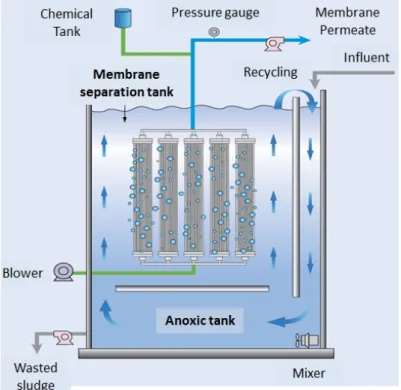
All field-scale DMBRTM systems have been identically designed and operated. The anoxic zone/oxic
zone ratio and internal recycle rate were maintained at 0.6 and 4Q, respectively as reported in the previous study [13]. As shown in Figure 1, influent and mixed liquor of suspended solid (MLSS) that was recycled from the oxic zone were introduced to the anoxic zone through the flow distributors. The aerobic zone is separated from the anoxic zone by a horizontal plate with a hole in the center. In the aerobic zone, disk-type diffusers were used to provide air bubbles (2800 m3/h = 0.42 m3/m2/h) for
oxidation of organic and ammonia and to reduce membrane fouling. Final effluent was withdrawn through 0.45 µm poly-tetrafluoroethylene (PTFE) hollow fiber membranes (Sumitomo Electric Fine Polymer, Inc., Tokyo, Japan). A permeate pump was operated for 9 min on and 1 min off in repeating cycles. After 36 cycles, the membranes was backwashed using permeate (flow rate = 1.5Q) for 1 min. To improve removal efficiency of phosphorus, FeCl3 (33%) was added into the oxic zone at 1.1 mole
Fe/mole P in the feed ratio. Excess sludge was withdrawn from the anoxic zone to maintain SRT. Average HRT of the MBR systems was 8.3 h. MLSS concentration in the bioreactor varied between 8400 and 9600 mg/L depending on SRT (37–45 d) (Table 1).
Figure 1. Schematic diagram of a field-scale DMBRTM system.
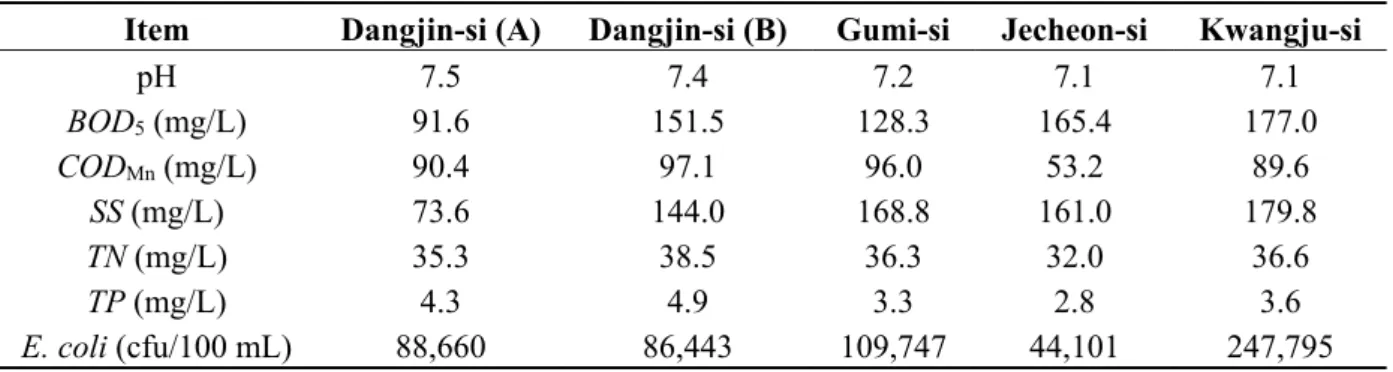
Table 2 shows characteristics of municipal wastewater used for the field-scale DMBRTM systems.
The COD/TN ratio and the COD/TP ratio of influent was found to be 1.8–2.6 and 19.0–29.1, respectively indicating a shortage of carbon for effective nutrient removal.
Table 1. Key information of the DMBRTM systems treating municipal wastewater larger than 1000 m3/d. Location in South Korea Capacity (m3/d) Commission (year) Membrane Area (m2) Water Temperature (°C) HRT (h) SRT (d) MLSS Concentration (mg/L) Dangjin-si (A) 3,500 2009 6,720 17.9 ± 4.5 8.3 41 9,100 Dangjin-si (B) 1,500 2009 2,560 18.1 ± 4.2 7.9 45 9,600 Gumi-si 8,000 2011 15,360 19.1 ± 3.4 8.4 40 8,500 Jecheon-si 1,100 2012 1,920 17.1 ± 5.2 9.2 37 8,900 Kwangju-si 16,000 2013 32,400 19.3 ± 3.9 8.5 38 8,500
Table 2. Characteristics of wastewater for the field-scale DMBRTM systems.
Item Dangjin-si (A) Dangjin-si (B) Gumi-si Jecheon-si Kwangju-si
pH 7.5 7.4 7.2 7.1 7.1 BOD5 (mg/L) 91.6 151.5 128.3 165.4 177.0 CODMn (mg/L) 90.4 97.1 96.0 53.2 89.6 SS (mg/L) 73.6 144.0 168.8 161.0 179.8 TN (mg/L) 35.3 38.5 36.3 32.0 36.6 TP (mg/L) 4.3 4.9 3.3 2.8 3.6 E. coli (cfu/100 mL) 88,660 86,443 109,747 44,101 247,795
2.2. Chemical Cleaning of the Membranes
Two different chemical cleaning schemes were applied for mitigation of membrane fouling in the bioreactor. Firstly, an in-line cleaning is applied once a week for 30 min at 4.96 mL/min/m2 using a
mixture solution of NaOCl (1000 mg/L) and NaOH (100 mg/L). Secondly, an off-line cleaning was conducted if TMP reaches to 60 kPa. For this purpose, the membrane modules was removed from the bioreactor and immersed into a mixture solution of NaOCl (1000 mg/L) and NaOH (2%) for 8 h, and followed by H2SO4 (1%) for 8 h.
2.3. Characterization of Wastewater and Membrane Permeate
SS and MLSS concentrations were determined by vacuum filtration of 100 mL of activated sludge through a pre-dried GF/C filter (Whatman–GE Healthcare, Pittsburgh, PA, USA) and then dried at 105 °C for 2 h. Chemical oxygen demand (CODMn), biochemical oxygen demand (BOD5), total Kjeldahl
nitrogen (TKN), NH4–N, and TP concentrations were analyzed as described in the previous study [14].
Concentrations of various ions such as NO2–N, NO3–N, and ortho-P were analyzed using ion
chromatography (IC) (Dionex DX-120, Sunnyvale, CA, USA) after filtering with a 0.45 µm membrane filter (ADVANTEC MFS Inc., Dublin, CA, USA). Temperature and pH were measured by temperature and pH electrodes connected with a pH meter (Orion Model 420A, Orion Research Inc., Beverly, MS, USA). Average removal efficiency of SS, organic compounds, and nutrients by the DMBRTM systems
as calculated as:
where Cf is the final concentration in the membrane permeate and Ci is the initial concentration in
the influent.
Tryptone-broth was used to enumerate E. coli, which was incubated at 37 °C for 24 h. Removal rejection efficiency of E. coli by the membrane was calculated by the following equation:
Removal efficiency (%) = (1 − NP/Nf)×100 (2)
where Np is colony forming units (cfu) of E. coli per 100 mL in the membrane permeate and Nf is the
cfu of E. coli per 100 mL in the influent. 3. Results and Discussion
3.1. Performance and Fouling Characteristics of the Full-Scale DMBRTM Systems
During the long-term operation of the field-scale DMBRTM systems treating municipal wastewater, it
was found that organic matter (BOD5 > 99%), particles (SS removal efficiency > 99%), and E. coli
(>99.9%) have been effectively removed (data not shown).
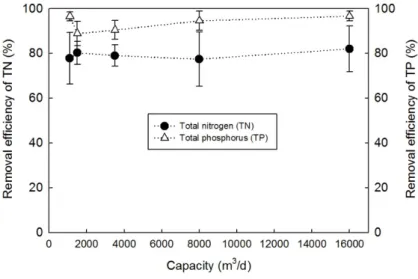
Average removal efficiencies of TN and TP by the DMBRTM system were found to be 79% and 90%
at 18 °C, 8.3 h HRT and 41 d SRT. Interestingly, there is no big change in removal efficiency of nutrients (TN = 78%–82% and TP = 89%–97%) regardless of the system size (Q = 1100–16,000 m3/d) (Figure 2).
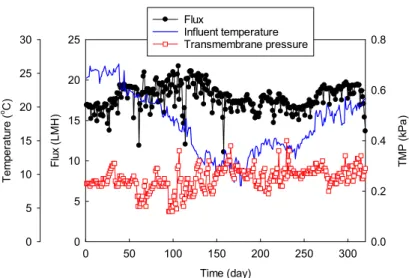
Moreover, the TMP was maintained below 40 kPa with membrane permeate flux at 18 LMH more than 300 days (Figure 3).
Figure 2. Average removal efficiencies of total nitrogen (TN) and total phosphorus (TP) by the full-scale DMBRTM systems (Data obtained from the full-scale DMBRTM systems for
1–5 years depending on operation period of each system).
Table 3 represents performance of full-scale submerged MBR systems treating municipal wastewater. System configuration of the MBR systems are similar to the Modified Ludzack-Ettinger (MLE) process (i.e., pre-denitrification followed by aerobic thank with submerged membranes). At the relatively higher COD/TN ratio (i.e., 8.5 and 17.2), the MLE-type MBRs showed good performance for both N and P removal. However, when the COD/TN ratio is low (i.e., 3.9), P removal efficiency was limited.
Figure 3. Progress of membrane fouling in a field-scale DMBRTM system (Dangjin-si (A),
South Korea).
Table 3. Performance of various submerged membrane bioreactor (MBR) systems treating municipal wastewater. MBR Type Capacity (m3/d) Operating Conditions Influent Characteristics (mg/L) TN Removal (%) TP Removal (%) Influent COD/TN Ratio Reference MLE 1,375 HRT = 33 h SRT = n.a. BOD = 114 TN = 29 TP = 3.4 78 50 3.9 a [11] MLE 2,400 HRT = 16.6 h SRT = 40 d COD = 447 NH4-N = 26 TP = 7.3 99 91 17.2 b [16] MLE 6,520 HRT = 3.5–5 h SRT = 14–21 d COD = 220 TN = 26 TP = 3.9 70 92 8.5 [17] Verical MLE 1,100–16,000 HRT = 7.9–9.2 h SRT = 37–45 d COD = 53–97 TN = 32–39 TP = 2.8–4.9 78–82 89–97 c 1.7–2.6 This study
Notes: a BOD/TN ratio; b COD/NH
4-N ratio; c The chemical precipitation was employed using FeCl3; n.a.: data
was not available.
As shown in Table 3, the DMBRTM system showed competitive performance for nitrogen removal
compared to other MBR systems even at the relatively low influent COD/TN ratio (<3). However, P removal efficiency of the DMBRTM was below 50% (data not shown) at the low COD/TN ratio. To
enhance the removal efficiency of P, FeCl3 (1.1 mole Fe/mole P in the feed) was introduced into the
aerobic tank resulting in 89%–97% removal of phosphorus. 3.2. Chemical Dosage and Excess Sludge Production
Because of the unique feature of MBRs and particularly the significant decrease in membrane price, MBRs have been increasingly and widely used for wastewater treatments in the last decade [12,16,17].
Time (day) 0 50 100 150 200 250 300 Fl ux ( LMH ) 0 5 10 15 20 25 T em perat ur e ( o C) 0 5 10 15 20 25 30 TM P ( kP a) 0.0 0.2 0.4 0.6 0.8 Flux Influent temperature Transmembrane pressure
However, despite these developments and applications of MBRs, energy demand together with frequent membrane cleaning remain a challenge in terms of energy consumption and optimization of MBRs [9]. Energy demand of full-scale CAS processes for municipal wastewater treatment, expressed per volume of treated wastewater was reported to be in the range of 0.1–0.6 kWh/m3 [18]. However, energy
consumption of MBRs was generally higher due to intensive membrane aeration rates required to mitigate membrane fouling and clogging than that of CAS systems. Typical energy demand values for full-scale MBR systems are reported to be in the range of 0.4–2.0 kWh/m3 [11,18].
The energy requirement of the DMBRTM systems was in the range of 0.8–1.0 kWh/m3 (data not
shown). The specific energy consumption of the full-scale DMBRTM systems was averaged at
0.94 kWh/m3. This is slightly higher than that of the CAS systems and some MBRs mainly due to
addition of FeCl3 for enhanced phosphorus removal.
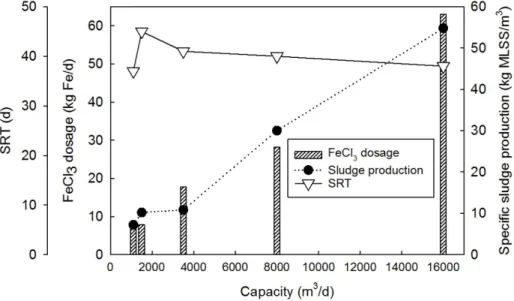
On the other hand, waste activated sludge (WAS) from CAS processes is one of the most serious problems in wastewater treatment [19]. It has been known that extremely low sludge production (0.05–0.25 kg mixed liquor of volatile suspended solid (MLVSS)/kg COD) is possible for low food-to-microorganism (F/M) ratios and long SRT in MBRs [20]. In this study, FeCl3 was introduced to
improve P removal efficiency. However, as FeCl3 dosage increased from 8 to 63 kg/d, the observed
sludge yield of the full-scale DMBRTM systems was also increased from 7.2 to 54.8 kg MLSS/m3 (or
from 0.92 to 6.3 kg MLVSS/kg COD) (Figure 4).
Figure 4. FeCl3 dosage and sludge production from the full-scale DMBRTM systems.
4. Conclusions
Since 2009, five full-scale vertical MBR plants (Q = 1100–16,000 m3/d) have been successfully in
operation to reduce the problems concerning effective removal of nitrogen and phosphorus from municipal wastewater for water recycling. Particles (i.e., SS), organic substances (i.e., BOD5 and
CODMn), and bacteria (i.e., E. coli) were effectively removed (>99%) by the MBR systems. TN and TP
removal efficiencies of the MBR plants were found to be 78%–82% and 89%–97%, respectively at 7.6–9.2 h HRT and 37–45 d SRT. However, the introduction of FeCl3 for improvement of phosphorus
removal efficiency resulted in relatively high sludge production compared to the conventional MBRs without chemical precipitation.
A stable operation was possible by applying the weekly in-line cleaning using a mixture of NaOCl and NaOH without significant increase in TMP (<40 kPa) for approximately one year with the average energy consumption of 0.94 kWh/m3. Recycling and reuse of P removed by FeCl3 will be beneficial to
the MBR operation. Acknowledgments
This study was supported by Korea Ministry of Environment as The Eco-Innovation project (Global Top project, Project No. GT-SWS-11-01-002-0).
Author Contributions
So-Ryong Chae, Jin-Ho Chung, Yong-Rok Heo, Seok-Tae Kang, and Sang-Min Lee carried out the experiments and wrote the paper; Hang-Sik Shin contributed to the analysis of the experiment data and edited of the manuscript.
Conflicts of Interest
The authors declare no conflict of interest. References
1. Mesfioui, R.; Love, N.G.; Bronk, D.A.; Mulholland, M.R.; Hatcher, P.G. Reactivity and chemical characterization of effluent organic nitrogen from wastewater treatment plants determined by fourier transform ion cyclotron resonance mass spectrometry. Water Res. 2012, 46, 622–634. 2. Grady, C.P.L., Jr.; Daigger, G.T.; Love, N.G.; Filipe, C.D.M. Biological Wastewater Treatment;
IWA Publishing–CRC Press: Boca Raton, FL, USA, 2011.
3. Huang, X.; Xiao, K.; Shen, Y.X. Recent advances in membrane bioreactor technology for wastewater treatment in china. Front. Environ. Sci. Eng. China 2010, 4, 245–271.
4. Santos, A.; Judd, S. The commercial status of membrane bioreactors for municipal wastewater. Sep. Sci. Technol. 2010, 45, 850–857.
5. Le-Clech, P. Membrane bioreactors and their uses in wastewater treatments. Appl. Microbiol. Biotechnol. 2010, 88, 1253–1260.
6. Van Nieuwenhuijzen, A.F.; Evenblij, H.; Uijterlinde, C.A.; Schulting, F.L. Review on the state of science on membrane bioreactors for municipal wastewater treatment. Water Sci. Technol. 2008, 57, 979–986.
7. Tai, C.S.; Snider-Nevin, J.; Dragasevich, J.; Kempson, J. Five years operation of a decentralized membrane bioreactor package plant treating domestic wastewater. Water. Pract. Technol. 2014, 9, 206–214.
8. Arevalo, J.; Ruiz, L.M.; Parada-Albarracin, J.A.; Gonzalez-Perez, D.M.; Perez, J.; Moreno, B.; Gomez, M.A. Wastewater reuse after treatment by MBR. Microfiltration or ultrafiltration? Desalination 2012, 299, 22–27.
9. Meng, F.G.; Chae, S.R.; Drews, A.; Kraume, M.; Shin, H.S.; Yang, F.L. Recent advances in membrane bioreactors (mbrs): Membrane fouling and membrane material. Water Res. 2009, 43, 1489–1512.
10. Chae, S.-R.; Ahn, Y.; Hwang, Y.; Jang, D.; Meng, F.; Shi, J.; Lee, S.-H.; Shin, H.-S. Advanced Wastewater Treatment Using Mbrs: Nutrient Removal and Disinfection; Iwa Publishing: London, UK, 2014; pp. 137–163.
11. Itokawa, H.; Tsuji, K.; Yamashita, K.; Hashimoto, T. Design and operating experiences of full-scale municipal membrane bioreactors in japan. Water Sci. Technol. 2014, 69, 1088–1093. 12. Meng, F.G.; Chae, S.R.; Shin, H.S.; Yang, F.L.; Zhou, Z.B. Recent advances in membrane
bioreactors: Configuration development, pollutant elimination, and sludge reduction. Environ. Eng. Sci. 2012, 29, 139–160.
13. Chae, S.R.; Kang, S.T.; Watanabe, Y.; Shin, H.S. Development of an innovative vertical submerged membrane bioreactor (VSMBR) for simultaneous removal of organic matter and nutrients. Water Res. 2006, 40, 2161–2167.
14. Chae, S.R.; Shin, H.S. Characteristics of simultaneous organic and nutrient removal in a pilot-scale vertical submerged membrane bioreactor (VSMBR) treating municipal wastewater at various temperatures. Process Biochem. 2007, 42, 193–198.
15. Chae, S.R.; Shin, H.S. Effect of condensate of food waste (CFW) on nutrient removal and behaviours of intercellular materials in a vertical submerged membrane bioreactor (VSMBR). Bioresour. Technol. 2007, 98, 373–379.
16. Silva, A.F.; Carvalho, G.; Oehmen, A.; Lousada-Ferreira, M.; van Nieuwenhuijzen, A.; Reis, M.A.M.; Crespo, M.T.B. Microbial population analysis of nutrient removal-related organisms in membrane bioreactors. Appl. Microbiol. Biotechnol. 2012, 93, 2171–2180.
17. Wan, C.Y.; de Weyer, H.; Diels, L.; Thoeye, C.; Liang, J.B.; Huang, L.N. Biodiversity and population dynamics of microorganisms in a full-scale membrane bioreactor for municipal wastewater treatment. Water Res. 2011, 45, 1129–1138.
18. Krzeminski, P.; van der Graaf, J.; van Lier, J.B. Specific energy consumption of membrane bioreactor (mbr) for sewage treatment. Water Sci. Technol. 2012, 65, 380–392.
19. Guo, W.Q.; Yang, S.S.; Xiang, W.S.; Wang, X.J.; Ren, N.Q. Minimization of excess sludge production by in-situ activated sludge treatment processes—A comprehensive review. Biotechnol. Adv. 2013, 31, 1386–1396.
20. Wang, Z.W.; Yu, H.G.; Ma, J.X.; Zheng, X.; Wu, Z.C. Recent advances in membrane bio-technologies for sludge reduction and treatment. Biotechnol. Adv. 2013, 31, 1187–1199.
© 2015 by the authors; licensee MDPI, Basel, Switzerland. This article is an open access article distributed under the terms and conditions of the Creative Commons Attribution license (http://creativecommons.org/licenses/by/4.0/).