181
작물병원 진균에 대하여 항균 활성을 보이는 Paenibacillus polymyxa DY5의
동정 및 특성
김효윤1·원항연2·김완규3·유관희4*
1안동대학교3 자연과학대학 생명과학과
,
2농촌진흥청 국립농업과학원유전자원센타,
농촌진흥청 농업과학원 농업미생물과
,
4*상지대학교이공과대학 생명과학과Identification and Characterization of Paenibacillus polymyxa DY5 with Antifungal Activity against Crop Pathogenic Fungi
Hyo Yoon Kim
1, Hang Yeon Weon
2, Wan Gyu Kim
3and Kwan Hee Yoo
4∗
1
Department of Biology, Andong University.
2
National Agrobiodiversity Center, National Academy of Agricultural Science, RDA, Suwon, 441-707, Korea.
3
Agricultural Microbiology Division, National Academy of Agricultural Science, RDA. Suwon, 441-707, Korea.
4Department of Life Science, Sangji University, Wonju 220-702, Korea.
(Received November 23, 2009. Accepted December 17, 2009)
ABSTRACT: A Gram-positive, rod-shaped bacteria named DY5 was isolated from a peat sample collected from Daeam mountain in Korea. The culture filtrate of the bacterial isolate DY5 showed a broad spectrum of antifungal activity on various crop pathogenic fungi such as Trichoderma koningii , Fusarium oxysporum , Colletotrichum gloeosporioides , Sclerotinia sclerotiorum , Rhizoctonia solani AG-1(IA) For the identification of the DY5, morpho- logical, biochemical, API 50 CHB test, analysis of fatty acid and molecular phylogenetic approaches were per- formed. The DY5 was found to be a member of the genus Paenibacillus on the basis of morphological and biochemical analysis. The 16S rRNA of DY5 showed high similarity(98%) with Paenibacillus polymyxa. On the basis of these results, the DY5 was identified as Paenibacillus polymyxa. Antifungal substance of the DY5 would be mild alkaline proteine molecule. The DY5 seems to have a great potential to be a biocontrol agent against various crop pathogens.
KEYWORDS: Antifungal substance, Biocontrol agent, Crop pathogens, Paenibacillus polymyxa , 16S rRNA
농작물생산증대는인류의생존을위해중대한과제이다
.
경제작물을 비롯하여저장 곡류 및과일 등에 막대한손 실을 초래하는 병충해를 효과적으로방제하는 것은 농업 생산성 향상을 위해 매우 중요하다
.
현재 수많은 종류의다양한 병충해방제용 유기합성화학약제가 각나라마다 등록되어있다
(
이등, 2008; Wheeler, 2002).
오늘날 사용되고 있는 유기합성농약은 주로 유기인산
ester
계, carbamate
계, pyrethroid
계,
염소계유기합성화합물들이다
.
세계적으로 이러한 유기합성농약이 대량으로사용되어식량증산이현저히증대되었으나
,
지나치게남용하여그폐해또한심각하다
(
이등, 2008; Takama, 2008).
유기합성농약은살충효과가강하고
,
가격이저렴하여경제성이뛰어나다
.
그러나해충에대한방제효과가일시적이고,
환경에서 자연적으로분해가잘되지않고
,
먹이연쇄에의해먹이사슬상위생물체내에축적
,
인축독성을유발하기때문에이를방지하기위한제도적인규제들이점차강화되고있다
(Bale et al ., 2008; Hiroshi, 1996).
또한지구의오염
,
생태계파괴,
잔류독성으로인한환경오염
,
지하수및식수오염등의문제가제기되고있다.
특히2, 4, 5 - Trichlorophenoxy acetic acid
는38
주, aldrin, chlodane,
lindane
등은15
년 동안이나 잔류되고 있어 심각한 토양오염을유발하며
(Casida, 2009; Hiroshi, 1995),
농약의장기간 사용으로 화학 살충제에 저항성을나타내는 해충도 등장하였으며
(Bravo and Soberon, 2008),
유기염소계및유기인계유기합성농약은정상적인대사기능을방해하는환경성 내분비교란물질
(
환경호르몬)
로작용하여심각한문제를야기하고있다
(Bretveld et al ., 2006).
이러한문제점을극복하기위한새로운방법으로환경과 조화를이루는 저항성품종 개발
,
경종적방제,
생물학적방제제로이용되는미생물농약등의개발에대한연구가 수행되었다
(Bai and Shaner, 2004; Montesinos, 2003).
오늘날유기합성농약을가급적적게사용하고
,
보다안전*Corresponding author <E-mail : [email protected] >
하며 자연계에서 생분해능이 좋은 살충성물질과 해충에 병원성을 갖는 길항미생물또는 이들이 생산하는 항생물 질을이용하려는생물적방제법에대한연구가지속적으로 이루어지고있다
(
이등, 2008; Fravel, 2005).
미생물 살충제로는 곤충
virus
인Baculovirus (Cheng and Lynn, 2009),
세균( Bacillus thuringiensis : BT)
의독소단백질(
길등
, 2007;
남등, 2004;
이등, 2006; Rosas-Garcia, 2009),
진균류
(Fernandes and Bittencourt, 2008; Lacey and Shapiro- Ilan, 2008)
및동충하초(
남등, 2004; Holder and Keyhani, 2005; Vu et al ., 2008)
등을이용한생물적방제에관한연구가 진행되었으며
,
진균을 이용한 토양선충의 방제(Jegathambigai et al ., 2008),
중복기생방법을이용한식물성병원균인진균의방제
(
신, 1994)
와버섯의항진균및항세균성 물질의탐색
(Gilardoni et al ., 2007; Quang et al ., 2006)
등에대해연구되었다.
생물농약은전체농업용화학물질의약
1%
를점유하고있다
(Fravel, 2005).
유럽및지중해작물보호기구(European and Mediterranean Plant Protection Organization (EPPO))
의2008
년보고서인Standards on Safe use of Biological Control - PM 6/3(3) - Version 2008, List of biological control agents widely used in the EPPO region
에의하면2008
년시점으로약
100
종의생물종이 상품화되어생물학적인방제의목적으로유럽지역에서널리사용되고있다
(EPPO, 2009).
생물적방제제로이용되는미생물농약은현지의기후풍토나 토양환경 조건 등
,
생태계환경에크게 영향을받으므로,
해당지역환경에따른활성의차이가크다고알려져있다
.
따라서 우리나라 기후나토양환경에맞는 생물농약의개 발이 절실히필요하다
.
최근 일부 외국 제조회사나 특허전문기업들이우리나라제조업체에지나친특허료를징수 하고
,
지적소유권분쟁을일으키는사례가많으며,
이러한상황에서우리고유의농업원천기술의확보는매우중요 하다
.
본연구에서는국내기후와환경에적합하고미생물농약으로사용할수있는새로운항진균물질생산균주를 선별하고 동정하였으며
,
새로운미생물농약으로서의가능성에대한기초자료를확보하고자하였다
. 재료 및 방법
실험재료 채집
강원도양구군에위치한대암산용늪주변에서산림이잘보 존되어 있는 활엽수림의
50
장소를 선정하여,
멸균된시약스푼으로
2~5cm
깊이의토양을약50~100g
채취하였다.
채취된토양을멸균된비닐봉지에넣어
Ice box
에보관하여실험실로옮겨
4
냉장고에보관하면서항균물질을생산하는균주를분리하기위한실험재료로사용하였다
.
실험 균주 및 배지
순수 분리된
Paenibacillus polymyxa DY5
의 항균활성을 알아보기위하여 국립농업과학원에서분양받은
5
종의작물병원균을실험균주로사용하였다
(Table 1).
실험에 사용한배지는 균 보존배지로
Nutrint agar(NA), Potato dextrose agar(PDA)
배지를사용하였고,
길항균주를분리하기 위한 배지로 선택배지
(Selestive media)
를 사용하였으며
,
세균의증균용배지로Nutrint broth(NB), Brain heart infusion(BHI), Muller hinton(MH)
배지를,
진균의 증균용배지로
Potato dextrose broth(PDB)
배지를사용하였다.
실험균주의 순수 분리
채취한토양
1g
을멸균증류수9ml
에넣고30
분간150rpm
으로교반하여얻은상등액을
80
oC
에서10
분간열처리하였다
.
이상등액을1,000
배로희석한다음,
희석액0.1ml
을선택배지
(SM: 4
µg/ml penicillin G, 5
µg/ml polymixin B sulfate)
에도말하고28
oC
에서48
시간배양하였다.
선택배지에서생장한각각의 집락을백금이로 취하여
NB
배지에1
백금이접종하여30
oC
에서48
시간배양한후,
배양액의일부는 균의 동정에 사용하였고
,
남은 일부는 항균물질생산여부를확인하는데사용하였다
.
항균물질 활성 측정
(
디스크 확산법)
PDA
배지중앙에작물병원균을접종한후,
접종한병원균의상
,
하,
좌,
우로1cm
떨어진곳에멸균된paper disk(
직경6mm)
를놓고, disk
위에48
시간배양된배양여과액을50
µl
떨어뜨린다음
27
oC
에서48
시간배양한후,
생장억제대(
투명환
)
의직경을측정하여항균물질의활성을조사하였다.
항균물질 생산균주의 동정
항균물질생산균주의형태적특성을알아보기위하여
NA
배지에
24
시간배양한균주를그람염색하여균의크기,
모양및
parasporal cystal
형성등의형태학적특성을조사하였으며
,
전자현미경(SEM; Hitachi S 0570, Japan)
을이용하여균의형태를검경하였다
.
생화학적특성을알아보기위하여
API 20E kit(Bio Merieux Co, France)
시험과API 50 CHB kit(Bio Merieux Co, France)
시험을시행하였다
. API kit
시험을위하여BHI
액체배지에균주를 접종한후
35
oC
에서18~24
시간 배양한 배양액을사용하였으며
, API 50 CHB kit
와API 20E kit
의사용은제조사의표준적인 실험방법에따라실험하였다
.
실험결과는
30
oC
에서2
일간배양한후판독하였다. Table 1. Fungi tested in this study
Isolate No. Fungi
KACC40779 Trichoderma koningii
KACC40896 Colleototrichum gloeosporioides KACC40037 Fusarium oxysporium
KACC40457 Sclerotinia sclerotiorum
KACC40101 Rhizoctonia solani AG-1(IA)
항균물질생산균주를동정하기위하여
16S rRNA
염기서열분석
(Baker et al ., 2003)
과 지방산분석(Yoon et al .,
2003)
을시행하여균을동정하였다.
항균물질생산균주의동정은
Bergey’s Manual of Systematic Bacteriology (David and Castenhol, 2001)
와The Genus Bacillus (Gordon et al ., 1973)
의 분류키를 이용하여속을결정하였다
.
아울러16S rRNA
유전자염기서열결과와Reva
등
(2001)
의호기성 포자형성 균의 분류키에 따라 균주를동정하였다
.
항균물질의 온도에 대한 안정성 분석
항균물질의온도에대한안정성을알아보기위하여
,
항진균물질을
10
oC
에서60
oC
까지10
oC
간격으로각각의온도에서30
분반응시킨후,
디스크확산법으로생장억제대의직경을측정하여온도에대한안정성을조사하였다
.
항균물질의 pH에 대한 안정성 분석
항균물질의
pH
에 따른 안정성을 알아보기 위하여, acetate buffer(pH 3-5), phosphate buffer(pH 6-8), Tris buffer(pH 9-11)
를사용하였다.
각각의
buffer 50
µl
와항균물질이포함된배양여과액50
µl
를 혼합한 다음
30
oC
에서30
분 반응시킨 후 디스크확산법으로생장억제대의직경을측정하여
pH
에대한 안정성을조사하였다
.
단백질 분해효소에 대한 영향
항균물질의단백질분해효소에대한영향을알아보기위 하여
25
µg/ml, 50
µg/ml, 75
µg/ml, 100
µg/ml
의proteinase K
용액을제조하였다
.
각각의
proteinase K
용액50
µl
와동량의항진균물질을 혼합한다음30
oC
에서30, 60, 90, 120
분반응시킨후,
디스크확산 법으로생장억제대의 직경을측정하여 단백질분 해효소에대한영향을조사하였다
.
항균물질의 적용실험
Paenibacillus polymyxa DY5
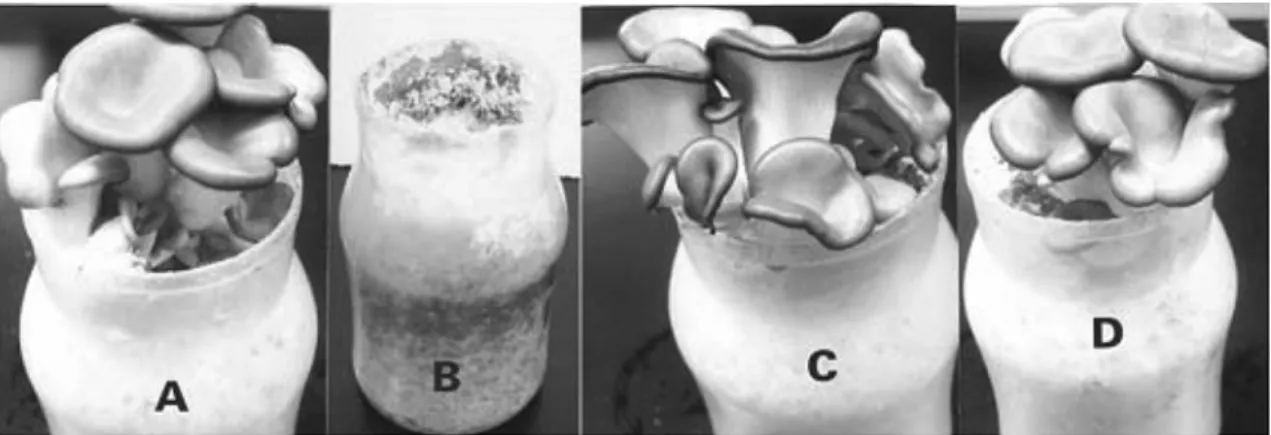
균주가 생산하는 항균물질을 생물농약으로 사용할수있는 지를알아보기 위하여 느타리버섯푸른곰팡이병을유발하는
Trichoderma koningii
균을사용하여적용실험을하였다
.
느타리버섯종균을접종하여
7
일간배양시켜느타리버섯균사체가생장한
4
개의병배지에아무것도처리하지않은것
(A), Trichoderma koningii
를처리한것(B),
항균물질을포함하고 있는 배양여과액을 처리한 것
(C), Trichoderma
koningii
와항진균물질을포함하고있는배양여과액을함께처리한것
(D)
등4
개의실험구를설정하여22
oC
에서10
일간더배양하여균사체를생장시켰다
.
균사체를생장시킨병배지를
15
oC
에서14
일간배양하여,
균사체가 병 배지의
3/4
이상으로 자랐을 때 균 긁기를시행하고
,
상대습도가90%
이상이고통기가잘되는15
oC
배양기에서배양하여자실체형성에미치는영향을조사하 여
, Paenibacillus polymyxa DY5
균주가 생산하는 항균물질을생물농약으로사용할수있는지를알아보았다
. 결과 및 고찰
항균물질 생산균주의 분리
선택배지
(penicilline G 4
µg/ml, polymyxin B sulfate 5
µg/ml)
를이용하여,
항진균물질을생산하는총11
균주를분리하였으며
,
이균주를DY1
에서DY11
로명명하였다.
분리한
11
균주 중DY5
균주가작물병원균에 대한 생장억제효과가가장높은것으로나타났다
. DY5
균주를배양한후원심분리하여 얻은 상등액을 느타리버섯 푸른곰팡이병균
( Trichoderma koningii ),
시들음병균( Fusarium oxysporum ),
탄저병균
( Colletotrichum gloeosporioides ),
균핵병균( Sclerotinia sclerotiorum ),
잎집무늬마름병균[ Rhizoctonia solani AG- 1(IA)]
이접종된PDA
평판배지에50
µl
씩떨어뜨린후디 스크확산법으로27
oC
에서48
시간배양후,
생장억제대(
투명환
)
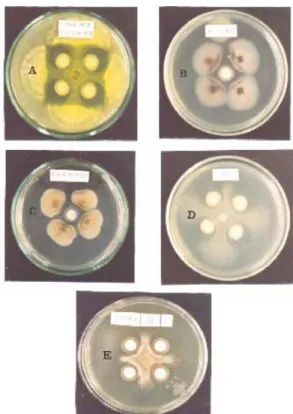
를조사한결과, DY5
균주는5
종의진균생장에강한억제력을나타냈다
(Fig. 1).
Fig. 1. Antagonistic effects of the isolated DY5 against five crop pathogenic fungi. Antagonistic effects are shown by the inhibition zones formed around disk papers on the PDA cultures.
A, Trichoderma koningii ; B, Fusarium oxysporum ; C,
Colletotrichum gloeosporioides ; D, Sclerotinia sclerotiorum ;
E, Rhizoctonia solani AG-1(IA).
분리균주의 동정
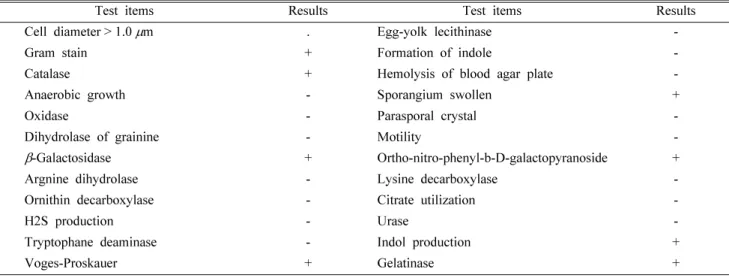
형태및생화학적특성분석에서
DY5
균주의크기는1
µm
이상이었으며
, catalase
및 β-galactosidase
효소활성도검사에서 양성반응을 나타냈다
(Table 2).
그람염색반응을통하여그람양성균으로확인되었으며
(Fig. 2A),
혐기성조건성장여부
, egg-yolk lecithinase
활성도, hemolysis
여부,
운동성
, oxidase
활성도반응 등에서모두음성으로 나타났고
(Table 2),
위상차현미경 및SEM
으로 검경한 결과타원형의내성포자
(endospore)
를형성하는간균임을확인하였다
(Fig. 2B, 2C).
또한
,
항균물질 생산균주를 동정하기 위하여 당으로부터 산생성능을 알아보는
API 50 CHB test
를 시행하였다. API 50 CHB test
를시행하여49
종류의당으로부터산생성능을조사한결과
L-arabinose
등24
종의당에는양성반응을 나타냈으나
, erythritol
등25
종의 당에는 음성반응을나타냈다
(Table 3). API 50 CHB test
결과를이용하여균주를 동정한 결과
DY5
균주는Bacillus circulans
에89.6%, Paenibacillus polymyxa
에98.8%
의유사도를나타냈다
.
장내세균인지를알아보기위하여API 20E test
를한결과
ONPG(Ortho-nitro-phenyl-b-D-galacctopyranoside) test, IND(Indol production) test, VP(Voges - Proskauer)
시험
, GEL(Gelatinase)
반응에서는양성반응을나타냈으며, ADH(Argine dihydrolase) test, LDC(Lysine decarboxylase) test, ODC(Ornithin decarboxylase) test, CIT(Citrate utilization) test, H
2S
생성반응, URE(Urase) test, TDA(Tryptophane deaminase)
반응에는음성반응을나타내어(Table 2) DY5
균주는장내세균이아닌것으로판별되었다
.
지방산 분석
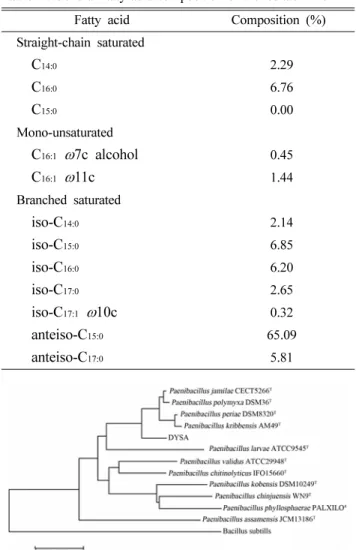
세포내 지방산 분석에서
DY5
균주 내에는 주로iso-
branched fatty acid
와ante iso-branched fatty acid
로구성되어있으며
,
그중C
15:0ante iso-fatty acid
가65.09%
로가장높은함유량을보이며
, C
15:0iso-fatty acid
를6.85%, C
16:0iso-
fatty acid
를6.76%
함유하고있음을확인하였다(Table 4).
균주내지방산조성분석결과분리균주
DY5
는다른Gram
양성균들의특징인
iso-type
과ante iso-type
지방산이주요구성성분이었으며
, ante iso-type
이iso-type
에비해큰비중을차지하고 있음을 확인하였다
.
이들 지방산 조성을MIDI library
에서 동정한 결과DY5
균주는Paenibacillus
속(genus)
에속하는균주로확인되었다.
이결과는Yoon
등(2003)
이P. kribbensis
와P. terrae
균주의세포내지방산분석에서
anteiso C
15:0 이주요지방산으로구성되어있다는Table 2. Morphological and biochemical characteristics of the bacterial isolate DY5
Test items Results Test items Results
Cell diameter > 1.0
µm . Egg-yolk lecithinase -
Gram stain + Formation of indole -
Catalase + Hemolysis of blood agar plate -
Anaerobic growth - Sporangium swollen +
Oxidase - Parasporal crystal -
Dihydrolase of grainine - Motility -
β
-Galactosidase + Ortho-nitro-phenyl-b-D-galactopyranoside +
Argnine dihydrolase - Lysine decarboxylase -
Ornithin decarboxylase - Citrate utilization -
H2S production - Urase -
Tryptophane deaminase - Indol production +
Voges-Proskauer + Gelatinase +
Fig. 2. Microphotographs of the bacterial isolate DY5.
A, Gram stain(×1,000); B, phase-contrast(×2,000); C,
scanning electron microscope(×5,000).
보고와일치하고있다
.
16S rRNA 분석을 통한 계통분석
PCR
로 얻은1,445 bp
의16S rRNA
유전자염기서열(Fig. 3)
은NCBI BLAST
검색결과Paenibacillus polymyxa
균주의
16S rRNA
유전자 염기서열(accession number AY
359632)
과98%
이상의 유사성을 나타내었다.
계통분석결과
DY5
균주는P . polymyxa, P. jamilae, P. peoriae, P.
kribbensis
와유연관계가매우높은것으로나타났다.
이상의형태및생리생화학시험에기반한분류키검색
(Reva et al ., 2001)
등,
계통분류학적결과를종합하여DY5
균주는기존의
Paenibacillus polymyxa DSM36
균주와98%
이상의유사성을나타내는새로운균주로판명되었다
.
Phaenibacillus
는새로운속으로1993
년Ash
등의연구에서제안된이후많은연구가이루어지지않은균주로
,
발효된쏘세지
(Piuri et al ., 1998),
폐수(Aguilera, 2001),
부엽토(Elo et al ., 2001),
토양(Yoon et al ., 2003),
멸치젓갈(Mah et al ., 2003),
강어귀습지
(Bae et al ., 2009)
등에서분리되었다.
이균주가다양한생태적환경에서분리된것으로보아
,
이 세균의생태적환경에대한조사가더이루어져야될것이다
.
발효소세지에서분리된
Paenibacillus polymixa
는 항균 활성을보였으며(Piuri et al ., 1998), Paenibacillus polymixa SCE2
는인체병원균에억제력을보였고(Seldin et al ., 1999),
식품에서분리된
Paenibacillus
는식중독균에항균력을보여주었다
(Girardin et al ., 2002). Paenibacillus peoriae strain
NRRL BD-62
는식물병원균들에광범위한항균력을보여주었으며
(Weid et al ., 2003),
식물의 근권에서 분리된Paenibacillus brasilensis Sa3
는식물병원균Cryptococcus neoformans
에저항성을가진항균물질을생산하였다(Fortes et al ., 2008).
새로운종류의항생물질과polymyxin
을동시에생산하는
Paenibacillus polymyxa strain
이분리동정되었으며
(He et al ., 2007),
두 가지 종류의peptide
항생제를동시에생산하는
Paenibacillus alvei NP75
가보고되었다Table 3. Acid production of the isolate DY5 from carbohydrates
(API 50 CHB)
Carbohydrate source Utilization Carbohydrate source Utilization
Glycerol - Salicin +
Erythritol - Celibiose +
D-arabinose - Maltose +
L-arabinose + Lactose +
Ribose + Melibiose +
D-xylose + Sucrose +
L-xylose - Trehalose +
Adonitol - Inulin +
β
-Methyl-D-Xylose - Melezitose -
Galactose + Raffinose +
Glucose + Starch +
Fructose + Glycogen +
Mannose + Xylitol -
Sorbose - Gentiobiose +
Rhamnose - D-turRanose +
Dulcitol - D-lyxose -
Inositol - D-tagatose -
Mannitol - D-fucose -
Sorbitol - L-fucose -
α
-Methyl-D-Mannoside + D-arabitol -
α
-Methyl-D-Glucoside - L-arabitol -
N-Acetyl-Glucosamine - Gluconate -
Amygdalin + 2-Keto-Gluconate -
Arbutin + 5-Keto-Gluconate -
Esculin +
Table. 4. Cellular fatty acid composition of the isolate DY5
Fatty acid Composition (%)
Straight-chain saturated
C
14:02.29
C
16:06.76
C
15:00.00
Mono-unsaturated
C
16:1 ω7c alcohol 0.45
C
16:1 ω11c 1.44
Branched saturated
iso-C
14:02.14
iso-C
15:06.85
iso-C
16:06.20
iso-C
17:02.65
iso-C
17:1 ω10c 0.32
anteiso-C
15:065.09
anteiso-C
17:05.81
Fig. 3. Phylogenetic dendrogram constructed from a comparative
analysis of 16S rRNA gene sequences showing the
relationships between the isolate DY5 and related
species of the genus Paenibacillus .
(Anandaraj et al ., 2009).
항균물질의 특성
Paenibacillus polymyxa DY5
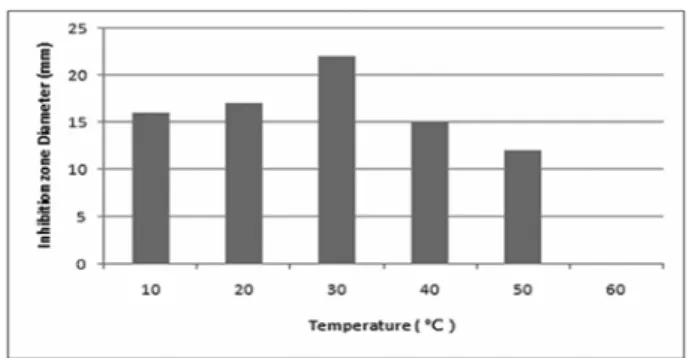
균주에서생산되는항균물질의온도에대한안정성을조사한결과
30
oC
에서30
분반응시켰을 때
,
최대 활성인22 mm
의 억제 환을 나타냈으며,
40
oC
와50
oC
에서도활성이있는것으로나타났다.
하지만60
oC
에서는전혀활성이나타나지않아(Fig. 4),
이물질은열에불안정한저온및중온성물질로판단된다
.
pH
에대한안정성을조사한결과pH 3, 4, 5
에서는항진균활성이전혀나타나지않았으나
, pH 6, 7, 8, 9
에서는30
분동안반응시pH 9
에서23 mm
의최대억제환을나타낸것으로보아
(Fig. 5)
이물질은호알칼리성(Alkalophilic)
물질로판단된다
.
단백질분해효소에대한영향을조사한결과
Paenibacillus polymyxa DY5
가생산하는항균물질은proteinase K
의용해농도가
25
µg/ml, 50
µg/ml, 75
µg/ml, 100
µg/ml
으로 높아질수록 활성이 낮아지는 것으로 나타났다
(Fig. 6).
이실험결과로
Paenibacillus polymyxa DY5
균주가생산하는항진균물질은단백질성물질로판단된다
.
항균물질의 적용시험
항균물질이실제로느타리버섯푸른곰팡이병균인
Trichoderma
koningii
에대해 방제효과가있는지를알아보기위하여적용실험을 시행한 결과
, Fig. 7
에서와 같이Trichoderma koningii
를 접종 한 배지(Fig. 7B)
를 제외하고,
아무것도처리하지 않은 배지
(Fig. 7A),
배양여과액을 첨가한배지(Fig. 7C), Trichoderma koningii
와배양여과액을같이첨가한 배지
(Fig. 7D)
에서는느타리버섯자실체가형성되었다
.
이는Paenibacillus polymyxa DY5
균주가생산한항균물질이
Trichoderma koningii
의생장을억제했기때문인것 으로생각되며, Paenibacillus polymyxa DY5
균주가 생산하는항균물질은생물농약으로사용될수있을것으로판단 된다
.
항균활성을갖는
Paenibacillus polymyxa
는국내에서는거의분리되지않았다
.
본연구에서분리.
동정된Paenibacillus
polymyxa DY5
가 생산하는 항균물질은작물병원균에 강한활성을나타냈으며
(Fig. 1),
생물농약적용실험결과,
느타리버섯푸른곰팡이병을유발하는
Trichoderma koningii
에대해 강한생장억제력을나타내어앞으로생물농약으로개발될잠 재력을가진것으로판단된다.
적요
대암산용늪토양에서작물병원성진균에대하여항균활성 을 갖는 새로운균주
DY5
를분리하고,
동정하였다. DY5
균주는푸른곰팡이병균
,
시들음병균,
탄저병균,
균핵병균,
잎집무늬마름병균에강한생장억제효과를나타냈으며
,
위상차현미경과
SEM
으로관찰한결과,
타원형의내성포자(endospore)
를형성하는 그람양성 간균임을 확인하였다
. API 50 CHB test
의산생성능,
형태적및생화학적실험결과를분석하여균주를 동정한 결과
, DY5
균주는Bacillus circulans
와Paenibacillus polymyxa
에가장가까운근연성을나타내었다.
세포내지방산조성분석을통하여동정한결과
, DY5
균주는Paenibacillus
속에속하는균주로확인되었다. DY5
의16S Fig. 4. Effect of temperature on the stability of antifungal substance
of the isolate DY 5. The antifungal activity against Trichoderma koningii was measured after incubation of the antifungal sustance for 30 min at differerent temperatures.
Fig. 5. Effect of pH on the stability of antifungal substance of the iolate DY 5. The antifungal activity against Trichoderma koningii was measured after incubation of the antifungal substance for 30 min at different pH.
Fig. 6. Inhibition of the antifungal substance by proteinase K produced from the isolate DY5. Reaction was carried out at 27
oC for 48hrs.
◆: 25mg/ml,
■: 50mg/ml,
▲
: 75mg/ml,
×: 100mg/ml,
●: none.
rRNA
염기서열은Paenibacillus polymyxa
균주와98%
이상의 유사성을 나타내었다
.
본연구에서분리동정된이Paenibacillus polymyxa DY5
가생산하는 항균물질은 중온성이며
,
호알칼리성이고,
단백질성물질로판단되며,
작물병원균에 강한 활성을나타내앞으로생물농약으로개발될 잠재력을가진균으로판단된다
.
참고문헌
길미라
,
김다아,
최수연,
백승경,
김진수,
김대용,
황인천,
유용만. 2007.
국내에서생산된Bacillus thuringiensis
살충제의특성.
농약과학회지
. 11(3):210-215.
남성희
,
정이연,
홍인표,
지상덕,
박해철,
이진근,
이명렬,
장승종. 2004.
동충하초자원의효율적이용에관한고찰.
한국잠사학회한국잠사학회지
. 46(1):18-22.
서미자
,
백채훈,
강미형,
이건휘,
이두구,
이규성,
윤영남,
유용만. 2009.
토양에서분리한곤충병원성세균Bacillus thuringiensis
의 혹명나방과벼애나방에 대한 실내살충효과검정 및생물학적 특성에미치는영향.
한국응용곤충학회지. 48(1):101-108.
신현동
. 1994.
우리나라에서흰가루병균을침해하는중복기생균의분리및동정
.
한국균학회지. 22:355-365.
이상계
,
최기현,
이영수,
오경석,
오정훈,
최성원. 2006.
국내에서선 발한Bacillus thuringiensis sp. Aizawai
균주의주요나방류해 충에대한살충활성및배양특성.
농약과학회지. 10(2):131-137.
이왕휴