Convergence Research on Emotional Labor, Professionalism, Social Support, and Performance of Nurses in Clinical Field
Myung Suk Koh
1, Hyunsook Zin Lee
2*, Mi Jung Kim
31
Department of Nursing, Sahmyook University
2
Department of Nursing, Kyungdong University
3
Doctoral Student, Department of Nursing, Sahmyook University
임상간호사의 감정노동, 전문직업성, 사회적 지지가 업무성과에 미치는 영향에 관한 융합연구
고명숙1, 이현숙2*, 김미정3
1삼육대학교 간호학과
2경동대학교 간호대학
3삼육대학교 간호학과 박사과정
Abstract The purpose of this study was to identify the effects of clinical nurses’ emotional labor and professionalism, and verify the moderating effects of social support on nursing performance. A survey was conducted with 230 nurses working in general hospitals using self-reporting questionnaires in Seoul. It was found that the number of years in current department, professionalism, social support, and deep acting of emotional labor were affecting nursing performance. Social support perceived by clinical nurses moderates the deep acting of emotional labor and it positively influenced nursing performance. Results of this study indicate that nurse managers should focus on increasing nurses’ professionalism and social support, and create working environments where nurses do more deep acting of emotional labor in order to increase nursing performance. This study contribute nurse managers to recognizing the impact of emotional labor, professionalism, and social support on nursing performance. Practical programs for increasing clinical nurses' professionalism, social support and decrease emotional labor is required to be developed in further research.
Key Words : Nursing performance, Emotional stress, Nurse, Professionalism, Social support
요 약 본 연구의 목적은 임상간호사의 감정노동, 전문직업성이 간호업무성과에 미치는 영향을 살펴보고, 이들 간의 관계 에서 사회적 지지의 조절효과를 검증하고자 하였다. 서울시에 있는 500병상 이상 종합병원에 근무하는 간호사 230명을 대 상으로 자기기입식 설문조사를 통하여 자료를 수집하였으며, 위계적 다중선형회귀분석을 실시하였다. 분석결과 간호업무 성과에 영향을 미치는 변수는 현 부서에서의 근무경력, 전문직업성, 감정노동 빈도. 표면행위로 나타났다. 또한 사회적 지지 는 감정노동의 진심행위와 간호업무성과 간에 긍정적 조절효과가 있었다. 본 연구를 통하여 간호관리자는 간호업무성과를 높이기 위하여 간호사의 전문직업성과 사회적 지지를 높이는 간호인력관리 전략을 수립하고, 감정노동의 진심행위를 더 많이 할 수 있도록 간호조직문화를 형성할 필요가 있음을 알 수 있었다.
주제어 : 간호업무성과, 감정노동, 간호사, 전문직업성, 사회적 지지
*This study was supported by the Health Sciences for Specialization Project Fund of the Sahmyook University in 2016.
*Corresponding Author : Hyunsook Zin Lee([email protected]) Received May 31, 2018
Accepted August 20, 2018
Revised July 12, 2018 Published August 28, 2018
1. Introduction
Today, medical institutions are increasingly faced with the demand for change both internally and externally; therefore, hospital nurses are required to present themselves more professionally or have better nursing performance than ever before[1]. Therefore, the level of emotional labor required by nurses is on the rise[2].
Emotional labor is defined as an individual’s efforts to moderate their facial expressions, gestures, tone of voice, or emotional feelings in order to comply with the rules of emotional expression required by an organization[3]. According to Hochschild[3], there are two types of emotional labor, including surface acting, which does not change the inner emotional state and deep acting, which actively changes the mind or emotional state to align with the organization’s rules of emotional expression. These two acts of emotional labor have in common is the fact that they exist to manage the emotions of employees.
Following the examination of precedent studies on emotional labor, there were many that were found that dealt with negative concepts, such as stress[4], depression[3], alienation[5], emotional disharmony[6], emotional exhaustion[5,6], intention for turnover[4,7], and others. As a result, it was revealed that the more aggressive emotional labor is by negatively affecting the wellness of a patient, the more negative effect it has on the emotional, physical, and occupational state of nurses. Therefore, nurses are found to not be satisfied with their jobs[7], thus increasing their level of exhaustion and the intention for turnover[7,8].
However, as surface acting and deep acting, which are sub-variables of emotional labor, are components that are independent of each other, emotional labor can have both positive and negative effects. Therefore, Grandey[5] pointed out that the positive effect of emotional labor can be shown when expressing emotion by moderating inner emotion is properly learned.
As for professionalism, the ability of nurses to effectively meet the health demands of patients and provide quality care are realized through professionalism[9], under the umbrella of fulfilling one’s calling and the belief of independence and public service in the nursing occupation[10]. Therefore, if one has a higher level of professionalism, he/she will likely have a higher level of satisfaction with his/her duties and thus, nursing performance will improve. Therefore, professionalism becomes a necessary factor for clinical nurses[9]. Consequently, maintaining competent nurses with a high level of professionalism and retaining them for a long period of time is another important factor in the strategy to manage nursing personnel.
Social support has to do with all the positive resources an individual can gain from personal relationships, and it is also considered a factor that moderates emotional responses in the interaction between the individual and the environment[11].
According to research, it is said to have a positive effect in moderating the ramifications of emotional disharmony from emotional labor in the sense of emotional wellness[12], releasing the feeling of tension from work, and recovering a sense of stability[11].
Moreover, it shows a positive correlation with the perception of professionalism[13], and in particular, it has been reported to serve as a factor that helps maintain professionalism at an appropriate level in situations where the stress level from work is heightened.
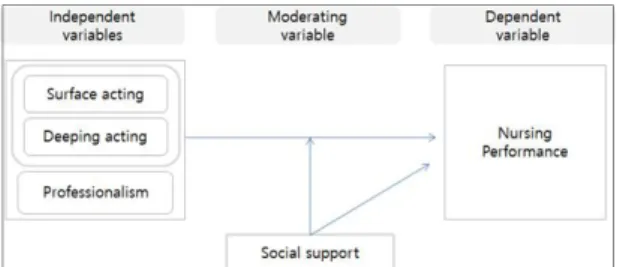
Against this backdrop, the purpose of this study was to identify the influence of surface acting and deep acting, which are sub-variables of the emotional labor of nurses, and professionalism on nursing performance, and to verify how its effect varies, depending on social support. The study seeks to discover if emotional labor and professionalism of nurses affect nursing performance, thereby providing the basic data necessary to improve work performance of clinical nurses.
Through reviewing precedent studies on the factors
affecting nursing performance, emotional labor, professionalism, and social support, a theoretical framework was suggested as Fig. 1.
Fig. 1. Conceptual Framework
2. Research Method
2.1 Study Design and Participants
In 2016, a survey was administered to professional nurses working in three general hospitals located in Seoul, South Korea. Upon hospital Board of Directors and Ethical Committee approval (2-1040781-AB-N-01- 201657HR), there were two meetings with department chiefs and nurse coordinators in which both verbal and written information about the study’s purpose was provided. Confidentiality was assured, and it was clearly stated that participation was voluntary. Nurse supervisors from the various departments were responsible for distributing the questionnaire in their units. Nurses were asked to return the completed questionnaire to their supervisors in a sealed envelope.
Paper questionnaires were distributed to 250 nurses employed at the hospitals (staff nurses working in medical, surgical, and clinical departments), and 230 (92.0%) completed questionnaires were returned. The total usable questionnaires were 216. A multiple- regression analysis was used to identify the effects of emotional labor and professionalism on nursing performance, and to explore the moderating effect of social support in those relationships.
2.2 Measure
We leveraged existing, previously validated
measures for all variables in this study. Because the original scales of emotional labor, professionalism, and social support were in English, they were translated into Korean and validated by several studies
Nursing performance
Nursing performance was measured using a 17-item scale developed by Ko et al.[1], with four sub-scales (competency, attitude, performance level, and applying nursing process), and a 5-point Likert-type response scale (1= strongly disagree; 5= strongly agree). The higher number indicated better performance. Internal consistency of the scale was supported by a Cronbach’s α of 0.92.
Emotional labor
To measure nurses’ emotional labor, a reduced version of the emotional labor questionnaire by Brotheridge and Lee[14] was used and translated into Korean by Yom[15]. Emotional labor was measured by two widely recognized facets: surface acting and deep acting. Likert-scaled items range from ‘1,’ indicating strongly disagree to ‘5,’ indicating strongly agree.
Internal consistency of the scale was supported by a Cronbach’s alpha of 0.75 for surface acting and 0.72 for deep acting.
Professionalism
The Korean version of Hall’s Professional Inventory developed by Kim and Baek[16], which was originally developed by Hall[17] and modified by Snizek[18], has been used. More specifically, a 25-item scale was used to measure beliefs in public service, autonomy, self-regulation, and a sense of having a calling to the field. Likert-scaled items ranging from ‘1,’ indicating strongly disagree to ‘5,’ indicating strongly agree has been used. Internal consistency of the scale was supported by a Cronbach’s alpha of 0.71
Social support
To measure social support, the Korean version of
the social support questionnaire developed by the National Institute for Occupational Safety and Health, and modified by Korea Occupational Safety and Health Research Institute[19] has been used. Social support was measured by three widely recognized facets:
supervisor, colleagues, and family. Likert-scaled items ranging from ‘1,’ indicating strongly disagree to ‘5,’
indicating strongly agree were used. The higher the total score indicated the higher the social support.
Internal consistency of the scale was supported by a Cronbach’s alpha of 0.91.
2.3 Data analysis
The data were evaluated using the SPSS 21.0 program. Inventories were assessed with the original evaluation criteria.
For the descriptive statistics, number, percentile, frequency, mean, and standard deviation were used. To determine whether the participants had similar socio-demographic properties and the socio-demographic property had a categorical structure, chi-square analysis was used. In addition, if the socio-demographic property had a numerical structure, one-way analysis of variance was used. Correlation analysis was used in the investigation of the relationships between emotional labor, professionalism, social support, and nursing performance.
Multiple-regression analysis was used in order to identify the effects of emotional labor, professionalism, and social support on nursing performance.
3. Result
3.1 General Characteristics of Participant The general characteristics of the participants are as follows: The average age was 32.3(±9.40) and 15%
(n=33) were under 23 years old, 24.8% (n=54) were aged 24 to 26 years, 25.7% (n=56) were aged 27 to 34 years, and 33.0% (n=72) were over 35 years old.
Fifty-nine per cent (n=130) was un-married and 38.5%
(n=84) was married. Half of the participants (n=108) had bachelor’s degrees and the mean of total work experience was 9.08(±9.00) years, with 14.7% (n=32) working less than 1 year, 17.9% (n=39) working from 1 to less than 3 years, 29.8% (n=65) working 3 to less than 10 years, and 36.7% (n=80) working for more than 10 years. The average years of work experience in current department was 4.93(±6.27) years and 15.6%
(n=34) reported working in their current department for less than 1 year. It was determined that 60% (n=131) of participants were working in medical and surgical units, 18.3% (n=40) were in Intensive Care and Emergency units, and 20% (n= 44) were in other departments, such as Out Patient and Delivery.
Eighty-two per cent (n=179) were staff nurses and 16.5% (n=36) were above-charge nurses. Most of the participants, 78%(n=170)
3.2 Means of the variables
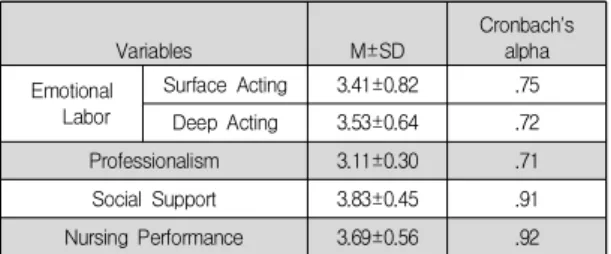
The level of emotional labor, professionalism, social support, and nursing performance are shown in Table 1. The mean scores for nurses obtained through the survey included surface acting of emotional labor, 3.41±0.82; deep acting of emotional labor, 3.53±0.64;
professionalism, 3.11±0.30; social support, 3.83±0.45;
and nursing performance; 3.69±0.56.
Table 1. The Means of Variables and Reliabilities
Variables M±SD
Cronbach's alpha Emotional
Labor
Surface Acting 3.41±0.82 .75
Deep Acting 3.53±0.64 .72
Professionalism 3.11±0.30 .71
Social Support 3.83±0.45 .91
Nursing Performance 3.69±0.56 .92
3.3 Differences of Variables by General Characteristics
The state of the socio-demographic characteristics
of the nurses in comparison with their professional
behavior, emotional labor, professionalism, social
support, and nursing performance are seen in Table 2.
When the level of emotional labor was examined, the nurses who worked shift schedules had higher scores in surface acting of emotional labor (t=2.36, p=.019), while the nurses over age 34(F=2.98, p=.033), married (t=2.19, p=.030), and working in emergency or intensive care units (t=3.13, p=0.46) were found to be high in deep acting of emotional labor. When professionalism levels were examined, a statistical difference was detected and the group over age 34(F=10.08, p<.001), married (t=4.68, p<.001), with more than 10 years of work experience (F=8.21, p<.001), above-charge nurses (t=3.42, p<.001), and those working a fixed schedule (t=2.81, p=.005) were higher. When the levels of social support were compared, the score averages of the group of nurses less than 23 years old, 27–34 years old, and over 34 years old were higher than the group aged 24–26 years (F=3.55, p=.015). The group of nurses who were married (t=3.22, p=.002) had higher scores than those who were not.
With regard to nursing performance, it was shown that the group of nurses who were over age 34 had higher scores than the groups of less than 23 years old, 24–26 years old, and 27–34 years old (F=15.71, p<.001). The married nurses had higher scores than those who were un-married (t=5.60, p<.001). In terms of work experience in their current department, the groups of nurses who worked 4-10 years or more than 10 years had higher scores than the group with less than a year of work experience (F=15.71, p<.001). The group of nurses with over 10 years of work experience had higher scores than the group with 1-3 years of work experience. The nurses ranked as above-charge nurses (t=4.75, p<.001) and those working a fixed schedule (t=4.96, p<.001) had higher scores in nursing performance.
3.4 Correlations Between Variables Related to Emotional Labor
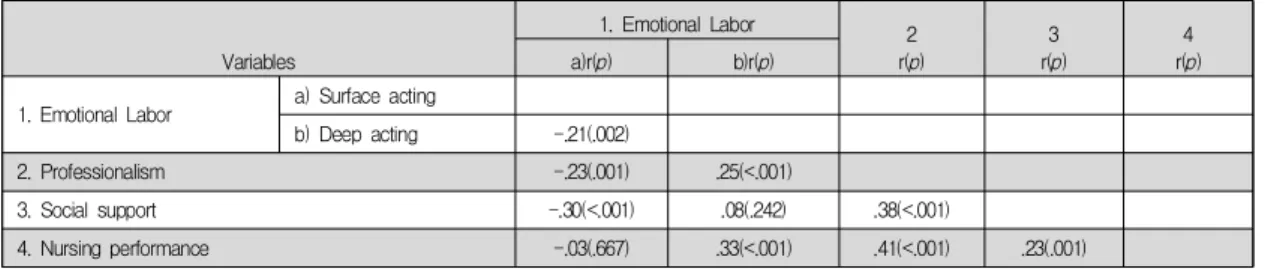
The relationships between emotional labor, professionalism, social support, and nursing performance are shown in Table 3. The correlation
coefficients for surface acting and deep acting of emotional labor were found to be r=.21(p=.002). Further, as the relationship between professionalism and emotional labor were examined, the correlation coefficients were found for surface acting, r=-.23(p<.001) and deep acting, r=.25(p<.001). The correlation coefficients for social support and deep acting of emotional labor was r=-.30 (p<.001), and professionalism was r=.38(p<.001). For nursing performance, the relationship with professionalism was r=.41(p<.001), deep acting of emotional labor was r=.33(p<.001), and social support was r=.23(p<.001).
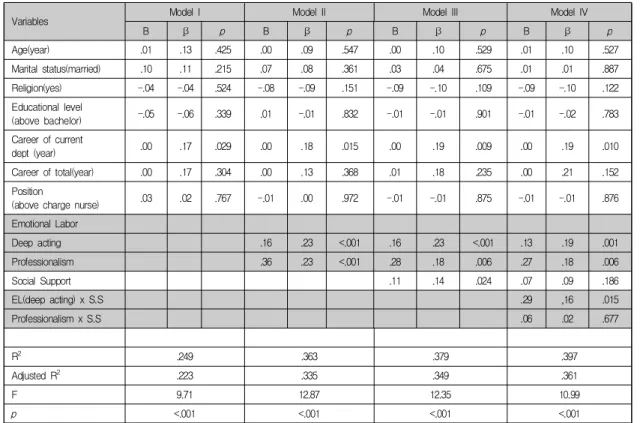
3.5 Factors Affecting Nursing Performance A three-stage hierarchical regression analysis was conducted for the influence on nursing performance (Table 4). Regression analysis was conducted by setting general characteristics as the control variable at Stage 1, and by including research variables that were confirmed to have a significant correlation with nursing performance at Stage 2. At Stage 3, the moderating effect of social support in the relationship between these variables and nursing performance was verified.
Before regression analysis, multicollinearity, residual, and singular value were determined in order to confirm whether the hypothesis of regression analysis was fulfilled. It was found that the Durbin-Watson statistic of the regression model was near 2 at 2.138 with no autocorrelation, and Variance Inflation Factor (VIF) was distributed at 1.101-7.434. All were indicated to be below 10; therefore, it was confirmed that there was no issue of multicollinearity. As a result of residual analysis, linearity of model, normality of error term, andhomoscedasticity were all confirmed.
In Model I, the explanation power was 24.9%, and it was found that the variable that had a significant influence on nursing performance was the working period in the current department (β=.17, p=.029).
In Model II, the explanation power was 36.3%, an
11.4% increase compared to Model I, and it was found
that the influence variables were the working period
Table 2. Differences of Variables by General Characteristics
Emotional Labor
Professionalism Social Support Nursing Performance Surface Acting Deep Acting
Categories
Mean±SD t/F
(p) Mean±SD t/F
(p) Mean±SD t/F
(p) Mean±SD t/F
(p) Mean±SD t/F
(p)
Age (year)
< 24
a3.42±0.77
1.53 (.208)
3.36±0.52
2.98 (.033)
3.09±0.20 10.08 (<.001)
3.81±0.51 3.55 (.015)
3.62±0.39 15.71 (<.001)
24-26
b3.60±0.71 3.44±0.73 3.06±0.23 3.48±0.56 3.67±0.41
27-34
c3.29±0.84 3.50±0.51 3.00±0.27
a,b,c<d
3.74±0.58 b<a,c,d
3.78±0.43 a,b,c<d
> 34
d3.34±0.88 3.70±0.67 3.25±0.35 3.76±0.54 4.09±0.39
Marital status
Unmarried 3.46±0.78 1.21
(.226)
3.45±0.61 2.19 (.030)
3.04±0.25 4.68 (<.001)
3.59±0.57 3.22 (.002)
3.70±0.42 5.60 (<.001)
Married 3.33±0.87 3.65±0.67 3.22±0.32 3.84±0.52 4.03±0.40
Edu Level*
College 3.51±0.81 1.68
(.094)
3.60±0.64 1.55 (.122)
3.14±0.26 1.40 (.163)
3.71±0.55 0.58 (.562)
3.87±0.44 1.46 (.145)
Bachelor 3.32±0.81 3.46±0.63 3.09±0.33 3.67±0.58 3.78±0.45
Work dept**
Med/Sur Units
a3.46±0.83 1.35 (.263)
3.58±0.61 3.13 (.046) a,c>b
3.11±0.29 1.01 (.367)
3.69±0.58 2.45 (.089)
3.81±0.46 2.37 (.096)
ER/ ICU
b3.43±0.77 3.30±0.65 3.07±0.32 3.56±0.61 3.75±0.43
Others
c3.23±0.82 3.58±0.67 3.16±0.29 3.83±0.41 3.95±0.38
Career in dept***
(year)
<1
a3.20±0.64
1.92 (.127)
3.45±0.57
1.41 (.240)
3.09±0.26
1.19 (.313)
3.74±0.55
0.21 (.891)
3.63±0.44 9.19 (<.001)
1-3
b3.56±0.89 3.43±0.60 3.09±0.27 3.69±0.67 3.82±0.37
4-10
c3.44±0.81 3.63±0.66 3.10±0.28 3.67±0.52 3.88±0.41 a<c,d
b<d
>10
d3.48±0.95 3.58±0.72 3.20±0.39 3.67±0.52 4.09±0.48
Total career (year)
<1
a3.26±0.64
1.61 (.189)
3.49±0.56 3.49 (.017)
3.12±0.23 8.21 (<.001)
3.88±0.49
2.00 (.115)
3.49±0.43 16.95 (<.001)
1-3
b3.63±0.82 3.27±0.58 3.05±0.21 3.57±0.57 3.72±0.40
4-10
c3.44±0.81 3.53±0.63
b<d
3.01±0.25 b,c<d
3.65±0.60 3.78±0.36 a<c,d
b<d
>10
d3.33±0.87 3.67±0.66 3.23±0.35 3.72±0.54 4.05±0.42
Pos
+Staff
nurse 3.41±0.82
0.21 (.831)
3.49±0.60 2.10 (0.37)
3.08±0.29 3.42 (.001)
3.67±0.58 1.16 (.249)
3.77±0.42 4.75 (<.001) Charge
nurse 3.38±0.79 3.73±0.76 3.26±0.29 3.79±0.48 4.14±0.46
Work Sch
++Fixed
schedule 3.16±0.80 2.36
(.019)
3.72±0.64 2.29 (.023)
3.22±0.36 2.81 (.005)
3.80±0.48 1.40 (.162)
4.10±0.40 4.96 (<.001)
3 shifts 3.48±0.81 3.48±0.63 3.08±0.27 3.67±0.58 3.76±0.43
*
Educational Level,
**Working Dept,
***Career in current dept
+Position
++Working Schedule
Table 3. Correlations between variables
Variables
1. Emotional Labor 2
r(p)
3 r(p)
4 r(p)
a)r(p) b)r(p)
1. Emotional Labor a) Surface acting
b) Deep acting -.21(.002)
2. Professionalism -.23(.001) .25(<.001)
3. Social support -.30(<.001) .08(.242) .38(<.001)
4. Nursing performance -.03(.667) .33(<.001) .41(<.001) .23(.001)
Table 4. Factors Affecting Nursing Performance
Variables Model I Model II Model III Model IV
B β
pB β
pB β
pB β
pAge(year) .01 .13 .425 .00 .09 .547 .00 .10 .529 .01 .10 .527
Marital status(married) .10 .11 .215 .07 .08 .361 .03 .04 .675 .01 .01 .887
Religion(yes) -.04 -.04 .524 -.08 -.09 .151 -.09 -.10 .109 -.09 -.10 .122
Educational level
(above bachelor) -.05 -.06 .339 .01 -.01 .832 -.01 -.01 .901 -.01 -.02 .783
Career of current
dept (year) .00 .17 .029 .00 .18 .015 .00 .19 .009 .00 .19 .010
Career of total(year) .00 .17 .304 .00 .13 .368 .01 .18 .235 .00 .21 .152
Position
(above charge nurse) .03 .02 .767 -.01 .00 .972 -.01 -.01 .875 -.01 -.01 .876
Emotional Labor
Deep acting .16 .23 <.001 .16 .23 <.001 .13 .19 .001
Professionalism .36 .23 <.001 .28 .18 .006 .27 .18 .006
Social Support .11 .14 .024 .07 .09 .186
EL(deep acting) x S.S .29 ,16 .015
Professionalism x S.S .06 .02 .677
R
2.249 .363 .379 .397
Adjusted R
2.223 .335 .349 .361
F 9.71 12.87 12.35 10.99
p