Introduction
Methicillin-resistant Staphylococcus aureus (MRSA) has been a problem since the 1960s as its infection is associated with higher mortality and increase cost in the hospitals (Klevens et al., 2007; Joung et al., 2012). It becomes more and more evident that bacteria, when faced with a new developed drug, respond with clever mechanisms of resistance (Tenover, 2006). Today, with this emergence of antibiotic resistant pathogens like MRSA, a new approach to natural products must be taken. These natural products are increasingly in demand due to their non-side effect benefit (Ghosh et al., 2008). Therefore, our ongoing efforts to find bioactive natural products have led us to study the antibacterial activity of
Lysimachia clethroides Duby. The primary purpose of this study was to investigate the in vitro effect against MRSA.
Lysimachia clethroides Duby, one of the species of genus Lysimachia, is a traditional folk Chinese medicine, distributed widely in many provinces of China. This plant has been used widely for treatment of throat ache, edema, and menoschesis (Bae, 1998).
It has also been shown to have antimicrobial activity on food-borne microorganisms (Han et al., 2001). Chemical study showed Astragalin, Isoquercitrin, Kaempferol-3-rutinoside, kaempferol-3-0-(2,6-di-o-rhamnopyranosylglucopyranoside), Kaempferol-3-0-(rhamnopyranosylglucopyranoside) (Yasukawa et al., 1986). Flavonoids and saponins (Zou et al., 2004; Ren et al., 2001) were present in this plant and the flavonoids were proved to be the main biological constituents, with the activities of anti-tumor, anti-bacterial and anti- platelet aggregation (Xu et al., 2003). However, little is known
A Study on Antimicrobial Activity of Lysimachia clethroides Duby Root Extracts against Methicillin-resistant Staphylococcus aureus
Dae Ki Joung
1, Dong Yeul Kwon
2and Dong Won Shin
3*
1
Graduate Student, Department of Development in Oriental Medicine Resources, Sunchon National University, Suncheon 57922, Korea
2
Professor, Department of Oriental Pharmacy, Wonkwang University, Iksan 54538, Korea
3
Professor, Department of Development in Oriental Medicine Resources, Sunchon National University, Suncheon 57922, Korea
Abstract - Methicillin-resistant Staphylococcus aureus (MRSA) is a bacterium responsible for a number of infections in humans that are difficult to treat, and as a result, is a substantial contributor to morbidity and mortality. In the present study, in search of natural products capable of inhibiting this multidrug-resistant bacterium, we investigated the antimicrobial activity of Lysimachia clethroides Duby root. The antibacterial activities of EtOH extract of Lysimachia clethroides Duby root and its n-hexane, EtOAc, n-BuOH and water fractions were evaluated against 15 strains of methicillin-resistant staphylococcus aureus (MRSA) and 1 standard methicillin-susceptible S. aureus (MSSA) strain by using the minimal inhibitory concentrations (MICs) assay, colorimetric assay using MTT test, checkerboard dilution test. Antimicrobial activity of n-hexane fraction of Lysimachia clethroides Duby root was remarkable. Against the 16 strains, the minimum inhibitory concentrations (MICs) were in the range of 31.25–62.5 ㎍/㎖ and FICI values for n-hexane fraction of Lysimachia clethroides Duby root+AM and n-hexane fraction of Lysimachia clethroides Duby root+OX were checkerboard method performed using the MRSA, MSSA and one clinical isolate strains via MICI 0.12-1 and 0.25-0.75, showing the increase of synergistic effect. When combined together, these antibiotic effects were dramatically increased. These effective combinations could be new promising agents in the management of MRSA.
Key words – Antimicrobial, Lysimachia clethroides Duby, Methicillin-resistant staphylococcus aureus (MRSA), Synergism
*Corresponding author. E-mail : [email protected] Tel. +82-61-750-3665
ⓒ 2018 by The Plant Resources Society of Korea
Short Communication
about its antimicrobial effects on MRSA. Thus, we present the current study demonstrating the antimicrobial activity of Lysimachia clethroides Duby against MRSA and methicillin- sensitive (MSSA) strains, as well as its synergistic effect.
Materials and Methods
Plant material and sample preparation
Lysimachia clethroides Duby roots were collected from Sunchon, southern Republic of Korea, in June, 2017. A voucher specimen was deposited in the Laboratory of Oriental Pharmacology (N.1369). Lysimachia clethroides Duby root was air-dried, and boiled in ethanol (2L for 3h). The ethanol extract of Lysimachia clethroides Duby root (5.67% w/w) was partitioned with organic solvents of different polarities to yield n-hexane, EtOAc, n-BuOH and water fractions, in sequence. The samples were stored at 4 ℃.
Test Microorganisms
Fourteen Clinical isolates (MRSA) were obtained from fourteen different patients at Wonkwang University Hospital (Iksan, South Korea). The Other 2 strains were S. aureus ATCC 33591 (Methicillin-resistant strain) and S. aureus ATCC 25923 (Methicillin-susceptible strain). Before use, all of the bacteria were stored in 30% glycerol and frozen at -7 0 ℃. The bacteria were cultured in Mueller-Hinton Broth (MHB) and Mueller-Hinton Agar (MHA) (Difco Laboratories, Baltimore, MD, USA). The bacteria were suspended in Mueller-Hinton Broth and then incubated at 37℃ for 24 hr.
Antibiotics
Ampicillin (AM) and Oxacillin (OX) (Sigma Chemical Co.
St. Louis, M0, USA) were used.
Minimum Inhibitory Concentration
The Minimum Inhibitory Concentration (MIC) was determined using the broth microdilution method according to the clinical and Laboratory standards Institute guideline (CLSI., 2000).
Briefly, a preparation of the microorganisms inoculated were done on 24 hr Broth cultures, and the suspensions were adjusted to a 0.5 McFarland standard turbidity (approximately 1.5×
10
8CFU/ ㎖). Final inoculums were adjusted to the 1.5×10
6CFU/㎖. These serially diluted cultures were then incubated at 37℃ for 18 hr. MIC was defined at the lowest concent- ration of AM, OX, Lysimachia clethroides Duby extracts, Fractions (n-hexane, EtOAc, n-BuOH, H
2O). At the end of the incubation period, the well plates were visually examined for turbidity. Cloudiness indicates that bacterial growth has not been inhibited by the concentration of antimicrobial agents contained in the medium. A colorimetric assay for rapid detection of the presence of bacteria was also performed (see below, Colorimetric assay using 3-4,5-dimethylthiazol- 2-yl)-2,5-diphenyl tetrazolium bromide [MTT] test).
Checkerboard dilution test
The synergistic combinations were investigated in the pre- liminary checkerboard method performed using the MRSA, MSSA and the five isolate strains came from fourteen patients via MIC determination, according to the CLSI guidelines (Mazumdar et al., 2005). The MIC was defined as the lowest Table 1. The S. aureus strains used in the experiments
S. aureus
strains Class mecA gene
Antibiotic resistance pattern
ATCC25923 MSSA -
z-
ATCC33591 MRSA +
zAM
y, OX
yDPS -1x MRSA + AM, OX
DPS -2 MRSA + AM, OX
DPS -3 MRSA + AM, OX
DPS -4 MRSA + AM, OX
DPS -5 MRSA + AM, OX
DPS -6 MRSA + AM, OX
DPS -7 MRSA + AM, OX
DPS -8 MRSA + AM, OX
DPS -9 MRSA + AM, OX
DPS -10 MRSA + AM, OX
DPS -11 MRSA + AM, OX
DPS -12 MRSA + AM, OX
DPS -13 MRSA + AM, OX
DPS -14 MRSA + AM, OX
z
(+), positive; (-), negative.
y
AM, ampicillin; OX, oxacillin.
x
DPS-1 indicates Staphylococcus aureus strains from the Depart-
ment of Plastic Surgery, Wonkwang University Hospital.
Table 2. Antimicrobial activity of Lysimachia clethroides Duby root ethanol extract, n-hexane, EtOAc, n-BuOH and water fractions against S. aureus strains under dark
Minimal Inhibitory Concentration(MIC) ( ㎍/㎖) S. aureus
strain Ethanol extract Fractions
n-hexane EtOAc n-BuOH H
20 Ampicillin Oxacillin
ATCC33591 250 31.25 250 ND
yND 1000 250
ATCC25923 250 31.25 250 ND ND 7.8 7.8
DPS -1
z250 31.25 250 ND ND 31.25 500
DPS -2 250 15.62 125 ND ND 1000 500
DPS -3 250 31.25 250 ND ND 31.25 500
DPS -4 250 31.25 250 ND ND 31.25 500
DPS -5 125 31.25 250 ND ND 31.25 500
DPS -6 250 62.5 250 ND ND 31.25 250
DPS -7 250 62.5 250 ND ND 250 500
DPS -8 250 62.5 250 ND ND 250 500
DPS -9 250 31.25 250 ND ND 125 500
DPS -10 250 31.25 250 ND ND 250 500
DPS -11 250 31.25 250 ND ND 250 500
DPS -12 250 31.25 250 ND ND 250 500
DPS -13 250 31.25 250 ND ND 31.25 1000
DPS -14 250 31.25 250 ND ND 250 500
z
DPS1 indicates staphylococcus strains from the Department of Plastic Surgery, Wonkwang University Hospital.
yND; no detected activity at this concentration.
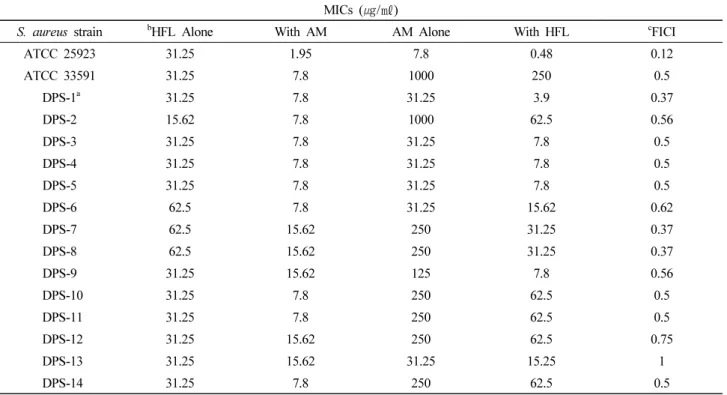
Table 3. Result of the combined effect of n-hexane fraction of Lysimachia clethroides Duby root and AM against S. aureus MICs ( ㎍/㎖)
S. aureus strain
bHFL Alone With AM AM Alone With HFL
cFICI
ATCC 25923 31.25 1.95 7.8 0.48 0.12
ATCC 33591 31.25 7.8 1000 250 0.5
DPS-1
a31.25 7.8 31.25 3.9 0.37
DPS-2 15.62 7.8 1000 62.5 0.56
DPS-3 31.25 7.8 31.25 7.8 0.5
DPS-4 31.25 7.8 31.25 7.8 0.5
DPS-5 31.25 7.8 31.25 7.8 0.5
DPS-6 62.5 7.8 31.25 15.62 0.62
DPS-7 62.5 15.62 250 31.25 0.37
DPS-8 62.5 15.62 250 31.25 0.37
DPS-9 31.25 15.62 125 7.8 0.56
DPS-10 31.25 7.8 250 62.5 0.5
DPS-11 31.25 7.8 250 62.5 0.5
DPS-12 31.25 15.62 250 62.5 0.75
DPS-13 31.25 15.62 31.25 15.25 1
DPS-14 31.25 7.8 250 62.5 0.5
c
FICI; fractional inhibitory concentration index.
b
HFL; n-hexane fraction of Lysimachia clethroides Duby root.
a
DPS; indicates Staphylococcus aureus strains from the Department of Plastic Surgery, Wonkwang University Hospital.
concentration of drug alone or in combination that inhibited the visible growth. The in vitro interaction was quantified by determining the fractional inhibitory concentration (FIC).
The FIC index was calculated as follows: FIC = (MIC of drug A in combination/MIC of drug A alone) + (MIC of drug B in combination/MIC of drug B alone). FIC indices (FICI) were interpreted as follows: <0.5, synergy; 0.5-0.75, partial synergy;
0.76-1.0, additive effect; >1.0-4.0, indifference; and >4.0, antagonism. All experiments were independently repeated three times.
Colorimetric assay using MTT test
A colorimetric assay based on MTT for rapid detection of the presence of bacteria was performed as previously described (Luis et al., 2014; Joung et al., 2015; Shi et al., 2008). Briefly, a stock solution of 5 ㎎/㎖ MTT (Sigma) was prepared in phosphate-buffered saline and kept at -70 ℃. A final con- centration of 1 ㎎/㎖ of MTT was used in the assay. After 24hrs of incubation a 37℃, 20 ㎕ of the yellow MTT was added to the 96-well microtiter plate and incubated for an
additional 20 min. The presence of a blue color indicates the presence of bacteria.
Results
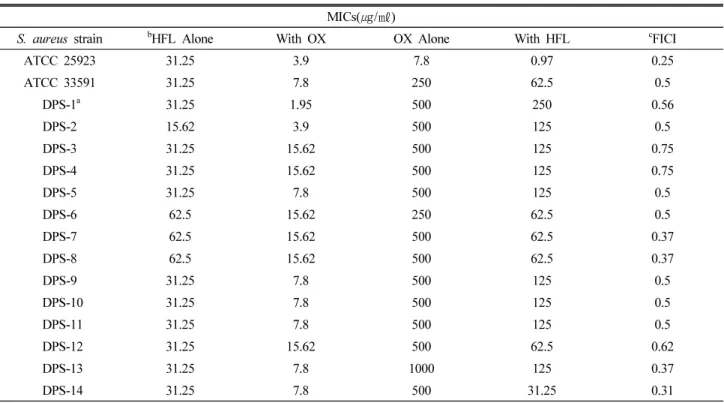
Ethanol extract had a MIC of 250 ㎍/㎖ against S. aureus ATCC 33591 under dark, and had a MIC of 250 ㎍/㎖ against S. aureus ATCC 25923 in the same condition. Antimicrobial activity of n-hexane fraction was remarkable, and had a MIC of from 15.62 ㎍/㎖ to 62.5 ㎍/㎖ against S. aureus strains (Table 1 and Table 2). n-hexane fraction of Lysimachia clethroides Duby root (HFL) lowered the MICs against the MRSA strain and MSSA but FICI values for HFL+AM and HFL+OX were 0.12-1 and 0.25-0.75, showing the increase of synergistic effect (Table 3 and 4).
Discussion
The most effective method is to develop antibiotics from the natural products without having any toxic or side effects.
Table 4. Result of the combined effect of n-hexane fraction of Lysimachia clethroides Duby root and OX against S. aureus MICs( ㎍/㎖)
S. aureus strain
bHFL Alone With OX OX Alone With HFL
cFICI
ATCC 25923 31.25 3.9 7.8 0.97 0.25
ATCC 33591 31.25 7.8 250 62.5 0.5
DPS-1
a31.25 1.95 500 250 0.56
DPS-2 15.62 3.9 500 125 0.5
DPS-3 31.25 15.62 500 125 0.75
DPS-4 31.25 15.62 500 125 0.75
DPS-5 31.25 7.8 500 125 0.5
DPS-6 62.5 15.62 250 62.5 0.5
DPS-7 62.5 15.62 500 62.5 0.37
DPS-8 62.5 15.62 500 62.5 0.37
DPS-9 31.25 7.8 500 125 0.5
DPS-10 31.25 7.8 500 125 0.5
DPS-11 31.25 7.8 500 125 0.5
DPS-12 31.25 15.62 500 62.5 0.62
DPS-13 31.25 7.8 1000 125 0.37
DPS-14 31.25 7.8 500 31.25 0.31
c
FICI; fractional inhibitory concentration index
b
HFL; n-hexan fraction of Lysimachia clethroides Duby root
a