1. Introduction
Classification of earth terrain using polarimetric synthetic aperture radar (POLSAR) images has been an important application in the SAR polarimetry technique. Many algorithms for supervised and unsupervised classification have been developed and the application studies using POLSAR data were presented. Unsupervised method classifies the POLSAR image automatically by computing clusters based on a certain criterion and the class identification may have to be inferred. These unsupervised classifications are effective when the ground truth data are not available. Supervised
classification firstly determines training sets for each class that are selected based on ground truth maps or differences in scattering feature of POLSAR image and then classify an whole image by decision rule.
Unsupervised classification techniques of POLSAR image data can be categorized into 3 types.
The first type of unsupervised classification technique is based on the statistical characteristics of POLSAR image data without considering of the physical scattering mechanism of terrain media. The second approach classifies POLSAR image by inherent physical scattering properties without utilizing the statistical characteristics (van Zyl, 1989; Cloude and Pottier, 1997; Lee et al., 1999a; Ferro-Famil et al.,
Filtering Effect in Supervised Classification of Polarimetric Ground Based SAR Images
Moon-Kyung Kang*, Kwang-Eun Kim*
†, Seong-Jun Cho*, Hoonyol Lee**, and Jae-Hee Lee*
*Korea Institute of Geoscience and Mineral Resources, Daejeon, Republic of Korea
**Kangwon National University, Chuncheon, Republic of Korea
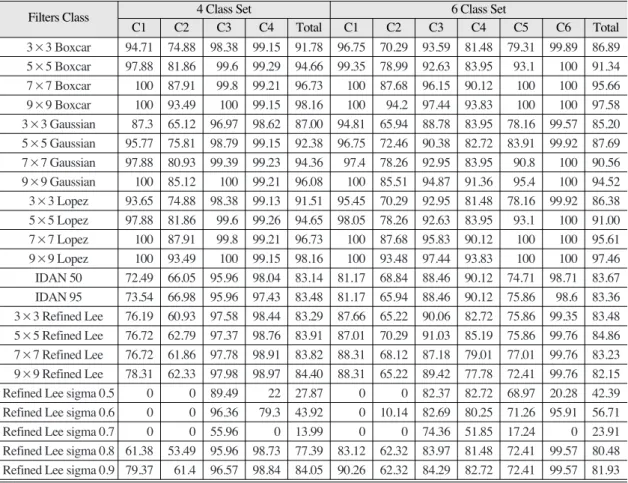
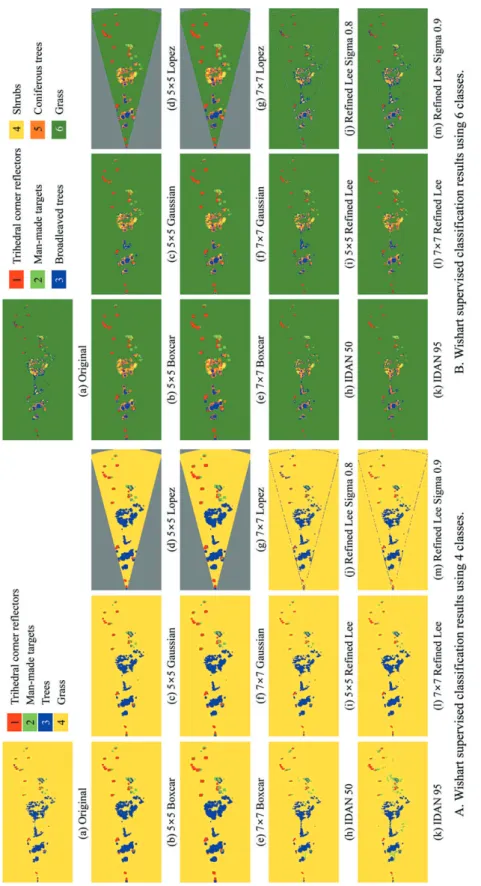
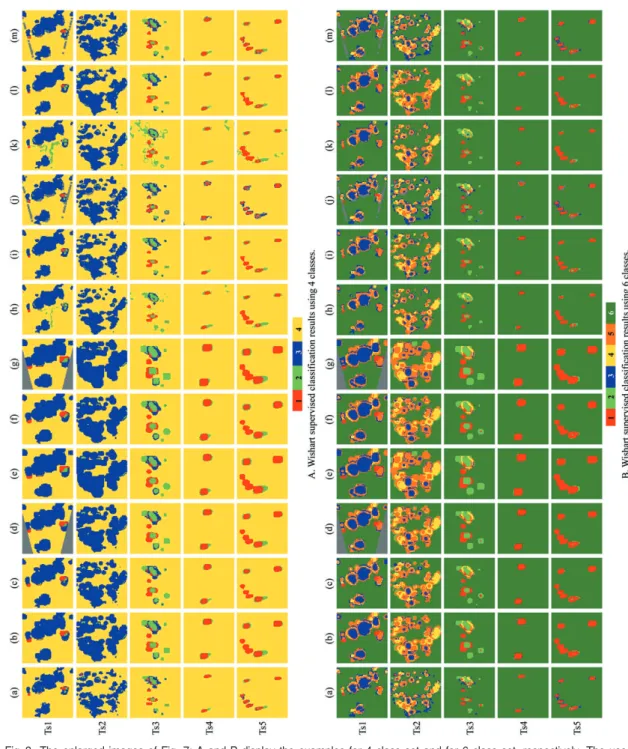
Abstract : We investigated the speckle filtering effect in supervised classification of the C-band polarimetric Ground Based SAR image data. Wishart classification method was used for the supervised classification of the polarimetric GB-SAR image data and total of 6 kinds of speckle filters were applied before supervised classification, which are boxcar, Gaussian, Lopez, IDAN, the refined Lee, and the refined Lee sigma filters. For each filters, we changed the filtering kernel size from 3×3 to 9×9 to investigate the filtering size effect also. The refined Lee filter with the kernel size of bigger than 5×5 showed the best result for the Wishart supervised classification of polarimetric GB-SAR image data. The result also showed that the type of trees could be discriminated by Wishart supervised classification of polarimetric GB-SAR image data.
Key Words : GB-SAR, polarimetric SAR, SAR speckle filter, Wishart supervised classification.
Received December 22, 2010; Accepted December 27, 2010.
†