• 검색 결과가 없습니다.

Radiometric Characteristics of Geostationary Ocean Color Imager (GOCI) for Land Applications

N/A
N/A
Protected

Academic year: 2021

Share "Radiometric Characteristics of Geostationary Ocean Color Imager (GOCI) for Land Applications"

Copied!
9
0
0

로드 중.... (전체 텍스트 보기)

전체 글

(1)

1. Introduction

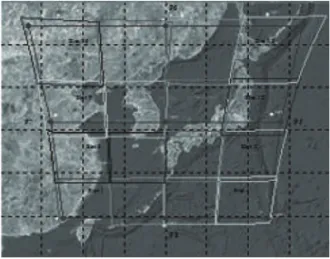
The Communication Ocean and Meteorological Satellite (COMS) has been successfully launched on June 27, 2010 and is having a geostationary orbit of 35,857 km altitude. The Geostationary Ocean Color Imager (GOCI) is one of two imaging sensors onboard the COMS and developed to provide continuous images at regional scale, which covers about 2,500×2,500 km

2

area centered at 130˚E × 36˚N (Fig. 1) (Cho et al., 2011). As the name implies, the GOCI has been mainly designed for ocean color

monitoring with eight spectral bands, which are very similar to the SeaWiFS system. Although the main function of the GOCI is ocean color monitoring, it contains large land area of northeast Asia including the entire area of the Korean peninsula and Japan and the partial area of China, Mongolia, and Russia.

GOCI image has about 500 m spatial resolution and is providing eight hourly observations per day during daytime. Considering the very high temporal resolution, GOCI data have a great potential for detecting and monitoring several short-term changes such as crop phenology, forest fires, drought, and

Radiometric Characteristics of Geostationary Ocean Color Imager (GOCI) for Land Applications

Kyu-Sung Lee , Sung-Min Park, Sun-Hwa Kim, Hwa-Seon Lee and Jung-Il Shin Department of Geoinformatic Engineering, Inha University

Abstract : The GOCI imagery can be an effective alternative to monitor short-term changes over terrestrial environments. This study aimed to assess the radiometric characteristics of the GOCI multispectral imagery for land applications. As an initial approach, we compared GOCI at-sensor radiance with MODIS data obtained simultaneously. Dynamic range of GOCI radiance was larger than MODIS over land area.

Further, the at-sensor radiance over various land surface targets were tested by vicarious calibration. Surface reflectance were directly measured in field using a portable spectrometer and indirectly derived from the atmospherically corrected MODIS product over relatively homogeneous sites of desert, tidal flat, bare soil, and fallow crop fields. The GOCI radiance values were then simulated by radiative transfer model (6S). In overall, simulated radiance were very similar to the actual radiance extracted from GOCI data. Normalized difference vegetation index (NDVI) calculated from the GOCI bands 5 and 8 shows very close relationship with MODIS NDVI. In this study, the GOCI imagery has shown appropriate radiometric quality to be used for various land applications. Further works are needed to derive surface reflectance over land area after atmospheric correction.

Key Words : GOCI, radiometric characteristics, land, COMS, NDVI, MODIS

Received April 20, 2012; Revised May 21, 2012; Accepted May 22, 2012.

† Corresponding Author: Kyu-Sung Lee ([email protected])

(2)

heavy snow over lands. Although polar orbit sensors, such as AVHRR and MODIS, provide daily observation over any places on earth at about the same spatial resolution, frequent cloud cover often obscures land observations to detect short term changes (Cihlar et al., 2004). To use polar orbit images over land area, we often generate 8- to 16-day cloud free composite, which can only be used to detect any changes that occur in longer than the composition period.

After the initial calibrations and testing period, the Korea Ocean Research and Development Institute (KORDI) has provided GOCI data since April 2011.

The KORDI supplies GOCI data in several different process levels, in which level 1B is radiometric calibrated and geometric corrected at-sensor radiance.

GOCI level 2 products are mostly related to ocean information, such as atmospherically corrected water- leaving radiance, chlorophyll content, and total suspended sediment. Currently, there is no GOCI data product that is particularly designed for land applications. The objectives of this study are to compare the GOCI image with another similar satellite image and to analyze the radiometric characteristics of the GOCI level 1B data for land applications. If the GOCI data has comparable radiometric quality to other polar orbit satellite

images like MODIS, which is widely used to derive several meaningful land related products, they can provide valuable information to monitor land surface parameters in short time period.

2. Dynamic range of GOCI radiance

In GOCI L1B image, each pixel has 32bit integer DN value and it can be directly converted to at-sensor radiance by applying the radiometric calibration coefficients provided by the KORDI. We have compared at-sensor radiance between GOCI and MODIS data obtained at the same time on April 5, 2011. Both MODIS Terra and Aqua data were geometrically registered to GOCI coverage and we extracted only the land area including the Korean peninsula and surrounding area after masking out the ocean part. Among the 36 spectral bands of MODIS, we initially selected only eight bands (MODIS band 8

~ band 15) that are spectrally almost the same as the GOCI bands.

Fig. 2 compares at-sensor radiance between GOCI and MODIS. In overall, GOCI radiance value showed wider dynamic range and higher mean value than MODIS in all eight bands. Even through both data were obtained at the same time, viewing geometry and optical path length of geostationary GOCI and polar orbit MODIS were very different.

Such differences might be one of the discrepancies between GOCI and MODIS. Wide dynamic range of GOCI can be beneficial to discriminate several land surface features having a little difference in reflected signal. The advantage of the GOCI’ s wide dynamic range was also confirmed by visual interpretation between two images, in which GOCI image was better to show rather subtle tonal difference than MODIS image.

High radiance value and wide dynamic range

Fig. 1. Geographical coverage of the GOCI data.

(3)

observed by the GOCI might be also due to the on- board preprocessing method to control gain modes.

The GOCI was developed to record surface reflected signal in two gain modes to cover wide range of surface features, ranging from low signal of water to high signal of land and cloud (Kang, et al., 2010).

Since the statistics showed in Fig. 2 were extracted from land area only, they probably represent signal obtained at low gain mode. The maximum radiance value of GOCI bands were close to the saturation radiance in low gain mode determined in pre-launch study (Cho, et al., 2010). The MODIS band 8 ~ band 15 are mainly for ocean observations and, therefore, they may not be suitable to be compared with GOCI over land area. When we further compared two MODIS bands (band 2 and band 4), which are mainly

for land observations and have similar spectral range with GOCI band 8 and band 4, the dynamic range between two sensors are very close. Since the viewing and sun illumination angles were not identical between GOCI and MODIS, we need further analysis to explain the difference.

3. Post-launch vicarious calibrations

To extract any meaningful and quantitative information from satellite image, we need to know accurate physical quantity from the digital number value of the image. In optical remote sensing data, the exact at-sensor radiance can be derived by applying the radiometric calibration coefficients provided by the satellite operating organization. Although pre- launch calibration coefficients were usually ready, we need to continuously monitor any changes in radiometric quality caused by various factors of space environments and satellite operations. The radiometric calibration of a sensor can be performed by several methods of the preflight laboratory works, the post-launch on-board calibration techniques, and the post-launch vicarious calibration (Thome et al., 1997; Kim et al., 2002).

We adopted post-launch vicarious calibration method, as shown in Fig. 3, to validate the at-sensor radiance of GOCI data. GOCI at-sensor radiance at several known reference targets were simulated by a radiative transfer model and they were compared with actual radiance values extracted from the GOCI image. Comparison between the simulated and actual radiance would give us the quality of the radiometric calibration coefficients that are currently provided.

First, surface reflectance was directly measured in fields using a portable spectrometer on clear sky conditions during the January and February of 2012.

Surface reflectance was measured at relatively large Fig. 2 . Comparison of at-sensor radiance (W/m

2

/mm/sr)

between GOCI and MODIS obtained in April 5, 2011 from Terra at 11:00 (a) and Aqua at 14:00 (b).

(b)

(a)

(4)

(about 1 km

2

) and homogeneous area of bare soil, tidal flat, dense coniferous forest, and winter barely fields. It is often difficult to conduct vicarious calibration with ground measurement because of the lack of homogeneous ground targets that are large enough to cover rather coarse spatial resolution like the GOCI data. To add more samples for the vicarious calibration, additional surface reflectance were indirectly derived from the atmospherically corrected MODIS data over relatively homogeneous sites of desert, tidal flat and fallow crop land, which is known as cross-calibration (Liu et al., 2004). We obtained surface reflectance at 13 reference sites from in-situ measurements and MODIS reflectance product (MOD09) to simulate GOCI at-sensor radiance.

The corresponding GOCI at-sensor radiance given the surface reflectance was estimated by the radiative transfer code (6S) developed by Vermote et al.

(1997). Radiative transfer models were frequently used to calibrate the radiometric performances of satellite sensors (Thome et al, 1997; Castle et al., 1984) and further to simulate the satellite signal in the solar spectrum (Vermote et al., 1997). The model

requires several input parameters related to atmospheric condition, viewing and sun angles, earth- sun distance, and sensor characteristics. Using such input parameters, it calculates the amount of energy- matter interactions in atmosphere. To simulate GOCI at-sensor radiance, we used a standard pre-defined atmospheric profile, aerosol model, and spectral response functions of eight spectral bands, and viewing and sun geometry. To overcome the discrepancy between GOCI and MODIS spectral responsivity, the MODIS reflectance values were interpolated to the GOCI spectral region (about 400~900 nm). We obtained several GOCI images that correspond to the in-situ measurements time and the data acquisition time of MODIS image. From GOCI images, at-sensor radiance values were extracted for the ground sites as well as the reference targets selected from MODIS images.

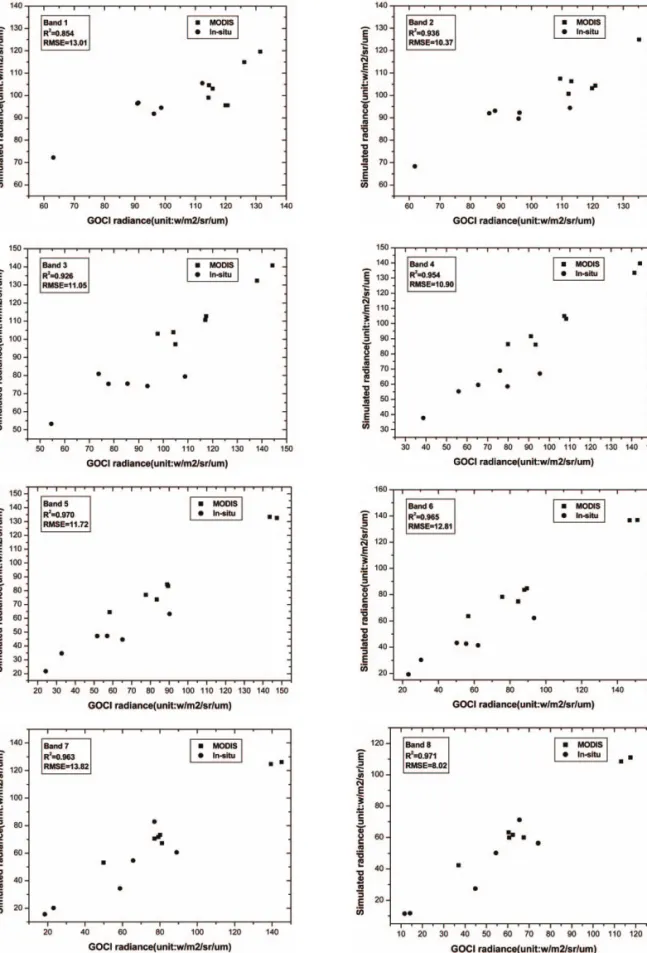
As seen in Fig. 4, the simulated GOCI radiance showed very close relationship with the actual radiance values obtained from the GOCI images.

Although the number of samples tested in this study were not enough to cover the total dynamic range of GOCI bands, the strong linear relationship between the simulated and the actual radiance values, with R

2

value ranging from 0.85~0.97, implies that the current radiometric calibration coefficients are suitable to derive absolute radiance recorded by the sensor. Root mean squared error (RMSE) ranges from 8.0 to 13.8, which is less than 10% of total dynamic range of each spectral band. In overall, actual GOCI radiance were slightly higher than the simulated radiance value, in particular at shorter wavelength blue band 1 to band 3. The higher GOCI radiance may be explained by several factors.

Atmospheric conditions are very important to simulate the process of energy transfer and interaction between the earth surface and the satellite sensors. In this study, we did not use actual atmospheric data at Fig. 3. Vicarious calibration procedure to simulate GOCI at-

sensor radiance from surface reflectance and to

compare the actual at-sensor radiance from GOCI

image.

(5)

Fig. 4. Relationship between simulated and observed at-sensor radiance values in eight spectral bands of GOCI.

(6)

the time of image acquisition, which is somewhat difficult to get for the large geographical coverage of GOCI image. Providing exact atmospheric conditions to the 6S model, we might have slightly different simulation although the linear relationship shown in Fig. 4 may not alter much.

Further validation by comparing the surface reflectance from the GOCI image and in-situ measured reflectance would provide more insight to the radiometric characteristics of the GOCI image.

Obtaining accurate at-sensor radiance of GOCI data is an essential step to extract surface reflectance, which will be the subsequent main product after atmospheric correction. Surface reflectance has become very important to derive quantitative biophysical variables, such as leaf area index (LAI), photosynthetically active radiation (PAR), and vegetation productivity. These products are critical parameters for terrestrial ecosystem modeling and they are usually estimated by surface reflectance after the atmospheric correction of at-sensor radiance.

4. Viewing and solar illumination variation

To cover large geographic area, earth observation sensors need wide field of view that cause large range of view and sun angle variations (Roujean et al., 1992). The large view and sun angle variation is also very important factor to influence the radiometric characteristics of GOGI images. Unlike the polar

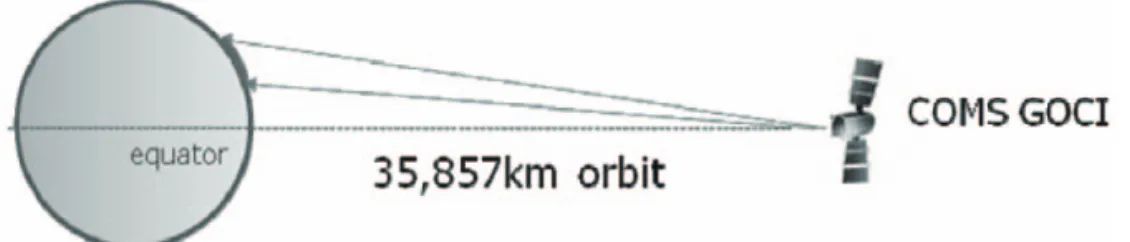
orbit satellite sensors like MODIS and AVHRR, the GOCI has fixed viewing azimuth and zenith angles for every pixel location (Fig. 5), which makes it possible to have a simple correction for viewing geometry.

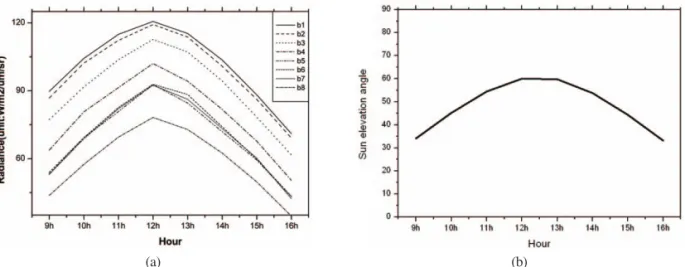
However, since the GOCI images were obtained eight times per day, solar illumination angle variation from morning to late afternoon is significantly large.

Fig. 6 shows the effect of solar illumination variations observed from a single day GOCI images. The morning scene (9:00) and late afternoon scene (16:00) show the lowest at-sensor radiance and the radiance is the highest at noon scene (12:00). The GOCI radiance follows almost the same pattern as the sun elevation angle change as seen in Fig. 6-b.

Hourly variation among the eight scenes per day can be normalized by simple cosine correction method although bidirectional reflectance effect can be another problem to delve into.

In processing of multispectral image data, band ratio has been known to normalize solar illumination effect as well as other atmospheric and topographic conditions. Fig. 7 shows the sun angle normalization effects of normalized difference vegetation index (NDVI). Using two spectral bands 5 and 8 from the GOCI data, hourly NDVI were calculated over large bare soil and coniferous forest. Although NDVI values were calculated from 8 hourly data obtained from the same day, they did not show the solar illumination angle effect that was evident in Fig. 6.

We calculated NDVI using 1) at-sensor radiance, 2)

Fig. 5. Fixed viewing geometry of the GOCI due to the geostationary constant viewing position.

(7)

cosine corrected top-of-atmospheric reflectance, and 3) Rayleigh corrected reflectance. Although absolute magnitude of NDVI value are slightly different (about 0.04) by different correction level, they are almost identical regardless of the sun angle from morning to late afternoon. NDVI has been frequently used to monitor several applications of terrestrial environments and the uses of NDVI vary by applications. Sometimes, we only need relative difference (or temporal profile) of NDVI to observe changes in an area over time. In other cases, absolute value of NDVI is critical to derive biophysical variables from optical remote sensor data. Even if we

used raw at-sensor radiance values without any corrections, the NDVI profile in Fig. 7 clearly shows the sun angle normalization effect.

We also compared NDVI values between GOCI and MODIS obtained from the same site at the same time. The GOCI NDVI was calculated using reflectance values that were corrected for solar illumination angle and Rayleigh scattering, while MODIS NDVI was calculated using atmospherically corrected surface reflectance values. As seen in Fig.

8, GOCI and MODIS NDVI were very similar in both magnitude and linear relationship. Although further atmospheric correction is required for GOCI Fig. 6. Large variation of solar illumination effects observed from eight hourly GOCI 8 band images per a day (a) . The GOCI at-

sensor radiances are almost proportional to sun elevation angle (b).

(a) (b)

Fig. 7. Sun angle normalization effect of NDVI calculated from GOCI bands 5 and 8, in which hourly variation of at-sensor radiance was diminished.

(a) (b)

(8)

data, the close relationship with MODIS NDVI is encouraging indication that the GOCI has comparable radiometric quality to be used in land related applications.

5. Conclusions

The GOCI is a very unique sensor to provide high temporal observations for the northeast Asia region.

Although it was mainly developed for ocean color observation, it showed great potential to be used for land applications. In this study, we have examined the radiometric characteristics of GOCI data and found that they have comparable radiometric characteristics to derive reliable information over land surfaces.

Compared with MODIS radiance and NDVI data, GOCI showed very confident results that can be used to monitor very short term changes in terrestrial environments. To expand its applicability over land area, further study is necessary for the atmospheric correction.

References

Castle, K.R, R.G. Holm, C.J. Kastner, J.M. Palmer, P.N. Slater, M., C.E. Ezra, R.D. Jackson, and R.K. Savage, 1984. In-Flight Absolute Radiometric Calibration on the Thematic Mapper, Proc. of 1984 IGARSS, 2(3): 251- 255.

Cho, S., Y.H. Ahn, J.H. Ryu, G.S. Kang, and H.S.

Youn, 2010. Development of Geostationary Ocean Color Imager (GOCI), Korean Journal of Remote Sensing, 26(2): 157-165.

Cihlar, J., R. Latifovic, J. Chen, A. Trishchenko, Y.

Du, G. Fedosejevs, and B. Guindon, 2004.

Systematic corrections of AVHRR image composites for temporal studies, Remote Sensing of Environment, 89: 217-223.

Kang, G., P. Coste, H. Youn, F. Faure, and S. Choi, 2010. An In-Orbit Radiometric Calibration Method of the Geostationary Ocean Color Imager, IEEE Transactions on Geoscience and Remote Sensing, 48(12): 4322-4328.

Kim, J.H., K.S. Lee, and D.R. Kim, 2002.

Radiometric Characteristics of KOMPSAT EOC Data Assessed by Simulating the Sensor Received Radiance, Korean Journal of Remote Sensing, 18(5): 281-289.

Liu, J.J., Z. Li, Y.L. Qiao, Y.J. Liu, and Y.X. Zhang, 2004. A new method for cross-calibration of two satellite sensors, International Journal of Remote Sensing, 25(23): 5267-5281.

Roujean, J.L., M. Leroy, P.Y. Deschamps, 1992. A Bidirectional Reflectance Model of the Earth ’ s Surface for the Correction of Remote Sensing Data, Journal of Geophysical Research, 97(D18): 20, 455-20, 468.

Thome, K.J, B.L. Markham, J.L. Baker, P.N. Slater, and S.F. Biggar, 1997, Radiometric Calibration Fig. 8. Comparison of NDVI between GOCI and MODIS,

where the MODIS NDVI were calculated using

atmospherically corrected surface reflectance value.

(9)

of Landsat, Photogrammetic Engineering and Remote Sensing, 63(7): 853-858.

Vermote, E.F., D. Tanre, J.L. Deuze, M. Herman, and J.-J. Morcrette, 1997, Second Simulation of

the satellite signal in the solar spectrum, 6S:

An Overview, IEEE Transactions on

Geoscience and Remote Sensing, 35(3): 675-

686.

수치

Fig. 2 compares at-sensor radiance between GOCI and MODIS. In overall, GOCI radiance value showed wider dynamic range and higher mean value than MODIS in all eight bands
Fig. 4.  Relationship between simulated and observed at-sensor radiance values in eight spectral bands of GOCI.
Fig. 6 shows the effect of solar illumination variations observed from a single day GOCI images
Fig. 7.  Sun angle normalization effect of NDVI calculated from GOCI bands 5 and 8, in which hourly variation of at-sensor radiance was diminished.

참조

관련 문서

Modern Physics for Scientists and Engineers International Edition,

If both these adjustments are considered, the resulting approach is called a bootstrap-BC a -method (bias- corrected-accelerated). A description of this approach

③ A student who attended Korean course at KNU Korean Language Program and holds TOPIK Level 3 or a student who completed Korean course Level 4 at the KNU Korean Language

· 50% exemption from tuition fee Ⅱ for the student with a TOPIK score of level 3 or higher or completion of level 4 or higher class of the Korean language program at the

Since every classical or virtual knot is equivalent to the unknot via a sequence of the extended Reidmeister moves together with the forbidden moves, illustrated in Section 2,

웹 표준을 지원하는 플랫폼에서 큰 수정없이 실행 가능함 패키징을 통해 다양한 기기를 위한 앱을 작성할 수 있음 네이티브 앱과

_____ culture appears to be attractive (도시의) to the

- quadriceps tendon 이 슬개골 하연에서 tibial tuberocity에 부착.