• 검색 결과가 없습니다.

Anti-inflammaory effects of the MeOH extract of Gentianae Macrophyllae Radix in vivo

N/A
N/A
Protected

Academic year: 2021

Share "Anti-inflammaory effects of the MeOH extract of Gentianae Macrophyllae Radix in vivo"

Copied!
8
0
0

로드 중.... (전체 텍스트 보기)

전체 글

(1)

교신저자 : 지선영, 대구 수성구 상동 165 대구한의대학교 부속 대 구한방병원 안이비인후피부과교실

(Tel : 053-770-2130, E-mail : [email protected])

∙접수 2009/11/04 ∙수정 2009/11/23 ∙채택 2009/11/30 Otolaryngology & Dermatology 2009;22(3) : 63-70

秦艽가 항염 효과에 미치는 영향

조희창

1)

·정호준

1)

·이재근

1)

·조미정

2)

·지선영

1)

1)

대구한의대학교 안이비인후피부과교실

2)

한방신약개발팀 (BK21 Team)

Anti-inflammaory effects of the MeOH extract of Gentianae Macrophyllae Radix in vivo

Hwi-Chang Cho·Ho-Jun Jung·Jae-Geun Lee·Mi-Jeong Jo·Seon-Young Jee

Objectives : The present study was examined to evaluate the anti-inflammatory effects of the Gentianae Macrophyllae Radix MeOH extracts (GMR) in vivo.

Methods : The effects of GMR on anti-inflammation were measured by production of NO, TNF-α (Tumor Necrosis Factor-alpha) and IL-1β (Interleukin-1β), IL-6 in Raw 264.7 macrophage cells stimulated with LPS.

Results : 1. All concentrations of GMR(0.10 ㎎/㎖) had no significant cytotoxicity in Raw 264.7 cell during the entire experimental period.

2. The level of NO and iNOS in culture medium was dramatically increased by LPS application.

However, these increases were dose-dependently(0.03 and 0.10 ㎎/㎖) attenuated by treatment with GMR.

3. All concentrations of GMR significantly inhibited the production of IL-1β in Raw 264.7 macrophage cells stimulated with LPS.

Conclusions : These results provide evidences that therapeutic effect of GMR on heat syndrome, especially due to the acute inflammation, are partly due to the reduction of some of inflammatory factors by inhibiting iNOS and COX-2 through the suppression of p-IκBα. Moreover, it suggests that the mechanism of action of GMR comes from the suppression of inflammatory mediators, such as NO, PGE

2

and pro-inflammatory cytokines.

Key words : Gentianae Macrophyllae Radix, Anti-inflammaory effects, NO, TNF-α, IL-1β, IL-6

(2)

서 론

秦艽는 용담과(Gentianaceae)에 속하는 큰잎용담 ( Gentiana Macrophylla )의 뿌리를 사용하며 형태 는 원추형으로 상부는 엉성하고 거칠며 하부는 가 늘고 비틀어져 있으며 매끄럽다. 길이는 7-30 cm 이고 표면은 황갈색 또는 회황색으로 세로로 비틀 린 주름이 있다. 근두부는 팽대하며 여러개의 근경 이 합쳐져 있고 끝에는 섬유상의 엽초 및 유관속 이 남아 있다. 질은 단단하면서 부스러지기 쉽고 목부는 황색이다

1)

.

秦艽의 性은 微寒 無毒하고, 味는 苦辛하다. 胃, 肝, 膽經으로 歸經하여 風濕을 祛하고 虛熱을 淸하 며, 筋絡을 舒하는 效能을 가진다. 風濕痺痛, 筋脈 拘攣, 骨節煩痛, 日晡潮熱, 小兒疳積發熱을 主治한 다

2)

.

현재까지 秦艽에 대한 연구로는 淸熱作用

3)

, 鎭 靜, 鎭痛, 催眠作用

4-5)

및 血壓降下作用과 抗히스타 민作用

6)

이 있으며, Collagen 유발 관절염의 면역 반응에 대한 作用

7)

이 보고되고 있다.

염증 반응 물질 중 NO (Nitric Oxide)의 생성 저해제는 염증반응조절제로서의 가능성 때문에 연 구가 활발하게 이루어지고 있으며, 최근에는 牡丹 皮, 靑黛, 苦楝皮, 款冬花, 當歸, 香附子 등의 한약 에서 이러한 조절제를 찾기 위해 많은 연구가 진 행되고 있다

8-14)

.

그러나 秦艽의 항염증효과의 기전에 관한 연구 는 부족한 실정으로 저자는 MeOH로 추출된 秦艽 (GMR)가 LPS로 활성된 Raw 264.7 cells에서의 NO 생성, TNF-α (Tumor Necrosis Factor-alpha), IL-1β (Interleukin-1β), IL-6 등의 염증매개물질 발현에 어떠한 영향을 미치는지 살펴보았다.

재료 및 실험방법 1. 秦艽 추출물 (GMR)의 제조

秦艽 (Gentianae Macrophyllae Radix, 대원약 업사, 대구) 300 g을 MeOH 2 L에 넣고 3일 침지한 후 추출물을 거어즈로 1차 여과하고 3000× g 에서 3분간 원심분리하고, 상층액만을 취하 여 0.2μm filter (Nalgene, New York, USA)로 여과하였다. 이 여과액을 rotary evaporator (EYELA, Tokyo, Japan)로 동결건조하고 사용 때 까지 -20℃에서 보관하였다. 秦艽 추출물의 수율은 17.39 %이었다.

2. 시약

LPS (Escherichia coli 026:B6; Difco, Detroit, MI, U.S.A.)와 3-(4,5-dimethylthiazol-2-yl)-2,5- diphenyltetrazoleum (MTT)은 Sigma (St. Louis, MO, USA)에서 구입하였고, fetal bovine serum (FBS)과 antibiotics는 Gibco/BRL (Eggenstein, Germany)로부터 구입하였으며, TNF-α, IL-1β와 IL-6의 ELISA Kit는 Pierce endogen (Rockford, IL, USA)에서 구입하였다.

3. 세포 배양

설치류 대식세포주인 Raw 264.7 cells은 한국세

포주연구재단 (Seoul, Korea)에서 구입하였으며,

Dulbecco’s modified Eagle’s medium (DMEM)에

10% fetal bovine serum (FBS), 100 U/ml

penicillin 및100 μg/ml streptomycin을 혼합한

배지를 사용하여 37℃, 5% CO

2

incubator에서

배양하였다. 실험과정의 모든 cells은 80∼90%의

confluence에서 실험하였고, 20 passages를 넘기지

않은 cell만 사용하였다.

(3)

4. 세포 생존율 측정

Raw 264.7 cells을 96 well plate에 5×10

4

cells/well로 분주한 다음 GMR를 농도별로 처치하 여 세포의 생존율을 구하였다. 세포에 0.03, 0.1, 0.3 mg/ml의 농도로 GMR를 처치한 후에 37℃, 5% CO

2

에서 배양하였다. 배양 후 생존세포에 MTT (0.1 ㎎/㎖)를 50㎕넣고 4시간 배양 한 후 배지를 제거하고 생성된 formazan crystals을 DMSO에 녹여 Titertek Multiskan Automatic ELISA microplate reader (Model MCC/340, Huntsville, AL)로 570 ㎚에서 흡광도를 측정하였 다. 세포생존율은 control cell에 대한 백분율로 나타 내었다. [i.e. viability (% control) = 100×/(absorbance of treated sample)/(absorbance of control)].

5. NO 생성량 측정

Raw 264.7 세포주로부터 생성된 nitric oxide (NO)의 양은 세포 배양액 중에 존재하는 NO

2-

의 형태로서 Griess 시약을 이용하여 측정하였다. 간 략하게 설명하면 세포배양 상등액 50 ㎕와 Griess 시약 (1% sulfanilamide in 5% phosphoric acid + 1% α-naphthylamide in H

2

O) 50 ㎕를 혼합 하여 96 well plates에서 10분 동안 반응시킨 후 540 ㎚에서 Titertek Multiskan Automatic ELISA microplate reader (Model MCC/340, Huntsville, AL)로 흡광도를 측정하였다. NO

2-

의 농도는 sodium nitrate를 희석하여 흡광도를 측정 하여 표준 곡선을 얻었다.

6. Cytokine 측정

Cytokine을 측정하기 위하여 6 well plate에 cells (5×10

5

/㎖)을 분주하고 GMR를 농도별로 처 치한 다음, 1시간 후에 LPS를 처치하였다. LPS

처치 후 18시간에 배지를 수거하여 cytokine을 측 정하였다. 수거된 배지는 측정 전까지 -70 ℃에서 보관하였다. TNF-α, IL-1β와 IL-6는 ELISA Kit(Pierce endogen, Rockford, IL, USA)를 사용 하여 측정하였으며, 실험의 방법은 manufacture r's instruction에 따랐다.

7. 통계적 검증

실험 결과는 mean ± S.D.로 나타내었으며, 통 계학적 분석에는 SPSS program 17.0 (SPSS, Chicago)을 사용하였다. 실험군간의 효과 비교를 위하여 Independent t-test를 사용하였으며, p값이 0.05 二下인 경우 유의성이 있는 것으로 판단하였다.

결 과

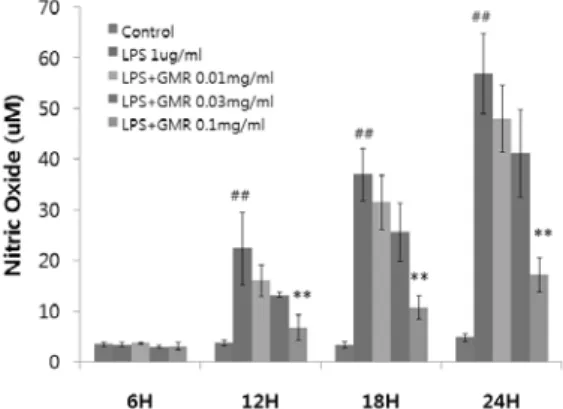
1. NO production에 미치는 영향 (Fig. 1)

Fig. 1. Effects of GMR on the production of NO by LPS.

NO release by GMR in LPS-activated RAW264.7

cells. The NO concentration in the culture medium

was measured for 6∼24 h. The data represent the

mean ± SD of three separate experiments. T-test

was used to assess the significant differences

between the treatment groups. (*: significant

compared with the control, **P<0.01, #: significant

compared with the LPS alone, ##P<0.01)

(4)

2. RAW 264.7 cells의 세포생존율에 미치는 영 향(Fig. 2)

Fig. 2. The effects of GMR on the cell viability.

The cytotoxicity of GMR in LPS-activated RAW264.7 cells. The cytotoxicity was measured for 24 h. The data represent the mean ± SD of three separate experiments. T-test was used to assess the significant differences between the treatment groups. (*:

significant compared with the control, ** P <0.01, #:

significant compared with the LPS alone, ## P <0.01) 3. TNF-α 에 미치는 영향 (Fig. 3)

Fig. 3. The effects of GMR on LPS-stimulated TNF-α production.

Production of TNF-α was measured in the medium of Raw264.7 cells cultured with LPS (1 μg/ml) in the presence or absence of AR for 6 h. The amount of TNF-α was measured by immunoassay as described in Experimental procedures. Data represent the mean ± S.D. with three separate experiments. T-test was used to assess the significant differences between the treatment groups.

(*: significant compared with the control, ** P <0.01,

#: significant compared with the LPS alone,

## P <0.01)

4. IL-1β에 미치는 영향(Fig. 4)

Fig. 4. The effect of GMR on LPS stimulated IL-1β production.

Production of IL-1β was measured in the medium of Raw264.7 cells cultured with LPS (1 μg/ml) in the presence or absence of AR for 12 h. The amount of IL-1β was measured by immunoassay as described in Experimental procedures. Data represent the mean ± S.D. with three separate experiments. T-test was used to assess the significant differences between the treatment groups.

(*: significant as compared to control, ** P <0.01, +:

significant as compared to LPS alone, ++ P <0.01) 5. IL-6에 미치는 영향(Fig. 5)

Fig. 5. The effects of GMR on LPS-stimulated IL-6 production.

Production of IL-6 was measured in the medium of Raw264.7 cells cultured with LPS (1 μg/ml) in the presence or absence of AR for 6 h. The amount of IL-6 was measured by immunoassay as described in Experimental procedures. Data represent the mean ± S.D. with three separate experiments. T-test was used to assess the significant differences between the treatment groups. (significant as compared to control,

** P <0.01, significant as compared to LPS alone, ++ P

<0.01)

(5)

고 찰

秦艽는 龍膽科(Gentianaceae)에 속한 多年生本草 인 秦艽(Gentiana macrophilla Pall.)와 麻花秦艽 (G. straminea.), 粗莖秦艽(G. crassicaulis Duthie ex Burk.) 혹은 小秦艽(G. dahurica Fisch.)의 뿌 리를 乾燥한 것

2,15-7)

으로, 『神農本草經』

18)

에 “秦 艽味平微溫無毒 主寒熱邪氣 寒濕風痹 肢節痛下水 利小便”이라고 하여 最初로 언급되었으며 風濕을 祛하고 虛熱을 淸하며, 筋絡을 舒하는 效能을 가져 風濕痺痛, 筋脈拘攣, 骨節煩痛, 日晡潮熱, 小兒疳積 發熱을 主治한다

2)

.

秦艽로부터 분리, 보고된 성분은 seco-iridoid인 gentiopicroside와 alkaloid인 gentianine, gentianidine, gentiadal 등이 있다. gentiopicroside는 장벽신경 을 촉진시켜 담즙분비 및 위액촉진 작용을 하며 강한 소염작용을 하고 관절염을 억제한다

1,19)

. 현재까지 秦艽에 대한 연구로는 淸熱作用

3)

, 鎭 靜, 鎭痛, 催眠作用

4-5)

및 血壓降下作用과 抗히스타 민作用

6)

이 있으며, Collagen 유발 관절염의 면역 반응에 대한 作用

7)

이 보고되고 있다. 그러나 秦艽 의 항염증효과의 기전에 관한 연구는 부족한 실정 으로 저자는 MeOH로 추출된 秦艽 (GMR)가 LPS 로 활성된 Raw 264.7 cells에서의 NO 생성, TNF-α (Tumor Necrosis Factor-alpha), IL-1β (Interleukin-1β), IL-6 등의 염증매개물질 발현에 어떠한 영향을 미치는지 살펴보았다.

NO는 염증반응을 조절할 수 있는 인자 중 하나 로 알려져 있으며 다른 free radical이나 중금속과 쉽게 반응하고 혈관확장, 신경전달체제, 항균물질, 면역조절 등의 생체 내 작용에 관여한다

20)

. L-arginine으로부터 NOS를 경유하여 생성되는 radical로 세포내에서 2차 신호전달자로서 중요한 역할을 한다. NOS는 크게 cNOS와 iNOS 두 가지 로 분류되는데 cNOS에 의한 NO의 생성은 생체 내 항상성 조절에 중요한 역할을 하는 것으로 알

려져 있으며 iNOS는 LPS, IFN-γ, IL-1 및 TNF- α 등의 자극에 의해 대식세포, 혈관평활근세포, 내피세포, 간세포, 심근세포 등에서 장시간 다량의 NO를 생성하는 것으로 알려져 있다

21)

. NO는 전 염증성 또는 항염증성 작용을 가지는 것으로 알려 져 있으나, 생체 내 고농도의 NO 생성은 숙주세 포의 파괴, shock에 의한 혈관확장, 염증반응 유발 에 의한 조직의 상해를 초래할 수 있는 이중적 생 물학적 성질을 가지는 것으로 알려져 있다

22,23)

. 따 라서 NO 생성 저해제는 septic shock, 다발성 경 화증, 류마티스 관절염과 같은 각종 염증성 질환의 염증반응조절제로서의 가능성에 관한 연구가 활발 하게 이루어지고 있다.

대식세포는 자연 면역 뿐만 아니라 획득 면역 등 다양한 숙주반응에 관여하여 숙주방어와 항상 성 유지에 관여하는 것으로 알려져 있으며 cytokine의 자극만으로도 스스로 NO를 생성하는 특성을 가지고 있다

24,25)

. LPS에 의한 대식세포의 활성은 염증 매개물질인 TNF-α, IL-1β, IL-6 등 다양한 cytokine을 유도하며 염증매개물질의 생성 은 phospholipase A

2

의 활성으로 인해 arachidonic acid가 prostaglandin으로 바뀌는 과 정 및 NO 생성 과정으로 이어지게 된다

26-8)

. 본 연구에서는 LPS로 활성화된 Raw 264.7 cells에서 GMR의 NO 생성억제를 평가하기 위하 여 GMR을 0.01, 0.03 및 0.10 ㎎/㎖의 농도로 LPS 처치 전 1시간에 Raw 264.7 cells에 처리하 여 생성되는 NO의 양을 측정하였다. LPS군에서는 control군에 비교하여 12, 18, 24 시간에서 NO의 생성량이 다량 증가하였으며, 0.10 ㎎/㎖ GMR을 처치한 실험군에서는 시간 및 농도 의존적으로 유 의성 있는 NO의 생성억제를 나타내었다(Fig. 1).

GMR이 0.01, 0.03 및 0.10 ㎎/㎖의 농도에서

LPS로 유도된 NO의 생성을 억제시킨 이유가

GMR의 세포독성으로 인한 것인지를 평가하기 위

하여 GMR의 농도에 따라 MTT assay를 실시하여

(6)

cell viability를 측정하였다. 실험결과 실험에 사용 된 GMR은 LPS 단독처치군에 비교하여 유의한 세 포독성을 나타내지 않았다. GMR은 오히려 LPS에 의한 세포독성을 억제하였다(Fig. 2).

한편, 대식세포는 LPS에 의해 다양한 cytokine, chemokine의 발현을 증가시킨다. cytokine으로는 TNF-α, IL-1, IL-6, G-CSF, M-CSF, GM-CSF 등 이, chemokine으로서 IL-8, MCP-1 등의 발현이 증가된다

33)

. 이 중 TNF-α는 pro-inflammatory cytokine으로서 monocytes, macrophages, mast cells 등으로부터 분비된다. 근래 TNF-α는 많은 자가면역질환에 있어서 핵심적 역할을 하는 것으 로 알려져 있다

29,30)

.

본 연구에서 LPS는 Raw 264.7 cells에서 TNF- α의 분비를 유의하게 촉진시켰으며, GMR은 TNF-α의 생성량을 유의하게 감소시키지 못했다 (Fig. 3).

IL-1β는 monocyte, macrophage, B-cell, dendritic cell, 간세포 등에서 분비되며, TNF-α, IL-2, IL-6와 함께 여러 면역학적 작용들과 연관되 어 있다. 또한 IL-1β는 T-cell의 활성화, B-cell의 성숙, NK cell의 activity를 활성화하고 hypothalamus에 작용하여 발열을 유도 한다

30)

. 본 연구에서는 LPS의 자극에 의하여 IL-1β의 분비가 유의성 있게 증가하였으며, GMR은 0.03 및 0.10 ㎎/㎖의 농도에서 모두 유의하게 IL-1β의 생성량을 감소시켰다(Fig. 4).

단핵구나 대식세포에서 분비되는 IL-6는 림프구 를 활성화시켜 항체생산을 증가시키는 것으로, IL-6의 level은 염증성 병변에서 항상 증가하는 것 으로 보고되고 있다

30)

.

본 연구에서 LPS는 IL-6의 분비를 유의성 있게 증가시켰으며, GMR은 LPS로 유도된 IL-6를 농 도 의존적으로 유의성 있게 감소시키지 못했다 (Fig. 5).

이상의 연구결과는 秦艽 추출물 (GMR)이 in

vitro 에서 유의한 항염증작용을 나타냄을 의미한다.

결 론

秦艽 추출물 (HJE)의 항염증효능을 평가하기 위 하여, 설치류 대식세포주인 Raw 264.7 cells를 LPS로 활성화시킨 후 NO의 생성량, IL-1β, IL-6, TNF-α 등에 미치는 GMR의 영향을 관찰한바 다 음과 같은 결론을 얻었다.

1. LPS에 의해 증가된 NO는 0.10 ㎎/㎖l GMR의 전처치에 의하여 시간 및 농도 의존적으로 유 의하게 억제되었다. 또한 GMR 처치군은 LPS 단독처치군에 비교하여 유의한 세포독성을 나타 내지 않았다.

2. GMR은 LPS에 의해 활성화된 대식세포에서 분 비되는 cytokine 중 IL-1β를 유의하게 억제하 였다.

이러한 결과로 보아, 風濕을 祛하고 虛熱을 淸 하며, 筋絡을 舒하는 效能을 가진 秦艽는 과도한 NO 및 염증성 cytokine에 의한 염증성 질환의 치 료에 적극 활용될 수 있을 것으로 판단된다.

참고문헌

1. 한국한의학연구원. 한약재관능검사기준연구.

서울. 1999:219-21.

2. 본초학. 전국한의과대학 본초학교수. 서울. 영 림사. 1995:264-5.

3. Louise G. Hutchins. 本草中數種藥材對于大白 鼠體溫之影響. Chin. J. Physiol. 1937;11(1):

35-40.

(7)

4. 王浴生. 中藥藥理與應用. 北京. 人民衛生出版 社. 1983:856-7.

5. 劉壽山. 中藥硏究文獻摘要. 北京. 科學出版社.

1975:506-7.

6. 康秉秀 外. 臨床配合本草學. 서울. 영림사.

1994:648-9.

7. 김성재, 이언정, 김형균, 송봉근. 秦艽가 Collagen誘發 關節炎의 免疫反應에 미치는 影 響. 대한한의학회지. 1998;19(1):368-84.

8. Chun SC, Jee SY, Lee SG, Park SJ, Lee JR, Kim SC. Anti-Inflammatory Activity of the Methanol Extract of Moutan Cortex in LPS-Activated Raw 264.7 cells. Evid Based Complement Alternat Med. 2007;4(3):

327-33.

9. Kawamata H, Ochiai H, Mantani N, Terasawa K. Enhanced expression of inducible nitric oxide synthase by Juzen-taiho-to in LPS-activated Raw 264.7 cells, a murine macrophage cell line. Am J Chin Med. 2000;28:217-26.

10. Lee BG, Kim SH, Zee OP, Lee KR, Lee HY, Han JW, Lee HW. Suppression of inducible nitric oxide synthase expression in Raw 264.7 macrophages by two-carboline alkaloids extracted from Melia azedarach.

Eur J Pharmacol. 2000;406:301-9.

11. Yoon TG, Byun BH, Kwon TK, Suh SI, Byun SH, Kwon YK, Kim SC. Inhibitory effect of Farfarae Flos water extract on COX-2, iNOS expression and nitric oxide production in lipopolysaccharide-activated Raw 264.7 cells. Korean J Oriental Physiology & Pathology. 2004;18(3):908-13.

12. 장선일, 김형진, 황기명, 배현옥, 윤용갑, 정헌 택, 김윤철. 활성화된 설치류 Raw 264.7 대식

세포에서 당귀에탄올 추출물의 항염증 효과.

대한한의학방제학회지. 2002;10(2):189-97.

13. Seo WG, Pae HO, Oh GS, Chai KY, Kwon TO, Yun YG , Kim NY, Chung HT. Inhibitory effects of methanol extract of Cyperus rotundus rhizomes on nitric oxide and superoxide production by murine macrophage cell line, Raw 264.7 cells. J Ethnopharmacol. 2001;76:59-64.

14. 이영선, 한옥경, 신상우, 박종현, 권영규. 향부 자 열수추출물의 Nitric oxide 생성 및 iNOS 유전자 발현에 미치는 영향. 동의생리병리학회 지. 2003;17(3):771-6.

15. 陵昌洙. 漢藥의 藥理·成分·臨床應用. 서울.

癸丑文化社. 1982:494-5.

16. 聶慶喜. 中藥材學. 北京. 科學出版社. 1993:

129.

17. 中華人民共和國衛生部藥典委員會. 北京. 中華 人民共和國藥典. 人民衛生出版社. 1990:242-3.

18. 吳普. 神農本草經. 서울. 醫道韓國社. 1976:10.

19. Dan, B., Andrew, G. Materia Medica.

Seattle. Eastland press. 1993:156-8.

20. Wink DA, Mitchell JB. Chemical biology of nitric oxide: Insights into regulatory, cytotoxic, and cytoprotective mechanisms of nitric oxide. Free Radic Biol Med.

1998;25:434-56.

21. Kubes P. Inducible nitric oxide synthase: a little bit of good in all of us. Gut.

2000;47(1):6-9.

22. Chiou WF, Chou CJ, Chen CF.

Camptothecin suppresses nitric oxide biosynthesis in RAW 264.7 macrophages.

Life Sci. 2001;69(6):625-35.

23. Seo WG, Pae HO, Oh GS, Kim NY,

Kwon TO, Shin MK, Chai KY, Chung

(8)

HT. The aqueous extract of Rhodiola sachalinensis root enhances the expression of inducible nitric oxide synthase gene in RAW 264.7 macrophages. J Ethnopharmacol.

2001;76(1):119-23.

24. Lee YS, Kim HS, Kim SK, Kim SD. IL-6 mRNA expression in mouse peritoneal macrophages and NIH3T3 fibroblasts in response to Candida albicans. J Microbiol Biotechnol. 2000;10(1):8-15.

25. Higuchi M, Higashi N, Taki H, Osawa T.

Cytolytic mechanisms of activated macrophages. Tumor necrosis factor and L-arginine-dependent mechanisms act synergistically as the major cytolytic mechanisms of activated macrophages. J Immunol. 1990;144(4):1425-31.

26. 염정호, 오경재, 유영천. 니켈 및 코발트의 세 포독성 기전에서 Nitric Oxide의 역할. 대한산 업의학회지. 2001;13(3):274-85.

27. McDaniel ML, Kwon G, Hill JR, Marshall

CA, Corbett JA. Cytokines and nitric oxides in islet inflammation and diabetes. Proc Soc Exp Biol Med. 1996;211(1):24-32.

28. Cetkovic-Cvrlje M, Eizirik DL. TNF-α and IFN-γ potentiate the deleterious effects of IL-1β on mouse pancreatic islets mainly via generation of nitric oxide. Cytokine.

1994;6(4):399-406.

29. Lee AK, Sung SH, Kim YC, Kim SG.

Inhibition of lipopolysaccharide-inducible nitric oxide synthase, TNF-α and COX-2 expression by sauchinone effects on I-κB α phosphorylation, C/EBP and AP-1 activation. British Journal of Pharmacology.

2003;139:11-20.

30. Delgado AV, McManus AT, Chambers JP.

Production of tumor necrosis factor-alpha,

interleukin 1-beta, interleukin 2, and

interleukin 6 by rat leukocyte

subpopulations after exposure to substance

P. Neuropeptides. 2003;37(6):355-61.

수치

Fig. 1. Effects of GMR on the production of NO by LPS.
Fig. 5. The effects of GMR on LPS-stimulated IL-6  production.

참조

관련 문서

1) Effects of methanol extracts of Capsella bursa-pastoris on cyclooxygenase-2 (COX-2) and Inducible Nitric oxide synthase (iNOS) expression in human prostate cancer cell

Inhibitory effects of classified methanol extracts of Smilax china L on the COX-2 and iNOS expression of human colorectal cancer cell lines... Inhibitory

Fig 4 : Inhibitory effects of classified methanol extracts of Acalypha australis the COX-2 protein expression of the human oral cavity carcinoma KB cells....

And Western Blotting was used to see the effects of Cnidium officinale MAKINO extracts on inducible Nitric Oxide Synthase (iNOS) and cyclooxygenase-2 (COX-2) expression..

In the present study we investigated the proliferation effect of human oral cancer KB cell treated with pulsatilla koreana extract.. We analyzed the effects of this

tricuspidata on the production of proinflammatory cytokines in TNFα+IFNγ-stimulated HaCaT cells ...15 Fig.5: The cell viability of sub-fractions from 70% EtOH

Antiinflammatory and superoxide radical scavenging activities of procyanidins containing extract from the bark of Pinus pinaster Sol.. and

Inhibitory effects of the concentration of methanol extracts from Plantago Asiatica against the COX-2 protein expression and iNOS expression of the MDA-MB-231 human