응복산 사면 일대 산림식생의 종 조성 및 군집 특성
1이하영2⋅이중효3⋅윤충원2*
Characteristics of Species Composition and Community Structure for the Forest Vegetation of Aspect Area in Mt. Eungbok
1Ha-Young Lee2, Jung-Hyo Lee3 Chung-Weon Yun4*
요 약
백두대간 조침령-신배령 구간의 응복산을 대상으로 2012년 4월부터 2013년 8월까지 영구조사구를 설치하여 조사하 였다. 총 25개소(20 × 20m)의 산림식생조사 자료를 토대로 Z-M식물사회학적 방법에 의해 식생유형 분류를 수행하였 다. 그 결과, 최상위 수준에서 신갈나무군락군이 분류되었으며, 군락단위에서는 난티나무군락과 물개암나무군락으로 세분화 되었다. 난티나무군락은 철쭉군과 산딸기군으로 나누어지며, 산딸기군은 다시 태백제비꽃소군과 줄딸기소군으 로 분류되어 총 4개의 식생단위로 분류되었다.
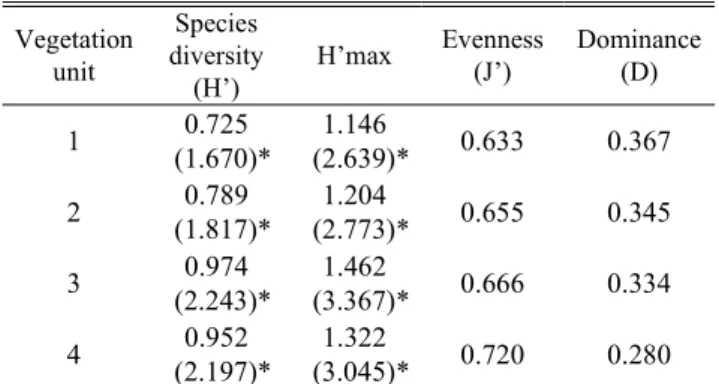
사면의 해발고에 따른 중요치는 교목층에서 신갈나무의 중요치가 높게 나타났으며, 아교목층에서는 당단풍이 높게 나타났다. 따라서 향후 교목층에서 신갈나무가 아교목층에서는 당단풍나무로 유지될 것이다. 종 다양성 분석결과 식생 단위 3에서 0.974로 가장 높게 나타났으며, 식생단위1에서 0.725로 가장 낮게 나타났다.
종간연관 분석 결과 크게 4개의 유형으로 구분되었고, 이는 식생단위의 식별종 및 표징종과 일치하는 경향이었다.
특히 그룹Ⅰ은 철쭉의 식별종과 일치하는 경향이었으며, 그룹Ⅲ은 물개암나무군락에서 주로 출현하는 식물종으로 이루어진 그룹으로 나뉘어졌다.
주요어: 식물사회학, 중요치, 종다양도, 종간연관분석
1 접수 2015년 9월 3일, 수정 (1차: 2015년 10월 22일), 게재확정 2015년 10월 23일 Received 3 September 2015; Revised (1st: 22 October 2015); Accepted 23 October 2015
2 공주대학교 산림자원학과 Dept. of Forest Resources, Kongju National University, Yesan 340-802, Korea 3 국립생태원 기후생태연구실 Dept. of climate & Ecology, National Institute of Korea, Seochon 325-810, Korea
* 교신저자 Corresponding author: Tel: +82-41-330-1305, E-mail: [email protected]
ABSTRACT
The study was carried out to analyze vegetation structure of Mt. Eungbok located in Jochimryeong to Shinbaeryeong of the Baekdudaegan mountain range. The survey for 25 plots was conducted from April 2012 to August 2013 in the permanent plots using phytosociological analysis. As a result, the vegetations were classified into four vegetation units. In species composition, they were classified into Quercus mongolica community group divided into 2 community such as Ulmus laciniata community and Corylus sieboldiana var.
mandshurica community, U. laciniata community was subdivided Rhododendron schlippenbachii group and Rubus crataegifolius group(into Viola albida subgroup, Rubus oldhamii subgroup).
In terms of Importance values according to layer-specific and altitude of ridge, Q. mongolica was the highest importance value of tree layer and Acer pseudosieboldianum was highest importance value of sub tree layer.
Therefore Q. mongolica and A. pseudosieboldianum could likely remain in the future of tree layer and sub tree layer respectively. Analysis of dominance most value of vegetation are on about 0.3. In ridge area was a species diversity result, vegetation unit 3 showed the highest value 0.974 and vegetation unit 1 showed the lowest value 0.725. Based on the interspecific association showed four types which were coincident with differential species and character species on the constancy table. Specially type Ⅰ plant species were mostly differential species and the characteristic species, which appeared in the Rhododendron schlippenbachii community classified phytosociologically, and type Ⅲ plant species were mostly the species appearing in the Corylus sieboldiana var. mandshurica community growing in the relatively.
KEY WORDS: PHYTOSOCIOLOGY, IMPORTANCE VALUE, SPECIES DIVERSITY, INTERSPECIFIC ASSOCIATION
서 론
산림생태계란 수목이 우점하고 있는 생태계라 할 수 있다 (Kimmins, 1992). 이러한 산림생태계를 관리한다는 것은 임목과 환경(기후, 토양, 수분 등)간의 상호관계에 대한 이 해를 바탕으로 한다(Borugeron et al., 1994). 관리의 목표를 생물적인 입장에서 본다면 산림생태계 원래의 생물적 속성 을 유지하거나 회복시키는 것이다. 여기서 생물적인 속성이 란 어떤 지역의 자연적인 서식지에서 나타나는 종의 구성, 다양성, 기능 등과 유사한 균형 잡힌 생물군집을 유지할 수 있는 상태라 할 수 있다(Sparks, 1995; Son and Kim, 1997).
산림생태계에 기반을 이루고 있는 식생은 그 외형적 모습 인 상관은 같아도 군락의 구성 상태나 생태적 특징이 다르 다(Braun-Blanquet, 1932). 그렇기 때문에 산림군락의 발달 과정과 보호, 관리 등에 필요한 중요한 기초정보를 제공하 기 위해서 종의 구성, 군락구조 등과 같은 식생의 생태학적 인 연구가 필요하다. 이러한 관점에서 산림의 식생자료는 식생의 발달과정과 양상을 규명할 수 있을 뿐만 아니라 앞 으로의 천이과정을 예측할 수 있어(Barbour et al., 1987) 넓게는 산림생태계 관리와 좁게는 군락생태학의 학술적 연 구에 크게 기여 할 수 있을 것이다.
한반도 산림생태계의 축이며 인접한 산계의 생태적 대들 보 역할을 하는 가장 큰 산줄기는 백두대간이다. 백두대간 은 자연환경의 근간으로서 생태적 기능을 발휘하는 역할 뿐만이 아니라 산악으로 인하여 생성되는 지형적 차이는 생태계 다양성과 기후의 다양성을 형성한다. 그리고 백두대 간을 중심으로 한 산악지역에 의존하여 살아가는 식물, 야생 동물 등 생물다양성을 증진시킨다(Korea Forest Research Institute, 2003).
반면 백두대간은 경제적인 성장과 개발위주의 정책으로 훼손이 심하였지만, 1990년대 들어와서부터 중요성이 대두
되기 시작했다. 특히 2003년 보호법 지정으로 각종 훼손으 로부터 보호되고 있으며, 그 후 백두대간 내의 산림식생에 대한 연구도 활발히 수행되었다(Korea Forest Service, 2003; Ministry of environment, 2012). 그러나 백두대간은 670㎞로 그 범위 또한 방대하여 지역별로 생태적 특성에 대한 기초자료를 축적하는 연구가 진행되고 있음에도 불구 하고 전 구간에 걸친 연구는 아직 부족하다.
본 연구지는 백두대간의 많은 구간 중에서도 조침령-신 배령 구간이다. 이 구간은 백두대간 마루금과 오대산 국립 공원이 이어지는 곳으로 구간의 주요 봉우리는 갈전곡봉과 응복산이있다. 이들 능선부에는 신갈나무림 능선이 이어지 며 생태적으로 매우 중요한 지역이다. 그러나 그동안 충분 한 조사가 이루어지지 않아 아직 산림식생에 관한 연구가 미비한 실정이다(Korea Forest Research Institute, 2003).
따라서 본 연구는 백두대간의 한 축인 오대산계 조침령-신 배령 구간의 주요 봉우리인 응복산을 대상으로 남사면과 북사면의 식생구조와 생태적 특성을 파악하고, 그 결과를 백두대간의 관리 및 보전에 필요한 기초자료 제공의 일환으 로 수행하였다.
연구방법
1. 연구대상지
응복산은 강원도 홍천군 내면과 양양군 서면에 속하며, 해발고는 1,359.6m로, 북위37° 52' 동경 128° 34'에 위치한 다. 또한 태백산맥의 여맥인 해안산맥 중의 한 산으로, 북서 쪽에는 암산(1,153m), 서쪽에는 약수산(1,306m), 남쪽에는 만월봉(1,281m), 서쪽에는 복룡산(1,015m) 등이 솟아 있다 (Encyclopedia of Korean Culture, 2014).
홍천 기상관측소와 대관령기상대의 최근 20년간(1994-2013) 기상자료를 조사하였다. 홍천기상자료에 의하면 연평균기
Figure 1. Climate diagram of Hongcheon(A) and Daegwallyeong(B) closed to the study area a:Station, b:Height above sea level(m), c:Mean
annual temperature(℃), d:Mean annual precipitation (㎜), e:Absolute maximum temperature(℃), f:Mean daily maximum temperature of the hottest month (℃), g:Number of years observation, h:Mean monthly rain>100mm(black scale), i:Monthly means of precipitation(㎜), j:Monthly means of temperature(℃), k:Relative humid season, l:Mean daily minimum temperature of the coldest month (℃), m:Absolute minimum temperature(℃), n:Months with mean daily minimum temperature below 0℃
온이 약 10.7℃이었으며, 연평균강수량이 약 1,445.8㎜ 정 도로 강수량의 대부분이 7-9월에 집중되었다. 또한, 최난월 의 일평균 최고기온은 31.9℃, 절대 최고기온은 33.8℃이었 고, 최한월의 일평균 최저기온은 –11.0℃, 절대 최저기온은 –16.4℃로 한서의 차가 심하였다. 반면, 대관령기상대는 해 발 772m로 홍천기상관측소의 해발보다 약 600m가량 높은 지대에 위치하였고, 연평균기온은 7℃이었다. 연평균강수 량은 약 1,733.7㎜ 정도로 강수량의 대부분이 7-9월에 집중 되었으나 홍천보다 겨울에 강수량이 높게 나타났다. 또한, 최난월의 일평균 최고기온은 26.8℃, 절대 최고기온은 27.
0℃이었고, 최한월의 일평균 최저기온은 –12.5℃, 절대 최 저기온은 –17.4℃로 한서의 차가 심하였다(Figure 1).
2. 조사분석
1) 산림식생유형분류
본 조사지는 2012년 4월부터 2013년 8월까지 약 17개월 에 걸쳐 응복산 정상기준으로 남사면 16개소, 북사면 8개 소, 정상 1개소로 총 25개소의 조사구(20 × 20m)를 선정하 여 조사하였다. 조사항목은 식생의 종조성과 구조 그리고 입지정보를 중심으로 하였다. 식생의 종조성은 식생조사법 에 따라 조사구별 전유관속 식물의 종류, 출현하는 각 종의 피도(coverage)와 개체수를 조합시킨 우점도(dominance) 계급을 층위별로 구분하여 판정 기록하였다. 입지정보는 조 사구별 면적, 위치좌표, 방위, 경사, 해발고, 지형, 바람(강, 중, 약), 일광(양, 중, 음), 군계(천연림, 조림, 초습원), 토습 (과건, 건, 약건, 적, 약습, 습, 과습), 토양, 암석노출도(%), 토양노출도(%), 낙엽층 깊이(cm)가 기록하였다. 또한, 조사 지 내의 생육하는 흉고직경 2cm 이상의 모든 교목성, 아교 목성 수종의 흉고직경과 수고를 측정하였다.
25개의 방형구의 식생자료를 Ms-Excel에 입력하여 소표 를 작성하여, 이후 소표로부터 다양한 종조합의 군락을 특 징짓기 위한 잠재적 진단종 그룹을 구분해내는 부분표를 만들었다. 그리고 부분표를 이용하여 식별종의 출현과 비출 현에 따라 식별표를 작성하여 이를 토대로 상재도급에 따라 상재도표를 작성하였다. 이와 같은 방법으로 Ellenberg(1956) 의 표조작법과 Hill(1979)의 TWINSPAN 이용에 의하여 소 표(raw table)로부터 여러 단계의 표조작과정을 거쳐 최종 적으로 상재도로 나타낸 식별표를 작성하여 식생유형을 분 석하였다. 식물분류와 동정은 원색식물도감(Lee, 2003), 원 색한국수목도감(Hong et al., 1987)을 기준으로 하였으며, 학명과 국명은 국가표준목록(Korea National Arboretum, 2014)과 국가생물종지식정보시스템(Korea National Arboretum, 2014) 기준으로 작성하였다.
Figure 2. Location of the study area 2) 중요치
식생조사에서 얻은 자료를 토대로 Curtis와 McIntosh (1951)의 방법에 따라 종들의 상대밀도(Relative Density, RD), 상대피도(Relative Coverage, RC), 상대빈도(Relative Frequency, RF)를 고려한 중요치(Importance Value, IV)를 산출하였다.
∙상대밀도 출현한 전체 종의 개체수 한종의 개체수
×
∙상대피도 출현한 전체 종의 흉고단면적 한 종의 흉고단면적
×
∙상대빈도 출현한 전체 종의 출현빈도 한 종의 출현빈도
×
∙중요치
상대밀도 상대피도 상대빈도
3) 종다양도
각 군락에 대한 다양성, 우점도 등을 분석하기 위하여 종다양도지수(Shannon-Wiener diversity, H’), 최대종다양 도(Max Diversity, H’max), 균재도(Evenness, J’), 우점도 (Dominance, D)를 분석하였다(Shannon and Weaver, 1949;
Brower and Zar, 1977).
∙종다양도 ′
log log
log 표본에서종의개체수
표본에서전체개체수
∙최대종다양도′max log
구성종수
∙균재도′ ′′max
∙우점도 ′ ′′max
4) 종간연관분석
25개의 방형구로부터 기록된 167종 중에서 식물사회학 적 분류에 나타난 표징종 및 식별종을 중심으로 각각 5%
이상의 빈도를 갖는 종을 선발하였다. 이 후 2×2 분할표를 작성하고 계산과 행렬표 작성 및 종 성좌표 작성의 순서 로 종간연관분석을 실시하였다(Agnew, 1961; Brower and Zar, 1977). 두 수종 A와 B가 독립적이라는 상관관계를 검 정하기 위하여 각 항목의 기대치를 산출하여 관측치와 비교 해야 한다. 2×2 분할표(table 1)에서 두 수종 A와 B가 독립 적이라는 귀무가설을 검정하기 위하여 검정을 이용한다.
species B present absent
species A
present a b m=a+b
absent c d n=c+d
r=a+c s=b+d N=a+b+c+d
* a=The number of SUs where both species occur, b=The number of SUs where species A occurs, but not B, c=The number of SUs where species B occurs, but not A, d=The number of SUs where neither A nor B are found Table 1. 2×2 contingency table for association
between two species, A and B(Cole, 1949)
①
관측치 기대치관측치 ②
수식 ①에서 관측치가 기대치보다 큰 값을 가질 때 즉, 수식 ②에서 ad>bc 일 때 정(正)의 상관관계가 있으며, ad<bc일 때에 부(負)의 상관관계가 있다(Agnew, 1961;
Brower and Zar, 1977). ++와 +는 양성결합을, --와 -는 음 성결합을 나타낸 것이며 ++와 --는 99%의 확률수준에서, +와 -는 95%의 확률수준에서 두 수종간의 유의한 상관관계 가 있음을 표시한 것이다(Agnew, 1961).
결과 및 고찰
1. 식생 군락 유형 분류
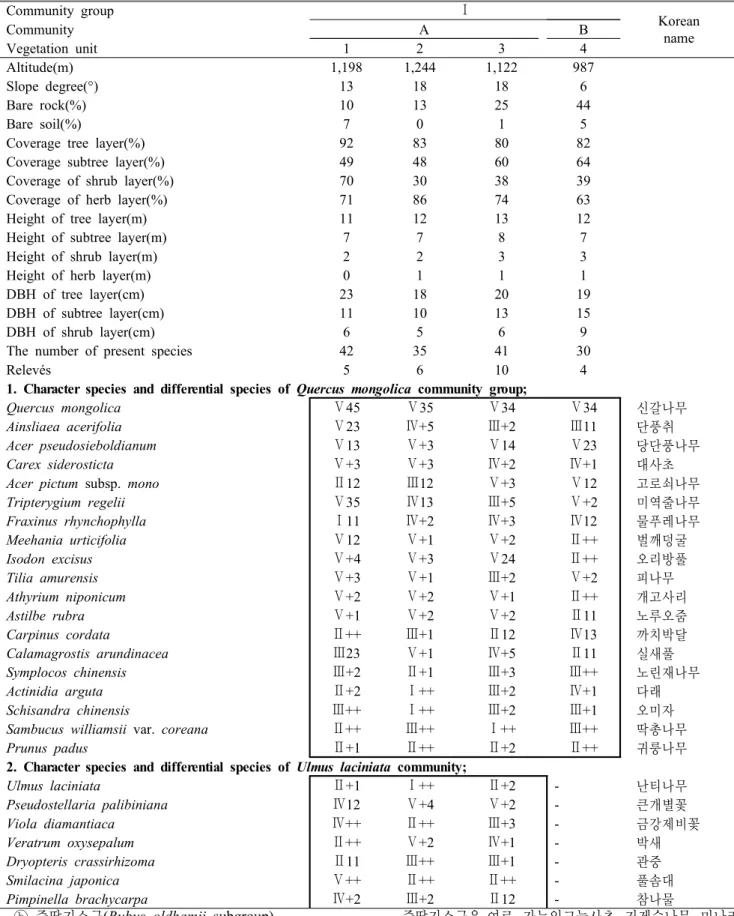
응복산 정상 기준으로 남사면 16개소 북사면 8개소 정상 1개소로 총 25개소의 산림식생조사 자료를 바탕으로 Z-M 식물사회학적 방법에 의해 식생유형 분류를 수행하였다. 그 결과, 최상위 수준에서 신갈나무군락군이 분류되었으며, 신 갈나무군락군은 난티나무군락과 물개암나무군락으로 세분 화 되었다. 난티나무군락은 철쭉군과 산딸기군으로 나누어 지며, 산딸기군은 다시 태백제비꽃소군과 줄딸기소군으로 분류되었다. 따라서 응복산의 신갈나무군락군은 총 2개 군 락과 2개 군, 2개 소군으로의 분류체계를 가졌으며 총 4개 의 식생단위로 분류되었다(Table 2).
1) 신갈나무군락군(Quercus mongolica community group)
본 군락은 신갈나무, 단풍취, 당단풍나무, 대사초, 고로 쇠, 미역줄나무, 물푸레나무, 벌깨덩굴, 오리방풀, 피나무, 개고사리, 노루오줌, 까치박달, 실새풀, 노린재나무, 다래,
오미자, 딱총나무, 귀룽나무에 의해 구분된 군락군으로 소 나무림과 신갈나무림의 군락군과 일치한다.
(1) 난티나무군락(Ulmus laciniata community)
본 군락은 난티나무, 큰개별꽃, 금강제비꽃, 박새, 관중, 송이풀, 곰취, 참취, 투구꽃, 참당귀, 진범, 족도리풀 등의 식별종이 출현하며, 하위단위로 철쭉군과 산딸군의 2개 하 급식생단위로 세분되었다. Kim et al.(2011)의 울릉도 산마 늘 자생지의 난티나무군이 분류되었으나 본 군락과는 다른 식별종으로 나타났다. Bae(2005)의 금봉산자연휴양림 식생 연구의 단일종인 난티나무 군락과는 식별종이 다르게 나타 났다.
① 철쭉군(Rhododendron schlippenbachii group) 철쭉, 함박꽃나무, 산가막살나무, 각시서덜취, 새끼노루 귀, 금강초롱꽃, 청시닥나무, 미역취, 괴불나무, 마가목, 애 기나리, 참나래박쥐, 사스래나무를 식별종에 의해 구분되었 다. 입지환경으로는 평균해발고 1,198m(1,117-1,283m), 평 균경사도 13°(3-20°), 평균암석노출도 10%(0-15%)로 나타 났다. 평균수고는 교목층 11m(9-12m), 아교목층 7m(6-8m), 관목층 2m(1-3m)였으며, 평균흉고직경은 교목층 23cm(15-29cm), 아교목층 11cm(7-16cm), 관목층 6cm(4-7cm), 출현종수는 42종(37-45종)으로 나타났다. 북사면에 출현하는 종들로 이루어진 철쭉군은 Yun et al.(2007)의 가야산과 Song and Yun(2006)의 설악산 철쭉군락과 식별종이 다르게 나타났 으나, Cho et al.(2004)의 아고산지역 상록침엽수림 연구에 서 사스래나무-철쭉꽃형의 식별종인 사스래나무가 일치한 것은 사스래나무와 철쭉이 주로 고산지역에서 분포하기 때 문이다.
② 산딸기군(Rubus crataegifolius group)
산딸기군은 산딸기, 동자꽃, 가는갈퀴나물, 넓은잎외잎쑥 등의 식별종이 출현하며 하위단위로 태백제비꽃 소군과 줄 딸기소군의 2개 하급식생단위로 세분되었다. Ahn et al.
(2004)의 덕유산 산딸기군락의 식별종과는 다르게 나타났다.
Ⓐ 태백제비꽃 소군(Viola albida subgroup)
태백제비꽃 소군은 양지꽃, 세잎양지꽃의 식별종이 출현하 였으며, 입지환경으로는 평균해발고 1,244m(1,169-1,305m), 평균경사도 18°(5-30°), 평균암석노출도 44%(3-78%)로 나 타났다. 평균수고는 교목층 12m(9-13m), 아교목층 7m(6-8m), 관목층 2m(1.5-2.5m)였으며, 평균흉고직경은 교목층 18cm (15-23cm), 아교목층 10cm(7-13cm), 관목층 5cm(3-8cm), 출현종수는 35종(29-40종)으로 나타났다.
Community group Ⅰ
Korean
Community A B name
Vegetation unit 1 2 3 4
Altitude(m) 1,198 1,244 1,122 987
Slope degree(°) 13 18 18 6
Bare rock(%) 10 13 25 44
Bare soil(%) 7 0 1 5
Coverage tree layer(%) 92 83 80 82
Coverage subtree layer(%) 49 48 60 64
Coverage of shrub layer(%) 70 30 38 39
Coverage of herb layer(%) 71 86 74 63
Height of tree layer(m) 11 12 13 12
Height of subtree layer(m) 7 7 8 7
Height of shrub layer(m) 2 2 3 3
Height of herb layer(m) 0 1 1 1
DBH of tree layer(cm) 23 18 20 19
DBH of subtree layer(cm) 11 10 13 15
DBH of shrub layer(cm) 6 5 6 9
The number of present species 42 35 41 30
Relevés 5 6 10 4
1. Character species and differential species of Quercus mongolica community group;
Quercus mongolica Ⅴ45 Ⅴ35 Ⅴ34 Ⅴ34 신갈나무
Ainsliaea acerifolia Ⅴ23 Ⅳ+5 Ⅲ+2 Ⅲ11 단풍취
Acer pseudosieboldianum Ⅴ13 Ⅴ+3 Ⅴ14 Ⅴ23 당단풍나무
Carex siderosticta Ⅴ+3 Ⅴ+3 Ⅳ+2 Ⅳ+1 대사초
Acer pictum subsp. mono Ⅱ12 Ⅲ12 Ⅴ+3 Ⅴ12 고로쇠나무
Tripterygium regelii Ⅴ35 Ⅳ13 Ⅲ+5 Ⅴ+2 미역줄나무
Fraxinus rhynchophylla Ⅰ11 Ⅳ+2 Ⅳ+3 Ⅳ12 물푸레나무
Meehania urticifolia Ⅴ12 Ⅴ+1 Ⅴ+2 Ⅱ++ 벌깨덩굴
Isodon excisus Ⅴ+4 Ⅴ+3 Ⅴ24 Ⅱ++ 오리방풀
Tilia amurensis Ⅴ+3 Ⅴ+1 Ⅲ+2 Ⅴ+2 피나무
Athyrium niponicum Ⅴ+2 Ⅴ+2 Ⅴ+1 Ⅱ++ 개고사리
Astilbe rubra Ⅴ+1 Ⅴ+2 Ⅴ+2 Ⅱ11 노루오줌
Carpinus cordata Ⅱ++ Ⅲ+1 Ⅱ12 Ⅳ13 까치박달
Calamagrostis arundinacea Ⅲ23 Ⅴ+1 Ⅳ+5 Ⅱ11 실새풀
Symplocos chinensis Ⅲ+2 Ⅱ+1 Ⅲ+3 Ⅲ++ 노린재나무
Actinidia arguta Ⅱ+2 Ⅰ++ Ⅲ+2 Ⅳ+1 다래
Schisandra chinensis Ⅲ++ Ⅰ++ Ⅲ+2 Ⅲ+1 오미자
Sambucus williamsii var. coreana Ⅱ++ Ⅲ++ Ⅰ++ Ⅲ++ 딱총나무
Prunus padus Ⅱ+1 Ⅱ++ Ⅱ+2 Ⅱ++ 귀룽나무
2. Character species and differential species of Ulmus laciniata community;
Ulmus laciniata Ⅱ+1 Ⅰ++ Ⅱ+2 - 난티나무
Pseudostellaria palibiniana Ⅳ12 Ⅴ+4 Ⅴ+2 - 큰개별꽃
Viola diamantiaca Ⅳ++ Ⅱ++ Ⅲ+3 - 금강제비꽃
Veratrum oxysepalum Ⅱ++ Ⅴ+2 Ⅳ+1 - 박새
Dryopteris crassirhizoma Ⅱ11 Ⅲ++ Ⅲ+1 - 관중
Smilacina japonica Ⅴ++ Ⅱ++ Ⅱ++ - 풀솜대
Pimpinella brachycarpa Ⅳ+2 Ⅲ+2 Ⅱ12 - 참나물
Table 2. Differential table of forest vegetation in study area
ⓑ 줄딸기소군(Rubus oldhamii subgroup) 줄딸기소군은 여로, 가는잎그늘사초, 거제수나무, 미나리
Community group Ⅰ
Korean
Community A B name
Vegetation unit 1 2 3 4
Pedicularis resupinata Ⅲ+2 Ⅱ++ Ⅱ+1 - 송이풀
Ligularia fischeri Ⅱ++ Ⅱ++ Ⅲ++ - 곰취
Aster scaber Ⅱ++ Ⅴ++ Ⅱ++ - 참취
Aconitum jaluense Ⅲ++ Ⅴ++ Ⅳ++ - 투구꽃
Angelica gigas Ⅰ22 Ⅳ+2 Ⅱ+1 - 참당귀
Aconitum pseudolaeve Ⅱ++ Ⅴ+1 Ⅲ+2 - 진범
Asarum sieboldii Ⅲ+1 Ⅲ++ Ⅳ+1 - 족도리풀
3. Character species and differential species of Rhododendron schlippenbachii group;
Rhododendron schlippenbachii Ⅴ+4 Ⅲ+4 - - 철쭉
Magnolia sieboldii Ⅴ+1 - - Ⅱ11 함박꽃나무
Viburnum wrightii Ⅳ++ Ⅰ++ - - 산가막살나무
Saussurea macrolepis Ⅳ++ - - - 각시서덜취
Hepatica insularis Ⅳ12 - - - 새끼노루귀
Hanabusaya asiatica Ⅲ++ Ⅰ++ Ⅰ++ - 금강초롱꽃
Acer barbinerve Ⅲ+2 - Ⅰ++ - 청시닥나무
Solidago virgaurea subsp. asiatica Ⅱ++ - Ⅰ++ - 미역취
Lonicera maackii Ⅱ++ - - - 괴불나무
Sorbus commixta Ⅱ++ - - - 마가목
Disporum smilacinum Ⅱ++ - - - 애기나리
Parasenecio koraiensis Ⅲ+1 Ⅱ++ - - 참나래박쥐
Betula ermanii Ⅱ12 - - - 사스래나무
4. Character species and differential species of Rubus crataegifolius group;
Rubus crataegifolius Ⅰ11 Ⅴ++ Ⅲ+3 - 산딸기
Lychnis cognata - Ⅴ+1 Ⅳ+1 - 동자꽃
Vicia anguste-pinnata - Ⅴ+1 Ⅳ+2 - 가는갈퀴나물
Artemisia stolonifera - Ⅴ+1 Ⅳ+2 - 넓은잎외잎쑥
5. Character species and differential species of Viola albida subgroup;
Viola albida - Ⅴ++ Ⅰ++ Ⅱ++ 태백제비꽃
Potentilla fragarioides var. major - Ⅳ+1 - - 양지꽃
Potentilla freyniana - Ⅲ++ - - 세잎양지꽃
6. Character species and differential species of Rubus oldhamii subgroup;
Rubus oldhamii - - Ⅲ+1 - 줄딸기
Veratrum maackii var. japonicum - - Ⅱ++ - 여로
Carex humilis var. nana - - Ⅱ+1 - 가는잎그늘사초
Betula costata - Ⅰ22 Ⅱ+2 - 거제수나무
Cardamine leucantha - Ⅰ++ Ⅱ+1 - 미나리냉이
Rubia akane - - Ⅱ++ - 꼭두서니
7. Character species and differential species of Corylus sieboldiana var. mandshurica community;
Corylus sieboldiana var. mandshurica Ⅰ++ Ⅰ++ Ⅱ++ Ⅴ+1 물개암나무
Sasa borealis - Ⅱ++ Ⅱ22 Ⅴ+4 조릿대
Symplocarpus nipponicus - - - Ⅳr+ 애기앉은부채
Actinidia polygama - - - Ⅲ+1 개다래
Betula schmidtii - - - Ⅱ11 박달나무
Pinus densiflora - - - Ⅱ22 소나무
Kalopanax septemlobus - - - Ⅱ22 음나무
Tilia manshurica - - - Ⅱ11 찰피나무
(Table 2. Continued)
Community group Ⅰ
Korean
Community A B name
Vegetation unit 1 2 3 4
Commelina communis - - - Ⅲ+1 닭의장풀
Euonymus fortunei var. radicans - - - Ⅲ++ 줄사철나무
Pilea japonica - - - Ⅲ++ 산물통이
Isodon inflexus - - - Ⅲ+1 산박하
Euonymus sachalinensis - Ⅰ++ - Ⅲ++ 회나무
8. Stephanandra incisa differential species group;
Stephanandra incisa Ⅱ++ - Ⅳ+3 Ⅱ++ 국수나무
Maackia amurensis - - Ⅰ11 Ⅲ+1 다릅나무
Viola collina - Ⅰ++ Ⅰ11 Ⅳ++ 둥근털제비꽃
Morus bombycis - - Ⅱ+1 Ⅳ11 산뽕나무
Ulmus davidiana var. japonica - - Ⅳ+2 Ⅴ+1 느릅나무
Deutzia glabrata - - Ⅲ+3 Ⅲ++ 물참대
Equisetum hyemale - - Ⅲ+4 Ⅲ++ 속새
Lespedeza maximowiczii - Ⅰ++ Ⅲ+2 Ⅴ+1 조록싸리
Brachybotrys paridiformis - - Ⅲ+1 Ⅱ++ 당개지치
9. Companions species group;
Cimicifuga dahurica Ⅱ++ - Ⅰ+3 - 눈빛승마
Saussurea tanakae - Ⅰ11 Ⅰ++ - 당분취
Parasenecio auriculatus var. matsumuranus Ⅰ++ Ⅱ++ Ⅱ++ - 박쥐나물
Clematis heracleifolia Ⅰ++ Ⅰ++ Ⅰ+1 - 병조희풀
Acer mandshuricum Ⅱ++ Ⅰ++ Ⅰ++ - 복장나무
Saussurea seoulensis Ⅱ++ Ⅲ++ Ⅱ++ - 분취
Saussurea grandifolia - Ⅱ+1 Ⅰ++ - 서덜취
Galium kinuta - - Ⅰ++ - 민둥갈퀴
*The others 78 companion species omitted.
(Table 2. Continued)
냉이, 꼭두서니 등의 식별종 출현에 의해 구분되었다. 입지 환경으로는 평균해발고 1,122m(1,004-1,362m), 평균경사 도 18°(5-25°), 평균암석노출도 18%(0-25%)로 나타났다.
평균수고는 교목층 13m(6-16m), 아교목층 8m(4-10m), 관 목층 3m(1-5m)였으며, 평균흉고직경은 교목층 20cm(15-27cm), 아교목층 13cm(8-20cm), 관목층 6cm(4-7cm)로 나타났다.
출현종수는 41종(26-51종)으로 나타났다.
(2) 물개암나무군락(Corylus sieboldiana var. mandshurica community)
물개암나무군락은 조릿대, 애기앉은부채, 개다래, 닭의장풀, 줄사철나무, 산물통이, 산박하, 회나무, 박달나무, 소나무, 음나 무, 찰피나무의 식별종이 출현하였으며, 입지환경으로는 평균해 발고 987m(963-1,008m), 평균경사도 6°(5-10°), 평균암석노출도 44%(0-65%)로 나타났다. 평균수고는 교목층 12m(11-13m), 아 교목층 7m(6-9m), 관목층 2.6m(2-3m)였으며, 평균흉고직경은 교목층 19cm(8-20cm), 아교목층 15cm(14-16cm), 관목층
9cm(8-10cm), 출현종수는 30종(26-37종)으로 나타났다. 한 국 자생 산돌배와 돌배나무 조성(Song and Ahn, 2003)의 연구에서 물개암나무군락이 일치하였으나 본 조사지에서 돌배나무는 물개암나무군락에 포함되지는 않았다.
2. 중요치
응복산 정상을 기준으로 남사면과 북사면으로 구분하여 해발고 별로 종조성 측면에서 어떤 차이가 있는지를 파악하 기 위하여 Curtis와 Mclntosh의 방법을 응용하여 주요 수종 의 중요치를 산출하였다(Table 2, Table 3).
남사면 교목층의 중요치를 산출한 결과 해발 1,000m, 1,100m 1,200m 1,300m의 모든 조사구에서 신갈나무가 각 각 50.07, 31.53, 72.62, 65.65으로 가장 높게 나타났으며, 이중 해발 1,200m에서 72.62로 가장 높게 나타났다. 다음으 로 물푸레나무가 해발 1,200m, 1,300m에서 각각 17.66, 19.61로 높게 나타났으나 1,000m에서는 피나무(5.71)가 물
South aspect North aspect Korean name 1,000m 1,100m 1,200m 1,300m 1,000m 1,100m 1,200m 1,300m
Quercus mongolica 50.07 31.53 72.62 65.65 49.39 54.22 46.84 53.43 신갈나무
Tilia amurensis 10.36 2.98 12.91 24.18 17.52 피나무
Fraxinus rhynchophylla 4.25 10.47 17.66 19.61 27.92 7.76 9.68 물푸레나무
Betula ermanii 9.51 11.06 사스래나무
Acer pictum subsp. mono 4.25 17.55 14.74 12.09 7.76 고로쇠나무
Cornus controversa 19.36 층층나무
Ulmus laciniata 18.82 난티나무
Pyrus pyrifolia 9.77 돌배나무
Prunus padus 2.98 7.76 귀룽나무
Betula costata 4.25 2.98 9.71 거제수나무
Pinus densiflora 4.25 소나무
Phellodendron amurense 4.25 7.49 황벽나무
Juglans mandshurica 3.05 4.52 가래나무
Sorbus alnifolia 3.05 4.52 팥배나무
Betula schmidtii 3.05 박달나무
Maackia amurensis 3.05 다릅나무
Quercus serrata 3.05 졸참나무
Tilia manshurica 3.05 찰피나무
Ulmus davidiana var. japonica 14.99 느릅나무
Total 100.00 100.00 100.00 100.00 100.00 100.00 100.00 100.00 Table 3. Importance values(%) of tree layer in aspect
South aspect North aspect Korean name 1,000m 1,100m 1,200m 1,300m 1,000m 1,100m 1,200m 1,300m
Acer pseudosieboldianum 21.51 23.71 33.06 8.50 57.65 50.00 26.88 39.78 당단풍나무
Quercus mongolica 8.67 14.05 8.75 40.52 13.24 신갈나무
Acer pictum subsp. mono 13.88 21.70 13.40 8.50 19.38 고로쇠나무
Tilia amurensis 6.62 3.20 12.12 16.99 50.00 17.19 7.25 피나무
Fraxinus rhynchophylla 4.08 6.39 12.12 8.50 9.69 물푸레나무
Carpinus cordata 11.34 3.20 7.47 8.50 까치박달
Sorbus alnifolia 4.05 4.65 8.50 팥배나무
Ulmus davidiana var. japonica 4.05 9.59 10.59 느릅나무
Morus bombycis 6.05 6.39 산뽕나무
Actinidia arguta 4.05 2.19 다래
Phellodendron amurense 1.51 3.20 황벽나무
Pyrus pyrifolia 1.51 2.81 10.59 돌배나무
Prunus padus 3.20 9.69 귀룽나무
Euonymus macropterus 3.20 나래회나무
Ulmus laciniata 2.81 17.19 난티나무
Acer mandshuricum 2.81 복장나무
Kalopanax septemlobus 2.54 음나무
Maackia amurensis 1.51 10.59 다릅나무
Fraxinus mandshurica 1.51 13.24 들메나무
Prunus sargentii 1.51 산벚나무
Abies holophylla 1.51 전나무
Cornus controversa 1.51 13.24 층층나무
Magnolia sieboldii 1.51 13.24 함박꽃나무
Betula costata 1.05 거제수나무
Syringa reticulata var. mandshurica 10.59 개회나무
Total 100.00 100.00 100.00 100.00 100.00 100.00 100.00 100.00 Table 4. Importance values(%) of subtree layer in aspect
Figure 3. Chi-square matrix for major 28 species in ridge area. 28 species were selected from major differential species and companion species of Table 1(+,-:0.01<P<0.05, ++,--:P<0.01)
Figure 4. Species constellation showing positive correlation between 28 species of Ridge area
QUMO; Quercus mongolica, ACPS; Acer pseudosieboldianum, ACPI; Acer pictum subsp. mono, TRRE; Tripterygium regelii, FRRH; Fraxinus rhynchophylla, ULLA; Ulmus laciniata, PSPA; Pseudostellaria palibiniana, VIDI;
Viola diamantiaca, VEOX; Veratrum oxysepalum, RHSC;
Rhododendron schlippenbachii, SAMA; Saussurea macrolepis, ACBA; Acer barbinerve, SOCO; Sorbus commixta, RUCR; Rubus crataegifolius, LYCO; Lychnis cognata, VIAL; Viola albida, POFR; Potentilla fragarioides var. major, RUOL; Rubus oldhamii, BECO; Betula costata, ACPO; Actinidia polygama, EUSA; Euonymus sachalinensis, BESC; Betula schmidtii, PIDE; Pinus densiflora, KASE;
Kalopanax septemlobus, TIMA; Tilia manshurica, MOBO;
Morus bombycis, ULDA; Ulmus davidiana var. japonica, BRPA; Brachybotrys paridiformis
푸레나무(4.25)보다 높게 나타났으며 해발 1,100m에서는 고로쇠나무(17.55)가 물푸레나무(10.47)보다 높게 나타났 다. 반면, 북사면에서도 남사면과 같이 해발 1,000m, 1,100m 1,200m 1,300m의 모든 조사구에서 신갈나무가 각 각 49.39, 54.22, 46.84, 53.43으로 가장 높게 나타났으나, 1,100m를 제외한 나머지 해발고에서는 남사면보다 낮게 나 타났다. 남사면에서 물푸레나무가 해발 1,200m(17.66)보다 1,300m(19.61)에서 높게 나타났으나, 북사면에서는 해발 1,000m(27.92)에서 비교적 높은 수치로 나타났다. 한편, 해 발 1,100m 와 1,300m에서는 피나무가 각각 24.18, 17.52로 높게 나타났으며, 해발 1,200m에서는 사스래나무가 11.06 으로 높게 나타났다. 전반적으로 남사면이 북사면에 비해 많은 수종이 나타난 것은 남사면이 계곡부에 위치하고 있어 수종이 다양한 것으로 판단된다(Table 3).
아교목층의 경우 남사면에서는 해발 1,000m, 1,100m 1,200m에서 당단풍나무가 각각 21.51, 23.71, 33.06 으로 높게 나타났으나 해발 1,300m에서는 신갈나무가 40.52로 당단풍나무(8.50)보다 월등히 높게 나타났다. 해발 1,000m 에서는 당단풍나무, 고로쇠나무, 까치박달 순으로 높게 나 타났다. 다른 해발고에 비해 까치박달(11.34)의 중요치가 다소 높게 나타났다. 해발 1,100m와 1,200m에서도 당단풍 나무와 고로쇠나무 순으로 높게 나타났으나 1,100m에서는 신갈나무가 14.05로 다소 높게 나타났으며 1,200m에서는 피나무와 물푸레나무가 다소 높게 나타났다. 북사면에서는 해발 1,000m, 1,100m 1,200m, 1,300m에서 당단풍나무가 각각 57.65, 50.00, 26.88, 39.78로 높게 나타났다. 해발 1,000m, 1,100m 에서는 당단풍나무의 중요치가 다른 수종 에 비해 월등히 높아 당분간 당단풍나무가 우점할 것으로
예상되나, 해발 1,200m 에서는 고로쇠나무(19.38), 피나무 (17.19), 난티나무(17.19)의 경쟁이 나타날 것으로 판단되 며 해발 1,300m에서도 들메나무(13.24) 신갈나무(13.24), 층층나무(13.24), 함박꽃나무(13.24)의 수종 간 경쟁이 지 속될 것으로 판단된다(Table 4).
남, 북사면에 중요치 결과는 신갈나무의 중요치는 높게 나타났으나, 당단풍나무, 피나무, 고로쇠나무의 경쟁이 심 화될 것이라는 Lee and Song(2011)과 Song et al.(2003)의 결과와 일치하였다. 따라서 남, 북사면은 신갈나무-당단풍 나무 군락으로 계속 유지 될 것으로 보이나 당분간 당단풍 나무와 피나무가 경쟁할 것이라 판단된다.
3. 종다양도
종다양성 지수는 구성수종의 수와 개체수를 기준으로 산 출되며, 식생구성 상태가 얼마나 다양한가에 대한 객관적인
Vegetation unit
Species diversity (H’)
H’max Evenness (J’)
Dominance (D) 1 0.725
(1.670)*
1.146
(2.639)* 0.633 0.367 2 0.789
(1.817)*
1.204
(2.773)* 0.655 0.345 3 0.974
(2.243)*
1.462
(3.367)* 0.666 0.334 4 0.952
(2.197)*
1.322
(3.045)* 0.720 0.280
*H’and H’max values in log10 scale(nature log scale)
Table 5. Species diversity, Evenness, Dominance of each vegetation unit
척도를 제공하기 때문에 산림의 안정 상태를 파악하는데 매우 효율적인 방법으로 활용되고 있다(Yang et al., 2001).
식생단위별 종다양도 지수를 살펴보면 대부분 0.8 내외로 나타났으며, 식생단위1에서 0.725로 가장 낮았고 식생단위 3 이 0.974로 가장 높게 나타났다. 백두대간 향로봉 신갈나무림 의 종다양도(Cheon et al., 2014)는 0.970±0.641-1.227±0.410 로 높게 나타났으나, 강원도 신갈나무림(Jang and Song, 1997)의 0.7340-0.9368과 비슷한 값이 나타났다. 균재도는 값이 큰 군집일수록 안정 상태에 도달된 것으로 평가되는데 (Cho et al., 2012), 각 식생단위의 균재도가 0.633-0.722으 로 나타나 안정된 상태에 있는 것으로 판단된다(Table 5).
4. 종간연관분석
종간연관분석은 식물종간의 연관성을 가장 잘 나타내주 며, 유의적인 연관성을 가지는 종들을 도형으로 나타낼 수 있어 종간의 분포상태와 유연성에 대한 이해도를 증진시킬 수 있다(Agnew, 1961; Park and Kim, 1979).
본조사지의 사면에서 식물사회학적 방법에 의해 분류된 표징종과 식별종 중 대표적인 28개의 종을 대상으로 이들 상호간의 관계를 파악하기 위해 종간결합을 분석하였다 (Figure 3, Figure 4).
Figure 4에 나타난 바와 같이 4개의 그룹으로 나뉘어졌는 데 즉, 그룹 Ⅰ은 철쭉, 청시닥나무, 마가목으로 철쭉군의 표징종과 일치하였으며 이는 북사면에서 나타나는 종들로 이루어진 그룹이다. 반면 그룹 Ⅱ의 경우 태백제비꽃, 양지 꽃, 박새, 큰개별꽃 등의 남사면과 북사면에서 공통으로 출 현하는 종들로 이루어진 식생단위 2와 식생단위 3의 식별종 과 일치하였다. 그룹 Ⅲ은 개다래, 음나무, 찰피나무, 산뽕 나무, 회나무, 박달나무, 소나무로 물개암나무 군락의 표징 종과 일치하였으며 주로 남사면에서 나타나는 종들로 이루 어진 그룹이다. Lee et al.(1995)의 청량산 종간연관 분석에
서 그룹 Ⅰ,Ⅱ가 신갈나무군락의 식물로 이루어진 결과와 는 대조적으로 나타났다.
결 론
이 연구는 백두대간 오대산계 조침령-신배령 구간의 주요 봉우리인 응복산을 대상으로 남사면과 북사면의 식생구조와 생태적 특성을 파악하고, 백두대간의 관리 와 보전, 그리고 생태계변화 해석과 평가 등에 필요한 기초자료 제공 일환으로 수행되었다. 응복산을 대상으 로 사면을 따라 조사구를 설치하였으며 식생조사와 매 목조사를 기반으로 식생유형 분류를 수행하였던 바 식 생유형은 총 4개의 식생단위로 분류되었으며, 식생단 위의 최상위 수준에서 신갈나무군락군으로 분류되었 고, 군락단위에서는 난티나무군락과 물개암나무군락 으로 세분되었다. 난티나무군락은 철쭉군과 산딸기군 으로 나누어지며, 산딸기군은 다시 태백제비꽃소군과 줄딸기소군으로 분류되어 응복산의 신갈나무군락군은 총 2개 군락과 2개 군, 2개 소군으로 분류체계를 가졌 다. 식생단위와 종조성, 층위별 중요치와 사면별 중요 치, 종다양도, 종간연관분석 등의 결과를 볼 때, 현재 남사면과 북사면 모두 신갈나무림으로 나타났으며 당 분간 유지될 것으로 판단되었다. 남한 백두대간 내 대 부분의 지역에서 소나무와 신갈나무가 동시에 나타나 고 있으나 신갈나무의 분포는 예년보다 증가하고 있다.
이러한 추세로 볼 때 백두대간에서 소나무림에 비해 신갈나무림이 앞으로 더 증가할 것이며, 앞으로 많은 구간의 식생변화 모니터링과 식생구조 등에 대한 연구 가 필요할 것으로 사료되었다.
REFERENCES
Agnew, A.D. Q.(1961) The ecology of Juncus effusus L. in North Wales, J. Ecol. 49: 83-102.
Ahn Y.H., Y.T. Jung and S.G. Lee(2004) Phytosocialogical Study of Weed Vegetation around the Climbing Paths on the Ridge of Deogyusan National Park. Kor. J. Env. Eco. 18(2): 191-196. (in Korean with English abstract)
Bae, K.H.(2005) Vegetation Classification and Ecological Application of Vegetation Data in the Keumbong Recreational Forest. Kor. J. For. Rec. Wel. 9(2): 11-20. (in Korean with English abstract)
Barbour, M.G., J.H. Burk and W.D. Pitts(1987) Terrestrial plant ecology 2nd ed. The benjamin Cummings Publishing Co.
Menlo Park. 604pp.
Bourgeron, P.S., H.C. Humphries, R.L. Develice and M.E.
Jensen(1994) Ecological theory in relation to landscape and ecosystem characterization. In Jensen M.E. and P.S. Bourgeron (eds). VolumeⅡ: Ecosystem Management: Principles and App-lications. USDA For. Serv. GTR-PNW-318. pp. 58-72.
Braun-Blanquet, J(1932) Plant sociology; the study of plant communties. New York and London, McGraw-Hill book com- pany, inc. 472pp.
Brower, J.E. and J.H. Zar(1977) Field and Laboratory Methods for General Ecology. Wm. C. Brown Co., Dubuque, Iowa. 288pp.
Cheon K.L., J.G. Byun, S.C. Jung and J.H. Sung(2014) Community Structure of Quercus mongolica Stand in Hyangrobong Area, Baekdudaegan. Journal of Agriculture & Life Sciences. 48(1):
1-13. (in Korean with English abstract)
Cho, H.J., K.H. Bae, C.S. Lee and C.H. Lee(2004) Species Composition and Structure of the Evergreen Coniferous Forest Vegetation of the Subalpine Area (South Korea). Jour. Korean For. Soc. 39(5): 372-397. (in Korean with English abstract) Cho. M.G., J.M. Chung, H.R. Jung, M.Y. Kang and H.S. Moon
(2012) Vegetation Structure of Taxus cuspidata Communities in Subalpine Zone. Journal of Agriculture & Life Sciences.
46(5): 1-10. (in Korean with English abstract)
Curtis, J.T. and R.P. Mcintosh(1951) An upland forest continum in the prairie-forest border region of Wis-consin. Ecology. 32: 476-498.
Ellenberg, H(1956) Grundlagen der vegetationsgliederung. Aufgaben und Methoden der Vegetationskunde. Ulmer. Germany. 136pp.
Encyclopedia of Korean Culture(2014) http://www.cha.go.kr/
Hill, M.O(1979) TWINSPAN, a FORTRAN program for arranging multivariate data in an ordered two way table by classification of the individuals and attribute. Ecology and Systematics, Cornell University. Ithaca, N.Y. 99pp.
Hong, S.C., S.H. Byen and S.S. Kim(1987) Colored Illustrations of Trees and Shrubs in Korea. Gyemyengsa, 310pp. (in Korean) Jang K.K. and H.K. Song(1997) Study of Dominance-Diversity on
Quercus mongolica Forests in Kangwon-do. Kor. J. Env. Eco.
11(2): 160-165. (in Korean with English abstract)
Kimmins, J.P(1992) Balancing Act : Environmental Issues in Forestry. University of British Columbia Press. 244pp.
Kim, H.J, C.W. Yun, H.K. Park, H.S. Shin, S.H. Lee, E.S. Doh, J.P.
Chang, M.S. Choi, J.K. Yang, W.H. Bae and H.J. Cho(2011) Forest Stand Structure and Interspecific Association in the Habitats of Allium victorialis var. platyphyllum . Jour. Korean For. Soc. 100(4): 565-576. (in Korean with English abstract) Korea Forest Research Institute(2003) Ecosystem status and manage-
ment setting rage of the Baekdudaegan. Seoul, 427pp. (in Korean) Korea Forest Service(2003) Study for the administration range set- ting and management measures established in Baekdudaegan.
270pp. (in Korean)
Korea National Arboretum(2014) Korea Plant Names Index Committee. http://www.nature.go.kr/
Korea National Arboretum(2014) Korea biodiversity information system. http://www.nature.go.kr/
Lee, C.B.(2003) Coloured Flora of Korea. Vol.Ⅰ, Ⅱ.
Hyangmunsa, Seoul, I: 914pp.; II: 910pp. (in Korean) Lee. H.J., H.R. Jung and B.G. Bae(1995) Syntaxonomy and
Analysis of Interspecific Association on the Forest Vegetation of Mt. Chongnyang. Kor. J. Env. Eco. 18(1): 121-136. (in Korean with English abstract)
Lee, M.J. and H.K. Song(2011) Vegetation Structure and Ecological Restoration Model of Quercus mongolica Community. J. Korean. Env. Res. Tech. 14(1): 57-65 (in Korean with English abstract)
Ministry of environment(2012) 2012 Baekdudaegan ecosystem scrutiny. Seoul, 406pp. (in Korean)
Park, B.G. and N.H. Kim(1979) A Study of Three Phytoscoiological Techniques on the Structure of Plant Community. Kor. Res.
Inst. Better Living. 23: 69-77. (in Korean with English abstract) Shannon, C.E. and W. Weaver(1949) The Mathematical Theory of
Communication. Urbana, IL: University of Illinois Press. 117pp.
Son, Y.H. and Z.S. Kim(1997) Concepts, Principles and Applications = Forest Ecosystem Management. Kor. J. Env.
Eco. 20(3): 201-216. (in Korean with English abstract) Song, H.K., M.J. Lee, S. Yee, H.J. Kim, Y.U. Ji and O.W.
Kwon(2003) Vegetation Structures and Ecological Niche of Quercus mongolica Forests. Jour. Korean. For. Soc. 92(4):
409-420. (in Korean with English abstract)
Song, J.S. and Y.H. Ahn(2003) Phytosociological Study on Composition, Distribution and Habitat of the Ussurian Pear and Chinese Pear, Korean Wild Species. Kor. J. Env. Eco. 16(2):
160-171. (in Korean with English abstract)
Song, Y.H. and C.W. Yun(2006) Vegetation Structure of Subalpine Forest Zone in Mt. Seorak. Korean. J. Environ. Biol. 24(3):
268-274. (in Korean with English abstract)
Sparks, R(1995) Need for ecosystem management of large rivers and their floodplains. BioSci. 45: 168-182.
Yang, H.M., S.G. Kang and J.H. Kim(2001) Selection of Desirable Species and Estimation of Composition Ratio in a Natural Deciduous Forest Jour. Korean For. Soc. 90(4): 465-475. (in Korean with English abstract)
Yun, C.W., C.H. Lee and H.J. Kim(2007) The Community Structure of Forest Vegetation in Mt, Gaya, Chungcheongnam-Do Province. Kor. J. Env. Eco. 21(5): 379-389. (in Korean with English abstract)