Print ISSN: 2288-4637 / Online ISSN 2288-4645 doi:10.13106/jafeb.2021.vol8.no4.0011
Sectoral Stock Markets and Economic Growth Nexus:
Empirical Evidence from Indonesia *
Hismendi HISMENDI
1, Raja MASBAR
2, Nazamuddin NAZAMUDDIN
3, M. Shabri Abd. MAJID
4, Suriani SURIANI
5Received: November 30, 2020 Revised: February 20, 2021 Accepted: March 02, 2021
Abstract
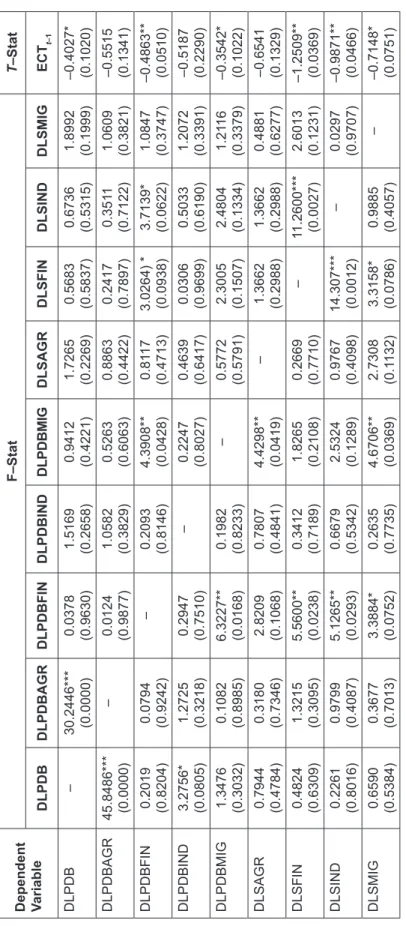
This study aims to analyze the causality relationship between sectoral stock markets (agricultural, financial, industrial, and mining sectors) and economic growth in the short and long term as well as to analyze whether it has similar types or not. The data used is quarterly time- series data (first quarter 2009 to fourth 2019). To determine the causality relationship, this study conducts a variable and multivariate causality test. The results of the varying granger causality test show that there is only a one-way relationship, where the economic growth of the agriculture sector affects its shares. A one-way relationship also occurs in stocks of the industrial sector, which has an influence on economic growth. The multivariate causality test shows that the economic growth of the agricultural sector has a two-way causality relationship, and it also exists between the industrial sector and the financial sector stock markets. The two-way causality relationship between the stock market and sectoral economic growth is a convergence towards long-term equilibrium. The findings of this study suggest that the government through the Financial Services Authority and the Indonesia Stock Exchange have to maintain stability in the stock market as a supporter of the national economy.
Keywords: Sectoral Stock Markets, Economic Growth, Multivariate Causality JEL Classification Code: F41, H54, P34, O16
1. Introduction
The role of financial markets is a key development factor in generating strong economic growth because this sector contributes to economic efficiency by diverting financial funds from unproductive to productive uses (Durusu-Ciftci et al., 2017). It is consistent with Schumpeter (1934) who stated that one of the major benefits of innovation is its contribution to economic growth. Simply put, innovation can lead to higher productivity, meaning that the same input (investment funds) generates a greater output. The theory of development by Schumpeter (1934) assigns a paramount role to the entrepreneur and innovations introduced by him in the process of economic development. Additionally, Goldsmith (1969), McKinnon (1973), and Shaw (1973) also proved that financial development has a positive effect on economic growth. In general, the capital market has a positive impact on economic growth (Ali & Fey, 2016). Based on the above theory, the presence of financial markets plays an important role in economic growth as it can encourage the mobilization of savings in the economy
*Acknowledgements:
The authors are thankful to the Editor and the anonymous reviewers for their helpful comments.
1
First Author. [1] Ph.D. Student, Faculty of Economics, Universitas Syiah Kuala, Darussalam, Banda Aceh Indonesia [2] Lecturer, Polytechnic Negeri Lhokseumawe, Indonesia.
Email: [email protected]
2
Professor, Faculty of Economics, Universitas Syiah Kuala, Darussalam, Banda Aceh, Indonesia.
Email: [email protected]
3
Associate Professor, Faculty of Economics, Universitas Syiah Kuala, Darussalam, Banda Aceh, Indonesia.
Email: [email protected]
4
Professor, Faculty of Economics, Universitas Syiah Kuala, Darussalam, Banda Aceh, Indonesia.
Email: [email protected]
5
Corresponding Author. Associate Professor, Faculty of Economics, Universitas Syiah Kuala, Darussalam, Banda Aceh, Indonesia [Postal Address: Jl. Teuku Nyak Arief No.441, Kopelma Darussalam, Kec. Syiah Kuala, Kota Banda Aceh, Aceh 23111, Indonesia]
Email: [email protected]
© Copyright: The Author(s)
This is an Open Access article distributed under the terms of the Creative Commons Attribution Non-Commercial License (https://creativecommons.org/licenses/by-nc/4.0/) which permits unrestricted non-commercial use, distribution, and reproduction in any medium, provided the original work is properly cited.