Print ISSN: 2288-4637 / Online ISSN 2288-4645 doi:10.13106/jafeb.2021.vol8.no10.0207
Triggering of Herding Instincts due to COVID-19 Pandemic in Pakistan Stock Exchange
Shaista JABEEN 1 , Sayyid Salman RIZAVI 2 , Adeel NASIR 3
Received: June 15, 2021 Revised: August 29, 2021 Accepted: September 17, 2021
Abstract
The present research intends to examine the herding aspect during the COVID-19 outbreak. The study is conducted to achieve specific objectives, so the underlying sampling technique is purposive sampling. The considered data source is the Pakistan Stock Exchange (PSX).
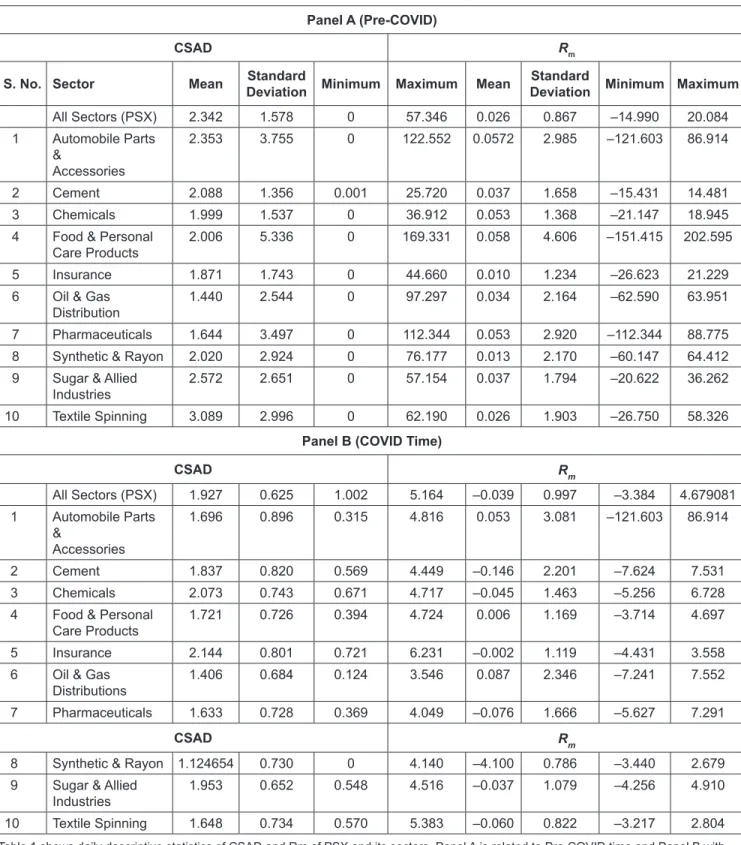
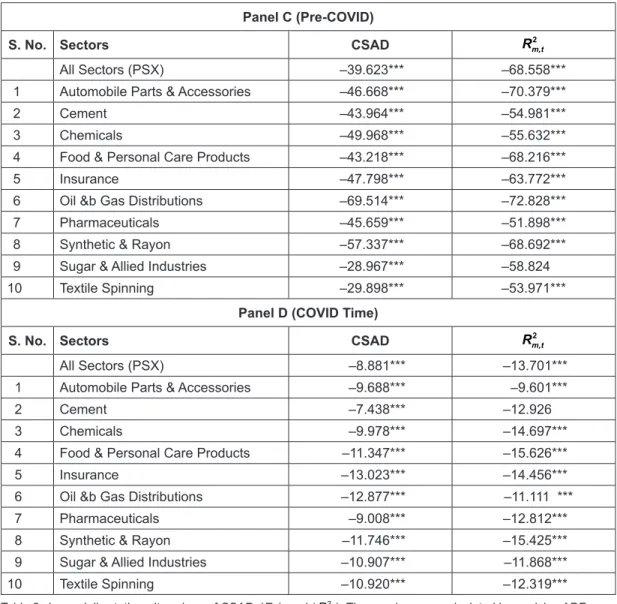
Daily stock prices of 528 listed companies in PSX have been taken from the official website of PSX from 1998 to 2021. The current study envisions investigating the herding aspects for pre-pandemic and the time covering the pandemic period. The study has also targeted ten sectors of PSX. The present study’s motive is to investigate investors’ herding prospects before and during the pandemic in the Pakistan Stock Exchange (PSX) and its selected sectors. Daily closing stock prices of listed companies have been collected from the official website of PSX to calculate the stock returns. The Cross-Sectional Absolute Deviation (CSAD) has been used as a herding measure. Findings revealed that herding has not been observed in PSX during both time spans and even not during the bullish and bearish trends. However, robust sectoral evidence has been observed during the pandemic. It implies that investors in PSX tend to follow the crowd irrespective of making their own decisions to avoid further losses.
Keywords: Pandemic, Herd Behavior, Cross-Sectional Absolute Deviation, COVID-19, Pakistan Stock Exchange, Financial Markets JEL Classification Code: G11, C33, E44, G15
which they follow other knowledgeable investors, despite knowing their information is better than others. Investors seem to be engaged in herding, specifically during panic market conditions, where they follow the crowd to avoid uncertain conditions or protect them from further losses (Waheed et al., 2020). The COVID-19 pandemic is an uncertain hazard that has significantly influenced economies, financial markets, stock markets, and investors’ financial decisions.
The turning of 2019 and rising of 2020 has faced the effects of a novel virus, COVID-19 (Boot et al., 2020). The coronavirus disease was detected in the Wuhan city of China in December 2019, and it was termed COVID-19. Globally, this virus is spreading at an escalating rate. From January to date, the number of victims of this virus has increased worldwide, particularly in China, Iran, Italy, France, Germany, USA, UK, and many other countries. To date of this writing, the total confirmed cases of COVID-19 are 208,263,868, out of which 4.379,612 deaths and 186,733,402 recovered cases have been observed around the globe. Moreover, taking into consideration the ranking of countries infected from this pandemic, the USA is at the top having 37,469,989 cases, India is at 2
ndnumber with 32,249,573 cases, Brazil has 20,364,099 reported cases, Russia and France are at
1
First Author. Lecturer, Department of Management Sciences, Lahore College for Women University, Lahore, Pakistan [Postal Address:
Lahore College for Women University, Jail Road, Lahore, 54000, Pakistan] Email: [email protected]
2
Professor, Hailey College of Commerce, University of the Punjab, Director General Gujranwala Campus, Pakistan.
Email: [email protected]
3
Corresponding Author. Assistant Professor, Department of Management Sciences, Lahore College for Women University, Lahore, Pakistan [Postal Address: Lahore College for Women University, Jail Road, Lahore, 54000, Pakistan]
Email: [email protected]
© Copyright: The Author(s)
This is an Open Access article distributed under the terms of the Creative Commons Attribution Non-Commercial License (https://creativecommons.org/licenses/by-nc/4.0/) which permits unrestricted non-commercial use, distribution, and reproduction in any medium, provided the original work is properly cited.
1. Introduction
Herding is an essential phenomenon in financial markets.
The herding behavior in financial markets indicates the process whereby the different participants of the market trade in a similar direction simultaneously (Mandal, 2011).
Herding deals with the imitating behavior of investors in
4
thand 5
thnumber with confirmed cases of 6.621,601 and 6,471,035. The origin point of COVID-19, i.e., China, has controlled the effects of this outbreak and now has reported 94,430 cases (Worldometer, 2020).
This pandemic has pushed the world’s economy towards the depression and raises a question for economists on how to manage financial stability? (Boot et al., 2020) as it can lead to an economic recession (Adrian & Natalucci, 2020). The IMF predicted a 3% decline in 2020 by keeping the fastest shrinking global economies and considered this downfall the worst one following the great depression (Chan, 2020).
The IMF has labeled this crisis as “The Great Lockdown.”
The IMF forecasted a 1.4% Gross Domestic Product growth of the United Kingdom; however, now the same institution predicted a 6.5% contraction of the economy in 2020. The US economy has also expected to shrink by 5.9% in 2020, the biggest fall since 1946 (Chan, 2020).
The economy of Pakistan is fragile indeed, and it was in the recovery phase since the happening of this incident. Experts are anxious concerning the slow recovery process of the economy. Pakistan’s economy is shrinking, unemployment is rising, and various sectors are in crisis,”
warned Zafar Moti, the former director of the Karachi Stock Exchange (KSE). Moreover, Mr. Khurram Shehzad, the investment banker, has predicted the shrink of Pakistan’s economy by $ 15 billion and the respective 10% decline in GDP in 2020. As per the finance minister’s pre-budget report, a reduction of 71% has been noticed in the current account deficit. Exports have been reduced by 2.4% and imports by 16.9%. Resultantly the trade deficit has been observed to be reduced by 29.5%. The international investors have withdrawn around $83 billion. The worst situation has compelled the nation’s citizens to limit their savings to cope with the unexpected time to come. The outbreak is troubling the economy in several ways (Phase-1), i.e., disturbed supply lines, shut-down of significant industries, restaurants, marriage halls, schools, travel and tourism industry, the airlines’ industry, and many more. World tourism and travel council has announced a 5.9% rise in the tourism industry of Pakistan, contributing a significant part in the economic development and GDP; however, the imposed lockdown due to pandemic has resulted in a dreadful situation. Government has to show its concern for saving lives and livelihood.
However, the relaxation in lockdown and reopening of markets has resulted in the escalated cases of COVID-19 (Phase-II, Phase III, and even Phase-IV), so the officials are in a ping pong game of running the economy (The Express Tribune, 2020). IMF has made projections about the Pakistan economy, i.e., the contraction in the economy by 1.5% with 2% growth in 2021; increase in CPI by 11.1%; deficit in the current account to touch 1.7% of GDP; and rise of the unemployment rate to 5.1%.
Taking the prospects of the financial markets into the loop, the performance of global financial markets has fallen following the ripple effects of the pandemic (Erdem, 2020).
The global stock market crash of 2020 was instigated on February 20, 2020 (Jolly, 2020). Moving towards Pakistan, speckled effects have been noticed from January 2020 to date. PSX demonstrated a bullish trend at the start of the year, and KSE-100 Index reached the recorded index point;
however, the month of February exhibited the depression phase as per the massive selling of stocks and unstable political conditions (Figure 1). Somehow bullish drift was observed in March 2020 following the decline in petroleum rates and inflation rate. Authorities took some measures to regulate the stock market performance, of which Market Halt was the significant one. The Market Halt is activated when the KSE-100 Index moved 4% or 5% either way and continued for five consecutive minutes. During such a halt, every kind of market activity is deferred, known as the
“cooling off” period. Various market halts were observed under such a strategy. The month of April 2020 paved the way to the so-called green zone due to the approval of
$ 1.4 billion loans from the IMF and the issuance of some Exchange Traded Funds (ETF). From April to date, ping pong effects have been experienced. The Index moved upward but gradually revealed both the bullish and bearish trends as per the Outbreak situation. Despite all, efforts have been made to maintain or improve the performance of PSX even when the global economies are struggling to keep themselves protected from the devastating effects of the pandemic.
The present study intends to examine the herding phenomenon concerning the COVID-19 pandemic. Existing studies have thoroughly explored the COVID-19 and its impact on stock market performance in local (Shehar Yar, 2020; Waheed et al., 2020) and international (He et al., 2020; Topcu & Gulal, 2020) contexts. In addition, some researchers have explored the phenomenon of COVID-19 and herding internationally (Allam et al., 2020; Arias, 2020;
Asia, 2020; Chang et al., 2020; Kizys et al., 2020). However, in the context of Pakistan, authors could not find the studies concerning the herding aspect and COVID-19-19 pandemic.
Hence, the current research will move one step ahead to have
an in-depth idea of these variables of interest to contribute
to the literature. To achieve this objective, the daily stock
price data of all the companies listed in the Pakistan Stock
Exchange (PSX) from 1998–2021 has been the point of
focus. Moreover, ten sectors have also been targeted for
thoroughly exploring herding aptitude. The novel aspect of
existing research emphasizes the herding exploration before
and during the COVID-19 period, i.e., examining cumulative
herd behavior before 2021 and then the presence/absence of
herding during the COVID-19 period.
2. Literature Review
Theoretically, the phenomenon of herd behavior has been categorized into intentional and spurious herding;
however, these theoretical aspects are quite challenging to differentiate (Bikhchandani & Sharma, 2000). Therefore, the primary emphasis of researchers has remained on exploring herding in different financial markets during various periods and through novel herding measures.
Christie and Huang (1995) conducted the pioneering work of herding, and the presented model is known as Cross-Sectional Standard Deviation (CSSD). The study was carried out in USA, South Korea, and Taiwan; however, herd behavior was not observed in USA, demonstrating that investors in these markets believe in their information.
Chang et al. (2000) carried out the second known study, and they have presented a measure known as Cross-Sectional Absolute Deviation (CSAD). The authors found partial herding in Japan, strong herding in Taiwan & South Korea, and non-existence in the USA. Finally, Hwang and Salmon (2004) observed the herding aspect in South Korea, deducing that herd behavior is a relative concept.
Chiang and Zheng (2010) could not detect herding in Asian markets and developed stock markets. On the other hand, Demirer et al. (2010) noticed its evidence in the Taiwan stock market during bullish trends. Similarly, Blasco et al. (2011) observed the intentional aspect of herding in Spanish bullish and bearish markets. Likewise, Mandal (2011) presented its evidence in the Indian National stock market on S & P Nifty 50 index. The existence of herding was also reported in Istanbul markets (Kapusuzoglu, 2011).
Moreover, Lao and Singh (2011) researched Indian and Chinese markets and found its presence in Chinese markets during bearish trends and in the Indian market during the bullish trend. Mwimali (2012) used the CSAD model and presented the absence of herd behavior in the Jordanian Stock Exchange before and after the global financial crisis of 2008; however, the CSSD measure demonstrated its existence during the crisis period. Seetharam (2013) found evidence of herding in South Africa but could not observe its evidence in the bearish market. Holmes et al. (2013) noticed intentional herding in the Portugal stock market.
Conversely, Ahsan and Sarkar (2013) did not find it in the Dhaka stock market. However, Cakan and Balagyozyan (2014) demonstrated the herding phenomenon in the Turkish banking sector. Similarly, Teng and Liu (2014) exhibited herd behavior in Greater Chinese stock markets. El-Shiaty and Badawi (2014) found it in the Egyptian stock market.
During the subprime mortgage crisis, Garg and Jindal (2014) noticed herd behavior in six Asia Pacific markets.
Herding effects were observed in the Amman stock market (Ramadan, 2015). Mahmud and Tinic (2015) showed herding in Chinese A-shares markets during bearish and B share markets during bullish trends. A similar result was reported by Chong et al. (2016). Herding was detected in the Korean stock market during panic market conditions, and bullish markets were found more potent. Vietnam stock market also reported its evidence during the bullish and bearish market trends (Vinh & Anh, 2016). Zheng et al.
(2017) established the robust existence of herd behavior in
the technology and financial sectors and partial evidence in
the utility sector. Chen et al. (2017) revealed the presence of
Figure 1: PSX vs Global Markets
herding in bullish Chinese markets. However, Mertzanis and Allam (2018) did not find herd behavior in the bullish and bearish Egyptian stock markets. Sharma (2018) also could not see herding signs during bullish, bearish, and extreme price movements, and he noticed limited effects during robust down markets. Brendea and Pop (2019) investigated herd behavior in the Romanian Stock Exchange. Shantha (2019) reported the herding signs in the Colombo Stock Exchange. Stavroyiannis and Babalos (2019) explored negative herd behavior in Eurozone stock markets. Ju (2019) described the presence of herding in Chinese A and B share markets. Arjoon et al. (2019) discovered herd behavior in the Singapore exchange and its sectors. Bharti and Kumar (2020) investigated herd behavior in fast-moving consumer goods of the Indian Nifty 50 market during the global financial crisis and could not find evidence of herd behavior.
Lu and Luong (2020) examined herding behavior in frontier and emerging Vietnam and Taiwan stock markets during the influenza pandemic. Herding was primarily observed in Vietnam markets as compared to Taiwan markets. Jalal et al.
(2020) studied herd behavior in cryptocurrencies of CC130 and sub-major cryptocurrencies of DJIA and found herding in cryptocurrencies during bullish market trends.
As far as Pakistan is concerned, researchers have used different measures to explore the herding phenomenon.
The studies have been conducted in different time spans by employing various herding measures. The findings of these researches represented mixed evidence, i.e., presence and the absence of herding. Javaira and Hassan (2015) and Javed et al. (2013) used daily and monthly data and CSSD and CSAD measures; however, they did not reveal their existence in Karachi Stock Exchange. On the other hand, Malik and Elahi (2014) used least-square and quantile regression analysis and demonstrated herd behavior during bullish and bearish trends. Likewise, Zafar and Hassan (2016) also presented its evidence. Shah et al. (2017) observed the signs of herd behavior in specific sectors of PSX. The sectoral evidence of herding was also observed by Khan and Rizwan (2018).
Moreover, Yousaf et al. (2018) detected herding in KSE-100 Index concerning Ramadan effects. Conversely, Jabeen and Rizavi (2019, 2021) employed the measure used by Chiang and Zheng (2010) and were unable to find its existence in PSX; however, they detected its presence in some sectors of PSX. Similarly, Kiran et al. (2020) did not find herding signs in PSX.
Researchers have made significant contributions to the literature by focusing on the literature of the COVID-19 pandemic and stock market performance. Topcu and Gulal (2020) explained that the adverse effects of COVID-19 on the emerging stock markets have decreased over time.
The results have been observed mainly in Asian emerging markets as compared to European markets. Moreover,
government facilitation can provide support to mitigate the effects of the virus. Chang et al. (2020) reported herd behavior due to the COVID-19 pandemic in the USA, Europe, and Asia during high and low oil returns. He et al. (2020) highlighted the significant negative impact of COVID-19 on China, France, Germany, Spain, Japan, South Korea, and the UK. Waheed et al. (2020) reported the positive increments in stock returns due to the pandemic in the Pakistan stock market. The government interventions have protected investors under such disasters. Shehar Yar (2020) conducted a study to explore the effect of COVID-19 on the performance of the Pakistan stock market. The findings suggested that COVID-19 recoveries influenced the performance of the Index and daily positive cases, whereas fatalities insignificantly related to the performance.
Internationally, limited studies are available investi- gating the impact of the pandemic on herd behavior, but to date, researchers could not find any paper exploring such a relationship in Pakistan. Asia (2020) investigated the herd behavior during the pre and post-pandemic time in the Indian National Stock Exchange at the industry level.
The findings revealed the absence of herding at sectoral levels; however, it was observed during the bullish and bearish trends. Kizys et al. (2020) described that the role of government could mitigate herding prospects in international markets during the COVID-19 period.
Besides, Arias (2020) noticed the strong herding effects in France, Germany, Italy, UK, and Spain during the pandemic. Moreover, Allam et al. (2020) observed the impact of the virus on the herding attitude of investors in the Egyptian stock market.
3. Data and Methodology
The present research intends to examine the herding aspect concerning COVID-19 Outbreak. The study is conducted to achieve specific objectives, so the underlying sampling technique is purposive sampling. The considered data source is the Pakistan Stock Exchange. Daily stock prices of 528 listed companies in PSX have been taken from the official website of PSX from 1998 to 2021. The current study envisions investigating the herding aspects for pre-pandemic and the time covering the pandemic era. The study has also targeted ten sectors of PSX. The selection of these sectors is, first, based on the number of companies.
In other words, sectors having a more significant number of companies are being targeted. Second, as per the research objectives, a single industry with more companies has been selected from industries with similar products/services.
Stock returns have been calculated using the daily closing
stock prices through the LN(P
t/P
t–1) * 100 formula. The
research has been processed by employing the CSAD
measured which is explained as under:
CSAD deals with the absolute deviation of returns.
The measure focuses on the return dispersion of individual securities and the weighted average market returns. If herd behavior exists, then the returns of individual securities will be gathered around the market, inferring that investors set aside their information and follow the information generated by the market.
The model is:
1 , ,
CSAD 1
iNR
i tR
m tN
== ∑ − (1)
Where: R
i,t= Stock return of firm i at time t; R
m,t= Cross- sectional average return of N stocks in the portfolio at time t;
N = number of stocks in the portfolio.
The CSAD model illustrates herd behavior’s existence by considering two factors of market returns and emphasizes the non-linear linkage between the returns of individual stocks and market returns. The non-linear association between these two returns portrays that they move in the opposite direction, demonstrating the absence of the herding phenomenon. On the other hand, the presence of herding reveals that this association decreases or at least increases at a less than proportionate rate as the market return. It can be tested by using the following equation:
The following equation is used to perform the tests:
CSAD = + α γ
1| R
m t,| + γ
2R
m t2,+ ε (2) R
m,t= market return; γ
2= if, significant and negative, infers herd behavior.
CSAD and R
mmay have an asymmetric relationship, and herding can be examined for bullish and bearish periods.
The test can be done just like the overall market, though it is categorized into two parts as per the direction of the relevant market return:
UP UP UP UP UP 2
1 , 2 ,
UP .,
CSAD ( )
if 0
t m t m t t
m t
R R
R
α γ γ ε
= + + +
> (3)
DOWN DOWN DOWN DOWN DOWN 2
1 , 2 ,
DOWN .,
CSAD ( )
if 0
t m t m t
t m t