• 검색 결과가 없습니다.

Mesenchymal chondrosarcoma in the maxillary gingiva of a Maltese dog: a case report

N/A
N/A
Protected

Academic year: 2021

Share "Mesenchymal chondrosarcoma in the maxillary gingiva of a Maltese dog: a case report"

Copied!
4
0
0

로드 중.... (전체 텍스트 보기)

전체 글

(1)

www.kjvr.org 1 / 4 2021 The Korean Society of Veterinary Science.

This is an open-access article distributed under the terms of the Creative Commons Attribution Non-Commercial license (http://creativecommons.

org/licenses/by-nc/4.0/), which permits unrestrict- ed non-commercial use, distribution, and repro- duction in any medium, provided the original work is properly cited.

Chondrosarcoma is a malignant neoplasm in which tumor cells produce vari- ous amounts of neoplastic chondroid and fibrillary matrix, but not osteoid matrix [1]. This is the second most common primary tumor of bone in humans and dogs and accounts for approximately 5% to 10% of all canine primary bone tumors [2].

In dogs, chondrosarcoma occurs most often in medium to large breeds, particu- larly boxers, German shepherds, and golden retrievers, but is rare in small and gi- ant breeds [1,3]. Moreover, the tumor is most common in middle-aged to older dogs; the mean age of the affected animals ranges from 5.9 to 8.7 years [3].

Mesenchymal chondrosarcoma is a rare subtype of chondrosarcoma among the World Health Organization classifications and accounts for approximately 1% of all chondrosarcomas in humans [4]. Histologically, mesenchymal chondrosarco- mas are characterized by a transition from undifferentiated mesenchymal cells and an array of variously differentiated chondroid components [1]. On the other hand, chondrosarcoma is relatively rare in most domestic species. This paper pres- ents a rare case of mesenchymal chondrosarcoma in the maxillary gingiva of a small-breed Maltese dog.

A 13-year-old castrated male Maltese dog was presented to a local animal hospi- tal with an oral hemorrhage and swelling on the right side of his face. An intraoral examination revealed an irregular proliferated lobular mass at the entire right side of the gingival region and hard palate (Fig. 1). A radiography examination showed a soft tissue mass lesion in the right maxillary region without metastases to other organs. Blood analysis revealed mild anemia (hematocrit, 29.8%; reference range, 35%-56%) and mild leukocytosis (21.8 L/µL; reference range, 5.0-20.0 L/µL). The serum biochemical results revealed moderate elevations in the alkaline phospha- tase (113 U/L; reference range, 17-78 U/L).

The dog did not respond after a 1-week treatment with steroids, and the edema-

Mesenchymal chondrosarcoma in the maxillary gingiva of a Maltese dog: a case report

So-Jeong Yim 1 , Jinyong Lee 2 , Jae-Hoon Kim 1 , Ji-Youl Jung 1,*

1

Veterinary Medical Research Institute, College of Veterinary Medicine, Jeju National University, Jeju 63243, Korea

2
Malee Animal Hospital, Jeju 63067, Korea

pISSN 2466-1384 · eISSN 2466-1392 Korean J Vet Res 2021;61(3):e27 https://doi.org/10.14405/kjvr.2021.61.e27

*Corresponding author:

Ji-Youl Jung

College of Veterinary Medicine and Veterinary Medical Research Institute, Jeju National University, Jeju 63243, Korea Tel: +82-64-754-3364

Fax: +82-64-702-9920 E-mail: [email protected] ORCID:

https://orcid.org/0000-0002-5938-2029 Conflict of interest:

The authors declare no conflict of interest.

Received: July 21, 2021 Revised: August 13, 2021 Accepted: August 17, 2021

Case Report

A 13-year-old castrated Maltese dog was presented to a local animal hospital with an oral hemorrhage. An intraoral examination revealed an irregular proliferated lobular mass at the right side of the maxillary gingiva and hard palate. A surgically excised mass was requested for a histopathology examination. Histopathologically, the neo- plastic foci were composed of biphasic morphologic patterns, such as primitive mes- enchymal tissue and mature or immature cartilage tissue. Immunohistochemically, most of the neoplastic cells forming cartilaginous islands tested positive for S-100;

the surrounding mesenchymal cells tested positive for vimentin. This paper describes a rare case of mesenchymal chondrosarcoma in the maxillary gingiva of a Maltese dog.

Keywords: Maltese dog; maxilla; gingiva; mesenchymal chondrosarcoma; case report

(2)

https://doi.org/10.14405/kjvr.2021.61.e27 Korean J Vet Res 2021;61(3):e27 • So-Jeong Yim, et al.

2 / 4

tous lesion worsened. The edema resulted in the caudal and dorsal displacement of the right eyeball. An incisional biopsy sample was presented to the Pathology Department of the Vet- erinary Medicine, Jeju National University, for a histopathologi- cal examination. The requested mass was approximately 3.5 × 1.8 × 1.8 cm in size. The cut surface was firm and tan to white.

The mass was fixed in 10% neutral-buffered formalin, trimmed and processed according to standard protocols, and embedded in paraffin wax. The paraffin sections (4 μm) were stained with hematoxylin and eosin and Alcian blue (pH 1.0 and 2.5) for the microscopic examination. To determine the or- igin of the tumor cells, replicated paraffin sections of the mass were also subjected to immunohistochemical analysis and incu- bated with the following primary antibodies: anti-vimentin (mouse monoclonal antibody, 1:100; Dako, Denmark) and an- ti-S-100 (rabbit polyclonal antibody, 1:400; Dako).

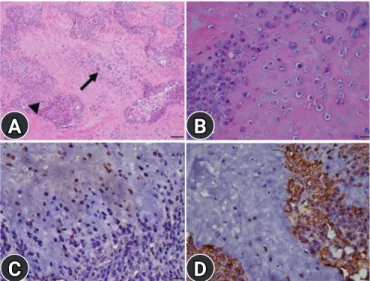
The microscopy examination showed that the neoplastic foci comprised a biphasic morphological pattern, such as primitive mesenchymal tissue and mature or immature cartilage tissues (Fig. 2A). The primitive mesenchyme was composed of round and oval or mild elongated immature neoplastic cells with high cellularity. These cells had scant pale eosinophilic cytoplasm and indistinct cellular borders with some mitotic figures. The cartilage areas were scattered throughout the lesions. The tumor cells were arranged irregularly within the lacunae of a pale, ba- sophilic or eosinophilic, intercellular matrix (Fig. 2B). These neoplastic cells had abundant pale-staining cytoplasm, moder- ate anisokaryosis, and round vesicular nuclei with prominent nucleoli. Mitotic figures were rare. A small number of multinu- Fig. 1. Gross findings. Irregular proliferated lobular mass was not- ed at the entire right side of the maxillary gingiva and hard palate (arrow).

A

C

B

D

Fig. 2. Histopathological findings. (A) Biphasic patterns of carti- lage (arrow) and undifferentiated mesenchymal tissues (arrow- head) (H&E, scale bar: 100 μm). (B) Neoplastic chondrocytes are embedded in an eosinophilic or basophilic cartilaginous matrix (H&E, scale bar: 20 μm). (C) Neoplastic chondrocytes show the immunoreactivity for the S-100 protein, whereas (D) the mesen- chymal cells exhibit strong immunoreactivity for vimentin (scale bar: 20 μm).

cleated giant cells were present within the mass. Severe multifo- cal necrosis was also present around the mass, particularly in the peripheral area. The cartilaginous materials and lacunae stained greenish-blue, and the nuclei of chondrocytes stained red in contrast to the Alcian blue stain. Through immunohisto- chemical analysis, most neoplastic cells forming multifocal car- tilaginous islands were strongly positive for the S-100 protein (Fig. 2C); the surrounding mesenchymal cells were strongly positive for vimentin (Fig. 2D).

Chondrosarcomas usually occur in older dogs from large breeds, and there is no sex predilection. To the best of the au- thors’ knowledge, this is the first report of mesenchymal chon- drosarcoma occurring in the maxillary gingiva of a small-breed Maltese dog.

In dogs, as in humans, chondrosarcomas more often involve the flat bones than the long bones. In a retrospective study of 97 dogs with chondrosarcomas, the nasal cavity was the most com- mon site (28.8%), followed by the ribs (17.5%), appendicular skeleton (17.5%), extraskeletal sites (13%), and facial bones (9%) [3]. In another study, 31 out of 35 cases (88.6 %) involved the flat bones, predominantly the ribs, turbinates, or pelvis [2].

Extraskeletal chondrosarcomas are rare soft tissue sarcomas

arising from soft tissues and visceral organs [5]. In dogs, ap-

proximately 1% of chondrosarcomas occur in extraskeletal lo-

cations, including the lungs, retroperitoneum, omentum, and

(3)

Mesenchymal chondrosarcoma in a dog

https://doi.org/10.14405/kjvr.2021.61.e27 3 / 4

spleen [6-9].

Histologically, two types of chondrosarcoma are recognized:

conventional, the most common type found in skeletal tumors, and mesenchymal, a rarer type found more often in the ex- traskeletal sites [10]. Myxoid or conventional chondrosarcoma consists of spindle-shaped cells trapped within a basophilic hy- aline matrix. Mesenchymal chondrosarcoma has been de- scribed as having two distinct histologic patterns. The first is moderate to well-differentiated chondroid tissue, while the sec- ond is described as undifferentiated malignant mesenchymal cells arranged in sheets [1]. The histological appearance of the oral mass, in this case, was similar to that described for mesen- chymal chondrosarcoma in humans and dogs.

The diagnosis of biopsy specimens remains a challenge be- cause of the variable tumor components, and specimens may contain only one of the two elements. The absence of cartilage in the biopsy sample can confuse this tumor with other small, round, blue-cell tumors. The histological differential diagnosis of mesenchymal chondrosarcoma included lymphoma, neuro- blastoma, small cell osteosarcoma, and embryonal rhabdomyo- sarcoma [11]. Large samples of healthy tissue at the edge and center of the lesion will increase the diagnostic yield. Moreover, typical immunohistochemistry findings include the positivity of the mesenchymal portion for the vimentin and the positivity of the cartilaginous regions for the S-100 protein. In this case, the requested mass was relatively large and contained two elements essential for diagnosis. Moreover, the mass showed similar im- munohistochemical findings to those previously reported [12].

In a diagnostic examination for chondrosarcomas, radio- graphs only provide the anatomical location of the tumor [13].

Computed tomography can evaluate the degree of bone inva- sion, and magnetic resonance imaging can reflect the increased aqueous contents of abundant neoplastic cartilage matrix in a T2-weighted hyperintense area, particularly in well-differentiat- ed low-grade chondrosarcoma, as reported in humans [13]. The dog, in this case, was examined using only radiographs, so no evidence of bony involvement was observed within the lesion.

Extraskeletal chondrosarcomas occurring in the oral cavity are exceedingly rare. In a previous study, among 109 malignant oral neoplasms in dogs, none were classified as chondrosarco- ma [14]. Extraskeletal chondrosarcoma of the gingiva has been reported in rabbits and humans [15]. In rabbit chondrosarco- ma, the tumor invaded the nasal cavity and the survival time af- ter diagnosis was 15 days [15].

In the present case, the dog only had a portion of the mass re- moved for biopsy; no other aggressive treatment, such as radical surgery with a wide margin or systemic chemotherapy, was per-

formed. After diagnosis, the dog was treated only with antibiot- ics, and the remaining tumor recurred more significantly. The prognosis was poor in this case, and the dog died two months after diagnosis. Although mesenchymal chondrosarcoma of the maxillary gingiva is rare, clinicians and pathologists should be aware of this rare entity when making a differential diagnosis of oral tumors.

ORCID

So-Jeong Yim, https://orcid.org/0000-0002-5295-0783 Jinyong Lee, https://orcid.org/0000-0003-3612-7268 Jae-Hoon Kim, https://orcid.org/0000-0002-4410-9126 Ji-Youl Jung, https://orcid.org/0000-0002-5938-2029

References

1. Thompson KG, Dittmer KE. Tumors of Bone. In: Meuten DJ (ed.). Tumors in Domestic Animals. 5th ed. pp. 394-400, Wi- ley Blackwell, Ames, 2017.

2. Brodey RS, Sauer RM, Medway W. Canine bone neoplasms. J Am Vet Med Assoc 1963;143:471–495.

3. Popovitch CA. Weinstein MJ, Goldschmidt MH, Shofer FS.

Chondrosarcoma: a retrospective study of 97 dogs (1987- 1990). J Am Anim Hosp Assoc 1994;30:81–85.

4. Koch BB, Karnell LH, Hoffman HT, Apostolakis LW, Robin- son RA, Zhen W, Menck HR. National cancer database report on chondrosarcoma of the head and neck. Head Neck 2000;

22:408–425.

5. Chikata S, Nakamura S, Katayama R, Yanagisawa S, Matsuo Y, Yamane I, Takahashi K. Primary chondrosarcoma in the liver of a dog. Vet Pathol 2006;43:1033–1036.

6. Patnaik AK. Canine extraskeletal osteosarcoma and chondro- sarcoma: a clinicopathologic study of 14 cases. Vet Pathol 1990;27:46–55.

7. LaRock RG, Ginn PE, Burrows CF, Newell SM, Henson KL.

Primary mesenchymal chondrosarcoma in the pericardium of a dog. J Vet Diagn Invest 1997;9:410–413.

8. Rhind SM, Welsh E. Mesenchymal chondrosarcoma in a young German shepherd dog. J Small Anim Pract 1999;40:

443–445.

9. Miller JM, Walshaw R, Bourque AC. Primary splenic mesen- chymal chondrosarcoma in a dog. Can Vet J 2005;46:163–165.

10. Casadei R, Ricci M, Ruggieri P, Biagini R, Benassi S, Picci P, Campanacci M. Chondrosarcoma of the soft tissues: two dif- ferent sub-groups. J Bone Joint Surg Br 1991;73:162–168.

11. Shakked RJ, Geller DS, Gorlick R, Dorfman HD. Mesenchy-

(4)

https://doi.org/10.14405/kjvr.2021.61.e27 Korean J Vet Res 2021;61(3):e27 • So-Jeong Yim, et al.

4 / 4

mal chondrosarcoma: clinicopathologic study of 20 cases.

Arch Pathol Lab Med 2012;136:61–75.

12. Huang WC, Hu KY, Kuo KT, Tsai CC. Mesenchymal chon- drosarcoma of the maxilla: case report and clinicopathologic review. Tzu Chi Med J 2013;25:55–57.

13. Chowdhury A, Kalsotra P, Bhagat DR, Sharma P, Katoch P.

Chondrosarcoma of the maxilla-recurrent. JK Sci 2008;10:94–

96.

14. Mikiewicz M, Paździor-Czapula K, Gesek M, Lemishevskyi V, Otrocka-Domagała I. Canine and feline oral cavity tumours and tumour-like lesions: a retrospective study of 486 cases (2015-2017). J Comp Pathol 2019;172:80–87.

15. Miwa Y, Nakata M, Takimoto H, Chambers JK, Uchida K.

Spontaneous oral tumours in 18 rabbits (2005-2015). J Small

Anim Pract 2021;62:156–160.

수치

Fig. 2. Histopathological findings. (A) Biphasic patterns of carti- carti-lage (arrow) and undifferentiated mesenchymal tissues  (arrow-head) (H&E, scale bar: 100 μm)

참조

관련 문서

Should a module be used with any of the absolute maximum ratings exceeded, the characteristics of the module may not be recovered, or in an extreme case, the module

3) A comparison of the stoichiometric equation with the experimental kinetic expression can suggest whether or not we are dealing with an elementary reaction. 4) If one

It considers the energy use of the different components that are involved in the distribution and viewing of video content: data centres and content delivery networks

After first field tests, we expect electric passenger drones or eVTOL aircraft (short for electric vertical take-off and landing) to start providing commercial mobility

1 John Owen, Justification by Faith Alone, in The Works of John Owen, ed. John Bolt, trans. Scott Clark, "Do This and Live: Christ's Active Obedience as the

Methods to overcome insufficient bone due to poor bone quality, the pneumatization of a maxillary sinus and other anatomical limitations of implant placement

Purpose: Calcaneal fracture is a rare fracture, which accounts for about 2% of all fractures, but is one of the most common fractures in the ankle bone.. There is

- The best value of a parameter of a probability distribution should be that value which maximizes the likelihood or joint probability of occurrence of