소아 야뇨의 한약치료에 대한 임상연구 동향 -중의학 논문을 중심으로-
신혜진․이보람․이지홍․장규태
경희대학교 대학원 임상한의학과 소아과학교실, 강동경희대학교병원 한방소아과
Received: April 26, 2018 ∙ Revised: May 15, 2018 ∙ Accepted: May 15, 2018 Corresponding Author: Chang Gyu Tae
Department of Pediatrics of Korean Medicine, Kyung Hee University Hospital at Gang-dong, 892 Dongnam-ro, Gangdong-gu, Seoul 05278, Republic of Korea Tel: +82-2-440-7126 / Fax: +82-2-440-7143
E-mail: [email protected]
ⓒ The Association of Pediatrics of Korean Medicine. All rights reserved. This is an open-access article distributed under the tenus of the Creative Commons Attribution Non-Commercial License (http://creativecommons.org/licenses/by-nc/3.0/), which permits unrestricted non-commercial use, distribution, and reproduction in any medium, provided the original work is properly cited.
Abstract
Review of Clinical Researches for Herbal Medicine Treatment on Nocturnal Enuresis in Children
Shin Hye Jin · Lee Boram · Lee Jihong · Chang Gyu Tae Pediatrics of Clinical Korean Medicine, Graduate School, Kyung Hee University, Department of Pediatrics of Korean Medicine, Kyung Hee University Hospital at Gangdong Objectives
The purpose of this study is to evaluate the efficacy and safety of herbal medication for the treatment of nocturnal enuresis in children by analyzing randomized controlled trials conducted in China.
Methods
We searched literatures from China National Knowledge Infrastructure published up to 19 January, 2018.
Selected literatures were collected and analyzed in order of publication year, and then demographic information, treatment method, duration of illness, duration of treatment, follow-up period, outcome measurement and adverse events.
Results
A total of 34 studies were selected for the analysis. In most studies, the total efficacy of the treatment group was reported to be higher than that of the control group, and the recurrence rate and complete cure rate were also found to be more effective in the herbal medicine treatment group. The most frequently used medical herb was Alpiniae Fructus (益智仁), and the use of medical herbs belong to tonifying yang (補陽藥), tonifying qi (補氣藥), and astringing essence strengthening collapse medicine (澁精縮尿止帶藥) were relatively high. The adverse events rate for the herbal medicine treatment group were significantly lower than those in the Western medicine treatment group.
Conclusions
This study showed that a herbal medicine treatment can be effective and safe option for treating pediatric nocturnal enuresis. However, additional well-designed clinical studies need to be performed to establish a basis.
Key words: Nocturnal enuresis, Herbal medicine, Randomized controlled trial, Review
ISSN 1226-8038(Print), 2287-9463(Online), https://doi.org/10.7778/jpkm.2018.32.2.043
Ⅰ. Introduction
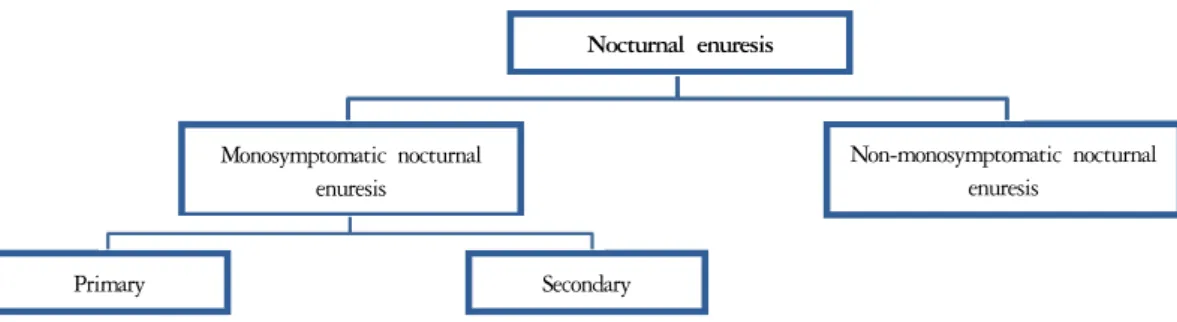
야뇨 (夜尿)는 수면 도중 불수의적인 배뇨 행위가 5 세 이상의 소아에서 일주일에 최소 2회 이상 나타나는 것으로 정의된다1). 기질적 질환의 유무에 따라 단일증 상성 야뇨증과 비단일증상성 야뇨증으로 분류되는데, 그 중에서도 단일증상성 야뇨증은 다른 하부 요로 증 상이나 방광 기능 장애가 없는 야뇨증으로, 기능성 야 뇨증과 같은 의미로 사용된다. 기능성 야뇨증은 다시 세부적으로 출생 이후 한 번도 일정 기간 이상 배뇨 조절을 하지 못한 경우인 원발성 야뇨증과 최소 6개월 이상 배뇨 조절이 가능하다가 야뇨증이 발생한 경우인 속발성 야뇨증으로 분류된다2) (Fig. 1).
5세에서 약 16%의 유병률을 보이는데, 나이가 들어 감에 따라 연간 15%씩 자연적으로 소실되어 청소년기 에는 약 1~3%만이 야뇨가 나타나게 된다3). 또한 여아 보다 남아에서 2배 정도 유병률이 높고, 유병기간이 길 수록 자연 소실될 가능성이 낮다4).
야뇨의 서양의학적 치료방법으로는 크게 약물치료 와 알람요법이 시행되고 있으나, 약물치료의 경우 약 물 복용 중단 시 재발률이 높고5), 알람요법의 경우 각 성 실패 또는 보호자 및 환아의 수면의 질 저하 등 한계 점6)이 있어 소아 야뇨에 대한 다른 치료방법 마련이 필요한 상황이다.
한의학에서 遺尿는 膀胱不約, 膀胱不藏하여 발생한 다고 보았으며, 腎·膀胱虛弱, 下焦蓄血, 虛勞, 下焦虛 寒, 肺氣虛의 원인에 따라 六味地黃丸, 五苓散, 加減八 味丸, 補陰丸, 縮泉元, 秘元丹, 鷄腸散, 大兎絲子元 등 의 처방을 응용한다7). 현재까지 야뇨의 한의학적 치료 에 대한 국내 연구로는 증례보고 5건8-12), 후향적 연구 1건13), 침구치료에 대한 문헌 고찰 3건14-16)이 발표되었 으나, 한약치료에 대한 문헌 고찰은 아직 발표되지 않
았다. 한편 중국에서는 다수의 임상연구 및 소아 야뇨 의 한약치료에 대한 체계적 논문 고찰 2건17,18)이 발표 되었으며, 중의소아과 임상진료지침19) 역시 개정되어, 활발하게 연구가 진행되고 있다.
이에 저자들은 중국에서 진행되고 있는 소아 야뇨 의 한약치료에 대한 무작위 배정 대조군 연구를 분석 하여, 치료효과 및 안전성을 평가하고 향후 소아 야뇨 의 한약치료에 대한 근거자료로 제시하고자 한다.
Ⅱ. Materials and Methods
1. 선정기준 및 배제기준
기능성 야뇨증이 있는 소아에게 한약을 투여한 뒤, 치료효과를 평가한 중국의 임상연구 중에서 무작위 배 정 대조군 연구 및 유사 무작위 대조군 연구를 선별하 였다. 치료군은 한약치료, 한약치료 및 기존치료, 한약 치료 및 양약치료, 한약치료 및 양약치료 및 기존치료 병용군으로 한정하였다. 한약은 모두 경구 복용하는 연구를 선별하였으며, 한약 이외에 鍼, 灸, 貼敷, 推拿, 耳壓法 등 다른 한의학적 치료를 병행한 경우나 사용 한 한약의 구성 약재를 명시하지 않은 경우 문헌 선정 에서 제외하였다. 대조군은 양약치료, 기존치료, 양약 치료 및 기존치료 병용군으로 한정하였다. 또한 대조 군에서 한약치료를 시행한 연구는 배제하였다. 성별에 제한을 두지 않았으며, 연령은 ≪중의소아과 임상진료 지침·소아유뇨증 (개정)≫19)의 치료 대상 연령인 3세 이상의 소아로 한정하였다. 결과 지표로는 총유효율을 일차 지표로 활용하였으며, 이외에도 연구에 활용된 평가 지표를 모두 포함하였다.
Nocturnal enuresis
Monosymptomatic nocturnal enuresis
Non-monosymptomatic nocturnal enuresis
Primary Secondary
Fig. 1. Classification of nocturnal enuresis
2. 문헌검색
검색원으로는 중국의 전자 데이터베이스 검색 사이트인 중국학술정보원 (China National Knowledge Infrastructure, CNKI)을 이용하였다. 검색어는 participant에 해당하는
‘夜尿’, ‘夜间尿’, ‘夜间遗尿’, ‘尿床’과 함께 intervention 에 해당하는 ‘中药’, ‘中医药’, ‘本草’, ‘汤’, ‘丸’, ‘散’, ‘方’,
‘颗粒’, ‘胶囊’, ‘自拟’를 사용하였으며, 중영문 교차 검 색 및 결과 내 검색을 시행하였다. 출판연도에 제한을 두지 않았으며, 검색일 이전에 출판된 연구들을 모두 포함하였다. 검색일은 2018년 1월 19일이었다.
3. 문헌선택
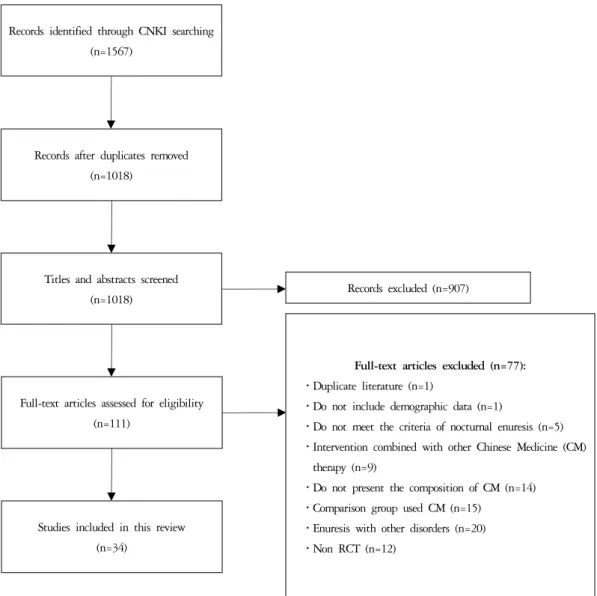
검색 결과 총 1567편의 문헌이 검색되었고, 그 중 549편의 중복 문헌이 제외되었다. 연구자가 1차로 제
목과 초록을 검토하여 선정기준에 맞지 않는 문헌을 제외한 결과 111편의 문헌이 포함되었다. 이 문헌들에 대해 전문 검토를 시행한 결과, 선정기준에 맞지 않는 77편의 문헌이 제외되어 최종적으로 34편의 문헌이 본 연구의 분석대상으로 선정되었다 (Fig. 2).
4. 자료수집 및 추출항목
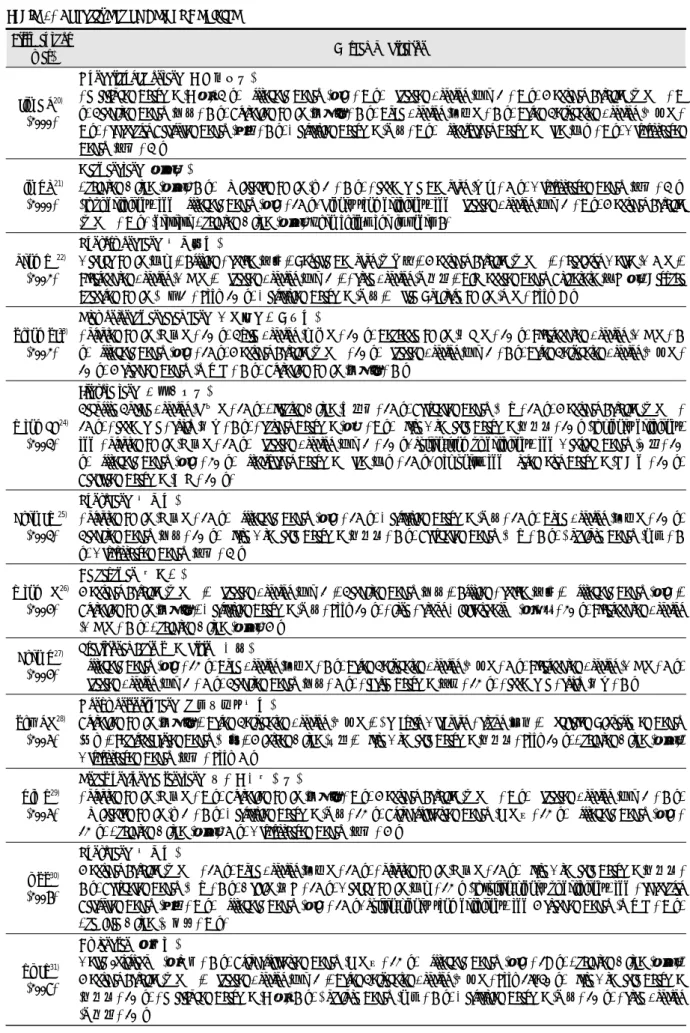
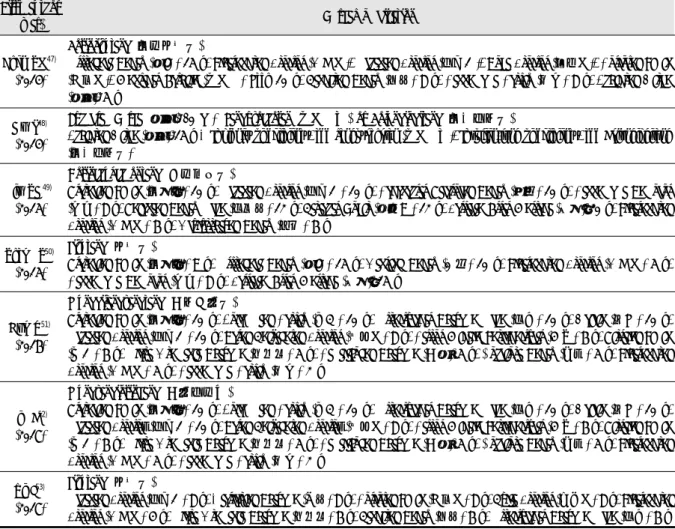
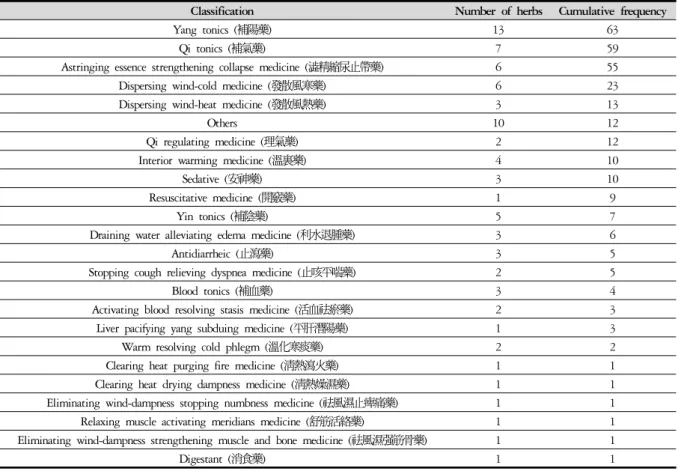
총 34편의 선정된 문헌을 출판연도 순으로 자료를 수집하였다. 각 문헌별 연구 설계 및 연구 대상의 인구 통계학적 정보, 치료방법, 유병기간, 치료기간, 추적기 간, 평가 지표 및 평가 결과, 안전성에 관한 정보를 추 출하였다 (Table 1). 치료방법에서 사용된 한약 처방의 구성은 별도로 기재하였으며 (Table 2), 각 연구에서 활 용된 처방의 구성 약재들의 빈도를 분석하여 도표에 제시하였다 (Table 3, 4).
Records identified through CNKI searching (n=1567)
Records after duplicates removed (n=1018)
Titles and abstracts screened (n=1018)
Full-text articles assessed for eligibility (n=111)
Full-text articles excluded (n=77):
․Duplicate literature (n=1)
․Do not include demographic data (n=1)
․Do not meet the criteria of nocturnal enuresis (n=5) ․Intervention combined with other Chinese Medicine (CM)
therapy (n=9)
․Do not present the composition of CM (n=14) ․Comparison group used CM (n=15)
․Enuresis with other disorders (n=20) ․Non RCT (n=12)
Studies included in this review (n=34)
Records excluded (n=907)
Fig. 2. Flow chart of study selection process
Table 1. Characteristics of the Included Studies First author (year)SampleTAge range (y) (mean) / Gender (M:F) Duration of illness (mean) Treatment group Duration of treatmentFollow-up after treatment
Cure rate (%) (T)Outcome measureResult (P value)Adverse events CControl groupCure rate (%) (C) Jin HR20) (2000)55
303~14 / 7:3NRPsychotherapy Bladder training Seunggichukcheontang (升芪縮泉湯), 2 times/d3 w 6 mo
90 1) TER1) T>C*
No SE 253~14 / 18:7NR
Psychotherapy Bladder training Imipramine hydrochloride (鹽酸丙咪嗪), 1 time/d, hs (age <6: 12.5 mg, 6≤: 12.5~25 mg)
4 w68Restless sleep (5 cases), GI reactions (4 cases) Lin XQ21) (2000)104563~14 / 5:33 mo~10 yMahwangtang (麻黃湯), 1 dose for every other day20 d NR91.1 1) TER1) T>C+ No SE 483~14 / 5:32 mo~10 yMeclofenoxate (遺尿丁), 0.1 g, 3 times/d10 d77.1 Teng YL22) (2002)96
505~12 (7.32 ± 1.12) / 19:62 mo~6 y (1.95 ± 0.41 y) Psychotherapy Life intervention Behavioural therapy Yunyoryeongbang (遺尿靈方), 2 times/d 8 d6 mo, 1 y, 2 y
98 1) TER 2) SDT 3) RR
1) T>C+ 2) T<C+ 3) T<C+
No SE 466~13 (7.18 ± 1.09) / 35:117 mo~7 y (1.89 ± 0.45 y)
Psychotherapy Life intervention Behavioural therapy Imipramine hydrochloride (鹽酸丙咪嗪), 12.5~25 mg, 1 time/d, hs
73.91Dizziness, Dry mouth (4 cases) Zhang ZJ23) (2002)123
823~14 / 19:22 6 mo~10 y Ojayeonjonghwangagambang (五子衍宗丸加減方), 2 times/d 2~4 wNR
96.34 1) TER1) T>C‡NR 413~14 / 16:25Meclofenoxate (遺尿丁), 0.1~0.2 g, 1 time/d, hs Atropine tablet 0.01 mg/kg, 1 time/d, hs63.41 Wang FD24) (2003)70
386~13 / 10:9<3 mo: 12, 6 mo: 17, >1 y: 9Ijigyotaetang (二至交泰湯), 2 times/d 8 w3 y
97.37 1) TER1) T>C+NR 325~14 / 13:3NRAlternating medicine every week Imipramine (丙咪嗪), 25 mg, 1 time/d, hs Meclofenoxate (遺尿丁), 0.1 g, 1 time/d, hs81.25 Chen JW25) (2003)74
445~14 (7.45 ± 2.19) / 8:3 NR Life intervention Behavioural therapy Yunyobang (遺尿方), 2 times/d 10~30 d1 y
93.18 1) TER1) T>C* NR 305~13 (7.29 ± 1.98) / 23:7
Life intervention Behavioural therapy Meclofenoxate (遺尿丁), 0.1 g, 3 times/d73.33
First author (year)SampleTAge range (y) (mean) / Gender (M:F) Duration of illness (mean) Treatment group Duration of treatmentFollow-up after treatment
Cure rate (%) (T)Outcome measureResult (P value)Adverse events CControl groupCure rate (%) (C) Wang LM26) (2004)62
345~14 (10.5) / 23:111~5.5 y
Psychotherapy Life intervention Behavioural therapy Bladder training Gaehaphwan (開合丸), 3 g, 3 times/d 1 moNR
88.24 1) TER1) T>C*NR 285~14 (10.3) / 19:92~5 y
Psychotherapy Life intervention Behavioural therapy Bladder training Imipramine hydrochloride (鹽酸丙咪嗪), 12.5~25 mg, 1 time/d, hs
53.57 Chen X27) (2004)74
44 5~12 (5.5) / 27:106 mo~8 y Bladder training Behavioural therapy Traditional Chinese Medicine (中藥), 3 times/d 10~30 d1 y
93.17 1) TER1) T>C+ NR 30Bladder training Behavioural therapy Meclofenoxate (遺尿丁), 0.1 g, 3 times/d73.33 Zhu RM28) (2005)72
365~15 (7.56) / 25:112~11 y (4.35 y) Psychotherapy Life intervention Behavioural therapy Seonpyeonsinjiyubang (宣肺溫腎止遺方), 2 times/d 3 w6 mo
91.67 1) TER 2) CCR 3) SDT 4) RR 5) AER
1) T>C† 2) T>C* 3) T<C* 4) T<C* 5) T<C*
Mild anorexia, Dry mouth (3 cases) 365~15 (7.41) / 23:132~10.5 y (4.26 y)
Psychotherapy Life intervention Behavioural therapy Clomipramine hydrochloride (鹽酸氯丙咪嗪片), 12.5~25 mg, 1 time/d, hs
83.33
Dry mouth, Nausea, Constipation, Sweating, Mild insomnia, Headache (9 cases) Xia Y29) (2005)68383~12 / 21:172 mo~6 yOnhaseungjunggaesangtang (溫下升中開上湯), 2 times/d5 wNR89.47 1) TER1) T>C* NR 303~11 / 17:133 mo~5 yMeclofenoxate (遺尿丁), 0.1 g, 3 times/d63.33 Li ZZ30) (2006)90455~14 / 2:1 NRYunyobang (遺尿方), 3 times/d 6 w6 mo88.9 1) TER1) T>C* NR 455~14 / 11:4Meclofenoxate (遺尿丁), 0.1 g, 3 times/d55.5 Yi JY31) (2007)90605~15 / 23:7 NRGyejangsan (鷄腸散), 1 time/d, hs 15~30 dNR901) TER 2) CCR1) T>C* 2) T>C*NR 305~15 / 23:7Meclofenoxate (遺尿丁), 0.1 g, 3 times/d53.3
First author (year)SampleTAge range (y) (mean) / Gender (M:F) Duration of illness (mean) Treatment group Duration of treatmentFollow-up after treatment
Cure rate (%) (T)Outcome measureResult (P value)Adverse events CControl groupCure rate (%) (C) Chen YJ32) (2007)62
325~12 (6.71) / 9:72 mo~5 y (1.84 ± 0.38 y) Psychotherapy Life intervention Behavioural therapy Gosinchuknyotang (固腎縮尿湯), 3 times/d 7 d6 mo, 1 y, 2 y
96.9 1) TER 2) SDT 3) RR
1) T>C+ 2) T<C+ 3) T<C+
No SE 305~13 (6.76) / 8:72 mo~5 y (1.95 ± 0.35 y)
Psychotherapy Life intervention Behavioural therapy Clomipramine hydrochloride (鹽酸氯丙咪嗪片), 12.5~25 mg, 1 time/d, hs
73.3Dizziness, Dry mouth (4 cases) Li XY33) (2008)65
333~10 (5.7) / 17:164~6 moCtrl T Tosajahwangagam (菟絲子丸加減), 1 dose/d 3~6 moNR
96.9 1) TER1) T>C* NR 323.5~10 (6.1) / 7:94~6 moBehavioural therapy Imipramine (丙咪嗪), 2.5 mg/kg/d Desmopressin (弥凝), 0.2 or 0.4 mg/d78.1 He XT34) (2008)58
33(7.43 ± 2.14) / 19:148 mo~9 yPsychotherapy Bladder training Onsingeonbijiyutang (溫腎健脾止遺湯), 2 times/d 3 w6 mo
100 1) TER1) T>C+
No SE 25(7.36 ± 2.42) / 14:116 mo~7 y
Psychotherapy Bladder training Imipramine hydrochloride (鹽酸丙咪嗪), 1 time/d, hs (age <6: 12.5 mg, 6≤: 12.5~25 mg) OR Meclofenoxate (遺尿丁), 0.01 g/kg/d, 1 time/d, hs 64Sleep anxiety, GI reactions (11 cases) Wang ZO35) (2009)8040 5~13 / 1:18 mo~10 y
Seoakchuknyosan (舒樂縮尿散), 2 times/d (age 5~6: 1~2 g, 7~9: 2~3 g, 10~13: 3~4 g)3~9 wNR97.5 1) TER1) T>C*NR 40Meclofenoxate (遺尿丁), 0.1 g, 3 times/d77.5 Gao J36) (2010)57
30(8.23 ± 2.61) / NR NR
Life intervention Behavioural therapy Olyeongsangami (五苓散加味), 2 times/d 1 mo2 mo 93.33 1) TER 2) RR1) T>C† 2) T<C*
No SE 27(7.85 ± 2.12) / NRLife intervention Behavioural therapy Desmopressin (弥凝), 0.2 mg, 1 time/d, hs88.89 Eyelid edema (2 cases), Headache (1 case), Vomiting (1 case)