Kor J Fish Aquat Sci 46(6),973-976,2013
한수지 46(6), 973-976, 2013Note
973
서 론민달고기
(Zenopsis nebulosa)
는달고기목(Order Zeiformes)
달고기과
(Family Zeidae)
에속하는어류로서우리나라남부해를포함하여일본중부이남
,
동중국해,
대만그리고중•
서부태 평양까지분포하며(Kim et al., 2005)
수심30-800 m
이내에서 식한다(Froese & Pauly, 2002, Knuckey and Curtain, 2001).
민달고기는골격이단단하며옆으로납작한몸의형태를가졌 고
,
아래턱은길게늘어나입은큰편이다(Koslow et al., 2000).
암컷의경우군성숙전장이대략
35 cm
에이르며겨울내내산란을한다고알려져있다
(Koslow et al., 2000).
우리나라주변 해역에넓게분포하고있는민달고기는Koslow et al. (2000)
의 연구에의하면소형어류들을주로섭이하는데우리나라주변 해역의생태계내에서도마찬가지로중요한포식자의위치에 있으며해양생태계내에많은영향을미치고있다.
그러나국외 에서는민달고기의포식자로서의위치에관한연구(Zidowitz et al., 2002),
민달고기의연령사정에관한연구(Knuckey and
Curtain, 2001)
등극히적은수의연구논문만이있었고국내에서는
Gang (2005)
에의한민달고기의형태와골격에관한연구가있을뿐생태에관한자료는전무한실정이다
.
최근해수의 온도상승으로난류성어종들의출현이증가하고있는데민달 고기역시난류성어종으로서우리나라주변해역에서넓은분 포범위를보이며최근에는매년조사때마다출현을하고있다(Seo and Yoon, 2008, Kim et al., 2005).
점점난류성어종의출 현이많아지고있는우리나라해역에서민달고기는어떻게분 포하고있는지에대하여알고자하였으며어떤종들과먹이경 쟁관계에놓여있는지파악하기위한먹이분석을실시하였다.
재료 및 방법
조사정점 및 조사방법
조사는
2009
년부터2013
년까지연2
회씩총5
년에걸쳐국 립수산과학원탐구20
호오터트롤(
망고3 m,
망폭23 m,
망목Article history;
Received 23 August 2013; Revised 15 November 2013; Accepted 12 December 2013
*Corresponding author: Tel: +82. 51. 720. 2280 Fax: +82. 51. 720. 2277 E-mail address: [email protected]
Kor J Fish Aquat Sci 46(6) 973-976, December 2013 http://dx.doi.org/10.5657/KFAS.2013.0973 pISSN:0374-8111, eISSN:2287-8815
ⓒ The Korean Society of Fishereis and Aquatic Science. All rights reserved
우리나라 남해안에 서식하는 민달고기(Zenopsis nebulosa)의 수직분포와 식성
김혜림·김정윤·김희용
1·최광호
*·최정화
국립수산과학원 자원관리과, 1국립수산과학원 남서해수산연구소 자원환경과
Vertical Distribution and Feeding Ecology of the Mirror Dory Zenopsis nebulosa in the Southern Sea of Korea
Hye Rim Kim, Jung Yun Kim, Hee Yong Kim
1
, Gwang Ho Choi*
and Jung Hwa ChoiFisheries Resources Research Division, National Fisheries Research & Development Institute, Busan 619-705, Korea
1
Fisheries Resources and Environment Division.Southwest sea Fisheries Research Institute.
National Fisheries Research & Development Institute, Yosu 556-823, Korea
We observed the vertical distribution and feeding ecology of the Mirror dory, Zenopsis nebulosa, in the Southern Sea of Korea from 2009 to 2013 using an otter trawl. The total length of captured individuals ranged from 11 to 48 cm. Individuals captured at greater depths were significantly larger than those from shallower sites. Fish abundance was significantly related to depth and temperature.
We found that 89% of the total catch was obtained at depths between 80 and 140 meters. Prey organisms, including fish, crusta- ceans, and cephalopods, were found in Z. nebulosa stomachs. Fishes were the main prey items for all size groups. Cephalopods were consumed by individuals > 25 cm in length. Our findings suggested that the vertical distribution of Z. nebulosa varied with depth and temperature, and that the fish are carnivores.
Key words: Zenopsis nebulosa, Southern sea of Korea, Vertical distribution, Feeding ecology
김혜림
ㆍ
김정윤ㆍ
김희용ㆍ
최광호ㆍ
최정화974
20 mm)
을이용하여우리나라남해안의총42
개정점에서3-4 knot
로각60
분간예망하였다정점은32°25′
에서35°25′ N
과124°25′
에서129°25′ E
였으며수심18 m
에서152 m
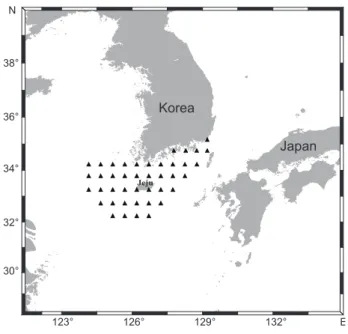
사이의범 위에서이루어졌다(Fig. 1).
조사가진행되는동안CTD (Sea-
Bird SBE 9)
로수온,
염분을측정하였으며채집된어류샘플은전장
(0.1 cm, Total length)
과체중(0.1 g, Body weight)
을 측정하였다.
측정한샘플은위내용물분석을위하여위를절취하여
10%
포르말린에고정한뒤실험실로운반하였고운반된샘플은현미경
(JP/SZX 51 and JP/SZX 7; Olympus, Tokyo, Japan)
하에서Kim et al. (2005), Hong et al. (2006), Min et al.
(2004), Chihara and Murano (1997)
를참고하여가능한종까 지동정하였다.
자료분석
수심과전장
(Total length)
사이에유의한차이의유무를판 단하기위해서변이의동질성(Homogeneity of Variance)
판단 후Kruskal – Wallis test
를시행하였고MINITAB, Version 12
를사용하였다.
각정점간민달고기의출현유무를알아보기위 하여수심,
수온과염분data
에민달고기의출현유무를factor
로하여다차원척도법(non-Metric Multidimensional Scaling, nMDS)
분석을시행하였으며PRIMER Version 5
를사용하였 다.
먹이생물은종류별로개체수를계수하고,
각먹이생물의크 기는전장0.1 cm
단위까지,
습중량0.01 g
단위까지측정하였 다.
위내용물의출현양상은각먹이생물에대한출현빈도(F
i: Frequency of occurrence),
먹이생물의개체수비(N
i: Number of individual),
습중량비(W
i: Weight)
및먹이생물의상대중요도지수
(IRI: Index of relative importance)
로나타내었다.
상대 중요도지수(IRI)
는개체수비와습중량비의합에출현빈도를곱 한값인데(Pinkas et al. 1971)
이것을백분율로환산하여상대 중요도지수비(% IRI)
를구하였다.
이외에도샘플의전장이증 가함에따른먹이생물의변화를알아보았다.
결과 및 고찰
출현양상
본연구해역에서채집된개체는총
621
개체였으며전장11-48 cm
의범위를보였다.
샘플의출현빈도는수심에따른유의한 차이를보였는데채집된전체개체수의약89%
가80-140 m
사 이의수심에서채집된것을확인할수있었다(Fig. 2).
다차원척 도법에의하여5
년동안의각조사정점은민달고기가출현하는 그룹A
와출현하지않는그룹B
로나뉘는것을확인할수있었는데이는수심과수온의차이임을알수있었다
(nMDS analy-
sis; Stress = 0.05, ANOSIM; Global R=0.082, P<0.01) (Fig.
3). 14°C
이하의수온에서는매우적은개체가출현하다가14°C
E N
Korea
Japan
Jeju
38°
36°
34°
32°
30°
123° 126° 129° 132°
0 10 20 30 40 50
60 80 100 120 140 160
Catch (%)
Depth (m)
0 20 40 60 80 100
20 25 30 35 40
(by wet weight) (%)
Total length
Pisces Crustacea Cephalopoda
0 10 20 30 40 50
60 80 100 120 140 160
Total length (cm)
Depth (m) Percentage of stomach contents
Group B Stress: 0.05
Group A
E N
Korea
Japan
Jeju
38°
36°
34°
32°
30°
123° 126° 129° 132°
0 10 20 30 40 50
60 80 100 120 140 160
Catch (%)
Depth (m)
0 20 40 60 80 100
20 25 30 35 40
(by wet weight) (%)
Total length
Pisces Crustacea Cephalopoda
0 10 20 30 40 50
60 80 100 120 140 160
Total length (cm)
Depth (m) Percentage of stomach contents
Group B Stress: 0.05
Group A
E N
Korea
Japan
Jeju
38°
36°
34°
32°
30°
123° 126° 129° 132°
0 10 20 30 40 50
60 80 100 120 140 160
Catch (%)
Depth (m)
0 20 40 60 80 100
20 25 30 35 40
(by wet weight) (%)
Total length
Pisces Crustacea Cephalopoda
0 10 20 30 40 50
60 80 100 120 140 160
Total length (cm)
Depth (m) Percentage of stomach contents
Group B Stress: 0.05
Group A
Fig. 1. Map showing study area. Triangles are the stations.Fig. 2. Total catch of Zenopsis nebuloas by depth.
Fig. 3. nMDS ordination plots based on the community similarity of each station in 2009, 2010, 2011, 2012 and 2013. Circle show similarity between each station.
민달고기 수직분포 및 식성
975
이상의수온에서부터는많은개체가출현하였으며
20°C
이상의 수온에서도매우많은개체가출현하여민달고기는따뜻한수 온을선호하는것을알수있었다.
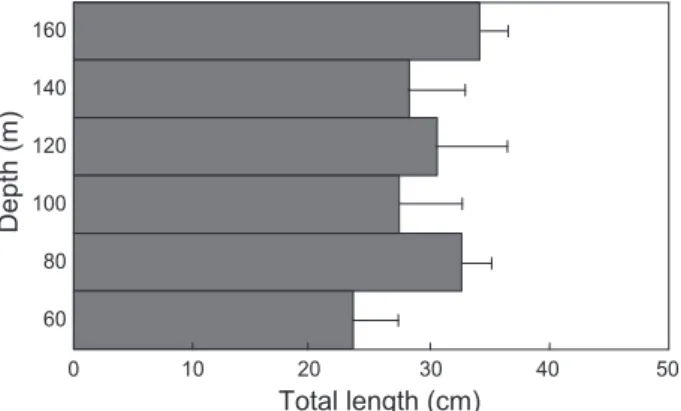
수심에따른전장의변화도 확인할수있었는데수심이깊어짐에따라전장이증가하는양 상을보였다(K–W test, P<0.05) (Fig. 4).
실제로Knuckey and
Curtain (2001)
의연구에서도연안의개체보다먼바다에서서식하는개체의전장이더큰것을확인할수있었는데본연구 의결과도이와일치하였다
.
먹이생물
먹이생물분석을위해사용된개체는총
128
개체였으며20-
43 cm
의크기를보였다.
식성분석에사용된개체의전체공위율은
71%
로서상당히높은공복률을보였다.
먹이생물분석을 통하여어류가민달고기의주먹이생물임을알수있었는데실 제로어류를주먹이로하는종들은어류가먹이로서의효율 이높은관계로공복률이상대적으로높은것을확인할수있 다(Choi et al., 2011, Baeck and Huh, 2004, Huh et al., 2006).
민달고기의주먹이생물은어류로서전갱이
(Trachurus japoni-
cas)
가11.5% IRI
값을보여어류중에서도가장높은비율을차지하였다
(Table 1).
전갱이는우리나라주변해역에많이분포하며수심
10-100 m
내외의중층및저층에서서식하는종이다(Kim et al., 2005, Cha et al., 2009).
본연구에서전갱이를섭이한개체는제주도남부의수심
100 m
지점에서발견된개체들이었으며이는전갱이의서식지와거의일치하는지점이었다
.
그다음은샛비늘치(Myctophum affine)
로IRI
값이6.1%
를나 타냈다.
어류다음많은비율을차지한분류군으로는갑각류인 곤쟁이류였는데이는상대중요지수비2.3%
를차지하여어류 보다는상대적으로적은비율이지만어류다음으로높은비율 을차지하였다.
그외섭이된먹이생물군은두족류였는데살오 징어(Todarodes pacificus)
가0.6%,
꼴뚜기류가0.2 %
로서두족류는총
1.1%
를차지하여어류에비하면극히적은비율을차지하였다
. Rowling et al. (2010)
의연구에따르면민달고기 는소형어,
작은크기의갑각류와두족류를주로섭이한다고하 였는데본연구에서섭이된먹이생물중에서주먹이생물이었던어류는전장이
15 cm
를넘지않는비교적작은개체들이었으며두족류역시몸통길이가
6 cm
미만의비교적작은개체들 로서Rowling et al. (2010)
의연구결과와거의일치하는결과E N
Korea
Japan
Jeju
38°
36°
34°
32°
30°
123° 126° 129° 132°
0 10 20 30 40 50
60 80 100 120 140 160
Catch (%)
Depth (m)
0 20 40 60 80 100
20 25 30 35 40
(by wet weight) (%)
Total length
Pisces Crustacea Cephalopoda
0 10 20 30 40 50
60 80 100 120 140 160
Total length (cm)
Depth (m) Percentage of stomach contents
Group B Stress: 0.05
Group A
E N
Korea
Japan
Jeju
38°
36°
34°
32°
30°
123° 126° 129° 132°
0 10 20 30 40 50
60 80 100 120 140 160
Catch (%)
Depth (m)
0 20 40 60 80 100
20 25 30 35 40
(by wet weight) (%)
Total length
Pisces Crustacea Cephalopoda
0 10 20 30 40 50
60 80 100 120 140 160
Total length (cm)
Depth (m) Percentage of stomach contents
Group B Stress: 0.05
Group A
Fig. 4. Total length frequency distribution of Zenopsis nebulosa by depth.
Fig. 5. Ontogenetic diet variations of Zenopsis nebulosa
Table 1. Composition of the stomach contents of Zenopsis nebu- losa
Prey organisms (%)
FO %W %N %IRI
Pisces
Trichiurus lepturus 2.7 14.3 0.8 1.4 Trachurus japonicus 10.8 28.0 3.2 11.5 Acropoma japonicum 10.8 3.5 4.8 3.1 Callanthias japonicus 2.7 7.1 0.8 0.7 Engrulis japonicus 5.4 5.1 14.5 3.6 Amblychaeturichthys
hexanema 2.7 0.6 0.8 0.1
Myctophum affine 5.4 0.6 31.5 5.9 Myctophiformes 2.7 0.1 8.1 0.7 Larimichthys polyactis 2.7 0.5 0.8 0.1 Unidetified Pisces 43.2 31.9 15.3 69.5 Crustacea
Mysidacea 8.1 0.1 8.1 2.2
Mollusca
Cephalopoda 10.8 4.2 5.6 1.1
Todarodes pacificus 2.7 3.6 2.4 0.6
Loliginidae 2.7 0.1 1.6 0.2
Unidetified Cephalopoda 5.4 0.4 1.6 0.4
Total 100.0 100.0 100.0
김혜림
ㆍ
김정윤ㆍ
김희용ㆍ
최광호ㆍ
최정화976
였다
.
또한민달고기는유영능력이상당히떨어지는종이라고알려져있는데
(Wheeler, 1969)
섭이된먹이생물이모두소형개체였던점은민달고기의유영능력과연관이있을것으로추 측할수있다
.
전장에따른먹이생물의변화를살펴보면25 cm
이상의크기군에서부터두족류의섭이가나타나기시작하였는 데25 cm
이상의개체군에서는약17.9%
를차지하였고30 cm
이상의크기군에서는1.6%
가섭이되었다.
갑각류인곤쟁이류 는가장작은크기군에서부터섭이되기시작하였지만극히미 량이었다(Figure 5). Zidowitz et al. (2002)
의연구에서와마 찬가지로모든크기군에서가장많이섭이된먹이생물은어류였으며
25-30 cm
의개체군에서어류가82%
를차지한것이외에는나머지크기군에서는모두어류가
99%
이상을차지하 여민달고기는어식성어류임을확인할수있었다. Zidowitz et al. (2002)
는Zenopsis
속어류들은개체의크기가커질수록 먹이생물이단편화된다고하였는데본연구에서도마찬가지 로개체의크기가커질수록먹이생물로서의어류가더욱우점 하는결과를보였으며가장큰크기의그룹에서는어류의비율 이100%
를나타냈다.
References
Baeck GW and Huh SH. 2004. Feeding habits of brown barra- cuda (Sphyraena pinguis, Teleostei) in the coastal waters of Gadeok-do, Korea. Kor J Fish Aqua Sci 37, 505 -510.
Cha HK, Lee JB, Kang SK, Chang DS and Choi JH. 2009.
Reproduction of the jack mackerel, Trachurus japonicas et Schlegel in the coastal waters around Jeju Island, Korea:
maturation and spawning. J Kor Soc Fish Tech 45, 243-250.
Chihara, M. and Murano, M. 1997. An illustrated guide to ma- rine plankton in Japan. Tokai University Press, Tokyo, Ja- pan, 1574 .
Choi JH, Yoon SC, Lee SI, Kim JB and Kim HR. 2011. Feeding Habits of Paralichthys olivaceus in the Uljin Marine Ranch- ing Area. Kor J Fish Aqua Sci 44, 684-688.
Hong SY, Park KY, Park CW, Han CH, Suh HL, Yun SG, Song CB, Jo SG, Lim HS, Kang YS, Kim DJ, Ma CW, Son MH, Cha HK, Kim KB, Choi SD, Park KY, Oh, CW, Kim DN, Shon HS, Kim JN, Choi JH, Kim MH and Choi IY. 2006.
Marine invertebrates in Korea Coast. Academy book, Seoul, Korea, 479.
Huh SH, Park JM and Baeck GW.2006. Feeding habits of Span- ish mackerel (Scomberomorus niphonius) in the southern sea of Korea. Kor J Fish Aqua Sci 39, 35-41.
Kang YG. 2005. Morphology and osteology of the Zeus faber and Zenopsis nebulosa. Sc.D. Thesis, University of Yosu, Yosu, Korea.
Kim IS, Choi Y, Lee CL, Lee YJ, Kim BJ and Lim JH. 2005.
Illustrated Book of Korean Fish. Kyohak Publishing, Seoul, Korea, 1–615.
Kim YU, Myoung JG, Kim YS, Han KH, Kang CB, Kim JG
and Yoo JH. 2001. The marine fishes of Korea. Hanguel Publishing, Busan, Korea, 1-382.
Knuckey IA and Curtain JM. 2001. Estimation of the current age structure of mirror dory and ocean perch. Final report to the Australian fisheries management authority. ARF Project R99/0377. Queenscliff, marine and freshwater resources in- stitute, Victoria.
Min, D.K. 2004. Mollusks in Korea. Min molluscan research institute, Seoul, Kroea, 566.
Pinkas L, Oliphant MS and lverson ILK. 1971. Food habits of albacore, bluefin tuna, and bonito in California waters. Calif.
Dep. Fish Game, Fish Bull, 152, 1-105.
Proese, R and Pauly, D. 2002. FishBase. World wide web elec- tronic publication.
Rowling K, Hegarty A and Ives M. 2010. Status of fisheries resources in NSW 2008/09. Industry & Investment NSW, Cronulla, 392 pp.
Seo WC and Yoon HJ. 2008. Relations NOAA/AVHRR SST between migratory fishes in the Korean seas. Kor Inst Mar Info Com Sci 12, 2265-2270.
Wheeler, A. 1969. The fishes of the British Isles and north west Europe. Macmillan. London, U.K.
Zidowitz H, Fock HO and Westernhagen HV. 2002. The role of
Zenopsis spp. As a predator in seamount and shelf habitats.
ICES J Mar Sci 28.