한수지 49(5), 694-700, 2016
694
Copyright © 2016 The Korean Society of Fisheries and Aquatic Science pISSN:0374-8111, eISSN:2287-8815 Korean J Fish Aquat Sci 49(5),694-700,2016
Note
서 론
날돛양태
(Callionymus beniteguri)
는농어목(Perciformes)
돛 양태과(Callionymidae)
에속하는어류로,
우리나라와일본연 안및동중국해등의북서태평양해역에서모래또는뻘로이 루어진지역에서식하는저서성어류(benthic fish)
이다(Kim et
al., 2005).
돛양태과어류는주로새우조망이나저인망의부수어획
(by-catch)
으로어획되며(e.g., Huh and An, 2000; Han et al, 2001; Jeong et al., 2014),
상업적으로이용하는어종은아니 지만,
튀김과같은요리로식용하기도한다(Doopedia, 2016).
돛양태과에속하는어종은
18
속130
종이분포하는것으로알 려져있으며,
우리나라주변해역에는5
속16
종이분포하는것 으로알려져있다(Kim et al., 2005).
지금까지 국내에서 이루어진돛양태과에 대한연구로는돛 양태과분류
(Lee and Kim, 1993),
실양태(Repomucenus va- lenciennei)
의 식성(Huh and Baeck, 2003)
및 성숙과 산란(Baeck and Huh, 2004a),
돛양태(R. lunatus)
의식성(Huh et
al., 2013)
등의생태학적연구등이있으며,
국외의경우에는Callionymus belcheri
의생태연구(Johnson, 1972)
를비롯한다 양한종의식성과생식주기에관한연구가진행되었다(King et al., 1994; Gonzales et al., 1996, 1997; Ikejima and Shimizu, 1998; Yamamoto and Tominaga, 2005).
한편본연구어종인 날돛양태에관한생태학적연구는식성(Takahashi et al., 1999;
Yamamoto and Tominaga, 2005)
과산란주기(Zhu et al., 1989)
에관한연구가있었으나,
국내에서날돛양태의생태학적연구 는전무한실정이다.
생태계의모든생물들은생존과번식을위해에너지를필요로 하며
,
소비자인어류는먹이생물을섭식하여에너지를얻는다.
생태계내에서이러한에너지의이동에대한정보는어류의식 성연구를통하여가능하다.
돛양태과어류는작은크기의저서 성갑각류나(Takahashi et al., 1999; Yamamoto and Tominaga,
2005)
이매패류와갯지렁이류등을주로섭식하였다(Huh and
Baeck, 2003).
한편돛양태과어류는황아귀(Lophius litulon)
나홍어(Okamejei kenojei)
와같은저서성육식성어종의먹이태안 주변해역에 출현하는 날돛양태(Callionymus beniteguri)의 식성
최희찬*·윤석현·박주면
1·허성회
2국립수산과학원 기후변화연구과, 1맥쿼리대학교 생물학부, 2부경대학교 해양학과
Feeding Habits of Whitespotted Dragonet Callionymus beniteguri in the Coastal Waters off Taean, Korea
Hee Chan Choi*, Seok Hyun Youn, Joo Myun Park
1
and Sung Hoi Huh2
Oceanic Climate and Ecology Research Division, National Institute of Fisheries Science, Busan 46083, Korea
1
Department of Biological Sciences, Macquarie University, NSW 2109, Australia
2
Department of Oceanography, Pukyong National University, Busan 48513, Korea
Specimens of Callionymus beniteguri (n=89) were collected from the waters off the coast of Taean, Korea, between April 2008 and January 2009, and their feeding behavior was observed. C . beniteguri (4.0-15.5 cm SL) was found to be a bottom-feeding carnivore that primarily preyed on gammarid amphipods, and secondarily consumed polychaetes but also ingested bivalves, shrimps, cumaceans, and sea urchins. Six additional minor prey groups also contributed to its diet, but the index of relative importance (IRI) for these groups was relatively low (<1.0). C . beniteguri exhibited size-related dietary changes. Small individuals (<10 cm SL) mainly consumed amphipods. As fish size increased, amphipods tended to decline in IRI, while the contributions of bivalves, sea urchins, and polychaetes became more important.
Key words: Callionymus beniteguri , feeding habits, Amphipoda, Taean, trawl by-catch
This is an Open Access article distributed under the terms of the Creative Commons Attribution Non-Commercial Licens (http://creativecommons.org/licenses/by-nc/3.0/) which permits unrestricted non-commercial use, distribution, and reproduction in any medium, provided the original work is properly cited.
http://dx.doi.org/10.5657/KFAS.2016.0694 Korean J Fish Aquat Sci 49(5) 694-700, October 2016
Received 7 October 2016; Revised 18 October 2016; Accepted 18 October 2016
*Corresponding author: Tel: +82. 51. 720. 2249 Fax: +82. 51. 720. 2266
E-mail address: [email protected]
날돛양태의 식성
695
원이되기도하여
(Baeck et al., 2011; Park et al., 2014)
최상위 포식자와하위영양단계를이어주는영양매개(trophic linker)
역할을 하기때문에,
이들의식성연구는 연구해역의 먹이망(food web)
을이해하는데중요한연구자료가될수있다.
따라 서본연구는한국태안주변해역에서트롤에의한부수어획물 로채집된날돛양태의위내용물분석을통하여주먹이생물을 파악하고성장에따른먹이생물변화를조사하였다.
재료 및 방법
본연구에사용된날돛양태의시료는
2008
년4
월부터2009
년1
월까지매월태안주변해역에서소형기선저인망(small otter trawl)
을이용하여총89
개체(2008
년4
월: 2, 5
월: 15, 6
월: 16, 7
월: 30, 8
월: 1, 11
월: 22, 2009
년1
월: 3)
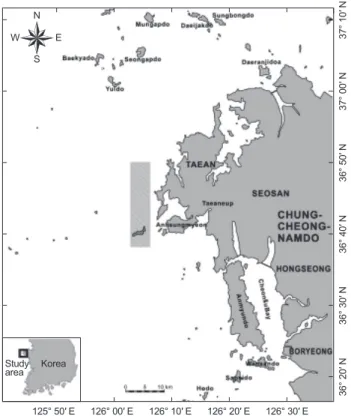
를채집하였다(Fig. 1).
채집된시료는냉장보관하여실험실로옮긴후각개체의표준 체장
(Standard length, SL; 0.1 cm)
과체중(0.1 g)
을측정하였 다.
이후어체에서위를분리하였으며,
위내용물은해부현미 경하에서먹이종류별로구분하였다.
출현한먹이생물은가능 한종까지동정하였으나,
소화가진행되어형태적으로종동정 이불가능한먹이생물은상위단계까지만분류하였다.
먹이생 물은종류별로개체수를계수하였으며,
건조기에서80℃
로24
시간건조시킨뒤,
전자저울을이용하여건조중량을0.1 mg
단위까지측정하였다
.
위내용물의분석결과는각먹이생물에대한출현빈도
(%F),
먹이생물의개체수비(%N)
및건조중량비(%W)
로나타내었으 며,
다음식을이용하여구하였다.
%F=A
i/N × 100
%N=N
i/N
total× 100
%W=W
i/W
total× 100
여기서
, A
i는위내용물중먹이생물i
가발견된날돛양태의개 체수이고, N
은먹이를섭식한날돛양태의총개체수, N
i(W
i)
는먹이생물
i
의개체수(
건조중량), N
total(W
total)
은전체먹이생물의개체수
(
건조중량)
이다.
먹이생물의 상대중요성지수
(index of relative importance, IRI)
는Pinkas et al. (1971)
의식을사용하였다.
IRI = (%N+%W)×%F
상대중요성지수비는 백분율로 환산하여 상대중요성지수비
(%IRI)
로나타내었다.
날돛양태의성장에따른먹이조성변화를파악하기위하여
3
개의체장군(Small: <10 cm, n=33; Medium: 10-15 cm, n=32;
Large: >15 cm, n=13)
으로나누어먹이생물을분석하였다.
체 장군에따른위내용물조성의통계적차이를분석하기위하여analysis of similarity (ANOSIM)
분석을실시하였다. ANO-
SIM
분석에서global R
통계량은각그룹의유사성을나타내는값으로
-1
에서+1
의범위를나타내며, ‘0’
에가까울수록그룹 간차이가없음을나타내고, -1
또는+1
에가까울수록각그룹은 유의하게구분되는것으로간주한다.
상기자료의분석을위하 여SAS (Enterprise 4.1)
를이용하였고,
통계적유의성은0.05
를적용하였다.
그리고체장의증가에따른먹이섭식특성파악 을위하여개체당평균먹이생물개체수(mean number of preys per stomach, mN/ST)
와건조중량(mean weight of preys per stomach, mW/ST)
을구하였고,
일원분산분석(one-way analy- sis of variance, ANOVA)
을이용하여유의성검정을실시하였 다(SPSS version 18.0; Chicago, IL, USA).
또한날돛양태가성 장하면서얼마나다양한먹이생물을섭식하는지파악하기위하 여dietary breadth index (B
i)
를구하였다(Krebs, 1989).
B
i= (1/n-1) ∙ (1/∑P
ij2) – 1
여기서
P
ij는포식자i
의위내용물중먹이생물j
가차지하는비 율이고, n
은총먹이생물의종수이다.
이지수는0
에서1
까지의 범위를보이며1
에가까울수록다양한먹이생물을섭식하는것0 50 100
Small Medium Large
Polychaeta Amphipoda Caridea Echinoidea Bivalvia Cumacea
Size class
IRI (%)
33 32 13
0 100 200 300 400 500 600 700
0 2 4 6 8 10 12 14
Small Medium Large
mN/ST mW/ST
Size class
mW/ST
mN/ST
0.00 0.10 0.20 0.30 0.40 0.50
Small
37° 10′ N37° 00′ N36° 50′ N36° 40′ N36° 30′ N36° 20′ N
Medium Large
Size class
Dietary breadth index
125° 50′ E Korea
E W
Study area
126° 00′ E 126° 10′ E 126° 20′ E 126° 30′ E N
S
Caridea
Fig. 1. Location of study area in coastal waters of Taean, Korea.
Samples were collected within the shaded area.
최희찬
ㆍ
윤석현ㆍ
박주면ㆍ
허성회696
을의미한다
(Gibbson and Ezzi, 1987; Krebs, 1989).
결 과
위내용물 조성
조사기간동안날돛양태는총
89
개체가채집되었고, 4.0-15.5 (10.5±2.1) cm
의체장(standard Length, SL)
범위를보였다.
위 내용물을분석한89
개체중먹이생물이발견된개체는78
개체 로87.6%
의섭식률을나타내었다.
위내용물이발견된78
개체 를대상으로 조사한누적먹이곡선(cumulative prey curve)
은76
개체에서점근선에도달하여최소표본크기는76
개체로확인되었다
.
먹이를섭식한78
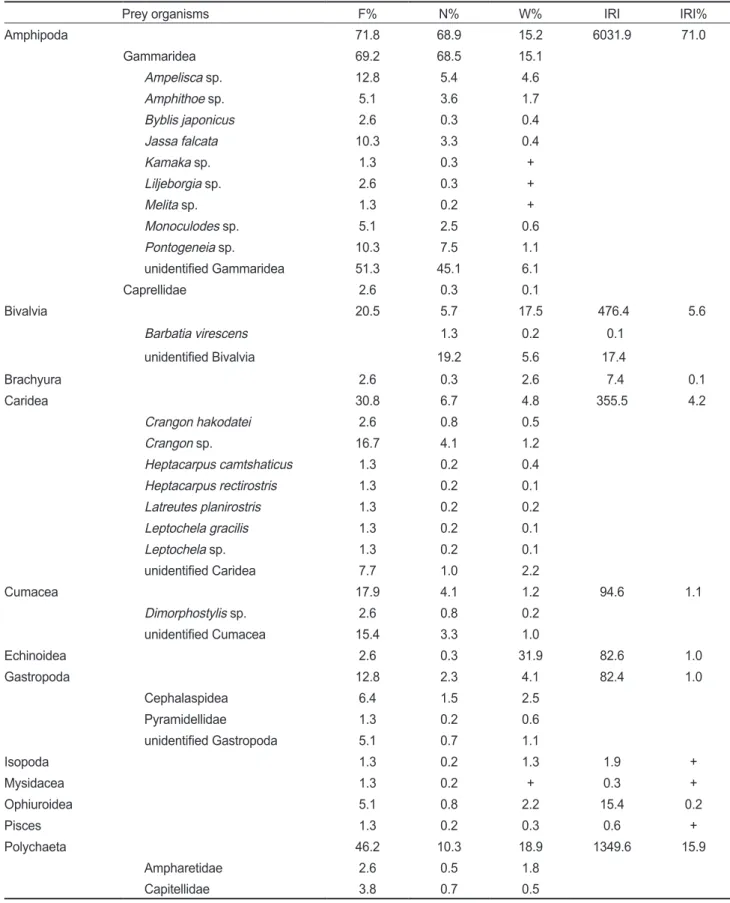
개체의위내용물분석결과(Table 1),
날돛양태의가장중요한먹이생물은출현빈도71.8%,
개체 수비68.9%,
건중량비15.2%
를보여상대중요성지수비71.0%
를보인단각류
(Amphipoda)
였다.
위내용물중단각류는총11
개분류군이출현하여높은다양성을보였다.
이중,
미동정단 각류가출현빈도51.3%,
개체수비45.1%,
건중량비6.1%
를차 지하였으며, Ampelisca sp.
가출현빈도12.8%,
개체수비5.4%,
건중량비4.6%,
그리고Pontogeneia sp.
가출현빈도10.3%,
개 체수비7.5%,
건중량비1.1%
를보여중요한먹이생물이었다.
단각류다음으로중요한먹이생물은출현빈도
46.2%,
개체수 비10.3%,
건중량비18.9%
를보여상대중요성지수비15.9%
를 보인갯지렁이류(Polychaeta)
였다.
갯지렁이류는10
개분류군 이출현하여단각류다음으로많은분류군이섭식되었고,
소화 가많이진행된개체의비율이높아미동정분류군의비율이높 았던것은단각류와유사하였다.
그다음으로이미패류
(Bivalvia)
가출현빈도20.5%,
개체수 비5.7%,
건중량비17.5%
로상대중요성지수비5.6%
를차지 하여비교적중요한먹이생물이었으며,
새우류(Caridea)
가상 대중요성지수비4.2%
로비교적많이섭식되었다.
그외쿠마류(Cumacea),
성게류(Echinoidea),
복족류(Gastopoda),
거미불 가사리류(Ophiuroidea),
게류(Brachyura),
곤쟁이류(Mysida- cea),
등각류(Isopoda),
어류(Pisces)
를섭식하였으나상대중요성지수비
1.1%
이하로전체먹이생물중매우적은부분을차지하였다
.
따라서날돛양태는단각류를주로섭식하면서갯지 렁이류,
이매패류및새우류등의다양한저서생물을섭식하는 저서동물섭식육식성어종(bottom-feeding carnivore)
이었다. 성장에 따른 먹이 조성의 변화
날돛양태의성장에따른먹이생물조성의변화를조사한결
과
(Fig. 2),
체장군에따른먹이조성은통계적으로유의한차이를보였다
(global R=0.175, P=0.001).
단각류는작은체장군에 서상대중요성지수비76.4%,
중간체장군에서54.4%,
큰체장군에서
28.5%
로체장증가에따라섭식률이급격히감소하는경향을보였다
.
갯지렁이류는작은체장군에서10.0%
의상대 중요성지수비를보였고,
중간체장군에서33.0%
로증가하였다가
,
큰체장군에서12.3%
로감소하는경향을보였다.
이매패류 의경우작은체장군과중간체장군에서각각4.3%
와2.9%
로 중요한먹이생물이아니었지만큰체장군에서24.5%
로단각류 다음으로많이섭식된먹이생물이었으며,
성게류도큰체장군 에서만섭식되었다.
그외거미불가사리류나게류등7
개분류 군을포함한기타먹이생물도날돛양태의체장증가에따라섭 식율이증가하였다.
날돛양태의개체당평균먹이생물개체수
(mN/ST)
는체장이증가함에따라유의하게감소하는경향을보인반면
(ANOVA,
F
2,75=10.255, P<0.05),
개체당평균먹이생물중량(mW/ST)
은 체장증가에따라점차증가하는경향을보였으나,
유의한차이 는없었다(ANOVA, F
2,75=1.972, P>0.05) (Fig. 3).
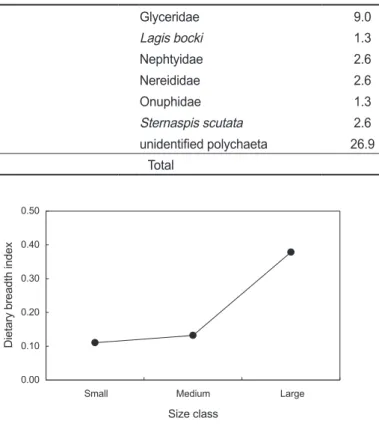
성장에따른날돛양태의
dietary breadth index
는체장이증가하면서점차증가하는경향을보였다
(Fig. 4).
가장작은체장0 50 100
Small Medium Large
Polychaeta Amphipoda Caridea Echinoidea Bivalvia Cumacea
Size class
IRI (%)
33 32 13
0 100 200 300 400 500 600 700
0 2 4 6 8 10 12 14
Small Medium Large
mN/ST mW/ST
Size class
mW/ST
mN/ST
0.00 0.10 0.20 0.30 0.40 0.50
Small
37° 10′ N37° 00′ N36° 50′ N36° 40′ N36° 30′ N36° 20′ N
Medium Large
Size class
Dietary breadth index
125° 50′ E Korea
E W
Study area
126° 00′ E 126° 10′ E 126° 20′ E 126° 30′ E N
S
Caridea
Fig. 3. Variation of mean number of preys per stomach (mN/ST) and mean dry weight (mg) of preys per stomach (mW/ST) of Cal- lionymus beniteguri among size classes.
0 50 100
Small Medium Large
Polychaeta Amphipoda Caridea Echinoidea Bivalvia Cumacea
Size class
IRI (%)
33 32 13
0 100 200 300 400 500 600 700
0 2 4 6 8 10 12 14
Small Medium Large
mN/ST mW/ST
Size class
mW/ST
mN/ST
0.00 0.10 0.20 0.30 0.40 0.50
Small
37° 10′ N37° 00′ N36° 50′ N36° 40′ N36° 30′ N36° 20′ N
Medium Large
Size class
Dietary breadth index
125° 50′ E Korea
E W
Study area
126° 00′ E 126° 10′ E 126° 20′ E 126° 30′ E N
S
Caridea
Fig. 2. Ontogenetic changes in composition of stomach contents of Callionymus beniteguri by percentages of index of relative impor- tance (%IRI). The numbers above each column are the number of individuals contained preys.
날돛양태의 식성
697
Table 1. Composition of Callionymus beniteguri stomach contents by percentage of frequency of occurrence (%F), number (%N), weight (%W), and index of relative importance (%IRI)
Prey organisms F% N% W% IRI IRI%
Amphipoda 71.8 68.9 15.2 6031.9 71.0
Gammaridea 69.2 68.5 15.1
Ampelisca sp. 12.8 5.4 4.6
Amphithoe sp. 5.1 3.6 1.7
Byblis japonicus 2.6 0.3 0.4
Jassa falcata 10.3 3.3 0.4
Kamaka sp. 1.3 0.3 +
Liljeborgia sp. 2.6 0.3 +
Melita sp. 1.3 0.2 +
Monoculodes sp. 5.1 2.5 0.6
Pontogeneia sp. 10.3 7.5 1.1
unidentified Gammaridea 51.3 45.1 6.1
Caprellidae 2.6 0.3 0.1
Bivalvia 20.5 5.7 17.5 476.4 5.6
Barbatia virescens 1.3 0.2 0.1
unidentified Bivalvia 19.2 5.6 17.4
Brachyura 2.6 0.3 2.6 7.4 0.1
Caridea 30.8 6.7 4.8 355.5 4.2
Crangon hakodatei 2.6 0.8 0.5
Crangon sp. 16.7 4.1 1.2
Heptacarpus camtshaticus 1.3 0.2 0.4
Heptacarpus rectirostris 1.3 0.2 0.1
Latreutes planirostris 1.3 0.2 0.2
Leptochela gracilis 1.3 0.2 0.1
Leptochela sp. 1.3 0.2 0.1
unidentified Caridea 7.7 1.0 2.2
Cumacea 17.9 4.1 1.2 94.6 1.1
Dimorphostylis sp. 2.6 0.8 0.2
unidentified Cumacea 15.4 3.3 1.0
Echinoidea 2.6 0.3 31.9 82.6 1.0
Gastropoda 12.8 2.3 4.1 82.4 1.0
Cephalaspidea 6.4 1.5 2.5
Pyramidellidae 1.3 0.2 0.6
unidentified Gastropoda 5.1 0.7 1.1
Isopoda 1.3 0.2 1.3 1.9 +
Mysidacea 1.3 0.2 + 0.3 +
Ophiuroidea 5.1 0.8 2.2 15.4 0.2
Pisces 1.3 0.2 0.3 0.6 +
Polychaeta 46.2 10.3 18.9 1349.6 15.9
Ampharetidae 2.6 0.5 1.8
Capitellidae 3.8 0.7 0.5
최희찬
ㆍ
윤석현ㆍ
박주면ㆍ
허성회698
군에서는
0.11
로가장낮은지수값을보였고,
중간체장군에서0.13
으로약간상승하였으며,
가장큰체장군에서0.38
로가장 다양한먹이생물을섭식하였다.
고 찰
태안주변해역에출현한날돛양태는단각류
,
갯지렁이류,
이 매패류,
새우류등의저서성먹이생물을주로섭식하는육식성 어류였다.
돛양태과에속하는어류는주로대형저서동물을주 로섭식하는특징을보였으나서식장소에따라주요먹이분 류군은차이를보였다(Gonzales et al., 1996; Takahashi et al., 1999; Huh and Baeck, 2003; Yamamoto and Tominaga, 2005).
국내에보고된돛양태과의식성을살펴보면
,
가덕도에서채집 된실양태는이매패류와갯지렁이류를주로섭식하였다(Huh and Baeck, 2003).
반면,
동해남부해역에서채집된돛양태는 단각류(60.8%, IRI)
와갯지렁이류(32.9%, IRI)
를주로섭식하 여본연구와유사한결과를보였다(Huh et al., 2013).
국외의 경우일본Tosa
만에서식하는꽁지양태(Callionymus japoni- cus)
와춤양태(R. huguenini)
는단각류,
갯지렁이류,
이매패류 를주로섭식하여본연구와유사한결과를보였다(Gonzales et al., 1996).
또한일본Omura
만에서채집된동갈양태와실양0 50 100
Small Medium Large
Polychaeta Amphipoda Caridea Echinoidea Bivalvia Cumacea
Size class
IRI (%)
33 32 13
0 100 200 300 400 500 600 700
0 2 4 6 8 10 12 14
Small Medium Large
mN/ST mW/ST
Size class
mW/ST
mN/ST
0.00 0.10 0.20 0.30 0.40 0.50
Small
37° 10′ N37° 00′ N36° 50′ N36° 40′ N36° 30′ N36° 20′ N
Medium Large
Size class
Dietary breadth index
125° 50′ E Korea
E W
Study area
126° 00′ E 126° 10′ E 126° 20′ E 126° 30′ E N
S
Caridea
Fig. 4. The size-related variation of diet breadth index of Calliony- mus beniteguri.
Table 1. continued
Glyceridae 9.0 2.2 1.7
Lagis bocki 1.3 0.3 0.3
Nephtyidae 2.6 0.7 0.6
Nereididae 2.6 0.3 1.3
Onuphidae 1.3 0.2 +
Sternaspis scutata 2.6 0.3 3.1
unidentified polychaeta 26.9 5.2 9.5
Total 100 100 100
태는이매패류와갯지렁이류를선호하는결과를보였다
(Eda, 1994).
한편일본Otsuchi
만에서채집된날돛양태는단각류를 가장많이섭식하여본연구와유사한결과를보였으나,
갯지 렁이류대신곤쟁이류를부가적으로섭식하여차이를보였다(Takahashi et al., 1999).
이와같이해역에따라돛양태과어 류들이선호하는먹이생물이차이를보이긴하였으나,
대부분 단각류와갯지렁이류를선호하는경향을보여본연구의결과 와유사한특징을보였다.
이런결과는돛양태과어류의형태 나서식환경이크게다르지않고,
또한단각류와갯지렁이류는 여러해역에서우점하는분류군이며다양한저서성어종의주 요먹이생물로이용되기때문으로생각된다(e.g. Baeck et al., 2002; Kwak and Huh, 2003; Baeck and Huh, 2004b; Huh et al., 2013).
본연구에서날돛양태는전체체장군에서단각류를가장중요 한먹이생물로이용하였으나
,
체장이증가하면서단각류의비 율은점차감소하고갯지렁이류와이매패류를비롯한다양한 대형저서동물에대한섭식은증가하는양상을보였다.
날돛양 태한개체당평균먹이생물개체수와중량의조사결과,
날돛양 태는성장함에따라단각류보다큰갯지렁이류나이매패류로 먹이전환이이루어지면서먹이생물의평균섭식개체수는감소 하였지만,
대신먹이생물의평균중량은증가하는경향을보였 으며, dietary breadth index
도체장이증가함에따라증가하여 섭식폭이증가함을알수있었다.
본연구에서채집된가장작은개체는체장
4 cm
였으나,
체장7cm
까지의날돛양태는위내용물이발견되지않아태안주변해 역의날돛양태유어단계의먹이생물에대해서는조사하지못 하였다.
그러나실양태의먹이조성연구에서가장작은크기인2-3 cm
크기군에서도단각류가가장중요한먹이생물이었으며
,
그외요각류가섭식되었다(Huh and Baeck, 2003).
그리고 고리주변해역에서채집된돛양태의먹이조성연구에서도4-6 cm
크기의개체들은대부분단각류를섭식하였다.
한편지중해 에서채집된돛양태류자치어의주요먹이생물은요각류유생이었으며
(Sanchez, 1998),
낙동강하구역에서채집된돛양태과의자치어역시요각류유생과소형요각류를주로섭식하였 다
(Choi, 2014).
그리고일본Seto
내해에서채집된3 cm
미만날돛양태의 식성
699
의돛양태류는소형단각류와곤쟁이류를섭식하는것으로보 고되었다
(Yamamoto and Tominaga, 2005).
이상의결과들로 미루어보면,
부유생활을하는돛양태류의자치어단계에서는 요각류를주로섭식하다가체장이증가하여저서생태계로가 입하면서저질에풍부한먹이생물인단각류로먹이전환이이 루어지는것으로생각된다.
하지만날돛양태의전체체급에서 의먹이전환을정확히파악하기위해서는자어시기부터7 cm
미만의개체들에대한식성연구가추가로이루어져야할것으 로생각된다.
본연구는서해태안연안에서출현하는날돛양태의먹이생물 과성장에따른먹이조성의변화에대한정보를제공하였다
.
날 돛양태는주로저서성갑각류(
특히단각류)
와갯지렁이류를주 로섭식하는육식성어종이었으며,
성장함에따라단각류에서 이매패류,
성게류,
갯지렁이류등다양한먹이생물을섭식하는 먹이전환특성을나타내었다.
그러나본연구에서는7 cm SL
보다작은개체에대한자료가없어날돛양태의섭식생태를완 전히밝히지못하였다.
따라서향후먹이섭식을시작하는후기 자어기부터치어단계,
그리고유어시기까지충분한표본을확 보한후분석이필요할것으로생각한다.
사 사
이논문은국립수산과학원
‘
한국근해해양변동모니터링및 생태계특성연구(R2016050)’
의지원으로수행된연구이며,
연 구비지원에감사드립니다.
References
Baeck GW and Huh SH. 2002. Feeding habits of tonguefish,
Cynoglossus joyneri collected in the coastal waters off Yosu,
Korea. Korean J Ichthyol 14, 234-239.Baeck GW and Huh SH. 2004a. Maturation and spawning of
Repomucenus valenciennei collected in Gwangyang bay,
Korea. Korean J Ichthyol 16, 87-93.Baeck GW and Huh SH. 2004b. Feeding habits of robust tonguefish, Cynoglossus robustus collected in the coastal waters of Yosu, Korea. Korean J Ichthyol 16, 341-347.
Baeck GW, Park CI, Choi HC, Huh SH and Park JM. 2011.
Feeding habits of ocellate spot skate, Okamejei kenojei (Müller & Henle, 1841), in coastal waters of Taean, Korea.
J Appl Ichthyol 27, 1079-1085. http://dx.doi.org/10.1111/
j.1439-0426.2011.01751.x.
Choi HC. 2014. Species composition of the ichthyoplankton and feeding ecology of early stage in the Nakdong River estuary, Korea. Ph.D. Thesis. Pukyong Nat`l. Univ., 143 pp.
Eda H. 1994. Life history of callionymid fishes in Omura Bay, Nagasaki, Japan. Ph.D Thesis. Nagasaki Univ., 151 pp.
Gibson RN and Ezzi IA. 1987. Feeding relationship of a de- mersal fish assemblage on the west coast of Scotland. J Fish
Biol 31, 55-69. http://dx.doi.org/10.1111/j.1095-8649.1987.
tb05214.x.
Gonzales BJ, Taniguchi N and Okamura O. 1996. Diet and feed- ing behavior of two dragonets, Calliurichthys japonicus and
Callionymus huguenini in Tosa Bay, southern Japan. Fish
Sci 62, 902-908.Han KH, Yang KS, Jin DS, Yoo DJ, Oh SH and Hwang DS.
2001. Species composition and seasonal variation of the fishes off Koheung Peninsula, Korea. Korean J Ichthyol 13, 143-157.
Huh SH and An YR. 2000. Species composition and seasonal variation of fish assemblage in the coastal water off Gad- eok-do, Korea. 1. Fishes collected by a small otter trawl.
J Kor Fish Soc 33, 288-301. http://dx.doi.org/10.5657/
kfas.2002.35.6.715.
Huh SH and Baeck GW. 2003. Feeding habits of Repomucenus
valencienei collected in the coastal waters of Gadeok-do of
Korea. Korean J Ichthyol 15, 289-294.Huh SH, Kim JM, Park JM and Baeck GW. 2013. Feeding hab- its of moon dragonet Repomucenus lunatus in the coastal waters off Gori, Korea. Korean J Ichthyol 25, 17-24.
Ikejima K and Shimizu M. 1998. Annual reproductive cycle and sexual dimorphism in the dragonet, Repomucenus va-
lencienei, in Tokyo Bay, Japan. Ichthyol Res 45, 157-164.
http://dx.doi.org/10.1007/BF02678558.
Jeong GS, Cha BY, Im YJ, Kwon DH, Hwang HJ and Jo HS.
2014. Comparison of species composition and seasonal variation of demersal organisms caught by otter trawl in the coastal waters off the Taean Peninsula, in the West Sea of Korea. Korean J Fish Aquat Sci 47, 264-273. http://dx.doi.
org/10.5657/KFAS.2014.0264.
Johnson CR. 1972. Biology and ecology of Callionymus
belcheri (Pisces: Callionymidae). Copeia 1972, 461-470.
http://dx.doi.org/10.2307/1442917.
Kim IS, Choi Y, Lee CY, Lee YJ, Kim BJ and Kim JH. 2005. Il- lustrated Book of Korean Fishes, Kyohak-sa, Seoul, Korea, King PA, Fives JM and McGrath D. 1994. Reproduction, 615.
growth and feeding of the dragonet, Callionymus lyra (Te- leostei: Callionymidae), in Galway Bay, Ireland. J Mar Biol Assoc U.K. 74, 513-526. http://dx.doi.org/10.1017/
S0025315400047639.
Krebs CJ. 1989. Ecological Methodology. Harper and Row, New York, U.S., 654.
Kwak SN and Huh SH. 2003. Feeding habits of Limanda yoko-
hamae in the eelgrass (Zostera marina) bed in Kwangyang
bay. Korean J Fish Aquat Sci 36, 522-527. http://dx.doi.org/10.5657/kfas.2003.36.5.522.
Lee CL and Kim IS. 1993. Synopsis of dragonet fish, Family Callionymidae (Pisces, Perciformes) from Korea. Korean J Ichthyol 5, 1-40.
Park JM, Huh SH, Jeong, JM and Baeck GW. 2014. Diet com-
최희찬
ㆍ
윤석현ㆍ
박주면ㆍ
허성회700
position and feeding strategy of yellow goosefish, Lophius
litulon (Jordan, 1902), on the southeastern coast of Korea.
J Appl Ichthyol 30, 151-155. http://dx.doi.org/10.1111/
jai.12337.
Pinkas ER, Oliphant MS and Iverson ILK. 1971. Feeding hab- its of albacore, bluefin tuna and bonito in California waters.
Fish Bull 152, 1-105.
Sanchez-Velasco L. 1998. Diet composition and feeding hab- its of fish larvae of two co-occurring species (Pisces: Cal- lionymidae and Bothidae) in the north-western Mediterra- nean. ICES J Mar Sci 55, 299-308. http://dx.doi.org/10.1006/
jmsc.1997.0278.
Takahashi K, Hirose T and Kawaguchi K. 1999. The impor- tance of intertidal sand-burrowing peracarid crustaceans as prey for fish in the surf-zone of a sandy beach in Otsuchi Bay, northeastern Japan. Fish Sci 65, 856-864. http://dx.doi.
org/10.2331/fishsci.65.856.
Yamamoto M and Tominaga O. 2005. Feeding ecology of domi- nant demersal fish species Favonigobius gymnauchen, Re-
pomucenus spp. and Tarphops oligolepis at a sandy beach
where larval Japanese flounder settle in the Seto inland sea, Japan. Fish Sci 71, 1332-1340. http://dx.doi.org/10.1111/j.1444-2906.2005.01099.x.
Zhu Y, Furukawa K, Aida K and Hanyu I. 1989. Annual repro- ductive rhythm of the tobinumeri-dragonet Repomucenus
beniteguri (Callimonymidae) in Lake Hamana. Nippon
Suisan Gakkaishi 55, 591-599. http://dx.doi.org/10.2331/suisan.55.591.
Doopedia. 2016. Mood dragonet, Repomucenus lunatus. Re- trieved from http://www.doopedia.co.kr/doopedia/master on October 7.
Table 1. Composition of Callionymus beniteguri stomach con- tents by percentage of frequency of occurrence (%F), num- ber (%N), weight (%W), and index of relative importance (%IRI)