7 1 2018. 6 1-4 https://doi.org/10.22645/udi.2018.7.1.001
1. Introduction
Buyeo, the capital of the ancient Baekje occupies the southern corner of the peninsula of Korea, is one of the oldest historical cities in Korea. Royal tombs, temple sites with weathered stone pagodas and a variety of Buddhist statues, as well as fortress ruins are still scattered around the city.
Kyoto founded in the eighth century had been the capital of ancient Japan. At that time, Japan was highly affected by Baekje’s cultural and physical elements. Meanwhile, there are a few records about diplomacy toward Japan.
According to the Japanese sources like Nippon Seogi, Baekje started to communicate with Japan at the reign of King Geuncogo in the middle of the fourth century. However, the relations between Baekje and Japan were not just formal. Japan sent military forces to Baekje and joined the allied forces with Gaya when Goguryeo advanced southward exercising its influence over Baekje. Japan always had a close political and military relationship with Baekje. It may be natural that after Baekje was destroyed the wandering people sailed across the sea to Japan because there was such a strong relationship between the two kingdoms.
It is quite possible to guess that those two
capital cities may have a sort of physical relation.
2. History and contents of the two capitals
Sabi became the new capital of Baekje in the 16th year of King Seong 538 A.D. Sabi is now Buyeo in Chungcheong Province. Castle walls of eight kilometers in length were built around the city.
Preliminary investigations and excavations of the area at the southern foot of Mt. Buso had a royal palace site in Buyeo, the Capital of upper Baekje for 123 years. It had revealed signs of a low stone wall, making it quite possible that a royal palace indeed once stood there. Road relics showed that there had been a network of east-to-west and south-to-north roads. Tile-built bases for buildings were found.
Stone structures marked the northern border of the palace. Pottery with a human face pattern, bronze spoons, pottery and tiles were discovered near the building sites and the stone-reinforced embankment. The remains of roads are particularly important to the study of
* Assistant Professor, Div. of Architecture and Urban Design, Incheon National University, 22012, Corresponding author([email protected])
A study on urban planning between Buyeo and Kyoto in terms of the interrelationship over the history
Jinho Kim*1)․
2 7 1 2018. 6
the royal palace plan and city planning of Buyeo.
Kyoto was founded when Emperor Kammu moved the capital from Nagaokakyo in 794.
Kyoto was built on an even vaster scale than Heijo, which was the first planned capital and it was called “Capital of Peace” which means a natural fortress.
For 1074 years, Kyoto remained the capital, though at times only in name. From 794 to the end of the 12th century, the city flourished under imperial rule. It might be said that this was the time when Japan’s culture started to become independent of Chinese or Korean influences and to develop its unique characteristics.
Such was Kyoto’s decline in the 17th and 18th centuries that when the power of the government was returned from the shoguns to the emperor, who moved his capital and imperial court to Edo, renaming it Tokyo.
However, Kyoto has been the cradle of Japanese culture in many ways, especially with its courtly aesthetic pastimes, such as moon-viewing parties and tea ceremonies. A stroll through Kyoto today is a walk through eleven centuries of Japanese history. Elderly women continue to wear kimonos as they make their way slowly along the canal walkways and sixteen hundred temples and several hundred shrines surround central Kyoto.
3. The development of two capitals
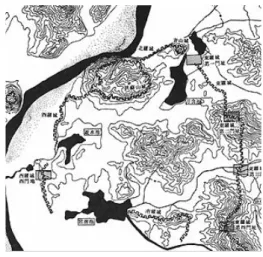
Buyeo, originally designed as a fortress city, was very different from the straight-lined castle walls which were often seen in Jang-An, the ancient capital of China. Buyeo’s wall were winding and the wall was not low, because of swampy places nearby on the Baekma River. Consequently, it is hard to say that Buyeo was a well-shaped city like Kyoto.
However, Buyeo was the first capital which was built inside the fortress in the Three Kingdom Period. In previous times, the royal palace and the fortress were separate and royal
palace became evacuated in case of war. Thus, the royal place was exposed to enemy forces.
Buyeo, as a third Capital in Baekje, tried to protect itself from Goguryeo from the North and Silla from the East by connecting the mountains through fortifications and by its location near the river. (Figure 1)
Figure 1. City planning of Buyeo
The Japanese city did not emerge naturally;
rather men and materials were brought together through political power in the establishment of the ritusuryo system. Nara and Kyoto were built according to this system.
As a tangible model of this ideal form, Chang-An, the capital of the Tang Dynasty, exerted a powerful influence. Therefore, the new capital was rectangular in shape and measured three and a half miles from north to south and about three miles form east to west.
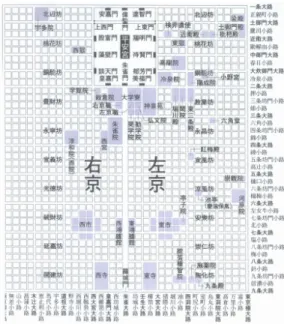
Within this outer enclosure a grid system of streets divided the city into more than 1,200 blocks of uniform size. The main entrance to the south was the great Rashomon Gate, which opened on the imposing Suzaku Avenue that bisected the city. At the avenue’s northern terminus was the Imperial Palace. The Imperial Palace compound housed both governmental and residential buildings as it had at Heijo, though with many additional structures, such as the Court of Abundant Pleasures, Burakuin.
Kyoto has two major parts, Ukyo and Sakyo, which divided by location of Imperial
3
Palace and city’s major street. In the late 10th century, the right side of the city, Sakyo, s declined and the symmetry of the city collapsed. Much of the city was destroyed in a fire in the latter part of the nineteenth century, but the restoration work which was done after it mostly followed the pattern of the city as it was in the Edo period. (Figure 2)
Figure 2. City planning of Kyoto
4. Similarities and differences in the two capitals
Geographically, both two historical capitals are located near the river. Baekje established its first capital south of the Han River near present day Seoul, but later moved to Gongju in 475 and finally to Buyeo along the Geum River in 538. The historical capital of Japan, Kyoto, is also located adjacent to major river, Kamo. In the past, rivers played a major role in transportation and trading with other countries.
Three Kingdoms in ancient Korea and Japan had the same religion, Buddhism. Buddhism was introduced into Baekje during the reign of King Chim-ryu by Marananta, an Indian monk. The Buddhism of Baekje was brought to Japan and had a significant impact on Japan which can tell its influence through the remains and the records in Japan. Temples and pagoda sat both cities show similar forms in many ways. The
pagodas at Kyoto’s Kofukuji or five-story pagoda at Nara’s Horyuji are actually built in styles imported from Baekje.
The stone pagoda at the site of the Jeongrimsa Temple near Dongnam-ri, Buyeo-eup, was erected during the Baekje Period, which along with the pagoda at the site of the Mireuksa at Iksan, can be considered as the prototype of the stone pagodas of Korea.
Though the pagoda, designated as National Treasure No.9, is patterned after a wooden structural frame, it displays a refined and creative form instead of being a simple imitation. The overall contour gives a solemn and lucid air. A description of the role played by Tang Chinese General Su Tingfang in the conquest of Baekje is inscribed on the four faces of the first-story portion of the pagoda, but the inscription is known to have been made well after the pagoda was erected. An excavation of the area has turned up a number of roof tiles bearing the name of the Jeongrimsa.
Those two sculptures, which represent the Buddha’s thinking moment, show almost the same techniques made by Baekje artisan, and the materials used in Japanese Buddha was from Baekje. (Figure 3 & 4)
Figure 3.
Kwangrungsa in Kyoto
Figure 4.
Buyeo Museum
On the other hand, Kyoto’s city planning was influenced by the ancient Chinese capital Chang-An, Tang, rather than Buyeo at that time. In the site selection, it was laid on the basin format and the street had grid pattern.
The main street is much wider than other street and located in front of palace. However, Buyeo had fortress along the mountains which had a rather organic form. After being destroyed by the Silla, Buyeo became the just a
4 7 1 2018. 6
small city in Korea. In other words, its importance degraded as time went by. Now we can find rather orthogonal layout, however.
Under the rule of Japanese Imperialism, Japanese tried to make their own palace, now became Buyeo High School, according to the new city plan. They believed that Buyeo was the origin of their Aska Culture. Ironically, modern Buyeo planning is mainly based on the Japanese planning. (Figure 5)
Figure 5.
Current Map of Buyeo city
5. Conclusion
Due to the strong relationship between Baekje and Japan through the same religion, Buddhism, we can find many similarities in cultural aspects in remains, such as temples, and pagodas, and in many relics, in both cities.
However, from the point view of urban
planning, Buyeo, originally designed as the fortress city, has a different city planning from Kyoto which is a straight-lined city. After Buyeo was destroyed by Silla, one of the Three Kingdoms in Korea, it got deemphasized in Korean history. Later, Buyeo’s recent city planning was directly affected by Japanese one which emphasizes the layout of Japanese temple which serves as the center of the ceremonies for their ancestors. Thus, we can find cultural interrelation in both cities throughout the history of both countries, Korea and Japan.
REFERENCES
Coaldrake, Willam (1996), Architecture and Authority in Japan, Routledge
Cybriwsky, Roman (1991), Tokyo: the changing profile of an Urban Giant, G K Hall,
Han, Phil-Won, The Future of Buyeo, The Historical City, Korean Architecture 9303,
Lee, Kyung-Chan (2001), “The Paradigm of Historical Cities-Buyeo”, Culture & I
Nishi, Kazuo, and Hozumi, Kazuo (1985), What is Japanese Architecture?, Kodansha
International.
Plutschow, Herbert (1979), Introducing Kyoto, Kodansha International.
논문투고일 월 일: 6 19 논문게재일 월 일: 6 30