• 검색 결과가 없습니다.

Increasing Trend of Isolation of Non-Tuberculous Mycobacteria in a Tertiary University Hospital in South Korea

N/A
N/A
Protected

Academic year: 2021

Share "Increasing Trend of Isolation of Non-Tuberculous Mycobacteria in a Tertiary University Hospital in South Korea"

Copied!
7
0
0

로드 중.... (전체 텍스트 보기)

전체 글

(1)

Tuberc Respir Dis 2012;72:409-415

CopyrightⒸ2012. The Korean Academy of Tuberculosis and Respiratory Diseases. All rights reserved.

Increasing Trend of Isolation of Non-Tuberculous Mycobacteria in a Tertiary University Hospital in South Korea

Jung-Wan Yoo, M.D.

1

, Kyung-Wook Jo, M.D.

1

, Mi Na Kim, M.D.

2

, Sang Do Lee, M.D.

1

, Woo Sung Kim, M.D.

1

, Dong Soon Kim, M.D.

1

, Tae Sun Shim, M.D.

1

1

Division of Pulmonary and Critical Care Medicine,

2

Department of Laboratory Medicine, Asan Medical Center, University of Ulsan College of Medicine, Seoul, Korea

Background: The isolation of non-tuberculous mycobacteria (NTM) has been increasing in South Korea. To date, however, the cause of this increase has not been determined, and it remains unclear whether the use of liquid media has contributed to this increase. The aim of this study was to evaluate the factors associated with NTM isolation and the impact of liquid media on NTM culture.

Methods: Mycobacterial smear/culture results of respiratory specimens (sputum and bronchial aspirates), obtained during the years 2002, 2005, and 2010, were retrieved and analyzed retrospectively.

Results: During the years 2002, 2005, and 2010, 83,096 sputum specimens were collected from 31,104 patients, and were cultured for mycobacteria, using solid media only in the 2002 and 2005 specimens and both solid and liquid media in the 2010. Of these, 3,516 (4.2%) specimens were smear-positive for acid-fast bacilli (AFB). The annual rate of NTM among positive culture specimens increased from 21% in 2002 to 57.8% in 2010 (p<0.001), as did the proportion of NTM, among AFB smear- and culture-positive specimens, from 12.2% in 2002 to 45.2%

in 2010 (p<0.001). In 2010, the NTM culture rate was higher in the liquid than in the solid media (13.9% vs.

8.4%, p<0.001). The NTM rate among AFB-positive specimens was higher in patients aged >50 than ≤50 years.

Conclusion: The rate of NTM isolation has steadily been increasing at the hospital in South Korea, likely due in part to the use of liquid media for the culture.

Key Words: Nontuberculous Mycobacteria; Culture Media; Sputum; Republic of Korea

Address for correspondence: Tae Sun Shim, M.D.

Division of Pulmonary and Critical Care Medicine, Asan Medical Center, University of Ulsan College of Medicine, 388-1, Pungnap-dong, Songpa-gu, Seoul 138-736, Korea Phone: 82-2-3010-3892, Fax: 82-2-3010-6968

E-mail: [email protected] Received: Feb. 8, 2012 Revised: Feb. 21, 2012 Accepted: Apr. 17, 2012

Introduction

Although the incidence and prevalence of non-tuber- culous mycobacterial (NTM) isolation and disease have varied among populations, both have tended to increase over time

1-6

. In South Korea also, NTM isolation, using solid media, and disease have been increasing in clin- ical practice

7,8

. South Korea is a country with an inter- mediate tuberculosis (TB) burden, making it important

to distinguish TB from NTM disease.

Liquid media is being used more commonly to isolate

Mycobacterium tuberculosis and NTM

9

. Because the

contamination rate is higher in liquid than in solid me-

dia, the combined use of liquid and solid media has

been recommended for mycobacterial culture. We pre-

viously reported that the use of liquid media increased

the isolation rate of mycobacteria, especially NTM, not

just M. tuberculosis alone

10

. Thus, in addition to a real

increase in NTM disease, the recent increase in NTM

isolation rate may be due, at least in part, to the addi-

tional use of liquid media. At our institution, a tertiary

referral hospital in South Korea, liquid media was in-

troduced for mycobacterial culture in June 2007. To test

the hypothesis that the increased rate of NTM isolation

was partly due to the introduction of liquid media we

determined the rate of M. tuberculosis /NTM isolation

(2)

during 3 years, 2002, 2005, and 2010, and the effect of culturing in liquid media on this isolation rate.

Materials and Methods 1. Data base

Mycobacterial smear/culture results of respiratory specimens (sputum and bronchial aspirates) obtained during the years 2002, 2005, and 2010 were retrieved and analyzed retrospectively. The Asan Medical Center is a tertiary referral center in Seoul, Korea, with 2,200 beds in 2002 and 2005. In May 2008, 500 beds were added, giving a total of 2,700 beds in 2010. The patients with recovery of NTM in two or three consecutive year were included and counted separately each year.

2. Specimen processing

Sputum specimens were decontaminated with N-ace- tyl-L-cysteine in 5% sodium hydroxide and concentrated by centrifugation at 3,000 ×g for 15 minutes. Acid-fast bacilli (AFB) smears were stained with fluorochrome, with positive results, defined as >1∼2 AFB per 300 high-power field, confirmed by Ziehl-Neelsen staining.

Processed specimens were cultured only in 3%

Ogawa medium (Korean Institute of Tuberculosis, Seoul, Korea) in 2002 and 2005, and in both 3% Ogawa medium and mycobacteria growth indicator tube me- dium (Becton Dickinson, Sparks, MD, USA) in 2010, with culture results monitored for 8 and 6 weeks, respectively. M. tuberculosis and NTM were dis- tinguished by hybridization against a commercial molec- ular probe (AccuProbe; Gen-Probe Inc., San Diego, CA, USA) or duplex PCR (Molecules and Diagnostics Inc., Wonju, Korea). NTM was identified using a polymerase chain reaction-restriction fragment length polymorphism method, based on the rpoB gene, at the Korean Institute of Tuberculosis and Asan Medical Center

11

. The study protocol was approved by the Institutional Review Board of the Asan Medical Center.

3. Statistical analysis

Data are expressed as numbers (percentage) or mean

and standard deviation. Categorical variables were ana- lyzed using Pearson's Chi-square test. Numerical varia- bles were analyzed using one-way ANOVA, followed by a Bonferroni post-hoc test. Cochrane Armitage Trend test was performed using for trend analysis. A p-value

<0.05 was considered statistically significant. All stat- istical analyses were performed using SPSS version 12.0 (SPSS Inc., Chicago, IL, USA) and SAS version 9.1 (SAS Institute, Cary, NC, USA).

Results

1. Patient characteristics and culture of specimens in solid media

During the 3 years of this study, 83,096 sputum speci- mens were collected from 31,104 patients and cultured for mycobacteria, with 3,516 (4.2%) specimens being smear-positive for AFB (Table 1). M. tuberculosis or NTM was observed in 7,122 (8.6%) sputum specimens cultured in solid media. The mean patient age was 56.7±15.6 years and 60.1% were male. The mean age in 2010 was significantly higher than other years (p

<0.001) and was not different between 2002 and 2010 (p=0.992). The male proportion in 2010 was sig- nificantly lower compared to that of 2002 or 2005 (p

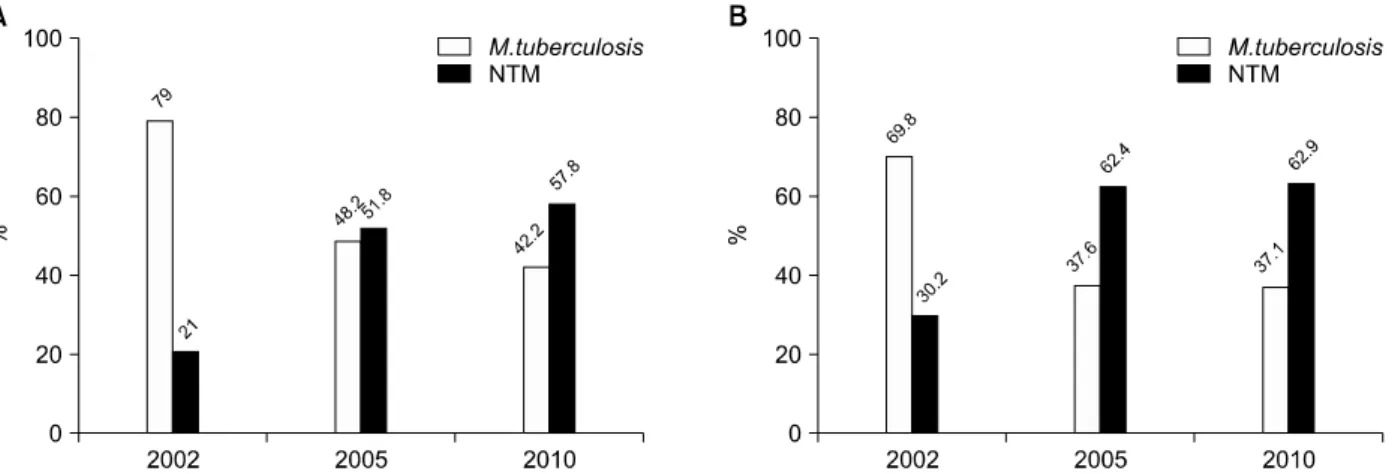
<0.01) and was not different between 2002 and 2005 (p=0.320). The recovery rate of NTM from specimens and proportion of patients with NTM isolation increased from 21% in 2002 to 57.8% in 2010 and from 30.2% in 2002 to 62.9% in 2010, respectively (each p<0.001) (Table 1, Figure 1). The proportion of AFB smear-pos- itive and culture-positive specimens positive for NTM al- so increased, from 12.2% in 2002 to 45.2% in 2010 (p

<0.001) (Table 1). In contrast, the rate of M. tuber- culosis isolation declined over time.

2. Solid vs. liquid media

Both solid and liquid media were used to isolate my-

cobacteria from 31,615 sputum specimens during 2010

(Tables 2, 3). Of these, 4,723 (14.9%) specimens were

positive for M. tuberculosis or NTM. The positive-cul-

ture rate was higher in liquid than in solid media (13.9%

(3)

Table 1. Baseline characteristics of culture results by solid media

2002 (%) 2005 (%) 2010 (%) p-value*

No. of specimens 26,820 24,661 31,615

No. of patients 9,821 9,655 11,628

Age, yr (±SD) 55.6±15.7 55.6±15.8 58.5±15.1 <0.001

Gender, male 6,026 (61.4) 5,857 (60.7) 6,280 (58.7) <0.01

AFB(+) 1,283 (4.8) 922 (3.7) 1,311 (4.1) <0.001

Positive culture specimens 1,921 (7.2) 2,553 (10.4) 2,648 (8.4) 0.003

Mycobacterium tuberculosis 1,518 (79.0) 1,230 (48.2) 1,118 (42.2) <0.001

NTM 403 (21.0) 1,323 (51.8) 1,530 (57.8)

Positive culture patients 873 (8.9) 1,344 (13.9) 1,104 (9.5) 0.38

M. tuberculosis 609 (69.8) 506 (37.6) 410 (37.1) <0.001

NTM 264 (30.2) 838 (62.4) 694 (62.9)

AFB smear(+)/Culture(+) specimens 801 (3.0) 677 (2.7) 933 (3.0) 0.951

M. tuberculosis 703 (87.8) 518 (76.5) 511 (54.8) <0.001

NTM 98 (12.2) 159 (23.5) 422 (45.2)

*One-Way ANOVA was done to compare numberical values between three groups.

Compared with mean age in 2010.

Compared with gender proportion in 2010.

AFB: acid-fast bacilli; NTM: non-tuberculous mycobacteria.

Figure 1. Recovery rate of Mycobacterium tuberculosis and non-tuberculous mycobacteria (NTM) on solid media in 2002, 2005, and 2010 (p<0.001). (A) Specimens. (B) Patients.

vs. 8.4%, p<0.001); for example, 30.4% (489/1,607) of the M. tuberculosis and 50.9% (1,586/ 3,116) of the NTM isolates were cultured only in liquid media.

However, among 1,179 (3.7%) AFB smear-positive/cul- ture-positive specimens, the proportions of M. tuber- culosis and NTM did not differ between solid and liquid media.

3. Factors predictive of NTM in AFB smear-positive specimens

Table 4 shows the distributions of M. tuberculosis

and NTM in AFB smear-positive/culture-positive speci-

mens

12

. During all three years, the proportion of NTM

by gender was similar but M. tuberculosis isolation was

associated with higher AFB smear grade. However, at

all AFB smear grades, the proportion with NTM in-

creased over time. The rate trend of NTM isolation was

higher as patients were older (p for trend<0.001), es-

pecially the rate of NTM positivity was higher in patients

aged >50 years, whereas NTM was rare and the rate

stable in patients aged <30 years. During 2010, how-

ever, the rate of NTM did not differ between solid and

(4)

Table 2. Comparison of solid and liquid media in 2010

Solid media (%) Liquid media (%) Combined* (%)

No. of specimens 31,615 (100) 31,615 (100) 31,615 (100)

No. of patients 11,628 (100) 11,628 (100) 11,628 (100)

Positive culture specimens 2,648 (8.4) 4,389 (13.9) 4,723 (14.9)

Mycobacterium tuberculosis 1,118 (42.2) 1,554 (35.4) 1,607 (34)

NTM 1,530 (57.8) 2,835 (64.6) 3,116 (66)

Positive culture patients 1,104 (9.5) 1,893 (16.3) 2,052 (17.6)

M. tuberculosis 410 (37.1) 532 (28.1) 545 (26.6)

NTM 694 (62.9) 1,361 (71.9) 1,507 (73.4)

Smear(+)/Culture(+) specimens 933 (3.0) 1,160 (3.7) 1,179 (3.7)

M. tuberculosis 511 (54.8) 634 (54.7) 637 (54.0)

NTM 422 (45.2) 526 (45.3) 542 (46.0)

Smear(+)/Culture(+) patients 351 (3.0) 410 (3.5) 418 (3.6)

M. tuberculosis 193 (54.9) 221 (53.9) 223 (53.3)

NTM 158 (45.1) 189 (46.1) 195 (46.7)

*Either test positive by solid media or by liquid media is regarded as positive results.

NTM: non-tuberculous mycobacteria.

Table 3. Recovery rate of solid and liquid media in 2010 Culture system

No. (%) positive cultures for

Mycobacterium tuberculosis (n=1,607) NTM (n=3,116) All mycobacteria (n=4,723)

Solid media only 53 (3.3) 281 (9.1) 334 (7.0)

Liquid media only 489 (30.4) 1,586 (50.9) 2,075 (44.0)

Both media 1,065 (66.3) 1,249 (40.0) 2,314 (49.0)

NTM: non-tuberculous mycobacteria.

liquid media according to age and AFB-smear status (data not shown).

Discussion

Although previous studies showed that NTM disease is increasing worldwide and that the incidence of NTM isolation is higher in liquid than in solid media, no re- ports to date have shown both findings. Our findings suggested that the recent increase in NTM isolation in South Korea, a country with an intermediate TB burden, may be due to both the use of liquid media and a real increase in the incidence of NTM. Moreover, the in- creased trend of NTM isolation was associated with pa- tients >50 years. The analysis after excluding over- lapped patients with NTM isolation showed the similar

results in the studied periods. The trend of increasing NTM isolation was also observed when subgroup analy- sis by gender separately was performed (data not shown). Therefore, a diagnostic algorithm involving nu- cleic acid amplification (NAA) tests may be used to rap- idly distinguish M. tuberculosis from NTM in AFB smear-positive specimens, especially those of subjects aged >50 years, even in a country in which TB is prevalent.

NTM isolation and disease have tended to increase

worldwide over time. For example, a study from

Ontario showed increased recovery over time in patients

with pulmonary NTM, from 9.1 per 100,000 population

in 1997 to 14.1 per 100,000 in 2003, while, at the same

time, the incidence of TB declined

1

. Studies from

Denmark and Netherlands have also reported increasing

(5)

Table 4. Distributions of Mycobacterium tuberculosis and NTM according to gender, AFB smear status and age groups in AFB smear-positive/culture-positive specimens using solid media

Year

2002 2005 2010

M. tuberculosis (%) NTM (%) M. tuberculosis (%) NTM (%) M. tuberculosis (%) NTM (%)

No. 304 51 173 50 193 158

Male, n (%) 195 (64.1) 24 (47.1) 111 (64.2) 26 (52.0) 118 (61.1) 80 (50.6)

AFB* smear(+)

Trace 60 (73.2) 22 (26.8) 75 (66.4) 38 (33.6) 97 (46.9) 110 (53.1)

1+ 221 (86) 36 (14) 118 (67) 58 (33.0) 197 (50.6) 192 (49.4)

2+ 151 (84.4) 28 (15.6) 111 (77.1) 33 (22.9) 105 (61.8) 65 (38.2)

3+ 74 (93.7) 5 (6.3) 117 (84.8) 21 (15.2) 78 (65.5) 41 (34.5)

4+ 197 (96.6) 7 (3.4) 97 (91.5) 9 (8.5) 34 (70.8) 14 (29.2)

Age

0∼10 0 0 0 0 0 0

11∼20 13 (100) 0 21 (100) 0 7 (100) 0

21∼30 85 (90.4) 9 (9.6) 73 (98.6) 1 (1.4) 55 (98.2) 1 (1.8)

31∼40 86 (94.5) 5 (5.5) 98 (91.6) 9 (8.4) 76 (83.5) 15 (16.5)

41∼50 134 (93.7) 9 (6.3) 102 (72.3) 39 (27.7) 107 (72.8) 40 (27.2)

51∼60 124 (87.9) 17 (12.1) 59 (61.5) 37 (38.5) 115 (42.4) 156 (57.6)

61∼70 139 (82.7) 29 (17.3) 97 (65.5) 51 (34.5) 65 (38) 106 (62)

>70 122 (80.8) 29 (19.2) 68 (75.6) 22 (24.4) 86 (45.0) 105 (55)

*AFB smear results were reported quantitatively according to American Thoracic Society guidelines

12

.

p for trend<0.001.

NTM: non-tuberculous mycobacteria; AFB: acid-fast bacilli.

rates of NTM disease

2,6

, and studies from several Asian countries have shown increases in the incidence of NTM lung disease

3,5

. In Taiwan, where the incidence of TB remains high, the proportion of patients with NTM in- creased from 32.3% in 2000 to 49.8% in 2008

4

. Also, in Korea the rates of NTM isolation and NTM-associated lung disease have increased. For example, the rate of NTM isolation from sputum specimens obtained at a ter- tiary-care medical center in South Korea was 31.7%, and the NTM recovery rate from AFB smear-positive sputum specimens was high

7

. From 2002 to 2008, the number of patients with NTM lung diseases increased, while the number of TB patients declined

8

.

The reasons for increased recovery of NTM are not yet clear. In Korea, the increases in NTM isolation and disease seem to be marked. We found that, among AFB smear-positive/culture-positive specimens, the percent- age containing NTM increased markedly, from 12.2% in 2002 to 45.2% in 2010. This increase may be due to

improvements in laboratory culture methods, increased awareness of NTM, a larger proportion of patients aged

>50 years, an increased prevalence of predisposing factors such as chronic obstructive lung disease (COPD) and, possibly, increased environmental exposure

13,14

. The prevalence of COPD, an important risk factor for NTM, is high

15

, and the population of Korea is aging.

These factors, however, do not seem to account entirely for the increases in NTM isolation and disease rates.

Since we only investigated mycobacteriologic results, we could not know whether isolated NTM were patho- gen or colonizer in our study.

Both solid and liquid media have been recommended

for mycobacterial culture

10,16

. In agreement with pre-

vious findings

10

, we found that culture in liquid media

increased the rate of mycobacterial isolation, especially

of NTM. Although liquid media is associated with a high

rate of contamination, we found no difference in the

contamination rate between solid and liquid media.

(6)

Since liquid media are increasingly used for mycobacte- rial culture in Korea, the increased rate of NTM recovery may be due, at least in part, to increased culture in liq- uid media. Hence, in comparing NTM isolation rates, it is important to compare results using the same culture media.

The NTM recovery rates were higher in elderly than in young patients with AFB smear-positive results.

Positivity on AFB smear has been considered a surro- gate marker for a diagnosis of TB and contact with AFB-positive subjects has been considered a risk factor for TB. If AFB-positive results are caused by NTM rather than by M. tuberculosis , investigation of contacts is unnecessary. Rapid identification techniques, such as NAA tests, should be used to differentiate M. tuber- culosis from NTM in AFB smear-positive sputum sam- ples, even in an intermediate TB-burden country such as South Korea

12,17

.

This study had several limitations, including its per- formance at a single tertiary referral center. Therefore, selection bias cannot be excluded and our study sub- jects may not represent the general population. In addi- tion, we collected and analyzed only laboratory results, and did not evaluate clinical characteristics, including the presence of true NTM disease. Furthermore, we did not determine the NTM species isolated.

In conclusion, we found that the rate of NTM iso- lation from sputum specimens has steadily increased in a hospital in South Korea, an increase due in part to the increased use of liquid media. As in the US, NAA tests should be performed to rapidly distinguish M. tu- berculosis from NTM in AFB smear-positive sputum samples, especially for elderly subjects, in South Korea.

References

1. Marras TK, Chedore P, Ying AM, Jamieson F. Isolation prevalence of pulmonary non-tuberculous mycobac- teria in Ontario, 1997-2003. Thorax 2007;62:661-6.

2. van Ingen J, Bendien SA, de Lange WC, Hoefsloot W, Dekhuijzen PN, Boeree MJ, et al. Clinical relevance of non-tuberculous mycobacteria isolated in the Nijme-

gen-Arnhem region, The Netherlands. Thorax 2009;64:

502-6.

3. Hosker HS, Lam CW, Ng TK, Ma HK, Chan SL. The prevalence and clinical significance of pulmonary in- fection due to non-tuberculous mycobacteria in Hong Kong. Respir Med 1995;89:3-8.

4. Lai CC, Tan CK, Chou CH, Hsu HL, Liao CH, Huang YT, et al. Increasing incidence of nontuberculous my- cobacteria, Taiwan, 2000-2008. Emerg Infect Dis 2010;

16:294-6.

5. Tsukamura M, Kita N, Shimoide H, Arakawa H, Kuze A. Studies on the epidemiology of nontuberculous my- cobacteriosis in Japan. Am Rev Respir Dis 1988;137:

1280-4.

6. Andréjak C, Thomsen VØ, Johansen IS, Riis A, Benfield TL, Duhaut P, et al. Nontuberculous pulmo- nary mycobacteriosis in Denmark: incidence and prog- nostic factors. Am J Respir Crit Care Med 2010;181:

514-21.

7. Jeon K, Koh WJ, Kwon OJ, Suh GY, Chung MP, Kim H, et al. Recovery rate of NTM from AFB smear-pos- itive sputum specimens at a medical centre in South Korea. Int J Tuberc Lung Dis 2005;9:1046-51.

8. Park YS, Lee CH, Lee SM, Yang SC, Yoo CG, Kim YW, et al. Rapid increase of non-tuberculous mycobacterial lung diseases at a tertiary referral hospital in South Korea. Int J Tuberc Lung Dis 2010;14:1069-71.

9. Chien HP, Yu MC, Wu MH, Lin TP, Luh KT. Compar- ison of the BACTEC MGIT 960 with Löwenstein-Jensen medium for recovery of mycobacteria from clinical specimens. Int J Tuberc Lung Dis 2000;4:866-70.

10. Bae E, Im JH, Kim SW, Yoon NS, Sung H, Kim MN, et al. Evaluation of combination of BACTEC mycobac- teria growth indicator tube 960 system and Ogawa me- dia for mycobacterial culture. Korean J Lab Med 2008;

28:299-306.

11. Devallois A, Goh KS, Rastogi N. Rapid identification of mycobacteria to species level by PCR-restriction frag- ment length polymorphism analysis of the hsp65 gene and proposition of an algorithm to differentiate 34 my- cobacterial species. J Clin Microbiol 1997;35:2969-73.

12. Diagnostic Standards and Classification of Tuberculosis

in Adults and Children. This official statement of the

American Thoracic Society and the Centers for Disease

Control and Prevention was adopted by the ATS Board

of Directors, July 1999. This statement was endorsed

by the Council of the Infectious Disease Society of

America, September 1999. Am J Respir Crit Care Med

2000;161(4 Pt 1):1376-95.

(7)

13. Glassroth J. Pulmonary disease due to nontuberculous mycobacteria. Chest 2008;133:243-51.

14. Daley CL, Griffith DE. Pulmonary non-tuberculous my- cobacterial infections. Int J Tuberc Lung Dis 2010;14:

665-71.

15. Yoo KH, Kim YS, Sheen SS, Park JH, Hwang YI, Kim SH, et al. Prevalence of chronic obstructive pulmonary disease in Korea: the fourth Korean National Health and Nutrition Examination Survey, 2008. Respirology

2011;16:659-65.

16. Bird BR, Denniston MM, Huebner RE, Good RC.

Changing practices in mycobacteriology: a follow-up survey of state and territorial public health laboratories.

J Clin Microbiol 1996;34:554-9.

17. Centers for Disease Control and Prevention (CDC).

Updated guidelines for the use of nucleic acid amplifi-

cation tests in the diagnosis of tuberculosis. MMWR

Morb Mortal Wkly Rep 2009;58:7-10.

수치

Figure 1. Recovery rate of Mycobacterium tuberculosis and non-tuberculous mycobacteria (NTM) on solid media in 2002, 2005,  and  2010  (p<0.001)
Table  3.  Recovery  rate  of  solid  and  liquid  media  in  2010 Culture  system
Table  4.  Distributions  of  Mycobacterium  tuberculosis  and  NTM  according  to  gender,  AFB  smear  status  and  age  groups in  AFB  smear-positive/culture-positive  specimens  using  solid  media

참조

관련 문서

3) A comparison of the stoichiometric equation with the experimental kinetic expression can suggest whether or not we are dealing with an elementary reaction. 4) If one

1 John Owen, Justification by Faith Alone, in The Works of John Owen, ed. John Bolt, trans. Scott Clark, "Do This and Live: Christ's Active Obedience as the

This study selected Korea University for South Korean university and the University of Pennsylvania and the University of Chicago, US for foreign

  Investigation of turnover comes from the job itself and in this study worked in a care facility for the elderly, Caregiver Stress, Burnout comes from

purpose of introducing the representative lawsuits in such a trend, it is necessary to review the status of representative cases and judicial issues in

However, in the process of operating and introducing, the south Korea applied Minimum operation income security system to Private investors from the first

Korea Institute of child care and education 6 7 Korea Institute of child care and education... Korea Institute of child care and education 12 13 Korea Institute of child

As a result of the rapid economic growth, there were side effects of overconcentration and unbalanced development in Korea. The direction of development policies was