DOI https://doi.org/10.9725/kts.2020.36.6.332
범프 타입 포일 스러스트 베어링의 정하중 구조 강성 및 손실 계수 차이에 관한 실험적 연구
이성진1†ㆍ류근2‡ㆍ정진희3ㆍ류솔지4
1
한양대학교 대학원 기계설계공학과 박사수료생
2
한양대학교 기계공학과 부교수
3
LG전자 H&A사업본부 H&A연구센터 에어솔루션연구소 자문역
4
LG전자 H&A사업본부 H&A연구센터 에어솔루션연구소 산업용에어솔루션선행연구팀 선임연구원
On the Bearing-to-Bearing Variability in Experimentally Identified Structural Stiffnesses and Loss Factors of Bump-Type
Foil Thrust Bearings under Static Loads
Sungjin Lee
1†, Keun Ryu
2‡, Jinhee Jeong
3and Solji Ryu
41
Ph.D Candidate, Dept. of Mechanical Design Engineering, Graduate School, Hanyang University
2
Associate Professor, Dept. of Mechanical Engineering, Hanyang University
3
Technical Advisor, Home Appliance & Air Solution Company, Home Appliance & Air Solution R&D Center, Air Solution R&D Lab., LG Electronics
4
Research Specialist, Home Appliance & Air Solution Company, Home Appliance & Air Solution R&D Center, Air Solution R&D Lab., Industrial Air Solution Advanced R&D Team, LG Electronics
(Received July 8, 2020 ; Revised November 9, 2020 ; Accepted November 11, 2020)
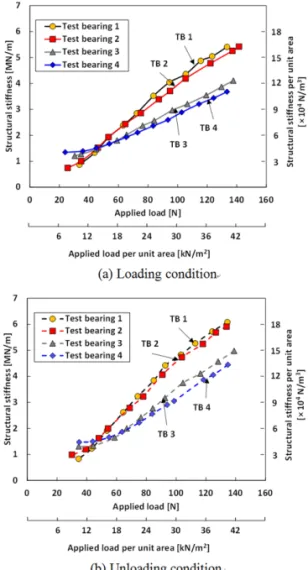
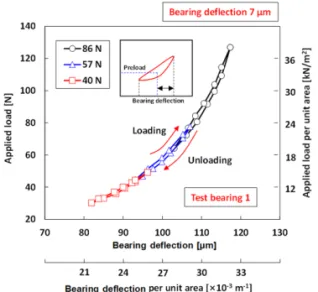
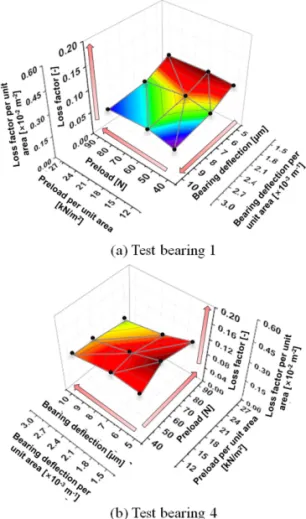
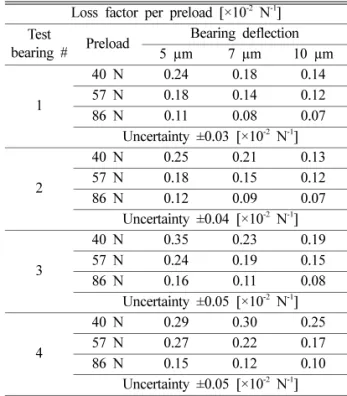
Abstract − High-speed turbomachinery implements gas foil bearings (GFBs) due to their distinctive advantages, such as high efficiency, lesser part count, and lower weight. This paper provides the test results of the static structural stiff- nesses and loss factors of bump-type foil thrust bearings with increasing preload and bearing deflection. The focus of the current work is to experimentally quantify variability in structural stiffnesses and loss factors among the four test thrust bearings with identical design values and material of the bump and top foil geometries using the same (open-source) fabrication method. A simple test setup, using a rigidly mounted non-rotating shaft and thrust disk, measures the bearing bump deflections with increasing static loads on the test bearing. The inner and outer diameters of the test bearings are 41 mm and 81 mm, respectively. The loss factor, best-representing energy dissipation in the test bearings, is estimated from the area inside the local hysteresis loop of the load versus the bearing deflection curve.
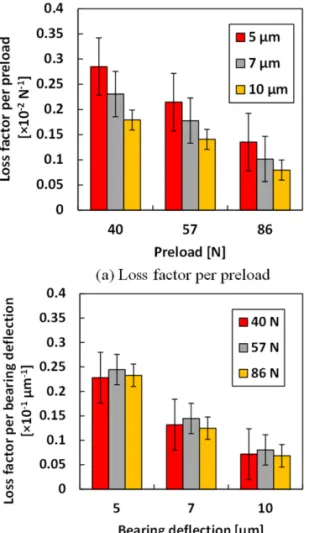
The measurements show that structural stiffnesses and loss factors of the test bearings significantly rely on applied preloads and bearing deflections. Local structural stiffnesses of the test bearings increase with applied preloads but decrease with bearing deflections. Changes of loss factors are less sensitive to applied preloads and bearing deflec- tions compared to those of structural stiffnesses. Up to 35% variability in static load structural stiffnesses is found between bearings, while up to 30% variability in loss factors is found between bearings.
†
Deceased January 6th, 2019
‡