• 검색 결과가 없습니다.

Effect of Balance Training on Ankle Muscle Activity and Static Balance in Stroke Patients

N/A
N/A
Protected

Academic year: 2021

Share "Effect of Balance Training on Ankle Muscle Activity and Static Balance in Stroke Patients"

Copied!
7
0
0

로드 중.... (전체 텍스트 보기)

전체 글

(1)

Original Article Open Access

균형훈련이 뇌졸중환자의 발목 근육 활성도와 정적균형에 미치는 영향

이영민⋅김상철 1 ⋅윤성경

2

한림대학교춘천성심병원 물리치료실, 1 기대찬의원 물리치료실, 2 불노요양병원 물리치료실

Effect of Balance Training on Ankle Muscle Activity and Static Balance in Stroke Patients

Young-Min Lee⋅Sang-Chul Kim 1 ⋅Sung-Kyeung Yoon 2

Department of Physical Therapy, Hallym University Chuncheon Sacred Heart Hospital

1 Department of Physical Therapy, Gidaechan Clinics

2 Department of Physical Therapy, Boolo Recuperation Hospital

Received: November 19, 2014 / Revised: November 30, 2014 / Accepted: December 10, 2014

ⓒ 2014 Journal of Korea Proprioceptive Neuromuscular Facilitation Association

This is an Open Access article distributed under the terms of the Creative Commons Attribution Non-Commercial License (http://creativecommons.org/licenses/by-nc/3.0) which permits unrestricted non-commercial use, distribution, and reproduction in any medium, provided the original work is properly cited.

| Abstract |

Purpose: This study aims to understand the effect of balance training on ankle muscle activity and static balance in stroke patients.

Methods: The subjects were composed of 12 patients who were admitted with chronic stroke in H, K, and R hospitals located in Gangwon-do from August to October 2014. This study conducted balance training on the subjects for 20 min a session, twice a day, five times a week for six weeks. This study measured the surface electromyogram (EMG) of the paretic side’s tibialis anterior and medial gastrocnemius for muscle activity. Static balance was measured as a TETRAX stability index. The measurements were conducted before the experiment and six weeks after. The result was statistically analyzed using paired t-test at the significance level of 0.05.

Result: Muscle activity of the paretic side’s tibialis anterior and medial gastrocnemius did not show a significant difference in the comparison between pre- and post-balancing training. However, the stability index showed a significant difference (p<0.05) between standing with eyes open (NO) and standing on a sponge with eyes open (PO).

Conclusion: Although balance training did not affect the muscle activity of chronic stroke patients, it had an effective influence on the stability index. That is, balance training was effective at the functional level, but it did not change the structure level in terms of the ICF evaluation standard. Balance training becomes more effective when it is applied in relation to task.

Key Words: Balance training, ankle muscle activity, static balance

†Corresponding Author : Young-Min Lee ([email protected])

(2)

Ⅰ. 서 론

뇌졸중이란 뇌혈관의 허혈성 또는 출혈성 원인으 로 대뇌 기능이 소실되어 다양한 증상이 동반되는 질 환이다(Peurala et al, 2007). 뇌졸중환자는 뇌손상 부위 와 정도에 따라 운동 , 감각장애 그리고 언어, 인지 등에 손상을 주게 되어 불안 , 우울, 좌절과 같은 정서적 장애 를 복합적으로 동반하며 , 일상생활에 많은 장애를 나 타낸다 (Gwon & Lee, 2003). 또한 움직임의 감소로 인 하여 비대칭적인 자세가 특징적으로 나타나게 되며, 이러한 비대칭적 자세로 인하여 신체의 중심이 비마 비측 다리로 편중되어 신체가 비대칭적인 형태로 변 형되게 하고, 선 자세에서의 균형조절을 어렵게 만들 어, 결국에는 평형반응(equilibrium reaction)에도 영향 을 주어 자세조절능력에 문제를 초래하게 한다(Ikai et al, 2003). 이러한 뇌졸중 환자의 균형능력 소실로 인해 발생할 수 있는 문제점으로 자세 흔들림의 증가, 마비된 다리에서의 체중지지 감소 , 그리고 낙상 위험 증가의 결과를 가져오게 된다(Pohl & Mehrholz, 2006).

일반적으로 균형 또는 자세의 안정성은 정적인 동 작을 유지시키고 원하는 동작을 안전하게 수행하기 위해 지지면 내에 신체 중심을 유지하는 것을 의미한 다. 이러한 균형능력은 기능적인 행동을 위해 필수적 인 것으로 앉기, 일어서기, 걷기 등에서 작용하고 (Yavuzer et al, 2006), 균형을 유지하고 조절하기 위한 고유수용성 감각, 시각, 전정 감각 등의 상호 작용이 조화를 이루어야 한다 (Chen et al, 2008). 하지만, 뇌졸 중 환자의 65 %는 촉각과 고유수용성감각의 상실을 경험하며, 주로 근 긴장도 저하로 인한 고유수용성감 각 손상이 원인이 된다(Kerrigan et al, 2001). 뇌졸중환 자의 균형에 대한 문제점들을 해결하기 위한 방법으 로는 주로 마비측 다리로 체중지지를 많이 하게 함으 로써 균형 문제를 해결하고 있으며, 고유수용성 신경 근 촉진 기법, Bobath 개념을 이용한 방법, 신경 발달 촉진 기술과 같은 운동치료와 과제 지향적 운동 등이 사용되기도 한다(Eser et al, 2008; Salbach et al, 2004).

뇌졸중 환자의 발과 발목관절의 기능장애는 필연

적으로 인체 전체의 불균형을 발생시키게 되며 , 허리 와 다리의 기능적⋅운동역학적인 면에서 서로 밀접하 게 연결되어있다(Brantingham et al, 2006). 뇌졸중 환자 는 균형훈련 시 신체적 안정성(Body Stability)을 위한 발목관절(Ankle Joint)과 엉덩관절(Hip Joint)이 균형 조절에 중요한 역할을 하며, 주로 신체동요가 작을 때는 발목관절이 작용하게 된다(Lee et al, 1996). 발목 관절은 자세조절전략에서 제일 먼저 나타나는 전략으 로써 발목전략의 근육수축을 통해 똑바로 서기 균형 을 일차적으로 회복한다 (Horak et al, 1989). 따라서 발 목관절 근육의 협응 작용은 선 자세에서 동요를 조절 하여 움직임 시 무게중심이 체간에서 벗어나지 않게 하는 안정된 자세를 유지시켜 준다(Chae et al, 2001).

뇌졸중환자는 정적인 선 자세에서는 발목관절을 많이 사용하게 되며 (Gatev et al, 1999), 낙상을 경험한 사람과 그렇지 않은 사람의 근력을 비교해 본 결과 엉덩관절의 폄근과 발목관절의 발등굽힘근에서 유의 한 차이를 보였다고 보고하였다(Daubney & Culham, 1999).

따라서 본 연구에서는 만성 뇌졸중환자에게 균형훈 련을 실시하였을 때 발목 근육의 활성도와 정적균형의 유지 시 어떠한 효과를 발휘하는지 알아보고자 하였다 .

Ⅱ. 연구 방법

1. 연구 대상

연구대상자는 강원도에 위치한 H대학병원과 K병 원과 그리고, R의원에 뇌졸중으로 진단 받고 입원중인 뇌졸중 환자 12명을 임의로 선정하였고 실험에 참여 하기 전, 환자(본인)과 보호자에게 본 연구의 목적을 설명하고 자발적으로 참여에 동의하였다.

대상자의 선정 기준은 다음과 같다 : 뇌졸중 진단 후

6개월 이상 경과하고 12개월 미만인 자, 소뇌와 안뜰기

관 질환 , 양 다리에 신경학적 손상, 선 자세 균형에 영향

을 주는 근골격계 손상, 시각 및 청각 장애가 없는 자,

약식정신상태검사(MMSE-K)의 점수가 23점 이상인

(3)

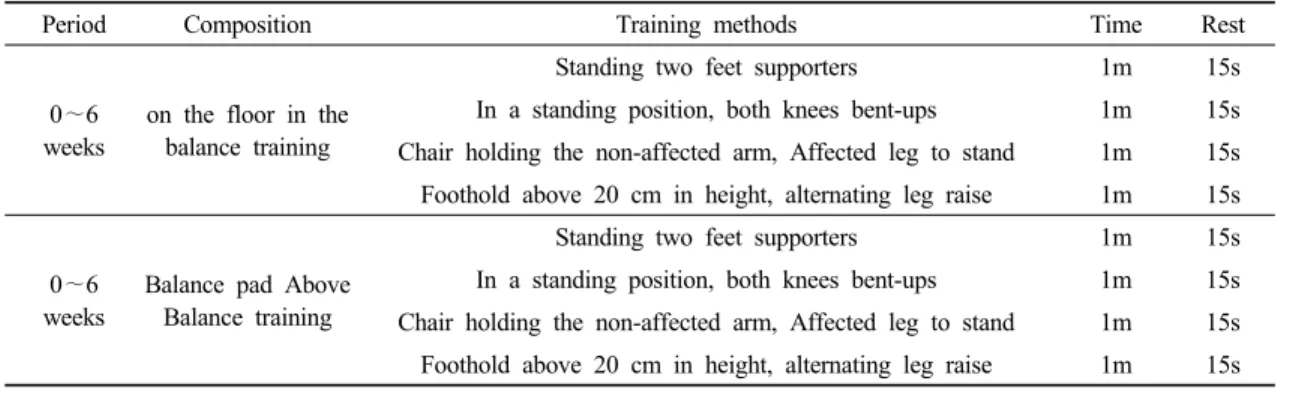
Period Composition Training methods Time Rest

0∼6 weeks

on the floor in the balance training

Standing two feet supporters 1m 15s

In a standing position, both knees bent-ups 1m 15s Chair holding the non-affected arm, Affected leg to stand 1m 15s Foothold above 20 cm in height, alternating leg raise 1m 15s

0∼6 weeks

Balance pad Above Balance training

Standing two feet supporters 1m 15s

In a standing position, both knees bent-ups 1m 15s Chair holding the non-affected arm, Affected leg to stand 1m 15s Foothold above 20 cm in height, alternating leg raise 1m 15s m: minute, s: second.

Table 1. Program for balance training.

자 , Berg 균형척도(berg balance Scale)가 40점 이상인 자.

2. 측정방법 및 도구

1) 발목 근육 활성도 측정 : 발목 근육 활성도 측정은 표면근전도(Tele Myo 2400T dyna mic electro myography, Noraxon Inc, U.S.A)를 이용하였다. 부착부위는 마비측 앞 정강이근 (tibialis anterior muscle)과 마비측 안쪽 장딴지근(medial gastrocnemius muscle)으로, 앞 정강이 근의 근위 1/3지점과 아킬레스건(achilles tendon)과 안 쪽 장딴지근이 만나는 부위에서 근위부 2 ㎝의 안쪽 장딴지근의 근배에 부착하였다. 수집된 표면근전도 (surface EMG) 신호는 디지털 신호로 Myoresearch-XP 1.07 소프트웨어를 이용하여 처리하였다. 근전도 (EMG) 신호의 표본 추출률(sampling rate)은 1000Hz로 설정하였고 대역통과필터(Band pass filter)를 이용하 여 20∼500 Hz로 필터링 하였으며, 60Hz 노치필터 (notch filter)를 사용하였다.

서 있는 자세에서 발목 근육 활성도를 측정하기 위해 대상자는 맨발로 5초간 선 자세를 유지하였다.

이때 마비측 앞 정강이근과 마비측 안쪽 장딴지근에 서 측정되는 근전도 값에서 시작과 끝날 때의 각 1초를 제외한 3초간의 데이터를 분석에 이용하였다. 각 근육 에서 측정된 근 활성도 신호는 제곱 평균 제곱값으로 처리하여 최대 수의 등척성 수축(MVIC)의 평균제곱 값에 대한 백분율로 표준화하였다(%MVIC).

2) 균형능력 측정 : 균형능력 측정은 Tetrax Portable

Multiple System (Tetrax, Tetrax Ltd, Israel)을 사용하였 다(Kohen-Raz, 1991). 실험자가 힘 측정판(force Plate) 에 발을 위치시키고 섰을 때 힘 측정판에 주어지는 압력에 대한 데이터는 증폭 및 필터링을 거친 후 컴퓨 터로 전달되며, Tetrax 소포트웨어 프로그램을 통해 분석된다. 균형능력의 측정항목으로 안정성지수 (stability index)를 측정하였으며 수집한 데이터는 체중 에 대한 백분율(%)로 기록하였다.

균형능력 측정은 눈 뜨고(eyes open), 눈 감고(eyes close) 바로선 자세(standing position)와 스폰지 위에서 눈 뜨고 (eyes open), 눈 감고(eyes close) 바로선 자세 (standing position)에서 지지대를 잡지 않고, 차렷 자세 로 3번씩 측정하였으며, 3번 측정한 평균값을 분석에 이용하였다. 이 측정 장비의 검사자내 신뢰도는 r = .88, 검사자간 신뢰도는 r = .95로 보고되었다(Kohen- Raz, 1991).

3. 실험 절차

Lee 등(2008)은 균형훈련 시 발목강화 운동보다 발

목전략 운동이 자세조절에 효과적이라고 하였고, 이

연구에 사용된 균형훈련 프로그램을 참고하여 수정

보완한 후 실시하였다 . 균형훈련 전 발목 근육 활성도

와 균형능력을 측정하였으며, 6주간의 균형훈련 후

재측정 하였다. 균형훈련은 4개의 세부항목을 편평한

바닥에서 2회, 균형패드(balance pad, Airex, Swiss)에서

2회로 총 20분간 실시하였다(Table 1).

(4)

4. 자료분석

본 연구에서 수집된 자료는 WINDOW용 PASW ver.

18.0 프로그램을 이용하여 대상자의 일반적 특성은 기술통계로 하였으며, 실험 전과 후의 차이에 대한 결과를 대응표본 짝비교(Paired t-test)로 분석하였다.

통계적 유의수준은 0.05로 하였다.

Ⅲ. 연구 결과

1. 연구대상자의 일반적 특성

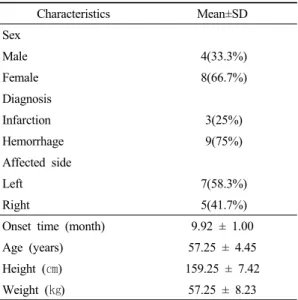
본 연구에 참가한 참가자들은 뇌졸중 진단을 받은 환자 12명으로 성별은 남자 4명(33.3%), 여자 8명 (66.7%)이었으며, 진단명은 뇌경색 3명(25%), 뇌출혈 9명(75%)이었으며. 마비 부위는 좌측 마비 7명 (58.3%), 우측 마비 5명(41.7%)이었으며, 유병 기간은 9.92 ± 1.00개월이었으며, 연령은 57.25 ± 4.45세이었으 며, 신장은 159.25 ± 7.42㎝이었으며, 체중은 57.25 ± 8.23㎏으로 나타났다(Table 2).

Characteristics Mean±SD Sex

Male 4(33.3%)

Female 8(66.7%)

Diagnosis

Infarction 3(25%)

Hemorrhage 9(75%)

Affected side

Left 7(58.3%)

Right 5(41.7%)

Onset time (month) 9.92 ± 1.00

Age (years) 57.25 ± 4.45

Height (㎝ ) 159.25 ± 7.42

Weight (㎏) 57.25 ± 8.23

Table 2. General characteristics of subjects (n=12)

2. 균형훈련 전⋅후의 발목 근육 활성도의 비교 6주간 실시한 균형훈련에서 발목 근육 활성도의

실험 전⋅후 비교 결과는 Table 3에 제시된 바와 같았 다. 근 활성도 비교는 %MVIC를 사용하였다. 마비측 앞 정강이근에서는 균형훈련 전 20.26 ± 3.83%에서 균형훈련 후 20.23 ± 3.49%로 감소하였으며, 마비측 안쪽 장딴지근에서는 균형훈련 전 24.87 ± 4.59%에서 균형훈련 후 25.51 ± 5.11%로 증가하였지만 모두 유의 한 차이가 없었다(Table 3).

Muscle

tibialis anterior medial gastrocnemius Pre 20.26 ± 3.83 24.87 ± 4.59 Post 20.23 ± 3.49 25.51 ± 5.11

p 0.52 0.40

* p<0.05

Table 3. Comparison of Muscle Activity between Pre-test and Post-test (n=12)

3. 균형훈련 전⋅후의 안정성 지수의 비교 6주간 실시한 균형훈련에서 TETRAX의 안정성 지 수에 대한 실험 전⋅후 비교 결과는 눈 뜨고 선 자세 (NO)에서는 균형훈련 전 22.45 ± 4.31점에서 균형훈련 후 21.05 ± 4.19점으로 감소하였으며, 스폰지 위에서 눈 뜨고 선 자세 (PO)에서는 균형훈련 전 28.03 ± 6.01점 에서 균형훈련 후 27.01 ± 6.03점으로 감소하여 유의한 차이가 있었다 (p<0.05). 그러나 눈 감고 선 자세(NC)에 서는 균형훈련 전 31.57 ± 9.28점에서 균형훈련 후 30.52 ± 10.04점으로 감소하였고, 스폰지 위에서 눈 감고 선 자세(PC)에서는 균형훈련 전 32.37 ± 7.51점에 서 균형훈련 후 32.25 ± 7.26점으로 감소하였지만 유의 한 차이가 없었다(Table 4).

Ⅳ. 고 찰

본 연구는 편마비로 진단받은 뇌졸중 환자를 대상

으로 균형훈련을 통하여 발목 근육 활성도와 정적 균

형에 미치는 영향을 알아보고자 하였다. 연구 대상자

는 6주간의 균형 훈련을 실시한 후 발목 주위 다리

(5)

Stability index

NO NC PO PC

Pre 22.45 ± 4.31 31.57 ± 9.28 28.03 ± 6.01 32.37 ± 7.51

Post 21.05 ± 4.19 30.52 ± 10.04 27.01 ± 6.03 32.25 ± 7.26

p 0.00 * 0.36 0.01 * 0.28

* p<0.05 NO: Normal Open, NC: Normal close, PO: Pillow Open, PC: Pillow close.

Table 4. Comparison of Stability index between Pre-test and Post-test (n=12)

근육의 활성도와 정적균형을 알아보기 위한 안정성 지수를 비교하였다. Geiger 등(2001)의 연구에서 시각 적 되먹임과 전통적 물리치료 운동프로그램을 제공한 결과 균형능력이 증가되었으며 Kim(2002)의 연구에 서도 하지 재정렬 운동치료를 실시한 결과 균형능력 이 증가한 것으로 나타났다. Cheng 등(2001)의 연구에 서 뇌졸중 대상자 30명에게 시각과 청각 되먹임을 이 용한 반복적 일어서기 훈련을 실시하였을 때 대칭적 인 체중분포가 증가했다고 하였다. 또한, 균형훈련에 적용한 불안정지지면은 안정지지면에 비해 전후방향 으로 자세동요가 증가하게 되므로, 전후방향에서의 안정성이 증가하게 되며, 감각 통합능력을 향상시켜 균형능력이 향상된다고 하였다(Bayouk et al, 2006;

Onigbinde et al, 2009; Patel et al, 2008). 방법적으로는 틀리지만 이와 유사한 균형평가의 결과로 본 실험에 서도 균형 훈련이 신체 안정성을 증가시켜준다고 보 여진다. Park 등(2013)은 불안정한지면에서 일어서기 동작훈련 시 슬관절 근육의 활성도가 높아졌고 균형 능력도 향상되었다고 보고하였다. 이는 본 연구에서 무릎 근육과 대퇴 근육에 대해 측정하지 않아 균형에 영향을 줄 수 있는 일부 요인을 확인하지 못한 제한점 이 있다.

본 연구에서의 결과를 고찰하면, 만성 뇌졸중환자 의 균형훈련 시 발목 근육 활성도에는 영향을 주지는 않았지만 균형능력 측정도구였던 안정성지수에 효과 적인 영향을 미치는 것으로 나타났다. 하지만 대상 선정 조건에 충족하는 일부의 환자만을 대상으로 하 였으므로 모든 뇌졸중으로 인한 편마비 환자에게 일 반화하기는 어려우며 이후의 연구에서는 균형 훈련 시 이의 효과를 증명할 수 있는 다양한 변수 선정에

주의를 기울여야할 필요가 있다고 생각한다 . 또한 연 구대상자의 수를 늘려 검증 연구가 필요하다고 사료 된다.

Ⅴ. 결 론

본 연구는 만성 뇌졸중환자의 균형훈련 시 발목 근육 활성도와 정적균형에 미치는 영향을 알아보기 위하여 실시하였으며 , 균형훈련을 1회 20분, 1일 2회, 주 5회 6주간 실시한 후, 발목 근육 활성도와 정적균형 을 알아보았다. 만성 뇌졸중환자의 균형훈련 시 근 활성도에는 영향을 주지는 않았지만 안정성지수에 효 과적인 영향을 미치는 것으로 나타난 것은 ICF의 평가 기준상 구조적 수준(Structure Level)의 변화는 없었지 만 기능적 수준(Functional Level)에서는 효과가 있었 으며 균형훈련은 작업(Task)과 관련하여 적용하면 더 욱 효과적일 것으로 사료된다.

참고문헌

Bayouk JF, Boucher JP, Leroux A. Balance training following stroke: Effects of task- oriented exercises with and without altered sensory input. International Journal of Rehabilitation Research. 2006;29(1):51-59.

Brantingham JW, Gilbert JL, Shaik J. Sagittal plane blockage

of the foot, ankle and hallux and foot

alignment-prevalence and association with low back

pain. Journal of Chiropractic Medicine. 2006;5(4):123-127.

(6)

Chae JB, Kim BJ, Bae SS. Study on the posture control and balance. The Journal of Korean Society of Physical Therapy. 2001;13(2):421-443.

Chen CK, Hong WH, Chu NK, et al. Effects of an anterior ankle-foot orthosis on postural stability in stroke patients with hemiplegia. American Journal of Physical Medicine & Rehabilitation. 2008;87(10):

815-820.

Cheng PT, Wu SH, Liaw MY, et al. Symmetrical body-weight distribution training in stroke patients and its effect on fall prevention. Archives of Physical Medicine and Rehabilitation. 2001;82(12):1650-1654.

Daubney ME, Culham EG. Lower extremity muscle force and balance performance in adults aged 65years and older.

Physical Therapy. 1999;79(12):1177-1185.

Eser F, Yanvuzer G, Karakus D, et al. The effect of balance training on motor recovery and ambulation after stroke: a randomized controlled trial. European Journal of Physical and Rehabilitation Medicine.

2008;44(1):19-25.

Gatev P, Thomas S, Kepple T, et al. Feedforward ankle strategy of balance during quiet stance in adults. The Journal of Physiology. 1999;514(3):915-928.

Geiger RA, Allen JB, O’keefe J, et al. Balance and mobility following stroke: effects of physical therapy intervention with and without biofeedback/ forceplate training. Physical Therapy. 2001;81(4):995-1005.

Gwon HC, Lee SR. The cognitive function of patients with stroke impact on activities of daily living. Physical Therapy Korea. 2003;10(3):41-51.

Horak FB, Shupert CL, Mirka. A: Components of postural dyscontrol in the elderly: A review. Neurobiology of Aging. 1989;10(6):727-738.

Ikai T, Kamikubo T, Takehara I, et al. Dynamic postural control in patients with hemiparesis. American Journal of Physical Medicine & Rehabilitation. 2003;82(6):

463-469.

Kerrigan DC, Karvosky ME, Riley PO. Spastic paretic stiff-legged gait: joint kinetic. American Journal of Physical Medicine & Rehabilitation. 2001;0(4):

244-249.

Kim YH. Effects of paralysed side realignment on gait and balance in hemiplegic patients. Yongin University.

Dissertation of Master’s Degree. 2002.

Kohen-Raz R. Application of tetra-ataxiametric posturo graphy in clinical and developmental diagnosis. Perceptual and Motor Skills. 1991;73(2):635-656.

Lee HS, Choi HS, Kwon OY,. Study on the balancing factor.

Physical Therapy Korea. 1996; 3(3):82-91.

Lee JW, Kwon OY, Lee CH, et al. Balance Balance damaged ankle strategy promoting effects of exercise in the elderly. Korean Journal of Health Promotion.

2008;8(3):158-167.

Onigbinde AT, Awotidebe T, Awosika H. Effect of 6weeks wobble board exercises on static and dynamic balance of stroke survivors. Technology and Health Care.

2009;17(5-6):387-392.

Park J, Woo YG, Park SY. Impact on the balance of power of this AD action training stroke occurred in unstable ground stop. Physical Therapy Korea. 2013;20(3):

01-08.

Patel M, Fransson P, Lush D, et al. The effect of foam surface properties on postural stability assessment while standing. Gait Posture. 2008;28(4):649-656.

Peurala SH, Könönen P, Pitkänen K, et al. Postural instability in patients with chronic stroke. Restorative Neurology and Neuroscience. 2007;25(2):101-108.

Pohl M, & Mehrholz J. Immediate effects of an individually designed functional ankle- foot orthosis on stance and gait in hemiparetic patients. Clinical Rehabilitation.

2006;20(4):324-330.

Salbach NM, Mayo NE, Wood-Dauphinee S, et al. A

task-orientated intervention enchances walking

distance and speed in the first year post stroke: a

(7)

randomized controlled trial. Clinical Rehabilitation.

2004;18(5):509-519.

Yavuzer G, Eser F, Karakus D, et al. The effects of balance

training on gait late after: A randomized controlled

trial. Clinical Rehabilitation. 2006;20(11):960-969.

수치

Table 1. Program for balance training.
Table 3. Comparison of Muscle Activity between Pre-test and Post-test (n=12) 3. 균형훈련 전⋅후의 안정성 지수의 비교 6주간 실시한 균형훈련에서 TETRAX의 안정성 지 수에 대한 실험 전⋅후 비교 결과는 눈 뜨고 선 자세 (NO)에서는 균형훈련 전 22.45 ± 4.31점에서 균형훈련  후 21.05 ± 4.19점으로 감소하였으며,  스폰지 위에서  눈 뜨고 선 자세 (PO)에서는 균형훈련
Table 4. Comparison of Stability index between Pre-test and Post-test (n=12)

참조

관련 문서

This policy workshop on Lifelong Learning is an activity co-organized by the Korea Research Institute for Vocational Education &amp; Training (KRIVET) and the World

Based the above study results, balance relaxation therapy is considered a therapy that can help the body recover its flexibility if there is an imbalance

Second, the SAQ training program meaningfully affects isokinetic leg strength (60°/sec)of recreational futsal members, which means it is confirmed as an

Among the sub-factors of autonomy support coaching behavior, strategy recognition had the most direct influence on the grit of athletes, followed by

– Mandatory consultations on and coordination of energy policies and related measures, including in the sphere of establishing a future energy balance structure,

Third, for the change in balance ability according to core training and plyometric training, the core group showed a significant difference in travel area

Kim, Dong-Myung Advisor : Prof. The control group did not get training. Only the experiment group had the plyometrics training 3 times a week.. There was

Competition on the Labour Market: An Analysis of the Position of Types of Training... Competition on the Labour Market: An Analysis of the Position of Types