Received February 6, 2015, Revised March 5, 2015, Accepted March 9, 2015 Corresponding author: Sei-Young Kang
Department of Internal Medicine, College of Korean Medicine, Woosuk University Korean Medicine Hospital, 46, Eoeun-ro, Wansan-gu, Jeonju 560-833, Korea Tel: +82-63-220-8616, Fax: +82-63-220-8400, E-mail: [email protected]
CCThis is an open access article distributed under the terms of the Creative Commons Attribution Non-Commercial License (http://creativecommons.org/licenses/ by-nc/3.0) which permits unrestricted non-commercial use, distribution, and reproduction in any medium, provided the original work is properly cited.
CAJ 검색을 통해 살펴 본 중국에서의 역류성 식도질환 침구치료 임상연구 동향에 대한 고찰
강세영
우석대학교 한의과대학 한방내과학교실
A Review on Clinical Studies of the Acupuncture and Moxibustion Therapy for Gastroesophageal
Reflux Disease in China by Searching CAJ
Sei-Young Kang
Department of Internal Medicine, College of Korean Medicine, Woosuk University
Objectives : The purpose of this study was to review the acupuncture and moxibustion therapy for gastroesophageal reflux disease (GERD) in China. Methods : The literatures were searched using the database-China Academic Journals(CAJ)(∼2015.1.). Clinical studies of acupuncture and moxibustion therapy for GERD such as randomized controlled trial(RCT), non-randomized controlled trial(NRCT), case series, or case report were included. Results : Thirty studies met our inclusion criteria: 24 RCTs, 4 NRCTs, 1 case series, 1 case report. Various kinds of treatment such as body acupuncture, abdominal acupuncture, acupuncture therapy with finger on back-shu point, electroacupuncture, acupoint injection, auricular acupuncture, and moxibustion were used in the clinical studies. The treatment groups take herbal medicines at the same time in 16 studies, and proton pump inhibitor(PPI) and histamine 2 receptor antagonist were used as a comparative treatment in the most of studies. Acupuncture or moxibustion treatments were done daily or 2∼3 times a week for 5 days∼18 weeks. All of studies reported higher effective rate in the acupuncture or moxibustion treatment group compared to the western medication control group. Conclusions : The results of this study could be used for the future practice and the clinical research about the acupuncture and moxibustion therapy for GERD.
Key words : acupuncture, CAJ(China Academic Journals), China, clinical study, GERD(Gastroesophageal reflux disease), moxibustion
서 론
2006년 몬트리올 합의에서 위식도 역류질환(gastroesophageal reflux disease; GERD)을 위 내용물의 역류가 불편한 증상이나 합 병증을 일으키는 상태라고 정의하였다1). 국내에서 검진수진자 연 구에서 주 1회 이상 증상을 기준으로 한 유병률은 1998년 3.4%에
서 2003년 13.2%, 2005년 이후의 연구는 5∼29.2%의 분포를 보 여 주었다. 내시경으로 진단되는 미란성 식도염의 유병률 연구는 대부분 검진수진자 연구인데 1994년 연구에서 2.4%, 1996∼1997 년 3.4%, 2000년대 이후 4.4∼8.5%로 증가하는 추세였다2). 하부 식도질환은 위내시경 상 미란의 유무에 따라 미란성 식도염과 비미 란성 식도질환으로 나눌 수 있으며, 각각 역류 증상의 여부에 따라
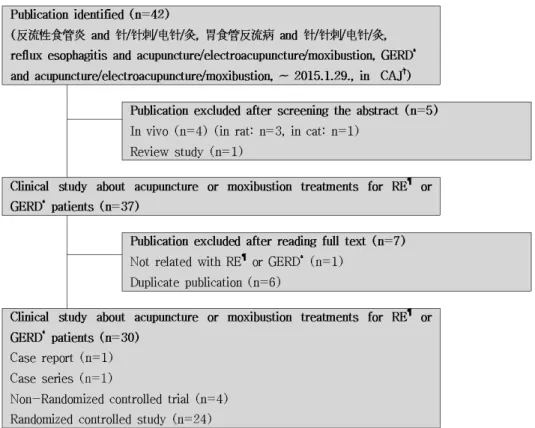
Fig. 1. Flow-chart of clinical study selection process.
*GERD : Gastroesophageal reflux di- sease, †CAJ : China academic journals,
¶RE : Reflux esophagitis.
전자는 역류성 식도염과 역류 증상이 없는 미란성 식도염, 후자는 비미란성 역류질환과 역류 증상이 없는 비미란성 식도질환으로 나 눌 수 있다.
대부분의 환자들에서는 생활 습관을 개선하고 증상이 생길 때마 다 제산제로 가라앉히는 방법이 효과적이지만 중증도의 환자인 경 우 반드시 약물치료로 H2 수용체 길항제 또는 운동 촉진 약제를 투여하여 하부식도의 압력과 위배출을 증가시켜준다. 더욱 심한 경 우에는 프로톤 펌프 억제제(Proton Pump Inhibitor; PPI)로 위내 산도를 pH4 이상으로 유지하여 주는 것이 권고되지만 약물을 중단 하면 80%의 환자에서 6개월 내에 재발하여 문제가 되는 실정이다.
이렇게 내과적 치료에 실패한 경우나 만성적으로 프로톤 펌프 억제 제를 사용해야 하는 젊은 환자의 경우에는 복강경을 이용한 위저부 추벽형성술을 시행하기도 한다3).
한의학적으로 역류성 식도질환은 나타나는 증상에 근거하여 “탄 산”, “토산”, “흉비(胸痺)”, “열격” 등의 병증에서 그 유사성을 찾을 수 있다. 변증은 크게 간위불화, 담습울조, 위기허역의 3가지로 나 누어 볼 수 있다4) 역류성 식도염의 변증과 처방에 관한 중국 논문 을 검색한 결과에 따르면 한의학적 치료가 매우 유용함을 알 수 있었으며, 초기병증인 간위불화가 가장 중요한 변증으로 판단되어 처방으로는 반하사심탕가감, 강역탕가감, 선복대자탕가감 등을 주 로 사용할 수 있다고 하였다5).
국내 한의학에서 역류성 식도질환에 대한 연구는 이진탕가미방 과 반하사심탕, 금은화와 오수유 추출물 등의 한약을 이용을 이용 한 실험논문과 내관혈 자침이 급성 역류성 식도염에 미치는 영향을 살펴 본 침구치료 실험논문이 있으며, 임상연구는 모두 증례보고형 식에 그치고 있어서 양이나 질적으로 매우 부족한 실정이다3,6-12). 이에 대안적 치료방법이 될 수 있는 침구치료법에 대하여 알아 보기 위하여 중국에서 이루어지고 있는 역류성 식도질환 침구치료 에 대한 동향을 살펴보고 향후 역류성 식도질환 치료와 임상연구의 기초자료를 제시하고자 CAJ(China Academic Journals; 中國期刊 全文數據庫) 검색을 통한 논문 review를 진행하였다.
연구방법
1. 논문의 검색
CNKI(The China National Knowledge Infrastructure; 清华 同方知网技术)는 중국의 Digital Resources System을 구축하기 위 해 1998년 중국정부와 청화(淸華)대학이 공동으로 주관한 중국 국 가 프로젝트로 4개의 database로 구성되어 있는데 그 가운데 하나 인 전자저널을 제공하는 가장 큰 Chinese database인 CAJ를 이용 하여 기간은 한정하지 않고, 검색범위는 의약위생(Medicine/ Hy-
Year of publication
Case report
Case
series NRCT† RCT¶ Total
2002 1 1
2003 1 1
2004 1 1
2007 1 1
2009 2 2
2010 2 5 7
2011 2 2
2012 1 4 5
2013 1 4 5
2014 5 5
Total 1 1 4 24 30
*GERD : Gastroesophageal reflux disease, †NRCT : Non-Ran- domized controlled trial, ¶RCT : Randomized controlled trial.
Table 1. Acupuncture and Moxibustion Therapy for GERD* in China
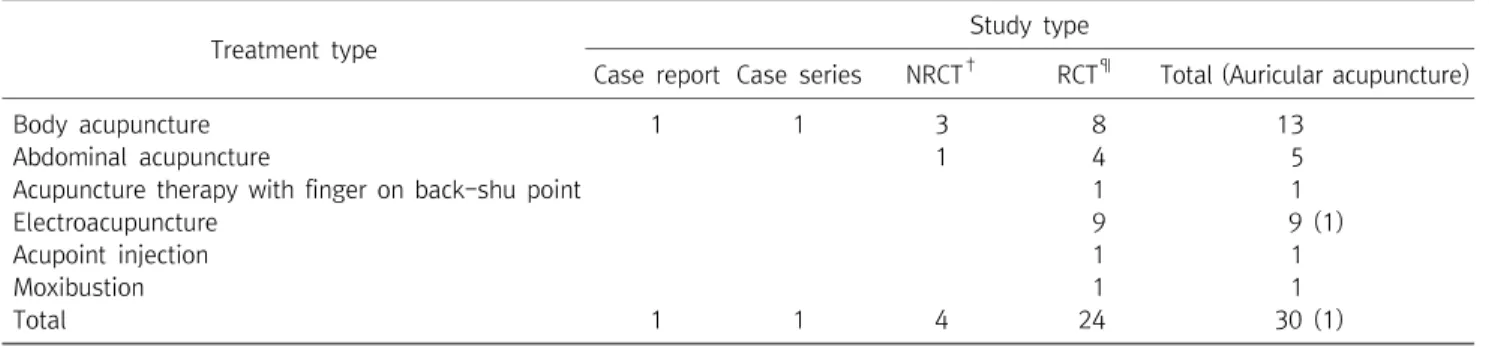
Treatment type Study type
Case report Case series NRCT† RCT¶ Total (Auricular acupuncture)
Body acupuncture 1 1 3 8 13
Abdominal acupuncture 1 4 5
Acupuncture therapy with finger on back-shu point 1 1
Electroacupuncture 9 9 (1)
Acupoint injection 1 1
Moxibustion 1 1
Total 1 1 4 24 30 (1)
*GERD : Gastroesophageal reflux disease, †NRCT : Non-Randomized controlled trial, ¶RCT : Randomized controlled trial.
Table 2. Acupuncture or Moxibustion Treatments on GERD* in the Studies
giene)의 “중의학” “중약학”, “중서의결합”으로, 주제(subject) 항 목에 검색어는 “反流性食管炎”, “胃食管反流病”으로 검색 후 각각
“针”, “针刺”, “电针”, “灸”로 결과중검색하였으며 또한 영문으로
“reflux esophagitis”와 “GERD”로 검색 후 각각 “acupuncture”,
“electroacupuncture”, “moxibustion”으로 결과중검색하여 역류 성 식도질환의 침구치료 논문을 검색하였다. 역류성 식도질환의 다 른 합병증인 식도협착이나 Barrett's esophagus로는 검색하지 않 았다. 논문의 검색은 2015년 1월에 이루어졌다.
2. 임상논문의 선별
검색하여 얻어진 논문 중 제목에 역류질환과 침구치료가 모두 표기된 논문을 선별하였다. 선별된 논문의 초록을 읽은 후 실험연 구와 review 연구를 제외하였고, 다음으로 전문을 정독하여 역류 성 식도질환과 관련 없는 연구와 중복된 논문도 제외하였다(Fig.
1). 역류성 식도질환의 침구치료에 대한 임상 논문 선별에서 체침 (體鍼), 복침(腹鍼), 이침(耳鍼), 배수지침(背兪指鍼), 전침(電鍼), 수 침(水鍼), 뜸 등의 모든 침구치료법에 대한 논문을 포함하였다.
3. 자료의 정리
최종 선택된 임상논문을 증례보고(case report), 증례군 연구 (case series), 비무작위배정 대조군 연구(non-randomized con- trolled trial; NRCT) 및 무작위배정 대조군 연구(randomized controlled trial; RCT)로 구분하였다. 치료방법, 치료간격, 치료기 간, 평가방법 등의 연구방법에 대하여 요약하였다.
결 과
1. 역류성 식도질환 침구치료 논문
검색어로 얻어진 논문 중 제목에 역류질환과 침구치료가 모두
표기된 논문 42편을 선별하였다. 1단계 초록 검토를 통해 역류성 식도질환 임상연구와 관련 없는 실험연구(in vivo) 4편과 review 연구 1편을 제외하고 37편의 역류성 식도질환 침구치료 임상논문 을 얻었다. 다음으로 전문을 정독하는 과정을 통하여 역류성 식도 증상의 치료와 관련이 없는 1편과 중복게재된 논문 6편을 제외하여 30편의 역류성 식도질환 침구치료 임상논문을 연구대상으로 확정 하였다(Fig. 1).
2. 역류성 식도질환 침구치료 연구동향
1) 논문 게재년도, 연구방법(study type): 연도별 논문 편수와 연구방법은 Table 1과 같다.
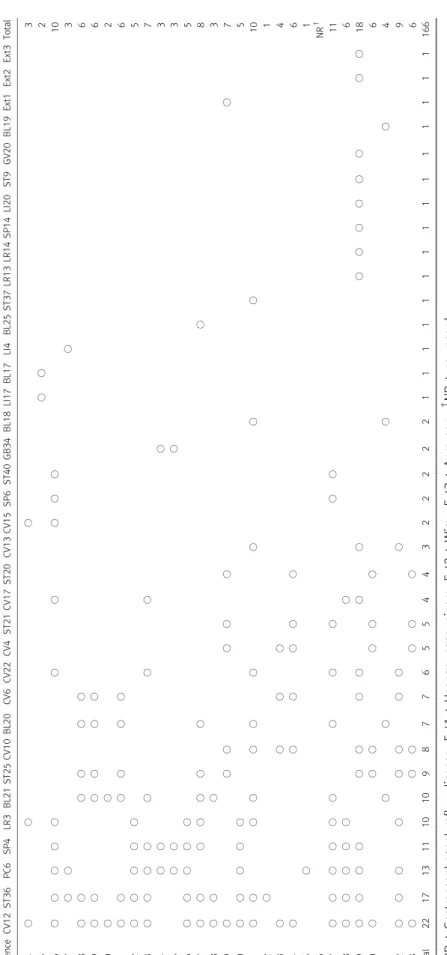
2) 사용된 치료방법: 연구에서 사용된 치료방법에 대한 분석에서 두가지 이상의 침구치료법을 사용한 경우 주된 치료로 설명된 침구 치료법을 따랐으며, 전침은 독립된 치료방법으로 분류하였다. 체침 연구가 13편으로 가장 많았으며, 전침 9편, 복침 5편, 배수지침, 수침, 뜸이 각 1편이었다. 이침은 전침과 함께 시술한 1편이 있었다(Table 2). 사용된 치료 혈위는 1∼18개로 다양하였는데 6개의 혈위를 선
ReferenceCV12ST36PC6SP4LR3BL21ST25CV10BL20CV6CV22CV4ST21CV17ST20CV13CV15SP6ST40GB34BL18LI17BL17LI4BL25ST37LR13LR14SP14LI20ST9GV20BL19Ext1Ext2Ext3Total 14○○○3 15○○2 16○○○○○○○○○○10 17○○○3 18○○○○○○6 19○○○○○○6 20○○2 21○○○○○○6 22○○○○○5 23○○○○○○○7 24○○○3 25○○○3 26○○○○○5 27○○○○○○○○8 28○○○3 29○○○○○○○7 30○○○○○5 31○○○○○○○○○○10 32○1 33○○○○4 34○○○○○○6 35○1 36NR† 37○○○○○○○○○○○11 38○○○○○○6 39○○○○○○○○○○○○○○○○○○18 40○○○○○○6 41○○○○4 42○○○○○○○○○9 43○○○○○○6 Total221713111010987765544322222111111111111111166 *GERD : Gastroesophageal reflux disease, Ext1 : Usangpungseupjeom, Ext2 : Wigu, Ext3 : Anmyeon, † NR : no record.
Table 3. Acupoints Used in the Treatment Group for GERD*
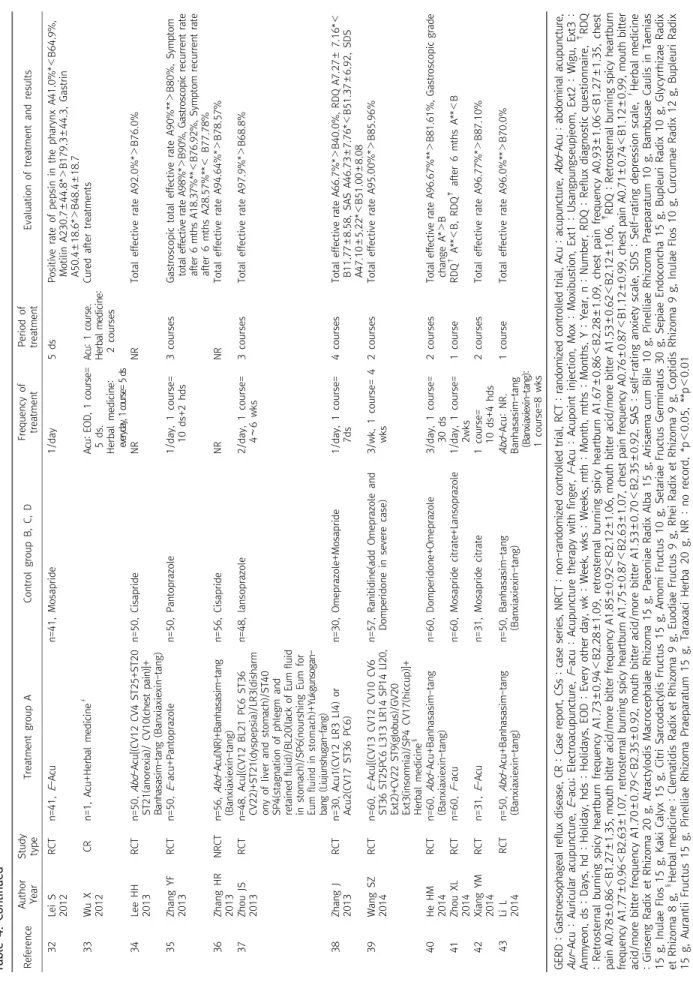
ReferenceAuthor yearStudy typeTreatment group AControl group B, C, DFrequency of treatmentPeriod of treatmentEvaluation of treatment and results 14Yan HG 2002CSsn=36, Acu1/day, 1 course= 10 ds+3 hds2 coursesCured n=13, Markedly effective n=18, Invalid n=5 15Chen M 2003NRCTn=36, Acu+Famotidinen=36, Domperidone+Famotidine1/day, 1course= 3 mths1 courseTotal effective rate A91.6%>B88.9%, Recurrent rate after 6 mths A8.3%*<B27.7%, Recurrent rate after 1Y A19.4%*<B44.4% 16Zhou GY 2004RCTn=84,E-Acu+Aur-Acu[MA-IC6 (esophagus) MA-IC7 MA-IC6 (stomach) MA-IC3 MA-TF1 MA-AH7 MA-IC5 MA-SC5]
n=80, Omeprazole+Sucralfate1/day, 1 course= 20 ds2 coursesGastroscopic R value(95% confidence interval) A0.6370∼ 0.7639>B0.4761∼0.6051, Total effective rate A84.52%* >B75.00%, Recurrent rate after 6 mths A23.94%*<B40.00% 17Wu XL 2007RCTn=37,I-Acu(PC6 ST36 LI4)+ Mosapride+OmeprazoleB: n=17, Acu(PC6 ST36 V12+CV22 CV17 BL17 LR3)+Mosapride+Omeprazole C: n=28, Mosapride+Omeprazole+ Haloperidol, Chlorpromazine, Lidocaine, Phenytoin, Amitriptylin 1/day, 1 course= 5 ds1 mthTotal effective rate A86.7%*>C71.4%, 82.4%*>C71.4%. Healing time A7.580±2.791*<C9.975±3.792, B7.950± 2.880*<C9.975±3.792 18Liu QQ 2009RCTn=30,E-Acu1(ST36 CV12+BL21 BL20) orE-Acu2(ST36 CV12+ST25 CV6)+ Jisilhamhyung-bang (Zhishixianxiong-fang)
n=28, Omeprazole+Domperidone1/day, 1 session= 8 ds+3 hds30 dsTotal effective rate A93.3%*>B79.6%, Gastroscopic total effective rate A83.6%*>B71.4%, Pathoscopic total effective rate A71.6%*>B55.6% 19Liu QQ 2009RCTn=78,E-Acu1(ST36 CV12+BL21 BL20) orE-Acu2(ST36 CV12+ ST25 CV6)+Jisilhamhyung-bang (Zhishixianxiong-fang)
n=75, Omeprazole+Domperidone1/day, 1 session= 8 ds+3 hds8 wksTotal effective rate A92.31%*>B80.00%, Gastroscopic mucosa condition A0.68±27*>B1.16±32, Pathoscopic total effective rate: squamous epithelial cell hyperplasia A0.64±0.31*<B1.29±0.73, lamina propria papillae extension A0.61±0.36*<B1.18±0.35 20Liang B 2010RCTn=28, Acu(CV12 BL21)n=26, Acu(CV12 ST36)1/day, 1 course= 10 ds+2 hds3 coursesTotal effective rate A85.71%>B80.77% 21Lu H 2010RCTn=42,E-Acu1(ST36 CV12+BL21 BL20) orE-Acu2(ST36 CV12+ST25 CV6)+ Jisilhamhyung-bang (Zhishixianxiong-fang) n=39, Omeprazole+Domperidone1/day, 1 session= 5 ds+2 hds, 1 course=4 session
2 coursesTotal effective rate 95%>B90%, Recurrent rate after 6 mths A21%*<B37% 22Jiang CX 2010NRCTn=40, Acu+Banhasasim-tang (Banxiaxiexin-tang)n=38, Omeprazole1/day8 wksTotal effective rate A97.5%*>B81.6% 23Wen N 2010RCTn=31, Acu[ST36 CV12 BL21 PC6+SP4(heartburn)/CV22 CV17(dysphagia)]
n=30, Omeprazole1/day, 1 session= 5 ds+2 hds, 1 course=4 session 2 coursesTotal effective rate A90.3%>B90.0%, Recurrent rate after 12 wks A9.1%*<B42.9% 24Lu ZJ 2010RCTn=30, AcuB: n=30, Acu+Gangyeok-jungyak (Jiangni-zhongyao), C: n=30, Gangyeok- jungyak (Jiangni-zhongyao), D: n=30, Omeprazole
1/day, 1 course= 2 mths2 coursesTotal effective rate B93.3%*>D83.4%, C83.4%>A80.0%, Gastrin B162.6±27.5*>C145.8±27.3, B162.6±27.5**> A127.6±29.4>D114.6±26.3. Motilin B298.7±76.9*>A257.6±29.4>C245.8±27.3> D225.6±52.1 25Guo XL 2010NRCTn=60, Acu+Jaeumganggi-tang (Ziyinjiangqi-tang)B: n=60, Jaeumganggi-tang (Ziyinjiangqi-tang), C: n=60, Omeprazole2/day, 1 course= 60ds1 courseMotilin A321.3±84.2*>B283.4±83.7>C279.1±76.8 26Liu XQ 2010RCTn=40, Acu+Banhasasim-tang (Banxiaxiexin-tang)n=38, Omeprazole1/day, 1 session= 6 ds+1 hd8 wksMotilin A305.28±64.24**>B256.32±79.55, Gastrin A56.52±21.25*>B45.25±18.21 27Meng Y 2011RCTn=40, Moxn=40, Omeprazole1/day, 1 course= 20 ds+3∼5 hds2 coursesTotal effective rate A90.0%*>B77.5% 28Liu SY 2011RCTn=20, Acu+Unnambaegyak-hoje (Yunnanbaiyao-huji)n=20, Omeprazole+Mosapride1/day4 wksTotal effective rate A90.00%*>B80.00%, Gastroscopic total effective rate A85.00%>B80.00% 29Huang L 2012RCTn=44,Abd-Acu[CV12 CV4 ST25+CV10 Ext1(chest pain, chest discomfort)/ ST20 ST21(dyspepsia,anorexia)]+ Haenggitonggang-pyeon (Xingqitongjiang-pian)
n=44, OmeprazoleAbd-Acu: 1 course= 7 ds. Haenggitonggang- pyeon (Xingqitong- jiang-pian): everyday Abd-Acu: 4 courses. Haenggitonggang-pyeon (Xingqitong- jiang-pian): 8 wks Total effective rate B93.2%*>D88.6% 30Zhang CX 2012RCTn=125, E-AcuB: n=125, Dallitong-granule (Dalitong-granule), C: A+B, D: n=125, Mosapride+Omeprazole+Amitriptyline
2/day, 1 course= 1 wk+2∼3 hds6 wksTotal effective rate C96.8%*>A81.2%>D80.5%>B80.8%. Total effective rate after 48 wks C95.2%*>A80.3%, C95.2%**>D63.4%>B62.5%, A80.3%*>D63.4% 31Liu BH 2012RCTn=41, Acu+Yukgunsogan-bang (Liujunshugan-fang)n=40, Cimetidine+Domperidone1/day4 wksTotal effective rate A90.24%**>B52.50%, Recurrent rate after 3 mths A31.71%**<B72.50%
Table 4. Acupuncture or Moxibustion Treatments on GERD in China