DOI https://doi.org/10.9725/kts.2018.34.6.307
스프링 보강 정적 실의 스프링 강성에 따른 기밀 성능 해석
장수연ㆍ성인하†
한남대학교 기계공학과
Analysis of Sealing Effectiveness Based on Spring Stiffness of a Spring-Energized Static Seal
Soo Yeon Jang and In-Ha Sung
†Dept. of Mechanical Engineering, Hannam University
(Received September 28, 2018; Revised November 24, 2018; Accepted November 25, 2018)
Abstract - Unlike a typical static seals, spring-energized static seals exhibit improvement in leak-tightness by reinforcing the spring inside the aluminum lining. Thus, spring-energized static seals are widely used in various industrial fields, such as aerospace, semiconductors, and petrochemical industries. The primary objective of this study is to develop design guidelines for spring-energized static seals in a wide range of temperatures, including that of cryogenic environments, by analyzing the required performance and influence of design variables through simulations. There are various parameters that can be controlled to design a leak-tight seal. In this study, the finite element analysis (FEA) is performed by controlling the parameters related to the spring and the thickness of the aluminum lining, and the result of the leakage between the seal and the casing is confirmed. Considering the influence of each parameters, all of them are found to be important. However, it is observed that the spring- related variables are more important than the aluminum lining or other variables when complexity is considered.
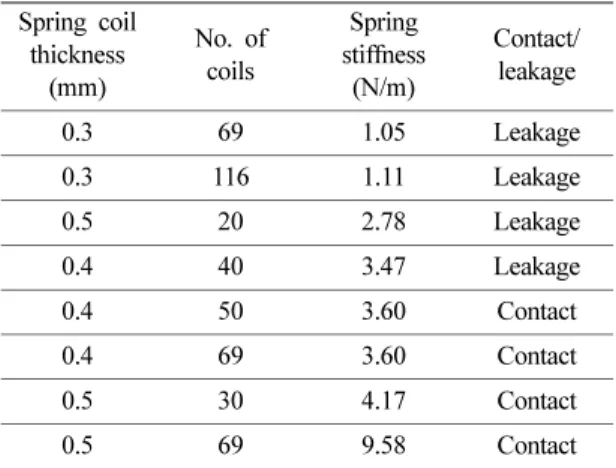
We can identify the threshold value of spring stiffness that changes leak-tight performance of the seal by per- forming FEA. Simulation results, under the conditions that are considered in this study, show that spring stiffness should be at least 3.6 N/m to maintain leak-tightness caused by the sufficient contact force between the aluminum lining and the upper and lower casings.
Keywords - finite element analysis( 유한요소해석), leakage(누설), static seal(정적 실)
Nomenclature
Y
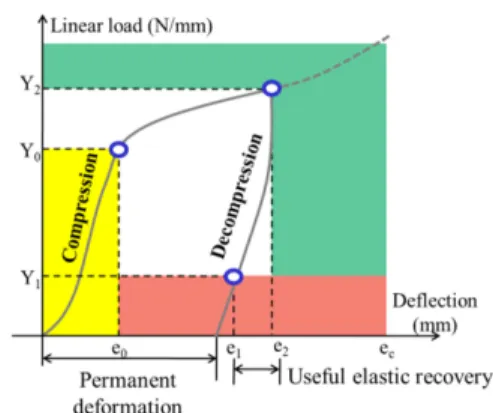
0: Load on the compression curve above which leak rate is at required level (N/mm) ( 항복하중) e
2: Optimum compression (mm) ( 최적압축량) Y1 : Load on the decompression curve below which
leak rate exceeds required level (N/mm) ( 기밀 유지를 위한 감압 하에서의 최소하중)
Y2 : Load required the reach optimum compression e2 (N/mm)( 최적압축량에서의 하중)
α : Helix angle (deg.) (코일 각도) E : Elastic modulus (GPa) (탄성계수) d : Wire diameter (mm) (코일 직경) n : No. of coils (코일 감긴 횟수) D : Spring diameter (스프링 직경)
1. 서 론
기계 부품내에 유체가 밀봉된 상태일 경우 압력이나 온도의 차이 때문에 밀봉되어 있던 유체가 외부로 유출
†