※ This study was supported by the Ministry of Trade, Industry and Energy's 2015 Design Innovation Capability Enhancement Project.
※ This research was supported by the New Young Researcher Support Program through the National Research Foundation of Korea funded by the Ministry of Science, ICT & Future Planning (NRF-2015R1C1A2A01054707).
†Corresponding Author:Joo-Hyeon Lee (Yonsei University) E-mail:[email protected]
TEL:02-2123-3108 FAX:02-312-8554
A Study on Product Development to Promote the Effects of Exercise on Children and to Induce Their Interest in Exercise: A Survey on the
Development of Cognitive and Motor Functions in Children
Hyun-Seung Cho*․Jin-Hee Yang*․Chan-Woong Jung**․Joo-Hyeon Lee**†
*Institute of Symbiotic Life-TECH, Yonsei University
**Department of Clothing & Textiles, College of Human Ecology, Yonsei University
Abstract
This study was conducted to develop wearable products with visual and auditory feedback aimed at promoting exercise interest in children. Here we determined the theoretical characteristics of cognitive and motor function development during childhood, empirical characteristics of children's motor functions, and factors that encourage exercise using natural observation and in-depth interview research methods. The questionnaire assessed children's motor ability, intensively trained body parts in sports programs, types of training or classes that improve the motor ability of each muscle group, significantly considered aspects of children's sports programs, and factors that promote children's interest in exercise. Our results suggest that the development of sport programs comprising varied exercise options that enhance body and limb movements are needed for balanced growth. Furthermore, it is very important to provide motivation for regular exercise and appropriate feedback, such as praise and encouragement, to maintain interest in exercise. This study identifies the standards for developing products that peak children's interest in exercise and the basis for a physically and mentally healthy society.
Key words: Inducing Interest in Exercise, Motor Function Development in Children, Visual and Auditory Feedbacks, Wearable Product
1. Introduction
This study was conducted to develop wearable products with visual and auditory feedback aimed at promoting children’s interest in exercise. Accordingly, we determined the theoretical characteristics of cognitive
and motor function development during childhood and the empirical factors that encourage children’s interest in exercises using survey research.
Childhood is generally defined as an age of 6–12 years,
categorized between toddler and adolescent ages. During
this period, physical, social, emotional, and intelligent
Vol.20, No.1, pp.41-48, 2017 https://doi.org/10.14695/KJSOS.2017.20.1.41development is remarkably fast. The developmental phases are divided into early childhood (age, 6–8 years) and late childhood (age, 9–12 years). The former is considered ideal for refining basic motor functions by learning stability and performing regular exercise. Motor development during this age has lasting effects that span into adulthood; thus, an appropriate amount of time should focus on basic movements and motor functions for normal physical, mental, and social development (Kim, 2009). Compared to children with a normal weight with a healthy diet and living environment, overweight children have a 2- to 6-fold increased risk of adult obesity, thus making obesity management in toddlers very important (Epstein et al., 2001). In particular, aerobic exercises, including running, quick walking, jumping rope, riding a bicycle, and swimming, are effective for children (Stunkard et al., 1990). These studies highlight the necessity to design activities according to the stage of a child’s development, particularly those aimed at improving cognitive-motor functions. Therefore, it is essential to develop wearable products for children that encourage their interest in exercise by monitoring exercise levels based on the motion of an individual body part and providing proper feedback. Feedback lets users know the amount of exercise completed and the impact of the results achieved. It is important to relay the results of a certain activity to users quickly and clearly (Norman, 1996).
Indeed, information on the results of a certain task strengthens the motivation to learn (Sin et al., 2015).
Accordingly, feedback is widely used in several fields, such as education, sports, health care, and rehabilitation.
In the educational field, feedback, such as academic awards, is an effective way to promote learning. In general, feedback methods are typically visual and/or auditory. The most effective feedback utilizes a multisensory approach to integrate various experiences.
Here we assessed the developmental phases of cognitive and motor functions and characteristics of child exercise to determine the feedback necessary to encourage children's interest in exercise.
2. Cognitive Development in Childhood
2.1. Cognitive Development Phases
Piaget describes cognitive development in stages:
sensorimotor, preoperational, concrete operational, and formal operational. In the concrete operational stage, children can infer logically with reversible operations.
Overcoming self-centered thinking, they can decentralize and understand differences, similarities, and interconnections between each other through interactions in peer groups. Notably, concepts such as size, weight, and priorities are developed during this time. However, this stage is also characterized with limited thinking and problem solving skills. In other words, children tend to deal with problems in specific circumstance familiar to them but struggle with abstract concepts or objects.
Piaget speculates that genuine learning is not provided by a teacher; rather, it comes from children themselves and is an active process of discovery. Thus, a useful learning method is to make children solve problems by themselves by providing tools that stimulate their interest and investigate solutions to problems.
This method can be emphasized with an education suitable for the developmental stage of children.
Therefore, it is important to understand the differences in the learning styles and interests of children. During interactions, children can develop logical thinking through mental actions that integrate different kinds of information. Indeed, social interaction, e.g., peer groups, promote learning and the sense of equality (Berk, 2012;
Lee & Lee, 2008).
2.2. Visual and Auditory Development in Childhood
2.2.1. Process of Visual and Color Cognition Development
Vision is gradually developed for several months after
birth. At birth, vision is somewhat obscure, but infants
can distinguish light, shapes, and motion. By 6–8-months
of age, the infant’s vision is similar to that of adults.
The first response to color in humans begins with distinguishing colors at 2–3 months of age. After 24 months, a child has a clear color preference. At this time, children usually prefer strong primary colors;
however, the differences between boys and girls remain unclear (Oh, 2005).
In early childhood (i.e., kindergarten), differences in shape are recognized before differences in colors. At 4 years of age, children understand the distinct concepts of space, color, and shapes. Prior to this age, children choose colors mechanically but are inclined to select colors that interest them. Original object colors are ignored, and children select their own preferred colors and connect them with the objects. Gradually, children become more likely to respond to shape. Notably, for shapes related to instruments, animals, or other things in their lives, children usually select colors. A child’s relationship with colors is decided by emotional characteristics. They cannot distinguish differences in colors, but they do have a broader sense of shape and color. During middle childhood (i.e., first to third grade in elementary school), children's visual development is nearly complete. Children at this age naturally discover the relationship between colors and objects. Color is no longer decided by subjective experiences or emotional relationships. As children develop spatial relationships, clear relationships with colors are established. It new environments, children recognize the interaction between an object and its color. A child's color scheme is derived from meaningful relationships related to visual or emotional concepts of color. However, children in first and second grade have a lesser ability to distinguish colors when compared with third graders. They say 'greenish yellow' not just 'yellow' when pointing a certain color, and they detect the darkness vs. lightness and murkiness vs. brightness in colors. Children are gradually likely to choose colors suitable to the characteristics of an object and those that fit their own intentions. By second and third grade, children can mix colors. In third grade, they also begin to express themselves with color.
At this age, children are ready to escape from fixed color
schemes and use these meaningful stimuli with intention (Oh, 2005).
2.2.2. Auditory Development
Hearing ability is one of the most important senses of humans, and it is necessary for communication through language. Being able to listen to sounds is required for voice adjustment. Toddlers with disabled hearing can barely acquire speaking abilities. Human ears detect frequency ranges of 20–20,000 Hz (Lee &
Nagamachi, 1996).
Psychologists previously thought that newborn babies cannot functionally hear sounds. However, infants were discovered to have some hearing abilities, and they can recognize familiar sounds (DeCasper & Fifer, 1980). By 6 months of age, infant’s hearing nears adult levels (Werner & Bargone, 1992). A newborn baby can distinguish a mother's voice or music that he or she listened to as fetus. At approximately 3 months of age, a baby can distinguish musical sounds and recognize parents' voices. Auditory development continues during the first year of life, and by 5 years of age, auditory abilities are similar to those of adults.
To determine sound intensity, sound pressure, which is a change in air pressure during sound wave delivery, is used. Sound pressure levels are expressed as an algebraic index. Humans tend to better detect higher frequency sounds. Accordingly, even if sounds are physically similar in size, different frequencies are detected as different sizes.
Human's available hearing range is called audio-frequency, and the most sensible frequency is approximately 4000 Hz, and sounds lower than 100 Hz are barely recognized.
Audio-frequency ranges depend on age and gender (Lee
& Nagamachi, 1996).
Auditory stimuli are effective for linguistic, emotional,
and cognitive development in children. Experiences
listening to music, singing, running, shaking hands, and
clapping lead to linguistic and motor development in
children. These actions are helpful for the integration of
various senses. Children who listen to music have better
spatial cognition and memory. Music also effectively
stimulates emotions and increases creativeness.
3. Motor Function Development in Childhood
During childhood, height, weight, and muscular composition continuously increase. Six to ten years of age is an ideal time to improve the organization of sensory and motor systems. Small gender differences are observed in height and weight. Both girls and boys show more development of the limbs than torso.
However, a boy's legs, arms, and standing height during childhood are generally longer than girls, who have wider hips and thicker thighs. Cognitive-motor ability quickly develops, but there can be occasional confusion in body direction, time, and space (Gallahue & Ozmun, 2009).
Motor development is a serial and successive process throughout life. Indeed, motor function is gradually developed and changed from simple and basic functions to more complex sports skills in successive stages of life development (Gabbard, 2000; Gallahue & Ozmum, 1988; Haubenstricker & Sefeldt, 1982). According to the hierarchical model of human motor development, children 7 years of age are at a specialized motor- function stage characterized by the accuracy, preciseness, and value of actions.
Motor function can be divided into basic and specialized categories. Basic functions require conscious motion of the body and limbs to achieve a task. Motion consisting of a combination of more than two limbs requires balance (twisting and rotating), moving motion (running and jumping), and operational motion (receiving and throwing) (Donnelly & Gallahue, 2003) (Table 1).
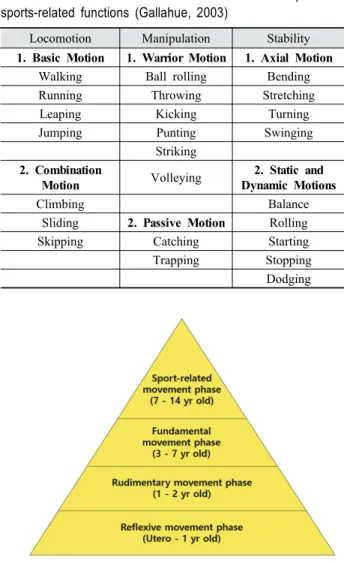
The fundamental movement phase largely occurs prior to childhood (3–7 year-olds). The next developmental stage is the sport-related movement phase. After reaching this phase, individuals can better develop recreational activities and healthy lifestyles (Fig. 1). The acquisition of motor functions through outdoor activities is critical, and it can be influenced by many conditions, such as environmental (social and physical) factors, facilities,
instruments, time, and especially praise and encouragement from people familiar to a child (family and teacher) (Gallahue & Ozmun, 2009).
Locomotion Manipulation Stability 1. Basic Motion 1. Warrior Motion 1. Axial Motion
Walking Ball rolling Bending
Running Throwing Stretching
Leaping Kicking Turning
Jumping Punting Swinging
Striking
2. Combination
Motion Volleying 2. Static and Dynamic Motions
Climbing Balance
Sliding 2. Passive Motion Rolling
Skipping Catching Starting
Trapping Stopping
Dodging
Table 1. Classifications of basic exercise and development of sports-related functions (Gallahue, 2003)
Fig. 1. Developmental stages of fundamental motor skills
Specialized motor functions consist of a combination
of specific sports motion and basic motor functions. The
development of these functions begins around 7 years
of age. The time reserved for various sports activities
at this age has lasting effects into adolescence and
adulthood. A jump shot in basketball, hitting a baseball,
a golf swing, and a tennis serve are examples of
specialized motor functions. The development of basic
motor and sport functions depends on environmental
factors, such as exercise, encouragement, and instrument
quality. To develop and refine motor functions during
childhood, sufficient time should be provided by
caregivers, and it is necessary to encourage this behavior with consistent praise (Gallahue & Ozmun, 2009).
Children also learn physical and motion abilities through play. Play is an important instrument for developing both macro- and micro-muscle movement skills and is critical for children's cognitive and emotional growth. Through play, children develop and refine various basic movements, including operational and balance motions. A stable and positive view of one’s self via the acquisition of control of muscular groups, which affects cognitive and cardiovascular functions, is important for proper emotional development in children.
For group play activities, it is important to make them feel joy and satisfaction, and groups should be structured to improve basic physical abilities and encourage participation (Gallahue & Ozmun, 2009).
4. Survey Research
To review the comprehensive motor ability of children (6–8 years-old) and factors inducing interest in exercises and deduce effective visual and auditory feedback methods, we conducted two observational surveys, in- depth interviews, and a questionnaire survey of experts on children's education and exercise.
4.1. Observation Research
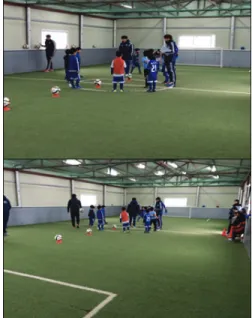
In this study, the observational research was conducted by visiting Y Children's Living Guidance Institute (January 28, 2016) and a children's soccer class in Suwon (February 27, 2016) to review the characteristics of children's motions during their daily lives and sports activities.
At the Children's Living Guidance Institute, we observed an indoor dance routine class and outdoor play class for 18 six-year-old girls and boys. During the soccer class, we observed the basic physical ability training and a simulated soccer match for 22 children, including one girl. The children's exercise activities and characteristics were recorded (Fig. 2).
Fig. 2. Observational research at a children's soccer class
4.2. In-depth Interview
To determine children's motor ability and the current status of sports education, in-depth interviews and surveys were conducted with 10 experts in children's education and sports. The in-depth interview was based on consultations with experts in children's education and sports and books on childhood motor development (Kim et al., 2009; Gallahue & Ozmun, 2009; Ha, 2002). The questionnaire consisted of questions about the characteristics of children's motor ability (advantages, disadvantages, and limits), body areas trained during sport class programs, and the types of training or classes for enhancing motor ability in each body area. We also inquired about aspects that were considered critical in child sports programs and factors that affect physical ability, such as promoting cardiovascular endurance, muscular strength, muscle endurance, coordination, balance, and speed. Other questions assessed factors that peaked children's interest in exercise, such as praise or rewards.
5. Results and Discussion
Children's indoor and outdoor movements were
monitored and recorded using the natural observation
method. During the indoor dance routine class, music
was used to stimulate movement. Exercises were attempted, and children completed motions by following the lead of the teacher. This type of physical activity promotes coordination and increases breathing ability.
The dance class focused on torso movement more than partial motions of the arms and legs. The children often completed light jumping motions based on the rhythm of the music. For balanced development in the arms, legs, and torso, an exercise program that utilizes the limbs as well as the torso is required.
The outdoor play class began with free playtime, such as “sand play”, “piling”, and “ball play”. Next, the children made various motions, e.g., “Taekwondo,”
“kicks,” or “balancing with one foot,” depending on their own interests. The children tended to behave in a group.
In general, activities including only the eyes and limbs are less developmental. In order to be skillful at specialized activities, e.g., hitting a baseball, significant amounts of exercises are required.
Children have ability to complete endurance-based activities; however, they prefer short and interesting activities. Therefore, short, repeated exercise with quick breaks between sessions may be the most suitable for children. During early childhood, attention spans are short but gradually increase. Indeed, during the observation session, children paid attention for approximately 7–8 minutes. Both boys and girls were active, but they also showed low endurance and tired easily. Notably, the response to training was higher.
Based on the in-depth interviews and surveys of experts, we examined the characteristics of children's motor ability, training methods to improve these abilities, and factors that encourage interest in exercise.
Characteristics of motor ability can be classified into upper and lower body categories. For the upper body, adjusting power for a task can be achieved quickly.
However, the development of micro-muscle is ongoing and thus vulnerable to activities requiring detailed motions. When using exercise equipment, additional accuracy is required. For lower body-related abilities, balancing skills are limited because of weakness in the legs. During childhood, macro-muscles are quickly
developed but micro-muscles barely form. Therefore, in both direct and indirect situations, there should be abundant chances for plays using macro-muscles.
Generally, there are no physical differences according to gender, but there are some cases in which girls have a better physical capacity than boys. Among body parts, the hands are firstly used. For muscular strength, the lower body is better, while coordination and detailed motions are better in the upper body (arms). Thus, arm exercises, which are easier for children, should be completed before lower body exercise. Activities including climbing and hanging are useful for developing the upper body and should be included in exercise programs.
Many educators chose legs as the body part trained most intensively in children's sports, followed by arms and waist. In particular, they concentrate on strengthening the lower body: “training of balancing legs,” “stretching,” “running,” and “jump.” Educators train the lower body and ankles through dribbling exercises. For arms training, they conduct exercises using the wrist and entire groups of arm muscles, such as jumping rope, and activities to improve catching and throwing. In childhood, bilateral motions like jumping rope are more difficult than unilateral ones; however, basic motion abilities are quickly developed (Yang, 2004). Focusing on activities to move the arms, shoulders, and upper body, requires an exercise program, and conversations should address bad posture habits.
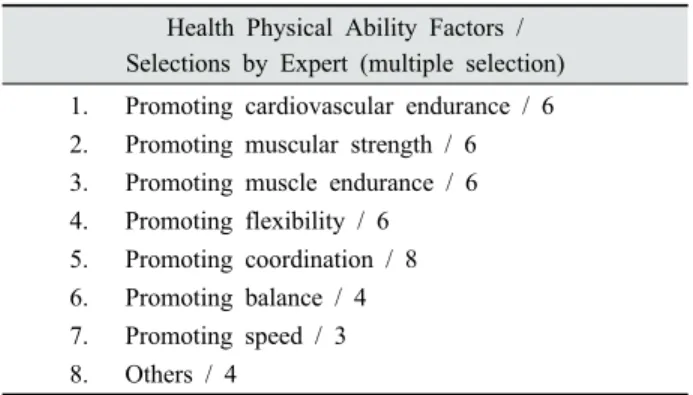
With regards to children's sports program, the results of the experts' assessment are shown Table 2. Multiple selections were allowed in the survey. Among the 7 items, “promoting coordination” was highest, followed by “promoting cardiovascular endurance.,” Other opinions included the importance of coordination, class inducing interest and fun, such as games, and the significance of classes for learning rules and improving attention (Table 2).
Interaction of health factors and physical activities are clear in the results of the experts’ assessment.
Regardless of initial, basic or sports technical phase,
all motion tasks require various levels of cardiovascular
physical ability, muscular strength, muscle endurance,
Health Physical Ability Factors / Selections by Expert (multiple selection) 1. Promoting cardiovascular endurance / 6 2. Promoting muscular strength / 6 3. Promoting muscle endurance / 6 4. Promoting flexibility / 6 5. Promoting coordination / 8 6. Promoting balance / 4 7. Promoting speed / 3 8. Others / 4
Table 2. Classifications of basic exercise and development of sports-related functions
and limb flexibility. When conducting a motion repeatedly, it requires muscle endurance. When repeating motions quickly for some time, it requires cardiovascular endurance and flexibility. Factors of physical abilities cannot be separated from motor activities, and it is rare to conduct motor activities that do not include muscular strength, muscle endurance, or flexibility.
To induce interest in exercise, proper rewards to children who conduct sincere exercises will encourage them to continue regardless of success or failure. Reward is effective as praise, and penalties can be used as light exercise (such as sitting down and standing up). Praising loudly in a group, clapping, giving stickers, and giving high fives were suggested options to peak interests (Table 3).
Order How to Induce Interest in Exercises 1 Feedback such as praise and reward from people
around them
2 Competitions among teams
3 Group exercise atmosphere, being together in a team 4 Competitions among individuals
5 Improvement to prepare personal existing exercise ability
6 Using symbols of sports, such as uniforms Table 3. How to induce children's interest in exercises
However, if interest in exercise decreases or is lost, it may be due to going beyond the limit of the child's attention span. It may also include losing self-esteem due to the difficulty of the exercise, the feeling of a lack of ability compared to the peer group, or losing in competitions. Therefore, children's sports programs should include many chances for positive strengthening to help forming healthy self-conception and reduce fear
against failures. Children are self-centered and unfamiliar with play in large groups. Thus, smaller group activities should be encouraged within large group activities and team sports experiences. For children who lose a game, it is necessary to emphasize reward (praise) and ongoing challenges. Children should be encouraged to work as a team, but given time to adjust to the group gradually.
To induce interest in exercise children should be made aware of the joy of working together and other merits of group exercises.
6. Conclusions and Future Works
Our research subjects included 6–8 year-old children.
During this time period, children conduct basic motor functions and acquire specialized motor abilities. This developmental stage is essential for maturation physically, mentally, and socially. The development of basic motor functions requires programs that exercise the limbs and the torso. In addition, exercises that are suitable to individual motor abilities, educate children, and encourage interest in exercises should be selected.
In conclusion, limb exercises peak children’s interest in attempting and continuing exercises. Furthermore, proper feedback is very important for a child’s normal development and encourages their exercise efforts.
A child connects his or her favorite color and object
and then reacts to them. Auditory stimuli lead to linguistic
and motor development. In particular, music improves
spatial perception and memory. Thus, the appropriate use
of feedback through auditory-visible stimuli may be
effective at raising interest in exercise. Exercise programs
should provide specific goals, firm procedures, motivation,
an ongoing sense of challenge, strong interaction,
feedback, and proper instruments. It is also necessary
to remove factors that impair attention. For instance, when
achieving targeted goals, visual representation is
important, such as shiny or color-changing wearable
products like bracelets, broaches, and necklaces. Colors
in various patterns that depend on the intensity of the
exercise should be utilized. Furthermore, auditory
feedback, such as praise, encouragement, musical sounds,
ⓒ 2017 (by) the authors. This open access article is distributed under the terms and conditions of the Creative Commons Attribution license (http://creativecommons.org/licenses/by/3.0), which permits unrestricted use, distribution, and reproduction in any medium, provided that the original work is properly cited.