이동통신 기지국 공사의 위험요인 분석에 관한 연구
이상욱⋅권순준 * ⋅이영섭 †
서울과학기술대학교 에너지환경대학원․
*
삼성 SDI(2015. 8. 17. 접수 / 2015. 9. 17. 수정 / 2015. 9. 22. 채택)
A Study on the Hazard Analyses of Construction for Base Station of Mobile Communication
Sang-wook Lee⋅Soon-joon Kwon * ⋅Young-seop Yi †
Department of Energy Safety Engineering, Graduate School of Energy and Environment, Seoul National University of Science & Technology
*
Samsung SDI(Received August 17, 2015 / Revised September 17, 2015 / Accepted September 22, 2015)
Abstract : As the domestic communication industry has been made rapid progresses, the construction of base stations are also expanded
yearly from more than 86,000 ones in the year 2005 to over 300,000 ones in 2013. While the new construction and rebuilt works have been rapidly increased, there has been not tried about the analysis as well as the control of hazards for the construction works. This study is conducted to do not only the focus interview for 27 expert groups who are engaged in the construction works and safety, but also the questionnaires for AHP analysis which is suggested by the Korea Occupational Safety and Health Agency for 92 persons who are engaged in the construction works in order to analyze the hazards of construction works for base stations. The high ranked risk works which are acquired from the two methods are fall under installation of antennae, struck by the hand tools and construction materials under installation of antennae, fall during going up and down the steel tower and telegraph poles and the fall by electric shock during the underground cable works. The control for the above hazards are the installation of fall protection equipments, the installation of safety nets for falling objects and the installation of protection equipment of electric shock.Key Words : hazard analysis of construction for base station of mobile communication, base station of mobile communication, hazard
analysis, focus interview, AHP†
Corresponding Author : Young-seop Yi, Tel : +82-2-970-6387, E-mail: [email protected]
Department of Energy Safety Engineering, Graduate School of Energy and Environment, Seoul National University of Science & Technology, 232, Gongleung-dong, Nowon-gu, Seoul 01811, Korea
1.
서 론최근 이동통신 규격과 기술이 1G에서 4G까지 비약 적인 발전으로 가입자 수도 급증하여 통화의 품질을 향상시키기 위한 무선 통신 기지국이 2005년에 86,000 여 국에서 2013년에는 3G 이하의 이동통신을 제외한 LTE기지국만 300,000여 국으로 증가하였다 1) .
‘이동통신 기지국’이란 우리나라의 전파법에 의하면
“육상이동국과의 통신 또는 이동중계국의 중계에 의한 통신을 하기 위하여 육상에 개설하고 이동하지 아니하 는 무선국 ”으로 정의하였다 2) . ‘이동통신 설비공사’는 이러한 기지국을 설치하는 공사로 실제로 공사 시는 주위의 지형지물의 영향을 많이 받는 특성이 있어서
대부분의 기지국 안테나는 높은 곳에 설치해야 한다 . 동 설비 공사는 고소작업이 수반되며 설치장소에 따라 실내형 , 옥상형, 옥탑형, 전주형 및 철탑형 공사로 구분 할 수 있다. 특히 도심 기지국의 경우 대부분 5층 이상 의 건축물 옥상 철탑부분을 임차하여 운용하고 있기 때문에 사전 안전관리 계획 수립이 매우 어려운 실정 이다 3) .
기지국 장비는 전주형과 옥상형의 경우 지면 또는
계단이 설치된 기존 건물에 설치함으로써 작업자가 장
비 등을 인력운반이 가능하며 설치공간도 넓은 편이다 .
그러나 옥탑형의 경우 작업자는 고정형 또는 이동식
사다리를 이용하여 작업장을 오르내려야 하고 장비는
직접 운반이 불가능하여 달줄로 옥상에 운반하고 운반
후에는 철가류라고 불리는 장비가대에 거치하여 본 공 사를 진행한다 . 또한 기존 설치 기지국의 장비를 교체 하는 경우에는 전원을 먼저 차단하고 장비를 임시로 거치한 후에 수축관을 이용하여 급전선을 장비와 연결 하고 기존 분전함의 전원을 연결해야 한다 .
안테나는 이동통신 단말기의 신호를 수신하여 장비 로 보내거나 반대로 전파를 공간에 방사하는 최말단 설비이다. 기지국 안테나의 설치 방식은 하나의 지지 대에 여러 개의 안테나를 설치하는 통합형과 하나의 지지대에 한 개의 안테나만 설치하는 분리형이 있다 . 일반적으로 통합형은 보통 전주 및 옥탑과 같은 협소 한 공간에 설치할 경우 , 분리형은 보통 옥상과 같은 넓 은 공간에 설치할 경우에 주로 사용한다.
이러한 기지국의 건설은 공사 종류의 분류에 있어서 건축공사나 토목공사로 분류하고 각 공사별 또는 공정 별로 각종 위험요인을 분석하고 여기에 따른 대략적인 대책이 절실히 필요하지만 이러한 시도는 지금까지 전 혀 없었다. 건설업의 위험성평가 기법인 ‘건설업 공종 별 위험성 평가모델’ 4) 에는 여러 종류의 공사와 관련하 여 일반적인 모델만 제시하고 있어서 본 논문에 적용 할 수 있는 모델은 ‘전기공사 위험성 평가모델’ 5) 이 유 일하다 . 본 논문의 연구범위는 철탑과 전주 등 설치와 건축공사를 제외하고 기지국 장비 및 안테나의 설치에 한정하고 공종별 위험 요인의 분석 및 우선순위화로 제한하였다. 이를 위하여 공사 담당자를 대상으로 회 의를 통하여 공종을 분류하고 위험요인을 분석하였다 .
위험성 평가를 위하여 포커스 그룹 인터뷰와 연구의 신뢰도를 높이기 위하여 설문조사를 통한 계층별 분석 법(AHP : Analytic Hierarchical Process)을 실시했는데 대상은 각각 현장소장 등 27명과 106명으로 했으며 이 들을 대상으로 위험성을 분석하였다.
2.
기지국 공사의 위험요인 분석이동통신 기지국 공사의 공종과 위험요인을 분류하 기 위하여 2015년 4. 1일부터 4. 30일까지 시공사 9개 업체를 3개 권역(수도권, 중부권, 남부권)으로 나누어 각 권역별로 현장 점검, 협의체 회의 및 청취 조사 등 세 가지 방법을 사용하여 공종과 위험요인을 분류하였 다. 현장점검에 의한 방법은 현장소장, 관리감독자, 안 전관리자/안전담당자 및 근로자가 합동으로 현장을 점 검한 결과를 활용하였다. 협의체 회의는 각 권역별로 안전관관리자/안전담당자와 관리감독자가 모여 현장별 일일점검 기록, 월간 협의체회의 기록 및 각종 시공 관 련 자료 등을 참조하였다. 청취 조사는 근로자의 의견
을 그대로 반영하기 위하여 각 권역별로 5개 현장을 선정하여 각 근로자 1명씩을 대상으로 어떠한 정보도 제공하지 않고 개인별로 심층 인터뷰를 실시하였다 . 그 결과 공종은 장비 설치 , 안테나 설치 및 케이블 포 설 및 접속 등으로 분류하였다 .
장비 설치에 따른 위험요인은 옥탑 고정사다리를 이 용하여 승하강 시 추락 , 이동식 사다리를 설치하여 옥 탑 승하강 시 사다리 전도에 의한 추락, 달줄을 이용하 여 옥탑으로 장비 인양 시 달줄 풀림에 의한 낙하, 옥 탑 상부의 협소한 공간에서 이동 중 하부로 추락 그리 고 장비의 전원 작업 시 감전 등이다.
안테나 설치에 따른 위험요인은 철탑 /전주 승하강 시 추락, 안테나 고정 작업 시 추락, 안테나 인양 시 달줄 풀림에 의한 낙하 , 안테나 고정 작업 시 작업공 구 및 자재 낙하, 기존장비 위치 미확인에 의한 충돌 등이다 .
케이블 포설 및 접속에 따른 위험요인은 전동공구 사용 시 끼임으로 인한 손 부상 , 케이블 포설 및 접속 시 감전에 의한 추락, 열 수축 작업 시 화재 발생, 케 이블 시험을 위해 A형 사다리 상부에서 시험 중 추락 등이다 .
2.1 포커스그룹 인터뷰(Focus group interview) 포커스그룹 인터뷰는 특정 주제에 대한 토론방식으 로 참가자들의 합의점을 도출하는 것이 아니라 선택된 주제에 대하여 심도 있는 의견 등을 이끌어 내는 기법 이다 6) . 또한 본 연구의 기법은 연구 목적을 분명히 하 고 필요한 인원 , 질문 및 얻어진 정보의 적합 여부의 판단 등을 명확히 할 필요가 있다 7) .
포커스그룹 인터뷰는 대규모 설문조사를 하기 전에 미리 예측할 목적으로 또는 그룹의 동질성이 결여되고 주제를 잘 알지 못할 경우 얻어진 결과를 증명할 통계 적 자료가 필요할 경우 적용한다 8) .
인터뷰 대상은 현장소장 7인, 안전관리자/안전담당 자 10인 및 관리감독자 10인 등 세 그룹 27인으로 나 누어 진행시켰다. 인터뷰의 절차는 참여자를 선정하여 교육을 실시하고, 미리 도출한 각종 설비공사의 위험 요인을 인터뷰 2일 전에 대상자에게 배포하는 등 사전 에 준비하였다 . 인터뷰를 실시할 경우에는 각 개인별 로 위험요인을 작성토록 하고 그 후 각 직종별로 그룹 인터뷰를 실시하였다.
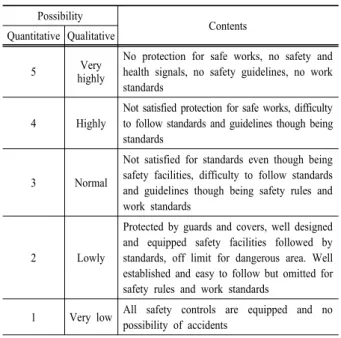
기지국의 설비공사에 있어서 위험요인에 의한 사고 가능성에 대한 추정은 다음 Table 1과 같이 5단계로 나 누어 분류하였다 .
사고의 가능성을 정량적으로 표현하기 위하여 위에
Work type Hazardous factors Possibility
1 2 3 4 5 Average
Installation of equipment
Fall during going up and down using fixed ladder in penthouse 18 7 2 - - 1.4 Fall by ladder during going up and down penthouse using mobile ladder 3 10 7 6 1 2.7
Struck by falling equipment by fastening rope during lifting 19 5 2 1 - 1.4
Fall during moving narrow space in penthouse 21 3 2 - 1 1.4
Electric shock during electrical work for equipment 10 8 8 - 1 2.0
Installation of antennae
Fall during going up and down steel tower and telegraph pole 10 8 5 3 1 2.1
Fall during fastening work for antennae 10 10 3 3 1 2.1
Struck by falling antennae from fastening rope during lifting 17 8 2 - - 1.4
Struck by hand tool and materials under fastening antennae 1 4 10 8 4 3.4
Struck against equipment by negligence of location 1 11 6 7 2 2.9
Underground cable work
Hand injuries by electrical hand tools 4 6 6 7 4 3.0
Fall by electrical shock under cable work and connection 10 7 6 3 1 2.2
Fire during heat shrimp works 11 13 3 - - 1.7
Fall during testing on mobile ladder for cable testing 4 6 14 3 - 2.6
Table 2. Accident frequency by the construction types Table 1. Estimate of possibility
Possibility
Contents Quantitative Qualitative
5 Very
highly
No protection for safe works, no safety and health signals, no safety guidelines, no work standards
4 Highly
Not satisfied protection for safe works, difficulty to follow standards and guidelines though being standards
3 Normal
Not satisfied for standards even though being safety facilities, difficulty to follow standards and guidelines though being safety rules and work standards
2 Lowly
Protected by guards and covers, well designed and equipped safety facilities followed by standards, off limit for dangerous area. Well established and easy to follow but omitted for safety rules and work standards
1 Very low All safety controls are equipped and no possibility of accidents
열거한 세 그룹으로 나누어 실시하고 그 결과는 Table 2와 같다. 여기에서 Average는 평균치로 위의 Table 1 의 가능성에 답변자 수를 곱하여 참여인원수로 수식으 로 표현하면 다음 식 1과 같다.
⋯
× ×⋯×
⋯⋯ [1]
여기에서, Aver은 평균
p는 표에서 possibility로 가능성(1〜5) n은 답변자의 수임
사고의 가능성이 높은 위험요인은 ‘안테나 고정 작 업 시 작업공구 및 자재 낙하 ,’ ‘기존 장비 미확인에 의 한 충돌 ,’ ‘전동공구 사용 시 끼임에 의한 손의 부상,’
및 ‘이동식 사다리의 옥탑 승하강시 전도에 의한 추락’
으로 나타났다. 그룹별 위험요인에 대한 점수분포는 현장소장과 안전관리자는 높게, 관리감독자는 낮게 평 가하였는데 이들은 공사현장의 직ㆍ조ㆍ반장으로 장기 간 이동통신 기지국 건설공사에 종사함으로써 위험요 인과 사고 가능성에 대하여 비교적 둔감하게 느끼는 결과라고 볼 수 있다.
기지국 설비 공사의 위험요인별 중대성은 가능성과 마찬가지로 현장소장 7인, 안전관리자/안전담당자 10 인, 관리감독자 10인 등 세 그룹 27인으로 나누어 각 참여자들이 추정하였으며 사고 중대성은 Table 3과 같 이 5단계로 나누어 분류하였다.
사고의 중대성을 정량적으로 표현하기 위하여 위에 열거한 세 그룹으로 나누어 실시한 결과는 Table 4와 같으며 중대성 점수를 모두 종합 , 정리한 최종 추정표 이다 .
Table 3. Severity estimate
SeverityContents Quantitative Qualitative
5 Severe
accident Severe accident
4 High Injury more than 1 month(disabled) 3 Normal Injury less than 1 month(hospital) 2 Low Injury less than 3 days(non-industrial accident)
1 No damage Non-injury accident
Work type Hazardous factors Severity
1 2 3 4 5 Average
Installation of equipment
Fall during going up and down using fixed ladder in penthouse 1 6 9 7 4 3.3
Fall by ladder during going up and down penthouse using mobile ladder 9 8 3 5 2 2.4 Struck by falling equipment by fastening rope during lifting 3 3 6 8 7 3.5
Fall during moving narrow space in penthouse 3 3 6 8 7 3.5
Electric shock during electrical work for equipment 13 6 4 4 - 2.0
Installation of antennae
Fall during going up and down steel tower and telegraph pole - 3 13 4 7 3.6
Fall during fastening work for antennae - 4 9 3 11 3.8
Struck by falling antennae from fastening rope during lifting 10 5 9 3 - 2.2
Struck by hand tool and materials under fastening antennae 7 9 7 2 2 2.2
Struck against equipment by negligence of location 20 4 3 - - 1.4
Underground cable work
Hand injuries by electrical hand tools 11 6 10 - - 2.0
Fall by electrical shock under cable work and connection 2 2 10 7 6 3.5
Fire during heat shrimp works 5 7 10 5 - 2.6
Fall during testing on mobile ladder for cable testing 8 10 3 3 3 2.4
Table 4. Accident severity by the construction types
Work type Hazardous factors Risk estimate
Possibility Severity Total Ranking
Installation of equipment
Fall during going up and down using fixed ladder in penthouse 1.4 3.3 4.6 10 Fall by ladder during going up and down penthouse using mobile ladder 2.7 2.4 6.5 4
Struck by falling equipment by fastening rope during lifting 1.4 3.5 4.9 8
Fall during moving narrow space in penthouse 1.4 3.5 4.9 8
Electric shock during electrical work for equipment 2.0 2.0 4.0 12
Installation of antennae
Fall during going up and down steel tower and telegraph pole 2.1 3.6 6.3 5
Fall during fastening work for antennae 2.1 3.8 8.0 1
Struck by falling antennae from fastening rope during lifting 1.4 2.2 3.1 14
Struck by hand tool and materials under fastening antennae 3.4 2.2 7.5 3
Struck against equipment by negligence of location 2.9 1.4 4.1 11
Underground cable work
Hand injuries by electrical hand tools 3.0 2.0 6.0 6
Fall by electrical shock under cable work and connection 2.2 3.5 7.7 2
Fire during heat shrimp works 1.7 2.6 3.4 13
Fall during testing on mobile ladder for cable testing 2.6 2.4 5.0 7
Table 6. Risk estimate(frequency, severity) by construction types 사고의 중대성이 높은 위험요인은 ‘안테나 고정 작 업 시 추락 위험(3.8),’ ‘철탑/전주 승하강 시 추락 위험 (3.6),’ ‘옥탑 상부 협소공간 내에서 이동 중 하부로 추 락 위험(3.5),’ ‘옥탑 상부 협소공간 내에서 이동 중 하 부로 추락 위험(3.5),’ ‘케이블 포설 및 접속 시 감전에 의한 추락(3.5),’ ‘옥탑 고정사다리를 이용하여 승하강 시 추락 위험(3.3)’ 순으로 나타났다.
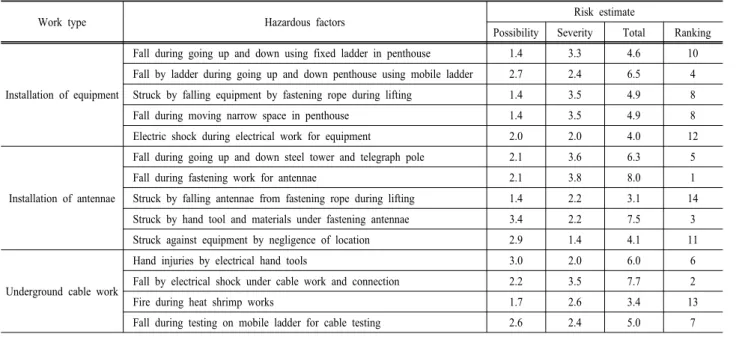
안전보건공단에서 제시한 건설업 공종별 위험성평 가모델 계산식인 사고의 발생빈도 × 사고의 발생강도 의 식으로 계산한 결과는 Table 5와 같다. 위험성 점수
Table 5. Risk estimate
Severity Possibility
Severe
accident High Normal Low No damage
5 4 3 2 1
Very high 5 25 20 15 10 5
High 4 20 16 12 8 4
Normal 3 15 12 9 6 3
Low 2 10 8 6 4 2
Very low 1 5 4 3 2 1
Work type Hazardous factors Group weight(A) Work weight(B) Risk index(AxB) Risk ranking
Installation of equipment
Fall during going up and down using fixed ladder in penthouse 0.15 0.1894 0.028 9
Fall by ladder during going up and down penthouse using mobile ladder 0.15 0.2350 0.028 9
Struck by falling equipment by fastening rope during lifting 0.15 0.0444 0.007 14
Fall during moving narrow space in penthouse 0.15 0.4056 0.061 5
Electric shock during electrical work for equipment 0.15 0.1256 0.019 13
Installation of antennae
Fall during going up and down steel tower and telegraph pole 0.65 0.2095 0.136 3
Fall during fastening work for antennae 0.65 0.4244 0.276 1
Struck by falling antennae from fastening rope during lifting 0.65 0.0807 0.053 8
Struck by hand tool and materials under fastening antennae 0.65 0.2337 0.152 2
Struck against equipment by negligence of location 0.65 0.0517 0.034 7
Underground cable work
Hand injuries by electrical hand tools 0.2 0.1007 0.020 11
Fall by electrical shock under cable work and connection 0.2 0.5951 0.119 4
Fire during heat shrimp works 0.2 0.1210 0.024 12
Fall during testing on mobile ladder for cable testing 0.2 0.2807 0.056 6
Table 8. The order of AHP hazard rates by work types 가 15〜25는 위험성 등급 ‘상’, 8〜15는 위험성 등급
‘중’, 1〜7은 위험성 등급 ‘하’로 분류하고 상과 중 등 급은 중점관리 대상이다.
위의 Table 2와 4에 의하여 작업공종별 위험도 등급 순위는 다음 Table 6과 같이 중 1개와 나머지는 하로 분류된 것으로 나타났는데 현장소장과 안전관계자는 가능성과 중대성 모두 높은 점수로 평가했으나 관리감 독자는 모든 점수를 2점 이하로 평가하여 전체적으로 낮은 점수의 분포를 보였다. 그래서 현실적인 사항을 고려하여 위험도 점수 6.5 이상을 중점관리 대상으로 선정하여 안전대책을 제시하고자 한다.
2.2 설문조사를 통한 AHP 위험지수 산정
AHP(Analytic Hierarchy Process : 계층적 의사결정방법) 는 Pennsylvania Wharton School의 Thomas L. Satty가 1971 년 제안한 의사결정 기준 모형이다 9,10,11) . 또한, AHP를 적용함에 있어서 역수성(reciprocal), 동질성(homogeneity), 종속성 (dependency) 및 기대성(expectations) 등 4가지 공리 (axioms)를 고려해야 한다 12) . 위의 2.1에서 제시한 위험도에 대한 정당성을 확보하기 위하여 설문대상자는 공사현장의 시공전문가인 현장소장 10명, 안전관리자/안전담당자 11 명 , 관리감독자 23명, 근로자 62명 총 106명을 선정하였으 며 최종 회수된 설문지는 현장소장 10명, 안전관리자/안전 담당자 10명, 관리감독자 18명 및 근로자 54명 등 92건의 설문지를 회수하여 분석하였다 . AHP분석에 활용한 공종 은 위험성평가 절차에 의한 우선순위 분석에 사용한 공종 과 동일하게 장비설치 5개, 안테나 설치 5개, 케이블 포설 및 접속이 4개 등 총 14개의 위험요인으로 분류하였다.
Table 7. Group weight of hazard rates by work types
Work type Installation ofequipment Installation of
antennae Underground cable work
Group weight 0.15 0.65 0.20
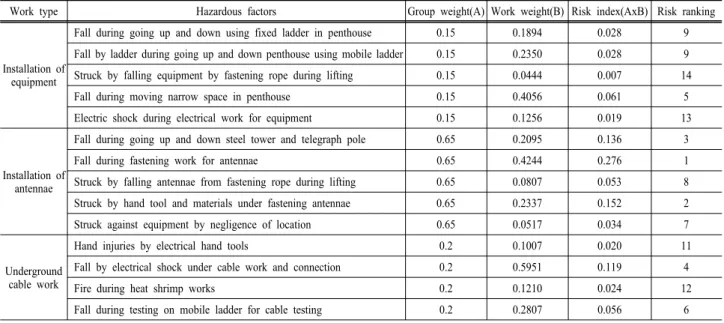
일관성 분석을 위하여 92명이 설문 응답자들이 응답 한 내용이 일관성비율 (Consistency Ratio : CR)이 0.1이 하인지 확인에 필요한 사용 프로그램은 Microsoft EXCEL 2010이었다. 일관성 비율이 0.1이하인 설문지 는 50%도 되지 않아서 총 92부 중 39부이었다. 이들 세 그룹에 대하여 AHP기법을 이용하여 각 Group별 쌍 대비교 (Cross-tabulation)에 의하여 가중치를 결정하게 되는데 평균 가중치는 Table 7과 같이 ‘장비설치 위험 요인 ,’ ‘안테나 설치 위험요인’ 및 ‘케이블 포설 및 접 속 위험요인’은 각각 0.15, 0.65, 0.20이다.
AHP기법을 활용하여 도출한 Group별 가중치(A)와 Group내부에서의 공종별 가중치(B)를 각각 구하여 이 를 곱한 값 (A x B)에 의하여 위험 순위를 등급화한 결 과치는 Table 8과 같이 나타났다.
2.3 위험지수 비교 분석
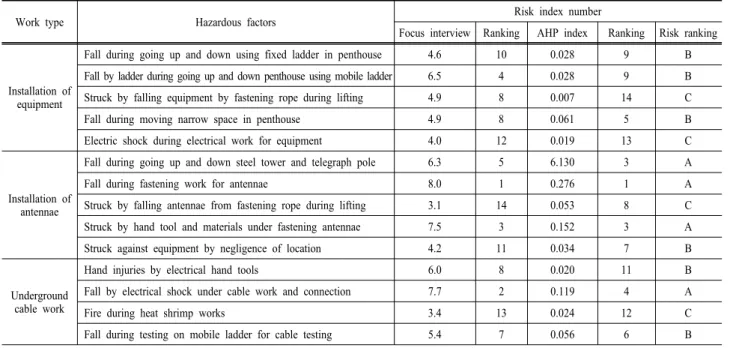
포커스그룹 인터뷰를 통하여 발생빈도와 발생강도 를 곱하여 산정된 위험도와 AHP기법을 이용하여 산정 된 위험지수를 비교 정리한 순위가 Table 9와 같다.
포커스그룹 인터뷰와 AHP분석 결과를 곱하여 구한
기지국 설비 공사 위험요인의 분석 결과 상위 4개의
위험요인 순위가 거의 일치하였다. 위험등급의 분류는
포커스그룹 인터뷰 시 사용했던 절대평가보다는 AHP
Work type Hazardous factors Risk index number
Focus interview Ranking AHP index Ranking Risk ranking
Installation of equipment
Fall during going up and down using fixed ladder in penthouse 4.6 10 0.028 9 B
Fall by ladder during going up and down penthouse using mobile ladder 6.5 4 0.028 9 B
Struck by falling equipment by fastening rope during lifting 4.9 8 0.007 14 C
Fall during moving narrow space in penthouse 4.9 8 0.061 5 B
Electric shock during electrical work for equipment 4.0 12 0.019 13 C
Installation of antennae
Fall during going up and down steel tower and telegraph pole 6.3 5 6.130 3 A
Fall during fastening work for antennae 8.0 1 0.276 1 A
Struck by falling antennae from fastening rope during lifting 3.1 14 0.053 8 C
Struck by hand tool and materials under fastening antennae 7.5 3 0.152 3 A
Struck against equipment by negligence of location 4.2 11 0.034 7 B
Underground cable work
Hand injuries by electrical hand tools 6.0 8 0.020 11 B
Fall by electrical shock under cable work and connection 7.7 2 0.119 4 A
Fire during heat shrimp works 3.4 13 0.024 12 C
Fall during testing on mobile ladder for cable testing 5.4 7 0.056 6 B