1336
ⓒ The Korean Society of Food Science and Technology
Effect of Thermal Pretreatment on the Functional Constituents of
Waxy Corn (
Zea mays
L.)
Eun-Ok Kim, Myong-Hwa Yu, Ki-Teak Lee1, Kyoung-Seob Yun2, and Sang-Won Choi*
Department of Food Science and Nutrition, Catholic University of Daegu, Gyeongsan, Gyeongbuk 712-702, Korea
1Department of Food Science and Technology, Chungnam National University, Daejeon 305-764, Korea 2Saimdang Cosmetics Co., R&D Center, Daejeon 211-201, Korea
Abstract Quantitative changes in functional constituents of waxy corn (Zea mays L.) by 5 different thermal pretreatments,
including roasting, steaming, microwave, puffing, and extruding, were determined and compared with those of the raw waxy corn. There were no significant differences in fatty acid compositions among the corn treated with 5 thermal treatments. Levels of α- and γ-tocopherols, soluble amino acids, and phytosterols decreased by thermal treatments, while those of p -coumaric and ferulic acids considerably increased by thermal treatments. In particular, the contents of tocopherols and phytosterols, and souble amino acid decreased significant in the steaming and puffing processes, respectively, whereas those of 2 free cinnamic acids increased significantly in the steaming and puffing processes. The extruding process showed smaller quantitative changes in tocopherols, phytosterols, and hydroxycinnamic acid derivatives compared to other heat pretreatments. These results suggest that the extruding process have a positive effect on valuable phytochemicals in waxy corn.
Keywords: waxy corn (Zea mays L.), functional constituent, quantitative change, thermal pretreatment
Introduction
Corn (Zea mays L.) is rich in starch, oil, protein, and dietary fiber, as well as in several phytochemicals, such as carotenoids, tocopherols, phytosterols, and phenolic compounds (1). In particular, carotenoid, tocopherol, and phytosterol derivatives in corn have been known to have valuable nutraceuticals properties including anticarcinogenic, anti-inflammatory, antioxidant, and cholesterol-lowering effects (1-3). In addition, 3 polyamine conjugates, N,N '-dicoumaroylputrescine (DCP), N-p-coumaroyl-N '-feruloyl-putrescine (CFP), and N,N'-diferuloylputrescine (DFP), together with 2 well-known phenolic acids, p-coumaric and ferulic acids, have been reported to have several biological effects, such as antidiabetic, antifungal, antioxidant, and anti-melanogenic activities (4-6). Therefore, corn is widely used as a source of dietary supplement ingredients with health-promoting properties.
Thermal processings, including roasting, steaming, microwave, puffing, and extruding have been reported to improve the digestibility, functionality, and palatability of cereal grains (7-9). Moreau et al. (10) reported that thermal process increased yield and composition of oil and phytosterols from corn fiber. Saulnier et al. (11) found that thermal treatment exerted solubilization of antioxidant feruloylated oligosaccharides from corn bran. Singh et al. (12) also reported that heat pretreatment of wet-milled corn improved recovery of corn fiber oil and phytosterols. In addition, Dewanto et al. (13) demonstrated that thermally processed sweet corn had higher antioxidant ferulic acid than fresh corn. Solihin et al. (14) recently reported that an
extrusion process enhanced enzymatic hydrolysis of corn starch by glucoamylase. Thus, thermal processing has been shown to greatly affect on the yield and chemical compositions of cereal grains.
In Korea, corns for production of corn starch, oil, gluten, and other corn processed products depended mostly on imports from United States, China, Australia, and other countries. Imported corns in 2007 reach about 2,150,000 MT, and most of imported corns are dent corn cultivars for corn processed products (15). Recently, since corns are known to have beneficial effects against diabetes, cataract, and atherosclerotic disease, consumption of corns, especially delicious palatable waxy corns increased greatly. Therefore, newly cultivated corn cultivars, such as waxy corn cultivars, Daehak and Mibaek, and dent corn cultivar, Kwangpyeongok have recently been developed and the former was widely consumed in Korea. The total Korea production of corns harvested in 2007 was 83,500 ton, and approximately 82% of the production was devoted to thermally processed waxy corn (15). Therefore, study on changes in functional quality of waxy corn after thermal processing is required. To date, information on quantitative changes of functional constituents in corn by thermal pretreatment is still limited.
The purpose of present study was to investigate quantitative changes in functional constituents of waxy corn, such as free fatty acids, tocopherols, phytosterols, free amino acids, and hydroxycinnamic acids by 5 different thermal pretreatments.
Materials and Methods
Materials and chemicals Daehak waxy corn (‘Yonnong 1’) used in this experiment was directly harvested in late August in 2008 from Goesan, Chungbuk, Korea. Free fatty acids, 4 tocopherol isomers (α-, β-, γ-, and δ-tocopherol),
*Corresponding author: Tel: +82-53-850-3525; Fax: +82-53-850-3516 E-mail: [email protected]
Received March 24, 2009; Revised July 17, 2009; Accepted August 7, 2009
3 phytosterols (campesterol, stigmasterol, and β-sitosterol),
and 2 free cinnamic acids, p-coumaric and ferulic acids,
were obtained from Sigma-Aldrich (St. Louis, MO, USA). Three polyamine conjugates, N,N'-dicoumaroylputrescine
(DCP), N-p-coumaroyl-N'-feruloylputrescine (CFP), and N,N'-diferuloylputrescine (DFP) were isolated from corn
bran according to previous method (6). High performance liquid chromatography (HPLC) solvents were obtained from Merck (Darmstadt, Germany). All other reagents used for this study were analytical grade.
Sample preparation Corn ears were dehusked, and the kernels were removed from the cobs. The kernels were dried rougly in cooling room for 1 week, and further in dry oven at 50oC for 24 hr and then milled with a mechanical
mixer. Corn kernel powder was subjected to 5 different heat treatments. Corn powder was steamed in a domestic stainless steel steamer [dimensions 260 (W)×200 mm (H)]
for 60 min, and cooled. Dried corn powder was roasted in an electric roaster (D-1692; Dongkwang Oil Machine Co., Seoul, Korea) with constant stirring at 200oC for 5 min.
The sample (50 g) was placed in a rotating glass container (dimensions 290 mm i.d.) in the center of domestic microwave (MW) oven (RE-C200T; 2,450 MHz, 90-700 W, inner volume 21.8 L Samsung Electronics Co., Ltd., Suwon, Korea) and heated for 5 min. The dried corn was puffed at 220-230oC and 1.5-1.7 kg/cm2 for 5 min. Finally,
the dried corn powder was extruded with twin screw extruder (FX-60; Korean Milling, Seoul, Korea) fitted with a water injector to provide water at 100 mL/min, and a thermocouple to monitor corn exit temperature. The extrusion chamber measured 50.0 cm with a screw pitch of 4.5 cm resulted in a resident time of 5 sec. The sample was continuously fed at an average rate of 0.2 kg/min. Three port temperatures of the extruder were controlled to 65, 130, and 140oC, respectively. Five thermally processed
waxy corns were dried for 4 hr in a drying oven at 50oC
and milled to 10-20 mesh. All samples in each treatment were stored in plastic bags at −40oC until use.
Preparation of oil and EtOH extract of waxy corn
Each treated corn (100 g) was extracted twice with CHCl3
-MeOH (2:1, v/v, 1 L) for 2 hr in an ultrasonic cleaner (5210R-DTH; Bransonic, Danbury, CT, USA) at room temperature, filtered, and evaporated under a reduced pressure. The concentrated sample was redissolved again in the same extraction solvent (100 mL) and partitioned with saturated NaCl solution (20 mL). The lower layer was evaporated in vacuo to yield oil. Meanwhile, dried waxy
corns (100 g) were milled and extracted twice with 80% aqueous (aq.) ethanol (EtOH) (1 L) in an ultrasonic cleaner for 2 hr, followed by filtration and evaporation in vacuo.
The EtOH extract was further redissolved in 80% aq. EtOH (500 mL) and left to stand overnight at refrigerator. The solution was centrifuged at 3,000×g for 30 min, and
the upper layer was evaporated in vacuo to yield the EtOH
extract.
Analysis of fatty acid composition Fatty acid (FA) composition of waxy corn was determined by gas chromatography (GC) (6890 Series; Hewlett-Packard, Avondale, PA, USA), as previously described (16). GC
conditions; SupelcowaxTM-10 fused-silica capillary column
(0.25 mm i.d.×60 m, Supelco, Bellefonte, PA, USA),
flame-ionization detector (FID) detector, carrier gas (He, 52.5 mL/min), injector (250oC), oven (190oC), detector
(260oC) temperatures.
Analysis of tocopherols Quantification of 4 tocopherol isomers in waxy corn oil was performed by HPLC as previously described (16). HPLC conditions; LiChrosorb DIOL column (5µm, 100×3mm i.d., Merck Co., Chrompack,
Palo Alto, CA, USA); UV detector (Younglin Absorbance, Seoul, Korea) at 295 nm; mobile phase, n-hexane-acetic
acid (1,000:1, v/v); flow rate, 0.5 mL/min.
Analysis of phytosterols Quantification of 3 phytosterols in waxy corn oil was conducted by GC as previously described (16). Corn germ oil (0.1 g) was saponified by 2 N KOH in EtOH, purified and then injected into GC. GC conditions; ultra 2 fused-silica capillary column (0.25 mm i.d.×60 m, Hewlett-Packard), FID detector, carrier gas (He,
25 mL/min), injector (300oC), oven (285oC), and detector
(300oC) temperatures.
Analysis of soluble amino acid Soluble amino acids of waxy corn were determined by HPLC, as previously described (17). The 80% EtOH extract of waxy corn was solubilized in 0.2 M lithium citrate buffer (pH 2.8, 2 mL) and then passed through a 0.45-µm membrane filter
(Gelman, Ann Arbor, MI, USA). The aliquot was diluted properly and analyzed by an amino acid analyzer (Biochrom 30; Pharmacia Biotech Ltd., Cambridge, England).
Analysis of hydroxycinnamic acid derivatives (HCADs)
The EtOH extract of waxy corn obtained previously was dissolved in 80% aq. EtOH and filled up to 100 mL with the same solvent. The soluble extract (50 mL) was evaporated and partitioned twice with 200 mL of CH2Cl2.
The concentrated CH2Cl2 fraction was further solubilized
in 10 mL of 80% aq. EtOH, properly diluted, and finally passed through Sep-Pak C18 cartridges (Waters Co.,
Milford, MA, USA) to remove interfering compounds prior to HPLC. The first 3.0 mL was discarded and next 1.0 mL was used for HPLC analysis for quantification of HCADs. HPLC was performed on a Gilson 506B HPLC System coupled with Gilson 170 UV-vis detector, and Gilson 231 XL autosampler with a 10µL loop. HPLC
analysis was performed using a YMC-Pack Pro C18 column
(250×46 mm i.d., YMC Inc., Allentown, PA, USA) with a
Guard-Pak C18 precolumn insert. The separation was
conducted using a linear gradient from 0.05%(v/v) H3PO4
in 20% MeOH (solvent A) to 80% MeOH (solvent B) for 60 min at a flow rate of 0.8 mL/min with UV detection at 310 nm. The elution profile was as follows: 0-5 min, 80% A, 20% B; 10-15 min, 60% A, 40% B; 20-25 min, 40% A, 60% B; 30-35 min, 20% A, 80% B; 40-50 min, 0% A, 100% B. The column was returned to initial conditions for 10 min before the next injection. Individual phenolics were identified by comparing their retention time with those of the 5 standard HCADs obtained previously (6). Peaks were identified by co-chromatography with authentic standards. Linear correlation coefficients were superior to 0.999 for
each HCAD. The concentrations of 5 HCADs were determined by calibration curves of 5 standard HCADs, and expressed as µg/g of dried weight. Recovery rates of 5
HCADs were above 98%.
Statistical analysis For quantitative analysis of phyto-chemicals in waxy corns, each heat pretreatment was repeated twice with duplicate samples, and the data presented are average of duplicate analyses. The data of the HCAD level are mean±standard deviation (SD) of triplicate determinations, and statistical analysis was performed by using Duncan’s multiple range test at p<0.05.
Results and Discussion
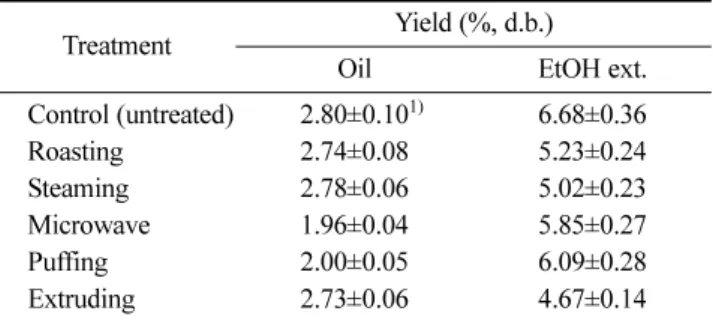
Yield of oil and EtOH extract of waxy corn The yields (%) of corn oils and EtOH extract prepared by 5 different heat pretreatments, such as roasting, steaming, microwave, puffing, and extruding process, are shown in Table 1. The yield of corn oils decreased somewhat by all thermal treatments, and especially considerable decreases were found in the microwave and puffing processes as compared to control. Meanwhile, the yield of the EtOH extract of corn also decreased somewhat by all thermal treatments. Thus, thermal treatments caused a slight decrease in yield of oil and EtOH extract of waxy corn. These results were not consistent with the previous report that heat pretreatment of wet-milled corn improved recovery of corn fiber oil (12). This discrepancy may be attributable to differences of structural modification by heat treatment between wet-milled waxy corn and dry-wet-milled waxy corn. Heat
treatment to the dry-milled waxy corn seems likely not to facilitate the removal of the germ and bran in corn tissues, thereby inhibiting partly extraction of oils and soluble components from waxy corn.
Fatty acid (FA) composition Changes in level of FA compositions of corn oil by the 5 different thermal pretreatments are shown in Table 2. Corn oil (untreated) consisted of 19.6% palmitic acid, 0.1% palmitoleic acid, 2.2% stearic acid, 23.9% oleic acid, 51.7% linoleic acid, 1.6% linolenic acid, 0.5% eicosadienoic, and 0.3% gadoleic acid. There were no significant differences in the FA composition of corn oil among 5 thermal pretreatments. A similar trend was observed in the FA composition of corn fiber (10), rice germ (16), and grape seed (18) oils during the heat pretreatments.
Tocopherol composition Changes in levels of 4 tocopherol isomers in corn oils prepared by 5 different thermal pretreatmetns are shown in Table 3. Among the 4 tocopherol isomers, 2 tocopherols, α- and γ-tocopherol,
were detected in any of the corn oils after heat processing. The content of α- and γ-tocopherols in corn oil considerably
decreased by 5 heat pretreatments, and especially a great decrease was found in the steaming process. Thus, these result support earlier report that steaming caused a considerable decrease in α-tocopherol levels of rice germ
oil (16). Contrary to these result, the previous study indicated that the content of α-tocopherol in rice germ oil
gradually increased by roasting and microwave heating (16). Thus, quantitative changes in tocopherol according to heat pretreatments could be affected by different processing conditions and plant seed types.
Phytosterol composition Quantitative changes in 3 phytosterols in corn oil by the 5 different thermal pretreatmetns are shown in Table 4. Three phytosterol derivatives, campesterol, stigmasterol, and β-sitosterol,
were identified, of which β-sitosterol was a predominant
phytosterol in corn. Corn oil (untreated) had 291.42 mg% campesterol, 147.54 mg% stigmasterol, and 809.98 mg%
β-sitosterol. Four thermal processings except the extruding
process considerably decreased levels of the 3 phytosterols up to totaling ca. 20, 18, and 13%, respectively, as compared to the control, and especially a moderate decline was found in the steaming process. However, no significant change on Table 1. Yield of oil and EtOH extract of waxy corn prepared
by 5 different thermal pretreatments
Treatment Oil Yield (%, d.b.)EtOH ext.
Control (untreated) 1)2.80±0.101) 6.68±0.36 Roasting 2.74±0.08 5.23±0.24 Steaming 2.78±0.06 5.02±0.23 Microwave 1.96±0.04 5.85±0.27 Puffing 2.00±0.05 6.09±0.28 Extruding 2.73±0.06 4.67±0.14
1)Values are mean±SD of duplicate analyses.
Table 2. Quantitative changes in fatty acid composition of waxy corn oils prepared by 5 different thermal pretreatments
Treatment
Fatty acids (mol %) Palmitic acid (C16:0) Palmitoleic acid (C16:1) Stearic acid (C18:0) Oleic acid (C18:1) Linoleic acid (C18:2) Linolenic acid (C18:3) Eicosadienoic acid (C20:0) Gadoleic acid (C20:1) Control 1)19.6±0.31) 0.1±0.0 2.2±0.1 23.9±0.3 51.8±0.4 1.6±0.1 0.5±0.1 0.3±0.0 Roasting 19.6±0.2 0.1±0.1 2.2±0.2 23.9±0.4 51.8±0.3 1.6±0.2 0.5±0.1 0.3±0.0 Steaming 19.6±0.3 0.2±0.0 2.2±0.1 23.8±0.3 51.7±0.5 1.6±0.2 0.6±0.1 0.3±0.1 Microwave 19.5±0.2 0.2±0.0 2.3±0.3 23.9±0.2 51.7±0.5 1.6±0.1 0.5±0.1 0.3±0.0 Puffing 19.6±0.4 0.2±0.0 2.3±0.1 23.7±0.2 51.7±0.4 1.7±0.2 0.5±0.0 0.3±0.0 Extruding 19.5±0.3 0.2±0.0 2.2±0.1 23.8±0.3 51.9±0.5 1.6±0.2 0.5±0.1 0.3±0.1
levels of the 3 phytosterols was observed in the extruding process. Moreau et al. (10) offered a possible explanation
for the heat-induced decrease in the levels of free phytosterols in corn fiber oil, suggesting that free phytosterols evaporate easily under vacuum and high temperature due to their low boiling points. Therefore, the extruding process is considered to be an appropriate thermal pretreatment to retain valuable cholesterol-lowering phytosterol components (19).
Soluble amino acid Quantitative changes in soluble amino acids of waxy corn according to 5 different heat pretreatments are presented in Table 5. Soluble amino acid contents of corn greatly decreased by heat treatments, and especially a severe decline was found in the puffing process. However, the steaming process of 5 thermal treatments rarely affect on levels of soluble amino acids. Additionally, the decrease patterns of essential amino acids are similar to that of total soluble amino acid in all thermally processed corns. Thus, thermal pretreatment was found to reduce soluble amino acids levels of waxy corn. It was already well-known that corn is deficient in the essential amino acids lysine and tryptophane; however, it contains a relatively high percentage of the sulfur-containing amino acids, methionine, and cystine (1). Two essential amino acids, tryptophane and methionine, were not detected in soluble amino acid fraction of this study.
Hydroxycinnamic acid derivatives (HCADs) Phenolic acids of corn are present in the free, esterified, soluble conjugates, and insoluble-bound forms (20). In particular, corn contains high levels of derivatives (HCADs), such as ferulic acid and p-coumaric acid, and their polyamine
conjugates, DCP, CFP, and DFP (12,13), which have been reported to have several biological effects including
antidiabetic, antioxidative, and anti-melanogenic activities (4-6). Thus, phenolic compounds of corn are receiving a renewed interest as dietary functional sources with health-promoting properties. We determined changes of 5 HCADs in a waxy corn according to heat pretreatments. As shown in Table 6, most of thermal pretreatments greatly increased levels of 2 free cinnamic acids, p-coumaric acid (CA) and
ferulic acid, and especially steaming and puffing processes significantly increased about 2-5 times as compared to control (untreated). However, other thermal processing did not greatly affect on levels of 3 polyamine conjugates, although some thermal pretreatments increased somewhat levels of 3 polyamine conjugates. Thus, it is very interesting to note that the steaming and puffing processes greatly increased levels of 2 free cinnamic acids, especially increased ferulic acid contents. These results partly supported a previous report that thermal processing increased antioxidant ferulic acid content in sweet corn (13). Dewanto et al. (13) offered a possible explanation for
the heat-induced increase in the levels of ferulic acid in sweet corns, suggesting that thermal processing releases bound phenolic acids in cell wall. Therefore, the puffing process, together with the steaming process, is also considered to be a good thermal pretreatment to enhance the levels of phytochemical ferulic acid in corns. Additionally, quantitative change pattern of 3 polyamine conjugates of waxy corn during heat pretreatments were similar to earlier reports that roasting of plant seeds caused a increase in the levels of some functional constituents but a decrease in other phytochemicals (16,18). Thus, these results indicate that the heat pretreatments considerably increased levels of 2 free cinnamic acids, but differently affected on compositions of polyamine conjugates.
In conclusion, the 5 thermal processes, such as roasting, Table 3. Quantitative changes in 4 tocopherol derivative concentrations of waxy corn oil prepared by 5 different thermal pretreatments
Treatment Tocopherol (mg%, corn oil)
α- β- γ- δ- Total Control 11.24±0.311) ND 42.03±0.52 ND 53.27±0.67 Roasting 7.70±0.18 ND 23.90±0.27 ND 31.60±0.43 Steaming 7.47±0.14 ND 20.86±0.28 ND 28.33±0.28 Microwave 8.03±0.20 ND 26.47±0.21 ND 34.50±0.40 Puffing 9.48±0.23 ND 28.19±0.23 ND 37.67±0.45 Extruding 8.60±0.22 ND 26.33±0.25 ND 34.93±0.39
1)Values are mean±SD of duplicate analyses; ND, not detected.
Table 4. Quantitative changes in phytosterol concentrations of waxy corn oil prepared by 5 different thermal pretreatments
Treatment Campesterol StigmasterolPhytosterol (mg%, corn oil)
β-Sitosterol Total sterol1)
Control 2)291.42±3.542) 147.54±2.220 809.98±6.43 1,248.94±4.84 Roasting 260.69±2.39 87.90±1.32 744.99±4.64 1,093.58±3.36 Steaming 220.81±2.38 95.74±1.43 670.67±6.28 0,987.22±4.21 Microwave 225.03±2.40 95.86±1.45 680.47±5.78 1,001.36±3.82 Puffing 206.98±2.28 73.27±2.03 750.90±5.37 1,031.15±4.12 Extruding 299.00±3.83 127.46±2.830 858.09±7.26 ,1,284.55±4.94 1)Campesterol+stigmasterol+β-sitosterol. 2)Values are mean±SD of duplicate analyses.
steaming, microwave, puffing, and extruding, considerably influenced on phytochemical profiles and contents of waxy corn. In particular, the extruding process has a positive effect on the levels of functional constituents (tocopherols, phytosterols, and HCADs) of waxy corn except soluble amino acid, as compared to other thermal processes. This fact inferred that an effective heating time of the extruding process is very shorter than that of other heat treatments. Further study is needed to investigate the optimum extruding conditions for producing high quality of waxy corn products.
Acknowledgments
This study was partly supported by research grant (107096-3) by Technology Development Program for Agriculture and Forestry, Ministry for Agriculture, Forestry, and Fisheries, and by the Korea Science and Engineering Foundation (KOSEF) grant funded by the Korea government (MEST) (No. S2-2008-000-00155-1) in 2008. We are grateful to Mr. Ki-Yong Lee, Instumental Analysis Center, Catholic University of Daegu, Gyeongsan, Gyeongbuk, Korea, for analysis of amino acid.
Table 5. Quantitative changes in soluble amino acid levels of waxy corn prepared by 5 different thermal pretreatments
Amino acid Control Roasting SteamingContent (mg%, d.b.)Microwave Puffing Extruding
O-Phospho-L-serine 1.041) 2.32 ND 2.20 ND 1.0 O-Phosphoethanolamine 2.87 3.52 5.88 ND ND ND Threonine 7.76 4.20 6.37 3.90 2.00 4.02 Serine 6.16 3.18 8.08 3.23 1.82 3.37 Asparagine 12.99 7.60 4.56 7.20 ND 5.38 Glutamic acid 30.30 18.06 39.30 15.62 6.74 13.43 Proline 33.34 20.00 23.33 18.46 5.74 12.82 Glycine 8.91 4.65 2.09 4.31 2.70 4.33 Alanine 34.29 19.96 44.52 17.61 13.19 19.69 α-Aminobutyric acid 3.61 ND ND ND ND ND Valine 10.82 5.35 6.43 4.65 2.76 5.75 Cystathionine ND 1.12 ND ND ND ND Isoleucine 4.89 2.71 3.71 2.28 0.91 3.91 Leucine 3.05 1.29 1.61 0.91 ND 3.13 Tyrosine 4.87 2.31 2.40 2.03 0.49 2.88 β-Alanine 5.23 2.58 1.51 2.59 1.33 3.30 Phenylalanine 2.28 0.94 1.58 1.16 ND 1.78 γ-Aminobutyric acid 18.45 9.10 7.28 8.47 3.46 10.79 Ethanolamine 3.69 1.41 ND 1.40 0.79 1.14 Ammonium chloride 3.28 2.81 2.19 3.03 8.35 3.30 Lysine 2.28 1.08 1.10 1.04 0.32 1.78 Histidine 1.71 0.65 0.65 0.64 ND 0.90 Arginine 4.32 2.03 ND 1.81 ND 2.90
Essential amino acid 31.08 15.57 20.80 13.94 5.99 20.37
Total amino acids 206.14 116.87 162.59 102.54 50.60 105.60
1)Values are mean±SD of duplicate analyses; ND, not detected.
Table 6. Quantitative change of 5 HCADs in waxy corns prepared by 5 different thermal pretreatments
Treatment CA FA HCAD1)CFP (µg/g, d.b.) DCP DFP Control Tr Tr 014.29±1.02a2) 7.82±0.22c 35.74±1.31c Roasting 2.10±0.07b 4.30±0.13b 10.37±0.73b 8.02±0.31b 47.36±1.52a Steaming 2.69±0.09a 5.17±0.12a 13.12±0.10a 7.42±0.27c 35.02±1.14c Microwave 2.06±0.04b 4.10±0.09b 10.45±0.82b 8.98±0.51a 41.32±1.22b Puffing 2.29±0.08b 5.18±0.11a 12.29±0.92a 8.15±0.48b 45.78±1.28a Extruding 1.09±0.02c 1.69±0.10c 10.25±0.84b 6.76±0.20d 31.72±1.10d
1)HCAD, hydroxycinnamic acid; CA, p-coumaric acid; FA, ferulic acid; CFP, N-p-coumaroyl-N'-feruloylputrescine; DCP, N,N
'-dicoumaroyl-putrescine; DFP, N,N'-diferuloylputrescine.
2)Values are mean±SD of triplicate analyses; Tr, trace (<1 mg/g); Values with different letters within each column are significantly different at
References
1. Plate AYA, Gallaher DD. The potential health benefits of corn components and products. Cereal Food World 50: 305-314 (2005) 2. Ribaya-Mercado JD, Blumberg JB. Lutein and zeaxanthin and their
potential roles in diaease prevention. J. Am. Coll. Nutr. 23: 567S-572S (2004)
3. Hicks KB, Moreau RA. Phytosterol and phytostanols: Functional food cholesterol busters. Food Technol. -Chicago 55: 63-67 (2001) 4. Niwa T, Doi U, Osawa T. Inhibitory activity of corn-derived
bisamide compounds against α-glucosidase. J. Agr. Food Chem.51: 90-94 (2003)
5. Mellon JE, Moreau RA. Inhibition of aflatoxin biosynthesis in
Aspergillus flavus by diferuloylputrescine and p -coumaroylferuloylputrescine. J. Agr. Food Chem. 52: 6660-6663 (2004)
6. Choi SW, Lee SK, Kim EO, Oh JH, Yoon KS, Parris N, Hicks KB, Moreau RA. Antioxidant and antimelanogenic activities of polyamine conjugates from corn bran and related hydroxycinnamic acids. J. Agr. Food Chem. 23: 1090-1092 (2007)
7. Yen GC. Influence of seed roasting process on the changes in composition and quality of sesame (Sesame indicum) oil. J. Sci. Food Agr. 50: 563-570 (1990)
8. Shin TS, Godber S, Martin DE, Wells JH. Hydrolytic stability and changes in E vitamers and oryzanol of extruded rice bran during storage. J. Food Sci. 62: 724-728 (1997)
9. Martinez-Tome M, Murcia MA, Frega N, Ruggieri S, Jmenez AM, Roses F, Parras P. Evaluation of antioxidant capacity of cereal brans. J. Agr. Food Chem. 52: 4690-4699 (2004)
10. Moreau RA, Hicks KB, Powell MJ. Effect of heat pretreatment on the yield and composition of oil extracted from corn fiber. J. Agr.
Food Chem. 47: 2869-2871 (1999)
11. Saulnier L, Marot C, Elgorriaga M, Bonnin E, Thibault JF. Thermal and enzymatic treatments for the release of free ferulic acid from maize bran. Carbohyd. Polym. 45: 269-275 (2001)
12. Singh V, Johnston DB, Moreau RA, Hicks KB, Dien BS, Bothast RJ. Pretreatment of wet-milled corn fiber to improve recovery of corn fiber oil and phytosterols. Cereal Chem. 80: 118-122 (2003) 13. Dewanto V, Wu X, Liu RH. Processed sweet corn has higher
antioxidant activity. J. Agr. Food Chem. 50: 4959-4964 (2002) 14. Solihin BW, Kim MH, Im BS, Cha JY, Ryu GH. Effects of feed
moisture content on enzymatic hydrolysis of corn starch in twin-screw extruder and saccharification of the dried extrudates. Food Sci. Biotechnol. 16: 381-385 (2007)
15. Imported Agricutural Produce Census. Available from: http:// www.nso.go.kr. Accessed Feb. 20, 2009.
16. Kwon JY, Lee KT, Yun TM, Choi SW. Effect of heat pretreatments on the functional constituents of rice germ. J. Food Sci. Nutr. 9: 330-335 (2004)
17. Kim EO, Lee KT, Choi SW. Chemical comparison of germinated-and ungerminated-safflower (Carthamus tinctorius) seeds. J. Korean Soc. Food Sci. Nutr. 37: 1162-1167 (2008)
18. Lee KT, Lee JY, Kwon YJ, Yu F, Choi SW. Changes in functional constituents of grape (Vitis vinifera) seed by different heat pretreatments. J. Food Sci. Nutr. 9: 144-149 (2004)
19. Ling WH, Jones PJH. Dietary phytosterols: A review of metabolism, benefits, and side effects. Life Sci. 57: 195-206 (1995) 20. Sosulski F, Krygier K, Hogge L. Free, esterified, and insouble-bound phenolic acids. 3. Composition of phenolic acids in cereal and potato flours. J. Agr. Food Chem.30: 337-340 (1982)