36-2 / H. Jorke
IMID 2009 DIGEST •
Abstract
A wavelength multiplexing based stereoscopic 3D-LCD will be introduced. A new 120 Hz scanning RGB-backlight unit was developed. This RGB-backlight module was combined with a standard 120Hz LCD. The 3D-LCD based on interference filter glasses offers an outstanding channel separation and a wide viewing angl.
1. Introduction
Stereo imaging techniques based on interference filter technology have gained a plenty of interest in the last few years in projection system applications as cinema1 and simulation visualization. Common
feature of these techniques is the high degree of realism experienced when image content is provided in a most natural way, namely in a way that the viewer perceives two independent images for the right and left eye.
In this report, we describe our results of transferring this wavelength multiplexing scheme2 to direct view
LCD applications. A demonstrator as described was setup.
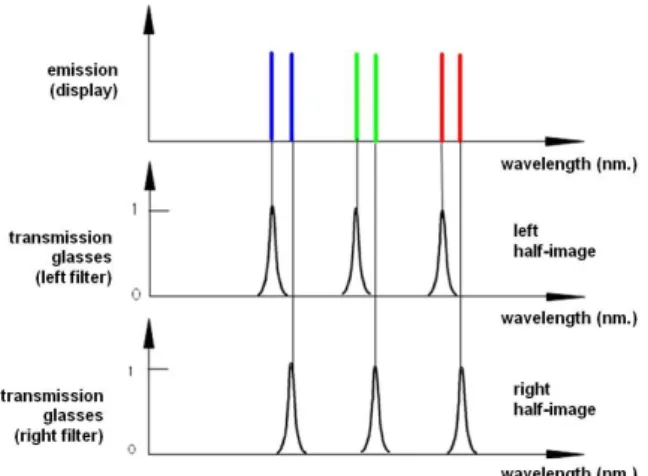
The desired system is based on wavelength multiplexing principle which codes image information in different spectral ranges. To separate the image information and to assign the correct image information to the respective eye, each eye has to be supplied with a narrow bandwidth filter. This filter must have a triple band characteristic to transmit selectively the narrow bands associated with the image content coded in these narrow bands. Using, for instance, two triples of narrow bands, stereoscopic images can be shown by wavelength multiplexing where each image is a full-color image
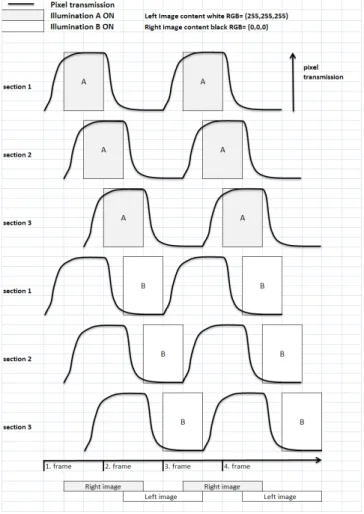
Images are time sequentially coded and refreshed at a frame rate of 120 Hz. The left and right images are illuminated with the two complementary spectra. However, the fact that the LCD is a hold type display where parts of the left and right image content are displayed at the same time requires a scanning
backlight. Image separation at the viewer is given by compatible interference filters glasses.
Figure 1: Stereo display principle using two wavelength emission triples and two matching complementary spectral filter sets for the glasses.
2. Experimental
The demonstrator setup uses the 120 Hz Samsung SyncMaster 2233RZ 22” Monitor. Combined with the Nvidia 3D vision package and a Geforce graphic card this system supports 120 Hz page flipping in the open GL mode. Instead of the commercially available shutter glasses we designed a system based on the interference filter technology (INFITEC).
Core of the system is a LED based scanning direct backlight unit. The screen is sectioned into 3 scanning sub regions which can be illuminated with the spectral filter characteristic A or B. The driving unit allows the individual timing adjustment of each region relative to the synchronization signal form the graphics card. A color sensor is used to control the white balance.
As light source 192 Lumileds Rebel LEDs were used. Each interference filter spectral range consists of 48 LEDs out of one color bin. Maintaining the transmission spectrum of the interference filters also
Interference filter based stereoscopic 3D-LCD
Helmut Jorke, Marc Parger, Arnold Simon, Sergej Schwarz, Markus Fritz
Infitec GmbH, Ulm, 89077, Germany
Tel.:+49 731 550299-57, E-mail: [email protected]
36-2 / H. Jorke
• IMID 2009 DIGEST
requires the control of the light incident angle to be less than ±15°. Therefore an additional optic is used to shape a parallel light beam which passes the interference filter.
Figure 2: Backlight unit composed of two spectral complementary illumination sources A and B
Figure 3: Backlight time multiplexing scheme
3. Results and discussion
The channel separation of the system is determined by the blocking characteristics of the two complementary interference filters and the switching time of the LCD. Filter blocking values is below 1% and therefore no subject to further improvement3.
However, the LCD gray to gray switching time may last for the entire frame. Therefore we recommend a short illumination frame to suppress crosstalk due to switching time effects.
The viewing angle of this display is basically not changed by using the wavelength multiplexing principle.
4. Summary
The wavelength multiplex technology copes with the image sequence of hold type displays like LCDs. Crosstalk can be kept insignificant by maintaining a short and constant illumination frame in reference to the driving sequence. The presented system is independent of the polarization state and the LC mode of the LCD.
Acknowledgement
The interference filter components for this demonstrator were designed and produced by Optic Balzers, Liechtenstein. This work was supported by the fund Pro Inno II of the German Department of Trade and Industry.
5. References
1. M. Pölönen, M. Salmimaa, V. Aaltonen, J. Häkkinen, and J. Takatalo, “Subjective measures of presence and discomfort in viewers of color-separation-based stereoscopic cinema”, Journal of the SID 17/5, 459-466 (2009)
2. H. Jorke, A. Simon and M. Fritz, “Advanced
Stereo Projection Using Interference Filters”, Journal of the SID 17/5, 407-10 (2009)
3. R Patterson, “Spatio-temporal properties of stereoacuity,” Optometry and Vision Science 67, 123–5 (1990).