INTRODUCTION
Presently, the agrochemicals used for preventing damage to vegetables fruits, flowering plants and grains caused by plant pathogens and noxious insects are usually in a liquid form, or in a particle form blended with a carrier. The effec-tive constituents can be released out of the region easily or make the soil acidic. They can also be evaporated and thus be rapidly reduced. Therefore, the duration of plant disease control is usually short, and thus a large quantity of agro-chemicals should be applied over the recommended dose. It
seriously has a bad effect on the health of farmers or the users of farm products. Agrochemicals can also cause serious environmental pollution if they are dispersed continuously, since salts of agrochemicals are accumulated in the soil.
A number of researchers are trying to regulate the activa-tion period of agrochemicals and to create a sustained- re-leasing property. In particular, agrochemicals in a solid or liquid form have been developed to discharge their effective components as a controlled pattern and to sustain their effec-tiveness for a long time, even when spread only once at a recommended concentration. Some of these demonstrated methods include the process for inserting the constituents into a microcapsule, converting the ingredients into cyclo-dextrin, and methods for blending effective constituents of
─ ─ 305 ──
Development of Sustainable Releasing Micro Formulation
System using γ-Irradiation Technique to Control Phytophthora
Blight Disease
Hae-Jun Park*, Hwa-Jung Kim and Dong Ho Kim Radiation Research Division for Biotechnology
Advanced Radiation Technology Institute, Korea Atomic Energy Research Institute Jeongeup 580-815, Korea
Abstract --We introduced a novel sustainable slow-releasing agrochemical formulation, a biopoly-mer bound to silica, for controlling plant diseases. The formulation was obtained through the fol-lowing process. Curdlan, sodium silicate (Na2SiO3) and isopropyl alcohol were dissolved in DDW
(Deionized-distilled water). The resultant solution was then irradiated using a 60Co γγ-irradiator
(150 TBq of capacity; ACEL, Canada) at KAERI. The resultant solution was treated with phos-phorous acid (H3PO3). Finally, we obtained a novel biopolymer-silica microsized formulation
con-taining phosphorous acid (H3PO3) from the solution. The morphology of the complex was
charac-terized using scanning electron microscopy (SEM) and transmission electron microscopy (TEM). SEM and TEM images revealed that the curdlan-silica formulation has a particle size ranging from 1 to 3μμm with high stability. We also detected that H3PO3was distributed within the
formu-lation through energy dispersive X-ray spectroscopy (EDX) analysis. H3PO3was sustain-released
from the formulation in water. Based on our results, it seems effectively that one or two applica-tions of the formulation during a cropping season will assist in controlling various plant diseases. Key words : Micro formulation, Sustainable releasing, γγ-irradiation, Plant disease, Phosphorous
acid
* Corresponding author: Hae-Jun Park, Tel. +82-63-570-3190, Fax. +82-63-570-3149, E-mail. [email protected]
agrochemicals into a particle or powder form independently or with an extender or other device, and then covering the nucleus of the particle with wax or various kinds of resins (Ohtsubo 2003; Tsuji 2003). Unfortunately, these methods have some disadvantages like i) procedures are too compli-cated; ii) the materials used are expensive and iii) a harmful effects on the environment.
To overcome these disadvantages, sustained-releasing agrochemicals composed of eco-friendly materials need to be developed. Some studies have illustrated a method for the conferring a sustained-releasing property in a pesticide, in which the agrochemicals are dissolved with a solvent and introduced into a biodegradable resin molded in a plate form. However, these methods also include complicated proce-dures and create environmental problems, since toxic com-pounds such as organic solvents are employed for the prepa-ration. In addition, they require considerable cost.
Phosphorous acid (H3PO3), which effectively controls vari-ous oomycetic diseases, is a unique phloem-tanslocated fungicide that moves upward and downward through the xylem and phloem in plants (Fenn et al. 1984; Stanghellini and Rasmussen 1994; Jee et al. 2002). H3PO3is widely ap-plied for trunk injection, soil drenching, foliar sprays, or di-rect supplements as nutrient solutions in hydroponics (Bar-chietto et al. 1988; Smillie et al. 1989; Feorster et al. 1998; Jee et al. 2002). However, soil drenching and foliar spray may not be as effective as trunk injection or a direct supple-ment because of run-off, leaching, and inactivation in soils. Consequently, sustainable forms of the chemical releasing slowly in the root zone are ideally taken up by plants to pro-tect against oomycetic diseases.
The aim of the present study was to provide a novel pro-cess for preparing sustained-releasing microformulation using γ-irradiation for enhancing the efficacy of the agro-chemical in field and reducing the labor costs.
MATERIALS AND METHODS
ChemicalsSodium silicate solution (Na2SiO3) and phosphorous acid (H3PO3, 99.8%) were prepared using analytical reagent grade. Curdlan was purchased from the Kirin-Food Tech Company (Japan) and isopropyl alcohol from the Aldrich
-Sigma chemical company. The solutions were prepared with purified water in a Milli-Q Plus water purification system (Millipore Co. Ltd. USA; final resistance of the water was 18.2 MΩ cm-1) and degassed prior to each measurement.
Preparation of the products
A sustainable-releasing micro-formulation was obtained as follows Curdlan (0.5 g), sodium silicate (Na2SiO3) (1.0 g) and isopropyl alcohol (20 ml) were dissolved in DDW (Dei-onized-distilled water) and made the total volume to 200 ml. The resultant solution was irradiated with γ-rays using a 60Co γ-irradiator (150 TBq of capacity; ACEL, Canada) at ARTI-KEARI; Korea. The resultant solution was treated with H3PO3(1.0 g), and then gently shaken for 10 minutes. After 1 hour, the colloidal solution was dried by a freeze dryer to obtain the final product. The surface morphology of the products was determined using field emission-scanning electron microscopy (FE-SEM, SU-70, HITACHI, Japan) and transmission electron microscopy (TEM, HD-2300, HI-TACHI, Japan).
Analysis of sustained-releasing pattern
To elucidate the sustained-releasing property of the pre-pared formulation containing H3PO3prepared in the present study, the aquatic discharge property was investigated under the same condition as that of the practical use. Concretely, 0.1 g of the prepared formulation was added to 200 ml of DDW and stored for 15 minutes in room temperature. The supernatant containing the ingredient was then recovered and the concentration of H3PO3was measured by performing ion chromatography (IC, ICS 2000, Dioxe, USA).
Preparation of effective preventive test to control plant pathogen
The preventive effects of the sustained-releasing product system were examined in a green house for control of red pepper phytophthora blight disease (a kind of oomycetic dis-ease). The experiment was performed by inoculating the pathogen, Phytophthora capsici, artificially. Twenty five ml of the zoospore suspension (1×10⁴ cfu ml-1) was drenched onto each pepper plant. Through the entire experimental pro-cedure, water was supplied sufficiently in a 3-day interval. The effects of the pathogen inoculation were examined after
3 weeks.
Four experimental groups, each containing 12 plants of red pepper (variety “Rockwang”) were adopted for the experi-ment. A control group that was not treated with phosphorous acid salt was maintained. A comparative group of red pepper that was treated with 100 and 1,000 ppm of phosphorous acid salt in liquid state (20 ml plant-1) around the region adjacent to the soil and stem. The experimental groups were treated with the sustained-releasing formulation product (50 mg plant-1). The invasion frequency of red pepper disease (phytophthora blight) was calculated at 3 weeks after treat-ment and the preventive effects against phytophthora blight were evaluated in each group. The disease control value was calculated using the following formula: Disease control val-ue (%)==((A-B)/A)×100, where A is the disease severity
triggered by pathogen inoculation alone and B is the disease severity after various treatments.
RESULTS AND DISCUSSION
Curdlan-silica micro formulationIn the present study, the term “sustainable-releasing micro formulation” means a complex comprised of microsized for-mulations that are combined with a network of curdlan and silica molecules which allow the sustainable-release of che-micals.
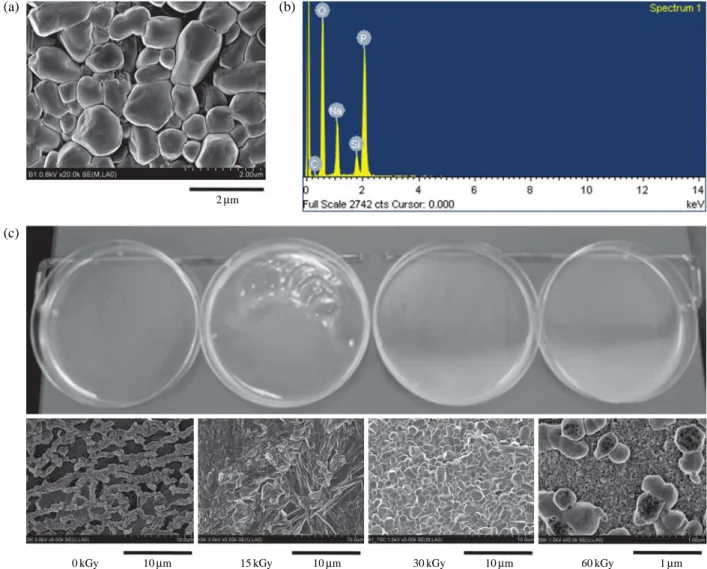
SEM images and EDX (Energy dispersive X-ray spectro-scopy) analysis show uniform spherical type morphology with an average size of 2μm, and the formulation is
contain-Fig. 1. FE-SEM analyses of a sustainable releasing microformulation containing H3PO3: (a) FE-SEM analysis, (b) EDX spectrum, (c) FE
-SEM analysis of the formulations irradiated with different dose of γ-irradiation.
0 kGy 10μm 15 kGy 10μm 30 kGy 10μm 60 kGy 1μm
(a) (b)
(c)
ed in H3PO3(Fig. 1a, b). The curdlan-silica compound poly-mers, which were irradiated by γ-ray (30 kGy), built up a micro formulation complex after the addition of H3PO3(Fig. 1c). The polymers irradiated with 15 kGy γ-ray was made only into a matrix after the treatment with H3PO3. A 60 kGy treatment caused the many nanoparticles with microparticles. Unfortunately, the formulation using 60 kGy γ-ray irradia-tion is not able to be used in the agriculture field because nanoparticles are not yet permitted for agrochemical formu-lation. The morphology of the formulation complex was also imaged by TEM, as shown in Fig. 2. Structural characteri-zation showed that there were significant interactions observ-ed among the silica, curdlan, and H3PO3molecules. Each curdlan-silica compound polymer was networked by H3PO3 in the formulation.
We suggest an illustration to understand the reaction me-chanism for the formation of the formulation complex con-taining phosphorous acid through γ-irradiation (Fig. 3). It was reported that an organic-inorganic hybrid matrix was formed from the polymer and silicate solution containing isopropyl alcohol by heat treatment (Bae 2001). In the pre-sent study, the formulation reprepre-sents a structure in which microsized particles are formed from curdlan-oligomer whi-ch is curdlan-polymer cut by γ-ray of 30 kGy or more (Byun et al. 2008; Park and Kim 2010), and silicate simultaneously Fig. 2. TEM analysis of a sustainable slow-releasing micro-
formu-lation containing H3PO3(a) 1μm scale and (b) 60 nm scale.
(a)
(b)
Fig. 3. Preparation of a sustainable slow-releasing micro-formulation using γ-irradiation. Curdlan Curdlan-silicon compound Hybrid polymer Add acid γ-irradiation Curdlan in Silicate solution
polymerized with isopropyl alcohol by γ-irradiation, and through a networking interaction with the addition of acid (H3PO3) inside the formulation.
A sustained-releasing analysis
The sustained-releasing property of the prepared formula-tion containing H3PO3was investigated in a one-time water supply in field. Only 5% of the H3PO3was released from the formulation at 3 hours after being added the formula-tion in the water. The concentraformula-tion of H3PO3gradually in-creased in water, and about 25% was released during at least a day after the treatment (Fig. 4). It is observed that the formulation slowly released H3PO3at the rate of 2~3% per
a day.
The sustained-releasing micro-formulation system prepar-ed in the present study dischargprepar-ed its effective component (H3PO3) only in the aquatic condition. The curdlan in system has a unique networking structure if acid is added into the KOH-curdlan solution (Sato et al. 1978; Park et al. 2007). Therefore, we confirmed that the curdlan networking struc-ture was constituted in the formulation by the above method. The networking structure was opened only in the aquatic condition, and the network closed again in a dry condition (Marchessault et al. 1977; Sato et al. 1978; Fulton et al. 1980; Stone and Clark 1992; Park et al. 2007). Therefore, the formulation system is able to prevent or reduce phos-phorous acid run-off in soils.
Formulation system to control plant pathogens effectively
As illustrated in Table 1, the highest control effect (88.9%) was observed in sustained-releasing product formulation
Fig. 4. Sustained-releasing rate of H3PO3phosphorous acid from
the prepared micro formulation. The bars indicate the stan-dard deviation from the mean in three experiments.
3 12 24 48 72 Hours Releasing rate (%) 35 30 25 20 15 10 5
Table 1. Effects of the sustainable slow releasing micro formulation
on the control of phytophthora blight in red pepper at 3 weeks after treatment
Dosage Disease Disease
Treatment
/plant incidence (%) control value (%) Micro formulation 50 mg 20 ml-1 10.00 88.90 (40% H3PO3product-1) H3PO3(1,000 ppm) 20 ml 35.00 53.81 H3PO3(100 ppm) 20 ml 66.67 24.77 Control - 80.00
-Fig. 5. The chemical injuries of red pepper plants caused by a high concentration of commercial product containing H3PO3. (a) water
treatment (20 ml), (b) 25 mg 20 ml-1, (c) 50 mg 20mL-1, (d) 500 mg 20 ml-1of the formulation product (40% H
3PO3product-1).
(a) (b)
system (40% H3PO3product-1) which showed the controlled release of the effective component (H3PO3). It is observed that the disease control effect (88.9%) of the formulation systems increased by 1.65 and 3.59 times of the comparative group treated with 1,000 ppm and 100 ppm of H3PO3salts, respectively.
In the present study, it is observed that the micro formu-lation system can maintain its efficacy during about 20~30 days of treatment (Table 1), and has no phytotoxicity in the formulation after treatment (Fig. 5). The results showed that the discharge of the effective component was controlled pro-perly in the micro formulation system and that preventive effects against the phytophthora blight were detected to be complete. Based on these results, it seems that one or two applications of the formulation during a cropping season may satisfy the control of phytophthora disease on various crops. This sustained-releasing phosphorous acid system can be also beneficial for reducing the human labor costs and environmental pollution. Further field trials on several crops for the control of plant diseases by the sustained-releasing micro formulation system are underway.
CONCLUSION
A new microsized curdlan-silica formulation containing phosphorous acid was prepared and conveniently manufac-tured through γ-irradiation at room temperature. The formu-lation released phosphorous acid sustainably in a solution and controlled phythphora blight in red pepper effectively in 3 weeks. Based on our results, it seems that one or two appli-cations of the formulation during a cropping season will be helpful in controlling phytophthora diseases in red pepper plants.
ACKNOWLEDGMENT
This work was supported by the Agriculture and Forestry research development project from the Korea Ministry of Education, Science and Technology. The authors thank the Nano Practical Application Center (NPAC) for FE-SEM and TEM analysis and would also like to thank Mr. Lee B.-C., Mr. Jeon K. S. and Mr. Yun Y.-M. for technical support of electron microscopy. Authors gratefully acknowledge Prof.
Kim H.-G. for his valuable scientific discussion of finding.
REFERENCES
Bae BS. 2001. Inorganic-organic hybrid matrials coating. Ploy-mer Science and Tech. 12:716-723.
Barchietto T, Sainrenan P and Bompeix G. 1988. Uptake and utilisation of phosphonate ions by Phyto phthora citrophora and Nectria haematococca in relation to their selective tox-icity. J. Pestic. Sci. 22:159-167.
Byun EH, Kim JH, Sung NY, Choi J, Lim S-T, Kim KH, Yook HS, Byun MW and Lee JW. 2008. Effect of gamma irradia-tion on the physical and structural properties of β-glucan. Radiat. Phys. Chem. 77:781-786.
Fenn ME and Coffey MD. 1984. Studies on the in vitro and in vivo antifungal activity of fosetyl-Al and phosphorous acid. Phytopathology 74:606-611.
Forster H, Adaskaveg JE, Kim DH and Stanghellini ME. 1998. Effect of phosphate on tomato and pepper plants on the sus-ceptibility of pepper to Phytophthora root and crown rot in hydroponic culture. Plant Dis. 82:1165-1170.
Fulton WS and Atkins EDT. 1980. The Gelling mechanism and relationship to molecular structure of microbial polysaccha-ride curdlan. Fiber diffraction methods. Washington. D.C., American chemical society. pp. 385-410.
Guest DL, Pegg KG and Whiley AW. 1995. Control of phyto-phthora diseases of tree crops using trunk-injected phospho-nate. Horticultural Rev. 17:299-330.
Jee HJ, Cho WD and Kim CH. 2002. Effect of phosphonate on the control of phytophthora root rot of lettuce in hydropon-ics. Plant Pathol. J. 18(3):142-146.
Marchessault RH, Deslandes Y, Ogawa K and Sundararajan PR. 1977. X-Ray diffraction data for beta-1,3-D-glucan. Cana-dian Journal of Chemistry 55:300-303.
Ohtsubo T. 2003. Controlled Release in pesticide formulations. J. Pestic. Sci. 28:376-378.
Park HJ, Kim SH and Jee HJ. 2007. Development of a new for-mulation system for sustainable slow releasing of phospho-rous acid in soils to control phytophthora diseases. Plant Pathol. J. 23:26-30.
Park HJ and Kim HJ. 2011. Preparation of nanosized micro element fertilizer formulation by using Gammma-irradiation Technique. J. Radiation Industry 4:347-352.
Saito H, Ohki T and Sasaki T. 1977. A 13C nuclear magnetic resonance study of gel-forming (1,3)-beta-D-gulucans. Evi-dence of the presence of single-helical conformation in a resilient gel of a curdlane-type Polysaccharide 13140 From alcaligenes faealis var. myxogenes IFO13140. Biochemistry
Saito H, Okumura K and Harada T. 1978. Character of curdlan and its application for food. New food Ind. 20:49-57. Smillie R, Grant BR and Guest D. 1989. The mode of action of
phosphite: evidence for both direct and indirect modes of action on three Phytophthora spp. in plant. Phytopathology
79:921-926.
Stanghellini ME and Rasmussen SL. 1994. Hydroponics: a solu-tion for zoosporic pathogen. Plant Dis. 78:1129-1138. Stone BA and Clark AE. 1992. Chemistry and Biology of (1,3)
-beta-Glucan. Victoria, Austrailia, La Trobe univ. Press. pp. 56-78.
Tsuji K. 2003. Pesticide formulation-Its role and resent trend. J. Pestic. Sci. 28:371-375.
Manuscript Received: November 7, 2011 Revised: November 17, 2011 Revision Accepted: December 2, 2011