Received 20 January 2021, Revised 04 March 2021, Accepted 08 March 2021 *Corresponding Author Am-Suk Oh(E-mail: [email protected], Tel: 82-51-629-1211) Department of Digital Media Engineering, Tongmyong University, Busan 48520, Korea.
https://doi.org/10.6109/jicce.2021.19.1.16 print ISSN: 2234-8255 online ISSN: 2234-8883
This is an Open Access article distributed under the terms of the Creative Commons Attribution Non-Commercial License (http://creativecommons.org/licenses/by-nc/3.0/) which permits unrestricted non-commercial use, distribution, and reproduction in any medium, provided the original work is properly cited.
Copyright ⓒ The Korea Institute of Information and Communication Engineering
Design and Implementation of Platform for Monitoring of
Notification System in Firebase Message
Am-Suk Oh* , Member, KIICE
Department of Digital Media Engineering, Tongmyong University, Busan 48520, Korea
Abstract
In this paper, to prevent accidents of school vehicles used by students, which have emerged as a continuous social problem, a boarding and leaving notification system using Bluetooth beacons is proposed. The platform structure uses Bluetooth, a smartphone, and an application, and provides real-time message reception between parents and teachers. It is not simply a system with Bluetooth capability alone, but also an IcT technology that is closely related to real life using two-way communication. The purpose is to provide user-friendly ICT technology as an integrated system for more practical effects. Two-way exchange of information between parents and teachers using cloud servers is made possible. By using this Bluetooth beacon notification system, safety accidents in student vehicles are reduced, which brings confidence from traffic accidents to schoolchildren of parents and teachers. Therefore, it is expected that parents and teachers are expected to improve their mental stability and quality of life from traffic accidents.
Index Terms: Bluetooth beacon, Firebase message, IoT, Life-friendly ICT, Notification system
I. INTRODUCTION
Various safety accidents such as a neglect of students remaining in vehicles and students not boarding have emerged as social issues, and many costs and manpower, including hand-checks by teachers, are being consumed to solve these problems. Despite such efforts, however, such events are not actually decreasing [1].
Bluetooth is indispensable in the current smart age and has become an essential tool. Because it is provided through var-ious technologies, it can permeate people without any sense of incompatibility. In addition, it can be easily applied to real life situations in comparison to technologies that have not yet been used in various fields owing to light security [2].
Bluetooth Beacon Entry and Exit Notification Service is a system in which a teacher recognizes a student’s Bluetooth signal based on information registered by the parent, uploads
the information to the cloud server, and delivers it to the par-ents through push messages.
The purpose of the platform is not to provide one-way applications using simple Bluetooth functions, but to prevent a high rate of occurrence of student accidents at low cost through two-way communication applied through cloud serv-ers. Using accidents as a precautionary measure, the quality of life is improved by lowering the burden on parents and teachers and applying user-friendly ICT technology such as Bluetooth beacons combined with school vehicles.
The purpose of the system is to decrease the rate of acci-dents in school vehicles by providing a boarding and leaving notification system using Bluetooth beacons, which will reduce parent anxiety about childcare.
By allowing parents to check the safety of their children, the system is expected to become an essential parenting plat-form.
through push messages [3, 4].
B. Smart Home Technology
Fig. 2 shows a single-platform hardware manufactured for smart homes [5].
A. Development Environment
Table 1 shows the development environment of the entry and exit notification services using Bluetooth beacons to be developed in this study. The OS used Android, and IDE used Android Studio 3.5. The language uses Java, and the SDK is for Android 6.0 at a minimum, and the most appropriate SDK is for Android 8.0. The resolution was set to 1.440 × 2,560 (560 dpi).
B. Accessories for Entering and Exiting Detection
Table 2 shows the components used for the development of Bluetooth beacons used to detect a student when in a vehicle.
Ultrasonic sensors are used for a better detection of Blue-tooth signals and GPS light modules are applied for vehicle location recognition.
C. Bluetooth Beacon Service Platform Components
Fig. 3 shows the structure of the overall Bluetooth beacon-based entry and exit notification service. When a parent’s smartphone enters information and device information for a student, it is updated on the cloud server. If the teacher’s smartphone recognizes the signal of the Bluetooth beacon of a student who is registered with the cloud server, the infor-Table 1. Detailed development environment
OS Android
IDE Android Studio 3.5
Language Java
Minimum SDK Android 6.0 (Marshmallow: API 23) Optimization SDK Android 8.0 (Oreo: API 27) Resolution 1440 × 2560 (560 dpi)
Fig. 1. Firebase cloud message.
Fig. 2. Smart home.
Table 2. Detailed development environment
ATMEGA168 PRO mini 5V Vehicle entry and exit detector SW Implementation
9-Axix acceleration sensor module IMU For research and development of non-contingent movement detection sensor GPS communication module antenna set 5V For research and development of vehicle location recognition function Ultrasonic distance measuring sensor 4.5M R&D on ride and exit recognition
mation will be updated on the cloud server, and the informa-tion will be sent to the parents through a push message using Firebase [7, 8].
Fig. 4 shows a fully configured cloud server and firebase message. The final goal is not only to provide Bluetooth functionality, but also to provide user-friendly ICT technol-ogy that consists of a single platform by utilizing different servers.
IV. SYSTEM DESIGN
Fig. 5 shows the overall composition of the entry and exit alarm service platform using Bluetooth beacons, which con-sists of the teacher’s application, parent’s application, and cloud server.
Fig. 6 shows how parents upload information from stu-dents, the unique addresses of the Bluetooth tokens, and the unique addresses of the devices to the server. Information can be updated through the application.
Fig. 7 shows a teacher’s application, which recognizes the Bluetooth signal of the Bluetooth beacons for the boarding,
unloading, and maintenance status; updates the cloud server, including the student information; and delivers push mes-sages to the parent’s application using Firebase [9].
Fig. 8 shows the cloud server, which provides the original information to the teacher’s applications and provides a real-time exchange of information such that the boarding status can be checked by parent’s application. Firebase plays a role in delivering push messages to parents based on updated entrance and exit information from the cloud server. The Bluetooth beacon entry and exit notification system has a structure that recognizes the signal of the Bluetooth beacons as being from a teacher’s device based on the information stored in the cloud server and delivers it to the parents. Fig. 5. Bluetooth beacon platform components.
Fig. 6. Parent device and cloud server components.
Fig. 7. Teacher device and Bluetooth beacon components.
Fig. 8. Notify parent’s components.
Fig. 3. Hardware component.
all permissions are granted, or the screen is turned over to perform monitoring or notification functions at touch [10].
Fig. 10 shows a screen where students enter their personal information, beacon addresses, and tokens for receiving push messages. Previously, if there is no registered information, a Register button will appear instead of a Cancel button, and after entering the student’s personal information, the Beacon Address will open a window where the user can select the surrounding Bluetooth beacon address when clicking Scan. A Push Token automatically enters the information on the device when pressing Get. When clicking the Update or Register button after finishing these inputs, the information entered is sent to the cloud server and registered [11].
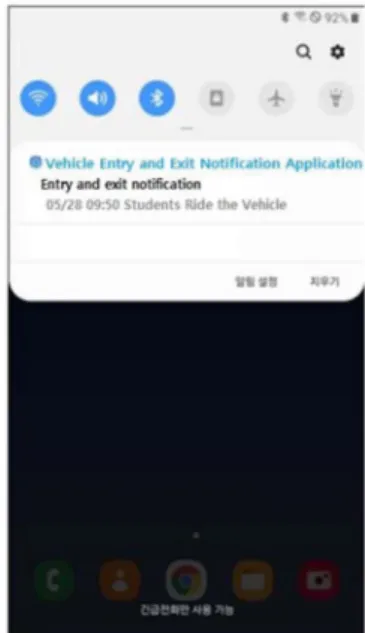
Fig. 11 shows a push message screen that appears when a student gets on and off the vehicle. The teacher recognizes the Bluetooth beacon signal when the student is on board
Fig. 12. Entry and exit status notification service screen.
Fig. 11. Push message receiving screen.
Fig. 9. Main screen of application.
Fig. 13 shows the teacher’s in-vehicle student monitor screen. If the status of entering and exiting the car is changed, the information is printed on the screen and updated on the cloud server, and a push message is sent to the parent’s application through Firebase [12, 13]
This Bluetooth beacon-based notification system is expected to prevent student accidents and reduce the anxiety of parents and teachers due to commuting accidents [14].
VI. EXPERIMENTS
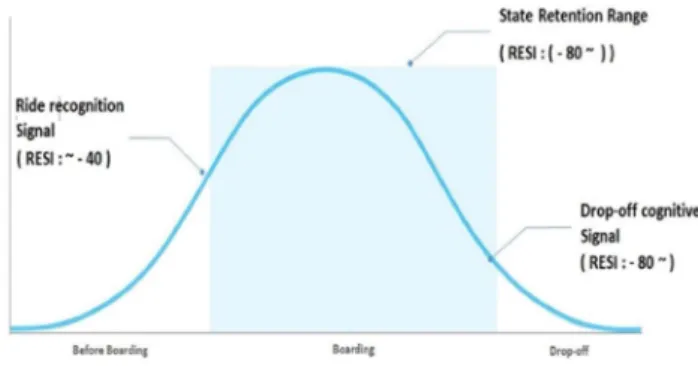
Fig. 14 shows the strength of the Bluetooth signal. It starts to be recognized as a ride from the designated signal strength, and if it is within a certain range, it will be changed to a
drop-off if it deviates from a ride.
Fig. 15 shows a graph of the Bluetooth signal strength rec-ognizing an entry and exit. The light blue is the range of the ride recognition, and when entering, it is recognized as a drop-off if it is outside of the vehicle. As such, a slightly higher standard was set for the ride and a larger range for the drop-off. Figs. 14 and 15 show only the measurement of a signal in an empty space and the strength of the signal using a Galaxy S10 for Bluetooth beacons, respectively.
VII. CONCLUSIONS
Accidents such as a neglect of students while riding a commuting vehicle and the absence of students at school are becoming issues, and many policies and techniques are being considered to solve them.
The purpose of this paper is to provide a notification ser-vice for student commuting vehicles utilizing Bluetooth bea-cons, smartphones, applications, and cloud servers. The purpose of this technology is to provide more cost and time efficiencies than other technologies, provide real-time deliv-ery through cloud servers rather than just Bluetooth technol-ogy, and establish itself as a user-friendly ICT technology by utilizing technologies that will not be difficult to immedi-ately apply.
By using these technologies, student accidents can be pre-vented more efficiently, thereby relieving the burden of teachers and parent anxiety, and improving their overall quality of life.
The quality of education is improved by reflecting various technologies in nurturing talent, and the use of Bluetooth signals as technical contributions provides options for utilizing Bluetooth functions in various fields as well as commuting.
ACKNOWLEDGEMENTS
This study was supported by the BB21+ project in 2020. Fig. 13. School vehicle monitoring screen for teacher.
Fig. 14. Bluetooth entry and exit signal strength.
Bluetooth low energy beacon,” 2019 Fourth International Conference on Informatics and Computing, Information and Commucation Engineering, vol. 20, no. 7, pp. 1262-1268, 2016. DOI: 10.1109/ ICIC47613.2019.8985797.
[ 4 ] Y. A. Badamasi, “The working principle of an Arduino,” In 2014 11th International Conference on Electronics Computer and Computation (ICECCO), 2014. DOI: 10.1109/ICECCO.2014.6997578.
[ 5 ] D. H. Ryu and T. W. Choi “Development of open IoT platform based on open source hardware & cloud service,” Korea Institute of Electronic Communication Science, vol. 11, no. 5, pp. 485-490, 2016. DOI: 10.13067/JKIECS.2016.11.5.485.
[ 6 ] S. K. Vishwakarma and P. Upadhyaya, “Smart energy efficient home automation system using IoT,” 2019 Fourth International Con-ference on Informatics and Computing, 2019. DOI: 10.1109/IoT-SIU.2019.8777607.
[ 7 ] M. Ture and A Hatipoglu, “Indoor location finding of the transmitter based on Bluetooth received signal strength,” 2019 International Symposium on Networks, Computers and Communications (ISNCC),
10.1109/IoT-SIU.2018.8519920.
[11] D. H. Park, H. C. Bang, C. S. Pyo, and S. J. Kang, “Semantic open IoT service platform technology,” In 2014 IEEE World Forum on Internet of Things, 2014. DOI: 10.1109/WF-IoT.2014.6803125. [12] S. Nurjanah and Z. A. Hasibuan, “Analysis of IcT context for
building conceptual understanding amongst research: A literature review,” International Conference on IcT for Smart Society, 2016. DOI: 10.1109/ICTSS.2013.6588098.
[13] B. Da, P. P. Esnault, and C. Wang, “Identity/identifier-enabled networks for Internet of Things,” 2018 IEEE 4th World Forum on Internet of Things, 2018. DOI: 10.1109/WF-IoT.2018.8355102. [14] N. S. R. Challa, P. Kesari, and S. R. Ammana and S. Katukojwala
and D. S. Achanta “Design and implementation of Bluetooth-beacon based indoor positioning system,” 2019 IEEE International WIE Conference on Electrical and Computer Engineering, 2019. DOI: 10.1109/WIECON-ECE48653.2019.9019997.
Am-Suk Oh
received BS and MS degrees in computer science from Busan National University and Chungang University, respectively. He received a PhD in computer engineering at Busan National University. He is currently with the Department of Digital Media Engineering, Tongmyong University as a professor. His research interests include databases, healthcare systems, big data, and IoT.