https://doi.org/10.9721/KJFST.2021.53.2.126
126
©The Korean Society of Food Science and Technology
Quality characteristics and antioxidant activities of cheonggukjang
prepared with soybean and lotus seeds
Hyo-Won Jeon1, Sanjeev Kumar Dhungana2, and Il-Doo Kim3,* 1Korea Natural Food Association
2Department of Southern Area Crop Science, National Institute of Crop Science, Rural Development Administration 3International Institute of Agricultural Research and Development, Kyungpook National University
Abstract Cheonggukjang (CGJ) is a famous traditional Korean food that is typically produced by fermenting steamed soybean seeds and has a unique flavor and taste. The objective of this study was to evaluate the effect of addition of lotus seeds on the quality and antioxidant activities of CGJ. Color value, 1,1-diphenly-2-picrylhydrazyl radical scavenging potential, and the amounts of total polyphenol, total flavonoid, mineral, and free amino acid were evaluated. The CGJ sample produced with lotus alone or a mixture of soybean and lotus produced in Korea showed relatively high antioxidant potential. The amount of essential and total free amino acids was also high in the sample prepared with lotus seeds grown in Korea. On the other hand, the total mineral content was low in the lotus-based samples. The results indicated that a mixture of an equal proportion of soybean and lotus seeds could be a good option to prepare nutritious CGJ.
Keywords: antioxidant potential, cheonggukjang, lotus seed, quality characteristic
Introduction
Cheonggukjang (CGJ) is a traditional Korean food that is produced by fermenting steamed soybean (Glycine max L.) and has a characteristic flavor and taste (Kim et al., 2004a). CGJ exhibits antioxidative, antimicrobial and many other beneficial bioactivities (Kim, 1999; Shon et al., 2000; Youn et al., 2001). A comprehensive study of the chemical components of CGJ from different regions of Korea showed that CGJ contains several biochemical components, including, fatty acids, amino acids, carbohydrates, and organic acids (Kim et al., 1998). The physicochemical and functional properties of CGJ are influenced by several factors, including the fermenting microorganisms, temperature, moisture, and so on (Lee et al., 1991; Lee et al., 2006b; Lee et al., 2007). The amount of bioactive materials, especially isoflavones and phenolic acids are increased or are newly produced during the fermentation of soybeans (Jang et al., 2006; Lee et al., 2005; Yang et al., 2006). CGJ possesses a number of functional properties, such as immunopotentiation (Kim et al., 2004b; Kim et al., 2009b; Lee et al., 2006a), anticancer and antioxidation (Lee et al., 2001), thrombolysis (Chang et al., 2005; Kim et al., 2002; Mine et al., 2005), antidiabetes (Kim et al., 2008), anti-inflammatory activity (Choi et al., 2008b), and antihypertension (Matsui et al., 2004) effect.
To enhance the properties and nutritional values of CGJ, several studies have been carried out adopting different techniques, such as the rotative fermentation method (Lee et al., 2010), the effects of manufacturing steps (Piao and Eun, 2020), various fermentation times (Choi et al., 2008a), use of germinated soybeans (Choi et al., 2007), and smoked soybeans (Ko et al., 2014). Similarly, the addition of Korean red ginseng (Kim et al., 2009a), garlic (Kim et al., 2014b), and hazelnut (Kim et al., 2018) have also been practiced during CGJ preparation. The addition of Korean red ginseng improved the quality and taste of CGJ, garlic enhanced the antioxidant activity, and hazelnut improved the angiotensin-converting enzyme inhibitory activity.
Considering the successful practices of high-quality CGJ production with the addition of some medicinal plants, this study aimed to produce CGJ supplemented with Korean and Vietnamese lotus (Nelumbinis nucifera Gaertn.) seeds. The use of lotus seeds produced in two countries may provide more reliable results. In general, lotus seeds contain 14.0% moisture, 4.05% ash, 2.05% fat, 16.2% crude protein, 8.13% sugar, 55.77% starch, all essential amino acids except tryptophan, and several micronutrients (Zhang et al., 2015). Lotus seeds are utilized as food, tea, natural pigments, and/or healthcare product (Mukherjee et al., 2009; Zhu et al., 2016). Some alkaloids found in the embryos possess various biological functions, such as anti-tumor (Poornima et al., 2014; Zhang et al., 2012), inflammatory (Lin et al., 2006), anti-oxidation, and sedation (Nishimura et al., 2013; Sugimoto et al., 2008). In this study, we investigated the effect of the addition of lotus seeds produced in Korea and Vietnam on the quality and antioxidant activities of CGJ. The potential use of lotus seeds in the production of traditional foods could increase the economic value of the seeds and the income of the lotus farmers.
*Corresponding author: Il-Doo Kim, International Institute of Agri-cultural Research and Development, Kyungpook National Univer-sity, Daegu 41566, Korea
Tel: +82-53-950-5707 Fax: +82-53-950-6880 Email: [email protected]
Received January 26, 2021; revised March 10, 2021; accepted March 11, 2021
Materials and Methods
Chemicals and plant materials
Folin-Ciocalteu phenol reagent; 1,1-diphenly-2-picrylhydrazyl (DPPH); and pyrogallol were purchased from Sigma-Aldrich (Sigma-Aldrich Chemical Co., St. Louis, MO, USA) and amino acid standards were obtained from Wako (Wako Pure Chemical Industries, Ltd., Osaka, Japan). All the chemicals used in this study were of analytical grade. Lotus seeds produced in Korea and Vietnam and soybean seeds produced in Korea were obtained from a local market in Deagu, Korea.
Preparation of cheonggukjang
The CGJ samples were prepared by following the traditional method of natural fermentation (Fig. 1). In summary, soybean and lotus seeds were washed, soaked in water for 12 h at 25oC, drained the water, and steamed for 30 min at 121oC. The steamed seeds were cooled to 40-42oC and fermented in an incubator for 40 h at 42±2oC. Samples were prepared in three replicates. The CGJ samples were named as follows: KTC (Control): Korean traditional CGJ prepared with 500 g soybeans seeds, KLC: CGJ prepared with 500 g of lotus seeds produced in Korea, KLSC: CGJ prepared
with 250 g of lotus produced in Korea+250 g of soybean, VLSC: CGJ prepared with 250 g of lotus produced in Vietnam+250 g of soybean. The samples were stored at −70oC for 24 h and subjected to freeze-drying. The freeze-dried samples were ground into powder using an electric grinder (HIL-G-501, Hanil Electric, Ansan, Korea) and strained using a 100-mesh sieve.
Color measurement
The Hunter’s color values of the powdered samples were determined on the basis of L* (lightness), a* (redness), and b* (yellowness) values using a Chroma Meter (CR-300, Minolta Co., Kyoto, Japan). A calibration plate (Minolta Co.; YCIE=94.5, XCIE=0.3160, YCIE=0.330) and a standard plate (Hunter Associates Laboratory Inc., Reston, VA, USA; L*=97.51, a*= −0.18, b*=1.67) were considered for standardizing the instrument with D65 illuminant as described earlier (Kim et al., 2014a).
Determination of DPPH radical scavenging activity The DPPH free radical scavenging activities of the sprout samples were measured following the method described earlier (Blois, 1958; Dhungana et al., 2016). One gram sample powder was extracted in 10 mL methanol for 4 h using a shaking incubator
(150 rpm, 25oC) and the extraction mixture was centrifuged (1,660×g, 10 min). The supernatant was filtered through a 0.2-mm syringe filter (Waters Co., Milford, MA, USA) and the filtrate extract was used for analyses. Equal volumes (0.1 mL) of sample extract and freshly prepared 0.01% (w/v) methanolic solution of DPPH were mixed in 96-microplate wells and left at room temperature for 30 min under dark condition. After 30 min, the absorbance values of the reaction mixtures were determined at 517 nm using a spectrophotometer (Multiskan GO, Thermo Fisher Scientific, Vantaa, Finland).
Determination of total polyphenol content
The total polyphenol contents (TPC) of the samples were measured according to the Folin-Ciocalteau method as described by Dhungana et al., 2015; Singleton et al., 1999. In short, 50 μL sample extract used for DPPH assay and 1000 μL of 2% (w/v) aqueous Na2CO3 were mixed in micro tubes using a vortexer and kept to react for 3 min at room temperature. Then, 50 μL of 1 N Folin-Ciocalteau reagent was mixed into the mixture and allowed to react for 30 min at room temperature under dark condition. The absorbance value of the reaction mixtures was measured at 750 nm using a spectrophotometer (Multiskan GO, Thermo Fisher Scientific). A calibration curve was drawn using gallic acid (GA) as a standard and the total phenol content was estimated as gallic acid equivalents (mg GAE/g of cheonggukjang).
Determination of total flavonoid content
The total flavonoid content (TFC) was measured as described earlier (Michalska et al., 2007) with some modifications. The 100 L sample extracts used for DPPH assay were mixed with 50 mL of 5% (w/v) aqueous NaNO2. The mixtures were allowed to react for 6 min at room temperature and 300 mL of 10% AlCl3 solution was added and incubated for another 5 min. Subsequently, 1 mL of 1 M NaOH was added to the mixture, vortexed, and the absorbance value was measured at 510 nm using a spectrophoto-meter (Multiskan GO, Thermo Fisher Scientific). The TFC was calculated using quercetin as standard.
Determination of mineral content
The mineral concentration of CGJ samples was determined using an inductively coupled plasma atomic emission spectrometer (ICP AES, Varian Inc., Victoria, Australia) following the method described earlier (Skujins, 1998). The 0.5 g sample powder was digested in 15 mL HNO3 (65%) and H2O2 (35%) in a closed microwave system at 200oC and the mixture was diluted with an equal volume of distilled water. The mixture was filtered through Whatman Ashless No 42 filter paper. The mineral content was measured after calibrating the instrument using known standards for each mineral element. Working conditions of ICP-AES were as follows-RF power: 0.7-1.5 kW; plasma gas flow rate: 10.5-15 L/ min; auxiliary gas flow rate: 1.5 L/min; viewing height: 5-12 mm; and copy and reading time: 1-5 s.
Determination of free amino acid content
The free amino acid profile of CGJ samples was evaluated by
following the method described by (Je et al., 2005) with some modifications. One gram sample powder was hydrolyzed with 10 mL 6 N hydrochloric acid in a sealed vacuum ampoule at 110oC for 24 h. The hydrochloric acid was removed using a rotary evaporator, followed by the addition of 0.2 M sodium citrate buffer (pH 2.2) to the remnant to make the volume 5.0 mL. The reaction mixture was passed through a cartridge (C18 Sep-Pak, Waters Co., Milford, MA, USA) and through a 0.22-mm membrane filter (Millipore, Billerica, MA, USA). The free amino acid content was determined using ninhydrin as color reactant on a single ion-exchange resin column in an automatic amino acid analyzer (Biochrom-20, Pharmacia Biotech, Uppsala, Sweden). Conditions of amino acid analyzer-performance column: 90×4.6 (Pharmacia Biotech); injection volume: 20 mL; mobile phase flow rate: lithium citrate 25.0 mL/h; and detection: 570 nm.
Statistical analysis
Analysis of variance was conducted using SAS 9.4 (SAS Institute, Cary, NC, USA) to compare the means of different samples, and the significant differences between the sample means were determined using the Tukey test at p<0.5. Average values of three replicates were reported.
Results and Discussion
Color value of cheonggukjang
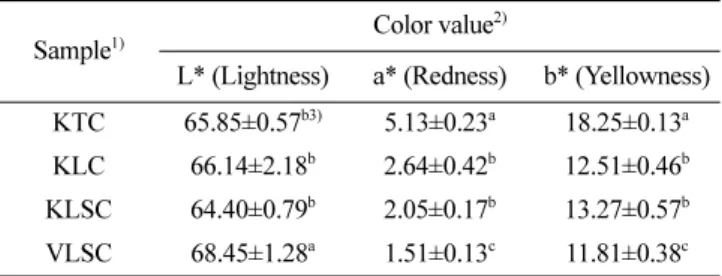
The color values of different CGJ samples were significantly affected by the raw materials (Table 1). The significantly highest lightness value was found in CGJ prepared with soybean and lotus seeds produced in Vietnam, VLSC (68.45). The lightness values of the other three samples were not significantly different. On the other hand, the significantly lowest redness and yellowness values were observed in VLSC (1.51 and 11.81, respectively). Korean traditional CGJ (KTC) had the significantly highest redness (5.13) and yellowness (18.25) values.
The color of a food product is one of the determining factors regarding the willingness of consumers to pay for the product (Udomkun et al., 2018). Although the redness and yellowness
Table 1. Hunter’s color value of cheonggukjang samples prepared with lotus and soybean seeds
Sample1)
Color value2)
L* (Lightness) a* (Redness) b* (Yellowness) KTC 65.85±0.57b3) 5.13±0.23a 18.25±0.13a KLC 66.14±2.18b 2.64±0.42b 12.51±0.46b KLSC 64.40±0.79b 2.05±0.17b 13.27±0.57b VLSC 68.45±1.28a 1.51±0.13c 11.81±0.38c
1)KTC (Control): Korean traditional cheonggukjang prepared with 500
g soybeans seeds, KLC: cheonggukjang prepared with 500 g of lotus seeds produced in Korea, KLSC: cheonggukjang prepared with 250 g of lotus produced in Korea+250 g of soybean, VLSC: cheonggukjang prepared with 250 g of lotus produced in Vietnam +250 g of soybean.
2)L*: lightness (100, white, 0, black), a*: redness (−, green; +, red),
b*: yellowness (−, blue, +, yellow). 3) Values are means±SD of triplicate measurements. The vales followed by the different letters in the same column are significantly different (Tukey test, p<0.05).
values of CGJ was reduced with the addition of lotus seeds produced in Korea, the lightness value remained significantly unaffected. Color combination of two products, sometimes, may not produce an intermediate state as found in the redness value of CGJ prepared with soybean and lotus seeds produced in Korea (KLSC); the reason of the color disparity was not clearly known.
DPPH, total polyphenol and total flavonoid
The DPPH and TPC of CGJ prepared with Korean lotus seeds (KLC) were significantly highest, whereas TFC was highest in KLSC (Table 2). The TFC of KLSC (141.39 mg QE/g DW) was slightly higher than KTC (137.96 mg QE/g DW) and KLC (126.14 g QE/g DW). The lotus seeds produced in Korea are found to contain higher antioxidants than those produced in Vietnam. Overall, the lowest antioxidant potential was observed in VLSC.
The antioxidant potentials of CGJ samples were evaluated through DPPH, TPC, and TFC. Similar results of higher DPPH and TPC were found in the lotus seeds-added rice porridge than that in soybean seed-added porridge (Kim et al., 2019). Also, concur with the study showing that lotus seed-added jeungpyun had increased DPPH radical scavenging capacity (Jeong et al., 2012). The higher antioxidant capacity of lotus-added CGJ might be attributed to the high phenolic acids including caffeic acid, chlorogenic acid, p-hydroxybenzoic acid, gallic acid, and other
phenolic compounds in lotus seeds (Yen et al., 2005). The variation in the antioxidant potential of CGJ fermented with lotus seeds produced in Korea and Vietnam might be differences in the phytochemicals due to spatial variation (Fischer et al., 2020). The outcome of antioxidant potential of foods is a complex mechanism as it is influenced by a number of factors, such as the partitioning properties of particular antioxidants, oxidation conditions, and physical state of the oxidizable substrate (Frankel and Meyer, 2000). So, a noticeable increase in the amount of an antioxidant, TPC and/or TFC, may not always contribute to elevated antioxidant potentials as found in the present study. For instance, TFC of KLSC is higher than that of KLC, however, DPPH and TPC are reverses. Similarly, TFC of KTC is higher than that of VLSC but the DPPH is lower in the former sample than in the latter one. The antioxidant potential of a sample may be reflected as the contributions of several phytochemicals, including polyphenols, flavonoids, vitamins, carotenoids, and so on.
Minerals
The highest and lowest total mineral contents were found in KLSC (17,941.31 mg/kg) and KTC (20,210.67 mg/kg), respectively (Table 3). The proportion of soybean and lotus seeds also significantly affected the mineral composition (except Mg) of CGJ samples. The most abundantly found mineral element was K (11,032.57-16,534.70 mg/kg), followed by Mg (1,985.09-2,101.83
Table 2. DPPH free radical scavenging activity, total polyphenol and total flavonoid contents of cheonggukjang samples prepared with lotus and soybean seeds
Sample1) DPPH2) (%) Total polyphenol (mg GAE3)/g DW) Total flavonoid (mg QE4)/g DW)
KTC 30.55±0.24d5) 14.14±1.24c 137.96±2.74b
KLC 89.17±0.27a 18.68±1.64a 126.14±2.25c
KLSC 60.63±0.20b 16.70±0.12b 141.39±0.64a
VLSC 52.75±2.00c 14.93±0.05c 77.20±2.38d
1)Samples are defined in Table 1. 2)DPPH: DPPH free radical scavenging activity. 3)GAE: Gallic acid equivalent. 4)QE: Quercetin equivalent. 5)Values
are expressed as means±SD of three replicates. Values followed by different letters in the same column are significantly different (Tukey test, p<0.05).
Table 3. Mineral contents of cheonggukjang samples prepared with lotus and soybean seeds
Element Contents (mg/kg) KTC1) KLC KLSC VLSC Na 198.56±4.85d2) 310.94±4.73b0 326.58±8.27a0 254.19±4.22c0 Mg 2,101.83±72.69a0, 2,036.69±40.02a0, 2,017.38±66.46a0, 1,985.09±71.10a0, K 16,534.70±337.61a0, 11,032.57±212.79c0, 13,527.89±362.88b0, 13,471.79±145.33b0, Ca 1,270.25±28.15c0, 1,611.22±20.11b0, 1,720.66±7.88a00, 1,129.31±14.11c0, Mn 29.22±0.15c 392.25±1.68a0 246.03±1.24b0 132.54±0.51c0 Cu 13.62±0.07c 13.45±0.14d 15.35±0.07b 20.58±0.14a Zn 41.81±0.20d 69.05±0.02a 50.30±0.23c 59.59±0.11b Fe 15.24±0.07c 32.29±0.21b 35.37±0.09a 12.71±0.09d Mo 05.44±0.27a 00.98±0.01c 01.75±0.02b 00.76±0.01d Total 20,210.67 15,499.44 17,941.31 17,066.56
1)Samples are defined in Table 1.
mg/kg) and Ca (1,129.31-1,720.66 mg/kg). The highest Na, Ca, and Fe contents were found in KLSC.
The results showed that the total mineral content of soybean CGJ is higher than that of lotus-based CGJ. However, the highest Na, Ca, and Fe content in KLSC indicated that the addition of lotus seeds to the traditional CGJ could help increase these mineral elements. Na is useful in the body to maintain fluid levels and is essential for the health of the heart, liver, and kidneys (Munteanu and Iliuta, 2011). Similarly, Mg, K, and Ca are beneficial against hypertension (Houston and Harper, 2008). Fe functions in oxygen transport, energy metabolism, mitochondrial respiration, DNA synthesis, and cellular growth and differentiation (Ganz, 2013).
Free amino acid
The compositions of different essential and non-essential amino acids found in CGJ samples are presented in Table 4. The highest and lowest amount of total free amino acids was measured in KLC (79.86 mg/g) and VLSC (58.34 mg/g), respectively. Similarly, KLC (33.72 mg/g) and VLSC (24.32 mg/g) contained the highest and lowest amount of essential amino acids, respectively. The concentration of glutamic acid, a precursor of γ-Amino-n-butyric acid (GABA), was highest in KLC. The amount of some functional amino acids such as proline and cystine were found to
be high in KLC and KLSC.
GABA is primarily synthesized in plants by the decarboxylation of glutamic acid in the presence of glutamate decarboxylase (Nikmaram et al., 2017). GABA and glycine, one of the highest amino acids found in KLC and KLSC, are reported to play role in enhancing learning and memory, against stroke and neuro-degenerative diseases; relieving anxiety, sedation, anticonvulsant, and muscle relaxation functions (Krogsgaard-Larsen, 1989; Mody et al., 1994; Oh and Oh, 2004). The high GABA-containing foods are considered brain foods and also play role in correcting several bioactive functions, such as blood cholesterol level, blood pressure, cerebral blood flow, insomnia, depression, and pain (Dhakal et al., 2012). The anti-diabetic effect of GABA has also been reported (Nikmaram et al., 2017). Functional amino acids like proline and cysteine, which were high in KLC and KLSC, play role in regulating key metabolic pathways that are necessary for maintenance, growth, reproduction, and immunity (Wu, 2009).
Conclusion
The physicochemical properties and antioxidant potential of CGJ prepared with soybean and/or lotus seeds were evaluated. The redness and yellowness values were high in CGJ produced with Table 4. Free amino acid (AA) composition of cheonggukjang samples prepared with lotus and soybean seeds
Amino acid Contents (mg/kg)
KTC1) KLC KLSC VLSC Essential AA Threonine 03.93±0.03b2) 4.58±0.21a 3.43±0.12c 3.25±0.17c Valine 4.23±0.12a 4.53±0.41a 3.69±0.12b 3.51±0.09b Methionine 0.89±0.11b 1.25±0.03a 1.25±0.08a 0.81±0.10b Isoleucine 3.44±0.14a 3.77±0.24a 3.39±0.28a 2.77±0.12b Leucine 7.55±0.40b 8.63±0.33a 7.21±0.16b 6.04±0.26c Phenylalanine 4.47±0.18b 5.18±0.27a 4.24±0.13b 3.53±0.22c Lysine 3.61±0.17b 4.23±0.26a 2.65±0.06d 3.16±0.21c Histidine 1.44±0.11a 1.55±0.13a 1.66±0.02a 1.25±0.04b Sub-total essential AA 29.56 33.72 27.52 24.32 Non-essential AA Aspartic acid 12.32±0.12a0 12.64±0.31a0 10.75±0.21b0 9.61±0.32c Glutamic acid 10.81±0.02b0 11.41±0.25a0 9.71±0.41c 8.59±0.23d Glycine 3.62±0.18b 4.77±0.18a 4.37±0.43a 3.35±0.24b Alanine 4.04.±0.04c 4.57±0.22a 4.31±0.18b 3.18±0.07d Tyrosine 2.56±0.28a 2.49±0.08a 2.35±0.16a 1.82±0.11b Arginine 4.53±0.36a 4.46±0.21a 3.33±0.27b 3.50±0.09b Proline 0.90±0.01b 1.29±0.20a 1.21±0.17a 0.79±0.07c Cystine 0.65±0.23a 0.74±0.30a 0.80±0.03a 0.56±0.03b Sub-total non-essential AA 42.74 46.14 40.35 34.02 Total free AA 72.30 79.86 67.87 58.34
1)Samples are defined in Table 1.
soybean seeds. The CGJ sample prepared with lotus or a mixture of soybean and lotus produced in Korea showed relatively higher antioxidant potential. The concentration of essential and total free amino acids was also high in the sample prepared with lotus seeds grown in Korea. However, the amount of total mineral content was lower in the lotus-based samples. Overall, a mixture of an equal proportion of soybean and lotus seeds could be a good option to prepare nutritious CGJ.
Conflict of interest
The authors declare no conflict of interest.
References
Blois MS. Antioxidant determinations by the use of a stable free rad-ical. Nature 181: 1199-1200 (1958)
Chang JH, Shim YY, Kim SH, Chee KM, Cha SK. Fibrinolytic and immuno-stimulating activities of Bacillus spp. strains isolated from cheonggukjang. Korean J. Food Sci. Technol. 37: 255-260 (2005)
Choi HK, Lim YS, Kim YS, Park SY, Lee CH, Hwang KW, Kwon DY. Free-radical-scavenging and tyrosinase-inhibition activities of Cheonggukjang samples fermented for various times. Food Chem. 106: 564-568 (2008a)
Choi UK, Kim MH, Lee NH, Jeong YS, Kwon OJ, Kim YC, Hwang YH. The characteristics of cheonggukjang, a fermented soybean product, by the degree of germination of raw soybeans. Food Sci. Biotechnol. 16: 734-739 (2007)
Choi YH, Lim H, Heo MY, Kwon DY, Kim HP. Anti-inflammatory activity of the ethanol extract of Chungkukjang, Korean fer-mented bean: 5-lipoxygenase inhibition. J. Med. Food 11: 539-543 (2008b)
Dhakal R, Bajpai VK, Baek KH. Production of GABA (γ-aminobu-tyric acid) by microorganisms: a review. Braz. J. Microbiol. 43: 1230-1241 (2012)
Dhungana SK, Kim BR, Son JH, Kim HR, Shin DH. Comparative study of CaMsrB2 gene containing drought-tolerant transgenic rice (Oryza sativa L.) and non-transgenic counterpart. J. Agron. Crop Sci. 201: 10-16 (2015)
Dhungana SK, Kim ID, Kwak HS, Shin DH. Unraveling the effect of structurally different classes of insecticide on germination and early plant growth of soybean [Glycine max (L.) Merr.]. Pestic. Biochem. Physiol. 130: 39-43 (2016)
Fischer S, Hilger T, Piepho HP, Jordan I, Karungi J, Towett E, Shep-herd K, Cadisch G. Soil and farm management effects on yield and nutrient concentrations of food crops in East Africa. Sci. Total Environ. 716: 137078 (2020)
Frankel EN, Meyer AS. The problems of using one-dimensional methods to evaluate multifunctional food and biological antioxi-dants. J. Sci. Food Agric. 80: 1925-1941 (2000)
Ganz T. Systemic iron homeostasis. Physiol. Rev. 93: 1721-1741 (2013)
Houston MC, Harper KJ. Potassium, magnesium, and calcium: Their role in both the cause and treatment of hypertension. J. Clin. Hypertens. 10: 3-11 (2008)
Jang CH, Lim JK, Kim JH, Park CS, Kwon DY, Kim YS, Shin DH, Kim JS. Change of isoflavones content during manufacturing of cheonggukjang, a traditional Korean fermented soyfood. Food Sci. Biotechnol. 15: 643-646 (2006)
Je JY, Park PJ, Jung WK, Kim SK. Amino acid changes in fer-mented oyster (Crassostrea gigas) sauce with different fermenta-tion periods. Food Chem. 91: 15-18 (2005)
Jeong SH, Choi SY, Cho JI, Lee SH, Hwang IG, Na HJ, Oh DH, Bahk GJ, Ha SD. Microbiological contamination levels in the processing of Korea rice cakes. J. Food Hyg. Saf. 27: 161-168 (2012)
Kim B. Physiological functions of chongkukjang. Food Ind. Nutr. 4:
40-46 (1999)
Kim DJ, Jeong YJ, Kwon JH, Moon KD, Kim HJ, Jeon SM, Lee MK, Park YB, Choi MS. Beneficial effect of Chungkukjang on regulating blood glucose and pancreatic β-cell functions in C75BL/KsJ-db/db mice. J. Med. Food 11: 215-223 (2008) Kim EJ, Hong JY, Shin SR, Moon YS, Yoon KY. Analysis of the
taste components and antioxidant properties of Cheonggukjang containing Korean red ginseng. Food Sci. Biotechnol. 18: 53-59 (2009a)
Kim ID, Lee JW, Kim SJ, Cho JW, Dhungana SK, Lim YS, Shin DH. Exogenous application of natural extracts of persimmon (Diospyros kaki Thunb.) can help in maintaining nutritional and mineral composition of dried persimmon. Afr. J. Biotechnol. 13: 2231-2239 (2014a)
Kim IJ, Kim HK, Chung JH, Jeong YK, Ryu CH. Study of func-tional cheonggukjang contain fibrinolytic enzyme. Korean J. Life Sci. 12: 357-362 (2002)
Kim J, Shin WK, Kim Y. Effect of lotus seed on viscosity and anti-oxidant activity of soy-based porridge. Cereal Chem. 96: 220-227 (2019)
Kim JD, Yi YH, Lee NH, Kim DH, Choi UK. Changes in the qual-ity characteristics of Cheonggukjang prepared with hazelnut. Korean J. Food Nutr. 31: 926-932 (2018)
Kim JH, Hwang CE, Lee CK, Lee JH, Kim GM, Jeong SH, Shin JH, Kim JS, Cho KM. Characteristics and antioxidant effect of garlic in the fermentation of Cheonggukjang by Bacillus amylo-liquefaciens MJ1-4. J. Microbiol. Biotechnol. 24: 959-968 (2014b) Kim JS, Yoo SM, Choe JS, Park HJ, Hong SP, Chang CM.
Physico-chemical properties of traditional Chonggugjang produced in dif-ferent regions. Agric. Chem. Biotechnol. 41: 377-383 (1998) Kim Y, Cho JY, Kuk JH, Moon JH, Cho JI, Kim YC, Park KH.
Identification and antimicrobial activity of phenylacetic acid pro-duced by Bacillus licheniformis isolated from fermented soybean, Chungkook-Jang. Curr. Microbiol. 48: 312-317 (2004a)
Kim YN, Heo SI, Wang MH. Antigenotoxic, fibrinolytic and immu-nomodulating activity of traditionally fermented soy product, Chungkukjang. J. Food Process Preserv. 33: 87-104 (2009b) Kim YS, Gwon JS, Gwon GS, Son HY, Gwon HY. Isolation of
immunostimulating strain Bacillus pumilus JB-1 from Chungkook-jang and fermentational characteristics of JB-1. Microbiol. Bio-technol. Lett. 32: 291-296 (2004b)
Ko HM, Choi SJ, Choi WS, Lee NH, Choi UK. Quality characteris-tics of Cheonggukjang made with the smoked soybeans. Korean J. Food Nutr. 27: 274-279 (2014)
Krogsgaard-Larsen P. GABA receptors. pp 349-383. In: Receptor Pharmacology and Function. Williams M, Glennon RA, Timmer-mans PMWM (eds). Marcel Dekker Inc., New York, NY, USA, (1989)
Lee BY, Kim DM, Kim KH. Studies on the change in rheological properties of cheonggukjang. Korean J. Food Sci. Technol. 23: 478-484 (1991)
Lee CH, Yang EI, Song GS, Chai OH, Kim YS. Effects of cheong-gukjang on immune responses and gastrointestinal functions in rats. Food Sci. Biotechnol. 15: 19-23 (2006a)
Lee JJ, Cho CH, Kim JY, Kee DS, Kim HB. Antioxidant activity of substances extracted by alcohol from cheonggukjang powder. Korean J. Microbiol. 37: 177-181 (2001)
Lee KH, Ryu SH, Lee YS, Kim YM, Moon GS. Changes of antioxi-dative activity and related compounds on the cheonggukjang preparation by adding drained boiling water. Korean J. Food Cook. Sci. 21: 163-170 (2005)
Lee MY, No HK, Kim SD, Prinyawiwatkul W. Quality of chungkuk-jangs prepared with various Bacillus strains. Int. J. Food Sci. Technol. 42: 587-592 (2007)
Lee MY, Park SY, Jung KO, Park KY, Kim SD. Quality and func-tional characteristics of Chungkukjang prepared with various Bacillus sp. isolated from traditional Chungkukjang. J. Food Sci. 70: M191-M196 (2006b)
Lee NK, Cho IJ, Park JW, Kim BY, Hahm YT. Characteristics of Cheonggukjang produced by the rotative fermentation method. Food Sci. Biotechnol. 19: 115-119 (2010)
plu-mule (Nelumbo nucifera Geartn.) supplementation on LPS-induced systemic inflammation in a BALB/c mouse model. J. Food Drug Anal. 14: 273-278 (2006)
Matsui T, Yoo HJ, Lee DS. Isolation of angiotensin I-converting enzyme inhibitory peptide from cheonggukjang. Korean J. Micro-biol. 40: 355-358 (2004)
Michalska A, Ceglinska A, Amarowicz R, Piskula MK, Szawara-Nowak D, Zielinski H. Antioxidant contents and antioxidative properties of traditional rye breads. J. Agric. Food Chem. 55: 734-740 (2007)
Mine Y, Kwan Wong AH, Jiang B. Fibrinolytic enzymes in Asian traditional fermented foods. Food Res. Int. 38: 243-250 (2005) Mody I, De Koninck Y, Otis TS, Soltesz I. Bridging the cleft at
GABA synapses in the brain. Trends Neurosci. 17: 517-525 (1994)
Mukherjee PK, Mukherjee D, Maji AK, Rai S, Heinrich M. The sacred lotus (Nelumbo nucifera)-phytochemical and therapeutic profile. J. Pharm. Pharmacol. 61: 407-422 (2009)
Munteanu C, Iliuta A. The role of sodium in the body. Balneo-Res. J. 2: 70-74 (2011)
Nikmaram N, Dar B, Roohinejad S, Koubaa M, Barba FJ, Greiner R, Johnson SK. Recent advances in γ-aminobutyric acid (GABA) properties in pulses: An overview. J. Sci. Food Agric. 97: 2681-2689 (2017)
Nishimura K, Horii S, Tanahashi T, Sugimoto Y, Yamada J. Synthe-sis and pharmacological activity of alkaloids from embryo of lotus, Nelumbo nucifera. Chem. Pharm. Bull. 61: 59-68 (2013) Oh CH, Oh SH. Effects of germinated brown rice extracts with
enhanced levels of GABA on cancer cell proliferation and apop-tosis. J. Med. Food. 7: 19-23 (2004)
Piao YZ, Eun JB. Physicochemical characteristics and isoflavones content during manufacture of short-time fermented soybean product (cheonggukjang). J. Food Sci. Technol. 57: 2190-2197 (2020)
Poornima P, Weng CF, Padma VV. Neferine, an alkaloid from lotus seed embryo, inhibits human lung cancer cell growth by MAPK activation and cell cycle arrest. BioFactors 40: 121-131 (2014) Shon MY, Lee SW, Sung NJ. Biological activities of Chungkukjang
prepared with black bean and changes in phytoestrogen content during fermentation. Korean J. Food Sci. Technol. 32: 936-941
(2000)
Singleton VL, Orthofer R, Lamuela-Raventós RM. Analysis of total phenols and other oxidation substrates and antioxidants by means of folin-ciocalteu reagent. 299, pp 152-178. In: Methods in Enzy-mology. Packer L (ed). Elsevier BV, Amsterdam, Netherlands (1999)
Skujins S. Handbook for ICP-AES (Varian-Vista). A Short Guide to Vista Series ICP-AES Operation. Varian Int. AG, Zug, Switzer-land (1998)
Sugimoto Y, Furutani S, Itoh A, Tanahashi T, Nakajima H, Oshiro H, Sun S, Yamada J. Effects of extracts and neferine from the embryo of Nelumbo nucifera seeds on the central nervous system. Phytomedicine 15: 1117-1124 (2008)
Udomkun P, Ilukor J, Mockshell J, Mujawamariya G, Okafor C, Bullock R, Nabahungu NL, Vanlauwe B. What are the key fac-tors influencing consumers’ preference and willingness to pay for meat products in Eastern DRC? Food Sci. Nutr. 6: 2321-2336 (2018)
Wu G. Amino acids: metabolism, functions, and nutrition. Amino Acids 37: 1-17 (2009)
Yang SO, Chang PS, Lee JH. Isoflavone distribution and β-glucosi-dase activity in cheonggukjang, a traditional Korean whole soy-bean-fermented food. Food Sci. Biotechnol. 15: 96-101 (2006) Yen GC, Duh PD, Su HJ. Antioxidant properties of lotus seed and
its effect on DNA damage in human lymphocytes. Food Chem. 89: 379-385 (2005)
Youn HK, Choi HS, Hur SH, Hong JH. Antimicrobial activities of viscous substance from Cheonggukjang fermented with different Bacillus ssp. J. Food Hyg. Saf. 16: 288-293 (2001)
Zhang X, Liu Z, Xu B, Sun Z, Gong Y, Shao C. Neferine, an alka-loid ingredient in lotus seed embryo, inhibits proliferation of human osteosarcoma cells by promoting p38 MAPK-mediated p21 stabilization. Eur. J. Pharmacol. 677: 47-54 (2012)
Zhang Y, Lu X, Zeng S, Huang X, Guo Z, Zheng Y, Tian Y, Zheng B. Nutritional composition, physiological functions and process-ing of lotus (Nelumbo nucifera Gaertn.) seeds: a review. Phyto-chem. Rev. 14: 321-334 (2015)
Zhu M, Liu T, Guo M. Current advances in the metabolomics study on lotus seeds. Front. Plant Sci. 7: 891 (2016)