Effect of OPU Session Periods on the Efficiency of In Vitro
Embryo Production in Elite Korean Native Cow
Byung-Hyun Choi1,3,*, Seok-Hwan Song1,*, Bun-Young Park3, Rami Kong1,3, Mi-Ju Son3, Chan-Sang park1,3, Nyeon-Hak Shin4, Hye-Young Cheon4, Sung-Hoon Lee4, Jong-In Jin2,3, Jung-Gyu Lee2,3 and Il-Keun Kong1,2,
1Division of Applied Life Science (BK21 Plus) 2Institute of Agriculture and Life Science
3GAST, Gyeongsang National University, Jinju 52828, Republic of Korea
4Gyeongsangnamdo Livestock Experiment Station, Sancheong 52263, Republic of Korea
Abstract
Up-to-date artificial insemination (AI) using frozen sperm consider as the most widely using technology for improvement of Korean Native Cow (Hanwoo) embryo production. However, it is time consuming, required at least 15~20 years to make more than 6 generations, and their offspring number is limited. To overcome such limitations, superovulation and in vitro fertilization have been developed. For superovulation, the number of produced embryos are not enough for commercialization and donor cows need rest period. This led to use of slaughterhouse ovary for in vitro fertilization, but it is impossible to repeat the collection from the same individual and it only can improve the genetic merits of offspring for one generation. Production of embryos using Ovum Pick-Up (OPU) technique, where oocytes can be repeatedly collected from living elite donor, might overcome these limitations. In this study, we investigated the possibility of using OPU technique from donors at different age and different session periods for mass-embryo-production. Oocytes were collected from 26 donor cows twice per week, 3 - 4 months per year, between 2013 and 2016. Results showed that, the average number of embryo produced in first year used donor was significantly higher than that in second year used donor (3.89 ± 2.85 vs 3.29 ± 2.70), however, there was no significant difference between third year used donor (3.51 ± 3.32) and other groups. Taken together, our data showed that repeated using of donor up to three years is possible for in vitro embryo mass-production. Moreover, OPU can be used as suitable embryo producing technique for livestock breed improvement.
Received 5 December 2018 Revised 13 November 2018
Accepted 17 December 2018 Key Words : OPU, Embryo, Embryo transfer, Korean native cow
* These authors were contributed equally.
INTRODUCTION
Embryo transfer (ET) is able to produce the numerous embryos from superior genetic animal and can effectively produce offspring using surrogate mother of poor genetic traits (Kim et al., 1998, 2002). In 1951, first ET for Korean Nativer Cow (Hanwoo) was conducted through laparotomy and live offspring has been produced. In Korea, ET technique has been dramatically improved. In recent decades, hormones have been used for superovulation, non-surgical embryo recovery and transfer techniques have been developed. Repeated oocyte collection by OPU has become alternative and competitive to superovulation for embryo production in cattle (Boni 2012). Recently, In vitro production (IVP) system using Ovum Pick-Up (OPU) derived oocytes, vitrification and sperm sorting has used in industry of dairy and beef cattle (Brackett et al., 1982, 1989; Xu et al., 1987; Cran, 1993; Yanget al., 1993; 1993; Kubota, 1998;Yang et al., 1993; Kubota et al., 1998; Pierson, 1999, Pierson and Adams, 1999). Since the end of 1980, Hanwoo OPU followed by in vitro production become the most widespread embryos production technology in the research and commercial areas. The success and efficiency of production system of OPU embryos depends on quality and quantity of aspirated Cumulus- Oocyte Complexes (COCs). Moreover, OPU technician, OPU assistance, interval of OPU, hormone treatment and synchronization can dramatically affect the efficiency and success of OUP technique (Merton et al., 2003).
After the introduction of OPU-IVP, many efforts have been made to improve the efficiency of embryo production but all of these have focused on non-genetic factors (Van Wagtendonk-de Leeuw et al., 2000; Merton et al., 2003; Lonegan et al., 2006)). Currently, the embryo production system through the OPU technique and the development rate to blastocyst stage have been improved but it is insufficient to supply the blastocyst as needed. Several researchers have reported on the effect of the donor age (Su et al., 2012) and hormonal treatment (Blondin et al., 1997) on development rate of blastocyst according to in vitro and in vivo maturation (Hendriksen et al., 2000; Rizos et al., 2002) but there is no report on the period of use. In order to commercialize the production system of in vitro fertilization embryo using OPU derived oocytes, effective utilization system of donors should be established. In this study, we have suggested a newly developed method to reuse the OPU donors for producing the embryo and to use them efficiently.
MATERIALS AND METHODS
1. ChemicalsUnless otherwise indicated, all of chemicals and media used in the present study were purchased from Sigma-Aldrich (St. Louis, MO, USA).
2. Ethics statement
All of the methods and experimental procedures were conducted according to the approved (Approval ID: GAR-110502-X0017) guidelines and regulations by the institutional animal care and use committee (IACUC) of the division of applied life sciences, department of animal science at Gyeongsang National University, Republic of Korea.
3. Experimental design
The experiment has been conducted from April 2013 ~ December 2016. Total 27 elite Hanwoo, which belonged to the Institute of Agriculture and Life Science, Gyeongsang National University, were used for OPU.
4. Recovery of oocytes by OPU technique
OPU technique has been conducted during the first wave of follicular development, as described (Deb et al., 2011). Hanwoo (body weight, approximately 600 ~ 800 kg) were used for two OPU sessions, 4 days apart. Cows were restrained in a chute and given 3 to 4 mL of epidural anesthesia (2% lidocaine). The COCs were retrieved by an ultrasonic instrument equipped with a 5-MHz convex transducer connected to a vacuum operating at a negative suction pressure of 85 to 90 mmHg. The follicular content of each cow was aspirated individually into TL-HEPES buffer (114 mM sodium chloride, 3.2 mM potassium chloride, 2 mM sodium bicarbonate, 0.34 mM sodium biphosphate, 10 mM sodium lactate, 0.5 mM magnesium chloride, 2 mM calcium chloride, 10 mM HEPES, 1 µL/mL phenol red, 100 IU/mL penicillin, and 0.1 mg/mL streptomycin) and imaged with a stereomicroscope. 5. Oocyte collection and in vitro maturation (IVM)
OPU derive oocyte were cultured in IVM medium as described by (Mesalam et al., 2017a). In brief, COCs were collected and washed in (TCM-199) supplemented with 10% (v/v) FBS (Gibco BRL, Life Technologies, Grand Island, NY, USA), 1 μg/mLestradiol- 17ß, 10 μg/mL follicle-stimulating hormone, 10 ng/mL epidermal
growth factor, 0.6 mM cysteine, and 0.2 mM sodium pyruvate. Thereafter, groups of up to 50 COCs were transferred to a 4-well dish (Thermo Fisher Scientific, Waltham, MA, USA) containing 500 μL IVM medium and incubated in a humidified atmosphere of 5% CO2 in air at 38.5°C for 22 ~ 24 h.
6. In vitro fertilization (IVF) and IVC
COCs were fertilized with frozen thawed sperm of a single selected bull previously described (Mesalam et al., 2017a). Semen was thawed at 39°C for 1 min, sperm were washed and pelleted in D-PBS by centrifugation at 750 × g for 5 min at room temperature, and motile sperm were recovered. The pellet was resuspended in 500 μL heparin (20 μg/mL) prepared in IVF medium [Tyrode’s lactate solution supplemented with 6 mg/mL bovine serum albumin (BSA), 22 mg/mL sodium pyruvate, 100 IU/mL penicillin, and 0.1 mg/mL streptomycin] and incubated at 38.5°C in a humidified atmosphere of 5% CO2 in air for 15
min (to facilitate capacitation). Thereafter, sperm were diluted in IVF medium (final density of 1 - 2 × 10⁶ sperm/mL). Matured
oocytes were transferred to 600 μL IVF medium containing sperm for 18 ~ 20 h. After IVF, cumulus cells were removed by repeated pipetting and denuded zygotes were placed in a well of a four-well plate containing 700 mL CR1-aa medium (Mesalam et al., 2017a) supplemented with 44 mg/mL C3H3NaO3, 14.6
mg/mL glutamine, 10 mL/mL penicillin/streptomycin, 3 mg/mL BSA, and 310 mg/mL glutathione for 3 days (IVC-I). The presumed zygotes were then cultured until day 8 of embryonic development (day 0, day of IVF) in a medium of the same composition (IVC-I), except that BSA was replaced with 10% (v/v) fetal bovine serum (IVC-II). Day 8 expanded blastocysts were ET for recipients.
7. Statistical analyses
Data are presented as mean values standard deviation, except for data reporting changes during embryo development, which are presented as percentages. Each experiment was performed at least three times, and results were analyzed with SPSS (ver. 18.0, SPSS Inc., Chicago, IL, USA). Differences between means were considered significant at P < 0.05.
RESULTS
1. Follicle and oocyte dynamics for session
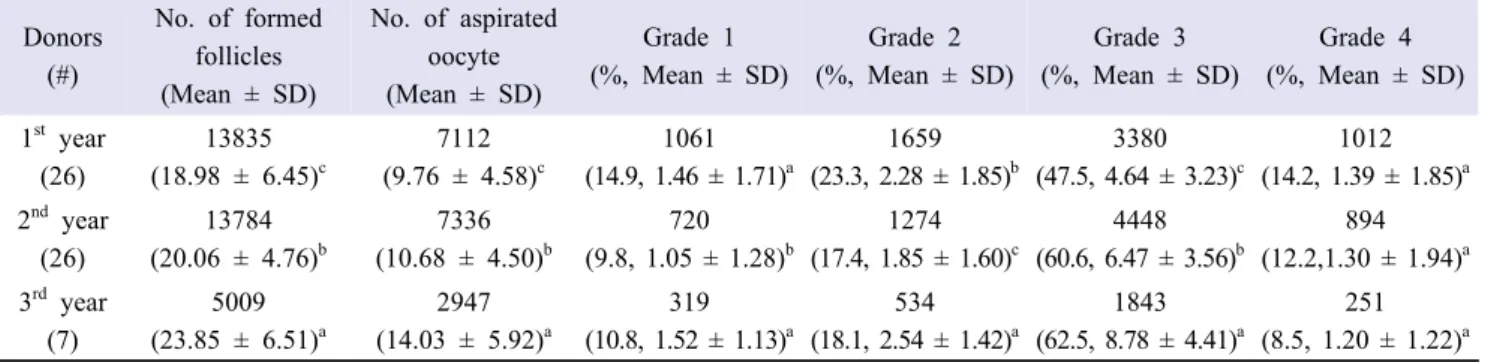
The recovered cumulus-oocyte complexes were morphologically classified into four grades based on the number of cumulus cells layers and homogeneity of the cytoplasm (Table 1). The average number of aspirated oocytes per donor was significantly (P < 0.05) higher in third year used cows (14.03 ± 5.92) comparing to than those in first and second year session groups (9.76 ± 4.58, 10.68 ± 4.50, respectively, Table 1). Moreover, the average number of grade 1 and grade 2 per donor were significantly (P < 0.05) greater in first (1.46 ± 1.71 and 2.28 ± 1.85, respectively) and third year groups (1.52 ± 1.13 and 2.54 ± 1.42, respectively) than that in second year group (1.05 ± 1.28 and 1.85 ± 1.60, respectively) (Table 1).
2. Embryo development rate and the number of blastocysts The percentage of cleaved embryos was determined on day 3 of culture. The cleavage rate was significantly (P < 0.05) higher in third year session (52.9 ± 5.00%) than those in first (48.7 ± 3.11%) and second year session (49.3 ± 3.16%) (Table 2). However, blastocyst developmental rate in first (39.3 ± 2.85%) and third year groups (25.0 ± 3.32%) were significantly higher (P < 0.05) than those in second year group (30.7 ± 2.70%).
Donors (#) No. of formed follicles (Mean ± SD) No. of aspirated oocyte (Mean ± SD) Grade 1 (%, Mean ± SD) Grade 2 (%, Mean ± SD) Grade 3 (%, Mean ± SD) Grade 4 (%, Mean ± SD) 1st year (26) 13835 (18.98 ± 6.45)c 7112 (9.76 ± 4.58)c 1061 (14.9, 1.46 ± 1.71)a 1659 (23.3, 2.28 ± 1.85)b 3380 (47.5, 4.64 ± 3.23)c 1012 (14.2, 1.39 ± 1.85)a 2nd year (26) 13784 (20.06 ± 4.76)b 7336 (10.68 ± 4.50)b 720 (9.8, 1.05 ± 1.28)b 1274 (17.4, 1.85 ± 1.60)c 4448 (60.6, 6.47 ± 3.56)b 894 (12.2,1.30 ± 1.94)a 3rd year (7) 5009 (23.85 ± 6.51)a 2947 (14.03 ± 5.92)a 319 (10.8, 1.52 ± 1.13)a 534 (18.1, 2.54 ± 1.42)a 1843 (62.5, 8.78 ± 4.41)a 251 (8.5, 1.20 ± 1.22)a a c Values with different superscripts were significantly different (P < 0.05).
DISCUSSION
Production efficiency of OPU-derived embryo is very important for commercialization of ET and several studies have been conducted to increase its production efficiency (Kim et al., 2014; Jin et al., 2011, 2014; Choi et al., 2011). Roth et al (2008) reported that, recovery the 13.2, 17.2 and 16.0 embryos, respectively after met-estrus (Day 4, 8, 11 and 15) of Holstein. Su et al (2012) recovered 7.3, 6.1, 4.7 embryos on average using 12 months, 7 to 8 years and 15 years or elder. Galli et al (2001) collected 8.4, 8.2, 10.3 and 9.4 embryos on average from 1997 to 2000 for four years. Galli et al (2014) reported that recovery the 12.8, 7.3, 10.4 and 10.9 embryos in Holstein of stage of suckler, pregnant by rearing calf, non-pregnant by rearing calf and previous rearing. Jin et al (2014) collected 7.5, 7.6, 9.6 and 7.3 embryos on average from 2010 to 2013 in Hanwoo. Jin et al (2015) obtained an average of 10.0 in six Hanwoo and this study collected 9.8, 11.9 and 14.0 embryos. The production of implantable embryos per year increased annually with 1.7, 2.1, 2.9 and 3.0. Galli et al (2014) collected 2.49, 1.43, 1.86 and 1.73 embryos according to donor. Jin et al (2014) produced an average 3.0, 2.2, 3.2, 3.0 and 4.1 embryos annually, these data agree with our results reported that the average embryo production per donor were 3.9, 3.3 and 3.5 embryos at first, second and third year sessions respectively.
Another aspect to consider for the optimization of OPU is the number and quality of collected oocytes. Production of embryos using OPU-derived oocytes can be used for mass embryo production, but average of number is different from study to another. We investigated the development rate of blastocysts, grade of oocytes, recovery of oocytes and number of follicles according to reuse the selected superior donor for OPU-derived embryo production. Our results suggest that the number of collected oocytes and development rate to blastocysts can affected by condition of embryo collection, generative function according to age, technique and production area of embryos. We reported that, second year used donors derived grade 1 and grade 2 oocyte
lower than first year used donor, but third year used donors were same as first year used donor. Moreover, efficiency of embryo production also shown similar results as follicle number data, suggesting an individual different among different donors. Jin et al (2015) reported that the period for reusing of donor was longer than half year. However, in order to exactly determine the reuse of donor, we have to consider not only efficiency of reusing but also production rate depends on the rest periods. We need to confirm the efficiency of production depends on rest period after OPU. In conclusion, our data showed that repeated using of donor up to three years is possible for in vitro embryo mass-production.
ACKNOWLEDGEMENTS
All the authors contributed to this manuscript; B. H. Choi designed and performed the experiments. S. H. Song, B. Y. Park, R. M. Kong, M. J. Son, C. S. Park, N. H. Shin, H.Y. Cheon, S. H. Lee, J. I. Jin and J. G. Lee analyzed the data and assisted with culture media preparation and Il-Keun Kong wrote the manuscript and managed this work. The authors declare that no conflicting financial interests exist. This work was supported by IPET through Agri-Bio Industry Technology Development Program, funded by MAFRA (Grant number: 117029-3 and 315017-5). S. H. Song was supported by scholarships from the BK21 Plus Program.
REFERENCES
Blondin P, Guibault LA and Sirard MA. 1997. The time interval between FSH-P administration and slaughter can influence the developmental competence of beef heifer oocytes. Theriogenology 48:803-813.
Boni R. 2012. Ovum pick-up in cattle: a 25 yr retrospective analysis. Anim. Reprod, 9:362-369.
Brackett BG, Bousquet D, Boice ML, Donawick WJ, Evans JF Donors
(#)
No. of oocytes collected (Mean ± SD)
No. cleaved embryos (%, Mean ± SD)
No. of blastocyst developed (%, Mean ± SD) 1st year (26) 7112 (9.76 ± 4.58)c 3464 (48.7, 4.77 ± 3.11)c 2796 (39.3, 3.89 ± 2.85)a
2nd year (26) 7336 (10.68 ± 4.50)b 3617 (49.3, 5.27 ± 3.16)b 2254 (30.7, 3.29 ± 2.70)b
3rd year (7) 2947 (14.03 ± 5.92)a 1561 (52.9, 7.43 ± 5.00)a 738 (25.0, 3.51 ± 3.32)a,b a c Values with different superscripts were significantly different (P < 0.05).
and Dressel MA. 1982. Normal development following in
vitro fertilization in the cow. Biol. Reprod. 27:147-158.
Brackett BG, Younis AI and Fayrer-Hosken RA. 1989. Enhanced viability after in vitro fertilization of bovine oocytes matured
in vitro with high concentrations of luteinizing hormone.
Fertil. Steril. 52:319-324.
Choi BH, Jin JI, Kwon TH, Kim SS, Jo HT and Kong IK. 2011. Effect of recipient breeds on gestation length and birth weight of offspring derived from OPU Hanwoo embryo. J. Emb. Trans. 26:27-32.
Cran DG, Johnson LA, Miller NG, Cochrane D and Polge C. 1993. Production of bovine calves following separation of X- and Y-chromosome bearing sperm and in vitro fertilization. Vet. Rec. 132:40-41.
Deb GK, Jin JI, Kwon TH, Choi BH, Bang JI, Dey SR, Cho IR and Kong IK. 2011. Improved blastocyst development of single cow OPU-derived presumptive zygotes by group culture with agarose-embedded helper embryos. Reprod. Biol. Endocrinol. 9:121. doi: 10.1186/1477-7827-9-121
Galli C, Crotti G, Notari C, Turini P, Duchi R and Lazzari G. 2001. Embryo production by ovum pick up from live donors. Theriogenology 55:1341-57
Galli C, Duchi R, Colleoni S, Labutina I and Lazzari G. 2014. Ovum pick up, intracytoplasmic sperm injection and somatic cell nuclear transfer in cattle, buffalo and horses: from the research laboratory to clinical practice. Theriogenology 81:138-151.
Hendriksen PJM, Vos PLAM, Steenweg WNM, Bevers MM and Dieleman SJ. 2000. Bovine follicular development and its effect on the in vitro competence of oocytes. Theriogenology 53:11-20.
Jin JI, Choi BH, Kim SS, Jo HT, Sun DW, Lim HT, Lee JG, Min CS and Kong IK. 2014. Transplantation and Production of OPU Derived Hanwoo IVP Embryos. J. Emb. Trans. 29:273-281.
Jin JI, Choi BH, Kim SS, Park BY, Lee JG and Kong IK. 2015. Possibility of Repeated Use of Elite Donor Cows for Mass Production of OPU-Derived Embryos. J. Emb. Trans .30:149-159.
Jin JI, Kwon TH, Choi BH, Kim SS, Jo HT, Bang JI, Kim SC, Cho KW, Lee JG and Kong IK. 2011. Effect of early pregnant heifer as donor on the ovum pick-up derived oocyte aspiration and embryo production. J. Emb. Trans. 26:19-25.
Kim DI, Seo SW, Chung JK, Lee KS, Seo KW, Park CS, Chung YC and Park BK. 2002. The Studies on In Vivo Embryo
Production and Transfer in Hanwoo - I. Factors Influencing
In vivo Embryo Production. J. Emb. Trans. 17:23-32.
Kim HR, Kim DL, Won YS, Kim CK, Chung YC, LEE KS, Suh KW and Park CS. 1998. Studies on the improvement of embryo transfer efficiency in Korean cattle. I. effect of embryo conditions on pregnancy rate after embryo transfer. J. Emb. Trans. 13:53-60.
Kim SS, Choi BH, Jo HT, Jin JI, Ha AN, Min CS, Cho GW and Kong IK. 2014. Effect of Collection Seasons on the Oocyte Quality and Developmental Competence of Oocytes Derived from Korean Native Cows (Hanwoo) by Ovum Pick-Up. J. Emb. Trans. 29:265-71.
Kubota C, Yang X, Dinnyes A, Todoroki J, Yamakuchi H and Mizoshita K. 1998. In vitro and in vivo survival of frozen- thawed bovine oocytes after IVF, nuclear transfer, and parthenogenetic activation. Mol. Reprod. Dev. 51:281-286. Lonergan P, Fair T, Corcoran D and Evans ACO. 2006. Effect
of culture environment on gene expression and develop mental characteristics in IVF-derived embryos. Theriogenology 65:137-152. Merton JS, de Roos AP, Mullaart E, de Ruigh L, Kaal L, Vos
PL and Dieleman SJ. 2003. Factors affecting oocyte quality and quantity in commercial application of embryo technologies in the cattle breeding industry, Theriogenology 59:651-674. Mesalam A, Khan I, Lee KL, Song SH, Chowdhury MMR, Uddin Z, Park KH and Kong IK. 2017a. 2-Methoxystypandrone improves in vitro-produced bovine embryo quality through inhibition of IKBKB. Theriogenology 99:10-20.
Mesalam A, Kong R, Khan I, Chowdhury M, Choi BH, Kim SW, Cho KW, Jin JI and Kong IK. 2017b. Effect of charcoal: dextran stripped fetal bovine serum on in vitro development of bovine embryos. Reprod. Biol. 17:312-319.
Pierson RA and Adams GP. 1999. Remote assessment of ovarian response and follicular status using visual analysis of ultrasound images. Theriogenology 51:47-57.
Rizos D, Ward F, Duffy P, Boland MP and Lonergan P. 2002. Consequences of bovine oocyte maturation fertilzation or early embryo development in vitro versus in vivo: Implications for blastocyst yield and blastocyst quality. Mol. Reprod. Dev. 61:234-248.
Roth Z, Inbar G and Arav A. 2008. Comparison of oocyte developmental competence and follicular steroid content of nulliparous heifers and cows at different stages of lactation. Theriogenology 69:932-939. Su L, Yang S, He X, Li X, Ma J, Wang Y, Presicce GA and Ji W. 2012. Effect of donor age on the developmental competence of bovine oocytes retrieved by ovum pick up. Reprod. Domest.
Anim. 47:184-189.
Van Wagtendonk-de Leeuw AM, Mullaart E, Roos de APW, Merton JS, Den Daas JHG and de Ruigh L. 2000. Effects of different reproduction techniques: AI, MOET or IVP, on health and welfare of bovine offspring. Theriogenology 53:575-597.
Xu KP, Greve T, Callesen H and Hyttel P. 1987. Pregnancy resulting from cattle oocytes matured and fertilized in vitro. J. Reprod. Fertil. 81:501-504.
Yang X, Jiang S and Foote RH. 1993. Bovine oocyte development following different oocyte maturation and sperm capacitation procedures. Mol. Reprod. Dev. 34:94-100.