64-3 / T. H. Lee
• IMID 2009 DIGEST
Abstract
Image compression techniques such as JPEG and MPEG induce losses of image quality. These losses are usually investigated on the spatial distortions from reconstructed images. Representative specifications are blocking artifacts, color bleeding and smearing. However, the compression techniques also influence the color information. The distortion of color information means distortion of gamut characteristics such as gamut size and unique color from the CIELAB values for each pixel in the reconstructed images. Accordingly, this paper introduces the investigation of the relationship between image compression and the gamut characteristics for reconstructed images using MPEG compression. The results show the consist variation of gamut, hue, and chroma due to MPEG compression.
1. Introduction
In the case of limitation for transmission bandwidth or storage space at the receiver end, images compression schemes are developed. For the still images, JPEG and JPEG2000 have been used and for movies, MPEG series including MPEG1, MPEG2, and so on are employed. These schemes facilitate the transmission and storage of data in an efficient form by reducing the redundancy of image data. However, lossy compression methods cause various types of distortion, such as blockiness, color bleeding, blurriness, and
noise in the reconstructed images3,4,5. Deservedly,
higher compression induces the lager distortion for the above distortion items. This is the trade-off between the level of compression and the quality of the reconstructed images.
Many studies examined the image distortion for JPEG and JPEG2000 introducing quality metrics for measuring above artifacts and presenting practical approaches for improving the perceptual quality of
decompressed images3,4,5. The basic conception is that
reduction of chrominance component data which are
less sensitive to human visual system. However, at high compression ratio, subsampling and coarse quantization of chrominance channels cause color artifacts in the reconstructed images. The compression techniques also cause the change of color information such as color smearing and color bleeding. These phenomena finally influence to the gamut of the original images. Previous paper investigated the relationship between JPEG and JPEG2000 image compression and color gamut for each method. In the paper, gamut size in a*b* plain from CIELAB color space and unique color as the number of used CIELAB values for an image were introduced. Also, gamut fidelity was finally introduced as the metric to present the variation according to the compression ratio, then used for comparing two compression methods.
This paper also investigates the gamut size and unique color for MPEG2 image compression techniques. Essentially MEPG2 method is based on JPEG compression method. It means the artifacts from JPEG exist on the MPEG2. However this method additionally has the process for motion estimation and motion vector to reduce data for sequential images as one movie. In addition, the process is performed for each frame and employed different method for each frame. Hence, the investigation of image quality for MPEG2 method needs the study of gamut characteristics for each frame.
Accordingly, this paper presents the gamut characteristics for MPEG2 algorithm using gamut size and unique color. Also, these metrics are investigated between each frame for sequential images as a movie. Five sample movies consisted of 8 colors on Macbeth color chart are applied. Also three general movies are used to observe the gamut characteristics.
2. Gamut characteristics for MPEG2
2.1. Prior works for investigation
On the Relationship of Color Image Compression and
Gamut: MPEG2
Tae-Hyung Lee*, and Yeong-Ho Ha*
*School of Electrical Engineering and Computer Science, Kyungpook National University, Taegu, Korea
Tel.:82-53-950-5535, E-mail: [email protected], [email protected]
64-3 / T. H. Lee
IMID 2009 DIGEST •
1 2 3 4 5 6 1 2 3 4 5 6
1 2 3 4 5 6
Fig. 1. Initial frame image for five sample movies.
In the investigation, sample movies are generated as the reference movies using 6 colors on Macbeth color checker. Figure 1 shows the 6 colors and shape of sample movies to emphasize the color shift in reconstructed image. Five different sample movies are created with the initial frame as the figure 1. At the first movie, the object circles are not moved to watch influence of MPEG2 with no movement. Second movie is created with two pixel interval movement to observe the influence of motion information. Third and forth movies are created with four and eight pixel interval movement. These movies will be compared with second movie to observe the influence of moving quantity in MPEG2. Last movie is generated with accelerated object.
Two elements are considered: Gamut size and unique color. Gamut size presents the range of image in a*b* color space from CIELAB color space. This is calculated using maximum outside a*b* values. In this case, the integer is basic unit. Unique color is defined as the color number used to construct images. Therefore the number of unique color is the number of CIELAB values.
The investigation is performed with still images for each frame from the original movies and the reconstructed movies. In this case, frames are consisted of I, B, and P frames. I frame is encoded and decoded with the same procedure as the JPEG. B and P frame have almost the same procedure however they only use the motion vectors for each pixel instead of RGB pixel values. Accordingly, this paper observes the gamut size and unique color with the sequential I, B, and P frames.
2.2. Distortion in MPEG2
Similar with JPEG, MPEG2 has the color shift around each sample color because it has the same procedure for I frame. In addition B and P frames are reconstructed with using I frame, therefore they also have the almost same phenomenon. Figure 2 shows the example of color shift in a*b* plain. Original has
1 2 3 5 6 4 a b a b a b (a) (b) (c)
Fig. 2. CIELAB values for sample movies. (a) original, (b) I frame, and (c) P frame.
only 6 values. However for I and P frame, values are exist according to the color shift. Also I frame has more values than P frame because P frame use only motion vector as the image data, also quantization level is more bigger than I frame. B frame has all most the same shape with P frame.
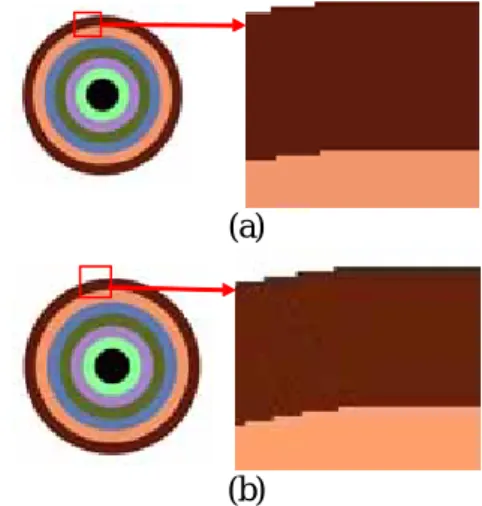
Figure 3 shows the distortion of color zooming the specific part. This is the also the same problem in JPEG. Even though the color shift or bleeding, the original color is also not completely reconstructed. This is show in figure 4 as the difference between original and P and B frames.
(a)
(b)
Figure 3. Original image and reconstructed image.
(a)
(b)
Figure 4. Difference between original and P and B frame
64-3 / T. H. Lee
• IMID 2009 DIGEST
2.3. Gamut characteristics for sample movies
The results of investigation are shown using gamut size and unique color. As mentioned before, gamut size is calculated in a*b* plain as the distribution range such as in figure 2 (b) and (c). Also unique color is the number of used CIELAB values for each frame.
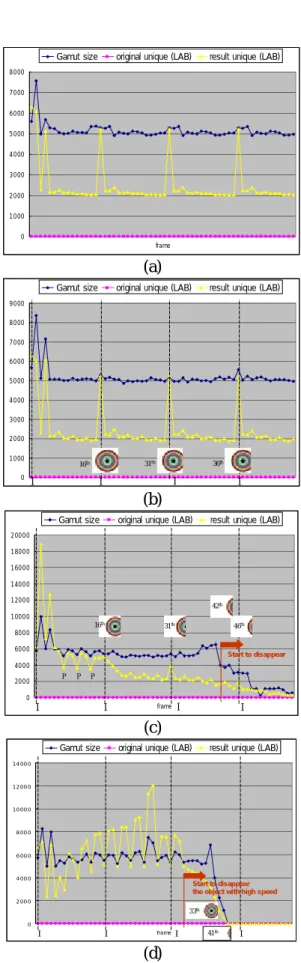
Figure 5 shows the results for each movie. For the first movie with no moving objects in figure 5(a), the values of unique color are much bigger than the original image having 6 colors. Second and third movies which have 2 and 4 pixel moving interval show almost the same results with first movie shown in figure 5(b). These movies has almost the same trend because for each I frame, the original images are used and for B and P frame, only motion information is used to reconstruct images. Therefore B and P frame have less unique color caused by the quantization level.
However for forth and fifth movies which have each 8 pixel movement and accelerated movement, the results are quite different. I frames have smaller values of unique colors. This color distortion can be happened due to big motion vector. Gamut size also observed simultaneously with the unique color. However, gamut size did not provide the trend of variation.
Figure 6 shows gamut fidelity defined as follows:
size
Gamut
color
unique
of
number
fidelity
Gamut
=
(1)This value means the density of CIELAB value in gamut size. However the results present irregular trends for the sequential frames.
2.3. Gamut characteristics for test movies
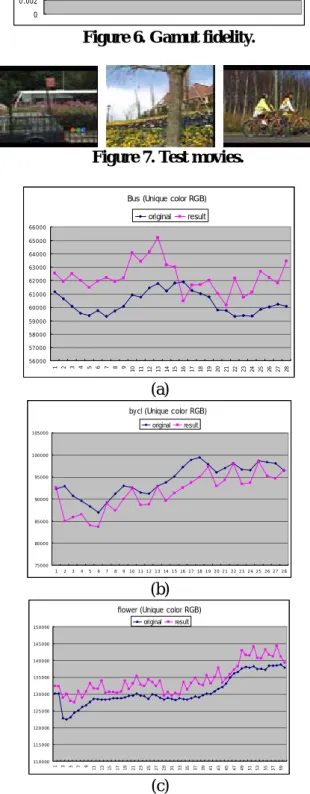
This investigation is performed with test movies which are bycl and flower movies shown in figure 7. In figure 8, the unique color is shown, however the results are quite different. This means that the gamut fidelity also different. Therefore, more research is necessary to generalize the results for typical movies.
3. Results and discussion
This paper informs the influence of the color distortion according to the compression methods using gamut size and color gamut in CIELAB color space. Two elements (gamut size and unique color) are used
I I I I 0 1000 2000 3000 4000 5000 6000 7000 8000 frame
Gamut size original unique (LAB) result unique (LAB)
(a) 0 1000 2000 3000 4000 5000 6000 7000 8000 9000
Gamut size original unique (LAB) result unique (LAB)
I I I I 31th 36th 16th (b) 0 2000 4000 6000 8000 10000 12000 14000 16000 18000 20000 frame
Gamut size original unique (LAB) result unique (LAB)
I I I I 31th P P P 46th 16th 42th Start to disappear (c) 0 2000 4000 6000 8000 10000 12000 14000 frame
Gamut size original unique (LAB) result unique (LAB)
I I I I
Start to disappear the object with high speed
33th
41th
(d)
Figure 5. Investigation of gamut characteristics. (a) no movement, (b) 2 pixel, (c) 8pixel, and (d)
64-3 / T. H. Lee IMID 2009 DIGEST • 0 0.002 0.004 0.006 0.008 0.01 0.012 0.014 0.016 0.018 0.02
stop shift-2 shift-4 shift-8 shift-irr
Figure 6. Gamut fidelity.
Figure 7. Test movies.
Bus (Unique color RGB)
56000 57000 58000 59000 60000 61000 62000 63000 64000 65000 66000 1 2 3 4 5 6 7 8 9 10 11 12 13 14 15 16 17 18 19 20 21 22 23 24 25 26 27 28 original result (a)
bycl (Unique color RGB)
75000 80000 85000 90000 95000 100000 105000 12 34 56 78 9 10 11 12 13 14 15 16 17 18 19 20 21 22 23 24 25 26 27 28 original result (b)
flower (Unique color RGB)
110000 115000 120000 125000 130000 135000 140000 145000 150000 1 3 5 7 9 11 13 15 17 19 21 23 25 27 29 31 33 35 37 39 41 43 45 47 49 51 53 55 57 59 original result (c)
Figure 8. Unique color for test movies. (a) unique color for bycl and (b) unique color for flower.
to present the characteristics of gamut variation according to the sequential images for each movie, however they just show the variation. This paper is on going work. In our future work, it is necessary to consider the technique for removing color bleeding. Also the final object is the enhancement of the perceptual image quality by establishing effect of gamut for reconstructed movies.
Acknowledgement
This work was supported by the Korea Science and Engineering Foundation (KOSEF) grant funded by the Korea government (MEST) (No. 20090079859)
5. References
1. T. Y. Park, K. W. Ko, and Y. H. Ha, "On the Relationship of Color Image Compression and Gamut: JPEG and JPEG2000," Sixteenth Color
Imaging Conference: Color Science and Engineering, Portland, Oregon, U.S.A., pp. 44-49,
Nov. 2008.
2. T. Y. Park, K. W. Ko, and Y. H. Ha, "Analysis of Relationship Between Image Compression and Gamut Variation," International Workshop on
Advanced Image Technology 2009, Seoul, Korea,
Jan. 2009.
3. E. Allen, S. Triantaphillidou, and R. E. Jacobson, “Image quality compression between JPEG and JPEG2000. I. Psychophysical investigation,”
Journal of Imaging Science and Technology, vol.
51, no. 3, pp. 248-258, May/June 2007.
4. S. Triantaphillidou, E. Allen, and R. E. Jacobson, “Image quality compression between JPEG and JPEG2000. II. Scene dependency, scene analysis, and classification,” Journal of Imaging Science
and Technology, vol. 51, no. 3, pp. 259-270,
May/June 2007.
5. U. Steinggrimsson and K. Simon, “Perceptive quality estimations: JPEG2000 versus JPEG,”
Journal of Imaging Science and Technology, vol.