1114
-Abstract - This paper describes the design of toroid-typeHTS DC reactor magnet. Target operating current and inductance of the HTS DC reactor are 1,500 A and 400 mH, respectively. The HTS DC reactors were designed through electromagnetic analysis and 3D CAD program. And, we analyze the operating performance of the Double Pancake Coil module for the 1,500 A, 400 mH HTS DC reactor magnet under the liquid nitrogen condition.
1. Introduction
Large electric power systems, such as HVDC transmission systems need large capacity reactors that have large inductance and high transport current. General DC reactor used metal conductor of HVDC systems has some disadvantages such as large reactor size, leakage flux, large install space, heavy weight and big losses according to the large operating current.
The High-Temperature Superconductor (HTS) DC reactor as a key technology to diminish the disadvantages associated with general DC reactors. HTS has zero electric resistance under DC current conditions. It is possible to increase the capacity of the transport current, hence, reduce the reactor’s size, weight, and electrical losses. From the flux leakage point of view, a toroid-type magnet is an ideal structure. The toroid-type HTS magnet has much lower flux leakage compared to a solenoid-type HTS magnet. So, the installation space can be much smaller with the toroid-type HTS DC reactor [1-4].
In this paper, the toroid-type HTS DC reactor was designed. The toroid-type HTS magnet for DC reactor system is designed by 3D CAD program, and manufactured using the GdBCO 2G HTS wire. The magnetic field of the toroid-type HTS DC reactor magnet is analyzed using FEM program. The design goal of HTS DC reactor are 1,500 A, 400 mH class. Expected operating temperature is under 20 K using conducting cooling. And, we analyze the performance (inductance, expected Ic, flux density of coil) of the HTS Double Pancake Coil (DPC) module for 1,500 A, 400 mH class toroid-type HTS DC reactor magnet under the liquid nitrogen temperature condition.
2. Design of the 1,500 A, 400 mH toroid-type HTS DC reactor
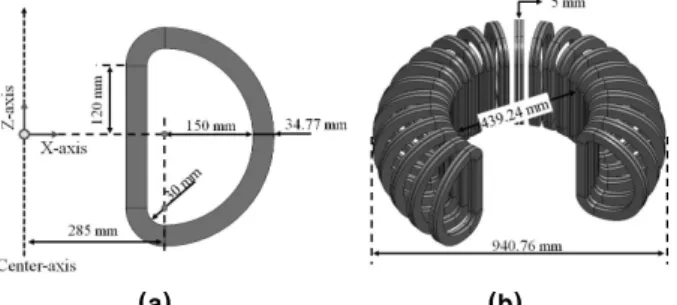
2.1 Structure design of the HTS DC reactor magnet Fig. 1 presents the structure and size of the toroid-type DC reactor magnet. The inner diameter and outer diameter of the reactor magnet are 439.24 mm and 940.76 mm, respectively. The DPCs are arranged at an angle of 12° from each other based on the central axis of the toroidal-type magnet. That is, all coils constituting the toroidal-type magnet are arranged at identical intervals. The toroid-type magnet consists of 30 DPCs. The unit length of DPC is 87.6 m, and the total wite length of the toroid-type HTS DC reactor magnet is about 2.628 m.
2.2 Electromagnetic analysis and whole system drawing of the HTS DC reactor
Fig. 2 shows the electromagnetic analysis results of the reactor
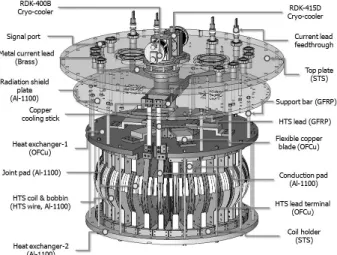
magnet, which was conducted on one-half of the DPC with a selected boundary condition. The values obtained here were applied to all the DPCs to determine the parameters of the magnet. When the operating current was assumed to be 1,500 A, the max. perpendicular flux density, the max. parallel flux density, and the inductance were 1.65 T, 4.52 T, and 404.59 mH, respectively. The detailed specifications and 3D CAD drawing of the designed toroid-type DC reactor are shown in Table 1 and Fig. 3.
<Fig. 1> Structure and size of the DC reactor magnet : (a) reactor coil (DPC), (b) HTS DC reactor magnet.
<Fig. 2> Electromagnetic analysis results of the HTS DC reactor coil (Half of DPC) : (a) Perpendicular flux density,
(b) Parallel flux density. <Table. 1> Specifications of HTS DC reactor
Parameter Value
Wire type 2G GdBCO wire
Thickness of wire 0.61 mm Width of wire 12 mm Operating temperature 20 K Operating current 1,500 A Magnet inductance 404.59 mH Length of wire (DPC) 87.6 m Number of DPC 30 ea
Total length of wire 2,628 m
Number of turns 57 turns
Width of magnet 940.76 mm Height of magnet 370.76 mm
1,500 A, 400 mH급 고온초전도 직류 리액터 설계
김광민*, 김성규*, 박민원*, 하홍수**, 심기덕**, 손명환**, 이헌주***
창원대학교*, 한국전기연구원**, 서남***
Design of the 1,500 A, 400 mH class HTS DC reactor
Kwangmin Kim*, Sung-Kyu Kim*, Minwon Park*, Hong-Soo Ha**, Kideok Sim**, Myung-Hwan Sohn**, Hunju Lee** Changwon National University*, Korea Electrotechnology Research Institute**, SuNAM***
(a) (b)
(a) (b)
1115
-<Fig. 3> 3D CAD drawing of the 1,500 A, 400 mH classHTS DC reactor system.
3. Performance test result of the DPC module for 1,500 A, 400 mH toroid-type HTS DC reactor
3.1 Experiment setup
Fig. 4(a) shows the configuration of the DPC module. the DPC module for DC reactor magnet is composed of a center plate, two D-shape coils, two bobbins, two side plate and joint parts(joint plate, wire holder). The whole structure (without joint plate(Cu)) of DPC was made by GFRP. 50 μm Kapton tape was lapped around the HTS wire for the insulation between each HTS wire.
Fig. 4(b) shows the experiment setup for performance test of DPC module. The hall sensor was positioned at the center line of the DPC module. The voltage taps were soldered at the DPC module terminal. All characteristic tests were performed in a bath of liquid nitrogen at 77 K.
(a)
(b)
<Fig. 4> Performance test of the test DPC module: (a) Shape of the DPC module, (b) Experiment devices. 3.2 Performance test result of the DPC module
Fig. 5 shows the performance test result of the DPC module. The critical current, terminal voltage and flux density were tested. The charge current ramping rate and the terminal voltage of the HTS DC reactor magnet were 1 A/sec and 5.37 mV. The inductance of the HTS DC reactor magnet was 5.37 mH. The FEM analysis value was 5.49 mH. It has a value difference of 2.18 %. The magnetic field of the HTS DC reactor from hall sensor installation point was 0.187 T. The FEM analysis value from the same point was 0.203 T. It has a value difference of 7.89 %. The critical (quench) voltage was 8.76 mV without inductance voltage. Therefore, the critical current of
the DPC module was 350 A. The expected critical current of the DPC module was 345.6 A. Table 2. shows the comparison results of the DPC module performances in test value and design value.
<Fig. 5> Performance test results of the DPC module. <Table.2> Comparison of the DPC module Performances in test value and design value.
4. Conclusions
The authors developed the HTS DC reactor system. The concept of the toroid-type magnet model was suggested. The toroid-type reactor magnet consists of 30 DPCs. The operating current and inductance of the reactor magnet were concluded as 1,500 A and 404 mH at 20 K. In addition, the performance characteristics (inductance, critical current, magnetic flux density) of DPC module for the toroid-type HTS DC reactor magnet were tested at liquid nitrogen condition. The fundamental data obtained from these researches will be applied to the real HTS DC reactor system.
Acknowledgement
This work was supported by the Power Generation & Electricity Delivery Core Technology Program of the Korea Institute of Energy Technology Evaluation and Planning (KETEP), granted financial resource from the Ministry of Trade, Industry & Energy, Republic of Korea.(No. 2013T100200094).
[참 고 문 헌]
[1] S. Noguch, and M. Tsuda, “An Optimal Configuration Design of Superconducting Magnets for DC Reactor Taking Loss into Account”, IEEE Trans. on applied supercond., vol. 21, no. 3, Jun. 2011.
[2] M. Tsuda, T. Yagai, and T. Hamajima, “Suitable Method for Increasing Current Carrying Capacity of HTS Toroidal Coils for SMES and DC Reactor”, IEEE trans. on applied supercond., vol. 20, no. 3, Jun. 2010.
[3] K. Kim, J. G. Kim, H. Jung, S. Kim, S. Lee, M. Park, and I. K. Yu, “Design of a 400 mH 400 A Toroid-Type HTS DC Reactor Magnet”, IEEE Transactions on Applied Superconductivity, vol. 23, no. 3, June 2013.
[4] K. Kim, B. S. Go, H. J. Sung, H. C. Park, S. Kim, S. Lee, Y. S. Jin, Y. Oh, M. Park, I. K. Yu, “Design and manufacture of a D-shape coil-based toroid-type HTS DC reactor using 2nd generation HTS wire”, Physica C, C. 504, 2014.
Items Measurement value Designed value Inductance
of module DPC 5.37 mHError : 2.18%5.49 mH Critical current of DPC 350 A Error : 1.26%345.6 A
Flux density from