in Korea
Eunyoung Choi
Jinsoo Kim
Woobaik Lee
Korea Institute for Health and
Social Affairs
Korea is now experiencing an epidemiological transition. During the last few decades, the incidence of infectious diseases has decreased while the incidence of chronic diseases has been consistently growing. To cope with this epidemiological change, the Korean government has placed more emphasis on health promotion.
The implementation of health insurance for the whole nation by the Korean government has increased the demand for health care and subsequently the need for more health manpower and facilities. The main issue of the health care system in Korea is therefore the improvement of accessibility, equality and availability of health care with lower costs for the majority of the people. Policy measures for long term development of the health security sector were suggested by the Health Security Reform Commitee(1994). Concrete implementation strategies were provided to enhance health security by the Medical Care Reform Committee(1996). Most recently, a special committee for integration of the health insurance societies was organized, in March 1998, to improve management of the health insurance system.
The purpose of this paper is to report to the OECD on the health care system and health reform movement of the Republic of Korea. The current state and problems in Korea's health status, medical delivery system, health care resources, regional health care resource distribution, and the health insurance system were
This publication was prepared by Dr. Eunyoung Choi at the Korea Institute for Health and Social Affairs in collaboration with Dr. Jinsoo Kim and Mr. Woobaik Lee.
The authors would like to thank Dr. Youngseok Shin and Dr. Youngho Oh at KIHASA and Dr. Jeong-kee Hong at MOHW for their valuable advice, and Julie Oh and Nanhee Lee for editing the draft.
The views and opinions expressed in this report are those of the authors alone and do not reflect the views of the Korea Institute for Health and Social Affairs.
December, 1998 Kyungbae Chung, Ph.D. President, KIHASA
Summary ··· 11 Ⅰ. General Information ··· 19 1. History ··· 19 2. The Land ··· 20 3. Population ··· 20 4. Economic Activities ··· 24 5. Health Expenditure ··· 25 6. Medicine ··· 27 7. Health Indices ··· 28
8. International Comparison of Health Status ··· 29
Ⅱ. Health Promotion and Protection ··· 35
1. Implementation of the National Health Promotion Act ··· 35
2. Prevention of Adult Diseases ··· 36
3. Cancer Control Programs ··· 37
4. Promotion of Maternal and Child Health ··· 37
5. Family Planning Program ··· 38
Ⅲ. Control of Communicable Diseases ··· 39
1. Notifiable Disease and Reporting Procedure ··· 39
2. Immunization ··· 40
3. Control of Tropical Diseases and Orphan Drug Services ··· 41
4. Quarantine ··· 42
5. Control of Tuberculosis and Leprosy ··· 42
6. Control of AIDS ··· 43
Ⅳ. Control of Mental Health ··· 45
1. Enhancement of the Mental Health Act ··· 45
2. Promotion of the Community Mental Health Program ···· 45
3. Health Manpower ··· 52
4. The Regional Distribution of Health Resources ··· 55
5. Health Care Resources in Rural Areas ··· 57
6. Emergency Medical System ··· 58
7. Organ Transplantation Management System ··· 59
8. Home Care Program ··· 59
9. Hospital Service Evaluation Program ··· 60
10. Medical Management ··· 60
11. Oriental Medicine ··· 60
12. Health Care Science and Technology ··· 62
Ⅵ. The National Health Insurance Program ··· 63
1. History of Health Insurance ··· 63
2. Structure ··· 64 3. Incentives ··· 66 4. Beneficiaries ··· 67 5. Benefits ··· 69 6. Financial Resources ··· 71 7. Copayment ··· 72
8. Patient Referral System ··· 74
9. The System for Review of Claims and Payment of Medical Fees ··· 75
10. Appeals System ··· 78 Ⅶ. Future Issues ··· 79 1. Issues ··· 79 2. Proposal for 1997 ··· 80 3. Proposal for 1998 ··· 83 REFERENCES ··· 85
Table 1. Population Distribution and Density ··· 23
Table 2. Prospects of Population ··· 38
Table 3. List of Notifiable Diseases and Reporting Procedure... 39
Table 4. Annual Cases of Notifiable Diseases ··· 40
Table 5. Recommended Schedule of Vaccination(1997) ··· 41
Table 6. Annual Trend of HIV Infection and AIDS Cases ··· 44
Table 7. Classification of Medical Facilities ··· 50
Table 8. The Number of Medical Education Institutes(1998) ··· 52
Table 9. Qualified Medical Specialists by Specialty(1996) ··· 55
Table 10. Regional Distribution of Health Resources(1996) ··· 56
Table 11. Regional Distribution of Physicians(1995) ··· 56
Table 12. Number of Beds by City and Province(1995) ··· 57
Table 13. Distribution of Health Resources(in 1996) ··· 58
Table 14. Status of Oriental Medical Doctors and Medical Institutes(1996) ··· 61
Table 15. Current Standards in Medical Insurance Coverage(December, 1997) ··· 69
Table 16. General Hospitals and Hospitals ··· 73
Table 17. Clinics and Public Health Centers ··· 73
Table 18. Dental Clinic ··· 73
Figure 1. Birth, Death and Natural Increasing Rates ··· 21 Figure 2. Age Composition of the Population ··· 21 Figure 3. Composition of the Population by
Educational Attainment(25 Years of Age & Over) ··· 22 Figure 4. Health Expenditure in GDP ··· 25 Figure 5. Expenditure on Health Care in Korea by Source (1996) ··· 26 Figure 6. Expenditure on Health Care in Korea
by Type of Institution(1996) ··· 27 Figure 7. Life Expectancy at Birth ··· 28 Figure 8. Leading Causes of Death(1996) ··· 29 Figure 9. Evolution of the LE at Birth in Major
Asian Countries ··· 30 Figure 10. Evolution of Infant Mortality in Major
Asian Countries ··· 31 Figure 11. Evolution of the Age-adjusted Mortality
in Major Asian Countries ··· 32 Figure 12. Evolution of Age-adjusted Mortality due to
Malignant Neoplasm in Major Asian Countries ··· 33 Figure 13. Evolution of the Age-adjusted Mortality due to Ischaemic Heart Disease in Major Asian Countries ·· 34 Figure 14. Psychiatric Facilities in Korea(December 31, 1997) ·· 46 Figure 15. The Distribution of Medical Facilities ··· 51 Figure 16. The Distribution of Beds ··· 51 Figure 17. The Number of Health-related Persons Having
Registered Licenses Per 100,000 Persons ··· 53 Figure 18. The Number of Specialists and Ratio of
Specialists to Registered Physicians ··· 54 Figure 19. Coverage and Organization of National Health
Insurance(October, 1998) ··· 66 Figure 20. Beneficiaries By Year ··· 68 Figure 21. Contribution of the Self-employed(1998) ··· 72
for Medical Services ··· 77
List of Abbreviations
CDPA : Communicable Disease Prevention Act CMHP : Community Mental Health Program CT : Computerized Tomograph
FPP : Family Planning Program GNP : Gross National Product HCT : Health Care Technopolis
HCTI : Health Care Technology Innovation HPDP : Health Promotion Demonstration Programs HRDP : Health Research and Development Programs IHR : Internal Health Regulation
JCMI : Joint Commission for Medical Insurance KFDA : Korea Food and Drug Administration KHCA : Korea Health Control Association
KIHASA : Korea Institute for Health and Social Affairs KIOM : Korea Institute of Oriental Medicine
KLCA : Korean Leprosy Control Association KMA : Korean Medical Association
KNTA : Korean National Tuberculosis Association LE : Life Expectancy
LC : Life Committee
NCC : National Cancer Center MAD : Medical Aid Program
MIP : Medical Insurance Program
MIRC : Medical Insurance Reappeals Committee MOE : Ministry of Education.
MOHW : Ministry of Health and Welfare MSA : Medical Service Act
MSRC : Medical Care Reform Committee NAC : National AIDS Committee
NAP : National AIDS Prevention Program NFMI : National Federation of Medical Insurance NHIC : National Health Insurance Corporation NHPA : National Health Promotion Act NHPF : National Health Promotion Fund NIH : National Institute of Health NMC : National Medical Center
OECD : Organization for Economic Co-operation and Development
OMB : Oriental Medicine Bureau
OTMC : Organ Transplantation Management Center PHC : Primary Health Care
PHDs : Public Health Doctors
SCHR : Special Committee for Health Reform SEMC : Special Emergency Medical Centers VC : Vaccination Committee
Ⅰ. Introduction
The purpose of this paper is to report to the OECD on the health care system and health reform movement of the Republic of Korea. The current state and problems in Korea's health status, medical delivery system, health care resources, regional health care resource distribution, and the health insurance system were discerned and the recent health reform movement was examined. The individual health statuses of Asian countries were also compared.
Ⅱ. Health Indices
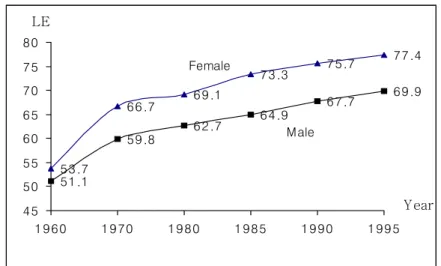
Due to the development of health and medical science, improved living standards and national nutrition, and the upgrading of the quality of health and medical care, the life expectancy of the Korean people has been greatly prolonged. The life expectancy for males increased from 51.1 years in 1960 to 69.9 years in 1995 and from 53.7 years to 77.4 years for females. The crude birth rate was down to 16.1 per 1000 persons in 1995 and the crude death rate was 5.4 per 1,000 persons, giving a natural increasing rate of 10.7 per 1,000 persons. The infant mortality rate also dropped from 89.2 per 1,000 live births in 1962 to only 9.9 in 1993. In the past, the main causes of
death were acute and communicable diseases, but now these have been replaced by chronic and non-communicable diseases. The leading causes of death in 1996 were diseases of the circulatory system, malignant neoplasms, accidents, chronic liver disease and diabetes mellitus.
Ⅲ. International Comparison
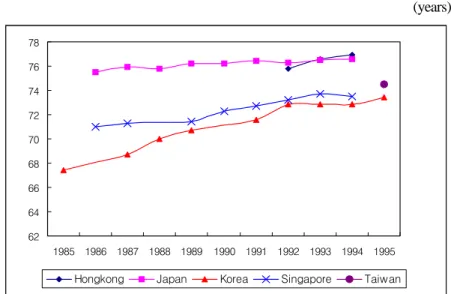
Korea's life expectancy in 1994 was lower than the life expectancies in Hongkong, Japan, and Singapore and the infant mortality rates and age-adjusted mortality rates in Korea are among the highest in major Asian countries. Age-adjusted mortality in Korea was higher than that of Singapore and Japan and has increased since 1992. The level of age-adjusted mortality due to malignant neoplasm in Korea was lower than in Singapore and Japan before 1987 but increased sharply and became higher after 1990. The level of age-adjusted mortality due to ischaemic heart disease in Korea is the lowest in the major Asian countries but has increased rapidly since 1990.
Ⅳ. Public Health
Korea is now experiencing an epidemiological transition. During the last few decades, the incidences of infectious diseases has decreased while the incidences of chronic degenerative diseases has consistently grown. To cope with this epidemiological change, the Korean government enacted the National Health Promotion Act in January 1995 which placed more emphasis on health promotion. This act provided a legal and institutional base for people to raise the responsibility for and value of their own health. The main contents of the Act are as follows:
- Nutrition and Dental Health Care Programs
- Promotion of Health Education
- No Smoking and No Drinking Movement
- National Health Promotion Fund
The prevention of adult diseases is essential because most adult diseases have no symptoms and are not detected until the terminal stage. Currently, the mortality rate from chronic diseases is rapidly increasing and it is anticipated that this tendency will become more pronounced with the aging of the population structure, change in diet, increased smoking population, and decrease in physical activities. Focus has therefore been put on prevention activities, various public education methods, and the 13 chronic disease screening centers of the Korea Health Control Association(KHCA) where screening at a low price is carried out through mobile screening teams.
The hospital cancer registry project has been implemented by the National Medical Center(NMC) since 1980. Cancer patients who are diagnosed in general hospitals are registered and controlled at the NMC. The National Cancer Center(NCC) carries out national cancer control programs which include prevention, screening and treatment.
The Maternal and Child Health(MCH) program is aimed at improving the level of national health through prenatal care for pregnant women as well as health care services for preschool children. The Ministry of Health and Welfare(MOHW) also provides free vaccinations for diseases such as PDT, Polio, MMR and DT, Rubella and Hepatitis B. The Family Planning Policy also aids in improving national health by maintaining the present low fertility trend. It focuses on quality-oriented programs such as sex-education for the youth, prevention of induced abortion and other MCH programs.
A communicable disease control system was established and a notification system and immunization programs were implemented for the management of communicable diseases.
Quarantine stations inspect passenger and provides health information to overseas trvelers and the National Medical Center(NMC) provides orphan drugs.
In December 1985, the first HIV positive persons were identified and the first AIDS case was reported in February 1987. The cumulative number of persons with HIV/AIDS is continuously increasing. Since 1985, MOHW has coordinated a wide range of activities for AIDS prevention and control and the Center for AIDS Control provides technical support for the National AIDS Prevention program(NAP).
To improve the quality of life and human rights of the mentally ill the government enacted the 'Mental Health Act' in December 1995. The fundamental objectives of the 'Mental Health Law' are to shift present mental health policies to a community based management system and to improve human rights of the mentally ill through a variety of support for their return to society.
Ⅴ. Medical Care System
Due to industrialization, urbanization and aging of the population in the past years, the demands, both in quantity and quality, of the people for health and medical care services has increased. There is an uneven distribution of medical care resources in Korea, though. The implementation of health insurance for the whole nation increased the demands for health care and revealed the fact that more health manpower and facilities are needed. The crucial issues of the health care system in Korea are the improvement of accessibility, equality and availability of health care with lower costs for the majority of the people.
Medical services are provided indirectly by medical care institutions established and operated by the national government or by local government and educational institutions or predominantly
by private corporations and private individuals. Medical care institutions are categorized by their scale of operations into general hospitals, hospitals, and clinics.
At the end of 1997, there were approximately 156 physicians(including oriental medical doctors) per 100,000 persons. By the year 2,000 it is estimated that there will be about 200 per 100,000 persons. In 1996, 58.2% of licensed physicians were specialists.
The health system depends mainly upon the private sector. Private clinics and hospitals make up more than 91.0% of all medical facilities, employ 88.8% of physicians, and include 91.0% of total beds. Most private facilities are concentrated in urban areas.
In Korea, 75.6% of the population resides in urban areas, but 95.8% of the physicians and 92.0% of hospital beds are concentrated in the cities. This makes it difficult for the rural population to have access to medical care. The skewed distribution of health resources is the result of laissez-faire policy towards the private medical care sector. The private sector tends to concentrate more in the cities where the demand for medical service is higher
To alleviate the maldistribution of medical facilities between urban and rural areas, the government provides those who establish medical facilities in rural areas with public doctors and financial incentives such as long-term low-interest loans.
The government has also made additional efforts in many areas. The people's convenience in the emergency medical system was improved at every stage from emergency calls, to delivery, and medical care. The government announced preliminary proclamation of the Organ Transplantation Law, which contains the legal definition of cerebral death, prevention of organ sale and extraction of internal organs from the cerebrally dead, and establishment of the Life Committee. A home care demonstration program was launched in 1994 which provides home care in the form of medical and nursing services to patients at home whom
were discharged early from a hospital with consent.
Oriental medicine, which is traditional Korean medicine, differs fundamentally from western medicine in principles and characteristics. Oriental medicine has long contributed to the improved health of Koreans with excellent clinical treatment effects. However, the lack of appropriate systems and organization for the development of oriental medicine in Korea has been a barrier for the standardization and modernization of oriental medicine. Increased research and support should also be focused on the globalization of oriental medicine.
Ⅵ. Health Insurance
The health insurance scheme was introduced in 1977. In 1988, insurance coverage was expanded to workplaces with more than 5 employees and to rural residents.
In 1989, the Korean government implemented a compulsory health insurance program for the entire population. Insurance coverage was gradually expanded from corporate employees to the self-employed and farmers. Pharmacies were also included as part of the medical insurance system.
There are two kinds of health insurance schemes; one is for ordinary employees and the other is for government employees, private school employees and self-employed persons. Ordinary employee insurance covers workers at industrial establishments with five or more employees and their dependents.
All insurers are members of the National Federation of Medical Insurance(NFMI). NFMI, on behalf of its members, designates medical care institutions to provide services to the insured and reviews and pays all claims from medical care institutions. All societies, National Health Insurance Corporation(NHIC) and the NFMI are under the guidance and administrative supervision of the Ministry of Health and Welfare.
Health care benefits include medical consultation, drugs and other therapeutical materials, medical and surgical treatment, hospitalization, operations and other care such as nursing care and transportation.
The financial resources of the insurance system consist of contributions paid by the insured and their employers and government subsidies. The system has social insurance characteristics resulting in contributions being the major source of income. There are two different insurance fund schemes with one covering employees and the other covering the self-employed. In both employees medical insurance and government and private school employees medical insurance, contributions are based on the income of the insured. However, the scope and amount of income and the contribution rate between the two are slightly different.
In the employees medical insurance program, the employee and employer each pay half of the contribution. In the government and private school employees medical insurance program, the government, as employer, pays half for the government employee, while for private school employees the owner pays 30% and the government subsidizes 20%.
The self-employed medical insurance program is financed by contributions from the insured and by government subsidies. The contribution of the insured is determined by income and property.
Ⅶ. Future Issues
Although Korea has established universal health care, problems remain. Consumers have been dissatisfied with the services provided by the health insurance scheme both in terms of quantity and quality because the supply of health services was not sufficient to meet the consumers' increased and diverse demands caused by health insurance expansion.
everyone was covered by an insurance scheme. In order to achieve this goal in a short period though, the government had to maintain premiums at a low level. This low premium policy resulted in a high copayment rate.
In response, the Korean government organized the Special Committee for Health Security Reform in January 1994. The goals of the reform are to increase efficiency of the system through restructuring of the health care system, to increase the satisfaction of both consumers and suppliers and to correct the inequity in the different insurance funds.
In 1996, the need for health reform was raised again, mainly by domestic causes. To overcome these problems the government reorganized a special Committee for Health Reform in November 1996. The goal of the committee's reform in 1997 was to increase the quality, access, and comprehensiveness of care and to increase efficiency of the health care delivery system. To improve management of the health insurance system, a special committee for integration of health insurance societies was organized in March 1998.
1. History
The history of Korea can be traced back nearly 5,000 years when, according to Korean folk legend, Ko-choson was founded by a semi-deity named Dangun in 2333 B.C..
Korea has been invaded many times since Dankun founded the country, but despite these invasions, it remained independent and self-reliant. Korea was under Japanese rule for 36 years(191 0~1945) and then was divided into two parts at the 38th Parallel shortly after being liberated at the end of World War Ⅱ. The Korean War from 1950 to 1953 separated the people and the land along the 155-mile Demilitarized Zone which stretches from the mouth of the Imjin River on the west coast to the Kumgang Mountains on the east coast.
The Korean War(1950~1953) left Korea devastated. During the sixties and seventies Korea succeeded in developing the economy and during the eighties the people's wish for democracy was achieved.
In 1988, Korea hosted the 24th Olympic Games in Seoul, which was the largest and most successful sports festival to date. In 1991, Korea joined the United Nations along with North Korea, and joined the OECD in 1996 marking its advancement into the ranks of developed nations.
Today Korea has reached an advanced stage of democracy with freely elected local councils and separation of the legislative
and executive branches of government. Korea's main political goal for the future is to be peacefully reunited.
2. The Land
Korea stretches southward from the eastern end of Asia and consists of the Korean Peninsula and the more than 3,400 islands adjacent to it. It has a total land area of 221,000㎢. The country has four distinct seasons and a climate that is well suited to a variety of activities. Seventy percent of the land is covered with mountains and in spite of the mountainous terrain, the inhabitants of Korea began to farm early on. Korea is bordered on the north by China and Russia and across the East Sea lies Japan.
3. Population
3.1 Population Size and Growth Rate
As of 1997, the population of Korea was estimated to be 46 million persons. The population growth rate was 3% in 1960, but economic and social development, together with a successful family planning campaign, gradually reduced the growth rate to 2% in 1970. It has remained under 1% since 1985.
3.2 Birth, Death and Natural Increasing Rate
Since 1970, the birth, crude death and natural increasing rate have been steadily decreasing. The birth rate in 1970 was 31.1 per 1,000 persons but in 1995 was 16.1 per 1,000 persons. The crude death rate in 1970 was 9.3 per 1,000 persons but in 1995 decreased to 5.4 per 1,000 persons. The natural increasing rate was 21.8 per 1,000 persons in 1970 and this rate also decreased to 10.7 per 1,000 persons in 1995(see Figure 1).
31.1 25.1 23.4 16.4 15.6 16.1 7.2 6.7 6.3 5.8 5.4 21.8 17.9 16.7 10.1 9.8 10.7 9.3 0 5 10 15 20 25 30 35 1970 1975 1980 1985 1990 1995
Birth Rate Crude Death Rate Natural Increasing Rate (%) 11.64% 8.85% 9.55% 8.78% 5.22% 2.48% 10.37% 8.33% 9.06% 8.41% 5.13% 4.21% 4.09% 3.87% 0% 5% 10% 15% 20% 25% 0-14 15-24 25-34 35-44 45-54 55-64 65+ Male Female Age
Figure 1. Birth, Death and Natural Increasing Rates
(unit: 1,000 persons)
Source: National Statistical Office, The Future Estimated Population, 1996.
3.3 Age Structure
The age structure of the population in 1998 shows 22.0% of the population to be ages 0~14, 71.4% to be ages 15~64, and 6.6% to be 65 and over. The age structure of the population in the past, especially in 1960, was pyramid-shaped, a typical structure for less developed countries.
Figure 2. Age Composition of the Population
27%
16% 37%
20%
Primary School Graduates & Under M iddle School Graduates
High School Graduates College, University Graduates & over
However, the pattern has become bell-shaped as a result of low birth rates and low mortality rates. In the near future, it is expected to become post-shaped like those of advanced countries which have a relatively low birth rate.
3.4 Marital Status
In 1995, of the 34,210,000 persons aged 15 years or above 30.2% were unmarried, 61.2% married, 7.5% widowed and 1.1% divorced.
3.5 Education
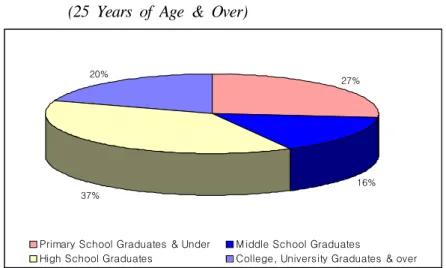
According to the Population-Housing Census, as of November 1, 1995, people with an elementary school education (including those who attended elementary school and dropouts of middle school) accounted for 92.7% of the population with a total of 37.5 million, out of 40.5 million persons aged 6 and over.
Figure 3. Composition of the Population by Educational Attainment (25 Years of Age & Over)
Source: National Statistical Office, Population & Housing Census, 1995.
In Korea, the rate of school attendance for preschool children rose to 39.9% in 1997. The total number of elementary schools
has been decreasing since 1980 so that there are now 5,721 elementary schools with a school enrollment ratio of 98.9%. The total number of higher education schools including colleges and universities in 1997 was 950, which was over twice the number for 1990, which demonstrates the high demand for college education in Korea.
Figure 3 shows us the distribution of educational attainment in the population aged 25 or over, 37% of these people have graduated high school.
3.6 Population Distribution and Density
Table 1 shows the regional distribution and population density of Korea population. It shows that 22.9% of the population lives in Seoul and 17.1% lives in Kyonggi Province. The population density of Seoul is highest at 16,864 preson per km2 and the population density of Kangwon Province is lowest at 87 preson per km2.
Table 1. Population Distribution and Density
Region Population ( % ) (Person per ㎢)Density Whole Country
Seoul Metropolitan City Pusan Metropolitan City Taegu Metropolitan City Inchon Metropolitan City Kwangju Metropolitan City Taejon Metropolitan City Kyonggi Province Kangwon Province Chungchongbuk Province Chungchongnam Province Chollabuk Province Chollanam Province Kyongsangbuk Province Kyongsangnam Province Cheju Province 44,551,183 10,215,222 3,809,107 2,445,007 2,303,606 1,256,931 1,270,895 7,638,115 1,465,835 1,395,213 1,765,272 1,900,719 2,066,132 2,672,530 3,841,500 505,099 (100.0) ( 22.9) ( 8.5) ( 5.5) ( 5.2) ( 2.8) ( 2.9) ( 17.1) ( 3.3) ( 3.1) ( 0.4) ( 4.3) ( 4.6) ( 6.0) ( 8.6) ( 1.1) 448 16,864 5,084 2,757 2,414 2,510 2,354 752 87 188 211 236 174 141 332 277 Source: National Statistical Office, Population & Housing Census, 1995.
4. Economic Activities
4.1 Economic Growth
Less than 50 years ago, Korea was still primarily an agricultural land. After the devastating war from 1950 to 1953, the Korean Peninsula was in ruin, but around 1960 Korea began to rebuild its economy. By 1965, the average annual growth rate of Korea's economy was 8.4 percent. In less than 30 years Korean development came to be referred to as the Miracle on the Han River and the country became industrialized.
Korea made up for its lack of natural resources through exports. In steel production, ship building, the heavy chemical industry, semiconductors, automobiles, and other advanced technology and skills, Korea made swift inroads into world markets. The composition of the business sector is slowly shifting towards service industries. Korea joined the OECD in October of 1996. Recently, at the end of 1997, Korea entered a period of economic crisis and became managed by the International Monetary Fund (IMF).
4.2 National Income
The gross national product(at current prices in 1997) totaled 437 billion US dollars(416.1 trillion won) with a decrease of 9% over the previous year. GNP per capita in 1997 was recorded as 9,511 US dollars.
4.3 Employment Trend
The labor force population, which includes persons aged 15 and over, exceeded 35.7 million persons in 1997 showing an increase of 1.6% over the previous year(35.1 million). The economically active population participating in the labor market was registered at 21.6 million persons with a 1.9% increase over the previous year.
235 1421.6 3492.8 9254.6 22955 2.28 3.73 4.26 5.15 5.89 0 5000 10000 15000 20000 25000 1975 1980 1985 1990 1996 0 1 2 3 4 5 6 7 Medical Expenditure (% ) of GDP 10 billion w on % of GDP
unemployment rate was 2.6%. The unemployment rate in May 1998 was 6.7%.
5. Health Expenditure
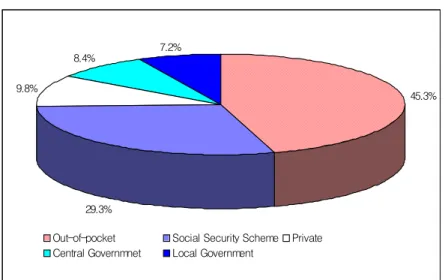
The level of spending on health care is decided by the providers and patients. The providers are doctors and hospitals. They are entitled to be paid for each service they decide to provide. If the service is on the fee schedule for reimbursable health care goods and services, they are paid by the insurance fund and patient copayment. Hence, there is no limit on total spending even for insured services. Additionally, patients pay in full for goods and services which are not on the fee schedule. Estimates of total spending on health care depend precisely on what is included, particularly with regard to out-of-pocket payments. It is estimated that, in 1996, Korea spent 5.89 percent of its gross domestic product on health care. This is marginally less than the average of OECD countries(see Figure 4).
Figure 4. Health Expenditure in GDP
Source: KIHASA, Estimation of National Health Expenditures and Analysis of
45.3%
29.3% 9.8%
8.4% 7.2%
Out-of-pocket Social Security Scheme Private Central Governmnet Local Government
In 1996, total spending on health care was estimated to be 22,955 billion won. Figure 5 shows the composition of health expenditure. Direct payments were estimated to be approximately 45.3%.
Figure 5. Expenditure on Health Care in Korea by Source(1996) (Total Spending: 22,955 billion won)
Source: KIHASA, Estimation of National Health Expenditures and Analysis of
the Type of Expenditures, Forthcoming.
Figure 6 shows health expenditure distribution by type of medical facility; 39.11% of health expenditure was being used in general hospitals and 23.49% was being used in clinics.
39.11 9.07 23.49 10.29 0.51 10.83 6.7 0 5 10 15 20 25 30 35 40 H1 H2 H3 H4 H5 H6 H7 (%)
Figure 6. Expenditure on Health Care in Korea by Type of Institution(1996)
(16,210 billion won)
Note: H1: General Hospital, H2: Hospital, H3: Clinics, H4: Dental Hospital and Clinics, H5: Public Health Center and Midwifery, H6: Oriental Medical Hospital and Clinics, H7: Pharmacy Source: KIHASA, Estimation of National Health Expenditures and
Analysis of the Type of Expenditures, Forthcoming.
6. Medicine
The prices paid for drugs which are dispensed to patients are controlled by the government. The government sets a standard price list for each item of pharmaceuticals. The price that the consumer is actually paying for drugs, which are sold, is less than the standard prices. Parmacists sell drugs at 20~50% less than the standard prices. The government therefore decided to eliminate the standard prices by January, 1999.
Prescribing and dispensing of medicines are not generally separated in Korea. In practice, this means that nearly all drugs are available without prescription. Prescribing and dispensing of medicine will be separated starting July 1999.
53.7 66.7 69.1 73.3 75.7 77.4 51.1 59.8 62.7 64.9 67.7 69.9 45 50 55 60 65 70 75 80 1960 1970 1980 1985 1990 1995 Female Male LE Year
7. Health Indices
Due to development in health and medical science, the betterment of living standards, the improvement in national nutrition and the upgrading of the quality of health and medical care, life expectancy of the Korean people has been greatly prolonged, from 51.1 years in 1960 to 69.9 years in 1995 for males, and from 53.7 years to 77.4 years for females in the same period(see Figure 7). The crude birth rate was down to 16.1 per 1000 persons in 1995 and the crude death rate was 5.4 per 1,000 persons, giving a natural increasing rate of 10.7 per 1,000 persons. The infant mortality rate dropped from 89.2 per 1,000 live births in 1962 to only 9.9 in 1993.
Figure 7. Life Expectancy at Birth
Source: National Statistical Office, 1995 Life Tables for Korea, 1997.
Figure 8 shows the distribution of causes of death for our country. Disease of the circulatory system is shown to be number one in total causes of death.
21.34% 24.61% 5.30% 14.55% 3.37% 30.84%
M alignant Neoplasms Disease of the circulatory system Chronic Liver Disease Accidents
Diabetes M ellitus Others Figure 8. Leading Causes of Death(1996)
Source: National Statistical Office, Annual Statistical Report on Causes of Death, 1997.
8. International Comparison of Health Status
When comparing the life expectancy(LE) of three Asian countries(Japan, Korea, Singapore)in the eighties, life expectancy in Korea was the lowest of the three countries. Life expectancy in Japan has been 75 years or higher since 1986 and the trend of life expectancy has been stable over the past years. Life expectancy in Korea was below 68 years in 1985, but has increased to 71 years with a higher annual increment. The difference of life expectancy between Singapore and Korea has been narrow over the last few years. In 1994, The LE in Korea recorded 72.8 years but is still lower than those of Hongkong, Japan, and Singapore(see Figure 9).
62 64 66 68 70 72 74 76 78 1985 1986 1987 1988 1989 1990 1991 1992 1993 1994 1995
Hongkong Japan Korea Singapore Taiwan
Figure 9. Evolution of the LE at birth in Major Asian Countries (years)
Source: WHO, World Health Statistics Annual, Each Year.
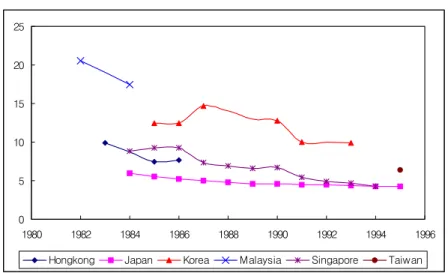
Korea still has one of the highest infant mortality rates among the major Asian countries. The level of infant mortality in Korea was above 10 before 1990, but then slightly decreased to 9.9 in 1993. In Japan, infant mortality was above 5 before 1987 and declined at a steady rate to 3.7 in 1997. The level of infant mortality in Singapore was above 5 before 1991, but the infant mortality gap between Singapore and Japan has reduced since then(see Figure 10).
0 5 10 15 20 25 1980 1982 1984 1986 1988 1990 1992 1994 1996
Hongkong Japan Korea Malaysia Singapore Taiwan
(per 1,000 live births)
Source: WHO, World Health Statistics Annual, Each Year.
KIHASA, Research on the infant mortality rate and cause, 1996.
National Statistical Office, 1995 Life Tables for Korea, 1997.
Currently Korea also has one of the highest age-adjusted mortality rates among the major Asian countries. Age-adjusted mortality in Korea was higher than that of Singapore and Japan and has tendency to increase after 1992. Age-adjusted mortality in Singapore has continuously decreased but is still currently at a higher level than in Japan(see Figure 11).
300 350 400 450 500 550 600 650 700 750 1984 1986 1988 1990 1992 1994 1996 Hongkong Japan Korea Singapore Taiwan
Countries
(per 100,000 persons)
Source: WHO, World Health Statistics Annual, Each Year.
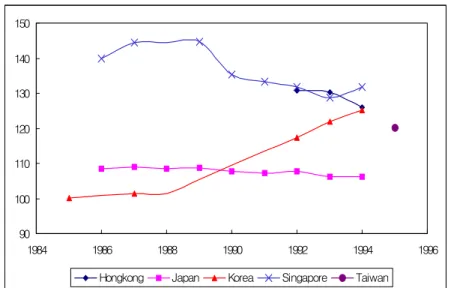
The level of age-adjusted mortality due to malignant neoplasm in Korea was lower than in Singapore and Japan but increased sharply after 1990. The level of age-adjusted mortality due to malignant neoplasm in Japan has maintained a slightly decreasing trend and was the lowest of four Asian countries in 1994. During the period from 1986~1989, the level of age-adjusted mortality due to malignant neoplasm in Singapore decreased, but after 1990 was still higher than Korea and Japan(see Figure 12).
90 100 110 120 130 140 150 1984 1986 1988 1990 1992 1994 1996 Hongkong Japan Korea Singapore Taiwan
Figure 12. Evolution of Age-adjusted Mortality due to Malignant Neoplasm in Major Asian Countries
(per 100,000 persons)
Source: WHO, World Health Statistics Annual, Each Year.
The level of age-adjusted mortality due to ischaemic heart disease in Korea is the lowest in major Asian countries but has rapidly increased since 1990. However, the highest level of age-adjusted mortality due to ischaemic heart disease in Singapore decreased continuously but was still almost 6 times higher than that of Korea in 1994. In Japan. the level of age-adjusted mortality due to ischaemic heart disease has maintained a slightly decreasing trend(see Figure 13).
0 20 40 60 80 100 120 140 1984 1986 1988 1990 1992 1994 1996
Hongkong Japan Korea Singapore Taiwan
Figure 13. Evolution of the Age-adjusted Mortality due to Ischaemic Heart Disease in Major Asian Countries
(per 100,000 persons)
1. Implementation of the National Health Promotion
Act
The government enacted the National Health Promotion Act in January 1995 and proclaimed its regulations and rules in September 1995. This act provided a legal and institutional base for people to raise the responsibility for and value of their own health. The main contents of the Act are as follows:
- Health Promotion Plans in Central and Local Governments
The government has implemented the health promotion demonstration programs at public health centers since 1995. Currently 16 demonstration health centers are established in 16 cities and provinces. The demonstration health promotion program will be implemented nationwide after appraisal of its' practicability and appropriateness.
- Nutrition and Dental Health Care Programs
To promote the nutritional status of the community, the government has implemented nutrition demonstration programs at public health centers from 1994. The oral health care program is aimed at increasing public awareness of oral health and early discovery, prevention, and control of oral diseases. To achieve these objectives, the government has promoted several projects such as water fluoridation, mouth rinsing with fluoridated water,
oral disease examination, pit and fissure sealing and also school and health programs.
- Promotion of Health Education
The government, in cooperation with other related organizations such as the Korea Institute for Health and Social Affairs, plans to develop a health textbook and national healthy life guidance book and to construct a national health education database.
- Smoking and Drinking
The government is trying to create a social environment for non-smoking, encouraging related authorities to designate public areas as non-smoking zones and prohibiting cigarette and alcoholic sales to the youth. In particular, the government is promoting the movement as a civil movement by providing financial support for relevant non-government organizations.
- National Health Promotion Fund
To secure financial resources for promoting the health status of the whole population, the government raises funds from cigarette producers by levying 2 won per cigarette pack and from health insurers by subtracting 5 percent of their preventive health care expenditures. As a result, about 13.7 billion won was raised in 1997 and 16 billion won will be collected by the end of 1998.
2. Prevention of Adult Diseases
The prevention of adult diseases is most important because most adult diseases have no symptoms and are not detected until the terminal stage. Currently, the mortality rates from chronic disease(or noncommunicable diseases) are rapidly increasing and it is anticipated that this tendency will be more pronounced
because of the aging of the population structure, change in diet habit, increase of the smoking population, and decrease in physical activities. The crude mortality rates(per 100,000 population) of major adult diseases in 1996 were; malignant neoplasm 111.9, cerebrovascular 74.7, hypertensive diseases 13.8, chronic liver disease 27.3 and diabetes mellitus 17.4.
Therefore focus is on prevention activities, various public information methods, and the 13 chronic disease screening centers of the Korea Health Control Association(KHCA) where screening at a low price is carried out by utilizing mobile screening teams.
3. Cancer Control Programs
The National Medical Center(NMC) has implemented the hospital cancer registry project since 1980. Cancer patients who were diagnosed in general hospitals are registered and controlled at the NMC, where 72,323 patients were registered in 1996. Data for cancer patients registered at 154 training hospitals were collected and analyzed by the NMC.
The National Cancer Center(NCC) will be built by 1999, and will carry out national cancer control programs including prevention, screening and treatment of cancer.
4. Promotion of Maternal and Child Health
The Maternal and Child Health Program is aimed at improving the level of national health by prenatal care for pregnant women as well as health care services for preschool children. Population coverage of the Maternal and Child program in 1996 included 4,560,596 persons, with 4,213,751 being preschool children and 346,845 being pregnant women.
57,116 pregnant women and 332,011 infants are registered in public health centers for regular medical examinations. Others
visited private clinics or hospitals. Pregnant women receive prenatal services of at least nine kinds, including examination for anemia and of urine and blood pressure. Infants receive nutrition, teeth and sight examinations, inborn errors of metabolism test, and medical examinations. Those who are found to be abnormal receive a follow-up examination and then treatment, if necessary. The Ministry of Health and Welfare(MOHW) also provides free vaccinations for diseases such as PDT, Polo, MMR and DT, Rubella and Hepatitis B for 4,213,751 infants and babies. As a result, the infant mortality rate was reduced to 9.9 per 1,000 persons in 1993.
5. Family Planning Program
Korea has attained comparative success in controlling its population growth by means of family planning. As a result, the natural increasing rate fell from 3.0% in 1960 to 1.01% in 1995, while the total fertility rate dropped from 6.0 to 1.7% in the same period(see Table 2).
Table 2. Prospects of Population
Classification 1960 1970 1980 1985 1990 1995 2020 Gross Population
(1,000 persons) 25,012 32,241 38,124 40,806 42,869 45,093 52,358 Total Fertility 6.0 4.5 2.7 1.7 1.6 1.7 1.8 Source: National Statistical Office, Social Indicators in Korea, 1996.
The basic direction of the family planning policy is to maintain the present low fertility trend, and the detailed program prospects are as follows:
- Contraceptive Supply
- Countermeasures for Unbalanced Sex Ratio and Adolescent Sexuality Problems
1. Notifiable Disease and Reporting Procedure
According to reporting procedures, notifiable diseases are categorized into three classes and the cases of notifiable diseases in recent years are shown in the following table(see Table 3 & 4).
Table 3. List of Notifiable Diseases and Reporting Procedure
Class Name of Diseases Reporting
1
Cholera, Plague, Epidemic typhus, Typhoid fever, Paratyphoid fever, Diphtheria, Bacillary dysentery, Yellow fever
Notify immediately to a nearby Health Center
2
Polymyositis, Pertussis, Measles, Mumps, Japanese encephalitis, Rabies, Malaria, Murine typus, Scalet fever, Relapsing fever, Amoebic dysentery, Meningococcal meningitis, Hemorrhagic fever with renal syndrome, Tetanus, AIDS, Leptospirosis, Tsutsugamushi disease
〃
3 Tuberculosis, STD 1)
, Leprosy, Chronic
viral hepatitis B Report once a month
Note: 1) syphilis, gonorrhea, non-gonorrheal urethriti(NGU), chanchroid, lymphogranuloma venereum, granuloma inguinale
Table 4. Annual Cases of Notifiable Diseases Name of Disease 1993 1994 1995 1996 Cholera Typhoid Fever Paratyphoid Fever Bacillary Dysentery Pertussis Measles Mumps Japanese Encephalitis Murine Typhus Scarlet Fever Amoebic Dysentery Meningococcal Meningitis
Hemorrhagic Fever with Renal Syndrome Leptospirosis1) Tsutsugamushi Disease2) 12 307 32 113 39 765 474 4 11 76 8 7 109 - - 36 267 8 233 39 7,883 1,874 3 9 152 2 5 132 7 238 68 370 30 23 3 71 430 0 14 141 3 4 89 13 274 62 475 9 9 7 65 254 0 3 132 3 3 118 6 263
Note: 1) Data available since 1994 2) Imported cases
Source: Ministry of Health and Welfare, 1998.
In addition to the notification system, a laboratory surveillance system is in operation for diseases such as influenza, Japanese encephalitis, typhoid fever and vibrio infections. If an epidemic outbreak occurs, a special investigation is conducted.
2. Immunization
The Communicable Disease Prevention Act was revised in 1994 to provide compensation at a national-level for side effects caused by vaccines and came into effect in 1995. If a person becomes ill from vaccination, the government reimburses the medical fees and if a person becomes permanently disabled or dies, the government will pay compensation. The experts of the Vaccination Committee in infection, vaccination, epidemiology and law are responsible for inspection and deciding whether
vaccination caused the claimed side effect or not. The recommended vaccination schedule is shown in Table 5.
Table 5. Recommended Schedule of Vaccination(1997)
Vaccine Initial Immunization Booster Immunization BCG within one month of birth
single dose
DTaP/Td 3 times(2nd, 4th, 6th month) with DTaP
DTaP at 18th month & between 4th and 6th year/Td between 14th and 16th year
OPV 3 times(2nd, 4th, 6th month) between 4th and 6th year
MMR single dose at 15th month
booster between 4th and 6th year/Rubella, at first year of girls, high school(15th year) For a limited period of time by the year 2006
HBV 3 times(immediately after birth,1st and 6th month) JE twice at 3rd year
once at 3rd year every other year until 15th year Source: Ministry of Health and Welfare, 1998.
3. Control of Tropical Diseases and Orphan Drug
Services
The number of international travelers has increased markedly in recent years. During overseas travel or after returning home, some people may suffer from an illness that is rare in Korea. In that case, diagnosis and appropriate treatment for patients may be delayed due to lack of experience by the physician or unavailability of the appropriate drug. In order to cope with this problem, measures to counter infectious tropical diseases and to prepare orphan drugs were introduced in 1994.
Major components of these countermeasures are as follows; - to provide appropriate information for overseas travelers on
how to protect themselves during their stay abroad
- to offer laboratory services to facilitate diagnosis in hospitals - to supply orphan drugs to help patients and physicians - to promote research
The National Institute of Health(NIH) is designated as the Center for Tropical Disease, and assumes major roles. The NMC provides essential drugs(orphan drugs) free of charge when requested by a physician. Travelers can also obtain useful information at quarantine stations.
4. Quarantine
Thirteen national quarantine stations are in operation and the major roles are as follows:
- to inspect passengers and crafts for cholera, plague and yellow fever
- issue international certificates of vaccination in accordance with International Health Regulations
- provide health information to overseas travelers.
5. Control of Tuberculosis and Leprosy
The annual risk of tuberculosis infection for a child was lowered from 5.3% in 1995 to 0.5% in 1996. The tuberculosis and leprosy control program with technical assistance from the Korean National Tuberculosis Association(KNTA) and the Korean Leprosy Control Association(KLCA) are two of the most successful public health programs in Korea.
6. Control of AIDS
In December 1985, the first HIV positive persons were identified and the first case of AIDS was reported in February 1987. Although the rate of increase appears to have become moderate, the cumulative number of persons with HIV/AIDS is continuously increasing(see Table 6).
Medical personnel must, upon identification of AIDS patients or death due to AIDS, immediately report this to a public health center.
Since 1985, the MOHW has coordinated a wide range of activities for AIDS prevention and control. The National AIDS Committee(NAC) was organized in March 1987. The Center for AIDS Control established at the NIH in May 1987 provides technical support for the National AIDS Prevention Program(NAP).
□ National AIDS Prevention Program(NAP) - Laboratory testing
‧ Since July 1987, general screening of blood for transfusion and blood products have been conducted to protect blood users.
‧ Free and anonymous HIV antibody testing services are available at public health centers.
- Training of professionals - Research activities - Education
Table 6. Annual Trend of HIV Infection and AIDS Cases
HIV Infection AIDS Cases Male Female Total Male Female Total Total 546 77 623 56 7 63 1986 1987 1988 1989 1990 1991 1992 1993 1994 1995 1996 2 4 17 35 50 38 72 71 78 89 90 3 5 5 2 4 4 4 7 19 19 12 5 9 22 37 54 42 76 78 108 108 102 -1 2 -2 -2 5 10 14 20 -1 1 -1 -1 1 -2 -1 3 1 2 1 2 6 11 14 22
1. Enhancement of the Mental Health Act
To improve the quality of life and human rights of the mentally ill, the government enacted the 'Mental Health Act' December, 1995. This law has been in effect since March 1, 19971) and it makes legal and institutional provisions for
strengthening the mental disease management system. The fundamental objectives of the 'Mental Health Law' are to shift present mental health policies to a community based management system and to improve human rights of the mentally ill through various support for their return to society.
2. Promotion of the Community Mental Health Program
The goal of the community mental health program in public health centers is to improve quality of life and human rights of the mentally ill, which will be achieved by preventing mental illness prolongation and by recovering the severely mentally ill
1) In 1996, the number of mentally ill patients who utilized mental health services is estimated to be approximately 2.16% of total population. In 1996, about 3.9% of total medical expenditure has been spent on psychiatric disorder. This figure is much smaller than that of other developed countries.
8.6% 40.7% 21.5% 9.9% 3.0% 7.2% 56.0% 3.6% 11.0% 38.6% 0.0% 10.0% 20.0% 30.0% 40.0% 50.0% 60.0% Mental Hos pital General Hos pital
Hos pital Ps y chiatric Clinic
Ps y chiatric As y lum
Facilities Beds
person's social functions. To facilitate the mental health program, the government plans to allocate mental health workers to public health centers by the end of 1998. They will undertake various duties such as early discovery of the mentally ill and admittance to hospitals. For implementation of this program, the 650 educated mental health workers present in 1997 will be increased to 1,750 by the year 2001.
3. Mental Health Care Facilities
There were 574 psychiatric facilities and 78 psychiatric asylums(approved mental health care institutions) in 1997. As shown in figure 14, the number of psychiatric beds in 1997 was 45,194 including those in psychiatric asylums (there were 57 beds per 100,000 persons excluding beds in psychiatric asylums or if including beds in psychiatric asylums, there were 98 beds per 100,000 persons).
Figure 14. Psychiatric Facilities in Korea(December 31, 1997) (Number of Total Facilities, Number of Total Beds)
Source: Ministry of Health and Welfare, 1998.
Figure 14 shows the distribution of the psychiatric facilities and psychiatric beds; 56.0% of psychiatric facilities are psychiatric clinics and 40.7% of beds are in medical hospital.
However, the number of mental health care facilities does not meet the need. The government plans to transfer existing mental nursing homes to mental hospitals and social rehabilitation facilities by the year 2003. Furthermore, the government will give support of approximately 23 billion won for the construction and operation of private social rehabilitation facilities, which will reach a total of 210 in 2003.
1. Overview
Due to industrialization, urbanization and aging of the population in the past years, the demands, both in quantity and quality, of the people for health and medical care services have increased. Health and medical care in Korea is uneven in distribution of medical care resources. The implementation of health insurance for the whole nation increased the demands for health care and revealed the fact that more health manpower and facilities are needed. The crucial issue of the health care system in Korea is the improvement of accessibility, equality and availability of health care with lower costs for the majority of the people.
2. Medical Facilities
Medical services are provided indirectly: medical care institutions established and operated by the national government or local government, by educational institutions and predominantly by private corporations and private individuals. Medical care institutions are categorized by their scale of operations into general hospitals, hospitals, and clinics. This classification is also applied to dental care institutions and oriental medical care institutions.
For health care in rural areas, government-oriented public health centers, health subcenters, and primary health care posts have been established throughout the nation. There are also pharmacies, dental hospitals and clinics, oriental medical hospitals and clinics, and midwifery. Medical personnel include doctors, dentists, pharmacists, oriental medical doctors, midwives, nursing aides, and medical engineers.
The general hospital is a medical institution where doctors or dentists give medical treatment, which is equipped with facilities capable of hospitalizing more than 100 inpatients, and whose specialized departments for medical treatment include at minimum internal, surgical, pediatric, obstetrics, X-ray, anesthetic, pathological, psychiatric and dental sections, with necessary medical specialists at each section.
Hospitals, dental hospitals or oriental medical hospitals are medical facilities where doctors, dentists or oriental medical doctors give medical treatment, and are equipped with more than 30 inpatient beds. However, dental hospitals are not subject to the requirements of facilities for inpatients.
Medical clinics, dental clinics or oriental medical clinics are medical institutions where doctors, dentists or oriental medical doctors give medical treatment and which have facilities for medical examination and treatment.
A midwifery is a medical institution where a midwife assists in child delivery, and conducts guidance on the health and nursing of pregnant women, women in childbirth or with newborn babies, and which is equipped with facilities sufficient in the providing of medical examination and treatment(see Table 7). At the end of 1996, there were 271 general hospitals, 421 hospitals, 15,242 clinics, 14 dental hospitals, 8,761 dental clinics, 81 oriental medical hospitals, 6,172 oriental clinics and 161 midwiferies in Korea.
Table 7. Classification of Medical Facilities
Institution Patient Doctor Primary Health
Care Facilities
- Public Health Center - Health Subcenter - PHC Post - Special Clinic
- Outpatient in the Area
- General Practitioner - Medical Specialist at Special Clinic Secondary Hospitals - Hospital with 30~99 Beds - Hospital with 100~699 Beds
- Outpatient and Inpatient Referred from PHC Facilities - Medical Specialist Tertiary Hospitals - Hospital with 700 or More Beds - University Hospital with 500 or More Beds
- Outpatient and Inpatient Referred from PHC Facilities and Secondary Hospitals - Medical Specialist in Each Field Special Hospitals - Mental Hospital - Rehabilitation Center - Cancer Hospital & Communicable Disease Hospital, etc
- Special Disease Patient - Medical Specialist on Specific Diseases
Source: Ministry of Health and Welfare, 1998.
Figure 15 shows the distribution of medical facilities; 97% of medical facilities are clinics. At the end of 1996, in Korea there were 190,151 hospitals beds. Figure 2 shows the distribution of beds; 53% of beds were in general hospitals and 25% of beds were in clinics.
271(0.9%) 516(1.7%) 30175(97.0%) 161(0.5%) 0 5000 10000 15000 20000 25000 30000 35000
General Hospital Hospital Clinic Midwifery
100828 (53%) 41572 (21.9%) 47553 (25.0%). 198 (0.1%) 0 20000 40000 60000 80000 100000 120000
General Hospital Hospital Clinic Midwifery Figure 15. The Distribution of Medical Facilities
Source: Ministry of Health and Welfare, Yearbook of Health and Welfare
Statistics, 1997.
Figure 16. The Distribution of Beds
Source: Ministry of Health and Welfare, Yearbook of Health and Welfare
3. Health Manpower
In 1998, there were 41 medical schools, 11 oriental medical schools, 11 dental schools, 112 nursing schools and 20 pharmaceutical schools. There were 3,300 medical students, 760 dental students, 750 oriental medical students, 11,125 nursing students and 1,301 pharmaceutical students in 1998(see Table 8). At the end of 1996, there were 507,315 licensed medical personnel. Of them, 59,399 were physicians, 9,299 oriental medical doctors, 14,371 dentists, 127,145 nurses, 197,788 nurses aides, 8,447 midwives, 85,517 medical technicians and 5,349 medical records officers. At the end of 1997 one physician served 736 persons, one oriental medical doctor served 4,999 persons, a dentist served 2,992 persons and a pharmacist served 1,004 persons.
Table 8. The Number of Medical Education Institutes(1998)
Classification Number of Institutes Number of Enrolled Doctor
Dentist
Oriental Medical Doctor Pharmacist Nurse 41 11 11 20 112 3,300 760 750 1,301 11,125
Source: Ministry of Education, Yearbook of Educational Statistics, 1998.
Figure 17 shows the number of health related persons per 100,000 persons. The number of health related persons has rapidly increased in the last decade, but is still fewer than in developed countries. At the end of 1997, the number of physicians(including oriental medical doctors) per 100,000 persons was about 156. The number of physicians per 100,000 persons by the year 2,000, is estimated to be about 200.
0 50 100 150 200 250 300 1990 1991 1992 1993 1994 1995 1996 1997
Phycisian(including Oriental Medical Doctor) Dentist Pharmacist Nurse
Figure 17. The Number of Health-related Persons Having Registered Licenses Per 100,000 Persons
Source: Ministry of Health and Welfare, Yearbook of Health and Welfare
Statistics, 1997.
Specialists are those who take a training course in internship and residency at a hospital or medical institution designated by the government after obtaining a doctors license according to the provision of the Medical Service Act, and whom pass the qualifying examination for specialists provided by the Korean Medical Association(see Table 9).
The purpose of the medical specialty system is to encourage physicians to receive intensive and complete training in clinical specialties and to continue to acquire new medical knowledge in order to upgrade the quality of medical care services to improve care for the health of the people. There were 26 specialties and 34,726 specialists in 1996. This represents a 4.1 times increase in the number of specialists compared to that of 1980. Figure 18 shows the number of specialists and proportion of specialists in physicians. The number of specialists has increased and the proportion of specialties in physicians has also increased since 1993. In 1996, 58.2% of licensed physicians were specialists. Table 9 shows the distribution of specialties; 14.2% of specialties was internal medicine, 10.6% of specialties was general surgery,
2 0 0 0 0 2 2 0 0 0 2 4 0 0 0 2 6 0 0 0 2 8 0 0 0 3 0 0 0 0 3 2 0 0 0 3 4 0 0 0 3 6 0 0 0 1 9 8 8 1 9 8 9 1 9 9 0 1 9 9 1 1 9 9 2 1 9 9 3 1 9 9 4 1 9 9 5 1 9 9 6 0 . 4 4 0 . 4 6 0 . 4 8 0 . 5 0 0 . 5 2 0 . 5 4 0 . 5 6 0 . 5 8 0 . 6 0 N o . o f S p e c ia lis t S p e c ia lis t R a t io
No. of S pe c ia lis t S pe c ialis t R a tio
10.1% of specialties was obstetrics & gynecology, 8.4% of specialties was paediatrics and 8.3% of specialties was family medicine.
Figure 18. The Number of Specialists and Ratio of Specialists to Registered Physicians
Source: Ministry of Health and Welfare, Yearbook of Health and Welfare
Table 9. Qualified Medical Specialists by Specialty(1996)
Specialty Persons(%) Specialty Persons(%) Internal Medicine General Surgery Orthopedics Surgery Neurosurgery Chestsurgery Plastic surgery Anaesthesia
Obstetrics & Gynecology Paediatrics Ophthalmology E. N. T Dematology Urology 4,917 3,691 2,339 1,079 580 606 1,533 3,498 2,902 1,233 1,605 886 1,058 (14.16) (10.63) ( 6.74) ( 3.11) ( 1.67) ( 1.75) ( 4.41) (10.07) ( 8.36) ( 3.55) ( 4.62) ( 2.55) ( 3.05) Anatomical Pathology Clinical Pathology Tuberculosis Rehabilitation medicine Preventive medicine Diagnostic radiology Therapeutic rapidiology Neurology Psychiatry Family medicine Occupational medicine Nuclear medicine Emergency medicine 466 429 195 276 514 1,311 547 746 1,211 2,868 114 71 51 (1.34) (1.24) (0.56) (0.79) (1.48) (3.78) (1.58) (2.15) (3.49) (8.26) (0.33) (0.20) (0.15)
Source: Ministry of Health and Welfare, Yearbook of Health and Welfare
Statistics, 1997.
4. The Regional Distribution of Health Resources
The health system depends mainly upon the private sector. Private clinics and hospitals make up more than 91.0% of all medical facilities in number, employ 88.8% of physicians, and include 91.0% of total beds. Most private facilities are concentrated in urban areas.
In Korea, while about 75.6% of the population reside in urban areas, 95.8% of the physicians and 92.0% of hospital beds are concentrated in the cities. This situation makes it difficult for the rural population to have access to medical care. The skewed distribution of health resources is the result of laissez-faire policy for the private medical care sector. The private sector tends to concentrate more in the cities where the demand for medical services is higher than in rural areas(see Table 10).
Table 10. Regional Distribution of Health Resources(1996)
Urban Areas(%) Rural Areas(%)
Population Beds Physicians 75.6 92.0 95.8 24.4 8.0 4.2
Source: Ministry of Health and Welfare, Yearbook of Health and Welfare
Statistics, 1997.
Table 11 shows the regional distribution of physicians. 36.8% of physicians work in Seoul and approximately 11.0% of physicians work in the Kyonggi province. On average, there were 93.9 physicians per 100,000 persons. Table 12 shows the regional distribution of beds. 25.5% of beds were in Seoul and 13.8% of beds were located in the Kyonggi province. On average, there were 440 beds per 100,000 persons.
Table 11. Regional Distribution of Physicians(1995)
Region Number of Physicians(%)
Number of Physicians per 100,000 persons Whole Country
Seoul Metropolitan City Pusan Metropolitan City Taegu Metropolitan City Inchon Metropolitan City Kwangju Metropolitan City Taejon Metropolitan City Kyonggi Province Kangwon Province Chungchongbuk Province Chungchongnam Province Chollabuk Province Chollanam Province Kyongsangbuk Province Kyongsangnam Province Cheju Province 41,853 15,409 4,142 2,730 1,498 1,744 1.505 4,589 1,195 994 1,157 1,815 1,017 1,432 2,358 268 (100.00) ( 36.82) ( 9.90) ( 6.52) ( 3.58) ( 4.17) ( 3.60) ( 10.96) ( 2.86) ( 2.37) ( 2.76) ( 4.34) ( 2.43) ( 3.42) ( 5.63) ( 0.64) 93.94 150.85 108.74 111.66 65.03 138.75 118.42 60.08 81.52 71.25 65.54 95.49 49.22 53.59 61.38 53.06
Source: Ministry of Health and Welfare, Yearbook of Health and Welfare
Table 12. Number of Beds by City and Province(1995)
Region Number of Beds(%) Number of Beds per 100,000 persons Whole Country
Seoul Metropolitan City Pusan Metropolitan City Taegu Metropolitan City Inchon Metropolitan City Kwangju Metropolitan City Taejon Metropolitan City Kyonggi Province Kangwon Province Chungchongbuk Province Chungchongnam Province Chollabuk Province Chollanam Province Kyongsangbuk Province Kyongsangnam Province Cheju Province 196,232 50,090 19,022 9,809 8,709 5,419 6,523 27,204 8,552 6,415 7,552 8,967 9,022 9,058 17,473 1,895 (100.0) (25.53) ( 9.69) ( 5.00) ( 4.44) ( 2.76) ( 3.32) (13.86) ( 4.36) ( 3.27) ( 3.85) ( 4.57) ( 4.60) ( 4.62) ( 8.90) ( 0.97) 440.46 490.35 499.38 401.18 378.06 431.13 513.26 356.16 583.42 459.79 427.81 471.77 436.66 358.46 454.85 375.17
Source: Ministry of Health and Welfare, Yearbook of Health and Welfare
Statistics, 1997.
5. Health Care Resources in Rural Areas
In preparing for the expansion of the health insurance system, the government has continuously strengthened the supply of medical manpower and facilities in rural areas since 1981. To alleviate the maldistribution of medical facilities between urban and rural areas, the government provides those who establish medical facilities in rural areas or industrial complexes with public doctors and financial incentives such as long-term low-interest loans.
The government expanded primary health facilities(public health centers/Health Subcenters, Primary Health Care Posts) to enhance health services for people in rural and fishery areas. With the expansion of facilities, the government has also provided
advanced medical equipment to those primary health facilities(see Table 13).
Table 13. Distribution of Health Resources(in 1996)
Health Centers Health
Subcenters PHC Posts Number of Facilities 244 1,327 2,034 Number of Health
Manpower 891(doctors) 1,859(doctors)
2,034 (Community Health
Practitioners) Source: Ministry of Health and Welfare, Yearbook of Health and Welfare
Statistics, 1997.
To solve the persistent problem of "Doctorless areas" in rural and fishery areas, the government enacted a special law in 1980 to post "Public Health Doctors(PHDs)", who are selected to work in doctorless areas instead of undertaking military service duty, which is compulsory in Korea. The government established 1,327 health subcenters in rural and fishery areas and posted PHDs at 1,327 health subcenters in 1996.
6. Emergency Medical System
With enhancement of the Emergency Medical Treatment Law in 1994 and its regulations and rules in 1995, the government has actively made efforts to improve the emergency medical system, by increasing people's convenience at every stage from emergency calls to delivery and medical care.
The 119 Rescue Agent takes charge of emergency calls and ambulance services, while the 129 Emergency Information Center carries out first-aid guidance, selection of emergency medical centers, analysis of emergency care procedures, management of emergency information, and education of emergency agents. The government plans to open and operate local emergency medical