ALE 기법을 기반 선박 및 해양 구조물의 내파 성능 분석
Investigation of Wave Resistance Performance for Ships and Offshore
Structures based on Arbitrary Lagrangian Eulerian Method
이 치 승1)∙김 주 현2)∙김 명 현3)∙이 제 명4)
Chi-Seung Lee∙Joo-HyunKim∙Myung-HyunKim∙Jae-MyungLee
Abstract
The primary aim of the present study is to propose new design formulae that can be used to evaluate the structural performance of breakwaters installed on container carriers under green water impact loads. A series of numerical analyses for green water impact loads inducing breakwater collapse have been carried out. The well-known fluid-structure interaction analysis technique has been adopted realistically to consider the phenomenon of green water impact loads. The structural behavior of these breakwaters under green water impact loads has also been carried out simultaneously throughout the transient analysis. A verification study of the numerical results was performed using the actual collapse incidents of breakwaters on container carriers. It would be expected that the proposed design formulae, based on the obtained insights, could be used as practical guidelines for the design of breakwaters on container carriers.
Keywords: Arbitrary Lagrangian Eulerian method; Collapse; Container carrier breakwater; Fluid-structure
interaction analysis; Green water. 1. Introduction
Generally, ship structures are subjected to severe impact pressures due to sloshing and slamming of green water. Among these, structural and commercial damage of container carriers is frequently reported because most on deck structures (including containers) can be damaged by green water. The optimum structural design requires the analysis of the characteristics of green water impact loads and nonlinear breakwater behavior(Hamoudi and Varyani, 1998; Kim et al., 2004; Nielsen and and Mayer, 2004; Pham and Varyani, 2005; Ryu et al., 2007; Chen and Yu 2009).
In order to investigate the structural behavior induced by green water impact loads precisely, fluid-structure interaction (FSI) effects must be evaluated simultaneously. Therefore, in this study, the well-known FSI analysis is adopted to consider the realistic phenomenon of green water impact loads. Moreover, the structural behavior of the breakwater is carried out in order to offer new effective design formulae, guaranteeing the structural integrity of the breakwater when installed on a container carrier.
1) 정회원∙부산대학교 조선해양공학과 박사과정 [email protected] 2) 부산대학교 조선해양공학과 석사과정 [email protected] 3) 부산대학교 조선해양공학과 교수 [email protected]
4) 정회원∙부산대학교 조선해양공학과 교수 [email protected]
2. Green Water Phenomenon
In present paper, this complex green water phenomenon is simplified in viewpoint of the structural integrities of breakwater. The velocity and the mass of green water for scenario of FSI series analysis is determined under the close investigation of experiments [2]
Fig. 1 (a) Green water phenomenon under harsh sea state (b) Schematic of the green water applied to the breakwater of the container carrier
Table 1 Green water scenario for FSI series analysis Net wave velocity Wave mass
2.0-14.0 m/s 62-150 tons
In Table 1, the net wave velocity with respect to the ship can be identified from the relative velocity. Waves which collide with the breakwater are postulated to have the same breadth and height as the breakwater, as shown in Fig. 1 (b). The breadth and height of the water volume is held constant and the wave thickness is varied(0, 1.5, 2.0 and 2.5m). The density of the sea water, , is 1,023kg/m3.
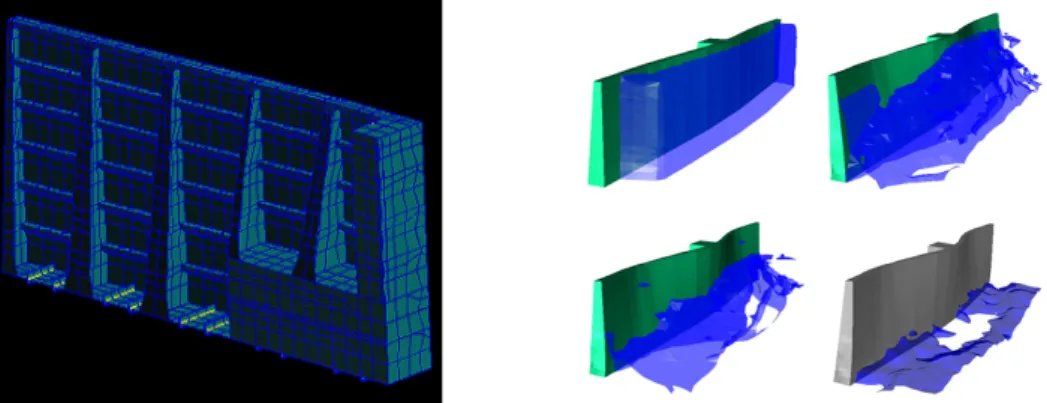
Fig. 2 (a) FE model of the 6500TEU container carrier breakwater model (b) Simulation result of the FSI analysis at each time step for a wave with velocity of 15m/s and a mass of 63ton
3. Application of FSI Series Analysis of Green Water to Breakwater
3.1 Numerical Setup of FSI Series Analysis
Fig. 2 (a) shows the global and local FE models of the 6500TEU container carrier. The FE model uses symmetric arguments, and models half of the target vessel. The breakwater consists of two kinds materials: mild and high tensile steel.
3.2 FSI Series Analysis Results of Various Wave Velocities and Masses
Fig. 2 (b) shows the simulation results of the FSI analysis at each time step for a wave with a net velocity of 15 m/s and a mass of 62 ton. The relationships between the maximum pressure, von-Mises effective stress and net wave velocity are shown in Fig. 3 (a). The following conclusions are drawn from these figures:
zIn medium velocity waves, the pressure is no longer directly proportional to the net wave velocity. Moreover, the pressure and the von-Mises effective stress are mostly dependent on wave mass. zIn high velocity waves, the maximum von-Mises effective stress occurs at the center of the
breakwater. This external force increases the displacement, and the maximum strain is relatively large. The effect of wave mass is negligible.
Fig 3 (a) Relationship between net wave velocity and von-Mises effective stress of breakwater (b) Pressure distribution of green water for a 94 ton wave
4. New Design Formulae for Optimum Breakwater
The von-Mises effective stress rapidly increases from 2-8 m/s under green water impact loads. It is possible to consider the dynamic buckling strength of the studied vessel’s breakwater to range between 381 and 397 MPa.
In order to guarantee the structural integrity of the breakwater under rough marine conditions, it is also important to determine the accurate pressure distribution of the green water collision. Based on the FSI series analysis results, the pressure distribution of the green water can be accurately calculated. For example, Fig. 3 (b) shows the pressure distribution of the green water for each wave velocity with a wave mass of 94 ton. In the case of the studied vessel, the red line in Fig. 3 (b) must be introduced as a pressure distribution when a 94 ton wave mass is applied to breakwater.
5. Concluding Remarks
In this paper, a series of numerical analyses for green water impact loads on container carrier breakwaters inducing post-buckling and collapse are carried out based on FSI analysis. Moreover, new design formulae for evaluating the structural performance of breakwaters are introduced in view of pressure and von-Mises effective stresses.
The conclusions of this study are as followings:
zAn identification method for green water and breakwater interaction was efficiently established using an FSI analysis method. The FSI analysis method was validated by the pressure history and pressure distribution.
zThe behavior of the fluid and structure, I.e., green water and breakwater was identified based on wave velocity and mass. Three behaviors, including low (less than 4 m/s), medium (4~8 m/s) and high (more than 8 m/s) velocity waves were studied.
zBased on parametric studies of green water impact loads, the optimum dynamic ultimate strength of the breakwater and the pressure distribution of the green water were introduced.
It is hoped that the proposed new design formulae and FSI analysis method will be a sound guideline for constructing safe container carrier breakwaters.
ACKNOWLEDGEMENT
This research was supported by the Basic Science Research Program through the National Research Foundation of Korea (NRF) funded by the Ministry of Education, Science and Technology (2010-0011489).
REFERENCES
Chen, H.C., and Yu, K. (2009) CFD simulations of wave-current-body interactions including green water and wet deck slamming, Comp Fluids, 38, pp.970-980
Hamoudi, B., and Varyani, K.S. (1998) Significant load and green water on deck of offshore units/ vessels, Ocean Engng, 25(8), pp.715-731
Kim, Y.J., Shin, K.S., Heo, J.H., Suh, Y.S., Kim, W.S., Ha, T.B., Ha, Y.R., Choo, K.D., Park, K.W., Kim, D.W., Kwon, S.M., Lee, C.K., Kim, M.S., Han, Y.Y., Lee, H.H., Moon, J.S., Kim, D.H., and Do, H.M. (2004) Numerical calculation and experiment of green water on the bow deck, Proc Annual Autumn Meeting of SNAK, pp.105-114.
Nielsen, K.B., and Mayer, S. (2004) Numerical prediction of green water incidents, Ocean Engng, 31, pp.363-399
Pham, X.P., and Varyani, K.S. (2005) Evaluation of green water loads on high-speed containership using CFD, Ocean Engng, 32, pp.571-585
Ryu, Y., Chang, K.A., and Mercier, R. (2007) Runup and green water velocities due to breaking wave impinging and overtopping, Exp Fluids, 43, pp.555-567