†
To whom corresponding should be addressed. Tel : +82-02-961-9671 E-mail : [email protected]
Chaeyeon Lima․Euntae Junga․Seongho Leea․Changsun Jangb․Chaewoon Ohc․Kyung Nam Shind† a
Center for Carbon Mineralization, Mineral Resources Division, Korea Institute of Geosciences and Mineral Resources, Daejeon, 34132, Korea.
b
Department of Transport and Sustainable Mobility, Global Green Growth Institute, Korea. c
Division of Policy Research, Green Technology Center, Seoul, 04554, Korea. d
Center for International Development Cooperation, Kyung-Hee University, Seoul, 02453, Korea (Received 4 August 2020, Revised 3 September 2020, Accepted 7 September 2020)
Abstract
In this paper, we reported that the global trend of cement production and utilization as raw materials and as a fuel. As we know, cement is one of the significant materials required for the construction industry. The recent trend of rising urbanization, both the cement and construction industry played a vital role. The cement industry is a major sustainable infrastructure for the countries. Currently, China producing cement half of the world's cement production. During the year 2018, Korea producing cements nearly 57.5 million metric tons. Waste materials are used as circular resources and also having tremendous benefits for cement production. Another important use of these circular resources is fuel for the cement industry. There is a large potential benefit of the cement industry, but it’s creating a severe environmental threat. The cement industry contributes to the major emissions of CO2. This leads the global warming. As per the Paris agreement, the Korean government initiated the recycling policy of waste materials and also the utilization of circular resources for the prevention of limited natural resources and also the global warming effect. Key words : Global trend, cement production, circulating resources, fuel, CO2 emissions
1. Introduction
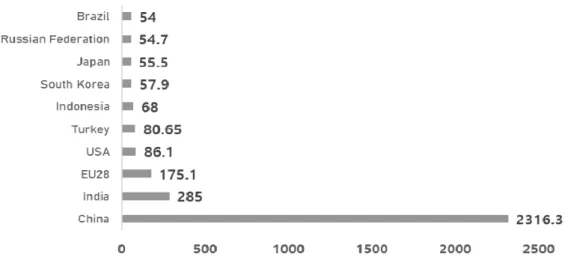
The cement industry is one of the major sus-tainable economic contributors and energy-efficient in the world. Currently, the cement industry is been trying to achieve higher efficiency with advanced technology. The global production of cement is estimated to be 4.4 billion metric tons in the year 2020 (Ali, M, 2011) Estimation of World cements production in the year 2018 is showed in Figure 1. (World cement production, cembureau, 2017). The top cement producers are China, India, South Africa, USA, Brazil, Indonesia, Vietnam etc. China is the major producer of (54.5 %) cement in the world.
Cement is one of the key materials for building constructions. The demand for the cement industry
has been continuously growing as per the demand for construction which leads the urbanization. The key reason behind the urbanization is deagriculturaliza-tion from the climate change (lack of water resour-ces) (Matthew Fry, 2011), (David Aldred, 2012). Regarding the cement industry growth is highly de-manded because in the developing countries govern-ments established several welfare schemes for shel-terless people and focus on infrastructures. India is one of the second largest cement markets both in consumption and production.
The main objective of this paper is to review the global trend of the cement industry, demand, and markets, the importance of circulating resources, and global CO2 emissions from the cement industry. The cement industry is an important economic sector even though it highly emits CO2 emissions. Since, 1920 to 2018, the CO2 emissions from the cement industry are 1500 Mt in the world (R. M. Andrew,
Chaeyeon Lim․Euntae Jung․Seongho Lee․Changsun Jang․Chaewoon Oh․Kyung Nam Shin 58
Figure 1. World cement production (adopted from World cement production, cembureau, 2017
key facts, and figures).
2018). Ernst Worrell, 2001, reviewed the detailed CO2 emissions from the calcination process of lime-stone.
As per the COP 21, Paris agreement, all countries should reducing the CO2 gas emissions to prevent global warming affect 2°C. Based on that resolution, every Nation is trying to be reducing CO2 emissions from all sectors. Currently, the cement industry has focused on facilities with advanced technologies. Due to this new sustainable technology, the CO2 emissions from the cement industries are reduced by nearly 30 to 35%. In Korea, the governments esta-blished new recycling policies for the utilization of waste materials as circulating sources in every industry to follow the Paris agreement goals. The importance of circulating resources is discussed in the coming sections.
2. Cement industry status
The cement industry is an energy-consuming indu-stry and a large-scale device induindu-stry, with a high proportion of bituminous coal and power costs among manufacturing costs at about 60 %, and the stable facility operation rate is very important because of the high fixed cost burden (Gnanapra-gasam et al., 2010). It is also a typical domestic industry with a high proportion of logistics costs as a heavy product, which is bound to be sensitive to the construction industry. Recently, four domestic
cement companies have imported and used Japanese coal products, but in August 2019, the Ministry of Environment announced a policy to strengthen the environmental safety management of imported coal materials (enhancement of radioactivity, heavy metal management) and the Korea Cement Association announced that it will reduce imports of coal materials by 70 % from 2018 and replace Japanese coal materials with domestic coal products to address public concerns and anxiety over radiation and other damage (Kim et al., 2012).
As the production and demand for cement pro-ducts increase in the global cement industry, inclu-ding Korea, various strategies are needed to minimize warming and economic damage caused by climate change. Currently, the cement industry is trying to reduce carbon dioxide through the injection of alternative raw materials using cyclical resource utilization, or to induce the reduction of the amount of lime-stone input through the use of sub-materials containing CaO (non-CaCO3) and control of mixed design costs, and also to reduce energy reduction and CO2 generation by installing high-efficiency equipment such as coolers and plastic burners, or by pursuing high efficiency. It is also making efforts to build resource-circulating industries and societies by utilizing cyclical resources by injecting alternative fuels into main burners (for clinker plasticization) and auxiliary burners (mainly for limestone carbonic acid).
Figure 2. Cement production in South Korea
(Adopted from https://datis-inc.com/blog/worldwide-cement-production-from-2015-to-2019/#South_Korea) 2-1. Cement production in South Korea
The domestic cement industry is one of the most important industries in our country's key industries. In particular, it has played a major role in the modernization of Korea as an indispensable material in the field of civil engineering and architecture. Cement uses include large structures such as general buildings, dam construction, railways, roads, airports, and ports, as well as structures that are close to life, such as housing, living facilities, and concrete se-condary products such as files and fume pipes, and internal and external uses for housing.
As of 2016, domestic cement production was about 56,742,000 tons, export volume (cement + clinker) was 5.04 million tons, and import volume (cement + clinker) was 1.213 million tons. Domestic exports have increased every year from 5.97 million tons in 2005, 7.52 million tons in 2010, and 9.52 million tons in 2014 to 5.04 million tons as of 2015, and domestic imports have been decreasing since 2015, with 3.4 million tons in 2005, 770,000 tons in 2010, 890,000 tons in 2014 and 1.21 million tons in 2016. Since 2005, imports have been on a sharp decline as demand for cement in the domestic market has not increased significantly. Domestic cement exports are the world's fifth-largest, with about 9.52 million tons as of 2014. This is because
as demand in the domestic cement market gradually decreases, the entire cement production in China is used for export except for consumption in China. With the recent increase in demand for cement in Korea, cement production is also on the rise, and the output in 2016 is expected to rise slightly in the future, with a level of about 56.74 million tons. Since this is due to the increase in the number of domestic housing (apartments, etc.) sales, cement pro-duction is expected to decrease again if the housing market shrinks in the future (Fig. 2).
(https://datis-inc.com/blog/worldwide-cement-produ ction-from-2015-to-2019/#South_Korea).
According to statistics from the KCA (Korea Ce-ment Association, 2010) eight domestic companies are producing clinkers, which are cement raw ma-terials, and their production capacity has grown 1.5 times compared to 1990, and cement production plants are concentrated in North Chungcheong Pro-vince and Gangwon ProPro-vince, which are rich in limestone deposits, which are the main ingredients for the production of clinker production. Although there has been no large-scale expansion to expand production capacity since 1998, it has maintained 49,148,000 tons as of 2016 through some small-scale expansion.
Chaeyeon Lim․Euntae Jung․Seongho Lee․Changsun Jang․Chaewoon Oh․Kyung Nam Shin 60
2-2. The global trend of Cement production Global cement production has more than tripled since 1950, nearly quadrupled since 1990, and has grown much faster than global fossil energy pro-duction over the past two decades. Since 1990, cement production in China has nearly 12-fold increased, thanks to the rapid growth of 73 % of the world's cement production growth since 1990(EAST, M, 2017).
As of 2016, the global cement market stood at 46.5 million tons and is expected to grow 2.81 % annually in the future to 43.7 million tons as of 2020.11] The market size of India and China is 241 million tons and 2.9 million tons (as of 2016), respectively, accounting for 57.8% and 6.5% of the world market, making up the largest proportion in the global market. As of 2013, the size of the Japanese cement market stood at 47 million tons, and by 2020, it stood at 58 million tons, remaining at 1 to 2 % in the global market. Six major cement companies [Lafarge (France), Cemex (Mexico), Holcim (Swiss), Heidelberg Cession (Germany), Taiheiyo Cession (Japan), and ltalcmenti (Italy)] are mono-polizing the market around the world, and have recently formed a huge market with the merger of Holcim and Lafarge. The French-based company accounts for 5.5 % of the world's cement market share and is the world's largest producer of cement, running 117 plants in 43 countries (ECA, 2017) Chinese market
In 2012, China's cement production increased slightly, but on the contrary, the number of factories decreased. This is estimated to have resulted in a decrease in the number of factories as the old kiln was replaced with a new one (Number of cement producers: 3,853 companies/11 years as of 2011, 4,381 factories: → 3,899 companies, 3,917 as of 2012). Still, Chinese cement companies account for about 80 % of small and medium-sized companies, with sales of medium-sized companies falling slightly in 2012. On the other hand, the portion of small businesses rose slightly. China's cement output stood at 20.6 billion tons as of 2011, compared with 2.21 billion tons in 2012 (IBEF, 2019).
Indian market
India's cement market is the second-largest in the world, and its production and consumption are also
the second largest in the world. Government support is being actively carried out due to the booming construction market and the increase in urban infrastructure, and 4.55 million tons were produced in the two years 2017-2018 and 19-22 million tons are expected to increase in 2018-2019 and it is expected to continue its rapid growth every year (Balsara et al., 2019).
Japanese market
Japan's cement market is a mature market, with limits to future market growth. Given that the long-term Japanese cement market tends to shrink, each cement company is aiming for a recovery in sales prices and a thorough cost reduction. Since Japan first produced cement in 1875, 17 companies (30 factories) have been operating nationwide as of 2014. Since 2011, demand for cement in Japan has risen for the fourth consecutive year as construction investment has increased significantly due to the effects of the government's economic stimulus measures and earthquake recovery. On the other hand, exports fell for the fourth consecutive year due to continued facility reductions and increased domestic consump-tion. Portland cement production was 43 million tons as of 2013, up 4.3 % from 2012, marking the second consecutive year of increase since 2011. Mixed cement was mainly used for government-grade purposes, with 14 million tons being used as of 2013 due to increased disaster recovery and SOC investment. This is an 11.2 % increase from 2012. In 2013, the composition ratio of slag cement increased by 0.9% due to increased demand for public construction. In contrast, the Portland cement compo-sition ratio was 74.7 %, down 1.1 % from 2012 (Imbabi, 2012).
3. Utilization as circulating resources
Circulating resources are substances that are pro-duced or used in circulation and are collectively re-ferred to by the Minister of Environment for their environmental, economic, and technological capa-bilities. In the mid-1990s, Korea began recycling the waste as an alternative resource.
The reason for utilizing circulating resources in the cement industry in Korea is to use them as a means to counter the climate change agreement by reducing carbon dioxide while reducing the use of
the case of simple incineration, landfill disposal of incineration materials generated after incineration is required, but waste utilization in cement production has the advantage of being fully disposed of.
The scope of available waste has increased inde-finitely as the waste management system has re-cently shifted from a 'positive' method that allows recycling only for specified purposes and methods to a 'negative' method that allows recycling compre-hensively in principle if there is no damage to environmental pollution or human health. And the methods of managing and regulating utilization waste are benchmarked and applied in the United States and Europe.
The process of injecting circulating resources into cement manufacturing is the process of grinding raw materials, plastic, and cement, and the circulating resources used in each process are classified for raw materials, fuels, and additives according to their use. In the raw material process, coal ash, sludge, castings, and slag are replaced with raw materials that replace limestone, clay, and silicate. Waste tires, waste synthetic resins, and recycled oil are used as substitutes for bituminous coal in the plastic process. In the cement process, slag, subsidiary products, and gypsum are used instead of clinker gypsum.
The cement industry has pursued strategies to reduce CO2 emissions long before global warming comes first. Since 1999, after the world business council sustainable development(WBCSD) established the Cement Sustainability initiative(CSI), the industry has systematically gathered evidence and improved strategies. The 2009 international energy agency(IEA) and WBCSD roadmap presented scenarios for CO2 emissions and reduction. In the IEA study, the goal of a 50% reduction in global emissions of less than 2°C, the pre-industrial level, was to require an 18% overall reduction in CO2 emissions in the cement sector by 2050, compared with the 2006 baseline. However, despite the improvement in the production efficiency and emission mitigation efforts of the cement industry, as demand for cement in develo-ping countries increases, the proportion of cement output in artificial CO2 emissions is steadily increa-sing, and artificial greenhouse gas(GHG) by some sources now accounts for about 10 % or 6 % of the
cement production were expected to increase by 260% between 1990 and 2050. Unless a new method is implemented to reduce carbon dioxide emissions from cement production, CO2 emissions from the cement industry in 2050 will be about one-third of the total (Environment, U. N et al., 2018)
The cement industry is an energy-consuming industry in which carbonate(CaCO3) decomposition releases a large amount of CO2 and produces 0.8 tonnes of CO2 when producing a ton of cement. Worldwide, cement production has accelerated rapidly around the world since World War II, and as shown in Figure 1, world production now produces more than 0.5 tons per person per year.1,2,3] The cement industry generates large amounts of carbon dioxide due to two factors. First, after the cement process, the main ingredient of cement and clinker, limestone, is decomposed during the manufacturing process, resulting in CO2. This process contributes about 5% of total CO2 emissions.4] the second factor is the combustion of fossil fuels needed to heat them above 1000°C. Due to these factors, the cement industry has about 8% of global carbon dioxide emissions (Song, C et al, 2006).
3-1. Utilization of circular resources as raw materials in the cement industry
In the cement industry, various industrial products and wastes are used as raw materials for cement. The main components of cement are SiO2, Al2O3, Fe2O3, CaO, and industrial side products and wastes containing these main components can be used as raw materials for cement by replacing natural materials such as silicate, clay, and iron ore. Typical circulating resources include coal ash, sludge, castrate, and furnace slag. Clinker is the main material that makes up cement. It is common cement to react with water after grinding the clinker with plaster. Clinker, a common cement raw material, is a potential hydroponic mineral with the same proper-ties as the partially replaceable blast furnace slag, coal-fired power plant scattering, and natural vol-canic ash. When it is intended to reduce greenhouse gas emissions related to processes, fuel, and power
Chaeyeon Lim․Euntae Jung․Seongho Lee․Changsun Jang․Chaewoon Oh․Kyung Nam Shin 62
use in the manufacturing process of clinker, there are many limitations in actual application due to various factors. Inconsistency in the properties of substitutes and the application of cement, national standards on Ordinary Portland cement(OPC) and mixed cement, and rising prices of substitutes should be considered. Chemical compatibility is important for the circulating resources used as cement raw materials, and these wastes shall provide the com-ponents required for the production of clinkers. The primary chemical components required include lime (CaO), silica(SiO2), alumina(Al2O3), iron(Fe), and other substances that may be classified into different groups according to their composition. Plant fly ash, furnace slag, and other process residues may be used in part as a substitute for natural materials. Mainly in europe, such as fly ash, blast furnace slag, silica fume, iron slag, paper sludge, sulfite ash, spent foundry sand, soil-containing oil, etc. When selecting and using waste as raw material, the condi-tion should be that the waste is primarily made up of clinker components, and the concentration of vola-tile heavy metals should below. Besides, input materials should be analyzed regularly and monitoring should be continued.
3-2. Utilization of circular resources as fuel in the cement industry
The cement industry can reduce greenhouse gas emissions by replacing existing fossil fuels with alternative fuels that utilize them as cyclical resour-ces. The reason why circulating resources can be utilized as a fuel in the cement industry is that alternative fuel energy components can be used as substitutes for fossil fuels, and inorganic ingredients left after combustion are similar to those in the clin-ker and can be replaced. For this reason, the carbon emission unit is reduced because alternative fuels are excluded from carbon dioxide emissions.
The effect of utilization in the cement industry of recycling resources is that most of the alternative fuels emitted in the entire social process are waste, and carbon dioxide emissions are generated for the incineration process itself as additional fossil fuels are required for the incineration process when inci-nerated alone. The use of alternative fuels can also contribute to the development of the Sustainable Society by preventing unnecessary waste landfills and using them as useful resources. Typical
alterna-tive fuels used in the cement industry include pre-treated industrial and urban solid circulation resources, waste oil and solvent, textiles, plastics, paper residues, waste tires, and biomass. The use of alternative fuels in the cement industry is a tech-nology that can be used without any other invest-ment.
The current status of fuel utilization for cyclical resources by country is as follows. Due to the difficulty of establishing new waste disposal fac-ilities in Japan, the government and local govern-ments are jointly pushing for the development of waste resources in the cement industry. In particular, it is currently operating an efficient disposal system for circulating resources as it is equipped with a system that brings urban waste collected as a garbage collection car and uses it as fuel after three days of fermentation and biodegradation. It is used as a way to fuel scraps (ASRs) and FRP waste ships and to use them as raw materials for oil-conta-minated soil, incineration materials for urban waste, and household waste. Germany is the most active country in the world for recycling cyclical resources. 65 % of the total fuel used in cement plastic furnaces is recycled as a circulating resource. In addition to what the domestic cement industry uses, the U.S. is recycling a variety of circulating resour-ces. The fuel uses waste tires, plastics, solvents, paint sludge, leather wastes, and raw materials include coal ash, casting, fertilizer sludge, zinc waste, and fluorine waste. China is expanding recy-cling in the cement industry due to the problem of waste disposal caused by rapid urbanization. In October 2013, the State Council made it mandatory for factories with more than 10 % of cement plants to have recycling facilities for circulating resources. The Netherlands uses 83 % of alternative fuels (43% of sewage sludge) by injecting urban solid waste, waste tires, waste synthetic resins, hexagonal powder, sewage sludge, and biomass. In addition, more than 60 % of alternative fuels are used in Austria, Germany, and Norway, and the German cement producer's case study shows that the use of alternative fuels is around 90%, with plans to replace 100% if special situations are excluded in the future. The average use rate of auxiliary fuel in 28 countries with EU membership is 30.5%, indi-cating a high level. Brazil, Mexico, and Argentina, the major cement producing countries in Latin
Ame-4. Conclusion
With the expansion of various regulations and support systems for securing the sustainability of the efficient life cycle management perspective of resources worldwide, the utilization of circular resour-ces in the cement industry is treated as the most essential means of securing sustainability. In addi-tion to ensuring sustainability, cyclical resource utiliza-tion can be the most effective technical alternative to greenhouse gas reduction. Through the Europe 2050 project, the European Union is pushing ahead with a plan to foster a low-carbon society by linking the cement industry's circular resource utilization technology with CO2 emission reduction technology by 2050.
In Korea, the role of the cement industry is expected to become more important to achieve the national goal of reducing carbon dioxide emissions. Accordingly, the role of cement and concrete indu-stries will become more important in line with social demands for efficient use of cyclical resources and reduction of environmental load and the develop-ment of technologies to enhance their image as eco-friendly materials will be important.
References
1. Andrew, R. M., 2018, Global CO2 emissions from cement production. Earth Syst. Sci. Data, Vol. 10, pp.195–217
2. Balsara, S., Jain, P. K., et al.,. 2019, An inte-grated approach using AHP and DEMATEL for evaluating climate change mitigation strategies of the Indian cement manufacturing industry. Environ-mental pollution, 252, 863-878
3. Aldred, D,. 2012, Urbanization: A major driver of infrastructure spending. Citi Perspectives, Vol. 6, pp. 36-39
4. Environment, U. N., et al., 2018, Eco-efficient cements: Potential economically viable solutions for a low-CO2 cement-based materials industry. Cement and Concrete Research, Vol. 114, pp. 2-26. 5. Worrell, E., et al., 2001, Carbon dioxide
emis-sions from the global cement industry, Annu.
7. Gnanapragasam, N. V., et al., 2010, Feasibility of an energy conversion system in Canada involving large-scale integrated hydrogen production using solid fuels. International journal of hydrogen energy, Vol. 35, No. 10, pp. 4788-4807
8. Hasanbeigi, A., et al., 2013, Energy efficiency improvement and CO2 emission reduction oppor-tunities in the cement industry in China. Energy Policy, Vol. 57, pp. 287-297
9. Huh, S. Y., et al., 2018, Inter-fuel substitution path analysis of the korea cement industry. Renewable and Sustainable Energy Reviews, Vol. 82, pp. 4091-4099
10. Imbabi, M. S., et al., 2012, Trends and develop-ments in green cement and concrete technology. International Journal of Sustainable Built Envi-ronment, Vol. 1, No. 2, pp. 194-216
11. Kim, K. H., et al., 2012, KEIT PD Issue report. Korea Evaluation Institute of Industrial Tech-nology, pp. 61-83
12. Korea Cement Association., 2010, Cement Sta-tistical Yearbook. Korea Cement Association, pp. 5-7
13. Fry, M., 2011, From crops to concrete: urbani-zation, deagriculturaliurbani-zation, and construction ma-terial mining in central Mexico. Annals of the Association of American Geographers, Vol. 101, No. 6, pp. 1285-1306
14. Ali, M. B., et al., 2011, A review on emission analysis in cement industries. Renewable and Sustainable Energy Reviews, Vol. 15, No. 5, pp. 2252-2261
15. Song, C., 2006, Global challenges and strategies for control, conversion and utilization of CO2 for sustainable development involving energy, catalysis, adsorption and chemical processing. Catalysis today, Vol. 115, No. 4, pp. 2-32 16. Stafford, F. N., et al., 2015, Advances and
chal-lenges for the co-processing in Latin American cement industry. Procedia Material Science, Vol. 9, pp. 571-577
17. EAST, M., et al., 2017, 2014 Minerals Year-book. US Geological Survey
18. CEMBUREAU—The European Cement Associa-tion., 2018, Key Facts and Figures. Key Facts