https://doi.org/10.6111/JKCGCT.2021.31.2.096
Electrocatalytic properties of Te incorporated Ni(OH)
2microcrystals grown
on Ni foam
Jung-Il Lee*,**, Seong Gyun Oh*, Yun Jeong Kim*, Seong Ju Park*, Gyoung Seon Sin*, Ji Hyeon Kim*
and Jeong Ho Ryu*,**,†
*Department of Materials Science and Engineering, Korea National University of Transportation, Chungju 27469, Korea **Energy Fusion Technology Laboratory, Korea National University of Transportation, Chungju 27469, Korea
(Received March 25, 2021) (Revised April 2, 2021) (Accepted April 2, 2021)
Abstract Developing effective and earth-abundant electrocatalyst for oxygen evolution reaction (OER) and hydrogen evolution reaction (HER) is critical for the commercialization of a water splitting system. In particular, the overpotential of the OER is relatively higher than the HER, and thus, it is considered that one of the important methods to enhance the performance of the electrocatalyst is to reduce the overpotential of the OER. We report effects of incorporation of metalloid into Ni(OH)2 microcrystal on electrocatalytic activities. In this study, Te incorporated Ni(OH)2 (Te-Ni(OH)2) were
grown on three-dimensional porous NF by a facile solvothermal method with = 1, 3 and 5. Homogeneous microplate structure on the NF was clearly observed for the Ni(OH)2/NF and Te-Ni(OH)2/NF samples. However, irregular and
collapsed nanostructures were found on the surface of nickel foam when Te precursor ratio is () over 3. Electrocatalytic OER properties were analysed by Linear sweep voltammetry (LSV) and Electrochemical impedance spectroscopy (EIS). The amount of Te incorporation used in the electrocatalytic reaction was found to play a crucial role in improving catalytic activity. The optimum Te amount () introduced into the Ni(OH)2/NF was discussed with respect to their OER
performance.
Key words Elecrocatalysis, Ni(OH)2 microcrystals, Water splitting, OER
1. Introduction
Water splitting is one of efficient methods to produce clean hydrogen, which can be utilized as an alternative energy for traditional fossil fuels [1,2]. Water electroly-sis process contains anodic oxygen evolution reaction (OER) and cathodic hydrogen evolution reaction (HER) [3,4]. The slow kinetic process of OER on the anode always leads to a high overpotential, which would de-crease the efficiency of water splitting and result in a slow-going hydrogen production rate on the cathode. Even some noble metal materials such as ruthenium/ iridium oxides (RuO2/IrO2) have been proved to be
effi-cient catalysts for OER [5], their large-scale commer-cialization is limited due to their high cost and low production. Therefore, development of efficient and cheap OER electrocatalysts is extremely necessary for the hydrogen production through water electrolysis [6].
In the past decade, Ni-based catalysts, specially oxides, hydroxides, chalcogenides and others have been applied for OER due to their highly active and low-cost
proper-ties [7]. In order to address the corrosion issue under harsh alkaline environment and increase the reactive areas of Ni-based catalysts [8], the coupling of Ni nano-particles with carbon materials has become an effective way [9]. Additionally, heteroatom doping in composite catalyst could ulteriorly modify the electron transfer [10]. However, the increased structural complexity would gain difficulty in mechanism analysis for this kind of catalysts. In this case, in-situ techniques along with other effective characterizations becomes strongly needed to better understand the catalytic roles of different parts and mechanism. Here, we synthesized three-dimensional (3D) porous nickel foam with Ni(OH)2 microcrystals via
facile solvothermal route.
In this study, we show that metalloid incorporation into Ni(OH)2 microcrystals can be a promising strategy
for designing highly efficient and commercial electrocat-alysts for alkaline OER. Tellurium (Te) was selected as a promising metalloid element for modulating the cata-lytic properties of nickel oxide microstructure, where electrical conductivity and number of active sites can be simultaneously enhanced [11]. To the best of our knowl-edge, metalloid incorporation for tuning electrocatalytic properties of Ni(OH)2 has rarely been studied despite of
†Corresponding author
its high potential. Encouraged by the above discussion, we introduced Te into the Ni(OH)2 microcrystals grown
on three-dimensional porous nickel foam (NF) by a fac-ile solvothermal method. Benefiting from the optimized electronic structure from the introduced Te and the con-ductive NF as the current collector, the Ni(OH)2
micro-crystals on NF displays superior OER performance. Optimum Te amount introduced into the Ni(OH)2
micro-crystals was discussed on the electrocatalytic OER per-formance.
2. Experimental
2.1. Growth of Ni(OH)2 and Te-Ni(OH)2 nanoplate on nickel foam
Nickel foam (NF) was treated with acetone and then with 3 M HCl solution for 10 min using ultrasonication cleaner. The cleaned NF was dried overnight. All the chemicals were purchased from Kojundo chemical and were directly used without further purification. For the synthesis of Ni(OH)2 microcrystal, as-prepared NF was
immersed in 20 ml of deionized (DI) water. Then, the resulting solution was transferred to Teflon-lined auto-clave and hydrothermally reacted at 180oC for 5 h. The
Ni(OH)2 microcrystals on NF sample was washed
sev-eral times with DI water. The final Ni(OH)2 microcrystals
grown on NF sample (Ni(OH)2/NF) was subsequently
dried in vacuum at 60oC for overnight. Synthesis method
for Te-Ni(OH)2 on NF samples (Te-Ni(OH)2/NF) were
same as that of Ni(OH)2/NF, except that tellurium
tetra-chloride (TeCl4) solution was added before
hydrother-mal reaction. The added TeCl4 solution concentration in
the Te-Ni(OH)2 were 1.0, 3.0 and 5.0 × 10³mol for
the = 1, 3, 5, respectively.
2.2. Characterizations
Microstructural images of each samples were observed by field emission scanning electron microscopy (FE-SEM; model S4800; Hitachi) equipped with energy dis-persive X-ray (EDX). X-ray diffraction (XRD) was per-formed using a D/MAX-2500/PC (Rigaku) diffractometer at 40 kV and 100 mA with Cu-K radiation ( = 0.15418 nm). The electrochemical properties of cata-lysts in 1 M KOH were tested using a three-electrode electrochemical cell controlled by an electrochemistry workstation (model Autolab PGSTAT; Metrohm), in which the catalyst grown on NF was used directly as
the working electrode [12]. Prior to measurements, the electrolyte (1 M KOH, pH 13.7) was purged for about 10 min with O2, and the working electrodes were sealed
on all edges with a custom-made acrylate adhesive except for the working surface area of 0.25 cm2.
Graph-ite rod and Hg|Hg2SO4 were used as the counter and
ref-erence electrodes, respectively. A titration vessel of clear glass was used as a testing cell. The distance between working and reference electrodes was close to 1 cm. Linear sweep voltammetry (LSV) was measured with a scan rate of 0.5 mV/s in a range from 1.23 to 1.9 V vs. a reversible hydrogen electrode (RHE). Applied poten-tial values were calibrated against RHE, and all polariza-tion curves were iR-corrected. Electrochemical impedance spectroscopy (EIS) measurement was conducted over the frequency range of 0.1-100 kHz at 1.45 VRHE with a
sinusoidal amplitude of 5 mV.
3. Results and Discussion
Ni(OH)2/NF exhibits poor electrical conductivity, which
impedes facile charge transfer between the surface of catalyst and the adsorbed reactant. After Te incorpora-tion, electrical properties of Te-Ni(OH)2/NF can be
sig-nificantly improved to easily take up electrons in hydroxyl ions, crucially accelerating water oxidation kinetics. Te element can be incorporated into the transi-tion metal that is, a real catalytic active site in Ni(OH)2/
NF, where a strong covalent p-d hybridization occurred with a highly polarized local electronic structure signifi-cantly accelerating electrocatalytic OER activity of Te-Ni(OH)2/NF samples [13].
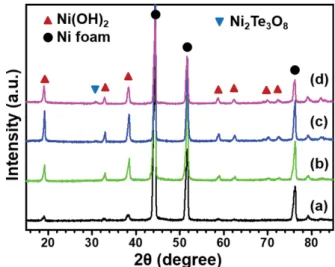
Fig. 1. XRD patterns of the (a) Ni(OH)2/NF, (b) Te-Ni(OH)2/
Ni(OH)2/NF and Te-Ni(OH)2/NF microcrystals were
synthesized by direct growth of NF using tellurium chloride via hydrothermal reaction at 180oC for 5 h.
Typical XRD analysis confirmed the formation of the Ni(OH)2/NF and Te-Ni(OH)2/NF crystal structures as
shown in Fig. 1. The strong diffraction peaks near 44o
and 51o could be assigned to Ni metal in the NF
sub-strate. The XRD patterns revealed the crystal structure and phase purity of the Ni(OH)2/NF microcrystals.
Except for the peaks from the NF substrate, all other detectable diffraction peaks at low 2 angles could be indexed to the theophrastite-like -Ni(OH)2 phase (PDF
00-059-0462). Prominent diffraction peaks for the lay-ered nickel-cobalt hydroxide were observed from at 19o,
33o and 38o. Notably, secondary phase related to Te
(Ni2Te3O8) was observed at 31o in the XRD pattern of
the 5Te-Ni(OH)2/NF sample, indicating that a very high
Te content is not desirable for synthesizing Te-incorpo-rated transition metal hydroxide nanosheets on the NF substrate.
Fig. 2 shows highly magnified FE-SEM images for the Ni(OH)2/NF and Te-Ni(OH)2NF ( = 1, 3, 5)
microcrystals. Fig. 2 represents that large-scale highly
interconnected and aligned microplate structure verti-cally grow on the skeletons of the NF with uniform morphology and dense loading, forming an ordered and 3D network with a highly open and interstitial struc-ture. Homogeneous microplate structure on the 3D mac-roporous NF was clearly observed for the Ni(OH)2/NF
and Te-Ni(OH)2/NF ( = 1, 3) microcrystals. However,
when the Te adding amount () is over 3, irregular and collapsed microstructure were found on the surface of Ni(OH)2 microcrystals. Also, highly aggregated particle
morphology with the large area of bare nickel foam, uncovered by the grown material, was formed for when Te precursor ratio further increased to more than = 3 as shown in Fig. 2(d).
The electrocatalytic activities of Ni(OH)2/NF and
Te-Ni(OH)2/NF samples were tested in alkaline media (1 M
KOH aqueous solution) using a three-electrode system. Linear sweep voltammetry (LSV) was performed at a scan rate of 0.5 mV/s on the samples. NF substrates were directly used as working electrodes, while a rotat-ing disk electrode (RDE) was employed for testrotat-ing powder samples such as RuO2. To remove the bubbles
generated during measurement, the RDE was
continu-Fig. 2. Highly magnified FE-SEM images for the (a) Ni(OH)2/NF, (b) Te-Ni(OH)2/NF, (c) 3Te-Ni(OH)2/NF and (d) 5Te-Ni(OH)2/NF
ously rotated at 2,000 rpm. All measured potentials were iR-compensated and were then referenced to the revers-ible hydrogen electrode (RHE). Notably, Te-Ni(OH)2/
NF exhibited enhanced catalytic activity for water oxi-dation compared to Ni(OH)2/NF sample. The
overpoten-tial () required to transmit a current density of 10 mA/ cm2 (10) is conventionally used as a standard to
com-pare electrocatalytic OER performance [14].
Fig. 3 shows LSV curves with a scan rate of 0.5 mV/s for electrocatalytic OER properties of the Ni(OH)2/NF
and Te-Ni(OH)2/NF samples. The 10 substantially
de-creased when Te was introduced into Ni(OH)2/NF. The
3Te-Ni(OH)2/NF sample required an 10 of 270 mV,
while 10 for Ni(OH)
2/NF was about 295 mV as shown
in Fig. 3. Importantly, an overpotential of only 285 mV was needed for 3Te-Ni(OH)2/NF to generate a high
cur-rent density of 100 mA/cm2, compared to the 330 mV
for the Ni(OH)2/NF sample, which can be beneficial for
practical electrolysis applications. The amount of Te incorporation used in the reaction was found to play a crucial role in improving catalytic activity. In terms of overpotential, the Te content in 3Te-Ni(OH)2/NF resulted
in the best catalytic activity for water oxidation. How-ever, further increasing Te content to 5Te-Ni(OH)2/NF
significantly disturbed its catalytic activity, which may be related to secondary phase observed in Fig. 1(d), and irregular microcrystal growth on the nickel foam sub-strate as shown in Fig. 2(d).
Tafel plots of the samples were derived from the mea-sured LSV curves based on the Tafel equation ( = b × logj + a), where is the overpotential, j is the current density, and b is the Tafel slope. Tafel slopes of
Ni(OH)2/NF and Te-Ni(OH)2/NF were calculated and
represented in Fig. 4. The measured Tafel slopes of the Ni(OH)2/NF was 36.5 and the and Te-Ni(OH)2/NF
were 33.5, 26.9 and 31.4 mV/dec for the values of 1, 3, and 5, respectively. Among the samples, 3Te-Ni(OH)2/NF exhibited the smallest Tafel slope (26.9
mV/dec) compared to Ni(OH)2/NF (36.5 mV/dec),
high-lighting the potential use of Te-Ni(OH)2/NF for
indus-trial electrolyzer because a smaller Tafel slope is desirable to reduce power losses [15].
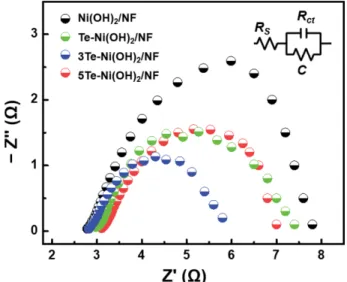
Charge transfer resistance (Rct) between
electrocata-lysts and electrolytes can be obtained from the semicir-cle diameter in the high-frequency region of a Nyquist plot (Zʹ vs. Zʹʹ) measured by electrochemical imped-ance spectroscopy (EIS). Here, the smaller diameter generally represents the lower Rct. Fig. 5 represents the
EIS data of the samples, where Te-Ni(OH)2/NF
sam-Fig. 3. LSV curves at a scan rate of 0.5 mV/s for electrocata-lytic OER properties of the Ni(OH)2/NF and Te-Ni(OH)2/NF
samples.
Fig. 4. Tafel slopes of Ni(OH)2/NF and Te-Ni(OH)2/NF samples
derived from the measured LSV curves.
ples (6.0~7.5 ) showed a value of Rct that was
obvi-ously lower than that of the Ni(OH)2/NFsample (~8.0
). Notably, 3Te-Ni(OH)2/NF exhibited a minimum Rct
(~6.0 ), implying the significant role of Te incorpora-tion for facilitating charge transfer from the catalyst sur-face to the adsorbed chemical reactants. Further increasing Te content (5Te-Ni(OH)2/NF) increased its charge
trans-fer resistance, which may be related to poorly grown nanosheets on the nickel foam substrate, which is same result with LSV curve and Tafel slope.
To quantitatively evaluate catalytic activity of Ni(OH)2/
NF and Te-Ni(OH)2/NF samples, we first estimated the
double-layer capacitance (Cdl) using a CV method in the
non-Faradaic region where the current generated from electrical double layer charging is essentially related to electrochemical surface area (ECSA). The CV test was conducted in an O2-saturated 1 M KOH solution to
esti-mate the Cdl at non-Faradaic overpotentials. CV
mea-surements were performed at various scan rates (20, 40, 60, 80, 100, and 120 mV/s). The difference in current density between the anodic and cathodic sweeps (Janodic
Jcathodic) at the middle of potential range was plotted as a
function of the scan rate, where the slope has a linear relationship with twice the Cdl of the catalyst [16]. The
Cdl was calculated to be 40.18 mF for 3Te-Ni(OH)2/NF
sample, while Ni(OH)2/NF and 5Te-Ni(OH)2/NF
exhib-ited much lower Cdl values of 17.95 and 31.50 mF/cm2,
respectively as shown in Fig. 6.
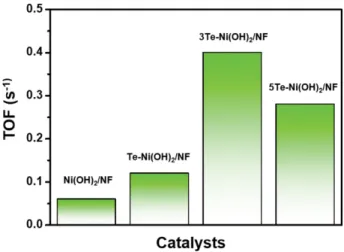
For quantitative analysis of the catalytic activity of the samples, the turnover frequency (TOF) needs to be cal-culated as TOF = j × A/(4 × F × Ns), where j is the
cur-rent density (A/cm2) at a specific overpotential, A is the
electrode area (cm2), F is the Faraday constant (96,485
C/mol), and Ns is the concentration of active sites (mol/
cm2). Cyclic voltammetry (CV) was performed to
calcu-late Ns for the redox reactions at different scan rates in
1.0 M KOH electrolyte. The peak currents were plotted verses scan rates where the slope is equal to, Slope = n2F2AN
s/4RT, here n is the amount of electrons
trans-ferred (here n = 1), F presents Faradic constant, A is the surface area of the electrode, Ns is the surface concen-tration of active sites (mol/cm2), R and T are the ideal
gas constant and the absolute temperature, respectively [11]. The TOF value of 3Te-Ni(OH)2/NF was 0.4 s1 at
an overpotential of 290 mV, which is much higher than those of Ni(OH)2/NF (0.06 s1) and 5.0Te-Ni(OH)2/NF
(0.28 s1) as shown in Fig. 7, indicating the intrinsically
high catalytic activity of 3Te-Ni(OH)2/NF sample.
4. Summary
In summary, Te-incorporated nickel oxide microcrys-tals were developed as highly efficient and low-cost electrocatalysts for water oxidation under alkaline condi-tions. The Ni(OH)2 and Te-Ni(OH)2 ( = 1, 3, 5)
micro-crystals were successfully grown on nickel foam (NF) via hydrothermal reaction at 180oC for 5 h.
Homoge-neous nanoplate structure on the NF was clearly observed for the Ni(OH)2/NF and Te-Ni(OH)2/NF samples. When
Te ratio () is higher over 3, irregular and collapsed nanostructures were found on the surface of NF. The electrocatalyst of 3Te-Ni(OH)2/NF sample provided
cur-rent densities of 10 and 100 mA/cm2 at overpotentials of
only 270 and 285 mV, respectively, with a very small Tafel slope of 26.9 mV/dec in an alkaline medium. Moreover, 3Te-Ni(OH)2/NF exhibited a minimum Rct
Fig. 6. The current difference between anodic and cathodic sweeps as a function of scan rate. The slope of the fitted line
was used to calculate Cdl.
Fig. 7. TOFs of the Ni(OH)2/NF and Te-Ni(OH)2/NF samples
(~6 ) wiht respect to the Ni(OH)2/NF sample (~8 ),
implying the significant role of Te incorporation for facilitating charge transfer from the catalyst surface to the adsorbed chemical reactants. The double layer capacitance Cdl was calculated to be 40.18 mF for
3Te-Ni(OH)2/NF compared to the value of 17.95 for Ni(OH)2/
NF. The 3Te-Ni(OH)2/NF sample showed much higher
TOF compared to the Ni(OH)2/NF and other Te-Ni(OH)2
samples. These results demonstrate that the Te-Ni(OH)2/
NF are promising electrocatalysts for water oxidation and optimum Te incorporation content () is 3.
Acknowledgement
This research was supported by the Basic Science Research Program through the National Research Foun-dation of Korea (NRF) funded by the Ministry of Edu-cation (No. 2019R1I1A3A0106266212).
References
[ 1 ] B. You and Y. Sun, “Innovative strategies for electrocat-alytic water splitting”, Acc. Chem. Res. 51 (2018) 1571. [ 2 ] Y. Shi and B. Zhang, “Recent advances in transition metal phosphide nanomaterials: synthesis and applica-tions in hydrogen evolution reaction”, Chem. Soc. Rev. 45 (2016) 1529.
[ 3 ] M. Zeng and Y. Li, “Recent advances in heterogeneous electrocatalysts for the hydrogen evolution reaction”, J. Mater. Chem. A 3 (2015) 14942.
[ 4 ] H.J. Lee, K. Cho and J.H. Ryu, J. Korean Cryst. Growth Cryst. Technol. 30 (2020) 17.
[ 5 ] W. Zhang, W. Wang, H. Shi, Y. Liang, J. Fu and M. Zhu, “Surface plasmon-driven photoelectrochemical water splitting of aligned ZnO nanorod arrays decorated with loading-controllable au nanoparticles”, Sol. Energy Mater. Sol. Cells 180 (2018) 25.
[ 6 ] R. Kant, S. Pathak and V. Dutta, “Design and fabrica-tion of sandwich-structured Fe2O3/Au/ZnO photoanode
for photoelectrochemical water splitting, Sol. Energy Mater. Sol. Cells 178 (2018) 38.
[ 7 ] S.A. Shah, Z. Ji, X. Shen, X. Yue, G. Zhu, K. Xu, A. Yu an, N. Ullah, J. Zhu , P. Song and X. Li, “Thermal synthesis of FeNi@nitrogen-doped graphene dispersed on nitrogendoped carbon matrix as an excellent electro-catalyst for oxygen evolution reaction”, ACS Appl. Energy Mater. 2 (2019) 4075.
[ 8 ] T. Zhang, M.-Y. Wu, D.-Y. Yan, J. Mao, H. Liu, W.-B. Hu, X.-W. Du, T. Ling and S.-Z. Qiao, “Engineering oxygen vacancy on NiO nanorod arrays for alkaline hydrogen evolution”, Nano Energy 43 (2018) 103. [ 9 ] L. Lin, T. Liu, B. Miao and W. Zeng, “Hydrothermal
fabrication of uniform hexagonal NiO nanoshet: Struc-ture, growth and response”, Mater. Lett. 102-103 (2013) 43.
[10] G.-Q. Han, Y.-R. Liu, W.-H. Hu, B. Dong, X. Li, X. Shang, Y.-M. Chai, Y.-Q. Liu and C.-G. Liu , “Three dimensional nickel oxides/nickel structure by in situ electro-oxidation of nickel foam as robust electrocata-lyst for oxygen evolution reaction”, Appl. Surf. Sci. 359 (2015) 172.
[11] H. Han, K.M. Kim, J.H. Ryu, H.J. Lee, J. Woo, G. Ali, K.Y. Chung, T. Kim, S. Kang, S. Choi, J. Kwon, Y.-C. Chung, S. Mhin and T. Song, “Boosting oxygen evolu-tion reacevolu-tion of transievolu-tion metal layered double hydrox-ide by metalloid incorporation”, Nano Energy 75 (2020) 104945.
[12] M. Xu and M. Wei, “Layered double hydroxide-based catalysts: Recent advances in preparation, structure, and applications”, Adv. Funct. Mater. 28 (2018) 1802943. [13] J. Masa, I. Sinev, H. Mistry, E. Ventosa, M. de la Mata,
J. Arbiol, M. Muhler, B. Roldan Cuenya and W. Schuh-mann, “Ultrathin high surface area nickel boride (NixB) nanosheets as highly efficient electrocatalyst for oxygen evolution”, Adv. Energy Mater. 7 (2017) 1700381. [14] C.C.L. McCrory, S. Jung, J.C. Peters and T.F.
Jara-millo, “Benchmarking heterogeneous electrocatalysts for the oxygen evolution reaction”, J. Am. Chem. Soc. 135 (2013) 16977.
[15] N.T. Suen, S.F. Hung, Q. Quan, N. Zhang, Y.J. Xu and H.M. Chen, “Electrocatalysis for the oxygen evolution reaction: Recent development and future perspectives”, Chem. Soc. Rev. 46 (2017) 337.
[16] X. Du, J. Huang, J. Zhang, Y. Yan, C. Wu, Y. Hu, C. Yan, T. Lei, W. Chen, C. Fan and J. Xiong, “Modulat-ing electronic structures of inorganic nanomaterials for efficient electrocatalytic water splitting”, Angew. Chem. Int. Ed. 58 (2019) 4484.