© Korean Powder Metallurgy Institute 1292
-Application of Pseud-superplastic PM Process to Ti-Al Intermetallic Compound for
MEMS Parts
Naoki Miyano 1,a, Yusuke Kumagai 2, Masayoshi Yoshimoto2, Yuta Nishimura2, Shigeo Tanaka3 and Kei Ameyama4,b
1 Department of MicroEngineering, Kyoto University, Yoshida-honmachi, Sakyo-ku, Kyoto 606-8501, Japan 2 Graduate school, Ritsumeikan University, 1-1-1 Noji-Higashi, Kusatsu, Shiga 525-8577, Japan
3 Taisei Kogyo Co. Ltd, Neyagawa, Osaka 572-0073, Japan 4 Faculty of Science and Engineering, Ritsumeikan University, Japan
a[email protected], b[email protected]
Abstract
A non-equilibrium powder metallurgy processing such as an MA/SPS (Mechanical Alloying / Spark Plasma Sintering) process is examined in a Ti-48moll%Al. TiAl intermetallic compound is a potential light-weight/high-temperature structural material. One of the major problems, however, limiting the practical use of the material is its poor workability. From this point, the powder metallurgy (PM) processing route has been attractive alternative of the conventional processing for such material The MA/SPS process is able to apply to a LIGA process. Optimization of the pseudo-superplasticity enables to fabricate micro-parts made of fine grained ceramics composites of TiAl by the LIGA process.
Keywords : SPS, LIGA, MEMS, Mechanical Aloying
1. Introduction
TiAl intermetallic compound is a potential light-weight / high-temperature structural material. One of the major problems, however, limiting the practical use of the material is its poor workability. From this point, the powder metallurgy (PM) processing route has been attractive alternative of the conventional processing for such material. A non-equilibrium PM process[1,2], which we have proposed, is able to produce metallic and/or ceramic micro-structured parts under sintering conditions of low temperature and low pressure. In connection with research of a micro turbine or a micro engine, which is growing in the micro electro mechanical system (MEMS) field[3], the demand of the materials which have high temperature strength is increasing. The present study is aimed at fabrication of the micro-parts for MEMS made by TiAl intermetallic compound using the non-equilibrium PM process.
2. Experimental and Results
The starting materials were commercially pure Ti (average particle size: 45µm) and Al powders. They were mixed to the composition of a Ti-48 mass% Al, and mechanically alloyed by a planetary ball mill conducted at a rotating speed of 250 rpm for 360 ks with a SKD11 vial and SUJ2 balls under an Ar gas atmosphere. The powder to ball weight ratio was 1 : 4.18, and 0.5, 1.0, 2.0, 3.0, 4.0, 5.0
mass% of n-Heptane was added as a process control agent. The balls and the internal surface of the vial were coated with Ti by milling with pure Ti powder prior to the mechanical alloying, in order to prevent contamination by other elements. Temperature of the vial during milling was kept below approximately 313 K owing to the cooling fins. The MA powders were sintered by SPS or a vacuum hot press (VHP). The SPS was carried out at 773 K for 3.6 ks, under a pressure of 50 MPa and at a heating rate of 1.7 Ks-1, followed by furnace cooling. The VHP was carried out at 753 K for 10.8 ks, under a pressure of 200 MPa and at a heating rate of 0.5 Ks-1, followed by furnace cooling. The MA powders and the compacts were examined by means of XRD, SEM and TEM/EDS.
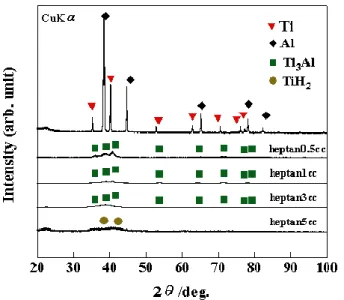
Average particle size of the milled powders for 360 ks becomes small with adding of the heptanes. Initial size of Ti and Al powder is 20m, and that of MA powder with 0.5 heptanes is approximately 5m which are determined by SEM observations. The microstructure change during milling was examined by XRD analysis of the MA powders. Fig. 1 shows XRD patterns of the powder mechanically alloyed for 360 ks. Substantial broadening of the XRD peaks of the original species took place with the progress of milling in powder. The broadening of the peaks indicates that the MA powders have an amorphous-like structure and/or an ultra fine grain structure. This XRD results suggest that the MA powder with 0.5 heptan has most non-equilibrium microstructure. Therefore, the MA powder with 0.5 heptan is applied to fabricate the micro-structures. 2006 POWDER METALLURGY
World Congress
© Korean Powder Metallurgy Institute 1293
-Fig. 1 XRD analysis of MA powders adding 0.5, 1.0, 2.0, 3.0, 4.0, 5.0.
The MA powder adding 0.5 heptan was sintered by SPS using a Ni mold produced by a LIGA process(see ref. [4] for detail). A SEM image of cross-section of SPS compacts are shown in Fig. 2. The Ni mold, which is at upper side in these figures, was formed by electro plating, and it has sharp edges and the surface roughness is less than 1 m. At the 973K for 10 min in Fig. 2(a), the MA powders seems not well-sintered, there are many spaces between the MA powders. Over the 1073K, in Fig. 2(b) and (c), sintering is carried well, but some phases formed between the Ni and MA powder. Although, the condition of SPS-1173K for 10 min is suitability among the others, the Ni mold were deformed, as shown in all figures of Fig. 2 More optimization is required in this study.
Fig. 2 Cross-section of SPS compact with Ni micro mold using the MA powder adding 0.5 heptan
3. References
1. Y. Suehiro and K. Ameyama, Journal of Materials Pro-cessing Technology, 111, p118 (2001).
2. K. Tagaya, Y. Suehiro and K. Ameyama, Proc. Fourth Pacific Rim Int. Conf. on Advanced Materials and Processing, JIM, p959 (2001)
3. Francis E. H. Tay: Materials & Process Integration for MEMS, Kluwer Academic Pub, Dordrecht, (2002) 4. N. Miyano, K. Tagaya, K. Kawase, K. Ameyama and S.
Sugiyama: Sensors and Actuators A, 108, p250 (2003) (a)
(b)