• 검색 결과가 없습니다.

Effect of postural change on shoulder joint internal and external rotation range of motion in healthy adults in their 20s

N/A
N/A
Protected

Academic year: 2021

Share "Effect of postural change on shoulder joint internal and external rotation range of motion in healthy adults in their 20s"

Copied!
6
0
0

로드 중.... (전체 텍스트 보기)

전체 글

(1)

http://crossmark.crossref.org/dialog/?doi=10.14474/ptrs.2019.8.3.152&domain=pdf&date_stamp=2019-9-25

Received: 2 September, 2019 Revised: 17 September, 2019 Accepted: 17 September, 2019 Corresponding author: Jong-Eun Yim (ORCID https://orcid.org/0000-0001-7510-8233)

Department of Physical Therapy, College of Health Science and Social Welfare, Sahmyook University, 815 Hwarang-ro, Nowon-gu, Seoul 01795, Republic of Korea Tel: 82-2-3399-1635 Fax: 82-2-3399-1639 E-mail: [email protected]

This is an Open-Access article distributed under the terms of the Creative Commons Attribution Non-Commercial License (http://creativecommons.org/licenses/

by-nc/4.0) which permits unrestricted non-commercial use, distribution, and reproduction in any medium, provided the original work is properly cited.

Copyright © 2019 Korean Academy of Physical Therapy Rehabilitation Science https://doi.org/10.14474/ptrs.2019.8.3.152

pISSN 2287-7576 eISSN 2287-7584

Phys Ther Rehabil Sci 2019, 8 (3), 152-157 www.jptrs.org

Effect of postural change on shoulder joint internal and external rotation range of motion in healthy adults in their 20s

Beom-Ryong Kim a,b , Dong-Hyun Yi b , Jong-Eun Yim b,c

a

Department of Physical Therapy, Design Hospital, Jeonju, Republic of Korea

b

Department of Physical Therapy, The Graduate School of Sahmyook University, Seoul, Republic of Korea

c
Department of Physical Therapy, College of Health Science and Social Welfare, Sahmyook University, Seoul, Republic of Korea

Objective: We aimed to investigate differences of range of motion in measuring shoulder internal rotation (IR) and external rota- tion (ER) resulting from posture change in manual scapular stabilization in prone, hook-lying, sitting, and standing positions in healthy young adults.

Design: Cross-sectional study.

Methods: This study included healthy young adults who agreed to participate after a thorough explanation about the study pur- pose and methods. A clinometer was used to measure shoulder rotation. Measurements of shoulder rotation according to postural change were performed in prone, hook-lying, sitting, and standing positions. The repeated measures analysis of variance was used to compare between-group differences in postural change.

Results: The lower the posture, the greater the average value of IR angle. In contrast, the higher the posture, the greater the aver- age value of the external rotation angle. In active and passive IR with posture change, there was difference in average value but with no statistical significance. In active and passive ER, there was a statistically significant difference between prone and sitting, prone and standing, hook-lying and sitting, hook-lying and standing, and sitting and standing position (p<0.05).

Conclusions: Our findings suggest that postural change should be considered in order to increase the strength or range of motion of the internal and external rotation of the patient's shoulder joint.

Key Words: External rotation, Internal rotation, Shoulder, Range of motion

Introduction

Range of motion (ROM) is the amount of movement of a joint measured when moving the legs and arms. This is an important indicator in the assessment of a medical disorder or to assess the degree of improvement of an intervention [1,2]. Therefore, the measurement of limited ROM can be regarded as one of the important clinical test methods for as- sessing disorder of intra-articular or surrounding tissue le- sions or the effectiveness of interventions [3].

The scapulothoracic joint of the shoulder complex per- forms the appropriate scapula movement by cooperative movements with the sternoclavicular joint and the acromio-

clavicular joint, and this affects the movement of the hume-

rus in the glenohumeral joint. Therefore, the joints of the

shoulder complex are intimately interconnected to facilitate

maximum shoulder movement. In addition, there are 16

muscles attached to the shoulder complex, and the range of

shoulder movement is controlled by these muscles. How-

ever, if one of these joints experiences a problem or one of

the associated muscles is weakened, the movement control

of the shoulder complex may be reduced to produce an ab-

normal shoulder movement, which limits the movement of

the shoulder [4]. Shoulder disease typically include rotator

cuff tear or shoulder impingement syndrome. Such shoulder

disease causes limited internal rotation (IR) and external ro-

(2)

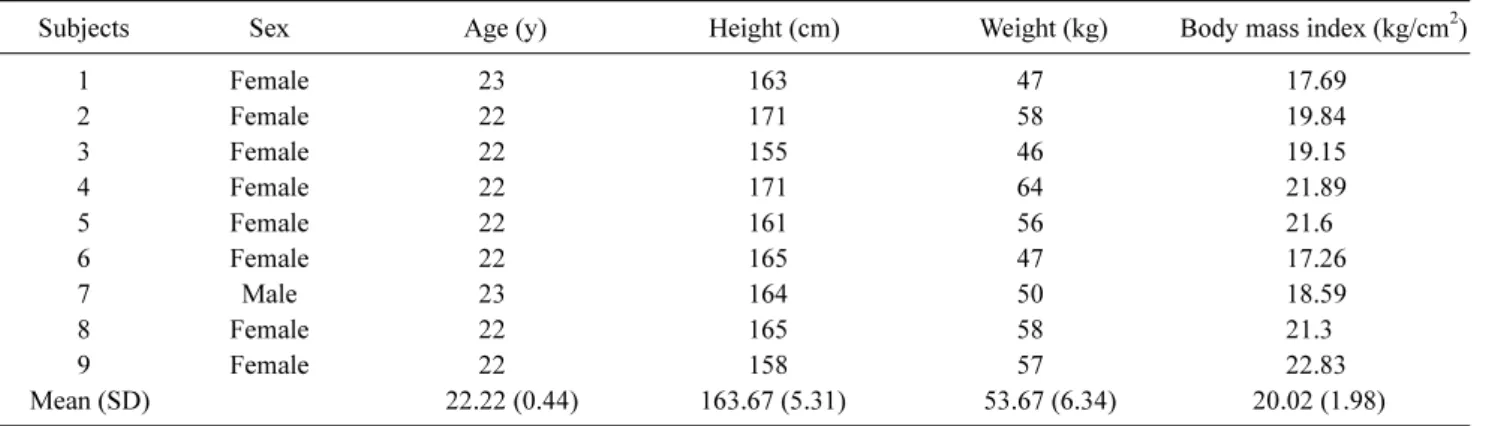
Table 1. General characteristics of the participants (N=9)

Subjects Sex Age (y) Height (cm) Weight (kg) Body mass index (kg/cm

2

)

1 Female 23 163 47 17.69

2Female 2 2 171 58 19.84

3 Female 22 155 46 19.15

4 Female 22 171 64 21.89

5 Female 22 161 56 21.6

6 Female 22 165 47 17.26

7 Male 23 164 50 18.59

8 Female 22 165 58 21.3

9 Female 22 158 57 22.83

Mean (SD) 22.22 (0.44) 163.67 (5.31) 53.67 (6.34) 20.02 (1.98)

Values are presented as number only or mean (SD).

tation (ER) ROM of the shoulder joint [5]. Therefore, a clin- ical assessment of the rotation of the shoulder is needed.

To measure shoulder rotation ROM, a goniometer was used to assess elite junior tennis players [6,7] and baseball players [8-10] in the hook-lying position, the shoulder in 90°

of abduction, the elbow at 90° of flexion. Assuming a hook- lying position is the general assessment procedure in meas- uring ROM shoulder rotation. According to Sadeghifar et al.

[11], another method of measuring shoulder rotation ROM involves using a goniometer in standing position with the shoulder in 90° abduction and elbow in 90° flexion for per- sons with shoulder dislocation. Sadeghifar et al. [11] also measures shoulder rotation in standing position so that IR is aided by gravity. ER rises against gravity up to a range of 90°, but it is aided by gravity beyond 90°. Previous studies have applied manual scapular stabilization that minimizes the movement of scapulothoracic joints in hook-lying or standing position to accurately measure ROM of shoulder rotation [12]. However, the measurements in these previous studies did not take into account the potential effect of grav- ity upon posture change for shoulder movement. Joint move- ment with gravity is thought to increase the measurement value of ROM by applying passive forces. Keating and Matyas [13] showed differences in the muscular strength of the knee extensor resulting from posture changes during knee extension operation.

In this study, we aimed to investigate differences of should- er IR and ER ROM resulting from postural change in manual scapular stabilization in prone, hook-lying, sitting, and stan- ding positions in healthy young adults.

Methods Participants

This study included practice students who visited Design Hospital rehabilitation center in Jeonju in April 2019. The purpose and method of the experiment were described thor- oughly, and those who agreed to participate in the experi- ment were selected. The Anterior Slide test was performed to find shoulder pain [14]. The Anterior and Posterior Drawer Tests were performed to determine anterior and posterior shoulder instability [15]. A positive Sulcus sign would in- dicate inferior shoulder instability [16]. Those with chronic shoulder pain or persistently severe pain, neuropathy, or anyone who was found to have had sensory abnormalities or muscle paralysis, those with difficulty in exercise perform- ance ability due to possible mental challenges or lack of cog- nitive understanding were excluded from the study. The gen- eral characteristics of the subjects are shown in Table 1.

This study was approved by the Institutional Review Board of the Sahmyook University (IRB no. 2-7001793- AB-N-012019015HR) and informed consent was obtained.

Outcome measurements and procedure

An Android smartphone (Samsung Galaxy S7, Samsung Electronics Co., Ltd., Suwon, Korea) was used to measure shoulder rotation using an application that was downloaded from Google Play named Smartphone Clinometer Application (Plaincode Software Solutions, Stephanskirchen, Germany).

The clinometer is an easy to use, low-cost solution available

on many smartphones. The evaluator downloaded the clin-

ometer to the smartphone, configured it, and became famil-

iar with its functionality before measurement. Measurements

of shoulder rotation according to postural change were per-

(3)

Figure 1. Measurement position. (A) Prone. (B) Hook lying. (C) Sitting. (D) Standing.

Table 2. Comparison of internal and external rotation angle by position (N=9)

Position AIR PIR AER PER

Prone (°) 56.50 (8.38) 65.72 (6.04) 89.83 (7.69) 98.28 (7.25)

Hook-lying (°) 55.55 (7.56) 64.72 (8.64) 90.17 (12.63) 100.17 (13.43)

Sitting (°) 55.17 (9.32) 64.17 (9.34) 100.11 (10.56) 110.72 (11.93)

Standing (°) 54.78 (7.49) 63.50 (9.71) 103.44 (10.54) 112.55 (11.00)

F (p) 0.246 (0.864) 0.729 (0.405) 29.343 (<0.001) 28.759 (<0.001) Values are presented as mean (SD).

AIR: active internal rotation, PIR: passive internal rotation, AER: active external rotation, PER: passive external rotation.

formed in prone, hook-lying, sitting, and standing positions (shoulder 90° abduction, elbow 90° flexion) with manual scapular stabilization on the treatment table [12]. Measure- ment positions are shown in Figure 1. The patient was asked to have the back and buttocks touch the wall to prevent trunk motion for the sitting and standing shoulder rotation measurements. The clinometer measured the angle in paral- lel with the ulna. The clinometer measurements were ob- tained by reading the value on the screen. The average value was recorded by repeating the measurement three times.

Inter-rater reliability is an appropriate tool for measuring ROM intra-class correlation coefficient (ICC) for the clin- ometer [17].

Statistical analysis

Statistical analysis was performed using PASW Statistics for Windows, Version 18.0 (SPSS Inc., Chicago, IL, USA).

The repeated measures ANOVA was used to compare the between-group differences for postural change. Statistical significance was set at p<0.05.

Results

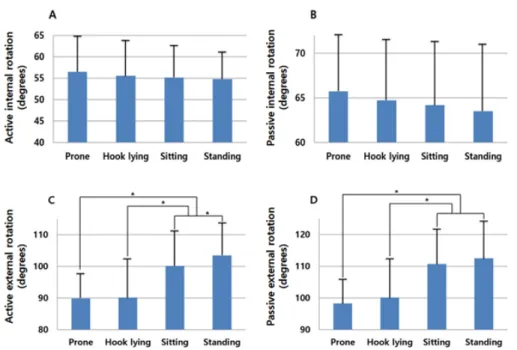
The IR and ER angles of the shoulder joint with postural change are shown in Table 2 and Figure 2. The lower the posture, the greater the average value of IR angles. In con- trast, the higher the posture, the greater the average value of the ER angles.

In active IR measurement, the highest angle was in the or- der of prone, hook-lying, sitting, and standing positions. In active IR with posture change, there was difference in aver- age value but with no statistical significance. In passive IR measurement, the highest angle was in the order of prone, hook-lying, sitting, and standing positions. In passive IR with posture change, there was difference in average value but with no statistical significance.

In active ER measurement, the highest angle was shown

in the order of standing, sitting, hook-lying, and prone

positions. There was a statistically significant difference be-

tween prone and sitting, prone and standing, hook-lying and

sitting, hook-lying and standing, and sitting and standing

(p<0.05) positions. In passive ER measurement, the highest

(4)

Figure 2. Comparison of internal and external rotation external rotation an- gle (in °) by position. (A) Active in- ternal rotation. (B) Passive internal rotation. (C) Active external rotation.

(D) Passive external rotation. *Signi- ficant difference between groups (repeated measures analysis of var- iance).

angle was shown in the order of standing, sitting, hook-ly- ing, and prone positions. There was a statistically significant difference between prone and sitting, prone and standing, hook-lying and sitting, hook-lying and standing (p<0.05) positions.

Discussion

One of the considerations for measuring shoulder ROM using a goniometer or a clinometer is the posture of the sub- ject during the measurement. The functional activity of the upper extremity is mostly performed in the sitting position [18], however in the actual clinic with stroke survivors, the ROM of the shoulder is measured in the hook-lying position in most cases. It is easy to control the trunk or scapular ad- duction and provides a wide base of support (BOS) to allow accurate ROM measurements by decreasing the tone of muscles with increased tone. In this study, we investigated the differences of shoulder rotation according to postural change. Rotation was measured in various postures, from the prone position (high trunk weight support), which pro- vides a wide BOS, to standing position (low trunk weight support), which provides a narrow BOS. As a result, the average value of IR angle increased with lower postures. In contrast, the higher the posture, the greater the average val- ues of the ER angle.

The biggest advantage when using a clinometer is the convenience. When measuring ROM with a goniometer, stabilization is performed by having the therapist use one

hand of on the fixed arm and the other hand used to move the moving arm [19]. Because the measurement posture is un- stable, errors can occur as the axis and fixed arm move, and it is difficult to maintain the moving arm exactly parallel to the length of the arm as it follows the movement. Also, the reading accuracy of the goniometer scale is slow and time consuming. However, when using the clinometer, the error of measurement from an unstable measurement posture is reduced because the smartphone is attached to the patient with the armband, and the clinometer can minimize error be- cause it does not need the imaginary vertical line required for measurement. Also, the measured angle is expressed as a number on the smartphone monitor in real-time, and an ac- curate measurement is immediately possible [20]. Yang et al. [21] measured hip joint ROM using a clinometer for 50 normal adults. Studies have shown that the inter-rater reli- ability (ICC=0.95-0.97) of the clinometer is higher than the inter-rater reliability (ICC=0.78-0.83) of the goniometer.

Werner et al. [17] measured the ROM of shoulder rotation using a goniometer and a clinometer for normal adults.

Studies have shown that the inter-rater reliability of the goni- ometer has a low inter-rater reliability with IR (ICC=0.64) and ER (ICC=0.78-0.83). However, the inter-rater reli- ability through the clinometer with IR (ICC=0.81) and ER (ICC=0.86) was higher inter-compared with the goniometer.

In this study, the measurement of shoulder rotation in normal adults was performed using a clinometer with inter-rater re- liability confirmed in previous studies.

ROM measurement is one of several tests performed dur-

(5)

ing a clinical visit, and is particularly suitable for testing mo- bility [22]. Because the shoulder is the most widely moving joint on the body and therefore can have the greatest func- tional impact, it is very important to have an accurate meas- urement of the ROM [23,24]. In this study, IR measurements showed the highest angle in prone, which is the lowest pos- ture, followed by hook-lying, sitting, and standing positions.

ER measurements showed the highest angle at the highest posture, which was standing, followed by sitting, hook-ly- ing, and prone positions. These results showed that the angle of IR was high when assuming a low posture with a wide BOS. Correspondingly, ER was high when assuming a high posture with a narrow BOS. Stability is needed to increase mobility. In IR motion, scapular protraction occurs and scapular stability decreases. In ER motion, scapular re- traction occurs and scapular stability increases [25]. The scapula should be stabilized when measuring shoulder rotation. However, due to previous studies, IR has the largest angle at low postures, where scapular stability is the highest.

ER appears to have the largest angle at high postures, where scapular stability is the greatest. In previous studies, specific exercises were designed for the push-up, in which the shoulder is in IR or neutral position, with the palm is facing downwards [26-29]. In this exercise, the push-up mod- ification emphasizing IR seems to be performed in a low posture with wide BOS. A wall-slide exercise, which em- phasizes ER, may be performed in a high posture with nar- row BOS. In addition, when performing exercise for ROM increase of IR, BOS should be performed at wide, low postures. When performing exercise for ROM increase of ER, BOS should be performed at narrow, high postures.

Also, at the anatomical location, the IR and ER of the shoulder joints are related to the roll and slide arthro- kinematics. However, shoulder rotation at approximately 90° of abduction position of this study is good for visualiz- ing kinematics because spin between one point of the head of the humerus and one point of the articular fossa occurs.

Therefore, measurement of shoulder rotation in approx- imately 90° of abduction according to postural change of this study may be useful for patient intervention and as- sessment.

There are some limitations to this study. First, measure- ment of shoulder rotation in side-lying position should be performed with the goniometer because there is difficulty in measuring shoulder rotation in the side-lying position using a clinometer. Second, the measurement of shoulder rotation was measured in the 90° abduction position. Therefore, an-

other method of measurement of shoulder rotation is needed.

Finally, although statistically significant results were ob- tained, the number of subjects is not sufficient to generalize the results of the study, and caution is needed in generalizing the study results to the majority of healthy young adult women.

In conclusion, the purpose of this study was to evaluate the ROM of the shoulder according to postural change in healthy young adults. The results of the study showed that the lower the posture, the higher the angle of IR, and the higher the posture the higher the angle of the ER. Therefore, it is considered that postural change should be considered in order to increase the strength of the shoulder or the IR and ER of the shoulder.

Conflict of Interest

The authors declared no potential conflicts of interest with respect to the authorship and/or publication of this article.

References

1. Laudner KG, Sipes RC, Wilson JT. The acute effects of sleeper stretches on shoulder range of motion. J Athl Train 2008;43:

359-63.

2. Shanley E, Rauh MJ, Michener LA, Ellenbecker TS, Garrison JC, Thigpen CA. Shoulder range of motion measures as risk fac- tors for shoulder and elbow injuries in high school softball and baseball players. Am J Sports Med 2011;39:1997-2006.

3. Borsa PA, Dover GC, Wilk KE, Reinold MM. Glenohumeral range of motion and stiffness in professional baseball pitchers.

Med Sci Sports Exerc 2006;38:21-6.

4. Neumann DA. Kinesiology of the musculoskeletal system - e-book: foundations for rehabilitation. Elsevier Health Sciences;

2013.

5. Lewis JS, Wright C, Green A. Subacromial impingement syn- drome: the effect of changing posture on shoulder range of movement. J Orthop Sports Phys Ther 2005;35:72-87.

6. Ellenbecker TS, Roetert EP, Piorkowski PA, Schulz DA.

Glenohumeral joint internal and external rotation range of mo- tion in elite junior tennis players. J Orthop Sports Phys Ther 1996;24:336-41.

7. McConnell J, McIntosh B. The effect of tape on glenohumeral rotation range of motion in elite junior tennis players. Clin J Sport Med 2009;19:90-4.

8. Scher S, Anderson K, Weber N, Bajorek J, Rand K, Bey MJ.

Associations among hip and shoulder range of motion and shoulder injury in professional baseball players. J Athl Train 2010;45:191-7.

9. Sauers EL, Huxel Bliven KC, Johnson MP, Falsone S, Walters S.

Hip and glenohumeral rotational range of motion in healthy pro-

fessional baseball pitchers and position players. Am J Sports

(6)

Med 2014;42:430-6.

10. Oliver GD, Weimar WH. Hip and shoulder range of motion in youth baseball pitchers. J Strength Cond Res 2016;30:2823-7.

11. Sadeghifar A, Ilka S, Dashtbani H, Sahebozamani M. A compar- ison of glenohumeral internal and external range of motion and rotation strength in healthy and individuals with recurrent ante- rior instability. Arch Bone Jt Surg 2014;2:215-9.

12. Boon AJ, Smith J. Manual scapular stabilization: its effect on shoulder rotational range of motion. Arch Phys Med Rehabil 2000;81:978-83.

13. Keating JL, Matyas TA. Method-related variations in estimates of gravity correction values using electromechanical dynamom- etry: a knee extension study. J Orthop Sports Phys Ther 1996;24:

142-53.

14. Kibler WB. Specificity and sensitivity of the anterior slide test in throwing athletes with superior glenoid labral tears. Arthroscopy 1995;11:296-300.

15. Gerber C, Ganz R. Clinical assessment of instability of the shoulder. With special reference to anterior and posterior drawer tests. J Bone Joint Surg Br 1984;66:551-6.

16. McFarland EG, Campbell G, McDowell J. Posterior shoulder laxity in asymptomatic athletes. Am J Sports Med 1996;24:468- 71.

17. Werner BC, Holzgrefe RE, Griffin JW, Lyons ML, Cosgrove CT, Hart JM, et al. Validation of an innovative method of shoulder range-of-motion measurement using a smartphone clinometer application. J Shoulder Elbow Surg 2014;23:e275-82.

18. Radomski MV, Latham CAT. Occupational therapy for physical dysfunction. Philadelphia: Lippincott Williams and Wilkins;

2008.

19. Clarkson HM. Musculoskeletal assessment: joint range of mo- tion and manual muscle strength. Philadelphia: Lippincott Williams and Wilkins; 2000.

20. Park IW, Lim OB, Park KN, Yi CH. Intra- and inter-rater reli- ability of measuring passive range of shoulder motion with smartphone and goniometer in patients with stroke. Phys Ther Korea 2014;21:1-12.

21. Yang H, Jeong C, Yoo Y, Bae S. Reliability study of hip range of motion measurement by smartphone inclinometer. J Korean Soc Integr Med 2016;4:89-96.

22. Kisner C, Colby LA, Borstad J. Therapeutic exercise: founda- tions and techniques. Philadelphia: F.A. Davis Company; 2017.

23. Cadet ER. Evaluation of glenohumeral instability. Orthop Clin North Am 2010;41:287-95.

24. Kolber MJ, Saltzman SB, Beekhuizen KS, Cheng MS. Reliabil- ity and minimal detectable change of inclinometric shoulder mo- bility measurements. Physiother Theory Pract 2009;25:572-81.

25. Provencher CM, Makani A, McNeil JW, Pomerantz ML, Golijanin P, Gross D. The role of the scapula in throwing disorders. Sports Med Arthrosc Rev 2014;22:80-7.

26. Choung SD, Weon JH, Jung DY. Effect of movement plane and shoulder flexion angle on scapular upward rotator during scap- ular protraction exercise. J Korean Soc Phys Med 2013;8:41-8.

27. Ha SM, Kwon OY, Cynn HS, Lee WH, Park KN, Kim SH, et al.

Comparison of electromyographic activity of the lower trapezius and serratus anterior muscle in different arm-lifting scapular pos- terior tilt exercises. Phys Ther Sport 2012;13:227-32.

28. Ludewig PM, Hoff MS, Osowski EE, Meschke SA, Rundquist PJ. Relative balance of serratus anterior and upper trapezius mus- cle activity during push-up exercises. Am J Sports Med 2004;32:

484-93.

29. Park KM, Cynn HS, Yi CH, Kwon OY. Effect of isometric hori- zontal abduction on pectoralis major and serratus anterior EMG activity during three exercises in subjects with scapular winging.

J Electromyogr Kinesiol 2013;23:462-8.

수치

Table  1. General characteristics of the participants (N=9)
Table  2. Comparison of internal and external rotation angle by position (N=9)
Figure 2. Comparison of internal and  external rotation external rotation  an-gle (in °) by position

참조

관련 문서

Based on the above results, the 12-week complex type correction program had a positive effect on the shoulder angle, trunk rotation angle, and body shape

In contrast, Chiropractic has shown better result than sports massage in the range of motion of the shoulder joint, Thoracic Scapular rhythm test, and the

Using this leap motion, a surgeon can perform the virtual shoulder arthroscopic surgery skillfully and reduce mistakes in surgery.. The simulation using leap motion shows

Absolute and Relative Velocity in Plane Motion Instantaneous Center of Rotation in Plane Motion Absolute and Relative Acceleration in Plane Motion... Analysis of Plane

It considers the energy use of the different components that are involved in the distribution and viewing of video content: data centres and content delivery networks

개인적 요인 요인 요인 요인, 사회적 사회적 사회적 사회적 영향 영향 영향 영향, 행동 행동 행동 행동 계속에 계속에 계속에 대한 계속에 대한 대한 대한 관심

After first field tests, we expect electric passenger drones or eVTOL aircraft (short for electric vertical take-off and landing) to start providing commercial mobility

The greater tubercle is palpable on the line from the lateral epicondyle of the distal humerus in the direction of the humeral longitudianl axis and just below the acromion