A Convergence Study on the Factor Influencing to
Healthcare-Associated Infection Control Guidelines of Nursing Students
Mi Ok Song 1 , Jeong Eun Moon 2*
1
Professor, Department of Nursing, Nambu University
2
Professor, Department of Nursing, Honam University
간호학생의 의료관련감염 관리지침 준수 영향요인에 관한 융합연구
송미옥 1 , 문정은 2*
1
남부대학교 간호학과 교수,
2호남대학교 간호학과 교수
Abstract In this preliminary study exploring the development of an convergent educational program, we identified the factors that affect adherence to healthcare-associated infection (HAI) control guidelines.
The data were collected using a self-reported questionnaire of 183 nursing students. The collected data were analyzed using AMOS 21.0 and SPSS 21.0 program. The model fit was χ
2=52.06 (df=9, p<.01), GFI=.93, RMSEA=.16, NFI=.85, and CFI=.90, and the explanatory power was 26.2%. As a result in this study, it was found that the theory of planned behavior(TPB) was appropriate for explaining the intention about healthcare-associated infection control guidelines. It is necessary to develop an education program that can reinforce the concepts of TPB, and iterate research to verify its effectiveness.
Key Words : Convergence, Nursing students, Healthcare-associated infection, Theory of planned behavior, Beliefs
요 약 이 연구는 임상실습 전 간호대학생의 의료관련감염 관리지침 수행에 관한 영향 요인을 파악하여 융합적 교육 프로그램 개발을 위한 사전조사로서 시행된 연구이다. 자료수집은 일 지역 간호학과 2학년 183명을 대상으로 자가보고 식 설문지를 이용하여 수행하였으며, 수집된 자료는 AMOS 21.0과 SPSS 21.0을 이용하여 분석하였다. 분석 결과 모형 적합도는 χ
2=52.06 (df=9, p<.01), GFI=.93, RMSEA=.16, NFI=.85, CFI=.90 이었으며, 설명력은 26.2%였다. 이를 통해 간호대학생의 의료관련감염 관리지침 수행의도의 설명에 계획된 행위이론이 적절함을 알 수 있었으며, 향후 간호 대학생의 의료관련감염 관리지침 준수를 높일 수 있도록 계획된 행위이론의 하위개념들을 강화할 수 있는 교육프로그램 을 개발하고, 이의 효과를 검증할 수 있는 반복연구가 필요하다.
주제어 : 융합, 간호학생, 의료관련감염, 계획된 행위이론, 신념
*Corresponding Author : Jeong Eun Moon([email protected]) Received September 28, 2019
Accepted November 20, 2019
Revised October 17, 2019
Published November 28, 2019
1. Introcuction
During the 2015 outbreak and transmission of Middle East Respiratory Syndrome (MERS) in South Korea, inefficient management resulted in various challenges such as poor initial response of the broadcasting authorities, delayed disclosure of information, unclear roles and responsibilities of each agency, lack of infrastructure related to infectious diseases in Korea Centers for Disease Control & Prevention (KCDC) and medical institutions, and inadequate infection control measures in healthcare facilities[1,2]. Therefore, Korean government solicited a diverse range of opinions through special committees in the National Assembly, on-the-spot meetings, public hearings, and the Infection Control Committee.
As a result, policies were developed such as renewed systems for prevention of emerging infectious diseases nationally[1,2] and legislation to establish and enhance the infection control infrastructure in healthcare facilities.
This concern is reflected in the healthcare- associated infection (HAI) control segment of healthcare accreditation as a major factor in the evaluation and certification by the Korea Institute for Healthcare Accreditation[3] or the Joint Commission of International Accreditation Standards[2]. And the evaluation criteria for these institutions recommend implementation and management of HAI education for students studying at medical institutions[3]. In addition, Kim, O.S [4] suggests that infection control education is needed for the students on the basis of the high detection rate of multi-drug resistant bacteria in nursing and medical students during hospital practice. However, the curriculum of the HAI control guidelines is not reflected in the nursing curriculum. This recommendation suggests that students should develop adequate contact with the patients during their practice and consider training before working as medical staff to effectively manage the infection. Based
on this, the researchers determined that proper infection control education program should be operated before the hospital practice. For this purpose, after completing basic nursing and the preliminary investigation of the students who have not yet experienced the clinical practice are necessary.
Experts studying human behavior believe that individual actions are highly affected by personal attitudes, beliefs, subjective norms, and self-efficacy[5]. Therefore, inculcation of appropriate beliefs and attitudes during impressionable and formative years is expected to result in acceptable behaviors[6]. Therefore, training to alter the perceptions and attitudes of nursing students regarding infection control measures in a clinical setting is necessary and desirable to develop future healthcare providers equipped with the requisite knowledge, skills, and attitudes.
Previous studies investigating infectious diseases report the nurse's beliefs about factors influencing infection management behavior[7], work intensity at the job site[8], intensive education for improved individual performance, the need for observation and feedback, and evidence-based knowledge[9]. In addition, it suggests that positive attitude and social awareness are required.
Adherence to these guidelines requires strong positive attitudes and social awareness, and intensive university education before becoming a nurse. However, studies related to nursing students have been limited to their knowledge level, awareness, and exposure to body fluids[10-17]. Nevertheless, these studies suggest the need for a pre-clinical training course, to establish a training program under HAI control.
In order to increase the effectiveness of education as discussed in the studies, it is necessary to strengthen the positive attitudes, beliefs, and subjective norms[7,18,19].
The purpose of this study was to identify the
factors influencing the intention of the nursing students, in implementing infection management guidelines. Toward this end, based on a literature review[17,20-22], we used Ajzen’s theory of planned behavior as a conceptual framework, which describes the behavioral intentions in various studies analyzing medical infection management.
Since the attitude, PBC, and subjective norms are not shaped instantly but develop over a long period of time, the researcher believes that it is necessary to study the intentions of nursing students to fulfil their obligations as nurses to carry out infection control guidelines. Of course, in the study of Moon and Jang[23], although the organizational factors such as organizational culture and resource support are influential factors in nurses’ performance of HAI control guidelines, the influence of individual attitudes, PBC, and subjective norms cannot be excluded.
Thus, it is important to strengthen personal beliefs and confidence in nursing college students who are in the process of learning knowledge, skills, and attitudes.
Therefore, we aim to identify the factors affecting performance intention by analyzing the relationship between intention, attitude, perceived behavioral beliefs, and subjective norms in the implementation of HAI control guidelines by second-year nursing students, who have yet to experience clinical practice.
2. Methods
2.1 Study Design
We used convenience sampling to select participants among second-year nursing students at 4 nursing schools located in Gwangju, South Korea, and calculated the sample size using the G-power program version 3.1.2 (Franz Faul, Germany). Based on a median effect size of .15, a type I error of .05, and statistical power of .95,
we calculated the sample size as 172. However, considering the dropout rate, we decided to use a sample size of 200 subjects.
We collected data from October 1
stto October 20
th, 2018, using a structured self-reported questionnaire. We conducted the study in accordance with the Declaration of Helsinki, and its ethical principles for medical research involving human subjects. We explained the study goals and procedures to potential participants and included those who were willing to volunteer following written informed consent.
We informed the participants of their rights to withdraw their participation at any time and that the anonymity of their data was guaranteed. The paper questionnaire was distributed to the volunteers participating in the study using a second-grade mailbox, with a participant response time of 10 ~ 15 min.
We received 195 responses (97.5% response rate) to 200 questionnaires distributed. We excluded surveys containing more than 10% missing values as well as 11 forms that had outliers (Z-score
±3)[24]. Ultimately, we used the data from 183 surveys for our analyses.
2.2 Study Tool
We completed the questionnaire according to the method reported previously using TpB[25].
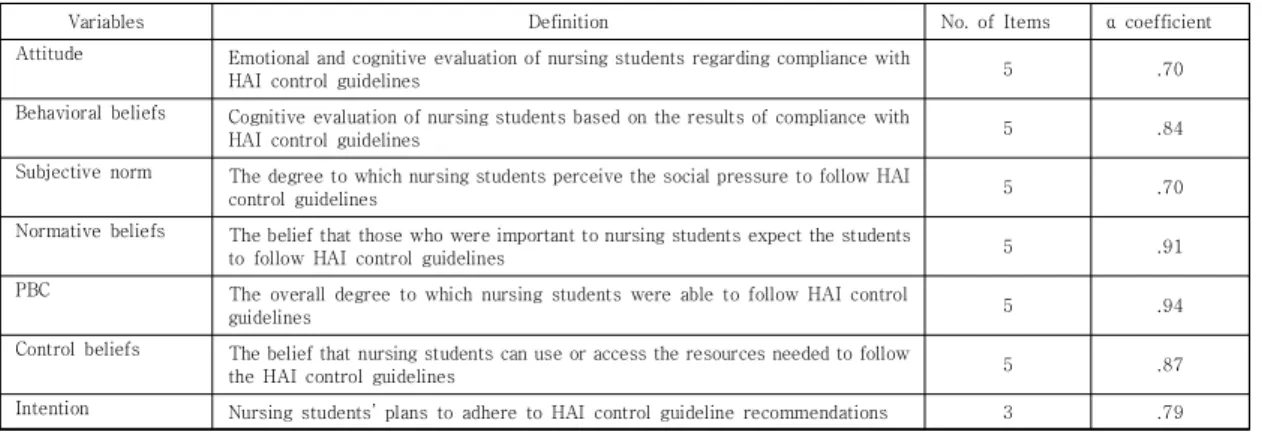
We developed study questionnaires to determine the general characteristics and the TPB variables associated with implementation of HAI control guidelines such as behavioral beliefs, attitude, normative beliefs, subjective norm, control beliefs, perceived behavioral control and intention. Except for the questions related to general characteristics, we modified and revised the study questionnaire based on questionnaires that were originally developed by Whitby, McLaws, and Ross[7] and modified by Moon and Song[20]. Table 1 lists the definitions, item numbers, and confidence of each variable.
The reliability of the attitude measurement
instrument consisting of 5 items, Chronbach’s α, was .70 and the reliability of the behavioral belief comprising 5 items was .84. The subjective norm was composed of 5 items, with a reliability of .70; and the normative belief consisted of 5 items, with a reliability of .91. The PBC consisted of five items, with a reliability of .94, and the control belief comprised of three items, with a reliability of .87. Finally, the intentional component was composed of 3 items with a reliability of .79.
Attitudes were evaluated on a 7-point semantic differential scale. All other variables were measured with a 5-point Likert scale. Each measurement variable was based on the average of the items constituting the variable. The reliability coefficient for question 3 was sufficiently low on the questionnaire that measured attitudes toward adherence to HAI control guidelines, and therefore, was excluded from the analysis. We also reversed the scales for the scores associated with the control belief items that were negatively worded.
2.3 Data Analysis
We analyzed the collected data using SPSS Statistics 21.0 (IBM Inc., Chicago, IL, USA) and IBM SPSS Amos ver 21.0 (IBM Corp., Build 1178) program. We analyzed the participants’ general
characteristics using descriptive statistics and reported the data as percentiles, means and, standard deviations. We measured internal consistency and reliability using Cronbach’s alpha, and measured the correlations between the predictors using Pearson’s correlation coefficient. Finally, in oder to confirm the estimation possibility of the structual equation model, the model identifiation evaluation was performed.
3. Results
3.1 General Characteristics of Participants and TPB Test
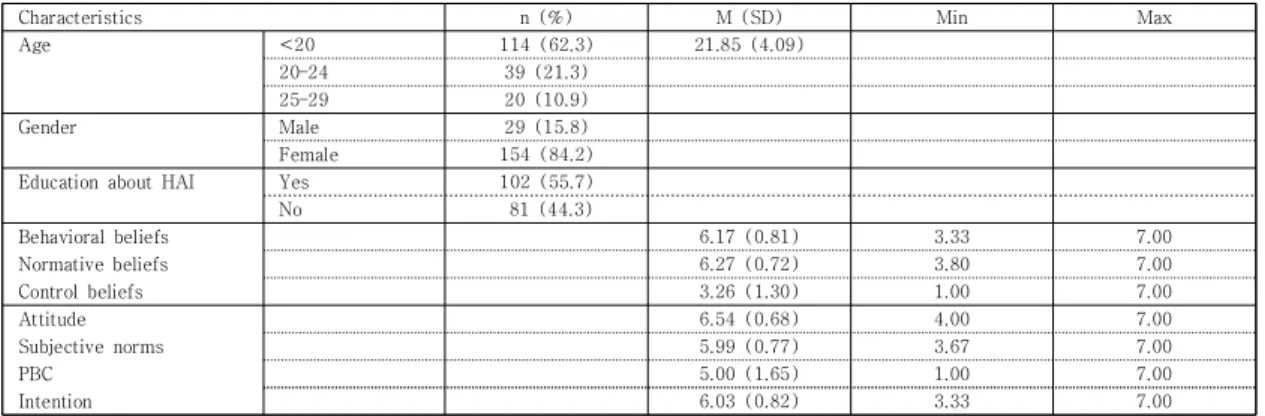
We analyzed the participants’ general characteristics using descriptive statistics and the results of baseline analysis for each variable are presented in Table 2. The participants included 154 (84.2%) females and 29 (15.8%) males, with a mean age of 21.85±4.09 years. In terms of educational experience involving HAI control in or out of curriculum, we analyzed beliefs, attitudes, subjective norms, PBC, and intentions by calculating the means for those items based on the TPB questionnaire construction manual [25].
Attitude scored the highest value (6.54±0.68), followed by normative beliefs (6.27±0.72), behavioral
Variables Definition No. of Items α coefficient
Attitude Emotional and cognitive evaluation of nursing students regarding compliance with
HAI control guidelines 5 .70
Behavioral beliefs Cognitive evaluation of nursing students based on the results of compliance with
HAI control guidelines 5 .84
Subjective norm The degree to which nursing students perceive the social pressure to follow HAI
control guidelines 5 .70
Normative beliefs The belief that those who were important to nursing students expect the students
to follow HAI control guidelines 5 .91
PBC The overall degree to which nursing students were able to follow HAI control
guidelines 5 .94
Control beliefs The belief that nursing students can use or access the resources needed to follow
the HAI control guidelines 5 .87
Intention Nursing students’ plans to adhere to HAI control guideline recommendations 3 .79 HAI=Healthcare-associated infection; PBC=Perceived behavioral control
Table 1. Reliability of the Theory of Planned Behavior Variables in Increasing Adherence to Healthcare-Associated
Infection Control Guidelines
beliefs (6.17±0.81), intentions (6.03±0.82), subjective norms (5.99±0.77), PBC (5.00±1.65), and control beliefs (3.26±1.30).
3.2 Analysis of Correlation and Hypothetical model
Correlation analysis on measurement variables and feasibility analysis results on measurement concepts are shown in Table 3. Behavioral beliefs (r=.437, p <.001), normative beliefs (r=.335, p <.001), attitude (r=.338, p <.001), subjective norm (r=.395, p <.001), and PBC (r=.418, p <.001) were significantly correlated with intentions to follow HAI control guidelines. However, control beliefs were not significantly correlated with intentions (r=.082, p =.269). Further, the variance inflation factor (VIF) for independent variables including behavioral beliefs, normative beliefs, attitude,
subjective norms, PBC, and infection control education did not exceed 10 (1.00 – 1.28), and the tolerance ranged between 0.1 and 10 (0.78 – 0.92). These results indicated the absence of multicollinearity between independent variables.
We tested the independence of residuals using the Durbin-Watson test, and the results were close to 2 (1.85) indicating lack of auto correlation.
Therefore, we concluded that the residuals were normally distributed and met the homoscedasticity assumption. Factor load (standardized coefficient) of each measured variable ≥.5, C.R. [Threshold]> ± 11.97, AVE [Average Dispersion Extraction Index]
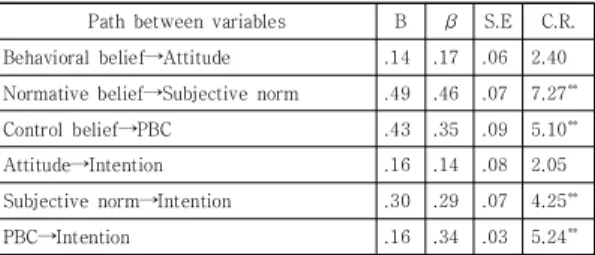
≥.50 The discriminant validity of the correlation coefficient between normative beliefs and behavioral beliefs is less than the minimum AVE .50. Table 4 show that Covariance structure analysis for confirm the validity of the causal model established. As a result, χ
2=52.06 (df=9
Characteristics n (%) M (SD) Min Max
Age <20 114 (62.3) 21.85 (4.09)
20–24 39 (21.3)
25–29 20 (10.9)
Gender Male 29 (15.8)
Female 154 (84.2)
Education about HAI Yes 102 (55.7)
No 81 (44.3)
Behavioral beliefs 6.17 (0.81) 3.33 7.00
Normative beliefs 6.27 (0.72) 3.80 7.00
Control beliefs 3.26 (1.30) 1.00 7.00
Attitude 6.54 (0.68) 4.00 7.00
Subjective norms 5.99 (0.77) 3.67 7.00
PBC 5.00 (1.65) 1.00 7.00
Intention 6.03 (0.82) 3.33 7.00
HAI=healthcare-associated infection; PBC=perceived behavior control
Table 2. General Characteristics of Participants and Descriptive Statistics of Variables (N=183)
Variables BB NB CB Att SN PBC Int
BB 1
NB .676
**1
CB -.046 -.048 1
Att .246
**.219
**.239
**1
SN .419
**.489
**.039 .390
**1
PBC .279
**.234
**.381
**.368
**.172
*1 1
Int .437
**.335
**.082 .338
**.395
**.418
**AVE
a.501 .501 .515 .501 .500 .500 .501
BB=Behavioral beliefs; NB=Normative beliefs; CB=Control beliefs; Att=Attitude; SN=Subjective norm; PBC=Perceived behavioral control; Int=Intention:
AVE=Average Variance Extract
*
. Correlation is significant at the 0.05 level
**