• 검색 결과가 없습니다.

Alterations of Gene Expression by Beta-tricalcium Phosphate in Osteoblast-like MG63 Cells

N/A
N/A
Protected

Academic year: 2021

Share "Alterations of Gene Expression by Beta-tricalcium Phosphate in Osteoblast-like MG63 Cells"

Copied!
6
0
0

로드 중.... (전체 텍스트 보기)

전체 글

(1)

Original Article

RECEIVED April 6, 2011, ACCEPTED May 25, 2011 Correspondence to Chang-Joo Park

Division of Oral and Maxillofacial Surgery, Department of Dentistry, College of Medicine, Hanyang University 17 Haengdang-dong, Seongdong-gu, Seoul 133-791, Korea

Tel: 82-2-2290-8646, Fax: 82-2-2290-8673, E-mail: [email protected]

CC

This is an open access article distributed under the terms of the Creative Commons Attribution Non-Commercial License (http://creativecommons.org/licenses/

by-nc/3.0) which permits unrestricted non-commercial use, distribution, and reproduction in any medium, provided the original work is properly cited.

Alterations of Gene Expression by Beta-tricalcium Phosphate in Osteoblast-like MG63 Cells

Jae-Yun Jeon, Tae-Yun Im, Seung-Hwan Jeon, Kyung-Gyun Hwang, Chang-Joo Park

Division of Oral and Maxillofacial Surgery, Department of Dentistry, College of Medicine, Hanyang University

Abstract

Purpose: Beta-tricalcium phosphate (β-TCP) is a synthetic calcium phosphate ceramic that has widely been used as a bone material to repair bone defects. Despite many clinical studies, the molecular mechanism whereby this biomaterial alters the gene expression in osteoblasts to promote bone formation is poorly understood. Thus, we attempted to address this question by using microarray techniques to identify the genes that are differentially regulated in osteoblasts exposed to β-TCP.

Methods: By using DNA microarrays, we identified several genes whose expression levels were significantly up- or down-regu- lated in osteoblast-likeMG-63cells cultured with β-TCP at a concentration of 100 mg/10 ml for 24 hours.

Results: The differentially expressed genes covered a broad range of functional activities: signal transduction, transcription, cell cycle regulation, vesicular transport, apoptosis, immunity, cytoskeletal elements and cell proliferation and differentiation.

Conclusion: The gene expression changes related to cell proliferation and differentiation, vesicle transport, immunity and defense could affect the osteogenic activities of osteoblasts for bone regeneration. However, further studies will be required to verify the relative importance of these genes in bone formation, their temporal and spatial expression patterns and their interactions with each other.

Key words: Beta-tricalcium phosphate, Bone regeneration, Microarray analysis, Osteoblasts

Introduction

Many graft materials have been used for the repair and restoration of bone defects in oral and maxillofacial surgery. Autogenous bone is accepted as the gold standard for graft material, but it needs to be harvested from other sites of the body. Various kinds of bone materials have been introduced and developed to replace the harvesting of autogenous bone.

Beta-tricalcium phosphate (β-TCP) is a kind of synthetic calcium phosphate ceramic that is widely being used as

a bone material to repair bone defects[1]. β-TCP is bio- compatible and absorbable, and the mechanism of bone formation by β-TCP is mainly osteoconduction since TCP is composed of calcium and phosphate ions, the most com- mon elements found in bone[1]. β-TCP acts as a space maker and scaffold for bone ingrowth[1], is completely resorbed coinciding with bone formation, and is replaced by vital host bone without residue within 6∼12 months[2,3].

β-TCP is completely replaced by newly formed bone be-

cause it dissolves in the presence of acids released by cells,

such as osteoclasts or macrophages[3]. In a comparative

(2)

histomorphometric study of various graft materials in pigs, TCP showed superior degradation and substitution, as com- pared to other graft materials, such as hydroxyapatite and demineralized freeze-dried bone allografts[4,5].

Cerasorb (Curasan AG, Kleinostheim, Germany), a syn- thetic pure-phase β-TCP, has been widely used for bone generation. It is multi-porous and has a polygonal struc- ture[2]. The porosity of the granules contributes to in- creased surface area, which is available for wetting by tis- sue fluids and cells, thus promoting its resorption[2]. In addition, growth factors for osteogenesis or osteoconduc- tion can easily penetrate through surface pores[3]. Macro- pores permit the growth of blood vessels into the matrix to supply blood, cellular, and fibrimental factors, as well as newly formed bone[2,3]. On the other hand, the dis- advantage of β-TCP is relatively early resorption in- dependent of new bone formation, resulting in insufficient bone formation, replacement, and the induction of ectopic bone formation due to residues remaining in regenerating tissue[4,6,7].

DNA microarray methodology enables the molecular analysis of gene expression of a very large number of genes spanning a significant fraction of the human genome, in parallel[8]. The analysis is both qualitative and quantitative, since the sensitivity is high enough to detect changes in expression levels in perturbed, as compared to normal cells[9]. The overall result is the generation of a so-called genetic portrait, corresponding to up-regulated or down- regulated genes in the investigated cell system[8-10].

β-TCP’s properties and structure have been the subject of many basic and clinical studies. However, there is in- sufficient information on the direct effects of β-TCP on gene regulation in osteoblasts. Therefore, in this study, we investigated alterations in gene expression in osteo- blast-like MG63 cells by β-TCP using DNA microarrays and examined the potential role of β-TCP in bone regeneration.

Materials and Methods

1. Cell culture

Osteoblast-like MG63 cells were cultured in Eagle’s mini- mum essential medium (MEM, Sigma, St. Louis, MO, USA)

supplemented with 10% fetal calf serum (FCS, Sigma) and antibiotics (penicillin 100 U/ml and streptomycin 100 mg/ml, Sigma). Cultures were maintained in a 5% CO

2

humidified atmosphere at 37

o

C.

MG63 cells were released with 0.1% trypsin, 0.02% EDTA in Ca

2+

and Mg

2+

-free Eagle’s buffer (Sigma), collected and seeded at a density of 1×10

5

cells/ml into 9 cm

2

(3 ml) wells. In 6 sets of wells, Cerasorb was added at a concentration of 100 mg/10 ml. After 24 hours, when cul- tures were sub-confluent, cells were processed for RNA extraction.

2. RNA preparation and hybridization

Total RNA was extracted from cells with Trizol reagent (Invitrogen Life Technologies, Carlsbad, CA, USA), and pu- rified with RNeasy columns (Qiagen, Gaithersburg, MD, USA). After DNase digestion RNA samples were quantified, aliquoted and stored at −80

o

C until use. RNA purity and integrity were evaluated by denaturing gel electrophoresis, measuring the optical density 260/280 nm ratio, and analy- sis on Agilent 2100 Bioanalyzer (Agilent Technologies, Santa Clara, CA, USA). Total RNA was amplified and puri- fied using the Ambion Illumina RNA amplification kit (Ambion Biosystems, Foster City, CA, USA) to yield bio- tinylated cDNA. Briefly, 550 ng of total RNA was re- verse-transcribed to cDNA by using a T7 oligo (dT) primer.

Second-strand cDNA was synthesized, in vitro transcribed, and labeled with biotin-nucleoside triphosphate. After puri- fication, the cDNA was quantified by using an ND-1000 Spectrophotometer (NanoDrop, Wilmington, NC, USA).

3. Microarray

Seven hundred fifty nanograms of labeled cRNA samples

of each group were hybridized to each Human-8 ex-

pression bead array (Illumina Inc., San Diego, CA, USA)

for 16∼18 hours at 58

o

C. A total of 6 BeadChips were

used in this study. Array signals were detected by using

Amersham fluorolink streptavidin-Cy3 (GE Healthcare

Bio-Sciences, Little Chalfont, UK). Arrays were scanned

with an Illumina bead array reader confocal scanner

(Illumina Inc.). Export processing and analysis of the array

data were conducted by using Illumina BeadStudio Gene

Expression Module v. 3.3.8 (Illumina Inc.).

(3)

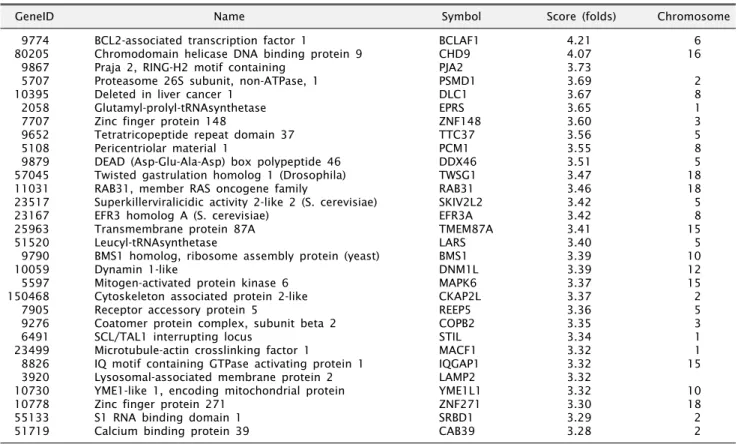
Table 1. Up-regulated genes expressed in osteoblast-like MG63 cells incubated with β-TCP at a concentration of 100 mg/10 ml for 24 hours

GeneID Name Symbol Score (folds) Chromosome

9774 BCL2-associated transcription factor 1 BCLAF1 4.21 6

80205 Chromodomain helicase DNA binding protein 9 CHD9 4.07 16

9867 Praja 2, RING-H2 motif containing PJA2 3.73

5707 Proteasome 26S subunit, non-ATPase, 1 PSMD1 3.69 2

10395 Deleted in liver cancer 1 DLC1 3.67 8

2058 Glutamyl-prolyl-tRNAsynthetase EPRS 3.65 1

7707 Zinc finger protein 148 ZNF148 3.60 3

9652 Tetratricopeptide repeat domain 37 TTC37 3.56 5

5108 Pericentriolar material 1 PCM1 3.55 8

9879 DEAD (Asp-Glu-Ala-Asp) box polypeptide 46 DDX46 3.51 5

57045 Twisted gastrulation homolog 1 (Drosophila) TWSG1 3.47 18

11031 RAB31, member RAS oncogene family RAB31 3.46 18

23517 Superkillerviralicidic activity 2-like 2 (S. cerevisiae) SKIV2L2 3.42 5

23167 EFR3 homolog A (S. cerevisiae) EFR3A 3.42 8

25963 Transmembrane protein 87A TMEM87A 3.41 15

51520 Leucyl-tRNAsynthetase LARS 3.40 5

9790 BMS1 homolog, ribosome assembly protein (yeast) BMS1 3.39 10

10059 Dynamin 1-like DNM1L 3.39 12

5597 Mitogen-activated protein kinase 6 MAPK6 3.37 15

150468 Cytoskeleton associated protein 2-like CKAP2L 3.37 2

7905 Receptor accessory protein 5 REEP5 3.36 5

9276 Coatomer protein complex, subunit beta 2 COPB2 3.35 3

6491 SCL/TAL1 interrupting locus STIL 3.34 1

23499 Microtubule-actin crosslinking factor 1 MACF1 3.32 1

8826 IQ motif containing GTPase activating protein 1 IQGAP1 3.32 15

3920 Lysosomal-associated membrane protein 2 LAMP2 3.32

10730 YME1-like 1, encoding mitochondrial protein YME1L1 3.32 10

10778 Zinc finger protein 271 ZNF271 3.30 18

55133 S1 RNA binding domain 1 SRBD1 3.29 2

51719 Calcium binding protein 39 CAB39 3.28 2

4. Statistical analysis

The array data were filtered by detection P values of less than .05 for at least 50% samples. The selected gene signal values were transformed by logarithms and were normalized by the quantile method (n=6). A comparative analysis between each sample was carried out by using fold change data. The fold value meant the fold difference between the test and control groups (test group value/con- trol group value). All data analyses and visualization proce- dures of differentially expressed genes were conducted by using ArrayAssist (Stratagene, La Jolla, CA, USA) and R statistical language v. 2.4.1. Biological ontology-based analyses were conducted by using the Panther database (http://www.pantherdb.org).

Results

The genes that showed changes in fold values more than 2-fold were found at 24 hours and one hundred fif- ty-seven genes of the 24,546 genes expressed in BeadChip

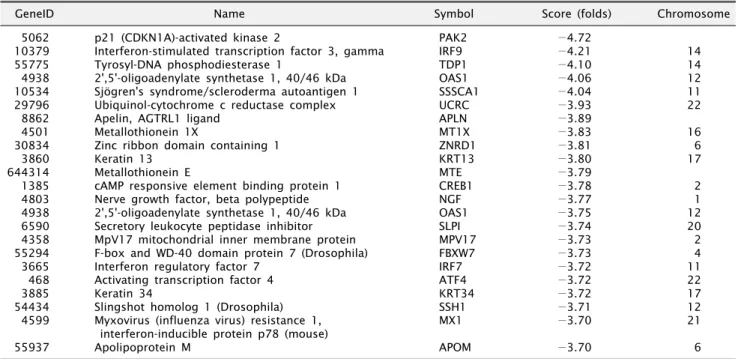
showed differences compared with those of the control group. Of these, 103 genes were up-regulated, and 54 were down-regulated. The genes that showed differences of more than 3-fold, and were considered to be related to mineralization out of genes that showed a difference of more than 3-fold were listed. Positive fold changes mean up-regulation (Table 1), and negative fold changes mean down-regulation of the gene (Table 2).

Of the 157 genes, the regulated genes were mainly re- lated to transcriptional regulation, transduction, cell cycle control, vesicular transport, cytoskeletal elements, im- munity, protein metabolism, and cell proliferation and differentiation.

Discussion

In oral and maxillofacial reconstruction, synthetic materi-

als are widely used[4]. Despite numerous basic and clinical

results[1-7], the direct effects of β-TCP on gene expression

for osteoblast activity involved in bone regeneration are

poorly understood. By using DNA microarrays[8-10], we

(4)

Table 2. Down-regulated genes expressed in osteoblast-like MG63 cells incubated with β-TCP at a concentration of 100 mg/10 ml for 24 hours

GeneID Name Symbol Score (folds) Chromosome

5062 p21 (CDKN1A)-activated kinase 2 PAK2 −4.72

10379 Interferon-stimulated transcription factor 3, gamma IRF9 −4.21 14

55775 Tyrosyl-DNA phosphodiesterase 1 TDP1 −4.10 14

4938 2',5'-oligoadenylate synthetase 1, 40/46 kDa OAS1 −4.06 12

10534 Sjögren's syndrome/scleroderma autoantigen 1 SSSCA1 −4.04 11

29796 Ubiquinol-cytochrome c reductase complex UCRC −3.93 22

8862 Apelin, AGTRL1 ligand APLN −3.89

4501 Metallothionein 1X MT1X −3.83 16

30834 Zinc ribbon domain containing 1 ZNRD1 −3.81 6

3860 Keratin 13 KRT13 −3.80 17

644314 Metallothionein E MTE −3.79

1385 cAMP responsive element binding protein 1 CREB1 −3.78 2

4803 Nerve growth factor, beta polypeptide NGF −3.77 1

4938 2',5'-oligoadenylate synthetase 1, 40/46 kDa OAS1 −3.75 12

6590 Secretory leukocyte peptidase inhibitor SLPI −3.74 20

4358 MpV17 mitochondrial inner membrane protein MPV17 −3.73 2

55294 F-box and WD-40 domain protein 7 (Drosophila) FBXW7 −3.73 4

3665 Interferon regulatory factor 7 IRF7 −3.72 11

468 Activating transcription factor 4 ATF4 −3.72 22

3885 Keratin 34 KRT34 −3.72 17

54434 Slingshot homolog 1 (Drosophila) SSH1 −3.71 12

4599 Myxovirus (influenza virus) resistance 1, MX1 −3.70 21

interferon-inducible protein p78 (mouse)

55937 Apolipoprotein M APOM −3.70 6

identified several genes whose expression was clearly up-regulated and down-regulated when osteoblast-like MG63 cells were treated with β-TCP.

1. Up-regulated genes

β-TCP appeared to up-regulate some functional activ- ities of osteoblast-like MG63 cells. BCLAF1 is an up-regu- lated transcriptional regulatory gene that induces the apop- totic response to DNA damage for cellular replacement[11], whereas ZNF271 is associated with cell proliferation and differentiation, and is involved in almost all cellular re- actions required to maintain genomic stability[12]. The up-regulated activators of cell cycle control (PSMD1, MACF1 and IQGAP1) mediate multi-protein complex as- sembly and regulate multiple physiological cellular proc- esses, such as cell-cell adhesion, cell polarization, cell mi- gration, and transcription[13,14].

DNM1L is involved in intracellular protein trafficking and endocytosis and belongs to the microtubule-associated pro- tein (MAP) family, which is thought to regulate microtubule dynamics for cell polarization and movement[15]. Although the exact function of this protein has not been determined, there is evidence suggesting a role in mineral accumulation in bone healing, as well as microtubule stabilization[16].

DLC1 and IQGAP1 are up-regulated signal transduction

genes. Moreover, COPB2 and TWSG1, which are involved in intracellular trafficking and transport, also have the un- usual property of being able to enhance signaling for the bone morphogenetic protein (BMP) family[17]. Up-regu- lation of these genes might lead to a more rapid osteogenic process by enhancing BMP signaling in the area grafted with β-TCP.

Because osteoblasts conduct new bone formation, osteo- conduction is always controlled by cell cycle proliferation and differentiation of osteoblasts. Carinci et al.[8,10]

showed that anorganic bovine bone or zirconium oxide up-regulates genes of osteoblast-like MG63 cells involved in the regulation of vesicular transport and cell cycle, pro- liferation, and differentiation, thereby producing excellent biocompatibility through modifications in the turn-over of extracellular matrix. Similarly, ZNF271, MACF1 and IQGAP1 are considered to have positive effects on growth and differentiation of osteoblasts with higher rates of pro- tein metabolism induced by β-TCP. LAMP2, YME1L1 and MAPK6 are closely regulated by protein kinases for almost all intracellular events, and are highly expressed in protein metabolism and modification[18].

2. Down-regulated genes

β-TCP mainly suppressed the expression of genes in-

(5)

volved in the immunological activities of osteoblast-like MG63 cells. OAS1 is known to synthesize intracellular 2’,5’-oligoadenylate, which inhibits viral replication throu- gh general degradation of RNA[12]. MPV17 is associated with autolysis by encoding an unusual mitochondrial inner membrane protein[19]. The IRF family, such as IRF9 and IRF7, contains nine members to date, with diverse roles in host defense, cell cycle regulation, apoptosis, onco- genesis, and immune cell development[20]. In addition, IRF9, OAS1, and IRF7 are important in interferon-mediated immunity[20,21], and MPV17 functions as an antioxidant in the removal of free radicals for cellular homeostasis[4,19].

Several genes encoding transcriptional regulatory factors are also down-regulated. ZNRD1 encodes a protein consist- ing of two zinc ribbon domains and may function in mul- ti-drug resistance, tumorigenesis, and the cell cycle[22].

ATF4, which belongs to the ATF/CREB protein family, is required to maintain endoplasmic reticulum homeostasis for calcium storage[23]. KRT13 and KRT34 are cytokeratins, and, thus, are reliable biochemical indicators of the epi- thelial differentiation process[24]. Transcriptionally in- duced by interferon, MX1 has antiviral activities against several RNA viruses[25]. Other down-regulated genes en- coding for protein metabolism were PAK2, SLPI, FBXW7, and SSH1.

The down-regulation of some genes, with simultaneous up-regulation of others in osteoblast-like MG63 cells by β-TCP could explain the clinical rapid bone formation and biodegradation of β-TCP. For example, β-TCP may simultaneously increase BMP signaling for bone formation and decrease autolysis of osteoblasts around the graft. Also, β-TCP might increase microskeletal MAP signaling for rap- id mineral accumulation while temporarily decreasing or holding off the inflammation process originating from the graft. The suppression of immunological response in osteo- blasts might promote the early stabilization and settlement of grafted β-TCP while suggesting that more efforts for infection control may be needed after using β-TCP.

Conclusion

Our study showed that β-TCP up-regulated some osteo- blast genes that function in mRNA transcriptional regu- lation, cell proliferation and differentiation, cell cycle con-

trol, vesicular transport, production of cytoskeletal ele- ments, as well as protein metabolism and modification.

In contrast, β-TCP primarily down-regulated osteoblast genes involved in immunity and in the production of cy- toskeletal elements. Via β-TCP, the simultaneous up-regu- lation of cell proliferation and differentiation, the cell cycle, and vesicle transport, and down-regulation of early phase immunity could result in rapid proliferation, differentiation, and osteogenic functions of the osteoblasts in the grafted area. However, the relative importance for bone formation, temporal and spacial function, and interactions of these genes are not yet clear. Further investigations will be re- quired to understand the molecular interactions between β-TCP and bone regeneration.

References

1. Trisi P, Rao W, Rebaudi A, Fiore P. Histologic effect of pure- phase beta-tricalcium phosphate on bone regeneration in human artificial jawbone defects. Int J Periodontics Restorative Dent 2003;23:69-77.

2. Neamat A, Gawish A, Gamal-Eldeen AM. Beta-tricalcium phosphate promotes cell proliferation, osteogenesis and bone regeneration in intrabony defects in dogs. Arch Oral Biol 2009;54:1083-90.

3. Okuda T, Ioku K, Yonezawa I, et al. The effect of the mi- crostructure of beta-tricalcium phosphate on the metabolism of subsequently formed bone tissue. Biomaterials 2007;

28:2612-21.

4. Buser D, Hoffmann B, Bernard JP, Lussi A, Mettler D, Schenk RK. Evaluation of filling materials in mem- brane--protected bone defects. A comparative histomorpho- metric study in the mandible of miniature pigs. Clin Oral Implants Res 1998;9:137-50.

5. Jensen SS, Broggini N, HjØrting-Hansen E, Schenk R, Buser D. Bone healing and graft resorption of autograft, anorganic bovine bone and beta-tricalcium phosphate. A histologic and histomorphometric study in the mandibles of minipigs.

Clin Oral Implants Res 2006;17:237-43.

6. Kurashina K, Kurita H, Wu Q, Ohtsuka A, Kobayashi H.

Ectopic osteogenesis with biphasic ceramics of hydrox- yapatite and tricalcium phosphate in rabbits. Biomaterials 2002;23:407-12.

7. Merten HA, Wiltfang J, Grohmann U, Hoenig JF.

Intraindividual comparative animal study of alpha- and be- ta-tricalcium phosphate degradation in conjunction with si- multaneous insertion of dental implants. J Craniofac Surg 2001;12:59-68.

8. Carinci F, Piattelli A, Degidi M, et al. Genetic effects of anorganic bovine bone (Bio-Oss) on osteoblast-like MG63 cells. Arch Oral Biol 2006;51:154-63.

9. Carinci F, Francioso F, Piattelli A, et al. Genetic expression

profiling of six odontogenic tumors. J Dent Res 2003;82:

(6)

551-7.

10. Carinci F, Pezzetti F, Volinia S, et al. Zirconium oxide: anal- ysis of MG63 osteoblast-like cell response by means of a microarray technology. Biomaterials 2004;25:215-28.

11. Liu H, Lu ZG, Miki Y, Yoshida K. Protein kinase C delta in- duces transcription of the TP53 tumor suppressor gene by controlling death-promoting factor Btf in the apoptotic re- sponse to DNA damage. Mol Cell Biol 2007;27:8480-91.

12. Blessing H, Kraus S, Heindl P, Bal W, Hartwig A. Interac- tion of selenium compounds with zinc finger proteins in- volved in DNA repair. Eur J Biochem 2004;271:3190-9.

13. Drabek K, van Ham M, Stepanova T, et al. Role of CLASP2 in microtubule stabilization and the regulation of persistent motility. Curr Biol 2006;16:2259-64.

14. Tsubota A, Matsumoto K, Mogushi K, et al. IQGAP1 and vi- mentin are key regulator genes in naturally occurring hep- atotumorigenesis induced by oxidative stress. Carcinogenesis 2010;31:504-11.

15. West RR, Tenbarge KM, Olmsted JB. A model for micro- tubule-associated protein 4 structure. Domains defined by comparisons of human, mouse, and bovine sequences. J Biol Chem 1999;266:21886-96.

16. Matsuguchi T, Chiba N, Bandow K, Kakimoto K, Masuda A, Ohnishi T. JNK activity is essential for Atf4 expression and late-stage osteoblast differentiation. J Bone Miner Res 2009;

24:398-410.

17. Sotillo Rodriguez JE, Mansky KC, Jensen ED, et al. Enhanc- ed osteoclastogenesis causes osteopenia in twisted gas- trulation-deficient mice through increased BMP signaling. J Bone Miner Res 2009;24:1917-26.

18. Fehrenbacher N, Bastholm L, Kirkegaard-SØrensen T, et al.

Sensitization to the lysosomal cell death pathway by onco- gene-induced down-regulation of lysosome-associated mem- brane proteins 1 and 2. Cancer Res 2008;68:6623-33.

19. El-Hattab AW, Li FY, Schmitt E, Zhang S, Craigen WJ, Wong LJ. MPV17-associated hepatocerebral mitochondrial DNA de- pletion syndrome: new patients and novel mutations. Mol Genet Metab 2010;99:300-8.

20. Tamura T, Yanai H, Savitsky D, Taniguchi T. The IRF family transcription factors in immunity and oncogenesis. Annu Rev Immunol 2008;26:535-84.

21. Ishibashi M, Wakita T, Esumi M. 2’,5’-Oligoadenylate syn- thetase-like gene highly induced by hepatitis Cvirus infection in human liver is inhibitory to viral replication in vitro.

Biochem Biophys Res Commun 2010;392:397-402.

22. Hong L, Chen Z, Zhang X, et al. Zinc ribbon domain con- taining 1 protein: modulator of multidrug resistance, tumori- genesis and cell cycle. Exp Oncol 2006;28:258-62.

23. Li WW, Hsiung Y, Zhou Y, Roy B, Lee AS. Induction of the mammalian GRP78/BiP gene by Ca

2+

depletion and for- mation of aberrant proteins: activation of the conserved stress-inducible grp core promoter element by the human nuclear factor YY1. Mol Cell Biol 1997;17:54-60.

24. van Dorst EB, van Muijen GN, Litvinov SV, Fleuren GJ. The limited difference between keratin patterns of squamous cell carcinomas and adenocarcinomas is explicable by both cell lineage and state of differentiation of tumour cells. J Clin Pathol 1998;51:679-84.

25. Holzinger D, Jorns C, Stertz S, et al. Induction of MxA gene

expression by influenza A virus requires type I or type III

interferon signaling. J Virol 2007;8:7776-85.

수치

Table 1. Up-regulated genes expressed in osteoblast-like MG63 cells incubated with β-TCP at a concentration of 100 mg/10 ml for 24 hours
Table 2. Down-regulated  genes expressed in osteoblast-like MG63 cells incubated with β-TCP at a concentration of 100 mg/10 ml for 24 hours

참조

관련 문서

In vitro cell migration in APE or JAG1 siRNA-treated M059K cell line Fig,11 Down-regulation of JAG1 induces S phase arrest in

:Acidulated phosphate fluoride treatment and formation of caries-like lesions in enamel: effect of application time.. Schmidt HF : The fluoride varnish

In contrast, cells expressing wild-type form or constitutively active form of RapC (GFP-RapC and GFP-RapC G13V ) showed decreased cell area and cell adhesion, whereas rapC

Biochemical markers of bone turnover can be classified according to the process that underlie in markers of bone formation, products of the osteoblast

(1) PCR monitoring of bphC gene of Ralstonia eutropha H850 in soil Amount of bphC gene amplification of H850 cells was not generally proportional to the cell density

4 > Effects of Taro on COX-2 expression and iNOS expression(hot water) in human thyroid cancer cells. The cells were pretreated for 48hours with either

of mineralized cancellous bone allograft(Puros) and anorganic bovine bone matrix(Bio-oss) for sinus augmentation: Histomorphometry at 26 to 32 weeks after

Comparison of cell attachment on the bone grafting materials synthesized as the defined mixing ratio of Hydroxyapatite (HA) and β-tricalcium phosphate (β-TCP) by DAPI staining