―
ISSN 1229-3350(Print) ISSN 2288-1867(Online)
―
J. fash. bus. Vol. 24,
No. 6:148-158, December. 2020 https://doi.org/
10.12940/jfb.2020.24.6.148
Chinese Consumers' Purchase Intention towards Fashion Goods
Yu Hua Cui
*· Yu Ling Bai
†*Dept. of Fashion Design, Yanbian University, China,
Dept. of Marketing, Beijing Institute of Fashion Technology, China
†Corresponding author
― Yu Ling Bai
Tel : +86-10-64288307 Fax : +86-10-64288307 E-mail : [email protected]
Keywords Abstract
celebrity endorsement, fashion goods purchase Intention, Korean celebrity, Chinese consumers
―
This paper is supported by Key Project of Social Science Program of Beijing Municipal Education Commission, China(No. SZ201910 012005); Special Fund for the Construction of High Level Teachers (No. BIFTTD202001) and Key Project of Education and Teaching Reform(No. ZDJG-1905) in Beijing Institute of Fashion Technology.
Korean celebrity endorsement is a common practice adopted by companies in China. This study assessed the impact of celebrity endorsement (trustworthiness, attractiveness, congruency, and expertise) on Chinese consumers’ intention to purchase clothes endorsed by Korean celebrities. This study used reliability and validity tests and structural equation model analysis to explore the relationship between variables using SPSS 22.0 and AMOS 22.0. This study conducted an online survey (www.sojump.com) from August 10, 2020 to August 20, 2020 and collected 370 respondents. Results show that all constructs of celebrity endorsement positively affected purchase intention and that celebrity expertise had the strongest impact. With respect to the influence of demographic variables on the constructs, gender, age, and education had a significant effect on trustworthiness; gender and age had a significant effect on attractiveness;
and income had an effect on purchase intention. Marketing executives should consider using Korean celebrities for different purposes in brand advertising.
Particularly, celebrity expertise, such as experience, knowledge, and skills, should
receive attention while publicizing to Chinese consumers. This study contributes
to the academic and practical implications of Korean celebrity endorsement.
I. Introduction
China’s clothing market is growing rapidly, and endorsements from local and foreign celebrities are emerging constantly. In the area of business, celebrity endorsement plays a vital role because it influences consumers’ purchase decisions (Kraa, Osei, Cofie, &
Quaye, 2018). Many countries use actors, actresses, entertainers, and sports celebrities to position a brand (Randhawa, Sharma, & Malhotra, 2015). In China today, most fashion industries or companies use celebrities for endorsement. In analyzing the current market situation, fashion marketers must use different famous personalities to associate themselves with their fashion brands to create unique identities and popularize the fashion company’s brand or product. A celebrity image that is good and fits with the product leads to the credibility and effectivity of the brand (Abraham &
Rajkumar, 2018). Celebrities are also effective because they are what many people aspire to be and are symbols of personal desire.
Celebrity endorsement influences consumers’ behavior.
Kooli, Habsi, and Abadli (2018) indicated that celebrity endorsement positively affects consumers’ attitude and purchase behavior in certain Arab countries (Oman and the UAE). Abdulmajid and Abdul (2012) confirmed that endorser attractiveness and expertise influence consumers’
attitude toward advertisement and purchase intention.
Ibidunni, Olokundun, Ibidunni, Borishade, Falola, Salau, Amaihian, and Fred (2018) revealed that celebrity image affects consumer brand loyalty, and celebrity worthiness influences consumer brand association in Srivastava (2011) showed that matching brand personality and celebrity personality increases purchase intention in India.
Recently, IU, Jun Ji-hyun, and other stars have participated in the endorsement of a Chinese fashion brand, which has achieved extraordinary results. In addition to public media exposure, social media, such as Tiktok and Weibo, are constantly mentioned and imitated by consumers and affect their purchasing power.
Especially in Tiktok, many Korean artists have opened official accounts to publicize their daily uploads. Even if
many Chinese consumers pay attention to Korean celebrities, few studies have shown the kind of behavior impact the endorsement effect of Korean celebrities in Chinese clothes has on Chinese local consumers.
Moreover, the ever-changing Chinese consumers are certainly different from before, and studies on the influence of consumers’ demographic variables on relevant factors must be conducted again.
Ultimately, this study focuses on the effect of celebrity endorsement on consumer behavior. Thus, this study mainly aims to examine the effect of Korean celebrity endorsement on the purchase intention of Chinese fashion brands in China. This study entails constructive suggestions for China’s clothing industry and provides valuable suggestions and solutions on how to employ suitable Korean celebrity endorsement.
II. Literature Review 1. Celebrity Endorsement
Celebrity endorsement is defined as a person with public recognition who stands up to publicize the products and products they represent (Hassan & Jamil, 2014).
Organizations that spare no expense on celebrity endorsement are worth noting. Khan (2018) indicated that celebrity endorsement is an powerful strategy for marketers. Consumers perceive the brands endorsed by celebrities they idealize to be of high quality. Celebrity endorsement is one of the applied strategies in raising various types of fashion products because it helps corporations construct fashion awareness and gain acceptance by adopting celebrities.
The importance of celebrity endorsement has prompted
several researchers to examine its effectiveness. To refer
to the response of more extensive consumer groups to
the endorsement effect of other countries’ celebrities, this
study refers to the relevant foreign examples. For
example, celebrity endorsers increasing attitude toward
luxury brands for sustainable consumption in the UK
(Cuomo, Foroudi, Tortora, Hussain, & Melewar, 2019),
enhancing consumers’ purchase intention toward
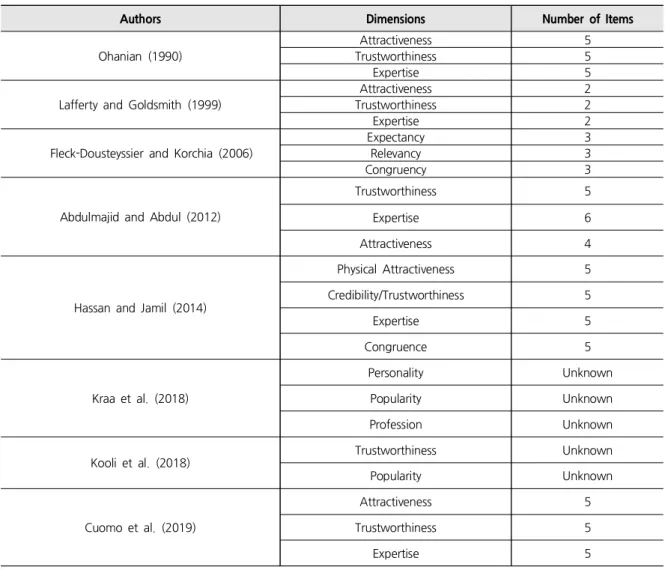
SAMSUNG mobile phones in Ghana (Kraa et al., 2018), impacting advertisement attitude, influencing brand attitude in Yemen (Abdulmajid & Abdul, 2012), improving purchase intention and marketing effectiveness in Pakistan (Khan, 2018), enhancing product sales in Arab countries (Kooli et al., 2018), and influencing brand preference in Lagos State, Nigeria (Ibidunni et al., 2018). A model has been proposed in Hung, Chan, and Tse (2011) assumes how celebrity-worship leads to value-transfer. That, in turn, could influence the brand purchase intention using Chinese respondents’ data. The outcome variables of celebrity endorsement are quite varied. Moreover, celebrity endorsement is divided into several dimensions. Each paper has different dimensions and questionnaire items, as shown in Table 1. Many Korean celebrities endorse brands in China recently. For
아이유 박신혜
example, IU ( ) and Park Shin-hye ( ) partnered with and endorsed Hstyle ( 韩都衣舍 ),
블랙핑크 리사
respectively, Lisa ( ) endorsed the Meng Niu 김수현
Group ( 蒙牛集团 ), Kim Soo Hyun ( ) endorsed 전지현
Semir ( 森马 ) brand, and Jun Ji-hyun ( ) endorsed YISHION ( 以纯 ) in China, indicating that Chinese brands still have a special preference for Korean celebrities. Especially affected by the Korean wave, the country image of Korea is particularly high in the eyes of Chinese people, which leads to the high degree of Chinese consumers' preference for Korean products (An, 2018). The effect of Korean wave is most obvious in the clothing industry, in Sohn, Im, Shin, and Lee (2003) study, Chinese consumers have higher awareness and satisfaction of Korean clothing.
On the basis of the discussed theoretical research above, combined with the current business situation between China and South Korea, and considering the characteristics of Korean celebrities, the present study makes the following decisions. Celebrity endorsement is divided into four most commonly used dimensions (Table 1), namely, trustworthiness, attractiveness, congruency, and expertise.
1) Celebrity Trustworthiness
The trust paradigm in communication is the degree of
confidence and acceptability of the listener to the speaker and the information (Ohanian, 1990). The variable dimensions are named as “dependable,” “honest,”
“reliable,” “sincere,” and “trustworthy.” Moreover, terms such as good personality, acceptance, psychological security, and perceived supportive atmosphere are generally regarded as the favorable results of “trust“.
Ibidunni et al. (2018) showed the regression and correlation between celebrity endorsement and consumer brand preference. Lafferty and Goldsmith’s (1999) results added to the evidence that “trustworthiness“ and
”expertise“ lead to positive advertisement attitude, brand attitude, and purchase intention.
2) Celebrity Attractiveness
Despite the numerous published reports addressing physical attractiveness, the issue has never been clear. A review of this area indicates that the variable of attractiveness is not necessarily a single dimension and that countless definition is used to operationalize attractiveness. This dimension is also referred to as
“attractiveness,” “classy,” “beautiful,” “elegant,” and
“sexy.” Attractiveness is the strongest factor of endorsing to enhance consumers’ attitude toward advertising, which affects consumers’ attitude brand, which in turn forms consumers’ purchase intention (Abdulmajid & Abdul, 2012). Hassan and Jamil (2014) assessed consumer celebrity relationship and confirmed that attributes of Indian celebrity are not much important for the purchase intention of Pakistan consumers. The present study needs to reevaluate whether foreign celebrity endorsement can affect local consumers’ purchase.
3) Celebrity Congruency
The term “congruency” is used in several research areas, particularly brand extension, co-branding, sponsoring, and endorsement (Fleck-Dousteyssier & Korchia, 2006).
Congruency between the celebrity and brand is also demanded by consumers because it helps them easily assimilate the message being conveyed (Khan, 2018).
Various terms have been used, namely, fit, link, and
match-up effect. To analyze the match-up principle of
celebrities with brand endorsing, celebrities positively and significantly affect purchase intention. Srivastava (2011) indicated that celebrity brand fit is a must. The – celebrity/product fit, which is also called the
“match-up,” refers to the harmony of the match between the celebrity endorser and the brand being endorsed.
Similarities between the celebrity and the product would create cohesiveness (Abraham & Rajkumar, 2018).
4) Celebrity Expertise
Consumers consider brand expertise in choosing a celebrity endorser as an indicator of credibility in the
Table 1. Celebrity Endorsement Dimensions from Previous Studies
Authors Dimensions Number of Items
Ohanian (1990)
Attractiveness 5
Trustworthiness 5
Expertise 5
Lafferty and Goldsmith (1999)
Attractiveness 2
Trustworthiness 2
Expertise 2
Fleck-Dousteyssier and Korchia (2006)
Expectancy 3
Relevancy 3
Congruency 3
Abdulmajid and Abdul (2012)
Trustworthiness 5
Expertise 6
Attractiveness 4
Hassan and Jamil (2014)
Physical Attractiveness 5
Credibility/Trustworthiness 5
Expertise 5
Congruence 5
Kraa et al. (2018)
Personality Unknown
Popularity Unknown
Profession Unknown
Kooli et al. (2018)
Trustworthiness Unknown
Popularity Unknown
Cuomo et al. (2019)
Attractiveness 5
Trustworthiness 5
Expertise 5
endorser and the brand, which improves the brand image of a product (Khan, 2018). Some clothing brands directly find their corresponding designers to speak for them, such as Tom Ford and Karl Largefield, which is professional and persuasive. Abraham and Rajkumar (2018) indicated that consumers should believe that the brand ambassador has expertise. Consumers usually perceive information as expertise and trust the source;
celebrities use the source for advertisement to give
unbiased and objective information (Randhawa et al.,
2015). As mentioned in a related study, Pakistan’s
celebrity expertise regression results show positive and
significant effects on purchase intention, unlike Indian celebrities. Thus, local celebrities are considered to be knowledgeable. Adjectives such as “expert,” “experienced,”
“knowledgeable,” “qualified,” and “skilled” have been used to measure this dimension (Ohanian, 1990).
2. Purchase Intention
Purchase intention refers to planning to purchase something for future use. However, before this intention is a cognitive process that works, where several factors of consumer perception about a product or a source person matter. Day and Tsai (2013) indicated that consumers tend to choose the greatest perceived value of the product or service while making purchase decisions, and purchase intention can measure the possibility of a consumer to buy a product. In purchase intention, the main focus of the study is the attitude toward the source person celebrity endorser ( — Hassan & Jamil, 2014).
Cuomo et al. (2019) suggested that celebrity endorsement can positively influence consumers’ purchase intention of luxury brands. Purchase intention depends on an individual’s attitude toward the behavior and the subjective norms associated with it (Pradhan, Israel, &
Sethi, 2014). In particular, the impact on Korean wave fans in K-pop, K-drama, K-food, K-fashion and other
Celebrity Trustworthiness
Celebrity Attractiveness
Celebrity Congruency
Celebrity Expertise
Purchase Intention Demographic
Variables Q1 Q2
Q3
Q4 Q5
Figure 1. Research Model
fields has increased the purchasing intention of Chinese consumers for Korean fashion goods (Shen & Kim, 2018), suggesting that purchase intention is an outcome variable of the attitude or Chinese consumer perception about the clothes endorsed by Korean celebrities.
III. Methodologies 1. Research Model
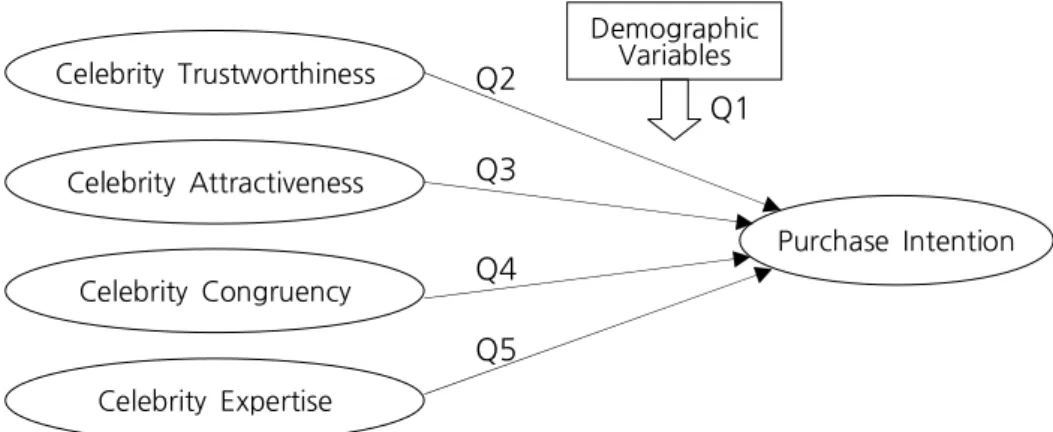
The research model presented in Figure 1 originates from the inference of the literature review. Every cell represents a construct and the factor(s) of the construct.
The arrow-headed line represents the causal relationship between the two constructs. Specific research questions are listed below.
Q1: How do demographic variables affect constructs?
Q2: How does Korean celebrity trustworthiness affect Chinese consumers’ purchase intention?
Q3: How does Korean celebrity attractiveness affect Chinese consumers’ purchase intention?
Q4: How does Korean celebrity congruency affect Chinese consumers’ purchase intention?
Q5: How does Korean celebrity expertise affect
Chinese consumers’ purchase intention?
2. Data Collection and Samples
A quantitative research approach was adopted for this study to examine the impact of Korean celebrity endorsement on Chinese consumers’ intention to purchase clothes. A total of 370 data were collected from Chinese residents under the age of 30 years old, from August 10~20, 2020, using convenience sampling, which is a non-probability sampling technique. The reason is that Chinese consumers under 30 years old are more sensitive to fashion, familiar with Korean celebrities and have certain consumption capacity. An online survey (www.sojump.com) questionnaire with scenarios was distributed to Chinese consumers who voluntarily filled out the questionnaires. In order to prevent brand power influence, the questionnaire did not indicate which brand it was , but asked the respondents to recall the brand they knew. In other words, To reduce the effect error caused by different brands and celebrities, the participants must imagine the Chinese clothing brand endorsed by a Korean celebrity and then answer the questionnaire in sequence, which can reduce the extra impact of the brand power or celebrity differentiation.
The front page of the questionnaire is as follows: “First, please recall the Chinese clothing brand endorsed by a Korean celebrity and mentally recite the celebrity’s name and clothing products. Then, answer the question.”
Half of respondents are male (50%, n=185), and the other half are female (50%, n=185). In terms of age, 32.7% (n=121) are 10~19 years old, 34.3% (n=127) are 20~29 years old, and 33.0% (n=122) are 20~29 years old, showing the uniform age distribution. The majority of participants completed undergraduate education (65.1%, n=241), the second largest group completed graduate education (22.2%, n=82), and the smallest group completed high school education (12.7%, n=47).
Approximately 27.3% (n=101) of respondents have household income below 1,000,000 won, 40.3% (n=149) have it between 1,000,000 and 1,500,000 won, and 32.4% (n=120) have it over 1,500,000 won.
3. Measurements
The scale measurement from previous studies, which is reliable and valid, is used in this study. Celebrity endorsement is measured based on four credibility constructs: (i) trustworthiness, (ii) attractiveness, (iii) congruency, and (iv) expertise. Some constructs, such as trustworthiness (four items), attractiveness (four items), and expertise (four items), are measured on the basis of the studies Ohanian (1990) and Hassan and Jamil (2014). Congruency (four items) is obtained and revised from relevant studies (Fleck-Dousteyssier & Korchia, 2006; Hassan & Jamil, 2014). Moreover, the purchase intention of clothes that celebrities endorse is tested though four items that were expanded and were based on Cuomo et al. (2019). A five-point Likert scale is conducted and arranged in an orderly manner from strongly disagree (1 point) to strongly agree (5 point).
IV. Results 1. Reliability and Validity Test
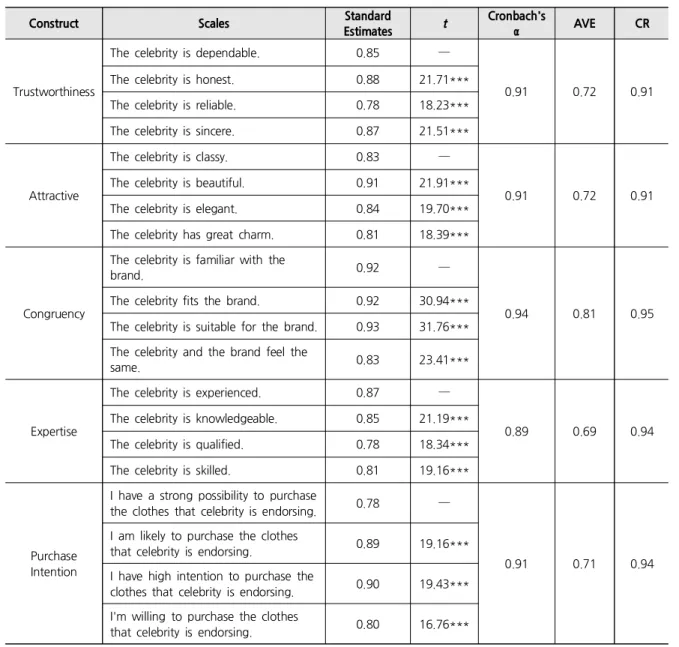
Both exploratory factor analysis (EFA) and confirmatory factor analysis (CFA) were conducted in sequence using SPSS 22.0 and AMOS 22.0 static systems. EFA was used to determine the factor structure of measure and scrutinize internal reliability in the research model. The results designate that Cronbach’s alpha (0.89 through 0.94) for each factor is internally consistent (Nunnally, 1978). Then, CFA was used to test the validity of the data, and all sub-constructs were tested separately (trustworthiness, attractiveness, congruency, and expertise). The items on each scale were valid. The measurement model for the sample has the goodness-of-fit values of X
2/ df =2.394, RMSEA=0.059, IFI=0.962, TLI=0.936, CFI=0.961, and GFI=0.906, indicating a sufficient level of acceptance. The average variance extracted (AVE) and composite reliability values were high at 0.69~0.94 and 0.91~0.95, respectively. The estimates were found to be between 0.78 and 0.92, which are deemed acceptable (Bryman & Bell, 2015), as shown in Table 2.
Moreover, Table 3 presents that, with regard to each
pair of potential variables, the AVE results for each variable were compared with square of the correlation coefficients between the two variables for testing discriminant validity. The square of the correlation coefficient was all lower than the AVE values, which accords with and satisfies the conditions of discriminant validity (Fornell & Larcker, 1981).
Table 2. Results of Validity and Reliability Testing
Construct Scales Standard
Estimates t Cronbach's
α AVE CR
Trustworthiness
The celebrity is dependable. 0.85 ―
0.91 0.72 0.91
The celebrity is honest. 0.88 21.71***
The celebrity is reliable. 0.78 18.23***
The celebrity is sincere. 0.87 21.51***
Attractive
The celebrity is classy. 0.83 ―
0.91 0.72 0.91
The celebrity is beautiful. 0.91 21.91***
The celebrity is elegant. 0.84 19.70***
The celebrity has great charm. 0.81 18.39***
Congruency
The celebrity is familiar with the
brand. 0.92 ―
0.94 0.81 0.95
The celebrity fits the brand. 0.92 30.94***
The celebrity is suitable for the brand. 0.93 31.76***
The celebrity and the brand feel the
same. 0.83 23.41***
Expertise
The celebrity is experienced. 0.87 ―
0.89 0.69 0.94
The celebrity is knowledgeable. 0.85 21.19***
The celebrity is qualified. 0.78 18.34***
The celebrity is skilled. 0.81 19.16***
Purchase Intention
I have a strong possibility to purchase
the clothes that celebrity is endorsing. 0.78 ―
0.91 0.71 0.94
I am likely to purchase the clothes
that celebrity is endorsing. 0.89 19.16***
I have high intention to purchase the
clothes that celebrity is endorsing. 0.90 19.43***
I'm willing to purchase the clothes
that celebrity is endorsing. 0.80 16.76***
X
2/df =2.394; RMSEA=0.059; IFI=0.962; TLI=0.936; CFI=0.961; GFI=0.906; p ***<0.001
2. Influence of Demographic Variables
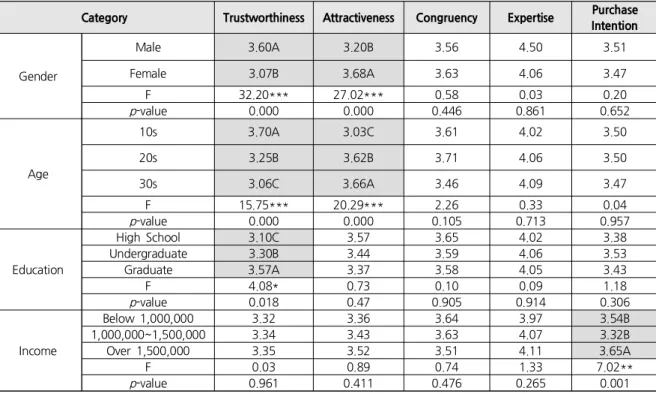
Applying independent sample t -test and one-way
ANOVA, this study examined the relations between
demographic variables and constructs. Demographic
variables include gender, age, education, and monthly
income. In the celebrity trustworthiness construct, gender,
Table 3. Correlation Matrix for the Constructs
Trustworthiness Attractive Congruency Expertise Intention
Trustworthiness 0.72
aAttractive 0.05
b0.72
aCongruency 0.24
b0.23
b0.81
aExpertise 0.04
b0.31
b0.35
b0.69
aIntention 0.14
b0.27
b0.31
b0.50
b0.71
aa