• 검색 결과가 없습니다.

The Influence of Celebrity Endorsement on Young Vietnamese Consumers' Purchasing Intention

N/A
N/A
Protected

Academic year: 2021

Share "The Influence of Celebrity Endorsement on Young Vietnamese Consumers' Purchasing Intention"

Copied!
10
0
0

로드 중.... (전체 텍스트 보기)

전체 글

(1)

Print ISSN: 2288-4637 / Online ISSN 2288-4645 doi:10.13106/jafeb.2021.vol8.no1.951

The Influence of Celebrity Endorsement on Young Vietnamese Consumers’ Purchasing Intention*

Nhu-Ty NGUYEN

1

Received: October 01, 2020 Revised: December 06, 2020 Accepted: December 14, 2020

Abstract

The paper aims to explain the influence of celebrity endorser on consumers’ purchase intention, and explain the influence of brand perception on purchase decision in regard to the case of OPPO F-series and singer Son Tung MTP, in the Vietnamese context. Advertisement is regarded as the fastest and most effective communication method for brands to build an association and attract their target consumers.

Among various types of communication tools, the use of celebrity endorsement is considerably growing owing to the explosion of social platforms. This study employs survey data from 258 people living and working in Ho Chi Minh City, Vietnam. Then, those data were used to analyze the general hypotheses by conducting research reviews based on foregoing investigations. The results from data analysis reveal that celebrity’s physical attractiveness, credibility, popularity, expertise, match-up, and multiple endorsements all have positive impacts on purchase intention. The findings from this study would suggest that brands, in general, and smart-phone brands, in particular, should not only focus on these attributes to select a suitable brand endorser, but also need to predict some potential risks when utilizing celebrity endorsement. Finally, various implications and recommendations for further studies and marketers are also discussed.

Keywords: Celebrity Endorsement, Brand Perception, Purchase Intention, Multiple Endorsements JEL Classification Code: M3, M14, M37

not to be international superstars, they could be an individual from any field such as politics, science, entertainment, sport and so on, who is perceived as an idol, who enjoy public recognition and have a congruence with the brand image (McCracken, 1989) to constitute a compelling power to affect consumers’ buying intention.

Never have we witnessed such colorful advertisements in this world of marketing. In Vietnam, where “idol culture”

and entertainment industry is a thing, celebrities in the role of representative faces for domestic and international brands are believed to “make advertisements conspicuous and endorsed products more outstanding and attractive by their improved level of product recall” (Bowman, 2002; Pham, 2020).

Therefore, like many other brands, OPPO – a Chinese- based consumer electronics and mobile communications company that entered the Vietnamese market in 2013 did select outstanding celebrities to represent the brand.

Moreover, as Vietnamese were sensitive to Chinese products and have the mindset “Chinese goods are clones”, OPPO needed to change their marketing strategy. Thus, taking advantage of the channel of entertainment by choosing well- fitted and well-known endorsers from the very first stage

*Acknowledgements:

The author would like to thank Ms. Luong Ngoc Diep from School of Business, International University – Vietnam National University, HCMC for her editorial assistance.

1

First Author and Corresponding Author. [1] School of Business, International University, Ho Chi Minh City, Vietnam [2] Vietnam National University, Ho Chi Minh City, Vietnam [Postal Address:

Quarter 6, Linh Trung Ward, Thu Duc District, Ho Chi Minh City, Vietnam]

Email: [email protected] ; [email protected]

© Copyright: The Author(s)

This is an Open Access article distributed under the terms of the Creative Commons Attribution Non-Commercial License (https://creativecommons.org/licenses/by-nc/4.0/) which permits unrestricted non-commercial use, distribution, and reproduction in any medium, provided the original work is properly cited.
1. Introduction

Advertisement is regarded as the fastest and most

effective communication method for brands to build an

association and attract their target consumers. Among various

types of communication tools, the utilization of celebrity

endorsement is considerably growing owing to the explosion

of social platforms (Krotoski, 2011). These celebrities need

(2)

of their access, OPPO soon became a phenomenon in the Vietnamese market and reached their target consumers – captured the young generation, created positive attitudes, inspirations and, thus, triggered the consumer purchase behavior.

After investigating for the perfect matching between celebrity, product, and delivered messages, brands would select some celebrities to be their endorser (Oh & Park, 2020;

Maharani et al., 2020; Kim & Lee, 2010; Lee, 2017). Son Tung MTP – a young and talented Vietnamese singer, who is known for dynamic images and a massive entertaining coverage, is believed to be one of the key reasons for the enhancement in brand awareness and recognition for brands such as Biti’s, Go-Viet, IvyModa, and OPPO, with most of its F-series smart-phones. Associating its F-series smart- phones with Son Tung, OPPO was positioning itself in people’s mind as a “Son Tung phone”, thus bouncing off major brands to win the market share.

The study aims to investigate some attributes of celebrity endorsement and their impacts on consumers’ buying motives by answering these following questions:

- Which are the true factors of celebrity endorsement that influence consumers’ buying motives?

- To what extent do celebrity endorsed advertisements impact on purchase intention?

- How does consumers’ brand perception affect their purchase intention given celebrity endorsement?

2. Literature Review 2.1. Celebrity Endorsement

According to McCracken 1989, celebrity endorser is a person who loves public recognition and being well-known in the community or at least the target audiences of the brand, in which she/he could take full advantage of reputation to come out with a product in the advertisement to attract consumers. Numerous companies worldwide are investing on famous, attractive and credible celebrities for brand advertisement (Pornpitakpan, 2003; Amos et al., 2008).

However, celebrity endorsement can be a two-edged sword, and its attractiveness might encroach negatively upon mood and body image. Hence, it is vital for company to look for an adequate solution to choose an absolute matching endorser for executing branding.

2.2. Dimensions of Celebrity Endorsement Physical Attractiveness

“Beauty is a better recommendation than any letter of introduction” (Ohanian, 1991). In fact, physical appearance is a powerful “weapon” for celebrity to stand out from others, draw audiences’ attention and affect their perception and

intention. Consumers are eye-centered, thus, celebrity with a glamorous appearance is likely to receive better and quicker appraisal and awareness from the community. Compared to an advertisement without an appealing subject, the one with an attractive celebrity endorser would exert more confident influences on consumer attitude toward brand and its products (Ohanian, 1991). The following hypothesis is proposed:

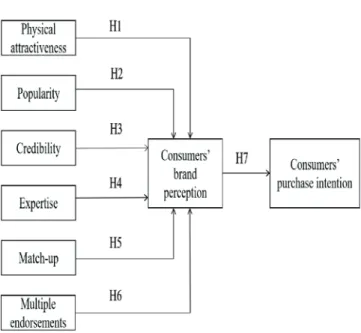
H1: Physical attractiveness has a positive impact on consumers’ brand perception.

Celebrity Popularity

Popularity is a dimension raised from the study’s exploratory process, leading to the belief that famous people are a potential source of credibility, which can affect customers’ attitude, perception and intention. The more popular the endorser is, the more influence he/she can have on the consumer’s brand assessment and their purchase intentions (Nguyen & Tran, 2019). Thus, the following hypothesis is proposed:

H2: Celebrity popularity has a positive impact on consumers’ brand perception.

Celebrity Credibility

Credibility is defined as “honesty, integrity and trust- worthiness of an endorser” (Erdogan et al., 2001). A high level of credibility could represent positive characteristics of the provider, influence the message consent and change consumers’ attitude toward a brand. If target consumers feel the celebrity is trustworthy and honest enough to convince and obtain their trust, they would become attentive and avoid exploring the endorsed brand and purchasing its products.

Thus, the following hypothesis is proposed:

H3: Celebrity credibility has a positive impact on consumers’ brand perception.

Celebrity Expertise

Expertise is explained as “the extent to which a communicator is perceived to be a source of valid assertions” (Hovland & Weiss, 1953), which focuses on the understanding, practice or skills that an endorser could gain to confidentially promote the products (Erdogan, 1999).

Therefore, if a celebrity is more expert and experienced in the endorsed field, he/she will easily gain trust, positive recognition (Braunsberger, 1996) and even generate the intention to purchase from customers. As a result, the following hypothesis is proposed:

H4: Celebrity expertise has a positive impact on

consumers’ brand perception.

(3)

Celebrity Match-up

The congruence/match-up is described as a harmony between the characteristics of celebrity and the essence of the product endorsed by him/her (Till & Busler, 2000). A “fit”

between celebrities’ attributes with the desired relevance or brand image could create or build up brand characteristics, recognition and image (Till, 1998). Irrelevancy might make audiences conclude that the celebrity promotes the product just because of financial benefits from the brand and have negative attitudes towards it (Erdogan, 1999). Therefore, we propose:

H5: Celebrity/product fit has a positive impact on consumers’ brand perception.

Multiple Endorsements

In certain cases, potential consumers are far and wide;

having lots of celebrities endorsing, the products may help to drive the viewer’s attention and enter the clutter of the advertising spots (Miciak & Shanklin, 1994). Moreover, Erdogan and Baker (2001) proved that, when using more than one celebrity in a campaign, consumers can reach the brand messages, gain more recognition easier; and advertisers can also reduce the boredom of having a single celebrity endorsement. Thus, the following hypothesis is formulated:

H6: Multiple endorsements have a positive impact on consumers’ brand perception.

Brand Perception

Brand perception is the capability to label a brand under various and different circumstances and conditions, which is demonstrated by their brand awareness or recall performance (Wonglorsaichon & Sathainrapabayut, 2008). The better the brand builds its image, the more superior values it can offer consumers to distinguish it among others, and the more recognition consumers give to its product. In other words, after seeing a product endorsed by a celebrity, the viewers’

awareness in the endorsed products may rise and result in an intention to purchase (Grewal et al., 1998). This leads to the following hypothesis:

H7: Consumers’ brand perception has a positive impact on purchase intention.

2.3. Purchase Intention

Purchasing process begins with the information-sourcing step of customers, right after they gain certain awareness of the brand. According to Schiffman and Kanuk (2000), when consumers pay attention to an endorsed product, their inter- communication toward it could enable them to evaluate customers’ buying willingness. And purchase intention now

could be seen as a desire to support and spend on a particular brand or product (Belch et al., 2004).

2.4. Conceptual Framework

Figure 1: Conceptual model

The model has been adopted from the integrated model that examines the use of celebrity endorsement on buying intention and behavior (Biswas & Hussain, 2009), which figured out that source attractiveness, source credibility (Heider, 1946) and meaning transfer (McCracken,1989) are models explaining celebrity endorsement (Figure 1).

However, instead of focusing on the buying behavior analysis, this paper highlights the impacts on the purchase intention. Three other new factors of celebrity endorsements are added into the model to conduct a new investigation and examination in the context of Vietnam and in the case of Son Tung – OPPO.

3. Research Methods and Materials

The research investigates the possible factors of celebrity endorsement and, in turn, how celebrity endorsement could influence the purchase intention of consumers after gaining brand perception, in the context of Vietnamese smartphone markets, OPPO F-series in particular. Deductive direction and quantitative research is applied in the study because of its convenience in collecting numerable data and translating them into usable statistics for further analysis.

This research would further come up with a proposed model

and the questionnaires with scale items. To conclude, SPSS

is regarded as a tool to help analyze collected data from

participants.

(4)

The data collection procedure will be done by delivering offline and online surveys using Google Form, and transferred both online via Facebook, Linkedin and hand-outs at some shopping centers in district 1 and 3 and at the International University (VNU-HCMC), a process that took place over one month. The research questionnaires will be designed based on the literature review, and the conceptual framework is prepared in two versions: English and Vietnamese, to ensure participants’ understanding.

The survey consists of two main parts:

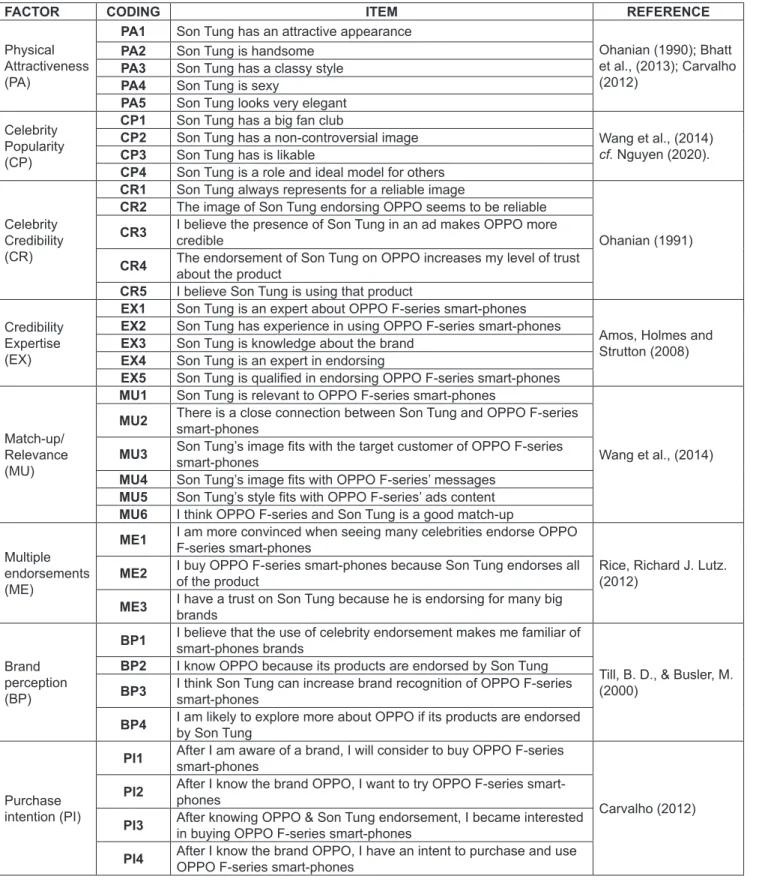
Part I: Demographic of respondents (age, gender, income) Part II and Part III: Consumer evaluations. 36 questions are delivered to participants in sequence. All statements related to listed factors are measured by a 5-point Likert scale (Likert, 1932), where 1= strongly disagree; 2 = disagree; 3 = neutral; 4 = agree and 5 = strongly agree (Table 1).

As Gorsuch (1983) and Hatcher (1994) stated, in order to measure the likelihood of item list with EFA, it is required to get the minimum size of sample five times as much as the total variables. Since the total items in the questionnaire are 36, the population size would need to reach at least 150 participants.

Thus, this paper collected 258 respondents’ questionnaires, in which participants already have an awareness of OPPO F-series smartphones and Son Tung endorsement, live in Ho Chi Minh City, and are above 18 years old.

4. Results and Discussion 4.1. Reliability Test

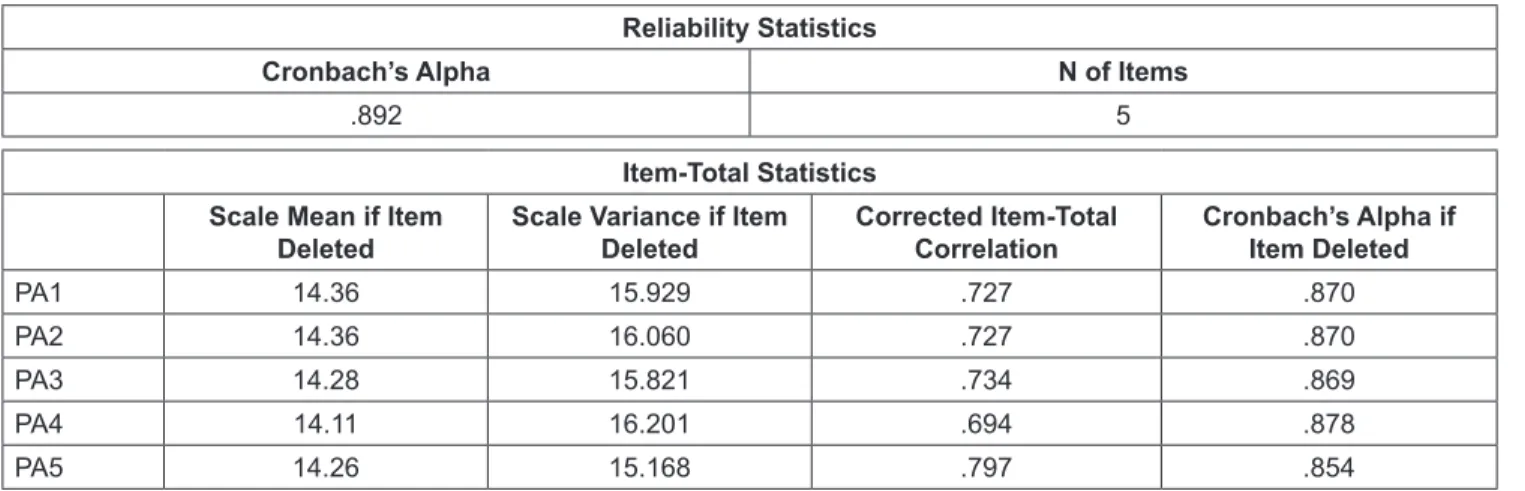
The measurement items of factors are well-designed and could be kept because they all achieve the necessary reliability;

considering the Cronbach’s Alpha value > 0.6 and all Corrected Item-Total Correlation < 0.3. Such a result would also be found in Celebrity Popularity (CP), AP and so on (Table 2).

Item CR5 has the Correlation value = 0.23 < 0.3, hence, this item is eliminated from the process. New result after deleting CR5 has the Cronbach’s Alpha of 0.851 > 0.6 and Corrected Item-Total Correlation values are all above 0.3.

Therefore, it is reliable and qualified for future analyzing.

We also test the reliability of Celebrity Expertise (EX), which shows that Cronbach’s alpha for expertise is 0.685, thus reliable it can remain unchanged with its four listed items.

Item Celebrity Match-up (MU) has the correlation coefficients of 0.15 < 0.3 and Cronbach’s Alpha= 0.874

> 0.762, it is eliminated. New result of reliability with the higher Cronbach’s Alpha of 0.874 and correlation coefficients are all > 0.3.

Now, the measurement scale passes the reliability test.

As we can observe, the correlation coefficients are all higher than 0.3 and all the Cronbach’s Alpha coefficients are higher than 0.6, showing the internal consistency among items of this measurement, hence, we will not eliminate any

variables in this factor. Such a result would also be found in Brand Perception (BP), Multiple Endorsements (ME), and Purchase Intention (PI).

4.2. Multiple Linear Regressions

Pearson Sig of independent variables PA, CP, CR, EX, MU, ME and dependent variable BP are below 0.05, thus, there is a linear relation among independent variables and BP. Specifically, two factors PA and EX, have a strong correlation to BP, with coefficient value of 0.599 and 0.530, respectively, while EX and ME has the weakest correlation with r of 0.136. Simultaneously, four other factors, including Celebrity Credibility (CR), Match-up (MU), Popularity (CP), and Multiple Endorsements (ME) have a medium correlation to BP.

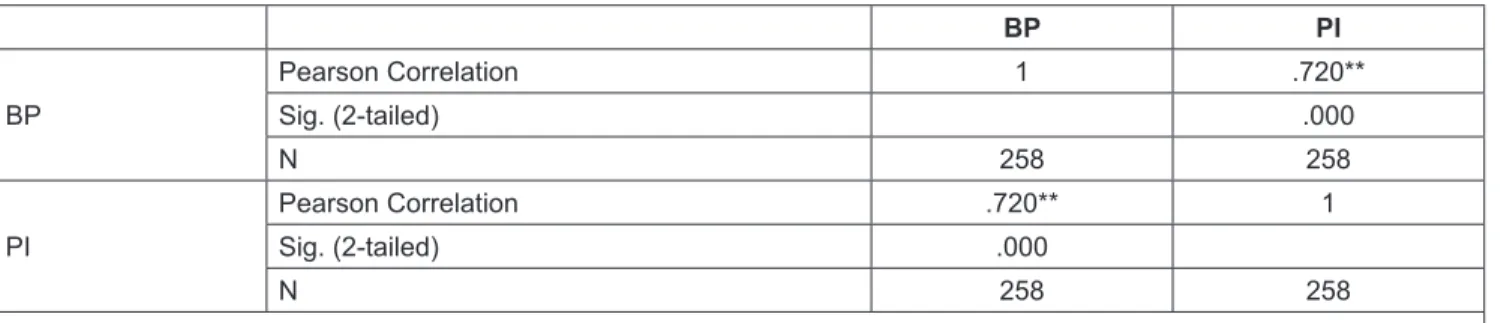
Table 3 provides clear data for the case of Brand Perception (BP) and Purchase Intention (PI). All sig values are 0.000 (< 0.01), hence, they are believed to be significant to create the correlations between BP and PI.

In the Model summary, the Adjusted R Spared value is 0.627, which means that the independent factors (PA, CP, CR, EX, MU, ME) put into regression affect 62.7% of the changes of the dependent factor (BP). Because it is more than 50%, this value is moderately large. Hence, the remaining 37.3% could be explained by other factors, which are not included in this study. The significance level is 0.000 < 0.05.

The analysis results show that the F test is worth 73.153, so the regression model is safe to use for the overall prediction.

As observed in the ANOVA table (Table 4), all sig.

Values< 0.05, which means that all six variables are valid within the model. Each of six variables PA, CP, CR, EX, MU and ME impacts on the dependent variable BP, so none is discarded from the study. Moreover, all variance inflation factors (VIF) values <2, hence, there is no colinearity.

Secondly, with Standardized Coefficients Beta value, factors that have the most positive effect on BP are CP (0.274) and EX (0.306). To be specific:

For factor PA: H1: Physical attractiveness has a positive impact on consumers’ brand perception. To test this hypothesis, we will look at the Sig value of t-test for PA, which is 0.000 < 0.05, this means the factor affects perception toward brand of the respondents (or dependent factor BP).

The Beta of PA is 0.207, which is positive, indicating that Physical Attractiveness positively affects the consumers’

brand perception. Hence, we accept H1.

For factor CP: H2: Celebrity popularity has a positive impact on consumers’ brand perception. Sig value of t-test for CP = 0.000 < 0.05, this means the factor affects perception toward brand of the respondents (or dependent factor BP).

The Beta of CP is 0.274, which means Celebrity popularity positively affects the brand perception of the customers.

Hence, we accept H2.

(5)

Table 1: Measurement items for the research model

FACTOR CODING ITEM REFERENCE

Physical Attractiveness (PA)

PA1 Son Tung has an attractive appearance

Ohanian (1990); Bhatt et al., (2013); Carvalho (2012)

PA2 Son Tung is handsome PA3 Son Tung has a classy style PA4 Son Tung is sexy

PA5 Son Tung looks very elegant Celebrity

Popularity (CP)

CP1 Son Tung has a big fan club

Wang et al., (2014) cf. Nguyen (2020).

CP2 Son Tung has a non-controversial image CP3 Son Tung has is likable

CP4 Son Tung is a role and ideal model for others

Celebrity Credibility (CR)

CR1 Son Tung always represents for a reliable image

Ohanian (1991) CR2 The image of Son Tung endorsing OPPO seems to be reliable

CR3 I believe the presence of Son Tung in an ad makes OPPO more credible

CR4 The endorsement of Son Tung on OPPO increases my level of trust about the product

CR5 I believe Son Tung is using that product Credibility

Expertise (EX)

EX1 Son Tung is an expert about OPPO F-series smart-phones

Amos, Holmes and Strutton (2008) EX2 Son Tung has experience in using OPPO F-series smart-phones

EX3 Son Tung is knowledge about the brand EX4 Son Tung is an expert in endorsing

EX5 Son Tung is qualified in endorsing OPPO F-series smart-phones

Match-up/

Relevance (MU)

MU1 Son Tung is relevant to OPPO F-series smart-phones

Wang et al., (2014) MU2 There is a close connection between Son Tung and OPPO F-series

smart-phones

MU3 Son Tung’s image fits with the target customer of OPPO F-series smart-phones

MU4 Son Tung’s image fits with OPPO F-series’ messages MU5 Son Tung’s style fits with OPPO F-series’ ads content MU6 I think OPPO F-series and Son Tung is a good match-up Multiple

endorsements (ME)

ME1 I am more convinced when seeing many celebrities endorse OPPO F-series smart-phones

Rice, Richard J. Lutz.

(2012) ME2 I buy OPPO F-series smart-phones because Son Tung endorses all

of the product

ME3 I have a trust on Son Tung because he is endorsing for many big brands

Brand perception (BP)

BP1 I believe that the use of celebrity endorsement makes me familiar of smart-phones brands

Till, B. D., & Busler, M.

(2000) BP2 I know OPPO because its products are endorsed by Son Tung

BP3 I think Son Tung can increase brand recognition of OPPO F-series smart-phones

BP4 I am likely to explore more about OPPO if its products are endorsed by Son Tung

Purchase intention (PI)

PI1 After I am aware of a brand, I will consider to buy OPPO F-series smart-phones

Carvalho (2012) PI2 After I know the brand OPPO, I want to try OPPO F-series smart-

phones

PI3 After knowing OPPO & Son Tung endorsement, I became interested in buying OPPO F-series smart-phones

PI4 After I know the brand OPPO, I have an intent to purchase and use

OPPO F-series smart-phones

(6)

Table 2: The example of reliability statistics for PA

Reliability Statistics

Cronbach’s Alpha N of Items

.892 5

Item-Total Statistics Scale Mean if Item

Deleted Scale Variance if Item

Deleted Corrected Item-Total

Correlation Cronbach’s Alpha if Item Deleted

PA1 14.36 15.929 .727 .870

PA2 14.36 16.060 .727 .870

PA3 14.28 15.821 .734 .869

PA4 14.11 16.201 .694 .878

PA5 14.26 15.168 .797 .854

Table 3: Correlation between variables

Correlations of independent and dependent variables

PA CP CR EX MU ME BP

PA

Pearson Correlation 1 .286

**

.178

**

.367

**

.275

**

.288

**

.530

**

Sig. (2-tailed) 0 0.004 0 0 0 0

N 258 258 258 258 258 258 258

CP

Pearson Correlation .286

**

1 .286

**

.340

**

0.064 0.054 .503

**

Sig. (2-tailed) 0 0 0 0.304 0.384 0

N 258 258 258 258 258 258 258

CR

Pearson Correlation .178

**

.286

**

1 .275

**

0.039 .241

**

.410

**

Sig. (2-tailed) 0.004 0 0 0.536 0 0

N 258 258 258 258 258 258 258

EX

Pearson Correlation .367

**

.340

**

.275

**

1 .319

**

.136

*

.599

**

Sig. (2-tailed) 0 0 0 0 0.029 0

N 258 258 258 258 258 258 258

MU

Pearson Correlation .275

**

0.064 0.039 .319

**

1 .144

*

.375

**

Sig. (2-tailed) 0 0.304 0.536 0 0.021 0

N 258 258 258 258 258 258 258

ME

Pearson Correlation .288

**

0.054 .241

**

.136

*

.144

*

1 .385

**

Sig. (2-tailed) 0 0.384 0 0.029 0.021 0

N 258 258 258 258 258 258 258

BP

Pearson Correlation .530

**

.503

**

.410

**

.599

**

.375

**

.385

**

1

Sig. (2-tailed) 0 0 0 0 0 0

N 258 258 258 258 258 258 258

**. Correlation is significant at the 0.01 level (2-tailed).

*. Correlation is significant at the 0.05 level (2-tailed).

(7)

For factor CR: H3: Celebrity credibility has a positive impact on consumers’ brand perception. Testing this hypothesis, we observe that the Sig value of t-test for Celebrity credibility is smaller than 0.05, which means the factor affects perception toward brand of the respondents and affects the least with Beta value = 0.154. Hence, we accept H3.

For factor EX: H4: Celebrity expertise has a positive impact on consumers’ brand perception. Sig value of t-test for EX = 0.000 < 0.05, this means the factor affects consumers’

brand perception (or BP). The Beta of EX is 0.306, which is the highest Beta value, meaning that Expertise influences the perception the most among six factors. Hence, we accept H4.

For factor MU: H5: Celebrity/product fit has a positive impact on consumers’ brand perception. To test this hypothesis, we will look at the Sig value of t-test for MU, which is 0.000< 0.05, meaning Celebrity Match-up affects consumers’ brand perception (or BP). The Beta of MU is 0.167, which positively affects the perception. Hence, we accept H5.

For factor ME: H6: Multiple Endorsements have a positive impact on consumers’ brand perception. Sig value of t-test for ME = 0.000 < 0.05, this means Multiple Endorsements also affect the perception toward brand by consumers (or dependent factor BP). The Beta of ME is 0.208, which positively affects the perception. Hence, we accept H6.

The regression equation now is:

BP = 0.207 PA + 0.274 CP + 0.154 CR + 0.306 EX + 0.167 MU + 0.208 ME

The second regression evaluates the relationship between the dependent factor of Brand Perception (BP) and the Purchase Intention (PI). As observed in Table 4, with Hypothesis H0: R2

= 0, the result gives F = 275.641, and the Sig F is 0.00 < 0.05.

We could reject H0 and conclude that the regression model fits with the data. In the Model summary table (Table 5), the Adjusted R Spared value = 0.517, which means up to 51.7% of the total variance in the dependent variable Purchase Intention (PI) can be explained by the variable Brand Perception (BP).

Table 4: Multiple Linear Regressions between variables (e.g., BP and PI) ANOVA

b

of BP

Model Sum of Squares df Mean Square F Sig.

1 Regression 90.800 6 15.133 73.153 .000

a

Residual 51.925 251 .207

Total 142.725 257

a. Predictors: (Constant), ME, CP, MU, CR, PA, EX b. Dependent Variable: BP

ANOVA

b

of PI

Model Sum of Squares df Mean Square F Sig.

1 Regression 150.366 1 150.366 275.641 .000

a

Residual 139.652 256 .546

Total 290.017 257

a. Predictors: (Constant), BP b. Dependent Variable: PI

Example of Correlations of Brand Perception & Purchase Intention

BP PI

BP

Pearson Correlation 1 .720**

Sig. (2-tailed) .000

N 258 258

PI

Pearson Correlation .720** 1

Sig. (2-tailed) .000

N 258 258

**. Correlation is significant at the 0.01 level (2-tailed).

(8)

For factor PI: H7: Consumers’ brand perception has a positive impact on purchase intention. It is observed that the Sig value of t-test for T is 0.000 < 0.05, which means the factor Brand perception (BP) affects the purchase intention of the respondents (or dependent factor PI). The Beta of T is 0.720, which positively affects the purchase intention of the customers. Hence, we accept H7. Besides, VIF coefficient<

2, so that there is no multi-correlation and influence on regression result. The regression equation will be: PI= 0.720 BP

5. Discussion and Conclusions 5.1. Discussion and Conclusions

Findings indicate that OPPO F-series smartphones with Son Tung endorsement influences positively consumers’

brand conception, thanks to his appealing appearance or Physical Attractiveness (PA), which then leads to the buying intention. This also agreed with Amos et al. (2008), the more attractive the endorser is, the greater the chance consumers could be aware of the product and brand, and thus stimulate their purchasing motives.

Celebrity Popularity (CP) is believed to be one of the key factors in determining whether consumers’ brand perception is affected. People have a belief that who is famous is more trustworthy and credible. Moreover, the choice to be popular with a positive or negative image is derived from the celebrity, which would be a consideration of brands when sourcing for a well-fitted endorser.

Thirdly, the brand perception resulting in the purchase intention was also proven positively by the element Celebrity Credibility (CR). It is obvious that, if target consumers feel the celebrity endorser is not trustworthy and honest enough, they would avoid exploring the endorsed brand and

purchase its products. That is the reason why Ohanian (1991) suggested persuading audience that reliability is one of the most important factors. Hence, if a celebrity wishes to build a nice profile to be the brand endorser, besides good-looking appearance, he/she should pay attention to improve their personality, starting with being honest and sharing reliable information in their daily lives or even in careers.

Professional and expertise brand ambassadors can be trusted by the society, which influence the perception and even purchase motives of target consumers (Al-Absy et al., 2020). The findings of this research do support the idea whereby Celebrity expertise is the most positive factor of celebrity – Son Tung in a case in point – that could affect consumers’ brand perception the most thanks to his professional demeanor in advertising and transferring the brand messages. Thus, besides taking care of appearance, it is advisable that celebrity should improve their knowledge in advertising or in the endorsed fields to achieve the optimal goals.

There are not many differences in respondents’ opinions regarding the attribute about Son Tung compared to others, consumers are aware of the connection between his images, style and the product, and brand messages – Celebrity Congruence. It could be understood that, if there is no or not much congruence between the two sides, consumers could think the endorsement is only for financial benefits and not trustworthy enough to make a decision on buying a product. Thus, brands had better take this fit/relevance into consideration, in aspects of celebrity – product –- message – brand to create a successful and effective marketing campaign.

Although Multiple Endorsements is not a big concern of participants, Son’s successful endorsements for many big brands such as Go-Viet, Shopee, Bitis’ Hunters, IvyModa and so on, not only prove his position in endorsing field, Table 5: Hypothesis testing results

Hypothesis B SigT value Conclusion Influential rank

1 H1: Physical attractiveness has a positive impact on

consumers’ brand perception. 0.207 0.000 Accepted 4

2 H2: Celebrity popularity has a positive impact on

consumers’ brand perception. 0.274 0.000 Accepted 2

3 H3: Celebrity credibility has a positive impact on

consumers’ brand perception. 0.154 0.000 Accepted 6

4 H4: Celebrity expertise has a positive impact on

consumers’ brand perception 0.306 0.000 Accepted 1

5 H5: Celebrity/product fit has a positive impact on

consumers’ brand perception. 0.167 0.000 Accepted 5

6 H6: Multiple Endorsements has a positive impact on

consumers’ brand perception. 0.208 0.000 Accepted 3

(9)

but also build trust, recognition and purchase intention from audiences toward his activities, and his participation with OPPO is not exceptional.

In spite of the fact that it is not always after consumers get to know a brand (Brand Perception) or a product owing to some positive factors of the endorser, that they would purchase it. However, the results of this paper documents the high level of buying OPPO F-series smartphones after respondents could identify the brand thanks to six mentioned factors of Son Tung despite different viewpoints in certain criteria. Therefore, if brands invest for a suitable and likable ambassador, not only it could increase awareness and visibility, but also encourage the buying motives of consumers.

5.2. Recommendations

First, brands had better invest more to identify consumers’

insights to have their own attributes and requirements for endorser selection. This, not only could promote brand, products and transfer key messages in a suitable and effective method, but also present a delicate brand, which offers their target consumers something beyond a simple product.

Secondly, having a nice appearance can attract audiences.

However, every celebrity has their own unique points and beauty, and how relevant it is with the product depends on the specific field he/she is endorsing. For instance, Bui Tien Dung, a football player in Vietnam national football team, is admired for his manly face, talent and personalities, suited for almost all fields from Fashion, Electronics, Footwear, but he is never a top pick for facial/cosmetics products because of his unhealthy skin. Thus, having appealing appearance could develop curiosity from audiences, but benefitting from a suitable appeal would better influence the purchase intention of consumers.

Thirdly, credibility is important to affect the trust and decide the support or loyalty of consumers. Therefore, besides the personal life, potential risk predictions are necessary, particularly, assessing the credibility and characteristics of brands he/she has been endorsing to prevent some unexpected issues. Taking an example of Le Duong Bao Lam; a well-known Vietnamese comedian /actor /streamer, he is gradually losing consumers’ beliefs since he has been endorsing many low-quality, unauthentic cosmetics brand and products. Those celebrities in the same situation as him should not be listed in potential celebrity endorsement related to cosmetics/facial in particular or other fields in general because carelessness in choosing a right endorser could damage brand reputation and image.

Finally, besides using celebrity image to approach target audiences online via social platforms, brands could create some other offline tactics such as events or activities with celebrity participation, which helps to create the real

experience for audiences besides the main aims of building brand awareness and stimulating the buying intention of consumers.

The study is only focused on analyzing celebrity endorsement in the smartphone industry, thus, the study’s outcomes could not be necessarily generalized to other fields. The second limitation is about sample. Due to restricted resources in time and budget, the study is only conducted within Ho Chi Minh City, and thereby lacks mass coverage in Vietnam. Though 258 is an acceptable sample size, however, a larger one could better enhance the reliability of the research’s results. Hence, future researchers could consider more diversified participants from different areas in Vietnam.

References

Al-Absy, M. S. M., Ismail, K. N. I. K., Chandren, S., Al-Dubai, S.

A. A., Nor, K., Ku, I., & Chandren, S. (2020). Involvement of board chairmen in audit committees and earnings management:

Evidence from Malaysia. Journal of Asian Finance, Economics and Business, 7(8), 233–246. https://doi.org/10.13106/

jafeb.2020.vol7.no8.233

Amos, C., Holmes, G., & Strutton, D. (2008). Exploring the relationship between celebrity endorser effects and advertising effectiveness: A quantitative synthesis of effect size. International Journal of Advertising, 27(2), 209–234.

Belch G. E., & Belch, M. A. (2004). Introduction to Advertising and Promotion: An Integrated Marketing Communications Perspective. New York, NY: Irwin.

Bhatt, N., Jayswal, R. M., & Patel, J. D. (2013). Impact of celebrity endorser’s source credibility on attitude towards advertisements and brands. South Asian Journal of Management, 20(4), 74–95.

Biswas, D., Biswas, A., & Das, N. (2006). The differential effects of celebrity and expert endorsements on consumer risk perceptions. The role of consumer knowledge, perceived congruency, and product technology orientation. Journal of Advertising, 35(2), 17–31.

Bowman, J. (2002). Facing advertising reality. Media Asia, 7(26), 14–15.

Braunsberger, K. (1996). The effects of source and product characteristics on persuasion. Arlington, TX: Doctoral dissertation, University of Texas at Arlington.

Carvalho, A. F. E. M. D. (2012). The effects of celebrity endorsement on consumers purchasing intentions. Lisbon, Portugal: Master Thesis dissertation, Instituto Universitário de Lisboa.

Erdogan, B. Z. (1999). Celebrity endorsement: A literature review. Journal of Marketing Management, 15(4), 291–314.

Erdogan, B. Z., Baker, M. J., & Tagg, S. (2001). Selecting celebrity endorsers: The practitioner’s perspective. Journal of Advertising Research, 41(3), 39–48.

Gorsuch, R.L. (1983). Factor analysis (2

nd

ed.). Hillsdale, NJ:

Lawrence Erlbaum Associates.

(10)

Hatcher, L. (1994). A step-by-step approach to using the SAS system for factor analysis and structural equation modeling. Cary, NC:

SAS Institute Inc.

Heider, F. (1946). Attitudes and cognitive organization. The Journal of Psychology, 21(1), 107–112.

Hovland, C.I., & Weiss, W. (1953). Transmission of information concerning concepts through positive and negative instances.

Journal of Experimental Psychology, 45(3), 175–182.

Kim, Y. E., & Lee, J. W. (2010). Relationship between corporate image and customer loyalty in mobile communications service markets. African Journal of Business Management, 4(18), 4035–4041.

Krotoski, A. (2011). WikiLeaks and the new, transparent world order. The Political Quarterly, 82(4), 526–530.

Lee, J. W. (2017). Critical factors affecting consumer acceptance of online health communication: an application of service quality models. Journal of Asian Finance, Economics and Business, 4(3), 85–94. http://dx.doi.org/10.13106/jafeb.2017.

vol4.no3.85

Likert, R. (1932). A technique for the measurement of attitudes. Archives of Psychology, No. 140, New York University.

Maharani, N., Helmi, A., Mulyana, A., & Hasan, M. (2020). Factors Influencing Purchase Intention on Private Label Products.

Journal of Asian Finance, Economics and Business, 7(11), 939–945. https://doi.org/10.13106/jafeb.2020.vol7.no11.939 McCracken, G. (1989). Who is the celebrity endorser? Cultural

foundations of the endorsement process. Journal of Consumer Research, 16(3), 310–321.

Miciak, A. R., & Shanklin, W. L. (1994). Choosing celebrity endorsers. Marketing Management, 3(3), 50.

Nguyen, N. T., & Tran, T. T. (2019). Optimizing mathematical parameters of Grey system theory: an empirical forecasting case of Vietnamese tourism. Neural Computing and Applications, 31(2), 1075–1089.

Nguyen, T. T. N. (2020). Gender Differences in Determinants of Customer Satisfaction in Beauty and Cosmetic E-commerce.

Journal of Asian Finance, Economics and Business, 7(10), 811–822. https://doi.org/10.13106/jafeb.2020.vol7.no10.811

Oh, A. H., & Park, H. Y. (2020). The Effect of Airline’s Professional Models on Brand Loyalty: Focusing on Mediating Effect of Brand Attitude. Journal of Asian Finance, Economics and Business, 7(5), 155–166. https://doi.org/10.13106/jafeb.2020.

vol7.no5.155

Ohanian, R. (1990). Construction and Validation of a Scale to Measure Celebrity Endorsers’ Perceived Expertise, Trustworthiness, and Attractiveness. Journal of Advertising, 19(3), 39–52.

Ohanian, R. (1991). The impact of celebrity spokespersons’

perceived image on consumers’ intention to purchase. Journal of Advertising Research, 31(1), 46–54.

Pham, H. C. (2020). Factors Determining Brand Equity for Retail Stores: A Market Segmentation Approach. Journal of Asian Finance, Economics and Business, 7(10), 843–854. https://doi.

org/10.13106/jafeb.2020.vol7.no10.843

Pornpitakpan, C. (2003). Validation of the celebrity endorsers’

credibility scale: Evidence from Asians. Journal of Marketing Management, 19(1-2), 179–195

Rice, D. H., Kelting, K., & Lutz, R. J. (2012). Multiple endorsers and multiple endorsements: The influence of message repetition, source congruence and involvement on brand attitudes. Journal of Consumer Psychology, 22(2), 249–259.

Schiffman, L.G., & Kanuk, L.L. (2000). Consumer behavior (7th ed.). London, UK: Prentice Hall.

Till, B. (1998). Using celebrity endorsers effectively: lessons from associative learning. Journal of Product & Brand Management, 7(5), 400–409.

Till, B.D., & Busler, M. (2000). The Match-Up Hypothesis:

Physical Attractiveness, Expertise, and the Role of Fit on Brand Attitude, Purchase Intent and Brand Beliefs. Journal of Advertising, 29(3), 1–13.

Wang, C. N., Nguyen, N. T., & Tran, T. T. (2014). An empirical study of customer satisfaction towards bank payment card service quality in Ho Chi Minh banking branches. International Journal of Economics and Finance, 6(5), 170–181.

Wonglorsaichon, P., & Sathainrapabayut, P. (2008). Brand

perception and brand equity of baby accessory products in

working moms’ perspective. International Review of Business

Research Papers, 4(1), 385–395.

수치

Figure 1: Conceptual model
Table 1: Measurement items for the research model
Table 2: The example of reliability statistics for PA
Table 4: Multiple Linear Regressions between variables (e.g., BP and PI) ANOVA b of BP

참조

관련 문서

Abstract The objective of this study is to identify the influence of utilization of SNS among consumers who watch performance art on their behavioral intention in the

Using Russian and Korean consumers as examples, we analyzed how sus- tainable activities affect a consumer's ethical consciousness, brand loyalty and purchase intention.. The

Abstract : This study attempted to investigate the influence of a beauty influencer’s characteristics on makeup behavior and color cosmetics purchase intention against young