—
ISSN 1229-3350(Print) ISSN 2288-1867(Online)
—
J. fash. bus. Vol. 21, No. 6:1-15, December. 2017 https://doi.org/
10.12940/jfb.2017.21.6.1
the Advertising Image of Chinese Consumers on Advertising and Brand Attitudes
-The Moderating Role of a Fashion Advertising Model’s Nationality-
Yu Hua Cui
Dept. of Fashion Design, Yanbian University, China
Corresponding author
— Yu Hua Cui
Tel : +86-0433-2435808 E-mail: [email protected]
Keywords Abstract
congruence between self-image and advertising image(CSIAI),
advertising attitude, brand attitude, purchase intention, nationality of model
-
2012 Jilin Province Department of Finance Special Education Fund
“Cross-culture Development Research Base”
-
2017 Yanbian University Humanities
& Social Sciences Fund Project No.: QN2017010
This study examines the various responses of Chinese consumers, depending on the nationality of the fashion advertising model featured in an advertisement; it explores the effects of a congruence between self-image and advertising image (CSIAI) on consumer attitudes. This study was conducted by collecting data online; 200 samples selecting a Korean model and 200 samples selecting a Chinese model with a fashion brand were analyzed. A structural equation model confirms the conceptual framework for the influence of CSIAI on consumer attitudes and purchase intentions. The results show that the perceived CSIAI of consumers positively influences their attitude toward the advertising and the brand, and further, that advertising and brand attitudes significantly affect the purchase intention of consumers.
This positive relationship is moderated by the nationality of the model. These findings suggest that the nationality of the model can serve as an important retail mix for global marketers. Other results and management implications are also discussed.
I. Introduction
As society changes to emphasize communication from consumers and minimize differentiations between products, the main issue is the manner in which the
delivery of advertising messages to consumers affect the creation of attitudes and changes of individuals (Tsang, Ho & Liang, 2004). Expression of advertising in fashion marketing directly relates to the images of fashion; people usually connects fiction to the reality of
consumers because of the romance that fashion usually expresses to consumers. This expression is the congruence between self-image and advertising image (CSIAI). Previous research on fashion advertising is mostly on the characteristics of the attractiveness of advertising models and effects to the behaviors of consumers. Celebrity endorsement positively affects the purchasing intention of customers for perfume brands (Priyankara, Weerasiri, Dissanayaka & Jinadasa, 2017).
Consumers desire to be connected to their own images to products (Sirgy, 1980). Consumers are usually convinced by advertising models who appear similar or attractive to them through identification (David, Morrison, Johnson, & Ross, 2002). Similarly, although fashion advertising has close category with self-identification, the majority of research on self-identification is only limited within the range of brand community of consumers, purchase intention, usage and possession of products, and investigation of the relationship between brand loyalty (Grzeskowiak &
Sirgy, 2007; Lee, Kim, & Yu, 2015; Sirgy, 1980; Stern
& Hair, 1977).
This tendency has also been observed in China, the fastest developing country in the world. Previous research on this topic has focused on the fashion industry, the most important industry in the Chinese economy. Models who appear in Chinese fashion advertising are usually Korean celebrities as the Korean wave strengthens. Korean female singer group T-ara was an advertising model for the Chinese fashion brand Celucasn, and Korean celebrity Jong Suk Lee was selected as an advertising model for famous Chinese fashion brand Semir (森马). Another Korean star Ji Hyun Jun also joined the Chinese brand advertising and worked as a model for YISHION (以纯). Given the difference between Chinese consumer responses to Korean and Chinese fashion advertising models, the impressions of consumers on the advertising messages of fashion brands and the effects of their attitudes on their behavior are unclear. Kim and Bae (2001) developed a fashion advertising model typology based on specific model characteristics related to demographics, body, and
job satisfaction factors. They found that the type of fashion advertising model differs with regard to consumer satisfaction. The age of fashion advertising model also influences the attitudes and purchase intention of the consumers of fashion apparel (Steinhaus
& Lapitsky, 1986).
Previous research on advertising models is not entirely insufficient, but finding a research on the nationality of advertising is difficult. The purpose of this study is to investigate the factors of CSIAI in fashion advertising, and to analyze effect on advertising attitudes, brand attitudes and purchase intention, and investigate the control effects of the nationalities of advertising models.
This research could benefit fashion industry managers by providing insights regarding the potential impact of fashion advertising on the brand attitude and examining how these factors can help them increase customer attitudes, especially Korean fashion company in Chinese market. This study will help Korean fashion operators increase their understanding of fashion advertising factors in relation to how Chinese consumers perceive and react to the nationality of fashion advertising model, providing Korean fashion managers with practical guidance to prioritize and implement congruence between self-image and advertising image.
II. Literature Review 1. CSIAI
The effect of models in fashion advertising is an important issue, and the background of the discussion is based on two perspectives. First, the schema or inherent association is related to the product; second, a relationship between the characteristics of advertising models and a product or consumer characteristics affecting the reactions of consumers is an issue from the model effects (Kamins, 1990). Self-image means an individual has a certain image of himself or herself;
thus, the images of people related to a certain product are the product user images (Sirgy, 1980). Types of self-image are classified into two perspectives, namely,
single and multiple self-constructs. Previous research (Sirgy, 1980; Stern & Hair, 1977) concluded that the congruence between self-image and product image affects the selection of consumers, but these studies are limited to verifying the reasons for using brands to express the ego of consumers. After 1990, research on self-image is mainly focused on investigating the dimensions of self-image and the effects on the behavior of consumers from the congruence of self-image and brand image. Stern and Hair (1977) claimed that consumers favor images, which are congruent with their self-images, and that consumers feel ideal in consumption situation. Keeling (2000) practically analyzed the effects to products and brand evaluation by the congruence of brand and self-images;
Lee, Leung, & Zhang (2000) asserted that consumers prefer brand images or individuality, which matches their own images. In particular, people, who are low self-monitors, show that they prefer the attitudes of brand and advertising when their self-schema matches with brand individuality.
We conducted this study to focus on the effects of the CSIAI of Chinese consumers on advertising and brand attitudes. Most studies on self-image congruence predicted product preference (e.g., clothing style), brand preference, brand choice, consumer satisfaction, and store loyalty (Sirgy, 1982). No studies on the effects of CSIAI on the attitudes of consumers are found. Our study focuses on investigating the effects of CSIAI on advertising and brand attitudes in the context of fashion goods.
2. Advertising and Brand Attitudes
Advertising attitude is a predisposition in which a receiver acts favorably to a certain stimulus of advertising under a certain revealed situation (Mackenzie
& Belch, 1986). This definition only emphasizes emotional aspects, which lack three aspects of attitude notion, namely, cognitive, emotional, and behavioral aspects. After proving that advertising attitude works as a causal mediator to affect the advertising image,
researchers started to consider advertising attitudes based on the causal relationship between advertising attitude and result variables (Mitchell & Olson, 1981).
However, consumer attitude is a psychological tendency, which expresses and evaluates the degree of prepossession toward a certain thing (Batra & Ahtola, 1991), and the tendency and thoughts of individuals on favorable emotion can be defined as brand attitude (Voss & Grohmann, 2003). Similarly, brand attitude can be expressed as an emotional desirability or preference that individuals have toward a brand. Many previous studies have been conducted to understand the causal relationship between advertising and brand attitudes (Mitchell, 1986; Mitchell & Olson, 1981). The common precondition of this previous research is if consumers favor the advertising, then the emotion of these consumers is extended to the brand; thus, advertising attitude can mediate brand attitude and classical conditionalization.
3. Purchase Intention
Purchase intention is regarded as a factor that affects the result of the purchase of consumers in the future.
Bagozzi (1992) claimed that preference differs from intention; the purchase may not lead to the action of purchase even with preference. Attitude can be a predictable variable of purchase behavior, but it only predicts limited behaviors in certain cases; therefore, considering the purchase intention and attitude to research on purchase behavior of consumers is important.
Positive attitude about purchasing a fashion brand after considering CSIAI positively affects the purchase intention (Li, Daugherty, & Biocca, 2013). However, uncontrollable factors can be barriers in terms of predicting the future; thus, purchase intention, which cannot be an absolute factor, is acknowledged as a reasonable theory of action. However, the reasonable theory of action continues to consider that actual purchase behavior depends on the intention to behave.
This research also believes that purchase intention can
be a direct determinant of actual purchase and can lead to the future purchase behaviors. By verifying the role of mediator in the causal relationship of consumer decision making, the importance of purchase intention is shown in the previous research as purchase intention or shopping for fashion products in advertising.
III. Research Hypothesis and Methods 1. Research Hypothesis
The hypothesis was adopted to verify the differences in the influence of the CSIAI on the attitude of consumers and the controlling role of the nationality of advertising models in this relationship.
Yoon and Yu (2017) indicated ideal self-image and realistic self-image, which are factors derived from psychology, affect pursued fashion style. This was opposed to the relationship between the realistic self-image and ideal self-image of women, which was more unconscious and self-satisfying. Also in Lee (2005) study, if fashion brand image and advertisement model image are in congruence, consumers’
advertisement attitudes would be higher. Consumers who are exposed to advertising do not actively search for brands or products, but their emotions from this exposure lead to a certain attitude without any cognitive process (Mitchell & Belch, 1986), and consumers favor advertising attitude when images of themselves match the brand image. Choi and Jeon (2008) argued that the congruence between consumers’
self-image and cosmetic advertising image has a significant influence on advertising attitude. Therefore, we hypothesize that
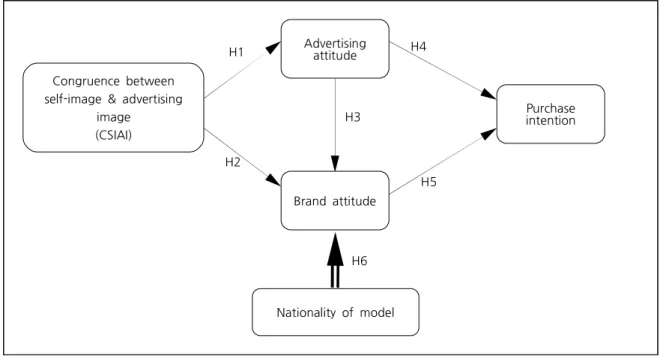
H1: CSIAI positively affects advertising attitude.
Lee (2005) argued that if fashion brand image and advertisement model image are in congruence, consumers’ purchasing intention would be higher. A positive attitude toward the brand is created as the self-image of consumers is congruent with brand image (Keeling, 2000). This condition means that consumers feel congruent to a brand, which reflects and expresses
well about their self-images, and they favor this brand.
Oh and Jeong (2015) suggested that the beliefs of consumers on TV home shopping advertising have a positive effect on the brand attitude of consumers.
David et al. (2002) claimed that the degree of congruence between advertising models and brand image can affect the advertising effects. Thus, the following hypothesis was established to find a connection between advertising effects and brand:
H2: CSIAI positively affects brand attitude.
The common factor that previous research includes is if consumers favor advertising as a classical conditionalization, then the emotion extends to the brand, and advertising attitude mediates with the brand attitude (Li et al., 2013; Mackenzie & Belch, 1986;
Mitchell, 1986; Mitchell & Olson, 1981). In Choi and Jeon (2008), the attitude of Korean consumers toward advertising had a significantly positive influence on brand attitude. Sallam and Wahid (2012) suggested that attitude toward a brand mediates the relationship between attitude toward advertisement and purchase intention. Therefore, we hypothesize that
H3: Advertising attitude positively affects brand attitude.
Sirgy (1980) demonstrated that favorable brand shows higher purchase intention than unfavorable brand, and favorable reaction to advertising connects with a favorable reaction to the product in the advertising attitude. Oh and Jeong (2015) argued that the attitudes of consumers toward TV home shopping advertising have a positive effect on purchase intention. The attitude of Malaysian consumers toward mobile advertising has a significant relationship with the purchase intention for products and services (Noor, Sreenivasan, & Ismail, 2013). Therefore, we hypothesize that
H4: Advertising attitude positively affects purchase intention.
Attitudes toward a brand mean emotional desirability of consumers toward a brand, and purchase intention means the strength of the intention of consumers who desire to purchase a certain brand when they select a
brand. Park, Jeon, & Sullivan, (2015) argued that favorable attitudes toward visual merchandising directly transfer to favorable brand attitudes that are positively associated with purchase intentions. Brand attitude is a partial mediator of the relationship between the pairwise personality congruence on purchase intention (Kwon, Hong, Seo, & Cho, 2009; Pradhan, Duraipandian, &
Sethi, 2014). Consumers express themselves through brands, which they feel further desirability and affection to the high brand identification, which images are congruent with self-image, and these consumers are likely to purchase the brand continuously (Grzeskowiak
& Sirgy, 2007; Keeling, 2000). Thus, we establish the following hypothesis:
H5: Brand attitude positively affects purchase intention.
Jeon and Shin (2011)’s study investigated how personality factors of brand and advertising model and personality congruence influenced upon brand equity in casual apparel brands. The results were: in casual apparel brands, personality factors of brand and
Advertising
attitude H4
H1
Congruence between self-image & advertising
image (CSIAI)
Purchase intention H3
H2
Brand attitude
H5
H6
Nationality of model
Figure 1. The Proposed Research Model
advertising model influence on personality congruence.
Personality congruence influenced on brand recognition and brand loyalty among brand equity. Many previous studies connect advertising models to the brand and verify effects to consumer reaction; however, lack of research still exists on the roles of advertising models according to nationalities. The nationalities of advertising models are significant; therefore, the nationalities of advertising models require being handled as an important variable in the connection between the brand and the advertising models. The present research predicts that a difference in perceiving the fashion brand of consumers exists according to the nationalities of advertising models based on previous research.
Therefore, we hypothesize that
H6: The nationality of fashion advertising model moderates the positive relationship among CSIAI, advertising attitude, brand attitude, and purchase intention.
The proposed research model is based on the research hypotheses above (see Figure 1).
2. Data Collection
Online survey (www.wenjuanxing.com) to test the proposed hypothesis was conducted to Chinese people who currently live in China. Researcher have good command on English and Mandarin Chinese and adequate experience in on-site data collection. The data collection site included various places in China.
Researcher gently intercepted respondents while passing out incentives to ask them if they were willing to participate in the survey. Once he or she agreed to participate to this study, the participant was asked to select the preferred nationality of the advertising model with whom they want to see. The survey was conducted for a month from December 12th in 2016 based on the entire region of China to generalize responses. But in this study, there’s no detailed distribution of residents.
This research suggested the following scenario in advance to provide a questionnaire: “Please answer questions with the assumption that you are planning to purchase fashion products and visiting famous Chinese fashion brand.” An imaginary fashion brand name was used to control for brand effect because using an actual brand name may have triggered memories of personal perceptions, experiences, or attitudes toward the actual brand, which could affect the research results. This research collected 200 respondents who selected a Chinese advertising model, and 200 respondents who selected a Korean advertising model based on two processes according to the nationalities of the advertising models. For statistical processing of collected data, SPSS18.0 and AMOS18.0 were used to analyze a descriptive statistic, reliability, factor, and structural equation model analysis of variables.
3. Measurements
This study uses measurement scale that has been widely used in previous studies on self-congruence and brand attitude. All the question in the questionnaire has been translated into Chinese in order to ease the respondents
when answering the questionnaire. Traditional self-congruence has been measured through the differences between self-image and brand image (Kressmann, Sirgy, Herrmann, Huber, Huber, & Lee, 2006). In the present study, the CSIAI was measured through a direct measure as advocated by Sirgy, Grewal, Mangleburg, Park, Chon, & Claiborne, (1997).
Three questions measuring the advertising attitude were adopted from Noor et al. (2013). Brand attitude was measured by the degree of emotional attitude that consumers felt using the items developed by Park et al., 2015. To measure the purchase intention, four questions were adopted from the study of Priyankara et al.
(2017). All of these items were measured on a five-point Likert scale ranging from “Strongly disagree=1” to “strongly agree=5”.
IV. Results 1. Sample Characteristics
A total of 400 responses were analyzed. The demography of respondents is as follows. Respondents in their twenties and thirties are 149 (37.3%) and 143 (35.8%), respectively, representing the most number of people. Regarding gender, 215 were men (53.8%), and 185 were women (46.3%). In terms of education level and marital status, 319 (79.9%) replied that they graduated from college or had a high level of education, whereas 267 (66.8%) were unmarried. The total monthly average income was less than RMB 30,000.
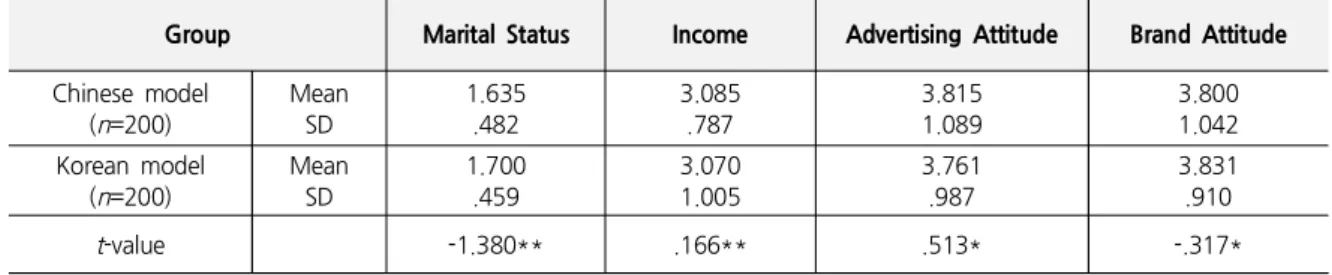
Considering that the central theme of this paper is the difference according to the nationality of model, a t-test was performed to determine whether any discrepancies exist in the prescribed sample characteristics between the group that selected the Chinese fashion advertising model and the group that selected the Korean fashion advertising model. The results are displayed in Table 1. One of the significant differences was in the marital status of the two groups (t= 1.380, − p=0.007). Moreover, other significant
differences exist in the monthly income of the two groups (t=0.166, p=0.003). Specifically, the group that selected the Korean fashion advertising model had a higher average income than the other group. No significant differences were observed on the other demographic characteristics.
An additional analysis was conducted on the discrepancies between the two groups regarding the latent variables used in the study (see Table 1). The group that selected the Chinese fashion advertising model has a significantly higher advertising attitude component (t=0.513, p=0.050), whereas the group that selected the Korean fashion advertising model had a significantly higher brand attitude component (t= 0.317, − p=0.030). Chinese consumers who prefer advertising attitude favor Chinese fashion advertising models, while the opposite is true for consumers who prefer brand attitude.
2. Measurement Model Evaluation
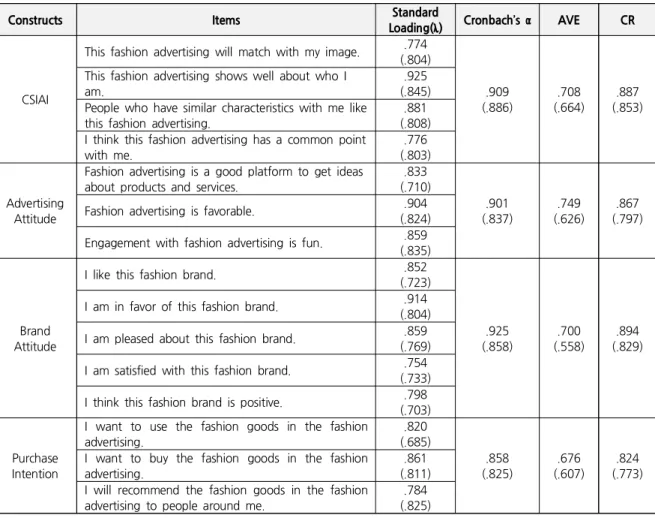
A confirmatory factor analysis was conducted to test the reliability and validity of variables measured in the current study (see Table 2). The measurement model for the sub-sample who selected the Chinese fashion advertising model was found to have the goodness of fit values of GFI=0.854, AGFI=0.791, CFI=0.961, RMR=0.042, RMSEA=0.056, X2=237.047 (df=84, p=0.000), and Normed X2=2.822, indicating a sufficient level of acceptance. A significant level of average variance extracted (AVE), composite reliability (CR),
Tabel 1. T-test Results for Differences in Sample Characteristics According to the Nationality of the Model
Group Marital Status Income Advertising Attitude Brand Attitude
Chinese model (n=200)
Mean SD
1.635 .482
3.085 .787
3.815 1.089
3.800 1.042 Korean model
(n=200)
Mean SD
1.700 .459
3.070 1.005
3.761 .987
3.831 .910
t-value -1.380** .166** .513* -.317*
**p<.01, *p<.05,
and factor loading were examined to test the convergence validity of the measurement model. The factor loadings of all measurement variables were significant at the 1% significance level, and AVE and CR values were high at 0.676 0.749 and 0.824 0.925, – – respectively. The Cronbach’s α for variables was examined to test reliability, and a high internal consistency of range 0.858 0.925 was confirmed. In – Table 2, the AVE value for each variable and the square of the correlation coefficients between the two variables were compared to test for discriminant validity for each pair of latent variables; for each pair, the square of the correlation coefficient was lower than the AVE values, satisfying the conditions for discriminant validity (Formell & Larcker, 1981).
The results of the confirmatory factor analysis on the subset that selected the Korean fashion advertising model are presented in Table 2. The goodness of fit coefficient of the measurement model was at GFI=0.816, AGFI=0.737, CFI=0.924, RMR=0.055, RMSEA=0.065, X2=312.638 (df=84, p=0.000), and Normed X2=3.722, indicating a sufficient level of acceptance. The convergent validity of the measurement model was tested by examining the significance levels of AVE, CR, and factor loading. For all measured variables, the factor loading was significant at the 1%
significance level, AVE value was 0.558 0.664, and CR – value was 0.773 0.853. For the reliability assessment, – the Cronbach’s α for the variables was examined, and a high internal consistency was confirmed with the range of 0.825 0.886. For each pair of latent variables,–
Tabel 2. Confirmatory Factor Analysis for the Measurement Model
Constructs Items Standard
Loading( )λ Cronbach’s α AVE CR
CSIAI
This fashion advertising will match with my image. .774 (.804)
.909 (.886)
.708 (.664)
.887 (.853) This fashion advertising shows well about who I
am.
.925 (.845) People who have similar characteristics with me like
this fashion advertising.
.881 (.808) I think this fashion advertising has a common point
with me.
.776 (.803)
Advertising Attitude
Fashion advertising is a good platform to get ideas about products and services.
.833 (.710)
.901 (.837)
.749 (.626)
.867 (.797)
Fashion advertising is favorable. .904
(.824) Engagement with fashion advertising is fun. .859
(.835)
Brand Attitude
I like this fashion brand. .852
(.723)
.925 (.858)
.700 (.558)
.894 (.829) I am in favor of this fashion brand. .914
(.804) I am pleased about this fashion brand. .859
(.769) I am satisfied with this fashion brand. .754
(.733) I think this fashion brand is positive. .798
(.703)
Purchase Intention
I want to use the fashion goods in the fashion advertising.
.820 (.685)
.858 (.825)
.676 (.607)
.824 (.773) I want to buy the fashion goods in the fashion
advertising.
.861 (.811) I will recommend the fashion goods in the fashion
advertising to people around me.
.784 (.825) Notes: parentheses for Korean fashion advertising model results.
Chinese fashion advertising model (Korean fashion advertising model)
Chinese: GFI=.854, AGFI=.791, CFI=.961, RMR=.042, RMSEA=.056, X2=237.047(df=84, p=0.000) Normed X2=2.822 Korean: GFI=.816, AGFI=.737, CFI=.924, RMR=.055, RMSEA=.065, X2=312.638(df=84, p=0.000) Normed X2=3.722
the AVE value for each variable and the square of the correlation coefficients between the two variables were compared to test for discriminant validity as presented in Table 3; for each pair, the square of the correlation coefficient was lower than AVE values, satisfying the conditions for discriminant validity (Formell & Larcker, 1981).
3. Invariance Test of the Measurement Model
Before analyzing the difference between the two groups, which have different nationalities, the measurement
invariance test through the multi-group confirmatory factor analysis was conducted to confirm the equivalence of the measurement model toward variables included in the research model (Steenkamp and Baumgartner, 1998). First, a configural invariance test was conducted to confirm whether the measurement frameworks for the two groups are identical. For the suggested measurement model, the chi-square value was significantly high (X2=612.419, df=168, p<0.001), but other indices showed a high goodness of fit (Normed X2=3.421, CFI=0.937, RMSEA=0.078); the measurement items for latent variables were found to have a factor
Tabel 3. Squared Correlations and AVE of the Variables
CSIAI Advertising Attitude Brand Attitude Purchase Intention
CSIAI .708a
(.664a) Advertising Attitude .644b
(.540b)
.749a (.626a)
Brand Attitude .638b
(.581b)
.625b (.482b)
.700a (.558a) Purchase Intention .631b
(.504b)
.631b (.515b)
.600b (.548b)
.676a (.607a) Parentheses for Korean fashion advertising model results.
Chinese fashion advertising model (Korean fashion advertising model)
a Average variance extracted (AVE) for constructs are displayed on the diagonal.
b Numbers below the diagonal are squared correlation estimates of two variables.
Tabel 4. Comparison of the Measurement Model as a Non-Restricted Model and a Restricted Model
X2 df RMSEA AIC CFI
Nonrestricted Model 612.419 168 .078 734.419 .937
Full Metric Invariance 549.685 168 .076 693.685 .945
loading of over 0.7, indicating a statistically significant level of configural invariance.
For the measurement equivalence test, the restricted model for the factor loading metrics of the two groups was compared with the non-restricted model. The results (see Table 4) showed that the increase in chi-square value was not statistically significant (Δ X2=62.734, df=11, p=0.164), confirming a perfect equivalence in measurement (Steenkamp and Baumgarther, 1998; Yi and La, 2004). Given that the two groups of different nationality preference were confirmed to be equivalent in measurement for all latent variables in the model, all recent model analyses were conducted as a full measurement invariance model.
4. Test of Path Coefficient Disparity
A structural equation model analysis with multiple group modeling was conducted to test the research
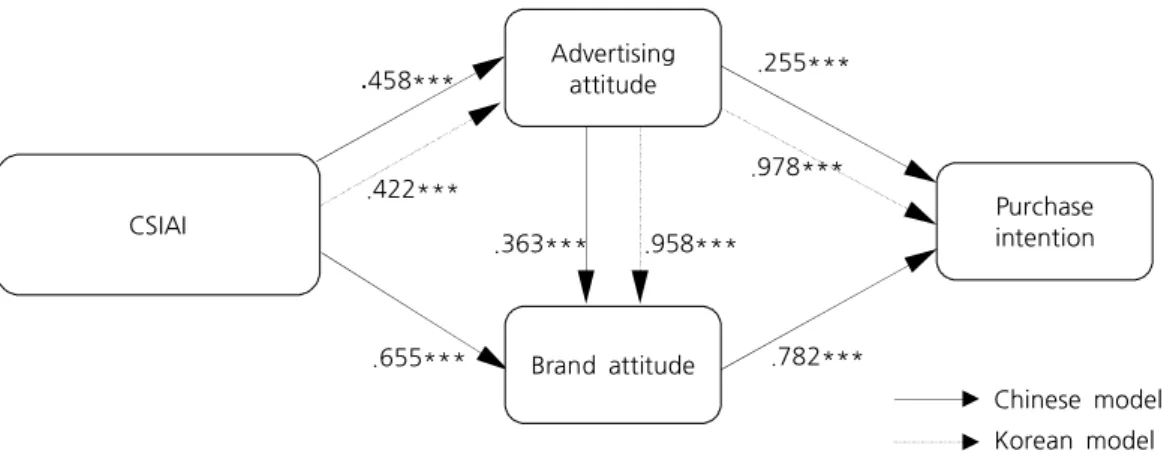
hypothesis. An analysis based on a full invariance model was conducted to investigate the disparity of the path coefficient between the group that preferred the Chinese fashion advertising model and the group that preferred the Korean fashion advertising model. The chi-square value was significantly high (X2=549.685, df=168, p<0.001), but the two groups had the high goodness of fit for all other indices (Normed X2=3.272, CFI=0.945, GFI=0.834, RMR=0.058, RMSEA=0.076), confirming that the suggested model and information were suitable. The results of the overall hypothesis tests are summarized in the original research model (see Figure 2).
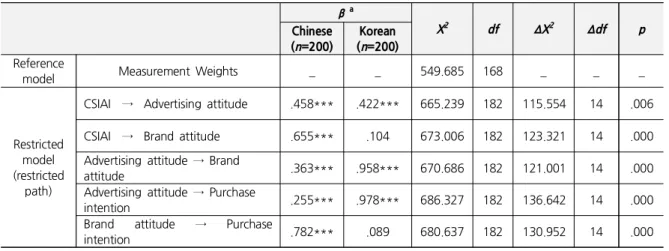
The CSIAI showed positive effects of the advertising attitude from the two groups (see Figure 2), and a significant difference was observed from the path coefficients of the two groups (ΔX2=115.554, Δdf=14, p=0.006). This research supports the investigation that consumers who were exposed to advertising do not
X2=549.685(df=168, p<.001), Normed X2=3.272, GFI=.945, CFI=.834, RMR=.058, RMSEA=.076; ***p<.001 Advertising
attitude .255***
.458***
CSIAI Purchase
intention .978***
.422***
.958***
.363***
Brand attitude .782***
.655***
Chinese model Korean model
Figure 2. Test of the Structural Model Invariance Across the Groups
actively search for information about products, and they behave without cognitive process from the caused emotions or combine with similar information in their own memories (Mitchell & Belch, 1986). The path coefficient of the CSIAI of the group, which selected the Chinese model and the advertising attitude, is 0.458, and the group, which selected the Korean model, shows a value of 0.422; thus, no substantial difference exists between the two groups. Therefore, the results support H1.
On the contrary, a relationship between CSIAI and brand attitude did not show a direct effect on the group that preferred the Korean model, but the group that preferred the Chinese model showed a significant effect; therefore, a difference exists between the two groups (ΔX2=123.321, Δdf=14, p=0.000). However, this result only corresponds to the case of a Chinese model, while it does not correspond to the case of a Korean model. The images of models and fashion brand are incongruent, and, thus, the result does not lead to brand attitude. Therefore, H2 was partially accepted.
The two groups showed that advertising attitude provides significant effects to brand attitude, and the path coefficients between the two groups were found in
the economic status (ΔX2=121.001, Δdf=14, p=0.000).
Similarly, these results match the previous research (Sallam & Wahid, 2012) that if consumers favor the advertising, then the emotion extends to the brand as a classical conditionalization; therefore, advertising attitude mediates brand attitude with the reverification of the dual mediation model. Moreover, the group that preferred the Korean model has a higher path coefficient between advertising and brand attitude (β=0.958, p=0.000) than the group that preferred the Chinese model (β=0.363, p=0.000); thus, this result shows that the advertising attitude in the group that selected the Korean model highly affected the brand attitude. Therefore, the results support H3.
The two groups confirmed that the advertising attitude affects purchase intention significantly, and the path coefficients between the two groups were also found significant (ΔX2=136.642, Δdf=14, p=0.000).
The path coefficient between advertising attitude in the group that preferred the Korean model (β=0.978, p=0.000) and purchase intention was higher than the group that preferred the Chinese model (β=0.255, p=0.000). The group that selected the Korean model shows relatively higher effects from the advertising attitude to the purchase intention. Therefore, the results
Table 5. The Group Comparisons of the Path Coefficients β a
X2 df ΔX2 Δdf p
Chinese (n=200)
Korean (n=200) Reference
model Measurement Weights _ _ 549.685 168 _ _ _
Restricted model (restricted
path)
CSIAI → Advertising attitude .458*** .422*** 665.239 182 115.554 14 .006
CSIAI → Brand attitude .655*** .104 673.006 182 123.321 14 .000 Advertising attitude → Brand
attitude .363*** .958*** 670.686 182 121.001 14 .000
Advertising attitude → Purchase
intention .255*** .978*** 686.327 182 136.642 14 .000
Brand attitude → Purchase
intention .782*** .089 680.637 182 130.952 14 .000
***p<.001
a The standardized regression coefficient in the reference model.
support H4. These results are consistent with the data reported by Sirgy (1980), in which favorable reaction to advertising in the advertising attitude relates to the favorable reaction to products.
No direct effect of the relationship between brand attitude and purchase intention was observed in the group that preferred the Korean model, but a direct significant effect was obtained from the group that preferred the Chinese model; therefore, a significant difference exists between the two groups (ΔX2=130.952, Δdf=14, p=0.000). Previous research on a high correlation between brand and purchase attitudes (Grzeskowiak & Sirgy, 2007; Keeling, 2000) only supported the case of the Chinese model but did not support the case of the Korean model. An alliance with the brand was hindered in the situation of the Korean model; this result did not lead to purchase intention because of the incongruence between the image of the Korean model and brand.
The disparities between the two groups were examined to test H6. First, the equivalency of the path coefficients that correspond to each other in the models for the two groups had to be examined. A nonrestricted model was constructed in which none of the path coefficients were restricted. This model would
be the reference model. A series of nonrestricted models were set up with each of the restricted corresponding paths. The chi-square values between the nonrestricted reference model and the other models were calculated, and a significant disparity was observed in all cases. A summary of the results is presented in Table 5. The results support H6.
V. General Discussion
This research tested the difference between the self-image of Chinese consumers and advertising image can affect brand attitude and purchase intention, and if a role of control in fashion advertising models exists in this relationship or not. The results of the research are as follows.
First, given that the CSIAI is high, advertising attitude is also high because consumers who are exposed to advertising, which matches their own images, do not actively search for brand or products, and their emotions from this exposure can become actions without any cognitive process. This finding supports the results of prior studies (Choi & Jeon, 2008). Regardless of nationalities, the purpose is to provide meanings to advertising products through fashion advertising models
for consumers to have the favorable attitude to the fashion product; therefore, advertising images are crucial at present.
Second, the effect of the CSIAI to brand attitude was only significant in the case of the Chinese model. This result shows that a favorable attitude exists toward the brand, because the congruence between self-image and the image of the Chinese model improves. This finding supports prior results (Oh & Jeong, 2015). Moreover, no effect on brand attitude exists in the case of the Korean model. Generally, the conditions of brand and products related to images activate the schema of self-image from consumers and create self and brand images. Similar creation path of the brand and advertising attitudes can be assumed through the results of this research.
Third, given that advertising attitude is high, brand attitude is also high. If consumers favor advertising, then the emotion extends to the brand as a classical conditionalization, an effect transfer exists because advertising attitude mediates brand attitude (Sallam &
Wahid, 2012). Fashion advertising is a peripheral path condition; advertising, which emphasizes attractiveness of a model, can be used to understand attitude creation based on emotional reaction, and this result shows a higher influence in the case of the Korean model than in the case of the Chinese model.
Fourth, considering that advertising attitude becomes high, purchase intention also becomes high. This finding also supports prior results (Noor et al., 2013; Oh &
Jeong, 2015). In addition, the case of the Korean model shows a strong influence of this finding; thus, a successful result may be obtained if the fashion advertising models are Korean celebrities and credible models.
Fifth, as brand attitude becomes high, purchase intention is also high. This finding also supports the reliance of consumers on brand attitude to explain their shopping behavior (Park et al., 2015; Pradhan et al., 2014). Kwon et al. (2009) claimed that brand attitude is affected by the purchase intention with the Korean celebrity advertising model. However, in this research,
the high correlation between brand attitude and purchase intention is only effective in the case of the Chinese model. This correlation is based on Chinese consumers; therefore, the images of Korean models and products do not match and lead to purchase intention.
In this study, the relationships among the four variables are revisited. The main difference between this study and previous studies lies in exploring the nationality of fashion advertising models who used in developing country for example China, compared to developed countries. This will provide the first insight on Chinese consumer’s behaviour in this area of study, especially for Korean fashion companies that want to enter the Chinese market. In addition, the findings are expected to broaden research on fashion shopping and are significant. Furthermore, the findings present recommendations to establish effective sales and marketing strategies.
1. Implications
The implications and suggestions based on this research are as follows.
First, if the self-image and advertising image are congruent, then consumers highly acknowledge the advertising attitude. The congruence of “in the same situation with me” in advertising can create a bond of sympathy. If an advertising image reflects the consumers own images, unlike Chinese and Korean models, then an increase occurs in brand differentiation and purchase; this result can be a strategic implication to exploiting the market.
Second, this research verified the congruence between the self-image of the consumers and advertising image and a relationship with advertising attitude. From this result, developing not only an emotional factor, which affects consumers emotionally, but also rational and cognitive factors for advertising strategies is required.
Recently, a difficulty has been experienced in promoting differentiation between the brand characteristics of products; thus, advertising strategies for establishing a brand asset in the fashion market from the implications
of this research can bring advantages in the market.
It is hoped that the study can provide insights for further research in fashion area an help policy makers of companies to employ the implementation of the role of advertising models as it is found to be the main driver of consumer behaviour in marketing, I hope that the future studies of fashion advertising models be long-term studies to give more deeply evaluation and high quality benefits.
2. Limitations
The limitations and prospective research directions are as follows. The limitation of this research includes the selection of variables; it does not reflect various variables and recognitions. This research is based only on the Chinese and Korean models to consider a control effect of the nationalities of the fashion advertising models, and the survey respondents are limited to the Chinese consumers, and thus the results cannot be generalized. Further improvement in the fashion marketing strategies will occur if extensive research is conducted by complementing these limitations, searching for a relationship between fashion advertising and consumer reaction, and investigating various respondents and nationalities of fashion advertising models. Therefore, further study should be conducted with added emphasis on the nationality of model by comparing brands from countries that are more and less economically developed than China.
References
Bagozzi, R. P. (1992). The self regulation of attitudes, intentions, and behavior, Social Psychology Quarterly, 55, 178-204.
Batra, R., & Ahtola, O. T. (1991). Measuring the hedonic and utilitarian sources of consumer attitudes.
Marketing Letters, 2(2), 159-170.
Choi, J. S., & Jeon, J. O. (2008). The effects of the congruence between cosmetic advertising image and self-image on consumer attitudes. Journal of the
Korean Home Economics Association,46(7), 35-45.
David, P., Morrison, G., Johnson, M. A., & Ross, F.
(2002). Body image, race, and fashion models: Social distance and social identification in third-person effects. Communication Research, 29(3), 270-294.
Formell, C., & Larcker, D. F. (1981). Evaluating structural equation models with unobservable variables and measurement error. Journal of Marketing Research, 18(1), 39-50.
Grzeskowiak, S., & Sirgy, M. J. (2007). Consumer well-being (cwb): The effects of self-image congruence, brand-community belongingness, brand loyalty, and consumption recency. Applied Research in Quality of Life, 2(4), 289-304.
Jeon, H. J., & Shin, S. M. (2011). The effect of personality factors of brand and advertising model and personality congruence on brand equity in casual apparel brands. Journal of Fashion Business, 15(4), 16-27.
Kamins, M. A. (1990). An investigation into the
“match-up” hypothesis in celebrity advertising:
when beauty may be only skin deep. Journal of Advertising, 19(1), 4-13.
Keeling, K. (2000) The impact of self monitoring on ‐ image congruence and product/brand evaluation.
European Journal of Marketing, 34(5/6), 641-667.
Kim, J. W., & Bae, J. K. (2001). An analysis on fashion model types. Fashion & Textile Research Journal, 3(5), 415-422.
Kressmann, F., Sirgy, M. J., Herrmann, A., Huber, F., Huber, S., & Lee, D. J. (2006). Direct and indirect effects of self-image congruence on brand loyalty. Journal of Business Research, 59(9), 955-964.
Kwon, Y. J., Hong, B. S., Seo, S. W., & Cho, M. A.
(2009). The effects of the attributes of Korean celebrity advertising models on Chinese consumers’
intention to purchase Korean fashion brands. Journal of Korean Society of Clothing and Textiles, 33(3), 477-488.
Lee, J., Kim, J., & Yu, J. (2015). Effects of congruence of product, visual image, and consumer self-image on art infusion advertising. Social Behavior &